I. INTRODUCTION
The challenge for research in the area of heterogeneous catalysis is to provide highly active and selective catalysts for important reactions such as hydrodesulfurization (HDS).Reference Donath1–Reference Helveg, Lauritsen, Lægsgaard, Stensgaard, Nørskov, Clausen, Topsøe and Besenbacher5 Molybdenum disulfide (MoS2) has been one of the most important catalysts used in refineries worldwide for HDS over the past century. Within the last decade, and with the advent of nanotechnology, there has been a renewed interest in this material and, more specifically, in MoS2 nanostructures like triangular nanoclusters,Reference Helveg, Lauritsen, Lægsgaard, Stensgaard, Nørskov, Clausen, Topsøe and Besenbacher5–Reference Zuriaga-Monroy, Martínez-Magadán, Ramos and Gómez-Balderas11 nanoparticles,Reference Zak, Feldman, Lyakhovitskaya, Leitus, Popovitz-Biro, Wachtel, Cohen, Reich and Tenne12, Reference Li and Galli13 nanotubes,Reference Seifert14–Reference Verstraete and Charlier17 nanowires (NWs),Reference Kibsgaard, Tuxen, Levisen, Laegsgaard, Gemming, Seifert, Lauritsen and Besenbacher18–Reference Popov, Gemming, Okano, Ranjan and Seifert22 nanoribbons,Reference Li, Newberg, Walter, Hemminger and Penner23–Reference Erdogan, Popov, Enyashin and Seifert30 and nanoplatelets.Reference Camacho-Bragado, Elechiguerra, Olivas, Fuentes, Galvan and Yacaman31–Reference Galvan, Amarillas and Jose-Yacaman36 The reason is 2-fold: first, such nanostructures have intriguing electronic properties, intrinsically associated with their low dimensionality and the resulting electronic confinement. Second, these novel properties, together with the large surface-to-volume ratio, suggest their use as nanocatalysts with improved efficiency. In the last decade, the properties of the MoS2 active surface and low-dimensional MoS2 nanostructures have been intensively studied.Reference Raybaud, Hafner, Kresse, Kasztelan and Toulhoat3–Reference Lauritsen, Kibsgaard, Helveg, Topsoe, Clausen, Laegsgaard and Besenbacher9, Reference Seifert14, Reference Popov, Gemming, Okano, Ranjan and Seifert22, Reference Byskov, Norskov, Clausen and Topsoe37, Reference Lauritsen, Nyberg, Vang, Bollinger, Clausen, Topsøe, Jacobsen, Lægsgaard, Nørskov and Besenbacher38 One of the most challenging goals was to establish a direct relationship between the structural properties and the catalytic activity. At present, there is a general consensus that the active sites of MoS2 are located at the so-called metallic Mo edge and at the S edge.Reference Raybaud, Hafner, Kresse, Kasztelan and Toulhoat3–Reference Lauritsen, Kibsgaard, Helveg, Topsoe, Clausen, Laegsgaard and Besenbacher9 The active centers correspond to coordinatively unsaturated sites (CUS) along the MoS2 edges oriented parallel to the hexagonal axis of this layered material. In particular, the CUS along the edges of catalyst nanoparticles are believed to provide the active sites where molecules can adsorb and undergo further reactions.Reference Raybaud, Hafner, Kresse, Kasztelan and Toulhoat3–Reference Lauritsen, Kibsgaard, Helveg, Topsoe, Clausen, Laegsgaard and Besenbacher9 Based on first-principles calculations, it has also been suggested that the role of Co and/or Ni promoters is to facilitate the creation of CUS by reducing the sulfur binding energy at the edge.Reference Byskov, Norskov, Clausen and Topsoe39 It is believed, therefore, that the reactivity is enhanced by the creation of vacancies at the neighboring sulfur sites. Since the sulfur coverage of the edge planes depends directly on the local sulfur–metal bond energy, a lot of effort has been put into making a detailed description of the edge morphology as a function of the sulfur saturation, the promoter type, the hydrogen saturation, etc. However, it is the consistent existence of intrinsic localized metallic edge states that appears as a crucial condition for catalysis.Reference Bollinger, Lauritsen, Jacobsen, Nøtrskov, Helveg and Besenbacher6, Reference Jaramillo, Jørgensen, Bonde, Nielsen, Horch and Chorkendorff10, Reference Byskov, Norskov, Clausen and Topsoe37, Reference Lauritsen, Nyberg, Vang, Bollinger, Clausen, Topsøe, Jacobsen, Lægsgaard, Nørskov and Besenbacher38
The majority of previous theoretical works have supported and/or completed the study of the structural and electronic properties of quasi-one-dimensional MoS2 nanostructures with the use of density functional theory (DFT) methods. However, the results obtained by previous first-principles calculations show a clear dependence on the structure modeled (planar, triangular, ribbon) and parameters (for instance, size and shape of the unit cell). Typical catalyst prototype models that have been used forthis purpose are the zigzag and armchair nanoribbons, i.e., layers with a ribbon shape that are formed after cutting the MoS2 sheet along the longitudinal and transversal direction, respectively.Reference Li, Newberg, Walter, Hemminger and Penner23–Reference Erdogan, Popov, Enyashin and Seifert30 Two approaches have been considered: the periodic and the cluster approach. Both have provided important insights about the edge properties and how these might be related with the catalytic activity. In addition, their electronic and magnetic properties have also been studied as a function of thickness, by considering more trilayers in the z direction, and width, by increasing the number of atoms in the unit cell in the y direction,Reference Li, Newberg, Walter, Hemminger and Penner23, Reference Li, Zhou, Zhang and Chen24, Reference Erdogan, Popov, Enyashin and Seifert30 see Fig. 1(c). Regarding its length, an arbitrary number of units have been considered in the x direction, possibly obeying a particular preference or as a result of the convergence tests for that specific model structure. However, the intrinsic initial symmetry of the S–Mo–S layer edges and its possible influence on the S edge configuration along this direction, by considering an even or odd number of Mo atoms on the unit cells, and the breaking of the border symmetry, have been overlooked. Moreover, very few studies have constructed models based on experimental data of very narrow NWs.Reference Wang, Li, Liu, Shi, Lu, Suenaga, Joung, Okazaki, Gu, Zhou, Gao, Li, Sanvito, Wang and Iijima28
Perspective view of the isolated double trilayer NWs (4Mo models) for the two different sulfur saturation (a) 50–100% and (b) 100–50%. Green (yellow) spheres: Mo(S) atoms. (c) Schematic figure of a S–Mo–S trilayer showing the M and S edge.

In this article, we have investigated the structural and electronic properties of infinite MoS2 NWs. These are of special interest since they constitute one of the smallest quasi-one-dimensional self-supported MoS2 systems, promising interesting catalytic properties. For the design of novel nanocatalysts with high catalytic activity, semi-infinite quasi-one-dimensional linear arrangements of MoS2 active edge sites seem to be another alternative to zero-dimensional nanostructures with triangularReference Zuriaga-Monroy, Martínez-Magadán, Ramos and Gómez-Balderas5–Reference Zuriaga-Monroy, Martínez-Magadán, Ramos and Gómez-Balderas11 or hexagonalReference Helveg, Lauritsen, Lægsgaard, Stensgaard, Nørskov, Clausen, Topsøe and Besenbacher5–Reference Zak, Feldman, Lyakhovitskaya, Leitus, Popovitz-Biro, Wachtel, Cohen, Reich and Tenne12 shape. According to some experimental high-angle annular dark field (HAADF) images of a material composed of a solid MoO2 core with MoS2+x crystallites nucleating on its surface, a strong sulfiding atmosphere stabilizes bundles of MoS2+x NWs, while their abundance depends on the thickness of the original oxide crystal.Reference Camacho-Bragado, Elechiguerra, Olivas, Fuentes, Galvan and Yacaman31–Reference Galvan, Amarillas and Jose-Yacaman36 In addition, the HAADF images also show singles and pairs of very long and thin nanostructures growing out of cone-shaped tips of MoS2 nanoplatelets. These can be regarded as quasi-one-dimensional MoS2 NWs. Interestingly, unlike other twisted and helical deposited MoS2 NWs,Reference Galvan, Deepak, Esparza, Posada-Amarillas, Núñez-González, López-Lozano and José-Yacamán19–Reference Deepak, Esparza, Borges, Lopez-Lozano and Jose-Yacaman21 these nanostructures nearly preserve a bulk-like flat-layered structure. It has been reported that the nanostructures have a length ranging from 14 to 30 nm and a width of around 0.6 nm.Reference Camacho-Bragado, Elechiguerra and Yacaman35 The HAADF images also suggest that the NWs have an average thickness of half of the regular MoS2-2H hexagonal unit cell.Reference Camacho-Bragado, Elechiguerra, Olivas, Fuentes, Galvan and Yacaman31, Reference Camacho-Bragado, Elechiguerra and Yacaman35 A first study proposed a simple model built from a single-layer MoS2 (0001) cut in such a way that it is limited by a (10 $\overline {\rm{1}} $0) plane on one side and by a (
 $\overline {\rm{1}} $010) plane on the other. The edges were then saturated with sulfur to compensate the dangling bonds. Preliminary DFT calculations of this model yielded a soft metallic state.Reference Camacho-Bragado, Elechiguerra and Yacaman35, Reference Galvan, Amarillas and Jose-Yacaman36 However, a complete study of the structural and electronic properties of these MoS2 NWs has been missing. On the other hand, zigzag MoS2 nanoribbons were encapsulated inside carbon nanotubes during an experimental study of MoS2 and WS2 ultranarrow nanoribbons by Wang et al.Reference Wang, Li, Liu, Shi, Lu, Suenaga, Joung, Okazaki, Gu, Zhou, Gao, Li, Sanvito, Wang and Iijima28 These nanoribbons were reported to have a thickness of about 1–3 layers of MoS2. DFT calculations were performed but only of the isolated single-layer structures. In another study, they performed a similar experiment on WS2, where they were able to identify defects, vacancies, and saturation by H and S atoms.Reference Liu, Suenaga, Wang, Shi, Okunishi and Iijima40 The narrower systems observed in both articles also have a width of three or four Mo or W atoms in the z direction. In addition, the change in the vibrational frequencies versus the number of layers of MoS2 nanostructures has been experimentally studied by Lee et al.Reference Lee, Yan, Brus, Heinz, Hone and Ryu41 The results are explained by a mixture of Coulombic interactions and stacking-induced deformations of the layers, illustrating the development from bi- to tridimensional regime.
To understand better the catalytic potential of these MoS2 NWs, their morphology, electronic, and magnetic properties have to be investigated taking into account the available experimental data. Moreover, due to their reduced dimensionality, their properties are expected to be different from those of the MoS2 monolayer or bigger MoS2 nanoribbons or stripes. In this work, we provide detailed ab initio DFT calculations with and without spin polarization of bundles of double- and single-layer MoS2NWs. The paper is organized as follows. After presenting the atomic models and methods we applied, we give a description of the structural and electronic properties of several atomic models with different sulfur saturations. The influence of the spin polarization is investigated. We conclude this paper with the discussion and conclusions.
II. ATOMIC MODELS AND METHOD
The slab models, displayed in Fig. 1, were based on experimental HAADF imagesReference Galvan, Deepak, Esparza, Posada-Amarillas, Núñez-González, López-Lozano and José-Yacamán19–Reference Deepak, Esparza, Borges, Lopez-Lozano and Jose-Yacaman21, Reference Wang, Li, Liu, Shi, Lu, Suenaga, Joung, Okazaki, Gu, Zhou, Gao, Li, Sanvito, Wang and Iijima28, Reference Liu, Suenaga, Wang, Shi, Okunishi and Iijima40 of narrow MoS2 NWs. These models, periodic in the x direction, consist of one or two (0001) basal planes of MoS2-2H cut in stripes limited by a (10 $\overline {\rm{1}} $0) Mo edge and a (
 $\overline {\rm{1}} $010) S edge. The Mo edge is then saturated with sulfur. The total width of the wire is around 0.6 nm as reported in experiments, which amounts to three rows of Mo in the y direction, see Fig. 1(c). In the x direction, the periodic unit contains either three or four Mo atoms along the edges (we will refer to these models as 3Mo and 4Mo). We can thus study possible distortions of the lattice that arise due to symmetric and asymmetric S edge configurations. Different research groups have focused on different slab systems to study the MoS2 surface properties, the triangular MoS2 nanoclusters and hexagonal MoS2 nanoclusters deposited on a gold surfaceReference Helveg, Lauritsen, Lægsgaard, Stensgaard, Nørskov, Clausen, Topsøe and Besenbacher5–Reference Zak, Feldman, Lyakhovitskaya, Leitus, Popovitz-Biro, Wachtel, Cohen, Reich and Tenne12; others, who have chosen a similar single-plane model (zigzag nanoribbon) with the same width, did not consider how the symmetry of the S edge configuration depends on the number of atoms in the supercell, specifically along the x direction.Reference Li, Newberg, Walter, Hemminger and Penner23–Reference Erdogan, Popov, Enyashin and Seifert30 We have found studies of the isolated narrow layerReference Song2 and the isolated layer,Reference Spirko, Neiman, Oelker and Klier42 but the double layer, which resembles much more the strong coupling, edge to surface ratio, and finite effects, has been overlooked in the literature. Early theoretical calculations have shown the S monomer and S dimer edge configurations to be energetically the most favorable for the saturation of the Mo edge.Reference Raybaud, Hafner, Kresse, Kasztelan and Toulhoat3–Reference Bollinger, Jacobsen and Nørskov7 They correspond to 50% and 100% of sulfur coverage, respectively. Moreover, the degrees of S coverage that best match the experimental findings are 0%, 50%, and 100%.Reference Camacho-Bragado, Elechiguerra and Yacaman35 Therefore, and taking also into account the measured stoichiometry, two models of sulfur saturation were tested: (i) 50% coverage of the Mo edge (one S atom for every Mo at the edge) and no modification of the S edge (50–100%) and (ii) 100% coverage of the Mo edge, with two S atoms for every Mo at the edge (100–50%). In this case, half of the S atoms are removed from the S edge to preserve stoichiometry.
Using the SIESTA code,Reference Soler, Artacho, Gale, Garcia, Junquera, Ordejon and Sanchez-Portal43 we performed ab initio DFT calculations with and without spin polarization within the Perdew, Burke and Ernzerhof (PBE) generalized gradient approximation, with a 200 Rydberg cutoff for the density integration grid, and density matrix and energy convergence criteria of 1 × 10⁻⁴ and 2 × 10⁻⁴ eV, respectively. To determine the most stable atomic position, all atoms were allowed to relax until the forces were smaller than 0.01 eV/Å. We used tetragonal cells with a lateral size of 30 Å and 50 k-points Monkhorst–Pack mesh along the periodic direction. The wave functions were expanded in a double-ζ polarized basis set. Optimizing MoS2bulk, we obtain a semiconductor with an indirect (direct) gap of 0.80 eV (1.55 eV). The S–Mo–S trilayer is also semiconductor with a direct gap of 1.76 eV.
III. RESULTS AND DISCUSSION
In all cases we explored, the structures containing two basal planes (depicted in Fig. 1) turned out to be energetically more stable than the single-plane structures proposed in Ref. Reference Camacho-Bragado, Elechiguerra and Yacaman35. This is consistent with more recent experimentsReference Wang, Li, Liu, Shi, Lu, Suenaga, Joung, Okazaki, Gu, Zhou, Gao, Li, Sanvito, Wang and Iijima28, Reference Liu, Suenaga, Wang, Shi, Okunishi and Iijima40, Reference Lee, Yan, Brus, Heinz, Hone and Ryu41 where strands of MoS2 NWs are seen in pairs and bundles and rarely isolated.Reference Deepak, Esparza, Borges, López-Lozano and Jose-Yacaman20 In particular, we observe that the binding energy increases by 0.04 eV when changing from a single to a double layer of MoS2 with 50–100% S saturation and in 0.3 eV for 100–50%. Also, in the double layer, the 50–100% S saturation has a higher binding energy than the 100–50% S saturation, and we can thus conclude a higher stability for that edge termination. These results are consistent with the results of Li et al.Reference Li, Zhou, Zhang and Chen24 and Botello-Méndez et al.Reference Botello-Mendez, Lopez-Urias, Terrones and Terrones25 In the following, we focus on the double-plane structure description only.
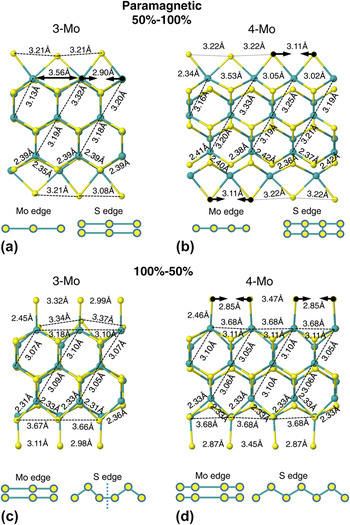
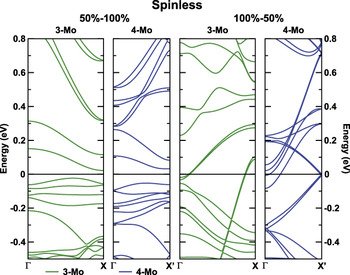
Upon geometry optimization, the inner atoms remain rather unaffected, with the largest distortions appearing for the S and Mo atoms at the edges due to the reduced width of the cells. Further relevant findings for the calculations without spin were (see Fig. 2): (i) for 50–100% of S saturation, using the 3Mo unit cell, the saturating sulfurs at the Mo edge are slightly paired (S–S = 3.21–3.08 Å) and arranged as a linear chain for both planes. However, in the 4Mo model, the pairing is slightly reduced (S–S = 3.22–3.11 Å) and the planes are displaced. Both structures are almost metallic, with a small gap of 45 and 74 meV, respectively, see Fig. 4, first two panels. Based on the comparison with other local minima structures, we can conclude that the gap can be reduced by pairing the S atoms at the S edge or by sliding the planes (see Supplementary material). Another interesting phenomenon is observed. The shift of the planes causes a subtle change in the structure (which can be seen as a relative shifting between the two layers and a change in the distance between them). Moving the whole system rigidly in the range of 0.05 Å in the direction of the planar base and a similar change in the interplanar distance generate a typical change in the total energy of 57 meV for the entire cell. These results were also obtained with models where the initial structure and periodicity were slightly distorted and different from the bulk. This shows both the presence of many quasidegenerate minima and the importance of breaking the initial bulk symmetry for a complete exploration of the energy landscape. In summary, the subtle sliding of the weakly bounded planes is not as important as the sulfur saturation and/or S configuration at the edges due to the weak interaction between the planes.
(a) and (b) Side view of the relaxed double layer 50–100% supercells for the 3Mo and 4Mo model, respectively. (c) and (d) Side view of the relaxed double layer 100–50% supercells for the 3Mo and 4Mo model, respectively. Both show the results obtained for a calculation without spin polarization. Green (yellow) spheres: Mo(S) atoms.

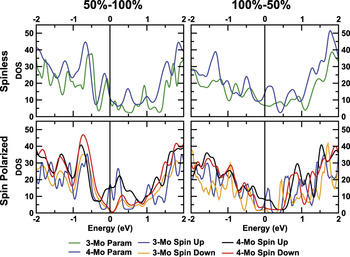
(ii) For the 100–50% 3Mo model, the sulfur atoms at the S edge form an asymmetric zigzag chain due to symmetry constraints imposed by the odd number of Mo atoms along the edge in the unit cell. At the Mo edge, the S dimers are also paired (S–S = 2.99–3.32 Å) and the system is clearly metallic, with four nearly degenerated bands crossing the Fermi energy level, see Fig. 3. For the 100–50% 4Mo model, the sulfurs at the S edge form a symmetric zigzag chain, while at the Mo edge, the dimers become more paired (S–S = 2.85–3.37 Å) and the system is more metallic. More bands cross the Fermi energy and an increment on the density of states (DOS) is observed, see Fig. 6, two panels on the top.
Band structures of the isolated double-plane MoS2NWs for 50–100% and 100–50% sulfur saturations and both 3Mo and 4Mo supercell models without spin polarization.

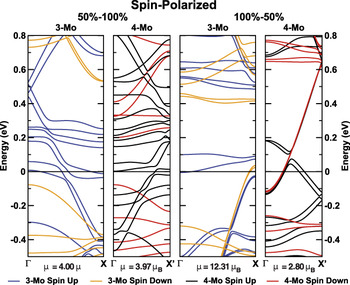
Figure 4 shows the lowest energy structures for the spin-polarized case. We observed essentially very similar results with respect to the spinless case except for the 50–100% 3Mo model, where all the S atoms are nearly equidistant (S–S = 3.18–3.19 Å). Nevertheless, the system is still metallic; see Fig. 5, first two panels. For the 100–50% S saturation, the pairing of the S atoms is slightly stronger in the 4Mo model (S–S = 2.89–3.43 Å) than in the 3Mo model (S–S = 2.44–2.99 Å). In general, the pairing is stronger in the 4Mo model than in the 3Mo model on average by 29%, except for the 100–50% 3Mo model without spin polarization. In summary, for all the structures obtained considering spin polarization, we observed several bands from both spin channels crossing the Fermi energy despite the pairing of the edge atoms, see Fig. 5.
(a) and (b) Side view of the relaxed double-layer 50–100% supercells for the 3Mo and 4Mo model, respectively. (c) and (d) Side view of the relaxed double-layer 100–50% supercells for the 3Mo and 4Mo model, respectively. Both show the results obtained for a calculation including spin polarization. Green (yellow) spheres: Mo(S) atoms.

Band structures of the isolated double-plane MoS2NWs for 50–100% and 100–50% sulfur saturations and both 3Mo and 4Mo supercell models including spin polarization.

A number of general trends can be extracted from the energy data with and without spin polarization. First, the 50–100% S saturation is more stable than the 100–50%, of the order of 0.07 eV/atom without spin and 0.05 with spin polarization. Moreover, the 50–100% 3Mo model is more stable (per atom) than the 4Mo model, while the 100–50% 4Mo model is more stable than 3Mo model. The small energy differences between all configurations studied probably imply that in experiment, one finds a coexistence of different structures.
Experimental studies have found room temperature ferromagnetism in nanosheet-like filmsReference Soler, Artacho, Gale, Garcia, Junquera, Ordejon and Sanchez-Portal44–Reference Tongay, Varnoosfaderani, Appleton, Wu and Hebard46 and defect-induced irradiatedReference Mathew, Gopinadhan, Chan, Yu, Zhan, Cao, Rusydi, Breese, Dhar, Shen, Venkatesan and Thong47 MoS2. Some studies assure that the enhancement or annihilation of the magnetic moment of MoS2 zigzag nanoribbons mainly depends on the creation of a S vacancy for a specific S saturation at the S edge.Reference Shidpour and Manteghian27 Other groups found that the magnetic moment decreases when the ribbon width is increased or when it is saturated with hydrogen.Reference Li, Zhou, Zhang and Chen24 In general, both S saturation and width seem to determine the magnetic properties of the nanoribbons. However, the specific symmetry configuration of the S atoms appears to play also an important role. Our results show that, for the same S saturation, the magnetization can be decreased by increasing the pairing of the S and Mo edge atoms and is always different from zero. We can perceive a clear correlation between pairing and spin: when enforcing an equal spacing of the S atoms at any of the Mo edges, we get a structure not only higher in energy but also with a larger spin (up to 14.58 and 17.57 μB for the 100–50% 3Mo and 4Mo models, respectively), while for the ground states (which show a pairing of the S atoms on the edge), a much smaller magnetic moment is obtained (12.31 and 2.80 μB for the 100–50% 3Mo and 4Mo models, respectively). The largest magnetic moment is found for the case of an odd number of Mo atoms (3Mo model) with 100–50% of S saturation. This corresponds to an antisymmetric configuration of the S atoms at the S edge. On the other hand, the magnetization for the 100–50% of S saturation is sufficiently different from the 50–100%, up to 8.31 μB for the 3Mo model, see Fig. 5. Therefore, these differences in the magnetization might be used to locate the active sites and possibly to measure the catalytic activity with a magnetic force microscope as it is suggested by Shidpour and Manteghian.Reference Shidpour and Manteghian27 We can conclude that the magnetization can be enhanced by (i) changing the type of S saturation but also by (ii) an equidistant S configuration at the Mo edge and/or an antisymmetric S configuration at the S edge.
It could be expected that the pairing of the S dimers and Mo atoms is a sign of a Peierls distortionReference Peierls48 leading to the complete suppression of the metallic character and, consequently, the modification of the catalytic properties of the NW. In the following, we will show that this is not the case. The calculated electronic band structures of the quasi-one-dimensional systems, depicted in Fig. 5, appear in groups of two almost degenerate bands, in particular for the 100–50% 3Mo model, due to the presence of two rather symmetric layers in the unit cell. The small deviations from exact degeneracy can be attributed to geometry distortions during the structural optimization. Band structures corresponding to different models differ strongly, concerning the number of bands crossing the Fermi energy, band dispersions, band widths, etc. Interestingly, the MoS2 NWs appear to be always metallic regardless of the sulfur saturation of the Mo edges and the number of Mo atoms along the edges, always with several bands crossing the Fermi energy. This is also true for the 4Mo 100–50% model, where we observe the strongest pairing of the S dimers. This result rules out the possibility of a Peierls metal–insulator instability. DFT calculations systematically underestimate the band gap. However, in the case of MoS2NWs, based on standard DFT calculations, we can reasonably expect the system to be metallic since there are many bands that cross the Fermi level, and the Fermi energy is generally close to the middle of the band.
To get more information about the characteristic metallic bands, we have computed the DOS (Fig. 6) and the projected density of states (PDOS) (Fig. 8). For the spinless band structures (Fig. 3) and DOS, Fig. 6, top panels, clear differences appear near the Fermi energy level (E F). For the 3Mo model, the bands and peaks above and below the E F are of 4d character from the Mo atoms. In the 4Mo model, the bands below E F show a 3d character from the S, while the contribution of the 4d orbitals of the Mo states grows above the Fermi level, surpassing that of the S at 0.25 eV.

The spin polarization changes the DOS in a subtle but important way. Individual peak positions and their amplitude do not seem to be heavily influenced generally by spin. However, for both saturations and models, the DOS for the majority spin surpasses the minority spin in a range of −0.25 to +0.5 eV around E F, making the material almost half-metallic in that range (see Fig. 6). The 3Mo model has a minority spin gap and peaks above E F for the minority spin, but for the majority spin, the contributions of both atomic species and orbitals are almost equal, in contrast to the 50–100% saturation. The 4Mo model has an even more peculiar structure, similar to the one reported by Seifert et al.,Reference Erdogan, Popov, Enyashin and Seifert30 with a depletion of the DOS near E F (in our case, 0.35 eV above). In that range, and for both spin channels, the bands are of 3p character, and the depletion of the 4d orbitals from the Mo atoms (level) is the cause of this drop in the DOS. Above that, the contribution of 4d from the Mo grows, having a peak in the flat bands around 0.7 eV.
Previous calculations found a metallic DOS for bare MoS2 NWs.Reference Li, Newberg, Walter, Hemminger and Penner23, Reference Li, Zhou, Zhang and Chen24, Reference Wang, Li, Liu, Shi, Lu, Suenaga, Joung, Okazaki, Gu, Zhou, Gao, Li, Sanvito, Wang and Iijima28, Reference Ataca, Sahin, Akturk and Ciraci29 These NWs may in some cases become semiconductors upon hydrogen passivationReference Botello-Mendez, Lopez-Urias, Terrones and Terrones25 but also remain as a half-metal.Reference Li, Newberg, Walter, Hemminger and Penner23, Reference Ataca, Sahin, Akturk and Ciraci29 In every case, the magnetism is localized at the edges, as in our case. Our results are also consistent with Li et al.Reference Li, Zhou, Zhang and Chen24 They studied the total magnetic moment as a function of the NWs width, with and without H passivation.
Finally, in the respective band structures and the PDOS, we can also observe that for both 3Mo and 4Mo models, the flat bands above E F are of p character. The biggest contribution for the majority spin comes from the 3p orbitals of the S atoms, followed by the 4d orbitals of Mo. For the minority spin, the states just above the Fermi energy are mainly from the 4d orbitals of the Mo and the 3d orbitals of S atoms. As we cross the Fermi energy, the minority spin DOS goes to 0, and below that, the relative weights invert for the group of bands shown in Fig. 5, where the contribution of the 3p orbitals from the S atoms contributes more than the 4d orbitals of the Mo atoms. The main difference is the presence of a gap of 0.5 eV for the minority spin for the 3Mo model, while for the 4Mo model, the minority gap decreases to less than 0.2 eV (but the DOS also goes to zero). The majority band is always metallic.
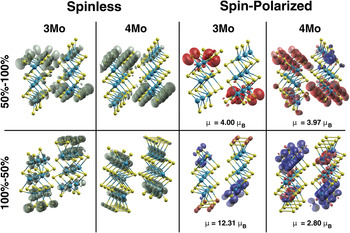
To investigate the origin of the metallic character of the NWs, we show in Fig. 7 the local density of states (LDOS), see Fig. 7. The spinless case does not show substantial differences between the 3Mo and 4Mo models for the 50–100% of S coverage. In both cases, the states around the Fermi level are located mainly around the sulfur atoms of both the Mo and S edges. In the 100–50% 4Mo model, the states are primarily localized around all the Mo atoms of the NW, particularly around the Mo edge. In the 3Mo model, two phenomena are present. First, the states are much less spread out than in the 4Mo model. Furthermore, this is the only case where some of the states are localized on the dimerized S atoms. In the spin-polarized calculation, some interesting effects were observed. The spin is mainly localized on the edges as it was previously observed.Reference Li, Zhou, Zhang and Chen24, Reference Botello-Mendez, Lopez-Urias, Terrones and Terrones25, Reference Erdogan, Popov, Enyashin and Seifert30 However, we observe substantial differences when using an even or odd number of Mo atoms, i.e., the 3Mo or 4Mo models, and different sulfur saturations. First of all, for both the 3Mo and 4Mo models with 50–100% S coverage, there is only one type of polarization in the S edge, while for the 4 Mo model, the magnetization between the Mo edges is opposite. In addition, in the S edge, the spin polarization appears to be localized around the S atoms, while for the Mo edge, it is localized around the Mo atoms. In contrast with the 4Mo model, the 3Mo model is a case where both charge and magnetization are localized at the S edge, around S atoms. Each edge presents ferromagnetic order parallel to each other.
LDOS and local spin density of states for different cell sizes, saturations, and spin configurations.

PDOS for different cell sizes, saturations, and spin configurations.

The case with 100–50% of S coverage also shows different patterns. For the 3Mo model, the S atoms at the Mo edge, which are dimerized, have some magnetization, while the magnetization of the S atoms of the S edge is stronger and opposite. In the 4Mo model, a more marked splitting of the band into the two spin channels is observed. On the Mo edge, the magnetization is localized around the Mo atoms, while on the S edge, the polarization, being opposite, is localized around both the Mo and S atoms. In contrast with other calculations with wider nanoribbons, we also found that the magnetization is not exclusively due to the Mo edge atoms and only along one of the edges,Reference Botello-Mendez, Lopez-Urias, Terrones and Terrones25 but magnetism is present at both edges and it shows a dependance on the S configuration for a given saturation.
In the experiment, narrow bundles of NWs appear to be more abundant than isolated NWs. Therefore, to complete our study, we also made calculations for MoS2 nanoplatelets by repeating the NWs in the direction defined by the c-axis of the bulk (separated by the same distance as the layers in the bulk). These structures turn out to be slightly more stable than the isolated NWs. However, the electronic properties of the nanoplatelets are very similar to those of the corresponding isolated NWs, exhibiting metallic states with very similar character. Furthermore, the dispersion in the new periodic direction is quite small, reflecting the weak interaction between the different MoS2layers.
In summary, we found that the metallic and magnetic states are always localized at the edge, so that these NWs can be viewed as true one-dimensional half-metallic systems. The existence of these half-metallic states at the edges is extremely important, for they have been related to the catalytic properties of MoS2 nanostructures and suggested as one of the main ingredients for the catalytic enhancement.Reference Bollinger, Lauritsen, Jacobsen, Nøtrskov, Helveg and Besenbacher6, Reference Lauritsen, Bollinger, Lægsgaard, Jacobsen, Nørskov, Clausen, Topsøe and Besenbacher8, Reference Lauritsen, Kibsgaard, Helveg, Topsoe, Clausen, Laegsgaard and Besenbacher9, Reference Camacho-Bragado, Elechiguerra, Olivas, Fuentes, Galvan and Yacaman31 The fact that the conduction happens along the edges (see Fig. 7) and is intertwined with the magnetism can lead to new phenomena related to electron correlation effects in one-dimensional conductors that can be accessed by transport experiments. It can also open a new use for this material, not only as a nanocatalyst but also as a material for nanoelectronics and nanospintronics.Reference Wang, Li, Liu, Shi, Lu, Suenaga, Joung, Okazaki, Gu, Zhou, Gao, Li, Sanvito, Wang and Iijima28 A similar situation appears in graphene nanoribbons (although with a different physical origin) where one-dimensional edge states are responsible for a wealth of interesting properties, including spin-Hall conductivity, valley-filtered transport, magnetism, and superconductivity.Reference Rycerz, Tworzydlo and Beenakker49–Reference Yao, Yang and Niu51 Clearly, we cannot completely rule out the possibility of semiconducting MoS2 NWs. For example, the possible twisting of the wires might influence strongly their electronic properties, in a similar way as shown for Mo6S6 NW bundles.Reference Kibsgaard, Tuxen, Levisen, Laegsgaard, Gemming, Seifert, Lauritsen and Besenbacher18 However, it is unlikely (and unsupported by experimental evidence) that a small bending completely destroys the one-dimensional states at the edges and therefore the metallic character of the system.
IV. CONCLUSIONS
The electronic and magnetic properties of isolated as well as bundles of MoS2 NWs were investigated as a function of their morphology using different atomic models with different sulfur saturations. The slab models were based on experimental HAADF images of MoS2nanoparticles and theoretically proposed models. To investigate how the electronic and magnetic character of these low-width NWs depends on the symmetry configuration of the S atoms, an even and an odd number of Mo atoms in the unit cells along the wire direction were used. We found that independently of the geometrical details and the coverage of extra sulfur at the Mo edge, quasi-one-dimensional metallic states located at the edge are predominant in all the low-energy model structures despite their reduced dimensionality and the strong pairing of the S and Mo edge atoms. The NWs are magnetic, with the spin mainly localized at the edges. However, the magnetization of the NWs is substantially affected by both the S saturation and the symmetry configuration of the S edge atoms. In particular, we found that the magnetization can be enhanced through an equidistant S configuration at the Mo edge and/or an antisymmetric S configuration at the S edge. The subtle sliding of the weakly bounded planes that constitute the NWs is not as important as the saturation and configuration of the S at the edges. All the studied NWs are metallic, with one-dimensional metallic states localized at the low Miller index edges. However, our work shows that the system does not experience a Peierls-like metal–insulator transition. These results put in evidence the high versatility of this material due to the high stability of its metallic edge states, opening the possibility of applications not only as a nanocatalyst but also as a metallic NW. The experimental challenge is therefore to determine the optimal sulfiding conditions to reach the optimal configurations for a specific S saturation.
ACKNOWLEDGMENTS
This work was supported by the EU’s 7th Framework Program through the e-I3 contract ETSF (211956). X.L-L. and S.B. acknowledge funding by the ANR (Grant No. JC05 46741). M.A.L.M. acknowledges support from the Portuguese FCT (Grant No. PTDC/FIS/73578/2006) and from the French ANR (Grant No. ANR-08-CEXC8-008-01). A.R. acknowledges funding by the Spanish MEC (Grant No. FIS2007-65702-C02-01), “Grupos Consolidados UPV/EHU del Gobierno Vasco” (Grant No. IT-319-07), NANO-ERA CHEMISTRY, Barcelona Supercomputing Center, “Red Española de Supercomputación,” and SGIker ARINA (UPV/EHU). L.F.S. and X.L-L. acknowledge the following funding: NSF-PREM DMR-0934218, UTSA-TRAC FY2011-2012. L.F.S., H.B., and X.L-L. thank the Computational Biology Initiative (UTHSCSA/UTSA) for providing access and training to the analysis software used. L.F.S., H.B., and X.L-L. acknowledge the Texas Advanced Computing Center at The University of Texas at Austin for providing HPC resources that have contributed to the research results reported within this paper. Some initial calculations were also performed at the Laboratório de Computação Avançada of the University of Coimbra. L.F.S. wants to thank Dr. Daniel Bahena Uribe (Department of Physics and Astronomy, The University of Texas at San Antonio) for his help and assistance in the parameters for running the STEM simulations.