I. INTRODUCTION
Magnesium (Mg) and its alloys have promising potential application in the fields of aerospace, automotive, and electronic communication technologies due to their low density, high specific strength, high specific stiffness, high electromagnetic shielding, and so on.Reference Li, He, Fu, Wu, Peng and Ding1,Reference Cui, Xiao, Liu, Wu, Wang and Li2 However, Mg alloys exhibit low strength and ductility because of their hexagonal close packed crystal structure, where limited independent slip systems could be activated at low temperature.Reference Pan, Zeng, iang, Zhang and Dong3 Therefore, their wide applications are limited to a great extent. To overcome these defects to improve their mechanical properties at room temperature, extensive efforts are being devoted to microstructural controlling, such as improving texture and grain refinement.Reference Zhang, Guan, Wang, Zhu and Chang4–Reference Cheng, Wang, Zhang and Cao6
A strong (0001) basal texture is usually formed in the traditional rolled or extruded Mg alloys,Reference Styczynski, Hartig, Bohlen and Letzig7,Reference Yua, Zhang, Sun, Luo, Xua, Zhang and Pan8 which induces a larger anisotropy and thus deteriorates the stamping formability.Reference Yi, Bohlen, Heinemann and Letzig9 Iwanaga et al.Reference Iwanaga, Tashiro, Okamoto and Shimizu10 significantly enhanced the drawability of Mg alloy sheets at room temperature by weakening the (0001) basal texture. Suh et al.Reference Suh, Victoria-Hernández, Letzig, Golle and Volk11 suggested that the drawing depth of the AZ31 Mg sheet could be increased from 6 to 15 mm for the samples before and after equal channel angular pressing (ECAP), which was due to the changing (0001) basal texture. In addition, according to the Hall–Petch relationship, the yield strength (YS) of Mg alloys at room temperature can be dramatically increased by grain refining. Therefore, important efforts have been devoted to refining the grain microstructure of Mg alloys using severe plastic deformation (SPD), e.g., friction stir process,Reference Mironov, Onuma, Sato, Yoneyama and Kokawa12,Reference Vargas, Lathabai, Uggowitzer, Qi, Orlov and Estrind13 different speed rolling,Reference Kaseem, Chung, Yang, Hamad and Ko14,Reference Luo, Wang, Zhao, Wang, Liu, Liu and Jiang15 cyclic extrusion compression,Reference Wang, Mu, Lin, Zhang and Roven16,Reference Tian, Huang, Yuan and Ding17 and ECAP.Reference Liu, Ju, Lu, Yan, Bai, Jiang and Ma18,Reference Motoyama, Watanabe, Ikeo and Mukai19 Although these SPD processing technologies can fabricate Mg alloys with fine grains even submicron or nanocrystalline grains, they usually possess complicated processes, repeated multiple steps, low efficiency, and high cost. Furthermore, they can only fabricate the material with a small volume and unable to realize the fabrication of large-size Mg alloys.
As one of the important metal plastic processing technologies, rolling has been widely used to produce large-size Mg alloys. The rolling of Mg alloys is usually conducted at elevated temperature due to their poor cold rollability.Reference Tang, Le, Jia, Liu and Cui20,Reference Jia, Hu, Zhao, Ju and Chen21 As suggested by Liu et al.,Reference Liu, Liu and Wang22 significant grain refinement of Mg alloys was achieved by multi-pass hot rolling, where the grain size was dramatically decreased from 250 μm in ingots to less than 30 μm in the as-rolled sheets. Yu et al.Reference Yu, Yan, Yao, Wang, Zha, Xu, Liu, Wang and Jiang23 suggested that Mg–Al–Zn–Sn Mg alloy sheets with a fine-grained structure (∼5 μm) and tilting (0001) basal texture were prepared by a 16-pass rolling process, thus resulting in the improving mechanical properties. After the AZ61 alloy was symmetrically rolled at a high temperature of 505 °C, the (0001) the basal texture was inclined from the normal direction to the rolling direction and thus the superior formability was obtained.Reference Huang, Suzuki, Chino and Mabuchi24 In addition, the temperature control plays a very important role in the hot rolling process of Mg alloy sheets, which dramatically affects the grain size. Chen et al.Reference Chen, Zhang, Zhang and Wang25 reported that according to the dependence of grain size on Zener–Hollomon parameter Z ( $Z = \dot{\varepsilon }\exp \left( {{Q / {RT}}} \right)$, where
 $\dot{\varepsilon }$ denotes the strain rate, Q denotes the activation energy, R denotes the gas constant, and T denotes the temperature), lowering rolling temperature could dramatically refine the grain size of Mg alloys, especially for multi-pass rolling. Therefore, multi-pass warm rolling with falling temperature was proposed to refine the grain microstructure and improve the mechanical properties in this study. The microstructural evolution of the obtained sheets during rolling and subsequent annealing was investigated, and the corresponding mechanical properties and stretch formability were determined.
II. EXPERIMENT PROCEDURES
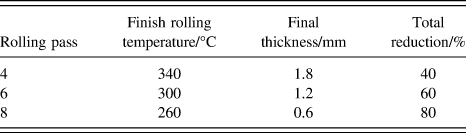
In the present work, the as-received AZ31 alloy sheet (rolled and annealed sheet) with a thickness of 3 mm was cut into rectangular samples with dimensions of 100 × 80 mm along the rolling direction. The samples were heated in a furnace at 400 °C for 5 min prior to rolling, and then rolled from 3 to 0.6 mm in thickness by 8-pass rolling with a thickness reduction of about ∼80%. Regarding rolling temperature control, after each rolling pass, the rolled samples were returned to the furnace with a decreasing temperature of 20 °C every time and reheated for 5 min. Table I indicates the rolling parameters. After 4, 6, and 8-pass warm rolling with falling temperature, the sheets were rolled to 1.8, 1.2, and 0.6 mm at finish rolling temperatures of 340, 300, and 260 °C, respectively. After multi-pass warm rolling with falling temperature, the rolled sheets were subjected to final annealing at 260 °C for 0.5 h.
Multi-pass warm rolling with falling temperature for AZ31 Mg alloy sheets.

The optical microstructure was examined by a standard metallographic technique. EBSD measurements were performed on a scanning electron microscope equipped with an EBSD system. EBSD was performed at 20 kV, together with a working distance of 20 mm and a tilt angle of 70 °C. Dog-bone tensile samples with nominal gage dimensions of 10 mm length, 6 mm width, and sheet thickness were machined from the rolled sheets along the angles of 0° (RD), 45, and 90° (TD) to the rolling direction by wire-cutting. Then, uniaxial tensile tests were carried out on a Shimadzu AGX-XD 20kN electronic universal testing machine (Shimadzu Instrument Co. Ltd., Suzhou, China) with a strain rate of 1 × 10⁻³/s at room temperature to determine the mechanical properties, e.g., YS, ultimate strength (UTS), and fracture elongation. Each mechanical test was repeated three times to get representative results. Furthermore, the blanks with a square of 55 × 55 mm were machined from the rolled sheets. Standard Erichsen tests were carried out at room temperature using a hemispherical punch having a diameter of 20 mm to investigate the stretch formability of sheets. Here, the punch speed was 2.5 mm/min and the blank-holder force was 10 kN. A graphite grease as a lubricant was pasted only on the center part of the samples. And the Erichsen value (IE), which was the punch stroke at fracture initiation, was measured. Each Erichsen test was also repeated three times to get representative results.
III. RESULTS AND DISCUSSION
A. Microstructural evolution
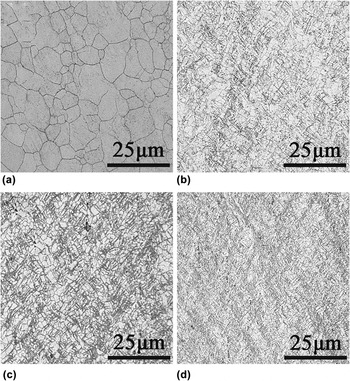
The optical microstructure of the AZ31 alloy sheets after multi-pass warm rolling with falling temperature are illustrated in Fig. 1. It can be found that the as-received sheet possesses a fully recrystallized equiaxial grain microstructure without twins and the average grain size is about 22.1 μm. After 4-pass warm rolling with falling temperature, the microstructure changed significantly, as shown in Fig. 1(b). The grain boundaries became obscure, a great deal of twins appeared, and individual shear bands together with a small number of recrystallized grains were also observed. While after 6-pass warm rolling with falling temperature, the number of the large grains decreased, but the number of shear bands and recrystallized grains increased obviously [Fig. 1(c)]. As indicated in Fig. 1(d), more shear bands and recrystallized grains were observed after 8-pass warm rolling with falling temperature. Generally, the deformation stored energy of metals is related to the amount of deformation. The large plastic deformation is usually accompanied by the high deformation stored energy, which favors the recrystallization during subsequent annealing. Recrystallization preferentially develops within shear bands, twins, intersections between grain boundaries and twins, which are the potential nucleation sites for recrystallization.Reference Li, Yang, Wang, Meng and Cui26,Reference Myshlyaev, McQueen, Mwembela and Konopleva27 This will result in the development of fine recrystallized grains during subsequent annealing.
Optical microstructure of the AZ31 alloy sheets after multi-pass warm rolling with falling temperature: (a) as-received; (b) 4-pass rolled; (c) 6-pass rolled; (d) 8-pass rolled.

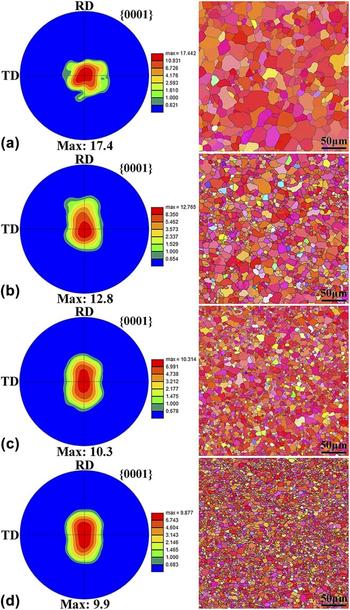
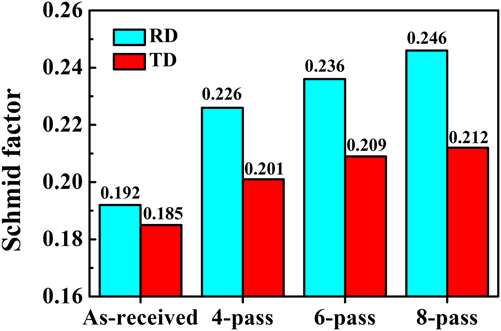
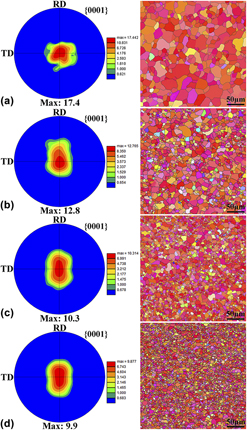
Figures 2 and 3 show (0001) pole figures, EBSD maps, and Schmid factors of 〈a〉 basal slip under the loading axis parallel to the RD and TD of various sheets in annealed condition, respectively. According to the reported data,Reference Suzuki, Sato, Maruyama and Oikawa28 the critical resolved shear stress of basal slip at room temperature is approximately 1/55 that of nonbasal slip, thus Fig. 3 only shows the Schmid factor of 〈a〉 basal slip. Similar to the result of the optical microstructure, a fully recrystallized equiaxial grain microstructure was observed in the as-received sheet, as shown in Fig. 2(a). In addition, the texture in the as-received sheet is a typical basal texture with the maximum intensity of 17.4, where the c-axis of grains is nearly normal to the ND. It is obvious that there is a small Schmid factor of 0.192 or 0.185 for 〈a〉 basal slip under the loading axis parallel to the RD or TD, which means the poor plasticity for the as-received sheet.
(0001) pole figures and EBSD maps of various sheets in annealed condition: (a) as-received; (b) 4-pass rolled; (c) 6-pass rolled; (d) 8-pass rolled.

Schmid factors of 〈a〉 basal slip under the loading axis parallel to the RD and TD of various passes rolled sheets in annealed condition.

As shown in Figs. 2(b)–2(d), after annealing at 260 °C for 0.5 h, the deformation microstructure of all the rolled sheets changed to a fully recrystallized equiaxial grain microstructure without twins. This is due to the fact that the static recrystallization occurred during the subsequent annealing.Reference Huang, Suzuki and Chino29 As previously mentioned, the nucleation and grain growth occurred preferentially in the shear band twins, intersections between grain boundaries and twins, thus resulting in fine grains after annealing. After 4, 6, and 8-pass warm rolling with falling temperature, the average grain size of the rolled sheets in annealed condition, measured by orientation imaging microscopy software (EDAX Inc., Mahwah, New Jersey), was refined from 22.1 μm to 11.7, 7.4, and 4.5 μm, respectively.
After multi-pass warm rolling with falling temperature, the rolled sheets in annealed condition still exhibited a typical basal texture but the c-axis of some grains were tilted away from the ND towards the RD and lay on the ND-RD plane, thus resulting in the ellipsoidal distribution of basal texture intensity in the (0001) pole figures, as shown in Figs. 2(b)–2(d). This is because the combination of nonbasal slip and twinning leads to the generation of such a texture.Reference Chino, Kimura and Mabuchi30 Furthermore, compared with the basal texture intensity of the as-received sheet, those of the multi-pass warm rolled sheets in annealed condition were reduced from 17.4 to 12.8, 10.3, and 9.9, respectively, which is due to the increasingly accumulated strain during multi-pass warm rolling. After multi-pass warm rolling with falling temperature and annealing, the soft-oriented grains of 〈a〉 basal slip are greatly increased due to the weakened basal texture. As indicated in Fig. 3, for the multi-pass warm rolled sheets in annealed condition, the average Schmid factor of 〈a〉 basal slip increased from 0.192 to 0.226, 0.236, and 0.246 under the loading axis parallel to the RD, respectively. Under the loading axis parallel to the TD, the average Schmid factor of 〈a〉 basal slip also increased from 0.185 to 0.201, 0.209, and 0.212 for the multi-pass warm rolled sheets in annealed condition, respectively. This means the plasticity of AZ31 Mg alloy sheets can be effectively improved by multi-pass warm rolling with falling temperature.
B. Mechanical properties
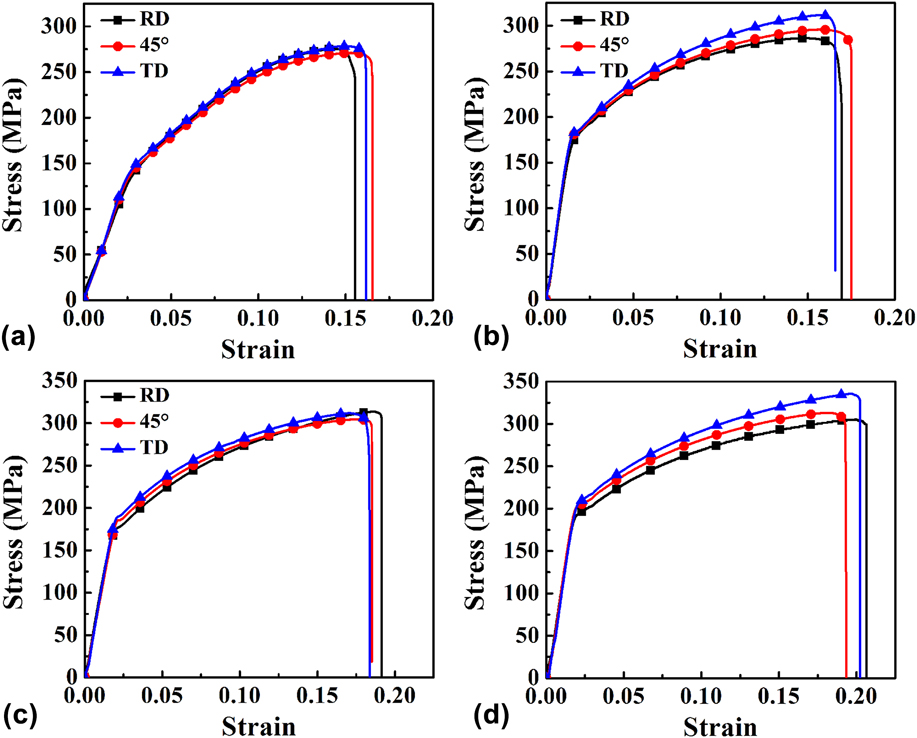
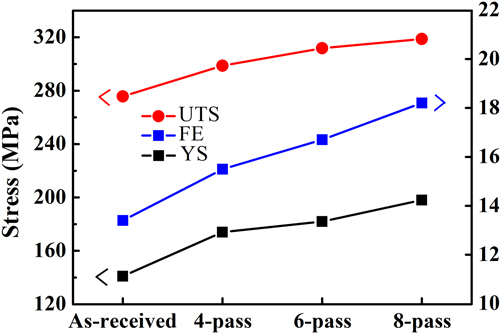
True stress–strain curves of various sheets in annealed condition in different tensile directions at room temperature are presented in Fig. 4. The corresponding mechanical properties, i.e., 0.2% YS, the UTS, and failure elongation (FE) are summarized in Table II, also included are the average grain size, basal texture intensity, and Schmid factor of 〈a〉 basal slip. For various sheets in annealed condition, the average YS, UTS, and FE in different tensile directions are indicated in Fig. 5. It is clearly observed from the true stress–stain curves in Fig. 4 that for various sheets, the YS depends on the tensile direction due to the influence of the texture,Reference Yang, Jiang, Zhou, Dai and Pan31 which is a typical characteristic of the conventional rolled AZ31 Mg alloy sheets.Reference Brown, Agnew, Bourke, Holden, Vogel and Tomé32 It is important to note that all sheets exhibited the lowest YS and the largest fracture elongation in the RD rather than the 45° and TD (Table II and Fig. 4), which can be attributed to the fact that the c-axis of some grains inclined from the ND towards the RD during rolling. In addition, the multi-pass warm rolling with falling temperature caused larger yield anisotropy in three different tensile directions, as shown in Figs. 4(b)–4(d). This is because the c-axis of some grains became tilted away from the ND towards the RD after multi-pass warm rolling with falling temperature and annealing, as indicated in (0001) pole figures in Fig. 2. As indicated in Table II, after multi-pass warm rolling with falling temperature, the rolled sheets in annealed condition still exhibited higher strength especially the YS regardless of the tensile direction. As shown in Fig. 5, the average YS and UTS of the 8-pass warm rolled sheet in annealed condition increased from 141 MPa to 275 MPa of the as-received sheet to 197 MPa and 318 MPa, respectively. According to the Hall–Petch relationship, the increasing strength is mainly due to the grain refinement strengthening resulting from multi-pass warm rolling with falling temperature and annealing. The decrease in grain size will increase the resistance to dislocation motion, and thus resulting in the increasing YS.Reference Zhang, Cheng, Fan, Xu and Dong33
True stress–strain curves of various sheets in annealed condition in different tensile directions (RD, 45°, TD): (a) as-received; (b) 4-pass rolled; (c) 6-pass rolled; (d) 8-pass rolled.

Mechanical properties of various sheets in annealed condition.

Average YS, UTS, and FE of various passes rolled sheets in annealed condition in different tensile directions.

As indicated in Table II, after multi-pass warm rolling with falling temperature, the rolled sheets in annealed condition also exhibited larger FE than the as-received sheet in different tensile directions, especially in the RD due to the basal texture becoming more diverse along the RD (Fig. 2). As shown in Fig. 5, the average FE of the 8-pass warm rolled sheet in annealed condition increased from 13.4% of the as-received sample to 18.2%. After multi-pass warm rolling with falling temperature and annealing, the increase in the FE of the AZ31 Mg alloy sheet is ascribed to the larger Schmid factor of 〈a〉 basal slip resulting from the weakened (0001) basal texture intensity. For Mg alloys with a small Schmid factor of 〈a〉 basal slip, it is difficult for basal slip system activation during deformation, and accordingly the strain localization and premature shear failure are easily produced.Reference Agnew and Duygulu34,Reference Agnew and Duygulu35 In addition, the grain refinement can also contribute to the increasing ductility of Mg alloys.Reference del Valle, Carreño and Ruano36
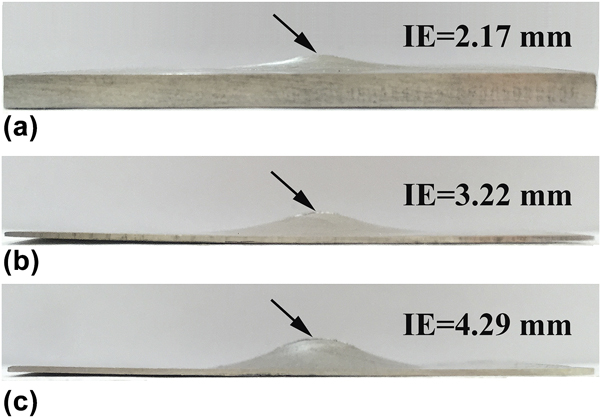
As shown in Fig. 6, the black arrow indicates the macroscopic crack of the Erichsen tested sheet. It is clear that for the as-received sheet with a thickness of 3 mm, the Erichsen value (IE) is very low, only 2.17 mm. The IE of the 8-pass rolled sheet with a thickness of 0.60 mm in annealed condition was dramatically increased to 4.29 mm (increased by ∼98%) in comparison to that of the as-received sheet. Considering the thickness of the sheet affecting the stretch formability, the as-received sheet with a thickness of 3 mm was also polished to 0.60 mm to avoid the effect of thickness. After Erichsen testing, the IE of the as-received sheet with a thickness of 0.60 mm is still small, about 3.22, as indicated in Fig. 6(b). Thus the IE of the 8-pass rolled sheet in annealed condition is still increased by ∼33% in comparison to that of the as-received sheet under the same thickness.
Erichsen values of (a) as-received sheet, (b) as-received sheet polished to a thickness of 0.60 mm, and (c) 8-pass rolled sheet with a thickness of 0.60 mm in annealed condition.

For the fine-grained microstructure, the amount of deformation can be dispersed in more grains under the same deformation condition to produce homogeneous deformation in each grain without producing serious deformation in a few of grains.Reference del Valle, Carreño and Ruano36,Reference Yuan and Mishra37 On the other hand, the finer grains indicate more boundaries, which help to prevent the spread of the crack.Reference del Valle, Carreño and Ruano36,Reference Yuan and Mishra37 Therefore, the finer grains can bear larger plastic deformation before the fracture and thus show good plasticity and ductility. In addition, after multi-pass warm rolling with falling temperature and annealing, the improved stretch formability of the AZ31 Mg alloy sheet can also be ascribed to the weakened (0001) basal texture intensity (9.9 versus 17.4), as indicated in Fig. 2. As shown in Fig. 3, the strong basal texture led to a low Schmid factor of 〈a〉 basal slip in the as-received sheet. The low Schmid factor of 〈a〉 basal slip indicates that most grains are in an orientation (hard orientation) difficult to deform since the resolved shear stress in the basal plane is equal to zero, and it is difficult to activate the 〈a〉 basal slip system, which leads to stress localization and premature shear failure.Reference Agnew and Duygulu34,Reference Agnew and Duygulu35 Furthermore, for Mg alloys, the strong texture will induce a poor deformation capability of sheet thinning,Reference Zhang, Huang, Wang and Li38,Reference Koike, Kobayashi, Mukai, Watanabe, Suzuki, Maruyama and Higashi39 and consequently resulting in a low ductility at room temperature. Thus, the stretch formability of the AZ31 alloy sheet can also be effectively improved by multi-pass warm rolling with falling temperature.
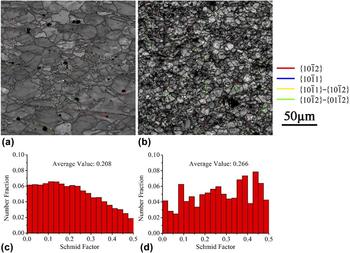
EBSD maps in the top part of different sheets stretch-formed to failure are indicated in Fig. 7. It is seen from Fig. 7(a) that a small number of twins were observed in the as-received sheet stretch-formed to failure and these twins were judged to be  $\left\{ {10\bar{1}2} \right\}$,
 $\left\{ {10\bar{1}1} \right\}$ twins and
 $\left\{ {10\bar{1}1} \right\}$–
 $\left\{ {10\bar{1}2} \right\}$ and
 $\left\{ {10\bar{1}2} \right\}$–
 $\left\{ {01\bar{1}2} \right\}$ double twins. Compared to the as-received sheet, more twins and double twins were found in the 8-pass rolled sheet stretch-formed to failure, as shown in Fig. 7(b). It is well known that
 $\left\{ {10\bar{1}2} \right\}$,
 $\left\{ {10\bar{1}1} \right\}$ twins and
 $\left\{ {10\bar{1}1} \right\}$–
 $\left\{ {10\bar{1}2} \right\}$ and
 $\left\{ {10\bar{1}2} \right\}$–
 $\left\{ {01\bar{1}2} \right\}$ double twins will led to grains to rotate by ∼86°, 56°, 38°, and 60°, respectively.Reference Barnett40,Reference Barnett41 Therefore, the generation of a great number of twins caused lattice rotation and increased the Schmid factor of 〈a〉 basal slip during stretch deformation, thus resulting in the improved stretch formability. As indicated in Figs. 3 and 7, for the as-received and 8-pass rolled sheets stretch-formed to failure, the Schmid factor of 〈a〉 basal slip under the loading axis parallel to the RD increased from 0.192 and 0.246 to 0.208 and 0.266, respectively. Furthermore, compared to the as-received sheet stretch-formed to failure, the 8-pass rolled sheet stretch-formed to failure still exhibited larger Schmid factor of 〈a〉 basal slip (0.266 versus 0.208) under the loading axis parallel to the RD, which contributed to the further deformation during stretch forming and thus enhancing the stretch formability.
EBSD maps and Schmid factors of 〈a〉 basal slip under the loading axis parallel to the RD in the top part of Erichsen tested sheets stretch-formed to failure: (a) and (c) as-received; (b) and (d) 8-pass rolled.

IV. CONCLUSION
In summary, multi-pass warm rolling with falling temperature was carried out to investigate its influence on the microstructural evolution and mechanical properties of AZ31 Mg alloy sheets. It is demonstrated that the grain microstructure of AZ31 alloy sheets was successfully refined from 22.1 to 4.5 μm by multi-pass warm rolling with falling temperature and annealing. Multi-pass warm rolling with falling temperature and annealing also produced the weakened (0001) basal texture, which resulted in the significantly increased Schmid factor of 〈a〉 basal slip. For the 8-pass warm rolled sheet in annealed condition, the average Schmid factor of 〈a〉 basal slip under the loading axis parallel to the RD or TD increased from 0.192 or 0.185 of as-received to 0.246 or 0.212. Furthermore, due to the refined grain microstructure and the weakened basal texture, the rolled sheets in annealed condition after multi-pass warm rolling with falling temperature exhibited higher tensile strength and larger fracture elongation than the as-received sheet, especially the IE of the 8-pass warm rolled sheet in annealed condition was significantly increased by ∼33% under the same thickness.
ACKNOWLEDGMENTS
The authors thank National Natural Science Foundation of China (51504162, U1710118, 51704209, and 51601123), Natural Science Foundation of Shanxi Province (2015011033, 2015021073, and 2016021063), Research Project Supported by Shanxi Scholarship Council of China (2016-029), Shanxi Province Fundamental Resources Platform of Science and Technology (201605D121030), and Scientific and Technological Innovation Programs for Excellent Researchers in Shanxi Province (201605D211015) for their financial supports.