Introduction
A generously funded National Singing Campaign (‘SingUp’) is drawing to a close in UK primary schools. In spite of this, however, a large numbers of boys on entry to secondary schooling express a resistance to singing. This is well known and has often been discussed (Harrison, Reference HARRISON2009; Welch et al., Reference WELCH, HIMONIDES, PAPAGEORGI, SAUNDERS, RINTA, STEWART, PRETI, LANI and HILL2009). Rather than engage with research that addresses the problem, many schools have seemed content to be buoyed along by a whole new genre of popular television that is based upon media exploitation of the phenomenon. For example, the young conductor Gareth Malone has achieved folk hero status through a series of ‘reality TV’ shows about reluctant choirs. The Choir, Boys Don't Sing (Isaacs, Reference ISAACS2006) has encouraged a style of reporting that oversimplifies a far more complex and nuanced picture but is typical of the new orthodoxy in popular discourse to homogenise ‘all boys’ as non-singers.
The most difficult time for boys’ singing is arguably between the ages of 11 and 14. For most boys in English government-funded schools (referred to below as ‘state maintained’), eleven is the age of transfer from primary to secondary school, though not the age, for the majority of boys, at which the changes of puberty might signal a new start to singing. This rite of passage can be, for girls as well as boys, a time to put behind them the ‘babyish’ activities of primary school, which can include singing together in chorus (as opposed to solo or small band) if the transition is not handled carefully. Welch et al. (Reference WELCH, HIMONIDES, PAPAGEORGI, SAUNDERS, RINTA, STEWART, PRETI, LANI and HILL2009) report on a growing disillusionment with songs chosen by teachers for the class to sing (the ‘school song’) at this time. For boys, however, there is the considerable extra difficulty of a voice that becomes increasingly unpredictable and difficult to manage towards the end of Y7 and throughout Y8 and Y9. This can often be both a source of embarrassment and a sign of male incompetence relative to females that boys find difficult (Joyce, Reference JOYCE2005; Ashley, Reference ASHLEY2010). Boys’ fear of feminine competence is often underestimated (Jackson, Reference JACKSON2003) and singing is one of their most vulnerable areas (Willis & Kenny, Reference WILLIS and KENNY2008).
In this paper, evidence is presented that in spite of all this, some boys aged between 11 and 14 do sing, sometimes in large numbers. Certain schools stand out as exceptional cases. This may be connected to the point made by both OFSTED and the Henley report. Secondary music teachers continue to work in isolation. The systematic application of relevant knowledge gained through research and the exchange of knowledge may well be a casualty of this (OFSTED, 2009; Henley, Reference HENLEY2011). The present paper offers an exploration of the apparent consequences of this for boys’ singing during Key Stage Three (11–14 years of age) on the basis of the author's engagement with 25 secondary schools.
Does singing matter?
The perceived importance of school singing in the UK has been given a significant boost through the willingness of the 1997–2010 New Labour government to fund in its latter years the £40m National Singing Programme for Primary Schools (SingUp). The fact that the Conservative-led coalition government elected during 2010 has provided a further £4m of funding at a time of unprecedented and draconian cuts in national spending is in some ways an even more remarkable testament to the importance attached to school singing. This is reiterated further by the Henley Review of Music Education which makes the importance of singing second in its list of 36 recommendations. According to Henley:
For many children, learning to sing is the beginning of their Music Education. However, it is something that should be part of their school lives until they are at least 14 years old and is currently included as a statutory requirement.
(Henley, Reference HENLEY2011, author's emphasis)
This endorsement of singing also makes sobering reading on reflection for two reasons. First, it is the case that both Henley and the National Curriculum call for singing up to the end of Key Stage Three (14 years of age in English schools). The National Singing Programme has been concerned only with primary schooling, Key Stages One and Two (up to 11 years of age in English schools). Second, the implicit assumption that when the word ‘children’ is employed, all children are intended is a fair one to make. In other words, all boys as well as all girls aged between 11 and 14 experience regular singing as part of their school lives. It is at this point that the aspirations and rhetoric of the Henley Review sharply part company with a picture that has been reported by research over a long period (Grace, Reference GRACE1916; Damson, Reference DAMSON1936; Viggiano, Reference VIGGIANO1941; Winslow, Reference WINSLOW1946; Forucci, Reference FORUCCI1957; Koza, Reference KOZA1992; Hanley, Reference HANLEY1998; Ashley, Reference ASHLEY2008a).
A recent report by the UK schools inspectorate OFSTED spelt out that the vital 11–14 years in boys’ vocal development are the least well served in UK schools (OFSTED, 2009). At that very stage of education when boys’ singing needs the most support few teachers seem to possess the knowledge necessary for success. According to the OFSTED report:
Teachers in the music department of an otherwise effective school highlighted the problem seen elsewhere. They did not know how to engage boys in vocal work when their voices changed, they wrongly referred to them as breaking. (OFSTED, 2009, p. 22, author's emphasis)
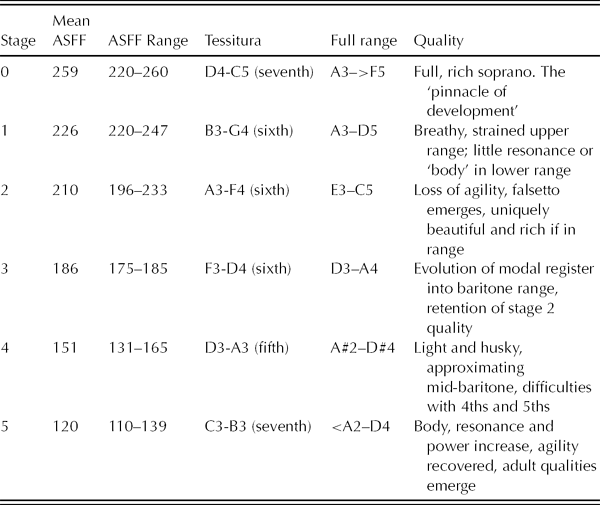
In spite of the ready availability of research on adolescent voice change (for girls as well as boys), the author's own experience confirms OFSTED's observation. The term ‘break’ was used almost universally by boys, teachers and choir directors consulted in the present research. OFSTED's confidence that it is wrong to refer to boys’ voices ‘breaking’ is probably attributable in some measure to the work of John Cooksey, in particular a discussion of the issue published in 1993 (Cooksey, Reference COOKSEY1993). Cooksey's ‘eclectic’ scheme is well known in the research literature (Table 1).
Summary of Cooksey's ‘eclectic’ scheme

Cooksey was by no means the first to propose a staged scheme such as this. Stubbs (Reference STUBBS1888) and Finn (Reference FINN1932) discuss similar ideas. Solutions to the problem of voice change have been sought and offered for well over a century. The ‘Cambiata plan’ advocated by Cooper is based on similar principles. Sassi (Reference SASSI2009, p. 9–10) has helpfully summarised the position, identifying three opposing approaches:
• School A. Originating with the work of McKenzie (Reference McKENZIE1956), this school believes that the voice changes slowly and predictably in a staged series of descending ranges, during which time tessitura contracts.
• School B. Originating with the work of Swanson (Reference SWANSON1961), this school believes that the voice may change quickly or slowly in a less predictable manner. The vocal history or ontogenesis is not the same for every boy.
• School C. Described by Phillips (Reference PHILLIPS1996) as the ‘English choirboy school’, this school believes that boys should sing in the ‘upper voice’ for as long as possible and then stop completely for a period of rest and adjustment.
Sassi does not mention the increasingly widely recognised work of Henry Leck who argues in favour of an expanded range during the time a boy begins to access his future adult voice but retains much of his former treble register (Leck, Reference LECK2009). Any diligent practitioner studying such potentially conflicting solutions offered might reasonably be confused. For reasons that are hard to understand, however, this appears not to be the problem. The issue is that there is often no engagement at all with any of these approaches. Given the relatively tiny number of boy trebles still singing in church choirs, it is curious that the choral practice engendered there seems still to be the default position: boys sing in the same range as girls until their voices ‘break’ and then stop altogether.
Should the voice be rested? – An old argument
If practitioners are to turn to research, the question of which research thus arises. Cooksey's scheme (Cooksey, Reference COOKSEY, Thurman and Welch2000) seems currently to have achieved pole position and is now cited almost universally in the academic literature on boys’ voices. It has found its way into practical handbooks such as the Voice for Life of the Royal School of Church Music and receives regular endorsement from the research community (Willis & Kenny, Reference WILLIS and KENNY2008; Killian & Wayman, Reference KILLIAN and WAYMAN2010 are recent examples). Barham & Nelson (Reference BARHAM and NELSON1991), in a practitioner handbook, acknowledge Cooksey's work but suggest that four rather than six stages are more practical for work in the classroom. The appeal of Cooksey's work is probably the accuracy with which it describes the changes that do happen to boys and there is little doubt that successive generations of researchers and interpreters have found these helpful as well as accurate.
Cooksey disliked the term ‘breaking’ (Cooksey, Reference COOKSEY, Thurman and Welch2000). His views amount to the proposition that a deficit model which positions boys as being in possession of a broken or defective vocal apparatus at a time when they are hypersensitive to their voices is about the worst thing possible. This debate too is an old one. A school of thought traceable back to Manuel Garcia (1805–1906), reputedly the first investigator to observe the vocal ‘cords’ with his newly invented mirror laryngoscope, argues that a boy should not sing at all for a while once his voice ‘breaks’. The celebrated Welsh tenor, Stuart Burrows, once spectacularly and publicly gave such advice to the 14-year-old boy singing star Aled Jones (Pope, Reference POPE1985). The opposing school of thought, which can be traced back via a lineage in the UK of Herbert Wiseman to the laryngologist Sir Morrell McKenzie (1837–1892), maintains that boys can and should sing through voice change in a series of progressively descending temporary registers (Spurling, Reference SPURLING1928; Mellalieu, Reference MELLALIEU1935; Cooper & Wikstrom, Reference COOPER and WIKSTROM1962; Cooksey, Reference COOKSEY, Thurman and Welch2000). Cooksey clearly writes in this latter tradition, the key point being that it is only through a positive approach to the changing voice that boys’ interest in singing can be maintained across Key Stage Three into Key Stage Four.
In spite of the logic of such arguments, it is contended in this paper that although Cooksey's work regularly receives endorsement it has had no more impact on pedagogical practice in UK secondary schools than the various schemes that have preceded it. The argument has additional potency in the UK where such practices in the independent and state-maintained sectors of education often differ. This was noted in 1963 by Irvin Cooper. Cooper was professor of music at Florida State University from 1950 to 1970. During his period as supervisor of music for the Montreal education system he became particularly interested in the non-participation of young adolescent boys. His research led him to formulate the Cambiata concept, which is also based on the principle of singing through voice change in a gradually descending range. During a study tour of the UK in 1962, he reported himself as being in awe of the public schools and cathedrals where he found choral singing ‘amongst the finest in the world’ (Cooper, Reference COOPER1964: 12). He found himself in disagreement, however, with a then prevailing view amongst public school masters and cathedral organists who declared the voice to be ‘useless’ from the time it ‘broke’ to maturation in the early 20s. He was also distressed by what he found in the state-maintained schools – widespread ignorance of boys’ voices, either no singing at all or a range of inappropriate vocal practices and a complete lack of any systematic training to address the problem.
This was before the UK had a National Curriculum. In 1988, such a curriculum was introduced and with it the statutory requirement for singing to be taught across Key Stages One, Two and Three. The approach adopted was one of linear progression which seemed to assume that children's vocal development proceeded along much the same lines as their mathematical development. In 1998, Cooksey & Welch published a significant critique of this curriculum (Cooksey & Welch, Reference COOKSEY and WELCH1998) in which it was pointed out that the linear progression model espoused paid little heed to the considerable and individually idiosyncratic disruptions to vocal functioning experienced by boys and girls during early adolescence. It would seem to be not unreasonable to question what had changed between 1964 and 1988 other than the introduction of an apparently poorly informed piece of curriculum legislation which gave official sanction to teachers’ ignorance of voice change and how to cater for it.
The story is now continued to the present day through the author's own research which appears to suggest that the fundamentals of the situation have not changed between the 1960s, the 1990s and the 2010s, in spite of the large investment in school singing.
Method
The work now reported is based on two substantial grants from the Arts and Humanities Research Council, first to investigate the gender imbalance in singing at ages 11–14 and then to devise practical solutions of value to schools. The main findings are reported in detail elsewhere (Ashley, Reference ASHLEY2008a, Reference ASHLEY2008b, Reference ASHLEY2009, Reference ASHLEY2010). The present paper focuses on a phenomenological approach with 25 secondary schools during a phase of the research which attempted to observe a variety of pedagogical practices and identify those that were successful. It draws out an analysis of the main findings common to the schools and illustrates these with five short, case study vignettes representative of the approaches. The schools visited were located in all four regions of England, in Wales and the Isle of Man. The sampling was purposively constructed to include urban and rural locations across affluent and socially disadvantaged neighbourhoods. The key variable, however, was that of the degree to which boys sung. Some schools were approached on the strength of an existing reputation or recommendation, others through teacher training partnerships supported by a trawl of school websites.
Ethical approval for this work was granted by the full University Ethics Committee which was in accord with the institutional procedure for work involving young people and/or work that might identify unfavourable information. The protocol was derived from the BERA (British Educational Research Association) guidelines which required the fully informed consent of all participants and offered anonymity, the right to withdraw and the right to review data. The granting of approval also required that no covert work would take place, no participants would receive incentives and illegal behaviour, if uncovered, would be disclosed. Consent for work with boys was obtained through a letter circulated to parents by the schools prior to the work. Boys were also provided with a full explanation of the work through an accessible language version of the BERA guidelines and were given opportunities to ask questions or seek clarification from the researcher.
The approach was a mixed methods one, drawing on the work of key authors such as Yin (Reference YIN2009) on case study. The voice (i.e. views) of the school pupils themselves also played a significant role. Construction of case studies was guided by a naturalistic mode of enquiry (Lincoln & Guba, Reference LINCOLN and GUBA1985; Bowen, Reference BOWEN2009) and an iterative approach to observational evidence and shared theorising between researcher and interviewees (Woodhead & Faulkner, Reference WOODHEAD, FAULKNER, Christensen and James2000; Alderson, Reference ALDERSON2003). The concept of ‘naturally occurring evidence’ describes the attempt to capture what is ‘out there’ without preconceptions or determining structures held by the researcher. A case study of each school was thus pieced together through interviews with key staff and focus group interviews with pupils employing humanistic phenomenological approaches to the elicitation and interpretation of interview narrative. These data, analysed through thematic coding, were supplemented by surveys of pupils, ethnographic observation during Key Stage Three music lessons and extra-curricular activity, and an analysis of documents describing the schools’ musical activities and outputs. Saturation point, the point at which data begin to repeat and no new themes are discovered (Smith & Osborn, Reference SMITH, OSBORN and Smith2003; Kendler, Reference KENDLER2005; Bowen, Reference BOWEN2009), was identified after a relatively small number of cases studies, leading to the eventual selection of five illustrative vignettes representative of the range of pedagogical vocal practice.
Results
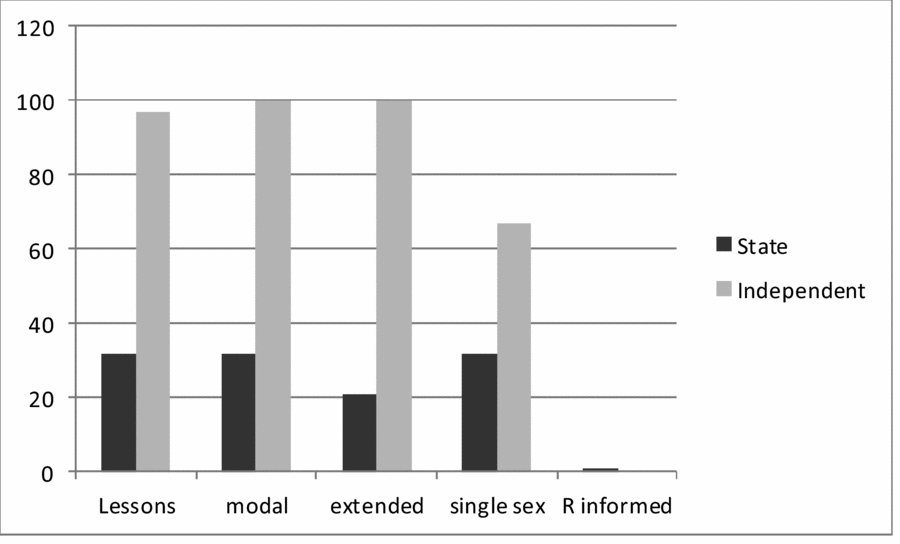
Figure 1 provides a quick overview of the situation uncovered in the 25 schools visited by the author for the research. The categories represented are whether or not class singing is a regular (weekly) feature of the Key Stage Three music curriculum (lessons), whether or not boys aged between 11 and 14 were regularly engaged in extra-curricular singing activities in the modal voice (modal), whether or not boys of that age regularly used their full extended singing range (extended), whether or not single-sex singing opportunities were provided for 11–14-year-olds and finally, whether or not the teachers had heard of research such as John Cooksey's and used it deliberately to inform their practice.
Boys’ singing in 25 UK secondary schools
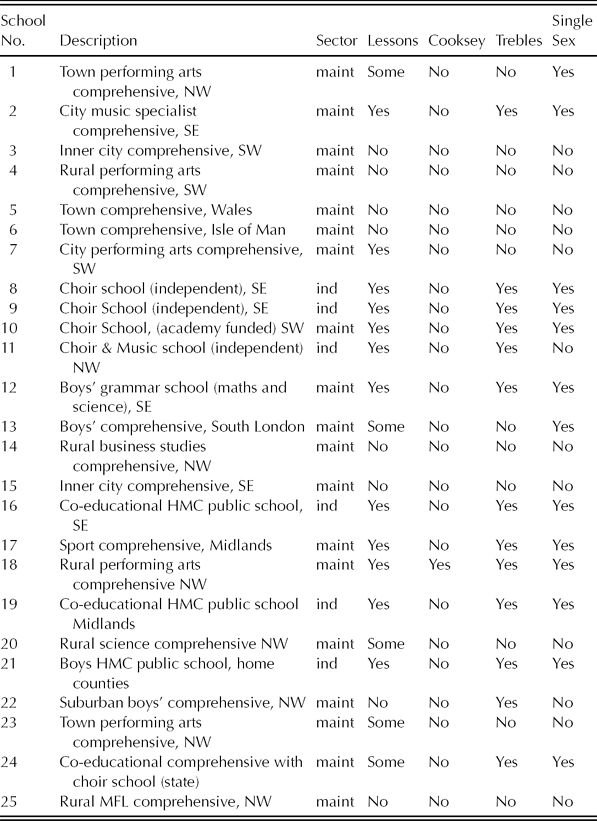
It will be seen that boys’ singing in the 11–14 age range was significantly more likely to occur in the independent than the maintained schools. The existence of singing by boys with unchanged or early change stage voices across the sectors was tested using chi square (p > 0.01 χ2), a finding which seems consistent with Cooper's observations during the 1960s. Whether or not the school's Head of Music had heard of the work of John Cooksey, or similar research, had minimal apparent association with the degree to which boys were part of a strong singing culture in either category of school. Tables 2 and 3 summarise data from which the graph was constructed and give further detail on the nature of each school. It will be seen that some of the schools were not co-educational. Thus the provision of single-sex singing opportunities was a deliberate policy only in the schools that educated boys and girls together. The significance of this is developed shortly in the vignettes.
Details of the 25 schools in the study
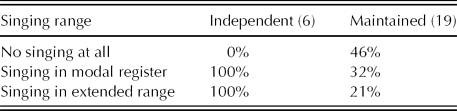
Distribution of Key Stage Three boys’ singing across sectors
A boy treble choir in which boys sang a full, extended treble (soprano) range until the ages of 12, 13 or 14 (and in a few cases, 15) and then continued to sing either alto, tenor or bass existed in all the independent schools (8, 9, 11, 16, 19, 21). Few examples of comparable practice were found in any of the state secondary schools, the majority of which had no boys singing at all during Key Stage Three (schools 1, 3, 4. 5, 6, 7, 13, 14, 20, 23, 25). The existence or not of a treble section was the most reliable predictor of whether boys sang in any significant numbers in the school. Other indicators of a state of health with regard to boys’ participation were the regular inclusion of singing in Key Stage Three curriculum music lessons and the availability of single sex extra-curricular singing opportunities.
Schools number 2 and 22 involved Key Stage Three boys with treble voices in singing a repertoire that drew mainly on the lower or modal register. School number 12 (a maintained boys’ grammar school) and school number 18 (a coeducational, comprehensive performing arts college) encouraged boys with treble voices to join a chamber choir which required them to sing an extended soprano range, although take-up was not great. Schools 10 and 24, though counted as maintained schools in the analysis, had strong associations with the independent sector. School 10 had been independent until achieving academy status and School 24 maintained an independent junior school in connection with its role in providing choristers for the cathedral whose name it bore. The percentage distribution of boys’ access to singing through school in the categories of modal only and extended range across the sectors is tabulated for clarification in Table 3.
Table 3 appears to provide further confirmation of the very different approaches between state-maintained and independent schools. In selecting the five vignettes, only state-maintained schools have been included. These schools do not generally have the level of association with Sassi's School C (the ‘English choirboy school’) that is encountered in the independent schools and signalled by the presence of boy trebles. It is the variety of choral practice outside the independent school tradition that is most illustrative of the variety of factors associated with boys’ participation in choral activity. Some illustration of the co-existence of the two approaches in the same school is provided in the first vignette below, where boy choristers and boys with no exposure to the English choirboy tradition are educated together. The school was formerly independent but became a state funded academy (the term ‘academy’ refers to an initiative introduced by the 1997–2010 Labour government initially to raise attainment in under-performing schools, but adopted by the new Coalition government as a means of reducing the level of local government control of schools).
Vignette One (School 10)
This state-funded school educated the boys of its associated cathedral choir and was keen to promote singing by non-choristers of similar age. Some initial unease by the cathedral's precentor that a rival ‘cool’ choir would demotivate the choristers proved unfounded. An enthusiastic and charismatic singing leader from the local authority music service was employed to set up a choir of boys not in the cathedral choir and enjoyed considerable success in doing so. The choir's repertoire was mainly music theatre and songs which proved popular with the 11–13-year-olds such as I'm a Believer (originally a Monkees hit but repopularised by the film Shrek). This music leader was aware that, by this age, boys were likely to have begun voice change and recognised the need to pitch songs in slightly lower keys than would have been the case for girls or younger boys. She did not, however, recognise that boys of this age with little singing training would have a limited tessitura. Some of the songs chosen, such as You Raise Me Up, thus had a range which stressed voices untrained to sing outside modal register (a twelfth in the case of this song). Although the choir enjoyed considerable success, both in recruitment and retention of boys and in its reception by the local community, its conductor seemed reluctant to anticipate the need to begin part work in order to retain boys whose voices progressed to later stages of change, or recruit the youngest boys in the school with unchanged voices.
Vignette Two (School 1)
School Number 1 was a town co-educational comprehensive school, located in a catchment area of mixed social class but with little ethnic mix, almost all the children being white British. It had a performing arts specialism and a reputation for its world music, particularly African singing. The head of music, an advanced skills teacher, was highly regarded within his local authority and determined to encourage boys’ singing. To this effect, he set up a boys’ rock choir named NFG (Not For Girls). This attracted initially a group of older boys from Y9 upwards. There was some part singing, boys describing themselves as ‘alto’ or ‘tenor’ in order to harmonise backing vocals for solo lines. The choir did not recruit the youngest boys in the school, however, and treble voices were not represented. As the choir progressed, this situation became entrenched. The older boys expressed the view that they did not want younger boys spoiling their choir and the leader seemed content to allow this situation to develop.
Vignette Three (School 2)
This school, located in a prosperous part of the South East, some 25 miles outside London, had an exceptionally large and well-regarded boys’ choir, as well as a parallel girls’ choir and a number of other choral ensembles. The choir's conductor had founded it from nothing on becoming the school's Head of Music and interviews with boys appeared to suggest that she was very highly regarded as a leader of boys’ singing. Membership of the boys’ choir reached 160 and was inclusive of all age groups within the school. The youngest boys with mostly unchanged voices (Y7) were well represented. In contrast to Vignette Two, a significant effort was made to promote the older boys as role models for the younger boys, commencing with outreach visits to primary schools. Repertoire was to some degree eclectic with the aim of expanding horizons, but centred upon a staple of music theatre and mainstream popular music such as I Can See Clearly Now. There was a limited degree of part singing but the conductor had discovered through her own experience unison singing ranges similar to those described by Cooksey & Welch (Reference COOKSEY and WELCH1998). Boys with unchanged voices did not therefore extend their vocal compass across the full treble range in this choir.
Vignette Four (school 18)
This was the only school that actively applied Cooksey's work. It was a co-educational comprehensive school with performing arts as a specialism situated in a largely white community of skilled working class background, and possessing a strong music department. The Head of Music, who was knowledgeable about choral technique, had come to know of Cooksey's work through his own interest and reading. The majority of secondary music teachers in the UK first undertake a subject degree and then complete a further year's training in pedagogy, known as the PGCE (Post Graduate Certificate of Education). Research findings on boys’ voices had not been part of this teacher's PGCE or any subsequent in-service training. A colleague with similar interests also supported him as accompanist. The pedagogical practice, after Cooksey, was regularly to assess the speaking pitch of the boys’ voices and allocate them to matching singing parts. Finding a paucity of UK published music that would appeal to English boys, this teacher had devoted considerable amounts of time to creating his own part arrangements for changing voices. The choir was able to sing these arrangements with confidence, the dominant tone being that of boys in midvoice rather than high treble.
Vignette Five (school 13)
School number 13 was a non-selective 11–16 Catholic boys’ school in South London, serving a predominantly Black African community. All but one of the boys in the choir (a Puerto Rican) were of Black African or African-Caribbean heritage. Although sponsored by the Roman Catholic Church, the dominant faith in the school was Adventist and this is likely to have been a contributory factor to the popularity of gospel singing and the degree to which this was accepted by the boys. The choir was taught by a white, female, classically trained peripatetic teacher. This teacher was highly committed to the choir's success and knowledgeable about vocal technique in general, though unaware of Cooksey's work. Boys were observed to participate in relatively sophisticated vocal warm-ups and exercises that required a specialist knowledge of singing and voice production. The organisational practice in the school was to limit membership of the choir to boys in Y8 and above. The youngest boys who were most likely to have unchanged voices were thus excluded and the procedure justified on the grounds that the boys would have a year to settle in the school and come to appreciate the choir as something to aspire to. The choir harmonised freely in the gospel style and boys talked readily and comfortably about being soprano and moving to tenor when their voices ‘broke’. The soprano range however was well within the compass of the stage 2 voice, by virtue of the repertoire and style of gospel singing rather than a deliberate choice in relation to a choral scheme such as that of Cooksey.
Discussion
Possibly the most striking feature of the above results is the difference between the state-maintained and the independent schools. The use of boy treble voices appears to be associated in the independent schools with a stronger choral tradition which leads to the progression of boys to alto, tenor and bass parts after voice change. Of arguably equal significance is the fact that this happens in the independent schools without reference to research such as that of John Cooksey. Many independent schools have clear links to the English choirboy school approach. This might be directly through their role as choir schools attached to cathedrals (Schools 8–11 and 24) or their emulation of the cathedral tradition in their own chapels (Schools 16, 19 and 21). These schools often take former cathedral choristers as music scholars, and may be staffed by teachers who themselves were once choirboys or studied in universities with strong choral traditions associated with the English choirboy school.
Approaches such as those described by Sassi as ‘School A’ and ‘School B’ have strong associations with educators working in the American middle or junior high schools who sought to maintain the interest of young adolescent males in singing through research. These bodies of vocal research and practice have largely arisen in response to systematic reflection on the reluctance of boys to sing through voice change (Koza, Reference KOZA1992). Arguably, such matters are not perceived as priorities in the English independent schools because boys do sing. In addition to a wide range of singing opportunities including music theatre, the majority of these schools maintain chapels where boys with newly changed emerging baritone voices ‘roar’ out traditional hymns
The boys totally outsing the girls in chapel. They really roar.
(Public School Director of Music 16)
Boy trebles progress to alto, tenor or bass parts as thought appropriate by the Director of Music and there is little apparent need for Cooksey's work. Indeed, some directors of music could be sceptical of it, perhaps perceiving it as a threat to their boy treble tradition. For example:
In September I had 21 boys aged between 13 and 15 singing treble. There are now 19 because a couple couldn't sing any more. We usually end up with around a dozen by June, but they are that much stronger and more experienced, so there is no adjustment to the balance of the choir . . . A lot of rubbish is talked about damage to their voices by still singing treble. All eight of my singing teachers encourage this robust approach! If the boy finds it uncomfortable (or painful) to sing, then of course he must stop.
(Public School Director of Music 21)
In another of the schools, which educated the boys of a cathedral choir, there had been active conflict when a newly appointed singing teacher had informed several members of the cathedral choir that they should no longer be singing treble. This would appear to illustrate that rigid application of the Cooksey scheme does not sit comfortably with established English choral practice. Contrary to Cooksey's insistence on the term ‘change’ an enduring belief that boys’ voices ‘broke’ was found to be near universal in the independent schools studied. Boys and staff equally referred regularly to voices ‘breaking’ as the crucial time when boys ceased to be trebles. These schools did not generally have the motivation to question this belief since their established choral practice appeared highly successful, producing what Cooper had described in 1964 as ‘some of the finest choral singing in the world’.
The state-maintained schools seldom drew on any of the three established approaches to boys’ singing. Those that had been successful invariably had a prominent member of the music department who was charismatic, inspirational, committed to the boys and admired by them as a strong leader. It was very difficult to separate such intangible or ‘magic’ personal qualities from what might be learned about vocal pedagogy and transferred to other schools. Transferable factors common to the successful schools appeared to be:
1. A commitment supported by senior management to providing single-sex singing opportunities for boys, whenever possible at times that did not clash with sporting commitments.
2. A robust approach to singing as a core part of the Key Stage Three class music curriculum, with a ‘this is what we all do here’ attitude.
3. Use of a singing range appropriate to voices in the earlier stages of change (Cooksey 1–3), sometimes referred to as ‘cambiata’.
It is the third point that is of most direct relevance to the present discussion. It was clear that, with the exception of Vignette 4, the teachers had discovered for themselves a singing range that worked well with the boys. This was not the result of a systematic familiarity with research findings either through initial or in-service training or with former experience as a choirboy as in the independent schools. It appeared to be more of a simple determination to make things work for boys through empathy. For example, the teacher in Vignette Three included the following advice in a pack issued in support of a ‘Boys Will Sing’ training day organised in association with SingUp:
Think like the age group/gender that you wish to inspire.
This was consistent with the author's interviews with the boys at the school which indicated very clearly their high regard for the way she and her colleague understood and supported them. One boy also showed a surprising insight into a key quality of leadership:
In other schools, teachers are scared in case they do it and no boys come.
Whilst Cooksey's work provides detailed research evidence about voice change, the operative success factor in this teacher's pedagogical practice appeared to be a fearless belief in boys’ singing combined with an ear that was sensitive to boys’ vocal difficulties. Also important was the disposition to work out vocal solutions even though this involved the time-consuming creation of arrangements. The teacher in Vignette Four, through his actual knowledge of Cooksey's work, was perhaps even more aware of the need to have sufficient commitment to create his own arrangements in the face of indifference or scepticism shown by publishers:
We have a whole host of arrangements written for the boys’ choir at (School 18) which do just that. We use a three-part model (Treble/Alto Tenor/Baritone Bass.) where the middle part has a limited range so that it can be sung by boys whose voices are in the Cambiata ranges. I have had conversations with publishers about these, but in order to get them out there, they need proof that they work in places other than (School 18).
The teacher in Vignette One expressed a similar commitment to boys’ success, also recognising the need to adapt and transpose so that the boys could sing comfortably. Most prominent in the interview, however, was her recognition of the nature of the exuberance of boys in the lower forms of secondary school and the need for an enthusiast to work out from experience how to manage it:
There's something really special about pre-teen boys, I think . . . they still have that sense of fun and wanting to be excited and inspired by things. Boys love singing but are easily embarrassed. You have to find your own ways for them to get through that.
Vignettes Three and Five were slightly different in that, though the teachers were keen to promote singing as an activity for boys, they placed less of a premium on the singing of the younger boys with unchanged voices. The gospel tradition in Vignette Five lent itself to a flexible approach to part singing which did not demand the highest range. Interviews with boys in this school revealed an acceptance that progression from ‘soprano’ to tenor or bass was a normal part of choir life, although there was some distaste for ‘opra’ (sic). By this was meant any form of sustained, melismatic vocal phrasing at a high pitch. The gospel tradition offered both an avoidance of what many boys appeared to regard as ‘unnaturally’ high singing and the opportunity to engage in some movement, also found to be a motivator of boys in Vignette One. The belief that a ‘rock choir’ would be the best way to motivate boys in Vignette Three appeared to lead to the exclusion of the younger boys. Earlier research by the author demonstrated significant awareness across the 11–14-year-old age group of genre appropriateness, the voice in earlier stages of change being considered inappropriate for rock music (Ashley, Reference ASHLEY2009: 136–137). Boys in this school were attracted to the rock choir once their voices had completed the earlier stages of change much as this research predicted.
Thus a final key difference between state-maintained and independent schools that emerges in the vignettes is the absence from the state schools of the high treble line that characterised the classical choral singing in the independent schools. Even boys with unchanged voices sang in the lower part of their range in the state schools. Importantly, it was found in the schools where boys did not sing that there was little awareness that boys aged around 12 or 13 even had a transitory singing range. The teachers were unaware of the unique sound of such voices correctly matched to appropriate music, and the motivating effect this has on boys who do not want to ‘sound like girls’. Although this could be interpreted simply as a result of the lack of contact with the relevant research, this paper appears to demonstrate that it is mainly a lack of willingness to look beyond an easy capitulation to media stories such as The Choir, Boys Don't Sing. Teachers who were successful in motivating boys were all characterised by a rejection of this message and a discovery for themselves of what appeared to work. One maintained school went further to attempt a higher level of vocal quality through the systematic application of Cooksey's work. The independent schools often appeared to believe that they were already successful.
Conclusion
The OFSTED report Making More of Music, in addition to its criticisms of boys’ singing at Key Stage Three, draws attention to the isolation in which many secondary music teachers continue to work (OFSTED 2009: 37). It is odd that secondary music teachers work in such isolation when the general climate of recent years in England has been one of micro-management by government, national strategies for core subjects, a national music manifesto, a national programme for primary school singing and, since the election of the coalition government, an emergent national music plan. The main task of this paper has been to promote reflection on why it is that well-regarded research which promises to go some way to solving a perplexing and widely reported problem is so little taken up by the practitioner community. There is, perhaps, an implicit criticism of those institutions that hold the responsibility of making relevant knowledge available to practitioners. This has not, however, been the main thrust of the discussion. What seems to stand out is the very fact that a small number of exceptional and inspirational teachers do work in isolation to achieve results in their own idiosyncratic ways. The status quo is maintained as much by the failure to make the work of these teachers more widely known within teacher development circles as it is by the populist discourse that it's not worth trying because ‘boys don't sing’.
Whether or not the pedagogy of already successful teachers might be further improved through greater knowledge of work such as Cooksey's is debatable. The balance of probability is that it might, given the reluctance to introduce more widespread part singing or to cater for boys in the earlier stages of voice change. The far larger question is that of whether any impact might be made upon a soundscape bereft of Key Stage Three boys’ voices. Might teachers who currently regard the task as largely impossible revise their opinions? It had been the optimistic hope at the outset of the knowledge transfer phase of the research that such an impact might be achieved. Continued sober reflection during the post-research phase, however, has toned this down. All the case studies of successful practice as well as all the case studies of schools where boys do not sing serve simply to confirm what had been an intuition at the outset – that the most significant variable is the charisma, passion and leadership quality of the individual teacher. The conclusion is that research needs to devote more attention to the examination of such factors in the practice of successful teachers. There is also clearly a significant task to be undertaken in linking the findings of the teachers who had discovered things for themselves to the findings of major research projects such as Cooksey's.
Martin Ashley is Head of Research in the Faculty of Education at Edge Hill University, UK. After an early career in sound recording with the BBC he trained as a middle school music specialist and taught for 17 years in state and independent middle schools, including a period at a cathedral choir school. He was, until 2007, Reader in Education at the University of the West of England, Bristol. He has researched extensively and published widely on the subject of boys and singing and is active in consultancy on choral outreach with boys.