Introduction
Helminths parasites adversely affected domestic livestock through an effect on weight gain, milk yield, and reproductive ability (Steelman, Reference Steelman1976; Byford et al., Reference Byford, Craig and Crosby1992). To control these parasites, veterinary drugs with various treatment methods (subcutaneous injection, oral administration, or pour-on formulation) have been developed. In particular, macrocyclic lactones (MLs) such as ivermectin, are highly effective in eliminating intestinal nematodes and arthropod parasites such as blood-sucking flies, mites, and lice (Miller et al., Reference Miller, Kunz, Oehler and Miller1981; Benz, Reference Benz1985; Schröder, Reference Schröder, Fivaz, Petnoy and Horak1992; Iwasa et al., Reference Iwasa, Maruo, Ueda and Yamashita2007; Adler et al., Reference Adler, Bachmann, Blanckenhorn, Floate, Jensen and Römbke2016). After MLs are applied to animals, most of the active ingredient is excreted into dung (Campbell et al., Reference Campbell, Fisher, Stapley, Albers-Schönberg and Jacob1983), and it remains for a long time in dung (Wohde et al., Reference Wohde, Blanckenhorn, Floate, Lahr, Lumaret, Römbke, Scheffczyk, Tixier and Düring2016), where it can kill the larvae of dung-breeding insects (Drummond, Reference Drummond1985; Floate et al., Reference Floate, Spooner and Colwell2001). However, residues of MLs in dung negatively affects non-target insects such as dung beetles and non-pest flies inhabiting dung pats in pastures (Floate et al., Reference Floate, Wardhaugh, Boxall and Scherratt2005), which may have long term ecological consequence.
Dung beetles play an important role in dung decomposition, and they provide important ecosystem services which include improvement of nutrient cycling and soil aeration, seed dispersal, and suppression of parasites of domestic animals in pastures (Bornemissza, Reference Bornemissza1970; Nichols et al., Reference Nichols, Spector, Louzada, Larsen, Amezquita and Favila2008; Manning et al., Reference Manning, Slade, Beynon and Lewis2016). Reduction of dung beetles may result in important consequences in pastures. It has been reported that ivermectin residues in dung reduce the survival and reproduction of dung beetles (Ridsdill-Smith, Reference Ridsdill-Smith1988; Wardhaugh & Rodriguez-Menendez, Reference Wardhaugh and Rodriguez-Menendez1988; Houlding et al., Reference Houlding, Ridsdill-Smith and Bailey1991; Fincher, Reference Fincher1992; Holter & Sommer, Reference Holter and Sommer1993; Lumaret et al., Reference Lumaret, Galante, Lumbreras, Mena, Bertrand, Bernal, Cooper, Kadiri and Crowe1993, Reference Lumaret, Errouissi, Floate, Römbke and Wardhaugh2012; Sommer et al., Reference Sommer, Grønvold, Holter, Madsen and Nansen1993; Krüger & Scholtz, Reference Krüger and Scholtz1997; Dadour et al., Reference Dadour, Cook and Neesam1999; Errouissi et al., Reference Errouissi, Alvinerie, Galtier, Kerboeuf and Lumaret2001; Iwasa et al., Reference Iwasa, Nakamura, Fukaki and Yamashita2005, Reference Iwasa, Maruo, Ueda and Yamashita2007). Ivermectin residues in dung also suppressed feeding activity or dung removal of dung beetles (Wardhaugh & Rodriguez-Menendez, Reference Wardhaugh and Rodriguez-Menendez1988; Dadour et al., Reference Dadour, Cook and Neesam1999; Pérez-Cogollo et al., Reference Pérez-Cogollo, Rodríguez-Vivas, Delfín-González, Reyes-Novelo and Ojeda-Chi2015; Manning et al., Reference Manning, Slade, Beynon and Lewis2017). These adverse effects may be associated with the delay of dung decomposition (Wall & Strong, Reference Wall and Strong1987; Madsen et al., Reference Madsen, Nielsen, Holter, Pedersen, Jespersen, Jensen, Nansen and Grønvold1990; Floate, Reference Floate1998; Krüger and Scholtz, Reference Krüger and Scholtz1998a, Reference Krüger and Scholtzb; Römbke et al., Reference Römbke, Coors, Fernández, Förster, Fernández, Jensen, Lumaret, Cots and Liebig2010) and reduction of diversity (Verdú et al., Reference Verdú, Lobo, Sánchez-Piñero, Gallego, Numa, Lumaret, Cortez, Ortiz, Tonelli, García-Teba, Rey, Rodríguez and Durán2018) in pastures. For conservation of pasture ecology (pastureland ecosystems), a detailed evaluation of anthelmintic drugs such as ivermectin on dung beetles is an important issue.
In Japan, ivermectin has been widely used, with the pour-on formulation introduced in 1996. However, there have been only a few papers about the effects of ivermectin on dung beetles in Japan (Yamashita et al., Reference Yamashita, Yoshida, Watanabe and Mikami2004; Iwasa et al., Reference Iwasa, Nakamura, Fukaki and Yamashita2005, Reference Iwasa, Maruo, Ueda and Yamashita2007). It is therefore necessary to obtain further information about the effects on dung beetles. This study was carried out to assess the effect of pour-on formulation of ivermectin on the survival, reproduction, and feeding activity of four dung beetle species: Copris acutidens Motschulsky, Onthophagus bivertex Heyden, O. lenzii Harold and Phelotrupes auratus auratus Motschulsky, which are important dung-decomposing species in Japan.
Materials and methods
Application of ivermectin and dung collection
The experiments were performed in a pasture of Yachiyo Farm southwest of Obihiro City, Hokkaido, Japan. In experiment 1, ten Holstein cattle (aged 10–30 months) were selected, and ivermectin (Ivomec Topical; Merial, Japan) was applied by pour-on formulation with the recommended dose of 500 µg kg−1 of body weight on 15 June 2015. In experiment 2, ten Holsteins were selected, and ivermectin was applied on 24 June 2016. Ten untreated Holsteins were used as a control. All cattle were pastured in Yachiyo Farm and mainly fed with green grass composed of Kentucky bluegrass, timothy, and Ladino clover.
Dung pats were collected immediately after defecation in the morning from treated and control groups on the day preceding treatment and at 1, 3, 7, 14, and 21 days after treatments. In each collection, a total of about 10 kg of dung from ten cows in each group was thoroughly homogenized and stored at −20°C until used.
Analysis of ivermectin concentration
The concentration of ivermectin in cattle dung was analyzed using high-performance liquid chromatography (HPLC) following the method of Payne et al. (Reference Payne, Hicks and Wehner1995) with some modifications. Two fecal samples (each 5 g) from dung collected from treatment and control groups at each date were analyzed, and the extraction was carried out with homogenizer (Physcotron, Microtec Co., Ltd) at 10,000 rpm for 1 min (instead of sonication), and the concentration was calculated from a calibration curve of a standard solution. The concentrations detection limit was determined to be 0.05 ppm.
The effect of ivermectin on the survival and reproduction of four species of dung beetles
Three species of Scarabaeidae (C. acutidens, O. bivertex, and O. lenzii) and one species of Geotrupidae (P. auratus) were selected as important dung beetles which are distributed throughout Japan (Hayakawa, Reference Hayakawa1981; Kawai et al., Reference Kawai, Hori, Kawahara and Inagaki2005; Imura, Reference Imura2007).
C. acutidens Motschulsky
C. acutidens is a medium-sized (9.7–16.0 mm) dung beetle which depends on dung of cattle, horse, and deer. Adults of C. acutidens were collected in Hokkaido in June 2015. A 70 g sample of dung collected from control and treated (3, 7, and 14 days after treatment in experiment 1) cattle was placed on andosol (commercial black soil for horticulture) (15 cm depth) in a plastic container (12 cm diameter, 18 cm depth) which was covered with gauze, and one male–female pair was placed on the dung surface. The rearing test was performed for 90 days; this period corresponds to the breeding season (June–August) of C. acutidens in Japan. Thereafter, dung samples were replaced with fresh ones every week. After every 30 days following the onset of rearing, the soil in the container was sieved to collect the brood balls (one egg laid per one brood ball). The brood balls collected were placed in a plastic cup (5 cm diameter, 3 cm depth) filled with andosol to record adult emergence rate. Rearing tests were replicated ten times for each dung from treatments and control.
O. bivertex Heyden and O. lenzii Harold
O. bivertex is small/medium sized dung beetle (5.2–6.8 mm), which is distributed in open and flat land. Adults of O. bivertex were collected in Hokkaido in June 2016. A 50 g sample of dung collected at 1, 3, and 7 days after treatment and control in experiment 2 was placed on andosol (15 cm depth) in a plastic container (12 cm diameter, 18 cm depth), and three male–female pairs were placed on the dung surface. Dung samples were replaced with fresh dung, and the soil in the container was sieved to collect the brood balls once per week for 56 days. Rearing tests were replicated five times for each dung treatment and control.
O. lenzii is medium-sized dung beetle (body size is 7.1–9.2 mm), which is distributed throughout Japan. Adults were collected in Tochigi prefecture in July 2016. A 50 g dung sample collected at 1, 3, 7, and 14 days after treatment and control in experiment 2 was used for rearing tests. The rearing method was the same as O. bivertex, and rearing tests were replicated five times for each treatment and control.
P. auratus auratus Motschulsky
P. a. auratus is a large dung beetle (body size: 12.4–22.0 mm) and it is widely distributed from flatland to highland. Adults were collected in the pasture of Yachiyo Farm, located in southwest of Obihiro City, Hokkaido in August 2015. A 200 g dung sample collected at 3 days after treatment and control in experiment 1 was placed on andosol (30 cm depth) in a plastic container (30 cm diameter, 40 cm depth), and two male–female pairs were placed on the dung surface. Dung samples were replaced with fresh dung once per week for 90 days; this period corresponds to their breeding season (August–October) in Hokkaido, Japan. The andosol in the container was sieved to collect the brood mass (one egg laid per one brood mass) every 30 days. At this time, we confirmed one egg laid per one brood mass. Rearing tests were replicated five times for each dung treatment and control group. The rearing tests on adults and larvae of C. acutidens, O. bivertex, O. lenzii, and P. a. auratus were conducted at a constant temperature of 22°C (light regime 16 L:8 D).
The effect of ivermectin on the feeding activity of four species of dung beetles
The dung samples placed in rearing containers were inspected when they were replaced with new ones. They were described following the level of feeding on an arbitrary scale of 0–4 based on Wardhaugh & Rodriguez-Menendez (Reference Wardhaugh and Rodriguez-Menendez1988) with some modifications (i.e., 0 = no feeding; 1 = one feeding trace on the surface of dung; 2 = two or more feeding traces on the surface of dung; 3 = most of the feces was degraded, but surface parts of dung was left; 4 = all of the feces was degraded into fiber or carried to a burrow).
Statistical analysis
The adult mortality of four species of dung beetle was analyzed using the log-rank test for differences between control and treatments. Then, for C. acutidens, O. bivertex, and O. lenzii, Bonferroni's method was used to apply a multiple testing adjustment of P-values for each comparison between control and treatment groups. The significance level which was required by the Bonferroni correction was set at 0.008 (=0.05/6: C. acutidens and O. bivertex) or 0.005 (=0.05/10: O. lenzii).
Generalized linear mixed models (GLMMs) with log-link function were used to analyze the numbers of brood balls or masses (Poisson error) and the adult emergence rates or larval survival (binomial error). The numbers of brood balls (masses) and adult emergence rates (larvae survival) were response variables, the type of feces (each treatment and control) were explanatory variables, and replicates were random effects.
The feeding activity levels for each treatment and control were evaluated using GLMMs with Poisson error distribution and log-link function. The estimated feeding levels (0–4) were response variables, type of feces were explanatory variables, and replicates were random effects. The significance level for multiple comparisons was adjusted by Tukey's method. All analyses were performed using R 3.2.4 software (R Development Core Team, 2016).
Results
Concentration of ivermectin residues in cattle dung
Ivermectin residues in dung attained maximal concentration at 3 days after treatment (fig. 1), followed by a marked decline by 7 days in both experiments. In experiment 1, ivermectin was not detected at 7, 14, and 21 days after treatment (<0.05 ppm). In experiment 2, ivermectin in dung at 7 days was about one-third of maximal concentration, and no ivermectin was detected at 14 and 21 days (<0.05 ppm) after treatment. No ivermectin was detected in dung from all dates in both control cattle.
Ivermectin concentrations in dung (ppm of wet weight) after treatments (pour-on treatment: 500 µg kg−1) in experiments 1 and 2.

The effect of ivermectin on survival, reproduction, and feeding activity of C. acutidens
In dung collected from control cattle, all of adults survived until 90 days after the beginning of rearing (table 1). In dung collected at 3 days post-treatment, however, accumulated adult mortality were significantly higher than the control at 30, 60, and 90 days after the beginning of rearing, and with 40% of maximal mortality at 90 days (table 1; 30 days: χ2 = 7.7, P < 0.008; 60 days: χ2 = 11.6, P < 0.008; 90 days: χ2 = 13.7, P < 0.008). Similarly, the adult mortality in dung collected at 7 days post-treatment were significantly high at 60 and 90 days after the beginning of rearing (table 1; 60 days: χ2 = 5.8, P < 0.008; 90 days: χ2 = 7.9, P < 0.008). In dung collected at 14 days post-treatment, there was no significant difference in adult mortality between control and treatment. There were 5.3 ± 1.2 brood balls in dung collected from control cattle, but there was no brood ball in dung at 3 days post-treatment. In dung collected at 7 days post-treatment, the numbers of brood balls were significantly low (table 1; Z = −2.6, P < 0.05), returning to levels of the control at 14 days post-treatment. The adult emergence rate in dung from control cattle was 96.1%, whereas those in dung collected at 7 and 14 days post-treatment were significantly decreased (table 1; Z = −5.7, P < 0.001; Z = −2.9, P < 0.01, respectively).
Accumulated adult mortality, number of brood balls, and adult emergence rate of C. acutidens in dung from control and treatment groups in experiment 1.

Each value is a mean of ten replicates involving one pair of male and female.
Values in parentheses are total numbers of brood balls.
In each column, the means not associated with the same letter differ among control and treatments in experiment 1 (adult mortalities: log-rank test followed by Bonferroni method P < 0.0083, numbers of brood balls and adult emergence rate: GLMM followed by Tukey's multiple comparisons P < 0.05).
In dung collected at 7 and 14 days post-treatment, there were no significant differences in feeding activity levels between at 7 and 14 days post-treatment and control (fig. 2). In dung collected at 3 days post-treatment, however, the feeding activity was significantly reduced compared to control (fig. 2; Z = −4.4, P < 0.001).
Accumulated feeding activity (F) of C. acutidens in dung from control and treatments in experiment 1. Different letters show significant difference among control and treatments (GLMM followed by Tukey's multiple comparisons: P < 0.05).

The effect of ivermectin on survival, reproduction, and feeding activity of O. bivertex
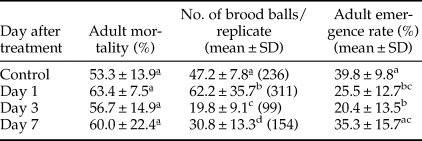
Adult mortality of O. bivertex in all treatments and control ranged from 53.3 to 63.4%, and there were no significant differences between each treatment and control (table 2). The numbers of brood balls increased significantly in dung collected at 1 day post-treatment compared to control (table 2; Z = 3.2, P < 0.05). In contrast, females in dung collected at 3 and 7 days post-treatment constructed significantly fewer brood balls than the control (table 2; Z = −4.1, P < 0.001; Z = −7.2, P < 0.001, respectively). Adult emergence rates in dung collected at 1 and 3 days post-treatment were significantly lower than control (table 2; Z = −2.96, P < 0.05; Z = −3.8, P < 0.001, respectively), but an equivalent level to the control was restored at 7 days post-treatment.
Accumulated adult mortality, number of brood balls, and new adult emergence rate of O. bivertex in dung from control and treatment groups in experiment 2.

Each value is a mean of five replicates involving three pairs of male and female.
Value in parentheses is the total number of brood balls.
In each column, the means not associated with the same letter differ among control and treatments in experiment 2 (adult mortalities: log-rank test followed by Bonferroni method P < 0.0083, numbers of brood balls and adult emergence rate: GLMM followed by Tukey's multiple comparisons P < 0.05).
There were no significant differences in the feeding activities of O. bivertex between all treatments and control (fig. 3), but those in dung collected at 1 and 7 days post-treatment differed significantly (fig. 3; Z = −2.67, P < 0.05).
Accumulated feeding activity (F) of O. bivertex in dung from control and treatments in experiment 2. Different letters show a significant difference between treatments (GLMM followed by Tukey's multiple comparisons: P < 0.05).

The effect of ivermectin on survival, reproduction, and feeding activity of O. lenzii
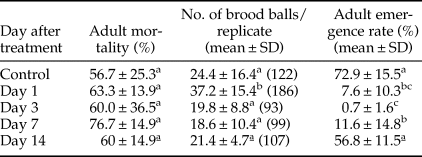
There were no significant differences in adult mortality of O. lenzii between each treatment (1, 3, 7, and 14 days post-treatment) and control (table 3). Numbers of brood balls in dung collected at 3, 7, and 14 days post-treatment were not significantly different from those of the control, but those in dung collected at 1 day post-treatment were significantly more abundant (table 3; Z = 3.63, P < 0.05). In control dung, adult emergence rate was 72.9%, but those in dung from 1, 3, and 7 days post-treatment were statistically smaller than that of control dung (table 3; Z = −9.12, P < 0.001; Z = −7.06, P < 0.001; Z = −5.26, P < 0.001, respectively), returning to control level at 14 days post-treatment.
Accumulated adult mortality, number of brood balls, and new adult emergence rate of O. lenzii in dung from control and treatment groups in experiment 2.

Each value is a mean of five replicates involving three pairs of male and female.
Value in parentheses is the total number of brood balls.
In each column, the means not associated with the same letter differ among control and treatments in experiment 2 (adult mortalities: log-rank test followed by Bonferroni method P < 0.005, numbers of brood balls and adult emergence rate: GLMM followed by Tukey's multiple comparisons P < 0.05).
There were no significant differences in the feeding activities of O. lenzii between all treatments (3, 7, and 14 days post-treatment) and control (fig. 4).
Accumulated feeding activity (F) of O. lenzii in dung from control and treatments in experiment 2. Same letters show no significant difference between treatments (GLMM followed by Tukey's multiple comparisons: P < 0.05).

The effect of ivermectin on survival, reproduction, and feeding activity of P. a. auratus
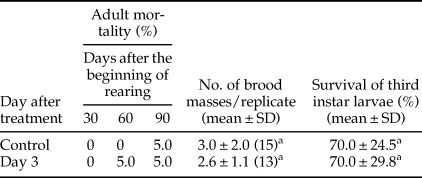
Adult mortalities of P. auratus were 5% and zero in dung collected at 3 days post-treatment and control, respectively, showing no significant difference between them (table 4). Females constructed some brood masses (control: 15, treatment: 13 masses), and there was no significant difference between treatment and control. The larvae in brood masses developed to the third instar, but all of them died before pupation in dung from both treatment and control cattle. No significant difference in the feeding activities of P. a. auratus was found between control and treatment (fig. 5).
Accumulated feeding activity (F) of P. a. auratus per replicates in dung from control and ivermectin-treated cattle in experiment 1. Same letters show no significant difference between treatments (GLMM followed by Tukey's multiple comparisons: P < 0.05).

Accumulated adult mortality, number of brood masses, and survival of third instar larvae rate of P. a. auratus in dung from control and ivermectin-treated cattle in experiment 1.

Each value is mean of five replicates involving two pairs of male and female.
Value in parentheses is the total number of brood masses.
In each column, the means not associated with the same letter differ among control and treatment in experiment 1 (adult mortalities: log-rank test followed by Bonferroni method P < 0.05, numbers of brood masses and survival of larvae: GLMM followed by Tukey's multiple comparisons P < 0.05).
Discussion
Ivermectin was excreted in dung for 2–4 weeks with peak concentration at 1 or 3 days post-treatment by pour-on formulation (Sommer & Nielsen, Reference Sommer and Nielsen1992; Herd et al., Reference Herd, Sams and Ashcraft1996; Dadour et al., Reference Dadour, Cook and Hennessy2000; Iwasa et al., Reference Iwasa, Nakamura, Fukaki and Yamashita2005, Reference Iwasa, Maruo, Ueda and Yamashita2007). The present results are similar to the previous studies, but there was a considerable difference in concentration at 7 days after treatment between the two trials: no detectable residues in experiment 1 and 0.07 ppm in experiment 2. The detection limit concentration of ivermectin in our study was 0.05 ppm, but a reduction of adult emergence rates of C. acutidens in dung collected at 7 and 14 days after treatment in experiment 1 suggests that an undetectable concentration of ivermectin may have been excreted in dung for at least 14 days after treatment.
Previous studies show that the adult survival of dung beetles of genera Aphodius, Caccobius, Euoniticellus, Liatongus, and Onthophagus are not affected by ivermectin residues in dung (Ridsdill-Smith, Reference Ridsdill-Smith1988; Fincher, Reference Fincher1992; Lumaret et al., Reference Lumaret, Galante, Lumbreras, Mena, Bertrand, Bernal, Cooper, Kadiri and Crowe1993; Yamashita et al., Reference Yamashita, Yoshida, Watanabe and Mikami2004; Iwasa et al., Reference Iwasa, Nakamura, Fukaki and Yamashita2005, Reference Iwasa, Maruo, Ueda and Yamashita2007; Pérez-Cogollo et al., Reference Pérez-Cogollo, Rodríguez-Vivas, Reyes-Novelo, Delfín-González and Muñoz-Rodríguez2017). Similarly, in our results, there were no effects of ivermectin on adult survivals of O. bivertex, O. lenzii, and P. auratus. In contrast, ivermectin residues in cattle dung reduced the survival of newly emerged adults of Copris hispanus Linnaeus (Wardhaugh & Rodriguez-Menendez, Reference Wardhaugh and Rodriguez-Menendez1988) and mature adults of Copris ochus Motschulsky and C. acutidens (Iwasa et al., Reference Iwasa, Maruo, Ueda and Yamashita2007). In the present study, the mortality of mature adults of C. acutidens increased in dung collected at 3 and 7 days post-treatment, although dung collected at those dates had no effect on adult survival of O. bivertex and O. lenzii. It is suggested that adults of Copris, which are large dung beetles, have a higher drug sensitivity against ivermectin than those of other genera in Scarabaeidae. Ortiz et al. (Reference Ortiz, Cortez, Azzouz and Verdú2017) reported a new method for the quantitative determination of ivermectin in bodies of dung beetles which ingested the dung containing ivermectin. It is expected that the relationship between the body sizes of dung beetles and the amount of intake of ivermectin residues in contaminated dung will be investigated using the new analysis method.
It has been suggested that there are no effects of ivermectin present in cattle dung on the production of brood balls of small dung beetles belonging to the genera Caccobius, Liatongus (Iwasa et al., Reference Iwasa, Nakamura, Fukaki and Yamashita2005, Reference Iwasa, Maruo, Ueda and Yamashita2007), and Euoniticellus (Fincher, Reference Fincher1992). In the genus Onthophagus which comprises small to medium-sized dung beetles, no reduction of brood balls of Digitonthophagus gazella Fabricius (body length: 9–13 mm) was observed in dung from cattle treated by injection and pour-on formulation of ivermectin (Fincher, Reference Fincher1992; Sommer & Nielsen, Reference Sommer and Nielsen1992; Yamashita et al., Reference Yamashita, Yoshida, Watanabe and Mikami2004). In O. binodis Thunberg (body length: 10–13 mm), however, the numbers of brood balls were reduced for 4 weeks in dung from abamectin-treated cattle by injection (Ridsdill-Smith, Reference Ridsdill-Smith1988). In addition, Pérez-Cogollo et al. (Reference Pérez-Cogollo, Rodríguez-Vivas, Reyes-Novelo, Delfín-González and Muñoz-Rodríguez2017) found that brood mass production by Onthophagus landolti Harold (body length: 5.0–5.5 mm) was almost completely suppressed in dung collected from ivermectin-treated cattle (ivermectin 1 and 3.15%) at 3, 6, and 14 days post-treatment. In the present study, the number of brood balls of O. bivertex decreased in dung collected at 3 and 7 days after treatment from ivermectin-treated cattle, but there was no adverse effect on those of O. lenzii although this species belongs to the same genus. Thus, it is suggested that the effects of ivermectin on the production of brood balls vary among the species even within the same genus (Onthophagus) regardless of the body size of adults.
Iwasa et al. (Reference Iwasa, Maruo, Ueda and Yamashita2007) reported that adults of C. ochus and C. acutidens produced no brood balls in dung collected at 1 day after ivermectin treatment, and Wardhaugh & Rodriguez-Menendez (Reference Wardhaugh and Rodriguez-Menendez1988) observed aberrant ovarian development of Bubas bubalus Oliver and reduction of brood balls of C. hispanus in dung from ivermectin-treated cattle. Correspondingly, our results show that the reproduction of C. acutidens was completely inhibited in dung collected at 3 days post-treatment and was significantly reduced until 7 days post-treatment. Therefore, it is conceivable that the reproduction of the relativity large dung beetles belonging to the genus Copris are affected by ivermectin residues compared to other genera.
Adult emergence rates of D. gazella in dung from cattle treated with ivermectin by injection were reduced for 1–2 weeks after treatment (Fincher, Reference Fincher1992; Sommer & Nielsen, Reference Sommer and Nielsen1992). Ridsdill-Smith (Reference Ridsdill-Smith1988) reported that larval survival of O. binodis was reduced in dung at 1–4 weeks after treatment with avermectin B1 by injection. In the present study, reduction periods of adult emergence rates differed between O. bivertex (1, 3 days post-treatment) and O. lenzii (1, 3, and 7 days post-treatment). Iwasa et al. (Reference Iwasa, Maruo, Ueda and Yamashita2007) suggested that the effective period of pour-on formulation of ivermectin on adult emergence rates of C. jessoensis (small beetle: 5–8 mm body length) was shorter (3–7 days after treatment) than for medium-sized dung beetles such as species of the genus Onthophagus. This present result agrees with Iwasa et al. (Reference Iwasa, Maruo, Ueda and Yamashita2007), suggesting that the effects of ivermectin on larval survival (adult emergence) are associated with the body size of dung beetles among the related genera and species.
Wardhaugh & Rodriguez-Menendez (Reference Wardhaugh and Rodriguez-Menendez1988) showed that the larval survival of C. hispanus was reduced in dung collected at 1 and 8 days after ivermectin-treatment by injection, and equivalent levels to the control were restored in dung collected at 16 days post-treatment. Our results revealed that the reduction of adult emergence rates of C. acutidens occurred in dung collected at 3, 7, and 14 days after treatment by the pour-on method of ivermectin. Although the concentrations of ivermectin in dung collected at 7 and 14 days post-treatment were less than the detection limit, adult emergence rates of C. acutidens decreased by 8.3% (7 days post-treatment) and 68.3% (14 days post-treatment) compared to control (table 1). Thus, it seems likely that the larvae of C. acutidens are sensitive to the undetectable concentration of ivermectin in dung.
Dung removal by O. landolti was decreased in dung spiked with ivermectin at 0.1, 1.0, and 10.0 mg kg−1 (Pérez-Cogollo et al., Reference Pérez-Cogollo, Rodríguez-Vivas, Delfín-González, Reyes-Novelo and Ojeda-Chi2015). Wardhaugh & Rodriguez-Menendez (Reference Wardhaugh and Rodriguez-Menendez1988) reported that the feeding activity of C. hispanus was restrained in cattle dung treated with ivermectin by injection for 1–8 days post-treatment. Dung dispersal by Onthophagus taurus Schreber was suppressed in dung at 7 and 10 days after ivermectin-treatment by injection (Dadour et al., Reference Dadour, Cook and Neesam1999). The present results show that the feeding activity of C. acutidens was suppressed in dung at 3 days post-treatment, same as the species mentioned above, although there were no adverse effects on those of O. bivertex, O. lenzii, and P. auratus. Martínez et al. (Reference Martínez, Lumaret, Ortiz Zayas and Kadiri2016) reported that ivermectin residues in dung caused the cessation of yolk synthesis in oocytes and reduction of body fat reserves of Euoniticellus intermedius Reiche because activities of feeding and oviposition were inhibited. Ivermectin suppresses the neurotransmission produced by γ-aminobutyric acid and glutamate in invertebrates, resulting in somatic paralysis and death (Keane & Avery, Reference Keane and Avery2003; Geary & Moreno, Reference Geary and Moreno2012). Indeed, muscle contraction of Scarabaeus cicatricosus Lucas decreased in dung containing ivermectin, resulting in a reduction of the locomotor capacity and foraging success (Verdú et al., Reference Verdú, Cortez, Ortiz, González-Rodríguez, Martinez-Pinna, Lumaret, Lobo, Numa and Sánchez-Piñero2015). It is assumed that the remarkable reduction of adult survival and brood ball construction of C. acutidens in dung at 3 days post-treatment in our study can also be attributed to the antifeedant and paralysis affected by ivermectin.
Regarding the effects of ivermectin on Geotrupidae species, Lumaret (Reference Lumaret1996) showed that ivermectin residues in horse dung have no effect on adult survival of Anoplotrupes stercorosus Hartmann. The results presented here show that there were no effects of ivermectin on adult survival and brood mass construction of P. a. auratus, although the adults fed a large amount of dung residual in the maximum concentration of ivermectin (3 days after treatment). Geotrupid adult beetles have mandibulate type of mouth parts, and their food habit is likely to differ from absorption type of scarabid beetles. Actually, adults of Thorectes lusitanicus Jekel (Geotrupidae) feed on oak acorn, semi-dry and dry dung (Verdú et al., Reference Verdú, Casas, Lobo and Numa2010), showing that they feed on nondecomposed plant material. Hence, it is assumed that the lower effects of ivermectin on adults of P. auratus than on other large species such as Copris (Scarabaeidae: filter-feeder) are also associated with a difference of feeding habits. Elucidation of the tolerance mechanism in dung beetles to ivermectin is needed in relation to their feeding habits in both adults and larvae.
Evaluations for the effects of ivermectin on dung beetles which have been studied all over the world are focused on common species which are small to medium sized (Floate et al., Reference Floate, Wardhaugh, Boxall and Scherratt2005), and there are few investigations on rare species facing extinction. McCracken (Reference McCraken1993) suggested that the rare species of dung beetles in the genera of Copris and Onthophagus are put at risk by use of avermectin owing to low recolonization potential. Moreover, the decrease of C. ochus and C. acutidens, which are listed as rare or endangered species in many prefectures of Japan, can be partly attributed to the residues of ivermectin in dung (Iwasa et al., Reference Iwasa, Maruo, Ueda and Yamashita2007). O. bivertex was also designated as an endangered species in some prefectures of Japan.
From our results that brood ball constructions and larval survival of C. acutidens and O. bivertex were inhibited by ivermectin residues, it is suggested that these two species have a higher drug sensitivity against ivermectin than common species such as O. lenzii and P. auratus. In particular, dung beetles of Copris construct fewer brood balls (2–10) per female than those of other dung beetles such as Onthophagus, and they stay in their nests for a long period to take care of their offspring in the breeding season. Frequent use of anthelmintics such as ivermectin in the breeding season could possibly cause a serious impact on the population of Copris species. Moreover, it is known that paracoprid species (such as Copris and Onthophagus) have an ability to bury a large amount of dung per day (Bang et al., Reference Bang, Lee, Kwon, Na, Jang and Kim2005). Further investigation is necessary to clarify the association between inhibition of activities of dung beetles (feeding and reproduction) by ivermectin and dung degradation, involving the body size of dung beetles.
Acknowledgements
We appreciate Drs T. Oshida and N. Kumano of Obihiro University of Agriculture and Veterinary Medicine, and Dr T. Nakamura of Hirosaki University for their valuable suggestion. We are also thankful to Mr S. Yamanaka and K. Mihara of Obihiro Yachiyo Farm, Mr K. Hasegawa of Ôno Farm, Mr T. Arai of Ôtawara city office, Agricultural Division, and Mr T. Nakamura of Nakamura Farm for their support during the survey in pastures. Our thanks are also extended to Associate Professor G. A. Hill of Obihiro University of Agriculture and Veterinary Medicine for checking the English in this manuscript.