In spite of their great volume, the records of central government have not been fully recognized or exploited as a resource for the study of language choice and linguistic change in late medieval England. Their neglect stems in part from the reluctance of historians to question how and why particular languages were used within the workaday bureaucratic systems of royal government, but also in part because the majority of work on language in the later Middle Ages has been conducted within literary or sociolinguistic spheres, where the focus has been on other types of writing. The relatively dry, formulaic, and “automated” nature of many of the documents produced within the writing offices of the central administration, in any case, appears, at first sight, to offer little by way of understanding how language was used and what informed the individual linguistic choices of the clerks charged to do the writing. In recent years, the study of language in later medieval England has expanded to consider some specialized local administrative contexts,Footnote 1 but the rules and customs that guided the choice of language within the royal secretariat remain for the most part shrouded in mystery. The subject deserves special consideration, for, as this article will show, the fifteenth century—and especially the years from 1425 to 1450—was a period of unprecedented linguistic change, when the extent of English, French, and Latin usage in some key government records was in an extraordinary state of flux.
In this study, my aim is to show that the records of central government have an important place in the linguistic history of later medieval England, not least by providing important context to many of the questions long considered by literary scholars. In particular, analysis of the records produced by the royal bureaucracy offers an empirical approach to, as well as a quantifiable measure of, language use, which nicely complements the more anecdotal nature of the literary texts that have formed the centerpiece of scholarship on the subject for many years.Footnote 2 The huge number of similar types of records produced by the central government allows a quantitative measure of the trajectory of linguistic change that is not possible using the work of the writers of literature. Furthermore, I hope to show that the clerks who wrote these documents were not mere automata, churning out documents according to a prescribed, fixed, and rational set of linguistic criteria. Instead, they were faced with real choices over the languages they used. I aim to explore what governed these choices and what the different languages meant to their users. A third and final element to my investigation will be uncovering the dynamic of linguistic change within the royal secretariat. From where did the impetus to change from French to English, or from English to Latin, emanate? The focus is the privy seal office, which lay at the heart of English central administration and coordinated a large proportion of the business of the king’s government. The records of the privy seal office—the writs and warrants it produced in copious numbers—are especially suitable for an analysis of attitudes toward language within the royal bureaucracy, for they were particularly susceptible to linguistic variation, more so, for example, than the records produced within the two other great offices of the English state, the chancery and exchequer, which continued to be written primarily in Latin throughout the fourteenth and fifteenth centuries.
Until recently, the question of what underpinned language choice within the departments of central government appeared to lead to a very straightforward answer: it was down to royal policy and, more particularly, the personal preference of the king. The abrupt conversion of the king’s signet letters from French to English in August 1417 has been widely seen as incontrovertible evidence of the Lancastrians’ particular regard for the English language and their ardent desire to promote its use. It is a widespread view, succinctly encapsulated in the statement of one recent commentator, that “Henry V encouraged the use of English in the Chancery, so that by the end of his reign, a few short years, English was the norm in Chancery documents where at the beginning it had been the exception.”Footnote 3 It is a view, however, that does not stand up to scrutiny. In a pair of recently published essays, I attempt to debunk the general assumptions that lie behind statements like these.Footnote 4 I have argued that there was no Lancastrian language policy, that the king, in fact, had little interest in the language his bureaucrats used, and, with the exception of the signet letters, the spread of English in records produced by the crown was actually quite negligible across the fifteenth century. In the central law courts, in the exchequer, and, most particularly, in chancery, English made almost no impact whatsoever.Footnote 5 Even the signet letters present rather less of a straightforward picture than has been supposed. They may have converted to English in the course of Henry V’s reign, but the evidence indicates that many went back to being written in French under Henry VI, and it appears that French was not finally expunged from the series until the beginning of the 1440s.Footnote 6 This is an important reminder that the development of language should not necessarily be regarded as a straightforward linear progression and that in the first half of the fifteenth century, attitudes to French and English were both complex and changeable. Overall, the records of central government were the products of an overwhelmingly bureaucratic culture shaped not by the king or his political advisors, but by his ministers and officers, and the dozens of clerks who worked for them in and around the writing offices of Westminster. It was the practical exigencies of running the royal government, rather than a political agenda inspired by the king, that determined the way language was used in this context. These points have particular resonance in the discussion that follows.
The Trilingual Writing Culture of the Fifteenth-Century English Bureaucracy
Since this study seeks to explore the relationship between English, French, and Latin, and the circumstances in which the languages were employed, it may be useful in the first instance to consider more generally how the languages related to each other in the records of central government. The convergence of English, French, and Latin was most likely to occur in the many hundreds of loose documents that circulated between the departments of central government at any given time and included endorsed petitions, letters, memoranda, and writs. The consolidated records of the great state departments, such as the plea rolls, memoranda rolls, patent rolls, and close rolls mostly used a single language, usually Latin, and therefore have little relevance to this discussion. The mixing of two or more languages has received detailed consideration in recent times and is often referred to as code mixing.Footnote 7 Code mixing has been identified in texts where one language was not able to replicate the technical vocabulary of another,Footnote 8 and in cases where it was used to serve more polemical ends, when the particular linguistic qualities associated with one language were considered to be sufficiently pronounced to warrant a deliberate and conspicuous changeover from another language.Footnote 9 In the administrative documents produced and processed by central government, code mixing took an altogether different form, for English, French, and Latin were rarely juxtaposed within the same body of prose (except on occasions where importance was attached to the accurate reporting of direct speech).Footnote 10 However, they often coexisted in the same document, as discrete bodies of freestanding text. Latin and French can be found mixed in this way throughout the later Middle Ages. In the early fourteenth century, the endorsements or responses of the crown to petitions were commonly written in Latin, while the petitions themselves were written in French.Footnote 11 In the second quarter of the fifteenth century, this phenomenon acquired an additional dimension as English began to appear alongside Latin and French in some written administrative contexts. There is little evidence to indicate borrowing of French or Latin terms or phrases in instances when this occurs. Rather, the English language appears from the outset to have been capable of communicating information and instructions in its own right. Footnote 12 This was an essential prerequisite to its emergence as a bureaucratic language in the fifteenth century.Footnote 13
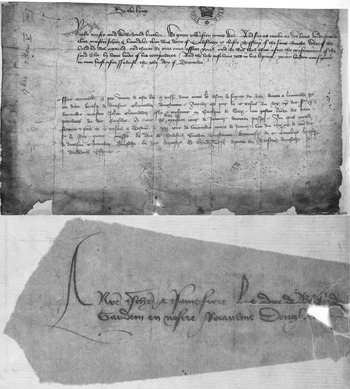
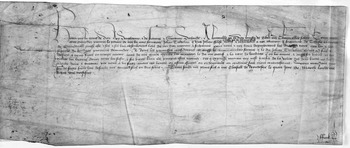
The phenomenon of coexisting languages is seen most clearly in the parliament rolls, the official record of parliamentary proceedings, which were written up from the beginning of Henry VI’s reign using a mixture of Latin, French, and English.Footnote 14 But it was also commonplace within the internal written communication of government itself, where a culture of linguistic diversity and interchangeability was the accepted norm for much of the fifteenth century. Three examples set out in the appendix illustrate this point. Each one demonstrates the use of different languages, by different clerks at different times, but all in the context of a single, smooth-running administrative process. The first (fig. A1) is a signet letter sent from Henry V to the Duke of Bedford in 1417. The letter addresses the duke in French (i.e., on its dorse), but was itself written in English. It was then passed to the council, where a note of the council’s assent was recorded in French. The second example is a direct warrant of Henry VI to his chancellor in January 1441 (fig. A2a). The warrant comprised an original bill written in French and a statement written in Latin in the upper margin, noting the circumstances of the grant. This was attached to a draft of a letter patent (fig. A2b) written in Latin, which itself has a note written in English in the lower margin ordering the chancellor to take action. The king appended his initials “RH” in the upper margin to indicate his assent. The third example shows a bill (fig. A3a) and its accompanying privy seal writ (fig. A3b). The bill was drafted in English but was endorsed in Latin; the writ, however, was penned in French. These examples demonstrate the trilingual writing practices of central government in the second quarter of the fifteenth century. It is necessary to be particular about the dating, for this was a new phase in the life of the bureaucracy. Until the end of Henry V’s reign, records of the central government were generated within a bilingual writing culture, that is to say, by the employment, exclusively, of Latin and French. The appearance of trilingual writing in the records of government, when English began to be used, thus occurred sometime after the phenomenon becomes observable in a later fourteenth-century literary context.Footnote 15
Some of the extracts included in the appendix adhere very closely to a set of linguistic characteristics that have come to be associated with the English, French, and Latin languages, respectively. Latin was the language of formal record.Footnote 16 It conveyed authority and validation. The use of Latin to draft the letter patent (fig. A2b), apart from anticipating the language used to enroll such instruments on the patent rolls, reflected more broadly a belief that Latin should be used to express the terms of long-lasting and immutable settlement: it was the language of posterity. On the other hand, French had long served as the language of internal communication in government. It was the language of current business. It was both practical and efficient and possessed a technical quality that made it appropriate for dealing with the day-to-day matters of government. It was ideally suited for use in writs (fig. A3b) and for internal minute taking (fig. A1). English combined utility with authenticity and increasingly found its niche as the most direct way of conveying the king’s wishes, as shown in his signet letters (fig. A1) and his instructions to the chancellor (fig. A2b).
It will be readily seen that the choice of language in the records of government was driven not by the status of the writer or recipient, or the inherent importance attached to the individual document, but by the functionality of the writing itself. This explains why English, the language of least prestige, first appeared in documents drafted for use at the highest level in royal government, the king’s chamber, because the underlying value of signet letters lay in the authentication they lent to the king’s personal instructions. Whatever the associations English had in other contexts, as a vulgar language of the ill-educated masses, this had little relevance in the context of government, where practical considerations were the most important. In this respect, it is no accident that signet letters, in addition to claiming the accolade as the first records to be written in English, were also the first to be written on paper.Footnote 17 Paper was cheaper and less durable than parchment; its use in the king’s correspondence reflected the essentially transient value placed on his letters—once they had been received and expedited, they lost their importance. Writs, and even more so enrollments, were compiled for the record. Greater importance was thus attached to the formality and technical precision of their writing, which is why these types of documents proved more resistant to the spread of English and why they continued to be written on parchment.
In these contexts, language use was strongly circumscribed by a set of clearly defined linguistic conventions, but in other areas the pattern is less obvious. It is important to recognize that a clear difference existed between those records that were unswervingly wedded to a single language, on the one hand, and other types of document that were subject to a less stringent set of linguistic conventions, on the other hand, where more than one language was employed for the same written purpose. Scholarship has sought to draw distinctions between English, French, and Latin by highlighting their different qualities and applications, but the fifteenth-century clerks of central government evidently regarded only a proportion of records in this way and were quite capable and prepared to use languages interchangeably, as compatible linguistic modes subject to no strict set of linguistic guidelines. This blurring or overlap of form and function is indicated by the fact that clerks of the central government routinely used both Latin and French to make notes of internal processes and decisions (see figs. A1, A2a, and A3b). The use of English and French in the petitions presented to the crown between ca. 1420 and ca. 1440 (many of which were probably drafted by royal clerks) also highlights the interchangeability and comparability of languages.Footnote 18 It is also shown particularly effectively in privy seal writs, which were variously written in all three languages in the middle decades of the fifteenth century.
This particular form of code mixing between documents that essentially served the same purpose raises a number of interesting questions, not least of which: What was it that tipped the balance in favor of one language or another? It is a difficult conundrum to resolve because the coexistence of languages in documents intended to serve the same purpose suggests that the choice of language was actually of little concern to the clerks who did the writing. And yet they still showed a preference. What informed this choice? Was it entirely whimsical? Did clerks simply write in the language that happened to catch their mood on a given day? Or were there other factors at play? Is it possible to discern specialists writing in one particular language? Perhaps the choice related to the context in which the document was written, or to its content. There is an added layer of complexity when we consider that it was rare for the two—or three—languages to be used in equal measure, and for their respective shares to remain at a fixed level. Their contiguity was in a state of flux. This was particularly the case between ca. 1420 and ca. 1440 when the use of French generally diminished and English increased. This raises additional questions. What was the trajectory of this linguistic shift, and what were its dynamics? Are we to look for internal factors to explain these changes, or were the clerks employed within government influenced by other considerations? Is there evidence to suggest that changes in the use of language in the royal bureaucracy resulted from centralized direction, or was the crown’s predisposition one of insouciance, content to allow the new trends to develop without interference or concern? It is time now to consider these questions by focusing more directly on the records and workings of the privy seal office.
English, French, or Latin? The Choice of Language in the Privy Seal Office
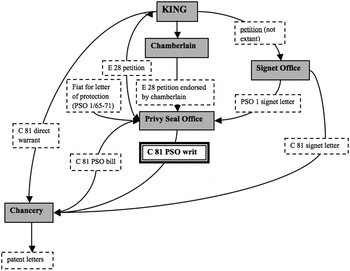
By the fifteenth century, the privy seal office was critical to the effective running of late medieval English government.Footnote 19 It acted, in the first instance, as the intermediary between the king and his principal officers of state: the chancellor, treasurer, and senior judges. By the fifteenth century, a large percentage of the king’s decisions, as well as those of the council, were conveyed to the main offices of central government via writs issued by the privy seal office.Footnote 20 It is less widely acknowledged that the privy seal office also dispatched large numbers of writs directly into the localities, on matters that were considered not to require the application of the great seal for authority.Footnote 21 Since the overwhelming majority of privy seal writs were written in French until the mid-fifteenth century, this point has enormous linguistic significance, for it highlights the crucial role the privy seal office played in maintaining the profile of this language to a wide constituency of the king’s subjects. Unfortunately, only a small number of these types of writ have been preserved, but a good indication of their importance is to be found in the formulary of the privy seal clerk Thomas Hoccleve, written between 1423 and 1425, which contains large numbers of warrants addressed to local officers, such as sheriffs, bailiffs, justices, and escheators as well as towns, religious houses, and individuals.Footnote 22 The writs sent to the treasurer and chancellor, respectively, are the most visible records generated by this department because the exchequer and chancery took particular care to preserve them in secure files (i.e., The National Archives, Kew [TNA] series, E 404 [Exchequer of Receipt: Warrants for Issues]), and C 81 [Chancery: Warrants for the Great Seal]). The writs sent to chancery are the focus of this discussion. Their place in the processes of central administration is illustrated in figure 1, which also indicates some of the other main routes by which the king communicated his wishes to the chancellor.
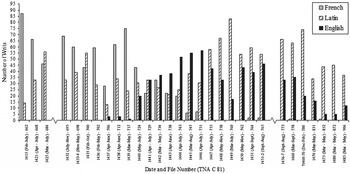
Figure 2 presents the results of a survey of the language of privy seal writs ranging across the fifteenth century. The survey begins in the reign of Henry V, where it confirms what we already know from the formulary of Thomas Hoccleve, namely, that the vast majority of privy seal writs at this time were drafted in French. The chart indicates that it was not until the late 1430s that English made an appearance in the writs sent to the chancellor. The first recorded example dates to 11 May 1437.Footnote 23 It is interesting to note that this was some eighteen months after the first writ sent to the exchequer had been written in English, on 23 November 1435.Footnote 24 In neither case is there any indication from the contents of these writs or their diplomatic style that English was used for any special reason; they are quite conventional, in both appearance and purpose. After these first examples, English caught on fairly rapidly, and by 1442, as figure 2 shows, it was the most heavily utilized language in the writs sent into chancery. But here is the
The administrative routes from the king to chancery

rub, for the period of English “ascendancy” was surprisingly short-lived: it lasted barely five years (1442–46). Thereafter, it was not English or French but Latin that appeared in the greatest number of writs. Latin had, in fact, always been present in these records and was used with increasing regularity from the 1430s, as figure 2 shows. But by the late 1440s, it had become the language of choice among the clerks of the privy seal office. The decline of French was as rapid as the rise of English, and by the mid-1440s, barely five years since it had begun to dominate the records, the language had all but disappeared. English continued to be used in privy seal writs but accounted for only a minority of such instruments after the end of Henry VI’s reign.
Three observations can be made in light of the data presented in this chart. First, the pace of linguistic change, though fast moving, was not instantaneous and so contrasts markedly with the linguistic profile of signet letters, which converted wholesale to English in 1417 (albeit before they reverted to French under Henry VI). The sudden shift to English of signet letters under Henry V suggests centralized coordination, perhaps by the king’s secretary, John Stone, who was head of the signet office at the time.Footnote 25 The graduated nature of the linguistic changes to privy seal writs, however, suggests the absence of linguistic prescription and, concomitantly, a situation in which privy seal clerks were given a measure of autonomy when deciding on the language they should employ for their work.
The languages of privy seal writs, 1415–85

Second, the critical period of change in privy seal writs, from the late 1430s to the mid-1440s, coincided with changes to affect other important classes of records. In particular, the rapid decline of French in the writs of the privy seal occurred when French was finally dropped from the signet letters and when it was also rapidly falling out of fashion in the compilation of petitions and was beginning to be dropped in the crown’s endorsements of such petitions.Footnote 26 Since writs issued by the privy seal were usually prompted by signet letters or endorsed petitions (see fig. 1), the connections between these records are suggestive and will be explored in due course. Finally, privy seal writs were not the only records to turn increasingly to Latin in the fifteenth century. For example, the chancery clerks responsible for writing up the parliament rolls early in Henry VI’s reign also adopted Latin, in preference to English, when French had fallen out of favor. So too did the clerks writing up the records of council meetings.Footnote 27 The augmentation of Latin in these contexts is a useful reminder that linguistic change was not only driven by shifting attitudes toward the two vernacular languages, but also by shifting attitudes toward Latin and the reassessment—indeed reassertion—of its place in the records of central government.
The Clerks
The privy seal writs sent to the chancellor asking him to act on the king’s wishes mainly concerned matters of royal grace. A majority conveyed instructions to the effect that letters patent should be issued bestowing a pardon, a license, or a grant such as an annuity or office. Close scrutiny of the files of writs issued in the early 1440s, when English, French, and Latin were employed in roughly equal measure, reveals no obvious connection between the content of the writ and the language chosen, at least insofar as English or French is concerned. Nor is there any clear pattern of language use relating to the location specified in the concluding dating clause of each privy seal writ, if this indicated where the writ had been compiled: English, French, and Latin writs were just as likely to have been used elsewhere than at Westminster itself.Footnote 28 One other possibility is that the different choice of
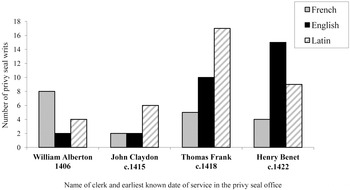
The language choice of privy seal clerks, April–July 1441 (TNA, C 81/729)

language reflected the specialization of particular clerks. Discerning these choices becomes possible after 1434 because, at this point, clerks began to write their names in the bottom right-hand corner of the writs for which they were responsible.Footnote 29 Figure 3 presents data on the writs written between April and July 1441, broken down by language and divided among the four main signatories responsible for privy seal writs at this time. The chart shows that all these clerks, at one point or another, put their names to writs written in each of the three languages: no one was averse to the English vernacular, but equally, no one had entirely abandoned French.
However, while all four privy seal clerks made use of the three languages available, they did not do so in equal measure. When one correlates these contrasting proportions with the longevity of the service of each clerk, some interesting connections can be made.Footnote 30 The clerk who had served the longest in the privy seal office—William Alberton, a veteran with over thirty-five years experience—was the only individual who signed off proportionately more writs written in French than those written in English and Latin. He was also the only clerk whose writs employed English the least. By contrast, the writs of Henry Benet, a relative newcomer to the privy seal office, having joined in the 1420s, utilized English the most. He also proportionately made least use of French. Thomas Frank similarly favored English more than French, though overall his writs employed Latin most frequently. John Claydon used English and French in equal measure. The obvious conclusion to be drawn is that the choice of language was, at least in part, a generational thing; the older generation stuck to what they knew, while the newer generation embraced change. This does not account for the relatively abrupt introduction of English-language writs at the end of the 1430s, but it could account for the gradual nature of the transition thereafter, as newer clerks who were more amenable to the English language gradually began to replace the older clerks who had spent most of their careers writing in French or Latin.
It is still not an entirely satisfactory explanation, however, for if we are to conclude that clerks had a preference for English over French and Latin, or vice versa, one wonders why, in the absence of any obvious linguistic rules, Alberton or Benet did not exercise this free choice and consistently write in the language they felt most comfortable using. This assumes, of course, that the signatures on the writs actually denoted authorship. Maxwell-Lyte took a different view: he argued that the signatures were appended to indicate the approval of the clerks for “the correctness of the phraseology” on writs “which had been prepared by subordinates.”Footnote 31 This supervisory procedure was certainly a well-known and long-established modus operandi in chancery,Footnote 32 though chancery was an altogether much bigger writing office than the privy seal office and had a more clearly defined and strictly regulated internal hierarchy.Footnote 33 In the privy seal office, albeit less elaborately, similar working practices do seem to have existed. An exchequer memoranda roll dating to 1444 appears to list all the principal staff working in the privy seal office at that time.Footnote 34 There were twelve clerks altogether, of whom five were designated “clerks,” and seven “underclerks.” The five clerks included three of the four men who applied their signatures to the writs produced in 1441: Thomas Frank, Henry Benet, and William Alberton. There was also Richard Priour and John Hamond. The seven underclerks were John Brewster, Thomas Beaugraunt, Edmund Taillour, Richard Langeport, John Foston, John Machon, and Robert Crosby. Their names do not appear on writs at this time, though shortly they would.Footnote 35 A distinction between junior and senior clerks in the privy seal office was not a new phenomenon in the 1440s. The term subclericus first appears in 1421, though a system of apprenticeship most assuredly predated this: Robert Frye was described as John Prophet’s clerk in 1394; Thomas Hoccleve had an apprentice, John Welde, serving under him during 1414–17; and Thomas Frank began his career in the privy seal office serving under Robert Frye in 1423.Footnote 36
The possibility that the four clerks named in figure 3 were in fact signing off warrants written by their apprentices or underclerks therefore seems fairly strong and is at least partly confirmed by a paleographical survey of the writs themselves, which reveals a variety of hands, and certainly more handwriting styles than the number of clerks whose signatures actually appear on the writs. However, we know that Thomas Hoccleve continued writing writs right up until his retirement in 1425, even though he had an apprentice working for him, so it is likely that some of the examples included in figure 3 were still written by the senior clerks themselves.Footnote 37 The signatures thus probably indicate a mixture of writs written by the signee himself, as well as those written by underclerks working under his supervision. This modifies the original premise that the writs reflected the straightforward linguistic preferences of Alberton, Claydon, Frank, and Benet, but it does not negate the overall thrust of the argument—that the length of the service of these clerks had some bearing on the choice of the language used in the writs that displayed their signatures—since it is quite likely that underclerks took their linguistic cue from the more senior colleagues who supervised their work.Footnote 38
Exploring the attitudes of privy seal clerks to the use of language in light of the findings contained in figure 3 opens up further areas for discussion, especially in relation to the most famous of late medieval privy seal clerks, Thomas Hoccleve, who worked in the office from the early 1380s until very shortly before his death in 1426.Footnote 39 If we accept the underlying premise that the output from the privy seal office of English-language writs in the late 1430s was in part indicative of a growing receptivity by privy seal clerks to the English vernacular, then it is a natural and obvious corollary to assume that English was not employed until this point because earlier clerks like Hoccleve did not regard it as an appropriate or adequate medium with which to convey the royal will. It may not be readily apparent from his literary output that an underlying linguistic conservatism pervaded the working environment of the privy seal office early in the fifteenth century, but a consideration of all Hoccleve’s writings, including his nonliterary work, demonstrates this point very effectively. His famous tract on ideal kingship, the Regiment of Princes (written ca. 1410–11), has tended to focus scholarly attention on the high regard with which he evidently held the English vernacular and his role in establishing the language in the written culture of late medieval England.Footnote 40 But his equally impressive creation of an expansive formulary of privy seal documents between 1423 and 1425, in which not a single example of a writ, bill, or letter was written in English, warns against an overly simplistic analysis of Hoccleve’s linguistic preferences.Footnote 41 The key point is that Hoccleve had a clear sense of the correct and proper contexts in which the English and French (and Latin) languages should be employed in writing.Footnote 42 In this, he was not alone, for it has long been recognized that the bureaucrats of late fourteenth- and early fifteenth-century England played a pivotal role in generating a vernacular literary culture, even though the French and Latin languages dominated the textual environment of their professional lives.Footnote 43 Hoccleve wrote the Regiment of Princes in English because he judged that this would please his patron, the prince of Wales,Footnote 44 and also possibly because he wished to be part of a burgeoning English-language literary tradition that had its more recent roots in the work of Geoffrey Chaucer, with whom Hoccleve had been acquainted and greatly admired.Footnote 45 But he could not countenance the possibility that the English language had a place in the more formal documentary culture of the central administration and, more specifically, the privy seal office. To Hoccleve, these contexts ought to be the exclusive preserve of French and Latin. Some indication of his attitude to English in the context of formal government process comes out clearly in the Regiment, where he has the Old Man advise him to “Endite in Frensshe or Latyn thy greef cleer” so as to secure a favorable financial settlement for himself.Footnote 46 The English language evidently had no place in this type of formal of writing.
Hoccleve’s decision to compile the formulary has tended to be seen in relatively neutral terms, insofar as it has attracted attention at all:Footnote 47 thus, the work is straightforwardly described by its editor as a “reference volume to which future clerks and under-clerks might turn to find the proper form, the proper wording for the documents that they were assigned to prepare.”Footnote 48 One obvious point to make, however, is that the formulary must quickly have lost its relevance. Just over a decade after it was finished in 1425, its utility would have significantly diminished as privy seal clerks dropped French and increasingly turned to English to write out their writs. This suggests that in creating his formulary, either Hoccleve was oblivious to the new linguistic trends fast approaching over the horizon or he chose to ignore them. Either way, his formulary presented a collection of examples that looked to the past in order to inform, validate, and legitimize current and future writing practices in the privy seal office. There may, however, be a third explanation. Hoccleve’s decision to collect French-language exemplars of privy seal writs may instead have been informed by the very shifts in attitudes to language that he appears to have ignored in his professional work. What I am suggesting is that Hoccleve well understood that English was beginning to spread in the records of central government, for it was readily apparent in the early 1420s in signet letters and in the parliament rolls.Footnote 49 His formulary was therefore compiled in an attempt to forestall the spread of English into the diplomatic of writs by demonstrating that French was still very much fit for purpose in the working environment of the privy seal office. If the formulary had been compiled specifically to help young apprentices work up their French at a time when their proficiency in this language could no longer be taken for granted, it is striking that Hoccleve ignored the obvious solution to this problem, of introducing English to the linguistic repertoire of his fellow clerks, and chose instead to stand steadfastly behind the continued use of French.
This interpretation flies in the face of a sizable body of work that places Hoccleve at the very forefront of the pioneers of the use of English in this period,Footnote 50 but here I am talking about Hoccleve the bureaucrat, not Hoccleve the poet. Hoccleve took great pride in his work and in his position as a clerk in the royal bureaucracy.Footnote 51 The use of French was not only the mark of an educated man but also, by the early fifteenth century, the mark of elite professional status, since it enhanced the requirement for specialist training and knowledge.Footnote 52 By compiling the formulary and within its pages underlining the importance of the French language to the workings of the privy seal office, Hoccleve was effectively offering the means of preserving the professional identity and elite status of his fellow clerks. Thus, it was not innovation that defined Hoccleve’s attitude to language use in his administrative tasks, but conservatism and tradition. Perhaps this is why the formulary contains such a broad and curious chronological assortment of exemplars, many dating back to Edward III’s reign, long before Hoccleve himself was employed in the privy seal office;Footnote 53 this was his way of emphasizing the timeless quality of the writ-writing technique (and the centrality of the French language to it), as well as the timeless authority he thought ought to be attached to his collection of documents.
There is, finally, one other possible factor to explain the changing linguistic preferences of privy seal clerks in the fifteenth century. It is a well-established fact that the profile of the clerks in the privy seal office, as elsewhere in the departments of central government, changed markedly across the late fourteenth and fifteen centuries, as ordained clergymen gradually began to be displaced by a new breed of lay bureaucrat in the financial and writing offices of the central government.Footnote 54 This development cannot possibly be used to explain the relatively sudden introduction of English in privy seal writs in the late 1430s, but it might provide additional context to explain the survival of the French language so far into Henry VI’s reign. To contrast a man like Thomas Hoccleve with clerks who were appointed to the privy seal office in later years may, on the face of it, appear to be a fruitless exercise, for Hoccleve was himself a secular clerk, having married sometime between 1399 and 1411. We know from the Regiment of Princes, however, that Hoccleve’s ambition had been to become a priest and that he, like many of his contemporaries, had entered royal service in the hope that he would receive lucrative benefices and therefore the means of becoming an ordained clergyman. What appears to have happened as the fifteenth century progressed, however, is that lay status increasingly became the preference of royal clerks, instead of the poor substitute for a failed clerical career.Footnote 55 Fewer and fewer clerks bothered taking up even minor orders, so that as a collective entity, the royal bureaucracy became far more emphatically secular in nature.
Arguably, this distinction has not been sufficiently recognized. Thomas Hoccleve himself is usually regarded as the epitome of the new breed of secular clerks whose lay status determined their forward-looking attitude to the use of the English vernacular.Footnote 56 Again, while this may readily apply to Hoccleve’s literary output, it does not necessarily hold true for his administrative work. At least for the purposes of his administrative work, he is probably better viewed as inhabiting a middle ground between the older bureaucratic order of the fourteenth century, dominated by beneficed clergy, and the newer bureaucracy of the later fifteenth century that was dominated by laymen. Hoccleve was a secular clerk, but not by choice. Thus, his reluctance to consider the possibility that English could be used for formal government process may have been the natural standpoint of an aging man approaching the end of a long and successful career, but it may also have been an attitude informed by a clergial perspective and a deeply held suspicion of the legitimacy of using the English language for the authoritative discourse of government.Footnote 57 The argument cannot be pushed too far, since the process of secularization also occurred in chancery, and no records there were written in English in these years.Footnote 58 But as increasing numbers of clerks who had no ambition to enter the clergy were employed in the privy seal office, it is not difficult to see how attitudes toward the English vernacular might also have begun to shift.Footnote 59
The Records
Making connections between the profile of the privy seal clerks who wrote the writs and the language they chose for this task suggests broader considerations that may have helped assimilate English into the documentary culture of the privy seal office, but they do not explain the more specific chronology of linguistic change. For this, a closer analysis of the relationship between privy seal writs and other documents produced by, or for, central government can yield better results. In this section, I should like to explore the possibility that the explanation for the appearance of English in writs, and for the later resurgence of Latin, is to be found in the processes employed within the privy seal office and, in particular, in the linguistic connections that existed between the different types of documents that were sent into and out of this writing office. As figure 1 demonstrates, privy seal writs were issued at a particular point in a paper trail that began with the king. A majority of writs were prompted either by an endorsed petition or by a letter issued by authority of the signet seal.Footnote 60 The sequential nature of this bureaucratic process raises a key question: What linguistic relationship was there, if any, between the antecedent warrants (endorsed petitions and signet letters) and the writs that they initiated? The question is of some relevance because the content of writs very often replicated what was said in the letter or petition that had given rise to it, so it made obvious sense for a clerk to draw on the same language without going to the trouble of translation.
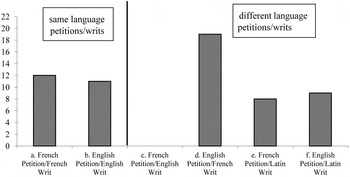
Figure 4 provides some answers to these questions. It presents data comparing
A comparison of the language of petitions (TNA, E 28) and privy seal writs (C 81), October 1440–February 1444.

the languages of petitionsFootnote 61 and their resulting privy seal writs between October 1440 and February 1444. Only a relatively small quantity of such pairings can be identified in these years (fifty-nine), but there are sufficient numbers from which to draw some meaningful conclusions. First, columns d, e, and f demonstrate that in a large number of cases there was no correlation between the language of an originating petition and the writ that it subsequently prompted. Column d is of particular interest in showing how clerks resolutely clung to the French language when writing their writs in spite of the fact that English was now employed in an overwhelming number of petitions presented in these years. Overall, in this survey, thirty-nine petitions were written in English, to just twenty written in French, but thirty-one writs were written in French compared to just eleven written in English. In other words, while English had become the dominant language of petitioning, French remained, for the time being at least, the principal language of the writ.
Figure 4 also shows that English-language writs appeared only in response to petitions that had been written in the English language (col. b). In other words, no English-language writs were written in response to French-language petitions (col. c). This is an important discovery. It suggests that English did not enjoy a parity of status with French or Latin since, unlike these languages, it was only used in writs where a linguistic precedent had been set in the originating petition. The clerks of the privy seal evidently did not have the confidence to ignore the example of a petition when it was written in French, by compiling a writ in English: English-language writs were only produced when they had the “validation” of an English-language petition (or signet letter). This highlights the continuing strength of linguistic tradition to surround the use of French. It also confirms the importance of documents emanating from outside the privy seal office in prompting the clerks there to use the new vernacular. Without English-language petitions (or signet letters), it is unlikely that privy seal writs would ever have been written in English.
In some cases, of course, it is possible that the clerks themselves wrote the petitions. This point is important, for we should not envisage a scenario in which the clerks of the privy seal office, along with their colleagues in the other departments of government, worked in self-imposed isolation, as the passive onlookers to broader trends in a writing culture from which they were entirely divorced. It was common practice throughout the royal bureaucracy for clerks to supplement their income from fees charged to private patrons or clients who required their professional services.Footnote 62 Privy seal clerks would have been no exception to this, and their exposure to English in other writing contexts could well have been a significant factor in stimulating the spread of English within the privy seal office itself. At least one case of common authorship has been identified among the writs and petitions dating to the early 1440s: an English-language writ drafted—if this is what his signature denoted—by Henry Benet in November 1441 was evidently prompted by a petition that was penned by Benet too.Footnote 63
Finally, the chart provides additional confirmation of the importance that Latin held for the clerks working in the privy seal office. Again, this point is worth underlining, for the privy seal office is usually regarded as the flag bearer of Anglo-Norman French in the late-medieval English central administration.Footnote 64 Actually, the continuous use of Latin in some of its records from its very beginnings meant that the privy seal office had always been a bilingual writing office. In the thirteenth century, privy seal writs were written predominantly in Latin, but even when the majority came to be drafted in French, early in the fourteenth century, Latin continued to be employed. Hoccleve’s formulary indicates the presence of Latin in a minority of cases in the 1410s,Footnote 65 as do the data presented in figure 2. Indeed, figure 2 shows that in 1425 and 1435, Latin actually accounted for a larger number of privy seal writs than French. Latin had also been used exclusively and without interruption to frame privy seal bills (see fig. 1). These were routine and highly formulaic instructions sent to the chancellor ordering him to issue letters of protection.Footnote 66 Privy seal bills, unlike writs, were not initiated by endorsed petition or signet letter sent from the royal chamber, but by warrants sent into the privy seal office by military captains acting on behalf of the men under their command. Significantly, these initial warrants, or fiats for letters of protection, were also drafted in Latin. Latin had thus always been as much the language of the privy seal office as French. Its increased use to frame writs was not a significant departure in linguistic terms from the point of view of the clerks of this office. The new trend simply brought this class of records more into line with privy seal bills and also with the greater proportion of other records produced within the departments of the central government.
There appear to be a number of reasons why this shift to Latin occurred. First, an examination of the writs issued in April–July 1441 suggests that a degree of discrimination was being exercised when employing Latin for certain types of writs. Latin appears to have predominated in those writs that issued licenses and pardons,Footnote 67 whereas French, and increasingly English, tended to dominate the writs that conveyed grants of royal patronage. In their form, length, and purpose, the privy seal writs written in Latin bear the closest resemblance to privy seal bills, and it may be that the factors that had always kept these bills firmly aligned with Latin now began to be increasingly applied to certain types of writs. The formulaic and routine nature of warrants for licenses and pardons arguably lent itself more readily to Latin than the more explanatory and varied content of grants of royal favor. It is interesting to note, in this regard, that Thomas Hoccleve did not consider it worth his while to include more than a few models of privy seal bills in his formulary; by far the greatest proportion of his work contains sample writs, which suggests that it was with these types of documents that he felt guidance was needed most. There is an additional consideration, for many of these more formulaic writs may have been issued internally as a result of verbal instructions within the privy seal office itself, perhaps directly from the king, from his councillors, or even at the personal behest of the keeper of the privy seal office. In these circumstances, there would have been no antecedent warrant, such as an endorsed petition or signet letter, setting a linguistic precedent in English or French, so the clerks would have used the language with which they felt most comfortable. Without a linguistic prompt, perhaps the default choice for the clerks was Latin. The rapid rise to prominence of Latin at the start of Henry VI’s reign may have been given a particular boost by the circumstances of the king’s minority and the fact that signet letters, one of the two principal vernacular sources for privy seal writs, appear to have been used infrequently in these years.Footnote 68
However, the shift toward Latin in these very sources may have been an additional factor in pushing the language to greater prominence in the writs. We have seen already how privy seal clerks took their linguistic cue from petitions and signet letters, and that as the latter increasingly used English, so too the writs followed by example. But it was not just English that appeared in the petitions and signet letters of the fifteenth century: Latin did too. In the course of Henry VI’s reign, it became increasingly common for supplicants to have draft letters patent written out to accompany their petition.Footnote 69 These letters were invariably written in Latin. Soon, it was the Latin draft letter patent that formed the substance of the request, for a petition was now presented, in effect, as a “ready-made” solution with just a single introductory sentence asking the king to grant what the draft letter contained. It was this portion that was written in English, typically asking the king to grant his “graciousez lettres patentes according to oone cedule to this bille annexed.”Footnote 70 The English-language portion was thus reduced to a minor role in petitions of this type; Latin had, for all intents and purposes, become the language of the complaint. By the 1460s, the petition and draft letter were no longer presented as separate documents but were unified within a single text, though the employment of different languages for the two elements, and the consequent disparity between the vernacular and Latin languages, remained in place in the majority of cases.Footnote 71 Alongside this development was the appearance of Latin in signet letters. Admittedly, the numbers are smaller, but the fact that Latin was used at all is itself of some significance and further underlines the increasing regard in which the language was held in the secretariat. Signet letters appear to have followed the example of privy seal writs by using Latin in cases that were relatively routine in nature. For both letters and petitions, the key point is that the clerks proved no less linguistically impressionable than they were when English rose to prominence, and accordingly chose to write their writs in Latin where they received Latin-language signet letters and petitions with accompanying Latin schedules.Footnote 72
Finally, the spread of Latin in privy seal writs may have gained some impetus by a change in the way the writs themselves were framed. For much of the fifteenth century, a writ sent into chancery summarized the key facts of a royal grant before charging the chancellor to generate an appropriately worded letter ensuring that the grant was duly made. Typical is a writ sent to Edward IV’s chancellor, Thomas Rotherham, bishop of Lincoln, on 31 May 1474, which ended with the following instruction: “We woll and charge you þat under our great Sele ye do make hierupon our writs suche and asmany as in þat case shalle [be] necessarie & accustomed.”Footnote 73 Two days later, another writ instructed the chancellor to “make herupon our letters patente in due and sufficient fourme.”Footnote 74 To have the chancellor write “in due form” was a standard part of the concluding clause of most privy seal writs until the mid-fifteenth century, whether they were written in English, French, or even Latin. But in the third quarter of the century, the form of some writs changed so that the wording of the patent letter was no longer left to the discretion of the chancellor but was set out in the privy seal writ itself.Footnote 75 A typical example is the following:
Edwardus dei gracia Rex Anglie et Francie et Dominus Hibernie. Reverendo in Christo patri Thome Lincoln’ Episcopo Cancellario nostro Salutem. Vobis mandamus quod letteras nostras patentes sub magno sigillo nostro in forma sequenti fieri faciatis. Rex etc salute sciatis quod nos de gracia nostra speciali…Footnote 76
In its structure, this new form of writ mirrored the new form of petitions that were accompanied by a schedule. Like petitions, the new form of writ did not just convey a request but specified the desired outcome in ready-made form. If the exact wording of a letter patent was now provided by the privy seal writ, it was an obvious corollary that the writ itself should be drafted in the language of engrossment. This was another key development that appears to have facilitated the spread of Latin in the writs of the privy seal office.
Conclusion
The picture of language use in the mid-fifteenth-century privy seal office is not straightforward. Its complexity was the result of the absence of any set of clearly defined rules governing how language was, or should be, employed in the writs. The keeper of the privy seal office did not impose a single, centrally managed language policy on his department; still less did one emanate from the king or his advisors. Instead, the clerks appear to have been left to their own devices, making choices about language use based on their own set of textual assumptions. Identifying what these assumptions were and how they were formed is no easy task, for the choices that the clerks exercised were not necessarily determined by a single, clearly delineated linguistic criterion. What happened in the privy seal office in the middle decades of the fifteenth century in many ways reflected the more general linguistic inconsistencies to be found in many other records of the royal bureaucracy, where the deployment of English, French, and Latin seemed to oscillate between a position where the languages were used interchangeably, as equivalent and compatible forms of government discourse, to a position where they were regarded as discrete linguistic codes, each possessing characteristics that made them suited to particular forms of writing. The clearest division lay between the two vernacular languages—French and English—on the one hand, and Latin on the other, but even here considerable overlap existed, so that one can easily find writs that served the same purpose and were written by the same clerk but were drafted in each of the three different languages. This is the true measure of the trilingual nature of the fifteenth-century royal bureaucracy and underlines the point that the key purpose of the administration, to transmit and coordinate government activity in the most efficient and effective manner possible, appears to have been little affected by the particular language used to articulate this activity.
The same point can be made in light of the frequent lack of correlation between the language used for a writ and the language used for the warrant that authorized it; as figure 4 shows, a petition written in English did not necessarily prompt a clerk to write his writ in English. The same holds true of French and Latin. Looking too hard to find rational or ideologically driven explanations to account for language choice risks imposing a set of linguistic assumptions about the importance of language that did not figure prominently in the minds of fifteenth-century privy seal clerks. Their linguistic dexterity in writing writs, and that of their colleagues in interpreting them, made such choices rather less significant than they might appear to the modern eye. In looking for rational explanations for language choice, we should thus contemplate the possibility that sometimes there was no underlying rationality behind the preferences, and that one language may have been chosen instead of another without any deep thought process informing that decision.Footnote 77 For some clerks, it may have been a source of great pride that they could demonstrate their mastery of English, French, and Latin by effortlessly alternating between these languages in their work.
However, the discussion has shown that there were undeniable shifts in the choice of language in the privy seal office across the fifteenth century and that some clear explanations are possible to account for these changes. Crucially, they show that the privy seal clerks were not the pioneers of linguistic change, at least in the context of their official duties within the privy seal office, but were reacting to linguistic precedents set elsewhere, most notably in the petitions and signet letters that were forwarded to them from the royal chamber in anticipation of the creation of a writ. The motor of linguistic change thus lay outside the “trauaillous stilnesse,” as Hoccleve put it,Footnote 78 of the privy seal office. There were other important documentary contexts in which English was beginning to be used. From the mid-1430s, the crown began to record some of its answers to private petitions using the English vernacular, and from 1437, the records of the royal council began to be noted almost exclusively in English.Footnote 79 This last development holds special significance because of the tendency for the secretaries of the council to be drawn from among the clerks of the privy seal office.Footnote 80 It is interesting to note that at the time that English began to predominate in the records of the king’s council in the late 1430s, the privy seal clerk Henry Benet was acting as the council’s secretary.Footnote 81 He was one of the clerks especially predisposed to the use of English in privy seal writs (fig. 3). What happened in the privy seal office was thus part of a much broader shift in the use of language across government as a whole, a shift that can be pinpointed specifically to the second half of the 1430s.
What stimulated the emergence of English in these other documentary contexts is a question that I have explored elsewhere.Footnote 82 Above all, this was a time when the fortunes of war had turned decisively against the English. The desertion of their former allies, the Burgundians, in 1435 precipitated in quick succession a series of important military setbacks that included the loss of Dieppe, Harfleur, and, in 1436, Paris itself. It was a measure of the weakness of England at this time that the one notable success in these years was the lifting of the siege of Calais, an event that nevertheless produced an outpouring of English vernacular popular verse expressing a mixture of patriotic fervor and vitriolic xenophobia. These were the years when the English people began to turn in on themselves, increasingly focusing on their own affairs and the challenges that the ending of minority government presented as Henry VI approached adulthood. Out of a period of military setbacks and crisis, the English language was beginning to acquire a greater profile and increased prestige as an expression of the national psyche of the nation. The ending of the royal minority may also itself have affected attitudes to the use of the English language in the formal record. It was not that French was dropped and English introduced to help the king comprehend the processes of government (Henry VI was a fluent French speaker); it was that the onset of the personal rule of the king diminished the importance that had previously been placed during his minority on maintaining the systems and styles of old to give government process an air of legitimacy and authority. In Henry’s minority years, linguistic innovation in formal administrative discourse would have been incompatible with the need to emphasize the continuity and constancy of the rule of the minority government. This no longer applied once Henry VI began to rule in person, in the late 1430s, because attention shifted from the correctness and protocol of government process to the source of authority itself: the king.
It must be stressed that these circumstances point to a changing linguistic environment rather than directed language policy. It was not a political matter whether English, French, or Latin was used in the internal workings of central government so long as government itself was not impeded by the choice of language. Since writs produced by the privy seal were mostly written by clerks for clerks, this is unlikely to have been a decisive factor. This is why the great overhaul of government process that occurred in the mid-1440s, and which resulted in the privy seal office being thrust into a position of great importance as the sole conduit for the flow of royal patronage, is unlikely to have had any significant bearing on linguistic trends.Footnote 83 If language had mattered, one might expect it to have featured in the list of ordinances that set out the hierarchical relationship between the signet seal, privy seal, and great seal, but it did not. Nor, interesting to note, was it mentioned in the measures implemented to help the king better understand the purport of the petitions that came before him. These ordinances demonstrate that there was a clear separation between policy making, on the one hand, and administrative process, on the other.
The disappearance of French from the records produced by the privy seal office may have signaled other important developments in the working practices of the clerks of central government. In particular, it is possible that the late 1430s witnessed the final swan song of French as a language of regular oral discourse within English government, and especially in the privy seal office. At the very least, this could have been the effect of the disappearance of French from the documentation of the central administration. In recent years, scholars have sought to overturn previous assumptions that the decline of French as a spoken language occurred at the end of the thirteenth century. Ardis Butterfield has stated that, “after the onset of war under Edward III, French in all … varieties, insular, continental, and hybrid, actually gained a stronger oral and written presence in England in the fourteenth century and into the fifteenth.”Footnote 84 Richard Ingham’s recent survey of the grammatical proficiency of the writers of petitions included in the parliament rolls offers valuable new evidence in support of this view, though his analysis suggests that the competency of clerks came to an end in the third quarter of the fourteenth century.Footnote 85 Thomas Hoccleve famously declared in his Regiment of Princes that “in Frensshe … [I] canst but small endyte,”Footnote 86 but this can almost certainly be dismissed as the feigned or ironic modesty of a poet seeking to justify his use of English.Footnote 87 John Gower offered similar apologies for his own apparent linguistic deficiencies, but as Tim Machan has shown, the use of the humility topos was a conventional literary strategy employed by medieval authors such as Gower and could be used actually to suggest what accomplished polyglots they were.Footnote 88 Further work is needed before the quality of the French used by the clerks of the privy seal office in the fifteenth century can be accurately gauged, but it would be a surprising outcome to discover that their use of the language was in some way not up to scratch or seriously deficient. It would also be surprising to discover that while clerks of the privy seal could write French proficiently, they could not, and did not, also speak it.Footnote 89 In all likelihood, so long as French was regularly used for writing in the privy seal office, it was also spoken by the clerks who worked there. The obvious corollary is that once French ceased to be used in writing, it also lost its utility in speech. In fact, it may initially have been a decline in the competence of the clerks in speaking French that contributed to the sense in which the language was losing its relevance for their writing.
With all this attention on English and French, however, I run the risk of neglecting the real linguistic headline of the fifteenth century. This was not the replacement of French by English in the writs produced under the privy seal, but the replacement of the vernacular languages by Latin. In the privy seal office, the primacy of English lasted barely half a decade, before the majority of writs began to be drafted in Latin. In a body of scholarship dominated by accounts of the emergence of English in crown records, the advance of Latin in writs and, more generally, in other records of central government has not been fully recognized or understood. It is not at all clear, for example, that the underlying explanation for this shift to Latin is to be located in extraneous factors, as appears to be the case for the rise of the English vernacular. James Clark has recently argued that there was a classical revival in England in the late fourteenth and fifteenth centuries, and with it renewed interest in Latin learning and scholarship,Footnote 90 but it is hard to see how this might have influenced the internal workings of the royal bureaucracy. There is no evidence to suggest that, in the mid-fifteenth century, there was a significant surge in the number of clerks employed in the central administration who were university graduates and who might therefore have been drawn more strongly toward the use of Latin in their work.Footnote 91 The relatively low-ranking royal clerks who wrote out writs continued to be drawn from comparatively humble origins and generally received their training on the job.Footnote 92 Even if there had been a great influx of learned clerks into the privy seal office, this would offer no straightforward explanation for the choice of language there. It is worth remembering that Adam Molyens, an Oxford graduate and a man of great learning and ability, who acted as clerk of the council and as keeper of the privy seal itself from 1444, continued the trend of writing in English to record the council’s minutes after Benet had relinquished these duties in 1438.Footnote 93 A high-flying career as a diplomat and senior officer of the crown did not necessarily generate antipathy toward the use of the English language in the formal records of government. Another possibility is that Latin became more prominent as the difficulties of Henry VI’s governance became more apparent and greater emphasis was placed on formal process. But the fluctuating and slow-moving nature of the linguistic trends argues against such a notion. In other contexts, notably in urban administration, the use of English steadily expanded as the fifteenth century progressed.Footnote 94
In the end, the explanation for the increasing use of Latin in the privy seal office is probably more mundane and relates to changing administrative procedures. In this analysis, I suggest that the key factor to explain the rise of Latin was the increasing regard given to the form of the chancery letters that were commonly issued at the end of the bureaucratic process, that is to say, primarily the patent letters issued under authority of the Great Seal. This came about because of new perceptions about the purpose of those documents and the manner in which they should be written. In essence, privy seal clerks increasingly favored Latin because petitioners increasingly incorporated draft letters patent into their requests and because, within the privy seal office itself, writs also began to take the form of draft letters patent. This has interesting things to tell us about the shared nature of the crown’s most formal and solemn discourse, but it also highlights how unassailable Latin’s place was in the records of central government throughout the later Middle Ages.
Appendix
Signet letter of 17 December 1417 (TNA, C 81/1542/9; no. 816 in Kirby, Signet Letters).

[face] By the kyng
Right trusty and welbeloved brother. We grete yow often tymes wel. And for as moche as we have understande that maistre Johan Chaundeler that was deen of Salesbury is chosen Bisshop of the same chirche. Wher of we hald us wel agreed and therto we yeve oure assent Roial and we wol wel that after the consecracion of the said Elit he have liveree of his temporaltees. And the holy gost have yow in his kepyng. Yeven under our signet in oure hoost afor Faloise the xvij day of Decembre.
Fait aremembre qe par vertue de ceste lettre et aussi d’une autre lettre desouz le signet du Roy directe a l’onurable pere en dieu l’evesque de duresme chanceller d’engleterre. Accordez est par le consail du Roy nostre dit seignur que lavantdit maistre Johan Chaundeller eslit et consecrit en Evesque de Sar’ ait restu liveree des temporaltes du dit Eveschee. A avoir del ditz del oytisme iour de Janver darrein passez. Au quel accord feurent presens en Consail a Westminster le xxj iour de lavantdit moys de Janver lan du regne de nostre dit seignur le Roy quint, Messires le duc de Bedeford Gardein d’engleterre, L’ercevesque de Cantirbire, L’evesque de Duresme chanceller d’engleterre, le duc d’excestre, W[illiam] Kynwolmerssh, depute du Tresorer d’engleterre, J[ohn] Doreward esquier.
[dorse] A nostre treschier et tresame frere le duc de Bedford, Gardein en nostre Roiaulme d’Engleterre.
[no image available]
—Direct warrant, January 1441 (TNA C 81/1426/36)
A Roi nostre souveraigne seignur
Ista billa cum cedula annexa concessa fuit per dominum Regem et liberata domino Cancellario Anglie apud Westm’ xxxj die Januarij ad exequenda anno xix.
Please au Roy nostre souveraigne seignur >de grace especeal< grauntier a vostre liege home Thomas Castel de Thacham vous gracious lettres de pardon solonq le fourme et purport dun cedule a icest bill annex et il preiera a dieu pur vous [etc.]
—Draft letter patent, January 1441 (TNA, C 81/1426/37)
RH
Rex omnibus ballivis et fidelibus suis ad quos etc., salutem. Sciatis quod cum Thomas Castel de Thacham super coram Johanne Giley uno coronatorum in com’ Berk super [etc.]
The kyng wol my lord chanceller spede this present my lord of Suff’ at Shene þe xxv day of Janur’ anno etc xix.
Endorsed supplication (TNA, E 28/67, 4 March 1441)

Face: To the kyng oure soverayn lord
Dorse: Rex apud Wyndesore iiij die marcii anno xix concessit presentem billam ut petitur et mandavit custodi privati sigilli sui facere garantum Cancellario Anglie ut ipse desuper fieri faciat literas patentes in debita forma presenta et supplicante pro ista billa. Johanne Seyntlo. Adam Moleyns
Besecheth mekely youre humble servaunt John Trevelyn chavalier forasmoche as on John Frost >son of Thomas Frost< natiff and regardant un to your manoyr and lordship of Teveste in the counte of Cornnwall whiche >John< is gon and hath withdrawen hymself and his godes from youre seid manore and lordship to þat entent þat ye and your heires shuld peacably leese þe right and title in hym and his sequele of bondage whiche ye have yn hym. Wherefore please it un to youre most speciall grace and inconsideracon of þe service þat your seid servaunt John Trevelyn hath don >to you< and desireth to do in tyme to come forto graunte un to hym the seid John Frost natiff and þe title of bondage whiche ye have in hym with his godes and also licence to seise hym and his godes where ever þey be founde that expresse mencon is not here made of the valu of the said godes ne of other yefts and graunts by you made to youre said servaunt be forntyme eny statute or ordinaunce here ayns made notwithstondyng and he shall pray God for you.
Privy seal writ (TNA, C 81/728/5830)

Henri par la grace de Dieu Roy d’Engleterre et de Fraunce et Seignur d’Irlande. A l’onurable pere en Dieu l’evesque de Bath nostre Chaunceller saluz. Come nous eons entenduz parmye la peticon de nostre bien ame serviteur Johan Trevelyn que unque Johan Frost >le filtz du Thomas Frost< natyf et regardant a noz manoir et seignurie de Teveste en countee de Cornewaill senest ale et soy et ses biens ad soubztrait hors de noz manoir et seignurie paront nous et noz heirs depardrerons les droitz et titre q’en lui et son sequel de bondage purviens demander. Nous les premises considerant et aussi le bon service que le dit Johan Trevelyn nous ad fuit et desira a nous faire en temps avenir eons de nostre grace especiale [etc.]