While there is much discussion of the importance of early language experience, there are few studies that actually examine whether there is continuity between early and later language competency. Yet there are two important reasons why we must explore the links between early and later language. First, it is crucial for understanding the extent to which individual differences in early language skills predict later language and cognitive outcomes. Are skills present earlier determinative of what happens later in language? Or, given the wide variability found in early language, is there but a weak relationship between children's earliest language skill and their later language? Second, for the purpose of the early identification of children with various language issues, it is essential to understand which factors are indeed predictive of later language and which are not. This paper will report on a link between children's ability to learn new vocabulary words at 21 months and their receptive vocabulary between the ages of seven and ten years.
In the few studies that are available, measures of vocabulary knowledge that focus on the products of language development (the words that children already know and produce) in infancy predict later language outcomes across the preschool period and upon school entry – even when using parent-report measures (Bates, Bretherton, & Snyder, Reference Bates, Bretherton and Snyder1988; Bornstein & Haynes, Reference Bornstein and Hayes1998; Can, Ginsburg-Block, Golinkoff, & Hirsh-Pasek, Reference Can, Ginsburg-Block, Golinkoff and Hirsh-Pasek2013; Feldman et al., Reference Feldman, Dale, Campbell, Colborn, Kurs-Lasky, Rockette and Paradise2005; Fenson et al., Reference Fenson, Dale, Reznick, Thal, Bates, Harters and Reilly1993; Fenson et al., Reference Fenson, Dale, Reznick, Bates, Thal and Pethick1994; Thal, O'Hanlon, Clemmons, & Fralin, Reference Thal, O'Hanlon, Clemmons and Fralin1999; Tomasello & Mervis, Reference Tomasello and Mervis1999).
The above findings show associations between the product measures of early vocabulary size and language outcomes. But what are the factors and processes that drive these language outcomes? Surely, the amount of exposure to words matters (Hart & Risley, Reference Hart and Risley1995; Rowe, Reference Rowe2012), as does the quality of language interaction children experience (Hirsh-Pasek et al., Reference Hirsh-Pasek, Adamson, Bakeman, Owen, Golinkoff, Pace and Suma2015; Rowe, Reference Rowe2012). But basic speech perception skills, as well as infants’ ability to associate words with their referents, also contribute to vocabulary size. Indeed, infants’ perception of speech sounds in the first year of life predicted subsequent language comprehension and production scores from 13 to 24 months (Benasich & Tallal, Reference Benasich and Tallal2002; Tsao, Liu, & Kuhl, Reference Tsao, Liu and Kuhl2004). In a retrospective analysis, Newman and colleagues found that 24-month-olds with vocabulary scores in the top 15% were more likely to succeed on a speech segmentation task at 12 months compared to children with lower vocabulary scores at 24 months. This finding extended out to preschool-age; infants with better speech segmentation skills from 7.5 to 12 months had better overall language at four to six years of age but showed no difference on a measure of verbal and non-verbal intelligence (Newman, Ratner, Jusczyk, Jusczyk, & Dow, Reference Newman, Ratner, Jusczyk, Jusczyk and Dow2006; see Singh, Reznick, & Xuehua, Reference Singh, Reznick and Xuehua2012, for similar results with a prospective design). Finally, individual differences in speed and accuracy of word recognition at 25 months was related to lexical and grammatical development from 12 to 25 months (Fernald, Perfors, & Marchman, Reference Fernald, Perfors and Marchman2006). Thus, the efficiency of phonetic and lexical processing predicts later linguistic outcomes.
It is likely that a constellation of abilities, including rapid auditory processing, phonetic discrimination, speech segmentation ability, and novel word–object association all contribute to infants’ ability to rapidly learn new words (Benasich & Tallal, Reference Benasich and Tallal2002, Newman et al., Reference Newman, Ratner, Jusczyk, Jusczyk and Dow2006; Tsao et al., Reference Tsao, Liu and Kuhl2004). However, there has been very little emphasis on the contribution of word learning. Finding various predictors is crucial in order to reveal a more complete picture of early language development. Might novel word learning per se predict later vocabulary development? And can predictions from early novel word learning performance extend out to even later receptive language status than the preschool years? A limitation to the studies reviewed is that they have mostly focused on short-term predictive validity. In one notable exception, Marchman and Fernald (Reference Marchman and Fernald2008) found that individual differences in speed and accuracy of word recognition at 25 months predicted expressive language, IQ, and working memory outcomes at eight years of age.
Yet studies examining the speed of lexical access have focused on infants’ ability to recognize familiar words. Recognition of familiar words likely involves different processes than does learning new words. Novel word learning entails encoding, storing, and retrieving the auditory details of spoken phonemes, remembering their order, processing the visual details about the object's properties, and linking a new phonological form to its referent; arguably a more demanding task (Golinkoff & Hirsh-Pasek, Reference Golinkoff and Hirsh-Pasek2008). Word recognition studies using familiar words and familiar referents do not tax infants’ cognitive resources to the same extent as novel words. Support for this claim comes from work that shows that infants younger than 17 months have difficulty detecting minimally contrastive novel words (e.g., bih-dih; Stager & Werker, Reference Stager and Werker1997; Werker, Fennell, Corcoran, & Stager, Reference Werker, Fennell, Corcoran and Stager2002). However, when recognizing a familiar word, without the necessity to form a new word–object association, even 14-month-olds can detect mispronunciations such as vaby versus baby (Swingley & Aslin, Reference Swingley and Aslin2002) or detect minimal pairs such as ball versus doll (Fennell & Werker, Reference Fennell and Werker2003). Prior knowledge of a word that already has an established link with its referent reduces the cognitive demands placed on the infant, allowing the infant to attend to and notice fine phonetic details (Fennell & Werker, Reference Fennell and Werker2003; Werker & Curtin, Reference Werker and Curtin2005). Therefore, using familiar stimulus words makes it difficult to disentangle the effects of general word processing skills from prior experience which may vary substantially from child to child.
The present study used novel words that provide children with equal amounts of exposure to the stimuli. The use of novel words allows researchers to tap into the process of word learning as it occurs in the moment rather than children's efficiency in responding to words they already know. Hearing a novel label guides infants’ attention toward novel objects (Mather & Plunkett, Reference Mather and Plunkett2010). Infants as young as 13 months can detect and remember novel word–object associations (Schafer & Plunkett, Reference Schafer and Plunkett1998; Werker, Cohen, Lloyd, Casasola, & Stager, Reference Werker, Cohen, Lloyd, Casasola and Stager1998; Woodward, Markman, & Fitzsimmons, Reference Woodward, Markman and Fitzsimmons1994). Therefore, infants’ skill at novel word learning may be linked to subsequent language comprehension.
One study conducted by Bernhardt, Kemp, and Werker (Reference Bernhardt, Kemp and Werker2007) provides insight into the predictive validity of novel word learning. Performance on a word–object association task using phonetically similar labels (e.g., bih and dih) at 17 and 20 months was related to standardized measures of language comprehension and production up to two and a half years later. The authors reasoned that infants who succeeded on this task may have an advantage in associating words and objects quickly in the real world, which in turn would yield greater language proficiency. One unanswered question, however, is whether infants’ skill at word–object association predicts subsequent language beyond the preschool period. It is possible that the relation between novel word learning and vocabulary weakens over time because higher-level linguistic skills, such as syntactic knowledge, become more important for uncovering word meaning (Gleitman, Reference Gleitman1990). On the other hand, basic cross-modal associative mechanisms may continue to serve an important role in vocabulary development. If so, we may expect correlations between early word–object association and vocabulary to remain strong into later childhood. The strength of this correlation may be especially pronounced in later childhood, as children who show high initial skill in word–object association may accrue more vocabulary, resulting in increasingly larger differences in vocabulary acquisition throughout childhood (i.e., the Matthew effect; Merton, Reference Merton1968).
Overview of present study
Novel word learning was assessed using the Intermodal Preferential Looking Paradigm (IPLP; Golinkoff, Hirsh-Pasek, Cauley, & Gordon, Reference Golinkoff, Hirsh-Pasek, Cauley and Gordon1987; Golinkoff, Ma, Song, & Hirsh-Pasek, Reference Golinkoff, Ma, Song and Hirsh-Pasek2013; Hirsh-Pasek & Golinkoff, Reference Hirsh-Pasek, Golinkoff, McDaniel, McKee and Cairns1996). Infants were trained on novel word–object pairs and then presented with two objects side-by-side during testing, along with one of the previously heard words. Prior research using this procedure has found that infants between the ages of 18 and 21 months can learn novel word–object pairings under conditions of infant-directed speech (IDS; Houston, Stewart, Moberly, Hollich, & Miyamoto, Reference Houston, Stewart, Moberly, Hollich and Miyamoto2012; Ma, Golinkoff, Houston, & Hirsh-Pasek, Reference Ma, Golinkoff, Houston and Hirsh-Pasek2011), whereas younger, 12- and 15-month-old infants did not exhibit evidence of word learning (Houston et al., Reference Houston, Stewart, Moberly, Hollich and Miyamoto2012). The period between 20 and 24 months of age is also a time of tremendous variability for the mapping between novel words and their referents as many children undergo a vocabulary spurt (Fenson et al., Reference Fenson, Dale, Reznick, Bates, Thal and Pethick1994). Based on these findings, we assessed 21-month-olds’ novel word learning performance and tested its long-term predictive validity.
In addition, the present study examined whether novel word learning in the laboratory was linked to later linguistic outcomes or associated with more general cognitive skills. To evaluate this issue, investigations on the links between infants’ language processing and their later language profiles should include outcomes that tap into non-verbal abilities not associated with the hypothesized target linguistic skill (Newman et al., Reference Newman, Ratner, Jusczyk, Jusczyk and Dow2006). Here we examined the long-term predictive validity of productive vocabulary and novel word learning at 21 months to receptive vocabulary, non-verbal intelligence, and visuospatial skills in later childhood. We were particularly interested in the predicted links between the infancy measures and later childhood receptive vocabulary to evaluate whether it is word learning skill per se that is associated with better language comprehension.
Method
Participants
Families of children who participated in the normal-hearing group as infants (all English-reared) in the Houston et al. (Reference Houston, Stewart, Moberly, Hollich and Miyamoto2012) study, and for whom we obtained measures of word learning performance at 21 months, served as participants. The original sample included 28 full-term, 21-month-olds (M = 21.1 months, range = 20.0–22.0 months; 16 females). Of these, we located seventeen children (M = 9.56 years, SD = .57, range = 7.87–10.11 years; 10 females) to participate in the longitudinal follow-up investigation. Seventeen percent of primary caregivers (percentages for secondary caregivers are listed in parentheses; 5.9%) had a high-school education, 5.9% (11.8%) had a trade degree, 47.1% (47.1%) had a college degree, and 29.4% (35.5%) had a graduate degree. This sample size gives 80% power to detect a positive correlation of r = .53 or greater.
Novel word learning at 21 months
As described by Houston et al. (Reference Houston, Stewart, Moberly, Hollich and Miyamoto2012) and Ma et al. (Reference Ma, Golinkoff, Houston and Hirsh-Pasek2011), a modified version of the IPLP (Golinkoff et al., Reference Golinkoff, Hirsh-Pasek, Cauley and Gordon1987; Hirsh-Pasek & Golinkoff, Reference Hirsh-Pasek, Golinkoff, McDaniel, McKee and Cairns1996) was used. Children were seated on their parent's lap facing a large monitor at a distance of 37 inches from the screen. A hidden camera recorded children's looking to the display. Parents listened to masking music during the study so that they could not influence their child's responses. Additional methodological detail is found in Houston et al. (Reference Houston, Stewart, Moberly, Hollich and Miyamoto2012) and Ma et al. (Reference Ma, Golinkoff, Houston and Hirsh-Pasek2011).
Visual and speech stimuli
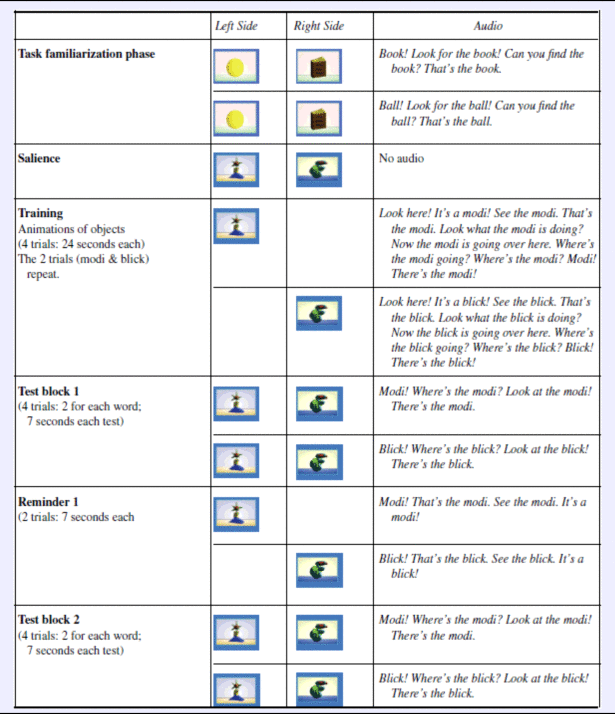
Two novel objects and two familiar objects (apple and book) were created using Macromedia's Extreme 3D program. In the training phase, novel objects first moved across the screen and then remained static at the center of the screen. The objects were static in all other phases, except for a bounce of the target object during the last second of each test trial (see Table 1 for stimuli). All auditory stimuli were presented by a female native English speaker using IDS (e.g., “It's a modi/blick! See the modi/blick. That's the modi/blick”).
Visual and linguistic stimuli used to teach two novel words in the IPLP

Procedure
The experiment consisted of five phases: (1) task familiarization, (2) salience, (3) training, (4) test block, and (5) reminder. A laughing baby presented between each trial served as an attention getter.
Task familiarization phase
Children saw images of a ball and a book side-by-side and were asked to look at the target image (i.e., “Book! Look for the book! Can you find the book? That's the book”).
Salience phase
Children saw two novel objects side-by-side in silence. The single trial salience phase assessed children's a priori preference for the pair of novel objects that children would be tested on in the test block phase.
Training phase
Infants saw the same two novel objects that they saw during the salience phase and heard two novel words twice in alternating order (Table 1). The training phase (four trials) taught children to associate two novel words with two novel objects. The position of the two objects (left or right) and assignments of novel words (blick or modi) were counterbalanced across infants.
Test block phase
There were two blocks of four test trials. For each trial, infants saw two novel objects side-by-side and were asked to look at the target item (e.g., “Modi. Where's the modi …”). Each test block included two trials for each object/label pair (four trials), presented in quasi-random order. The utterance of the target word occurred 1s after the onset of the visual stimuli. The time window for analysis began 367ms after the onset of the first utterance of the target word and the final second (i.e., when the target object bounces) was not included in the analysis.
Reminder phase
Test blocks 1 and 2 were separated by a reminder phase (2 trials). Infants were presented with one object/label pair at a time to remind them of the correct object/label associations. Reminder phases allowed infants additional time to learn the pairings of the novel objects and words.
Dependent variable and coding
Looking time was coded frame-by-frame with the audio turned off so that coders were blind to condition. Trained research assistants coded offline recordings of children's visual fixation to the left, right, and center of the screen for each trial. Preferential looking can be assessed in multiple ways, including measures of total looking time to target, proportion of target looking, or the duration of the longest look. The variables for measuring novel word learning reported were total looking time (the difference between the total duration of infants’ gaze to the target and non-target object), proportion looking (target looking time / total looking time), and longest look (the difference between the single longest look duration to the target object and the single longest look duration to the non-target object). Twenty percent of children's data were recoded offline by another trained coder, yielding an inter-rater reliability of .98.
Vocabulary at 21 months
There are few measures of infant language competency available to researchers. Therefore, we used what is arguably the most popular measure (the MacArthur-Bates Communicative Development Inventory; MCDI) when children were 21 months to assess their language productivity. The MCDI uses production data starting at 16 months on its toddler form. Caregivers completed the MCDI: Words and Sentences (Fenson et al., Reference Fenson, Dale, Reznick, Thal, Bates, Harters and Reilly1993). Vocabulary size was indexed as the number of words reported as ‘understands and says’.
Childhood outcomes at seven to ten years of age
Vocabulary
A standardized assessment, the Peabody Picture Vocabulary Test (PPVT-4; Dunn & Dunn, Reference Dunn and Dunn1997) was used to measure children's receptive vocabulary. Children were instructed to point to one of the four pictures that matched the word spoken by the experimenter. The PPVT is widely used for children in this older age group. Given that comprehension generally precedes production (Hirsh-Pasek & Golinkoff, Reference Hirsh-Pasek, Golinkoff, McDaniel, McKee and Cairns1996), a receptive measure offered a broader view of what children know than a production measure.
Visuospatial skills
Children's visuospatial skills were assessed using the block design task, a subtest of the Wechsler Intelligence Scale for Children (WISC-IV; Wechsler, Reference Wecshler2003). The experimenter instructed the child to replicate two-dimensional geometric patterns using three-dimensional blocks. There were 14 items on the WISC block design; testing ended when two consecutive items were missed.
Non-verbal general intelligence
The Test of Nonverbal Intelligence-Third Edition (TONI-3; Brown, Sherbenou, & Johnson, Reference Brown, Sherbenou and Johnsen1997) was used to assess children's abstract reasoning and problem-solving skills and is considered a test of fluid intelligence. The TONI is a language-free assessment that consists of 5 training items and 45 test items. Items resemble matrix analogy-type tests; out of four to six alternatives, the child had to pick the solution that best completed the visual pattern.
Results
Prior to conducting any statistical analyses, we computed standardized z-scores of the test phase data to check for possible outliers (i.e., standardized z-scores ⩾ 3 SD). No outliers were identified. Preliminary analyses showed no significant main effects or interaction effects involving gender on infants’ vocabulary size and novel word learning at 21 months or childhood vocabulary (PPVT), visuospatial skills (WISC-Block Design), and non-verbal IQ (TONI-3) outcome measures.
Novel word learning performance at 21 months
The proportion of looking time to the target was above the chance level of .50 (t(16) = 1.99, p = .03). A 2 (stimulus type: target vs. non-target) × 2 (test block: 1, 2) repeated measures ANOVA was conducted for the duration of infants’ mean longest looks. There was a main effect of stimulus type (F(1,16) = 4.56, p = .049, η p2 = .22), with infants looking longer to the target (M = 1.77, SE = .16) than to the non-target (M = 1.35, SD = .10). The main effect of block (F(1,16) = 0.84, p = .374) and the stimulus type by block interaction (F(1,16) = 0.53, p = .479) were not significant.
Predictive relations between infancy measures and childhood outcomes
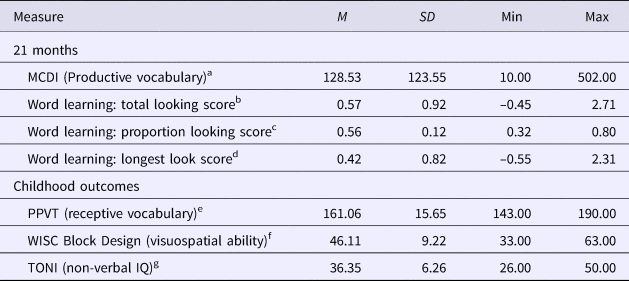
To examine the relation between infant word learning performance and later childhood language outcomes, a word learning performance score (using total looking time, proportion looking, and longest look) was calculated for each child. For total looking, the score was calculated by subtracting the mean looking time to the non-target from the mean looking time to the target. The proportion looking score was calculated by taking the mean proportion of time looking to the target divided by total looking time, and the longest look score was calculated by subtracting the mean longest look to the non-target from the mean longest look to the target. Both blocks of test trials were included in this calculation and no trials were missing. Positive scores indicate longer looking toward the target. Descriptive statistics for the vocabulary size and word learning performance scores at 21 months and the childhood outcome measures of receptive language (PPVT), visuospatial skills (WISC Block Design), and non-verbal IQ (TONI-3) are displayed in Table 2.
Descriptive statistics for the 21-month and childhood outcome measures

Notes. a Number of words reported as ‘understand and says’ on the MacArthur Communicative Development Inventory (MCDI): Words and Sentences; b Mean difference of looking time to target minus looking time to non-target; c Mean proportion of time looking to the target divided by total looking time; d Mean difference of longest look to target minus longest look to non-target; e Raw scores on the Peabody Picture Vocabulary Test (PPVT); Raw scores on the Wechsler Intelligence Scale for Children (WISC) Block Design subtest; g Raw scores on the Test of Nonverbal Intelligence (TONI).
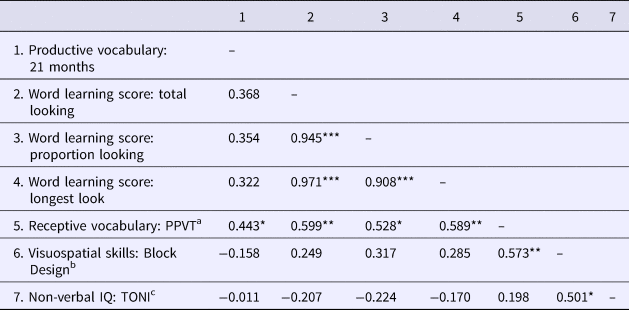
Correlations between vocabulary size and word learning performance at 21 months and childhood outcomes are displayed in Table 3. Word learning performance at 21 months was correlated with later childhood receptive vocabulary (total looking: r = .60, p < .01; proportion looking: r = .53, p < .05; longest look: r = .59, p < .01). In addition, later childhood indices thought to index visuospatial skills (i.e., block design subtest) and non-verbal IQ (i.e., TONI non-verbal reasoning) were correlated with each other (r = .50, p < .05). Finally, later childhood receptive vocabulary was correlated with visuospatial skills (r = .57, p < .01) but not non-verbal IQ.
Correlations between the 21-month and childhood outcome measures

Notes. aRaw scores on the PPVT; bRaw scores on the WISC Block Design subtest; cRaw scores on the TONI; ***p < .001, **p < .01, *p < .05.
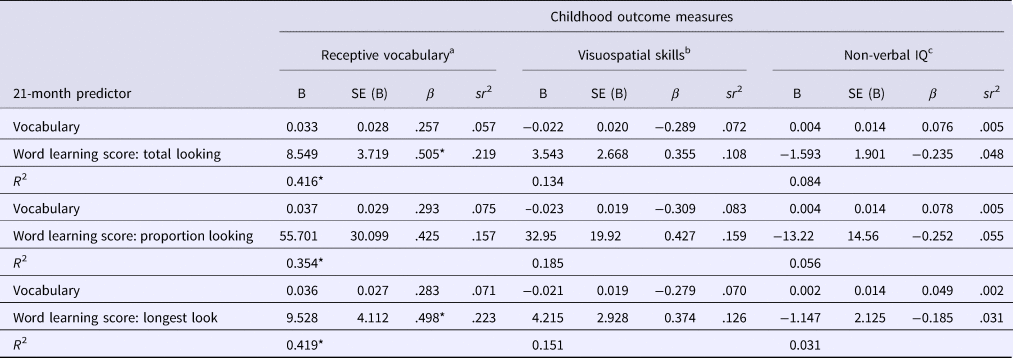
Table 4 summarizes the results from three multiple regression analyses. Predictor variables were vocabulary and word learning performance at 21 months (using total looking score, proportion looking score, and longest look score); outcome measures were childhood assessments of receptive vocabulary, visuospatial skills, and non-verbal IQ. The regression analysis using total looking score predicting receptive vocabulary was significant (R 2 = .42, F(2,14) = 4.96, p = .02). Only the word learning total looking performance score at 21 months made a unique and significant contribution to later childhood receptive vocabulary. In contrast, the regression analyses predicting visuospatial skills (R 2 = .134, F(2,14) = 1.08, p = .365) and non-verbal IQ (R 2 = .05, F(2,14) = 0.352, p = .709) were not significant. The regression analysis using proportion looking score predicting receptive vocabulary was significant (R 2= .354, F(2,14) = 3.84, p = .047); however, the proportion looking score did not predict later receptive vocabulary (t = 1.851, p = .085). The regression analyses predicting visuospatial skills (R 2= .185, F(2,14) = 1.58, p = .240) and non-verbal IQ (R 2 = .05, F(2,14) = 0.413, p = .669) were not significant. The regression analysis using longest look score predicting receptive vocabulary was also significant (R 2 = .42, F(2,14) = 5.05, p = .02), and a similar pattern of findings emerged. Only the longest look word learning performance score uniquely predicted later childhood receptive vocabulary, whereas the regression analyses predicting visuospatial skills (R 2 = .15, F(2,14) = 1.24, p = .318) and non-verbal IQ (R 2= .03, F(2,14) = 0.22, p = .803) were not significant.
Summary of regression analyses using vocabulary and word learning performance at 21 months as predictors of childhood outcome measures (n = 17)

Notes. aRaw scores on the PPVT; bRaw scores on the WISC Block Design subtest; cRaw scores on the TONI; *p ⩽ .05.
Discussion
Can infants’ early language ability predict their receptive vocabulary score five to eight years later? Prior research suggests that several aspects of early language skills, including parent-report measures of receptive and productive vocabulary, and aspects of infant language processing, such as phoneme discrimination, speech segmentation, and speed of lexical access, predict later childhood language and cognitive outcomes. However, another crucial aspect of language acquisition is the ability to map words onto objects, actions, and events – a skill which is essential for building a lexicon. Here we examined the predictive validity of novel word–object association performance in infancy to later childhood receptive language. Although previous research examined speed of lexical access by focusing on familiar words, training on novel words equalizes exposure to the novel stimuli and requires linking word forms with objects and events. Importantly, we also examined whether individual differences in novel word learning performance in infancy predict later receptive vocabulary outcomes or predict more broadly to general cognitive functioning.
With respect to novel word learning performance at 21 months, results from the proportion looking time data indicated that infants looked to the target object (the object associated with the word) at above-chance levels. The longest look data revealed that infants looked longer to the target object than the non-target object, replicating prior research on word learning using the IPLP (Houston et al., Reference Houston, Stewart, Moberly, Hollich and Miyamoto2012; Ma et al., Reference Ma, Golinkoff, Houston and Hirsh-Pasek2011). Infant productive vocabulary and novel word learning performance accounted for 35–42% of the variance in later childhood receptive vocabulary. Although infant MCDI scores were correlated with childhood PPVT scores, infant productive vocabulary failed to uniquely predict variance in childhood receptive vocabulary when included as a predictor variable along with novel word learning. In contrast, novel word learning (using total looking time and longest look) in infancy uniquely accounted for a large proportion of the variance (22%) in childhood receptive vocabulary. This strong finding underscores the difference between assessing how many words children can say versus examining whether they can form new word–object associations.
In general, we found that all three measures of novel word learning performance (total looking, proportion looking, and longest look) yielded very similar results, but that measures of total looking time and longest look uniquely predict later receptive language. In particular, longest look duration was used based on Schafer and Plunkett's (Reference Schafer and Plunkett1998) finding that it was a more sensitive measure than total look duration, especially in circumstances when longer test trials are used (those authors report a 10-second duration during testing trials; a 7-second duration was used in the current study). These findings need to be interpreted cautiously given our small sample size and considering that our word–object association measure only speaks to the initial mapping process and not the long-term retention of these mappings (a point which we discuss futher). Still, these findings are promising and suggest that novel word learning in infancy – and not the number of words a child already has – continues to bear a strong relation to receptive vocabulary into later childhood despite the fact that between five and eight years elapsed.
This is the first study to suggest that long-term outcomes of children's language success might relate to word mapping performance in infancy. Perhaps infants who succeed on this task are also more efficient at associating words and objects in the real world, which relates to later vocabulary accumulation. In contrast, children who struggle with mapping novel word–object pairings may require repeated exposure to the same words to facilitate referential understanding or phonological encoding, which in turn may lead to slower rates of vocabulary accumulation. Our results suggest that learning these arbitrary word–object links is an important skill for building a lexicon. In fact, learning novel words is a lifelong task. The transition to formal schooling entails multiple circumstances where novel word–object association is needed.
Crucially, we did not find a relation between children's PPVT and MCDI scores and our IQ measure – the TONI, a non-verbal IQ test. Other researchers have found weaker correlations between the PPVT and non-verbal IQ indices compared with correlations between PPVT and verbal IQ (Childers & Durham, Reference Childers and Durham1994; Hodapp & Gerken, Reference Hodapp and Gerken1999). Some investigators even caution against using the PPVT as an index for intellectual functioning (Altepeter, Reference Altepeter1989).
These results suggest some degree of continuity exists from infancy to later childhood in the domain of early word learning, but that this link may not be driven by general cognitive functioning. The ability to associate novel sound patterns to novel objects, an index of the process of word learning, may be especially important for long-term mastery of language. Later vocabulary development may be facilitated in part by this particular skill in infancy, the skill required to build representations of a new phonological form and its referent and form an associative link between the two. However, it is important to note that concurrent measures of visuospatial ability were also correlated with receptive vocabulary (r = .57). Although not feasible in the current investigation due to limitations in sample size, future studies using larger samples should determine whether novel word–object mapping in infancy is a significant predictor of childhood receptive vocabulary even after controlling for concurrent visuospatial ability.
Although word learning depends on the ability to map a label to its referent, that is not to say that it does not depend on other domain-general changes, such as the ability to encode, store, and retrieve these representations in memory (Wojcik, Reference Wojcik2013). Acquiring full referential understanding also involves recalling the word in a new context and extending a novel label to other instances (Golinkoff, Hirsh-Pasek, Bailey, & Wenger, Reference Golinkoff, Hirsh-Pasek, Bailey and Wenger1992), as well as knowing something of how it is used. Our experiment does not speak to either of these points, although it does speak to the first step in word learning – associating a word to an object with few exposures. Therefore, although we use the term ‘novel word learning’, we acknowledge that our findings relate to the encoding and immediate retention of word–referent mappings. Forming an initial name–object association likely requires more than one encounter and repetition may be especially important for word learning (Horst & Samuelson, Reference Horst and Samuelson2008; Mather & Plunkett, Reference Mather and Plunkett2009). Another limitation is that we do not know whether children who more readily form word–object associations are also more likely to retain those links over time (Axelsson & Horst, Reference Axelsson and Horst2013). Other studies using both offline (Horst & Samuelson, Reference Horst and Samuelson2008) and online measures (Bion, Borovsky, & Fernald, Reference Bion, Borovsky and Fernald2013) testing children's disambiguation of a novel word's meaning have found that 24-month-olds fail to exhibit evidence of retention. However, it is possible that differences in procedure using a less demanding task (i.e., using ostensive labeling in a preferential looking task and use of reminders) may have facilitated retention in the present study. Future studies would benefit from testing infants’ retention of novel word–object mappings over longer delays.
From an applied perspective, the predictive strength of children's performance on the word-learning task may be extended to discriminate children at risk for language delays from typically developing peers. Only one language test assesses novel word-learning processes (Golinkoff, de Villiers, Hirsh-Pasek, Iglesias, & Wilson, Reference Golinkoff, de Villiers, Hirsh-Pasek, Iglesias and Wilson2017); most existing tests merely assess the products of learning, or how many words children already know. In the present study, novel word learning performance in infancy predicted later childhood measures of receptive vocabulary. It is important to note that these results should be interpreted with caution and need to be validated by follow-up investigations using larger sample sizes. However, the strength of this predictive relation (accounting for 22% of the variance in receptive vocabulary five to eight years later) given such a small sample size is promising. It would be valuable for future investigations to examine whether novel word learning performance in infancy may serve as a clinically relevant predictor of later language delay or disorder in young children.
Acknowledgements
This research was supported by research grants to Derek M. Houston (NIH 5R01DC006235), Richard G. Schwartz (NIH 5R01DC011041), Roberta Michnick Golinkoff and Kathy Hirsh-Pasek (IES grants R305A100215, R305A090525, and R305B130012). The content of this manuscript is solely the responsibility of the authors and does not necessarily represent the official views of the National Institutes of Health or Institute of Education Sciences.