Introduction
Metastases to the brain are common among cancer patients and develop in 20–40% of patients, throughout the course of the disease, more commonly in patients where the primary cancer originated in the lung. About 30% of newly diagnosed cancer patients in the United States will develop brain metastasis at some point of time.Reference Siegel, Ma and Zou1 Traditionally, radiotherapy to the whole brain (WBRT) was used as a guideline to treat patients with metastases to the brain, with the addition of surgical resection to improve the results in patients presenting with a single brain metastasis.Reference Koay and Sulman2, Reference Maclean, Fersht and Singhera3
With the advancement of radiotherapy techniques, such as stereotactic radiosurgery (SRS) or stereotactic fractionated radiotherapy (SRT), the local treatment can be intensified; therefore, obtaining better outcomes. One benefit observed is in the improvement in local control (LC) of multiple brain metastases in patients who are treated with WBRT and SRS in comparison to WBRT, with only an advantage in the overall survival in cases of single brain metastasis.Reference Aoyama, Shirato and Tago4
A popular technical method used to intensify the radiotherapy dose to the tumour is by using a simultaneous integrated boost (SIB), using intensity-modulated radiotherapy (IMRT) and volumetric-modulated arc therapy (VMAT), achieving high tumour conformality.
The simultaneous delivery of the boost dose to the gross tumour using the SIB technique has proved to be beneficial by overcoming the problem of proliferation and accelerated repopulation of the tumour stem cells, rather than a sequential boost, thus decreasing the risk of radiotherapy failure.Reference Krause, Yaromina and Eicheler5, Reference Wilson, Saunders and Dische6
Many planning studies have evaluated the safety and feasibility of the use of a boost dose to brain metastases, in addition to the whole-brain irradiation using WBRT-SIB technique in the treatment of brain metastases.Reference Prokic, Wiedenmann and Fels7– Reference Kim, Seo and Lee10
Although the mechanism is still unclear, the radiation-induced injury to the hippocampus is of concern, as it can lead to deterioration in neurocognitive functions (NCFs) and memory loss.Reference Scoville and Milner11, Reference Padovani, André and Constine12 Therefore, the use of modern radiotherapy techniques to protect the hippocampus subgranular zone during irradiation of the brain seems logical and imperative.
Many studies have demonstrated the dosimetric superiority of VMAT and also IMRT over 3D conformal radiotherapy in many tumours of the brain.Reference Wagner, Christiansen and Wolff13, Reference Chen, Feng and Fang14
Sparing of hippocampus can be achieved using IMRT and VMAT in the treatment of primary and secondary brain tumours, to avoid decline in NCFs.Reference Kazda, Jancalek and Pospisil15
VMAT can deliver a highly homogenous dose to the target achieved by changing the speed of gantry rotation, the intensity of the beam and the rate of the dose, with shorter treatment session and less monitor units, compared to the IMRT technique.Reference Teoh, Clark and Wood16
We hypothesise that the addition of a boost dose to brain metastases with WBRT-SIB method is expected to increase the dose to the hippocampus, increasing the possibility of its injury; and thus, the selection of the best planning method to protect the hippocampus is of clinical importance.
This study aims to compare dosimetrically between IMRT and VMAT in the protection of the hippocampus and other organs at risk (OARs) and also planning target volume (PTV) coverage in planning of WBRT-SIB in patients with brain oligo-metastases.
Methods
In the period between February 2017 and December 2018, 16 patients with more than one brain metastases with oligo-metastatic brain disease (one to three lesions) and controlled primary tumour received fractionated stereotactic radiotherapy, with a prescription dose of 30 Gy/5fr/1 week in 5 consecutive days, without receiving whole-brain radiotherapy (WBRT).
All patients were immobilised by fixation of a thermoplastic mask at the stereotactic localiser of head and neck box base (Q-Fix SRS mask 4·8 mm thickness; Church Road Avondale, PA, USA) and underwent computer tomography (CT) simulation. The CT images were acquired at 2 mm thickness of slides and 0·5 mm slice spacing. Images were fused using magnetic resonance images (MRIs). Delineation of the target volumes and other risk structures was done, including the brain, brainstem, eye lenses, spinal cord, optic chiasm, eyes, and optic nerves, based on RTOG 0933 delineation protocol.Reference Gondi, Pugh and Tome17 All patients were treated using VMAT technique at a dose of 30 Gy in five fractions for 5 consecutive days. The target volume was the metastatic lesion with 5 mm margin. No WBRT was given. A written consent was obtained from each patient before treatment.
For the purpose of this retrospective planning study, the treated 16 patients’ pre-planning data were used to produce a second set of plans. A new dose was prescribed giving whole-brain (WB) irradiation with SIB to the metastatic lesions. For each patient, two sets of plans (five fields IMRT plan and dual-arc VMAT plan) were created. The PTV30 represented the brain volume except the hippocampi and a 0·2 cm margin around them. The PTV45 represented the brain metastasis defined in T1-weighted MRIs with contrast of 0·5 cm expansion around it. The prescription dose to PTV30 is 30 Gy given in ten sessions delivering 3 Gy/fraction to the WB minus the hippocampi planning risk volume. The prescription dose to the brain metastases is 45 Gy in ten fractions delivering 4·5 Gy per fraction to the brain lesion with 0·5 cm around it. The margins are tighter near the critical OARs. The delineation of the hippocampus on the MRIs was based on RTOG 0933 delineation protocol.Reference Gondi, Pugh and Tome17 The doses for target volume and OARs were respected according to the RTOG 0933 acceptable criteria as follows:
95% of volume of the brain or more receives 30 Gy (V30 Gy > 95% PTV)
2% of the target volume receives 37·5 Gy (D2% ≤ 37·5 Gy)
At least 98% of the volume of the target receives 25 Gy or more (D98% PTV ≥ 25 Gy)
Hippocampus min dose (Dmin = D100%) be ≤ 10 Gy
Hippocampus max dose be ≤ 17 Gy
Optic chiasm and optic nerves max dose be ≤ 37·5 Gy
Treatment planning
For each patient, two sets of plans were created and a five-field IMRT was planned. The Varian RapidArc technique delivers 2 arcs—VMAT with changing the dose rate and the speed of the gantry and multi-leaf collimator leaf speed to achieve proper coverage of the target volume.
The two sets of treatment plans were analysed in terms of their dose–volume histograms (DVHs), target volume covered by 95% of the prescription dose (V 98%) and maximum and mean structure doses (Dmax and Dmeanec). Calculation of all plans was undertaken using 6 MV photon with analytical anisotropic algorithm. Eclipse version 15·7 (Varian, Inc.3100 Hansen WayPalo Alto, CA), and the parameters of the plans were optimised according to the RTOG 0933 protocol.
Dosimetric Comparison of Plans
To evaluate PTV coverage, the volume receiving at least 30 Gy (V30Gy) and the Dmin of 98% of the volume are used. To determine the hot spots, the dose received by the hottest 2% of the PTV (D2%) is used. The homogeneity index (HI) was measured for each plan, where
 ${\rm HI} = {{{\rm D}2{\rm{\% }} - {\rm D}98{\rm{\% }}} \over {{\rm Dmedian}}}$
Quantification of the homogeneity of the dose within the WB volume is done by calculating the HI. IMRT and VMAT plans were compared, including mean and maximum doses to the hippocampus; maximum doses to the brainstem, optic chiasma, optic nerves, lenses and the eyes mean doses.
Plan evaluation and acceptance
All plans were evaluated based on DVH scoring values of PTV and OARs. PTV is evaluated using the conformity index (CI), HI and dose gradient index of the dose distribution. p Value was considered statistically significant if less than <0·05. The statistical values were calculated using origin 6·5 software.
Results
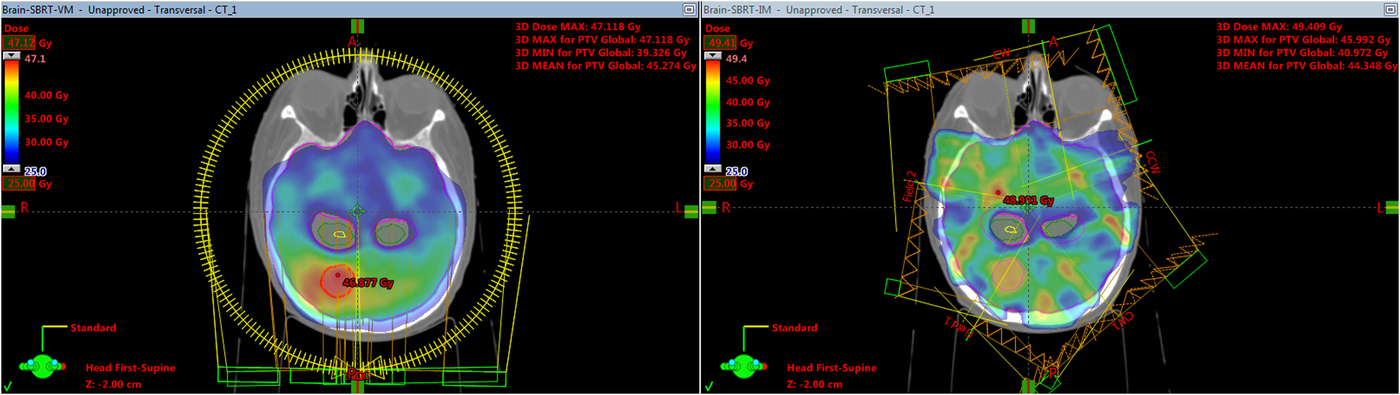
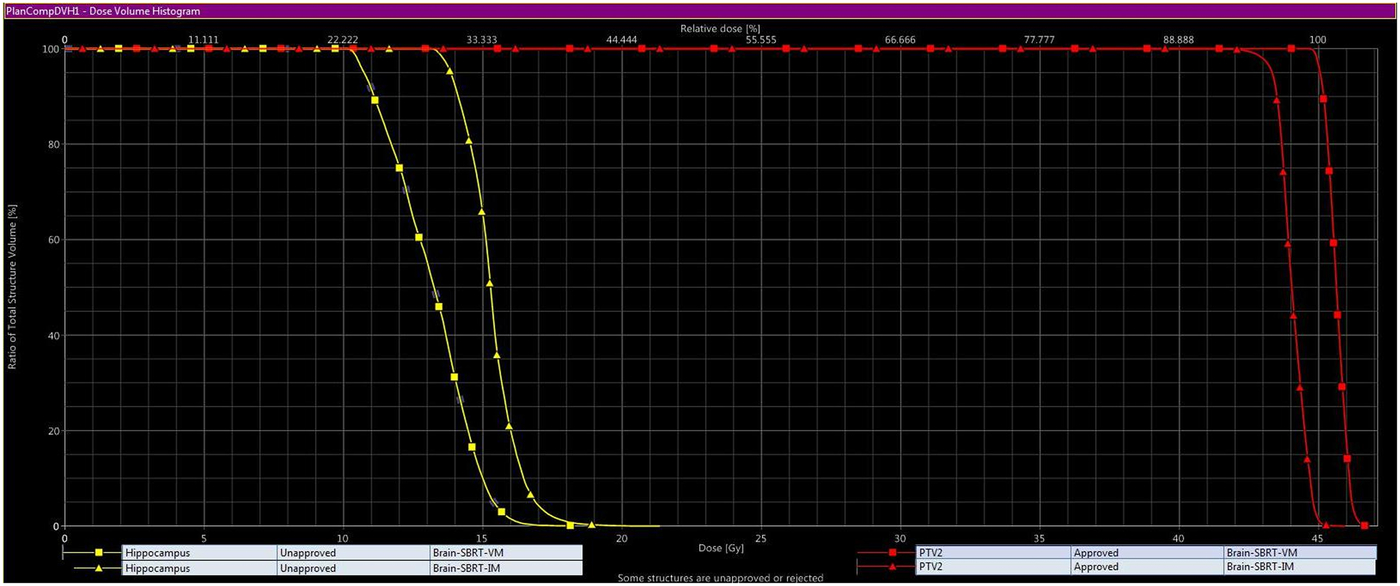
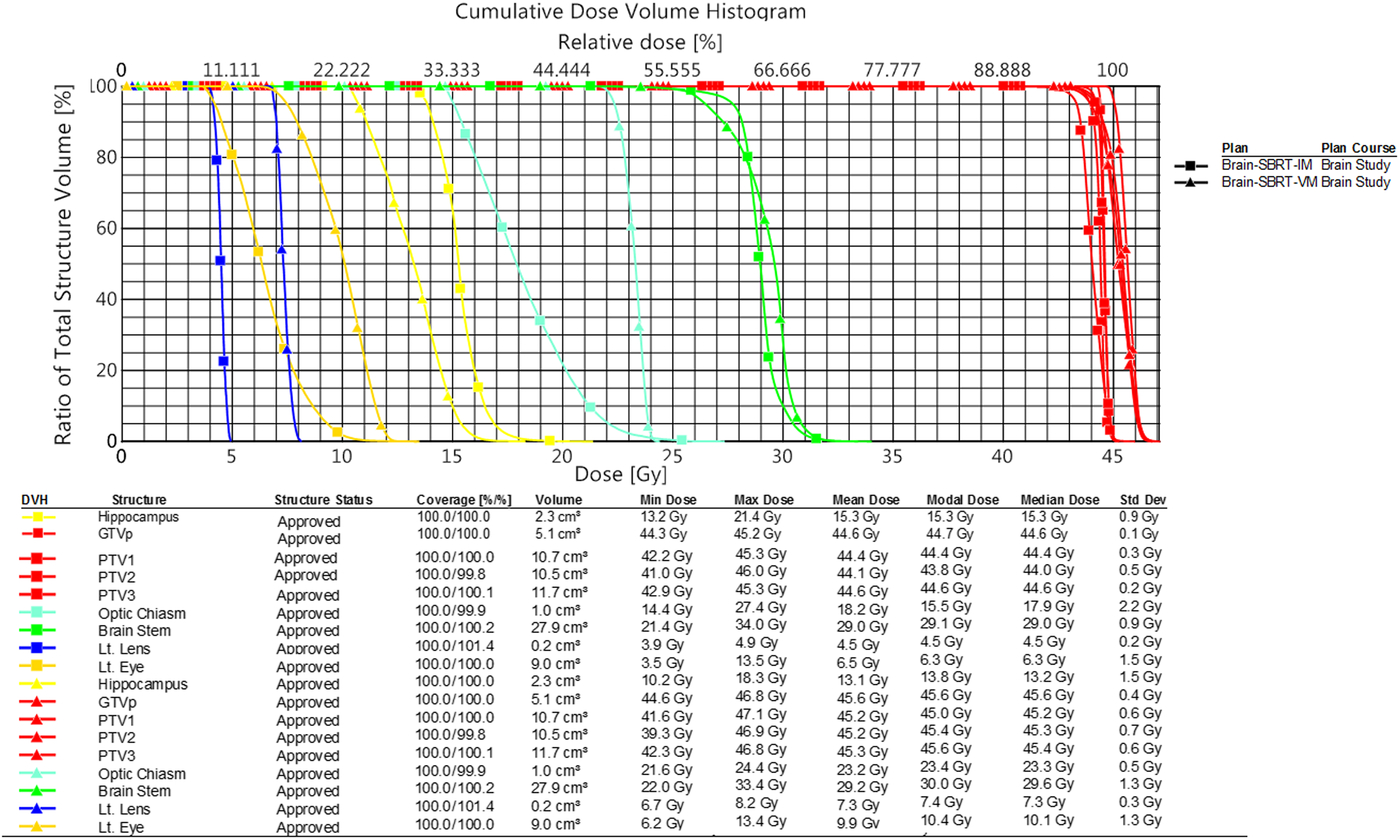
Both IMRT and VMAT achieved satisfactory dose distribution to the target volumes; however, VMAT plans showed better DVH, CI and HI than IMRT plans in most of the patients (Figures 1, 2 and 3).
IMRT and RA plan for a patient with three brain metastases, with better coverage and homogeneity using VMAT technique.

VMAT plan has better DVH parameters for both PTV and hippocampus.

Comparison between IMRT and VMAT plans for a patient with two brain metastases, showing better PTV coverage and better OARs preservation including hippocampus with VMAT technique.

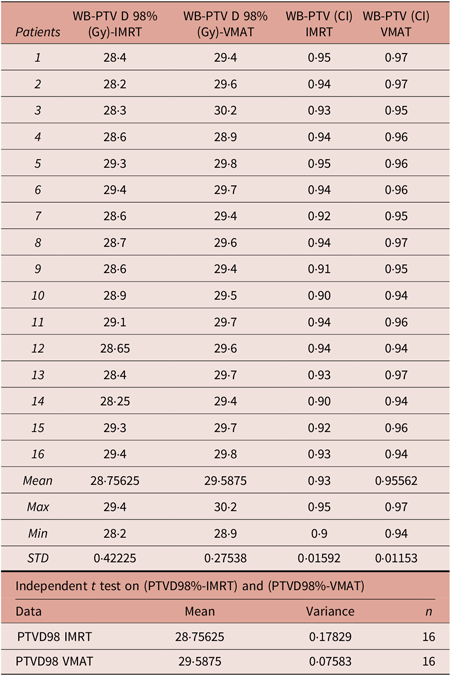
The WB-PTV D 98% in VMAT plans is significantly better than WB-PTV D 98%in IMRT plans with p value < 0·05 (Table 1).
– The CI for VMAT (0·95562) and IMRT (0·93) are significantly different in favour of VMAT, with p value < 0·05.
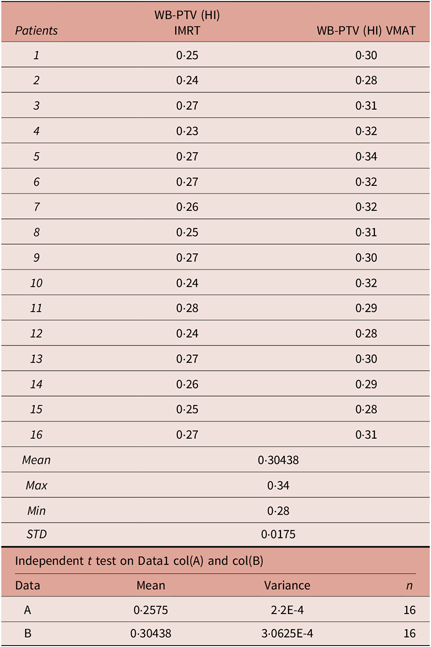
– The HI for VMAT and IMRT techniques are significantly different in favour of VMAT at the level 0·05 level (Table 2), giving a confirmation of better uniformity of dose distribution in the target volume.
WB-PTV target coverage parameters for all 16 patients HA-WBRT with SIB plansa

Notes: aPrescription: 30 Gy for WB-PTV and 45 Gy for each mean brain metastasis PTV in ten fractions p <0.05.
Abbreviations: HA-WBRT, hippocampus avoidance whole-brain radiotherapy; IMRT, intensity-modulated radiotherapy; PTV, planning target volume; SIB, simultaneous integrated boost; VMAT, volumetric-modulated arc therapy; WB, whole brain.
HI for PTV for both IMRT and VMAT plansa

Notes: a At the 0·05 level, the two means are significantly different p<0.05.
Abbreviations: HI, homogeneity index; IMRT, intensity-modulated radiotherapy; PTV, planning target volume; VMAT, volumetric-modulated arc therapy; WB, whole brain.
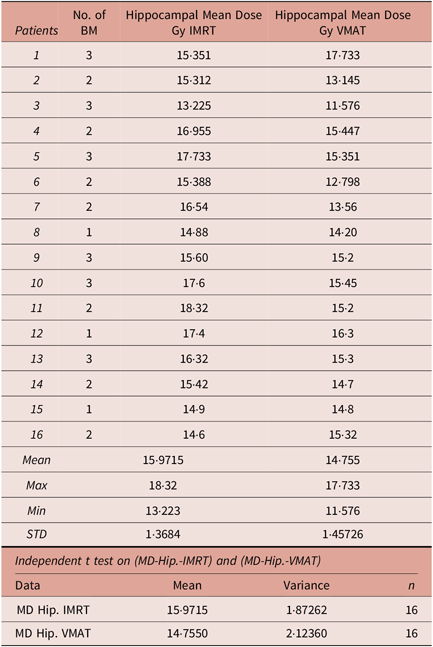
The mean hippocampal dose is significantly less in VMAT plans than IMRT plans (Table 3).
The mean hippocampal dose in VMAT and IMRT plansa

Notes: a At the 0·05 level, the two means are significantly different p<0.05.
Abbreviations: Hip., hippocampus; IMRT, intensity-modulated radiotherapy; VMAT, volumetric-modulated arc therapy; BM, brain metastasis; MD, mean dose
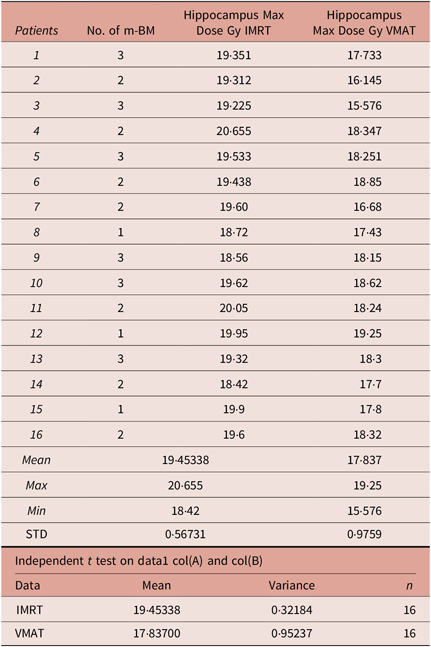
The maximum dose of hippocampus is significantly less in VMAT than in IMRT (Table 4) The rest of OARs including the brainstem, optic nerves, chiasm and lenses, and the mean dose to the eyes were within tolerance in all VMAT and IMRT plans, with no significant difference between both techniques.
Maximum dose of hippocampus in VMAT and IMRT plansa

Notes: aAt the 0·05 level, the two means are significantly different p <0.05.
Abbreviations: IMRT, intensity-modulated radiotherapy; VMAT, volumetric-modulated arc therapy; STD, standard deviation
Discussion
WBRT using 3D conformal radiotherapy has been used as the standard technique in patients with multiple brain metastases. Many studies have confirmed that the function of hippocampus is affected by radiotherapy and consequently raising the risk of decline in NCFs.Reference Merchant, Pollack and Loeffler9, Reference Shi, Molina and Robbins18
A phase II study (RTOG0933) that compared 113 patients treated by hippocampus avoidance WBRT (HA-WBRT) for brain metastases with previous studies in which patients received WBRT with no avoidance of hippocampus. Forty-two patients were evaluated at 4 months. There was significant reduction (7·0%) in the mean Hopkins Verbal Learning Test–Revised Delayed Recall from baseline to 4 months, compared to the historical control (p < 0·001), with no reduction in quality-of-life scores.Reference Gondi, Pugh and Tome17
In a dosimetric study presented by Lee et al., three patients were evaluated using VMAT and IMRT approaches in WB irradiation. Both techniques achieved satisfactory hippocampal sparing; however, VMAT was associated with a more homogenous PTV distribution.Reference Lee, Lenards and Holson19
These data are compatible with our results that show that VMAT approach had statistically significant better PTV coverage than IMRT. The WB-PTV 98% coverage was 29·5 Gy and 28·7 Gy with VMAT and IMRT, respectively.
Our study showed better statistically significant WB-PTV (CI) with VMAT (0·955) than with WB-PTV (CI) with IMRT (0·93) and also statistically significant WB-PTV (HI) with VMAT (0·3) WB-PTV (CI) than with IMRT (0·25).
The use of WBRT-SIB approach is widely used to intensify the dose to the tumour sites. In our study, we prescribed a dose of 4·5 Gy/fraction in ten fractions to the tumour metastatic sites with biological effective dose = 65·25 Gy. A similar dose was prescribed by Pokhrel et al. study. It was a single-arm planning study that evaluated five patients using IMRT technique. A 5-mm uniform margin around the paired hippocampi was created for each patient. In all patients, the maximum dose to the hippocampus was limited to 16 Gy.Reference Pokhrel, Sood and McClinton20 This dose is less than the results of our study, which shows that the hippocampus maximum point dose mean value is 17·8 Gy, while the mean value of the hippocampus maximum point dose with IMRT is 19·4 Gy. This can be explained by fewer margins around the hippocampus in our study (only 2 mm).
Another study by Gutiérrez et al. showed that WBRT with SIB by a single-helical tomotherapy is superior to 3D-conformal radiotherapy regarding the dose distribution and sparing of the hippocampus in ten patients with the prescription dose of 32·25 Gy in 15 fractions to the WB and boost dose according to the diameter of the brain metastases 63 and 70·8 Gy. The mean hippocampal dose was about 6·0 Gy.Reference Gutiérrez, Westerly and Tomé21 This study also used a wider margin around the hippocampus (5 mm) compared to our study.
The feasibility of VMAT-WBRT technique was demonstrated by Hsu et al. in ten patients in one to three brain metastases. The dose for WB was prescribed as 32·25 Gy in 15 fractions, while doses given using SIB were prescribed as 63 Gy to lesions more than 2 cm and 70·8 Gy to all other lesions (the same dose prescription and the same margin around hippocampus as mentioned by Gutiérrez et al.Reference Gutiérrez, Westerly and Tomé21). The mean hippocampal dose was 5·23 Gy. The study confirmed the highly conformal dose distribution with satisfactory avoidance of the hippocampus using VMAT and also highlighted the limited treatment time (less than 4 minutes).Reference Hsu, Carolan and Nichol8 Our study supports these results, as it shows less treatment time with VMAT (average beam on time is 4·3 ± 0·5 minute) in comparison to IMRT (average beam on time is 19·1 ± 0·6 minute).
The use of WBRT-SIB using VMAT technique achieved better sparing of the hippocampus compared to WBRT with sequential SRS, as confirmed by Prokic et al. The study included ten patients with a dose prescription of 30 Gy (EQD2 = 31·25 Gy) to WB and 51 Gy (EQD2 = 60·56 Gy) on brain metastasis-SIB in 12 fractions. Mean dose to hippocampus was 7·55 ± 0·62 Gy.Reference Prokic, Wiedenmann and Fels7 However, this study highlighted the correlation between increasing the margin around the hippocampus and the mean dose of the hippocampus. The mean dose to the hippocampus was 7·55 ± 0·62 Gy and 6·29 ± 0·62 Gy, respectively, when 5-mm and 10-mm margins around the hippocampus were created. In our study, we aimed at intensifying the dose to the target volume by decreasing the margin around the hippocampus (2 mm), so relatively higher doses of the hippocampus were noticed in our study.
In another study, in the evaluation of hippocampal sparing using WBRT-SIB, by Kim et al. in 11 patients with brain metastases, WBRT of 25–28 and 30–42 Gy was prescribed in 10–14 fractions. The median number of metastases per patient was 4 (range, 2–15). The study used only 1 mm margin around the hippocampus, and the mean dose to the hippocampus was 13·65 Gy.Reference Kim, Cho and Lee22
Awad et al. analysed the VMAT approach in hippocampus sparing in 35 patients treated with WBRT, SIB or both. In 23 patients, the median dose for WBRT was 30 Gy, while the median dose to brain metastases was 50 Gy (range: 20–70·8 Gy) delivered in a median of 15 fractions. The mean dose of the hippocampus ranged from 4·3 to 18·0 Gy and the maximum dose ranged from 8·4 to 32·2 Gy. The wide range of mean hippocampus dose is related to the wide range of dose prescription, giving a priority to the target coverage by omitting hippocampus avoidance if the target is within 10 mm close to the hippocampus.Reference Awad, Fogarty and Hong23 This is different from our study, in which we prescribed the same dose to all patients, so giving a relatively narrow range of hippocampus mean dose in both IMRT and VMAT techniques.
In another study of ten patients with brain metastases by Giaj et al., authors evaluated the feasibility of VMAT-WBRT with SIB and hippocampal avoidance. A dose of 20 Gy was prescribed to the WB and 40 Gy in five fractions to brain metastases was prescribed. The mean dose of hippocampus was 7·7 Gy and the maximum dose was 10·5 Gy.Reference Giaj Levra, Sicignano and Fiorentino24
The above-mentioned studies are compatible with our study results which showed that VMAT statistically significantly protected the hippocampus compared to IMRT. Using VMAT technique, the mean dose of hippocampus ranged between (11·5 and 17·7 Gy), with a mean value for all patients reaching 14·7 Gy. While using IMRT technique, the mean dose of hippocampus ranged between (13·2 and 18·3 Gy), with a mean value for all patients reaching 15·9 Gy.
Our results also demonstrated statistically significant superiority of VMAT approach over IMRT approach, regarding the reduction in the hippocampus maximum point dose which ranged between (15·5 and 19·2 Gy) by VMAT and with a mean value of 17·8 Gy. While it ranged between (18·4 and 20·6 Gy) and with a mean value 19·4 Gy with IMRT.
An explanation of higher doses to the mean and maximum doses to the hippocampus in our study in relation to some of the above-mentioned studies is that the dose prescription is different, as an increased dose escalation was done in our study to gain more LC.
Another explanation is that during planning, the expansion margin around hippocampus in our study is only 2 mm, while in most of the other studies there was a 5-mm margin, including the study by Pokhrel et al.Reference Pokhrel, Sood and McClinton20 that gave the same prescription dose as in our study. We used 2 mm margin only, due to the lack of prospective data of the incidence of recurrence in peri-hippocampus area as a result of hippocampus avoidance.
Taking into consideration the relationship between the higher dose to the tumour and improved LC, the reduced margin around the hippocampus that was chosen in our study aimed at allowing for better dose coverage of the tumour metastatic lesions and thus better LC.
Conclusion
Boosting dose to the tumour lesions using WBRT-SIB approach aims at improved LC; however, it can lead to higher doses to the hippocampus. VMAT showed better WB and tumour PTV coverage with less mean and maximum doses to the hippocampus. Clinical randomised controlled studies are needed to confirm safety and feasibility and also the clinical benefit of WBRT-SIB approach using VMAT technique.
Author ORCIDs
Ehab Saad 0000-0002-0273-357X
Acknowledgement
None.
Financial support
This research received no specific grant from any funding agency, commercial or not-for-profit sectors.
Conflict of interest
No authors have any conflicts of interest.