INTRODUCTION
The ‘small towns’ of Roman Britain have recently become the subject of renewed interest, with scholars considering how such sites fit into the broader settlement pattern and critically examining their supposed function as market centres for the surrounding countryside.Footnote 1 This follows something of a lull in the subject since a series of studies were published in the late twentieth century,Footnote 2 although developer-funded excavations have continued to bring new evidence for small towns to light. Recent excavation undertaken by Oxford Archaeology in advance of housing development has provided an opportunity to investigate part of the extramural area of the walled small town of Margidunum in Nottinghamshire, revealing the use of this area for both occupation and burials.
Margidunum lies on the northern outskirts of Bingham, 12 km east of Nottingham on the A46, which follows the line of the Fosse Way along a ridge of mudstone between the Trent Valley to the north-west and Bingham Basin to the east, part of the Vale of Belvoir (fig. 1). It comprises an unusual irregular hexagon shape defended area of 2.8 hectares,Footnote 3, and ribbon development along the Fosse Way to the north-east and south-west. It is situated at the junction of the A46 and the A6097 Bridgford Street (which runs down to a crossing of the Trent and may have Roman origins) and lies partly beneath the eponymous Margidunum Roundabout, which has obscured the southern part of the defences and some of the interior. The north and north-east parts of the defensive circuit can be traced on the ground as low earthworks in fields bordering the roundabout, but the ribbon development is not visible on the ground surface. Much of the previous investigations related to the construction of the roundabout at the end of the 1960s and its subsequent bypassing by a diversion in 2009.
The location of Margidunum and the Chapel Lane and A4 Improvement Scheme excavations.

The 90-ha Chapel Lane development area lay on the east side of the A46/Fosse Way and encompassed part of the Bingham Basin. An extensive programme of geophysical survey and trial-trenching uncovered archaeological remains only in a band of roadside settlement, suggesting that the lower-lying parts remained a boggy place largely unsuitable for settlement or agriculture prior to drainage in recent centuries. The area of settlement was subsequently excavated by means of a trench that measured 388 m long and 42 to 65 m wide, encompassing a total area of 1.66 ha (figs 2 and 3). The south-western end of the trench, beyond a modern field boundary, was excavated specifically in order to confirm that the settlement plots ended here, opposite the end of a corresponding group of boundaries on the west side of the road. A full report on the results of the excavation can be found on the OA Library at http://library.oxfordarchaeology.com/6158/.
Aerial view of the Chapel Lane excavation, facing north. The road to the left is the A46 Newark to Widmerpool Improvement Scheme and the road adjacent to the site follows the presumed line of the Fosse Way. Margidunum Roundabout is marked by the trees at the right edge of the view.

Plan of the Chapel Lane excavation and adjacent parts of the A46 Newark to Widmerpool Improvement Scheme excavation.

PREVIOUS INVESTIGATIONS AT MARGIDUNUM
Margidunum is recorded in the Antonine Itinerary as one of four settlements on the Fosse Way between Leicester and Lincoln, the others being Vernemetum (Willoughby-on-the-Wolds) to the south-west and Ad Pontem (East Stoke) and Crococolana (Brough) to the north-east. It was first described by William Stukeley, who visited in 1722, although at the time the location of the stations listed in the Itinerary for this part of the road had not yet been resolved and he mistakenly believed this to be Ad Pontem; only with the excavation of the settlement at East Stoke by Adrian Oswald in 1937–8 were the Roman place-names finally restored to their locations, and Margidunum ascribed its correct name. Stukeley noted the remains of buildings with floors and stone wall foundations, and recounted personally pulling up one of many wooden piles as well as recording the quarrying of the site for stone by locals.Footnote 4 Indeed, later excavations recovered two fourteenth-century pottery vessels from a robber trench that had been dug to extract stone from the town wall,Footnote 5 while the Victoria County History recorded that stone-robbing continued well into the nineteenth century.Footnote 6
The two major programmes of excavation at Margidunum during the twentieth century were both concentrated on the defended area. The first, by Felix Oswald, was a mammoth undertaking, excavating mostly single-handed each Saturday from 1910 until 1936, interrupted only by the First World War. During this time, he uncovered about a quarter of the area within the defences, mostly on the north-west side of the Fosse Way. Oswald did not bring his results together into a single volume but published a series of articles and pamphlets.Footnote 7 He believed the defences were military in origin and marked Margidunum as an important fort during the conquest period, with the stone wall being added in reaction to the ‘barbarian conspiracy’ of a.d. 367.Footnote 8 Furthermore, burnt and fire-cracked stones from an arched window were evidence for burning of the town by Boudicca's army as they chased the Ninth Legion up the Fosse Way to Lincoln.Footnote 9 In Oswald's interpretation, metalled surfaces became the Via Principalis and Via Quintana of the fort and substantial buildings were given colourful names; thus, a large stone building near the centre of the town was dubbed ‘the Commander's House’, while a building in a complex in the north-western part of the defended area became ‘the Schola’.Footnote 10 Oswald's findings were re-appraised by Malcolm Todd, who excavated at Margidunum between 1966 and 1968 in advance of construction of the current roundabout. Like Oswald, his investigations were mainly situated within the defended area, but he also sectioned the defences, investigated a small part of an extramural cemetery outside the south-west gate, and excavated a trench c. 275 m south-west of the defences at the junction of the A46 and Newton Lane. He questioned Oswald's conquest-period date and argued that the key samian assemblages dated to no earlier than a.d. 50, and perhaps after a.d. 55, and re-interpreted the military phase as being focused on a putative fort situated to the north of the visible defences, based on a V-shaped ditch that he believed to be part of its southern defences.Footnote 11 The town defences were re-dated to the late second or early third century and identified as being of civilian character.Footnote 12 Todd's Newton Lane trench did not identify any buildings but recovered considerable quantities of pottery dated to a.d. 60–75 and thus indicated that the settlement extended at least this far along the line of the Fosse Way even at this early date.Footnote 13
Further archaeological investigations were undertaken in connection with improvements to the A46 between Newark and Widmerpool in 2009. The initial stages comprised several phases of fieldwalking and geophysical survey that recorded pottery spreads extending for 700–800 m along the Fosse Way from the defended area, potentially representing extensive areas of extramural occupation, and noted a substantial courtyard villa 500 m west of the walled town, close to the modern village of Newton, encompassing an area of c. 100 × 60 m.Footnote 14 Further co-aligned features to the north-east may represent contemporary settlement, farm structures or pens (fig. 1).Footnote 15 A re-assessment of the pottery from the previous investigations suggested more extensive late Roman occupation within the defences than envisaged by Todd and indicated that the town wall dated to the fourth century.
The road improvement around Margidunum by-passed the town in order to minimise any impact on the archaeological remains, but impacted on the Fosse Way at two locations, where archaeological excavations recorded elements of the extramural settlement on the road frontage south-west of the town.Footnote 16 At one of these excavations, 300 m from the town defences, a pair of roadside plots each contained two late first-century timber roundhouses that were superseded by a sequence of post-built rectangular buildings occupied from the the mid second until at least the late fourth century (excavation area DE3002, fig. 3). A further 500 m to the south-west (excavation area DE3001), a more extensive excavation uncovered two small curvilinear enclosures (H and J) and a trackway, which by the late second century was replaced by a more regular arrangement of conjoined rectilinear enclosures that were recut during the third–fourth centuries and became the focus of an inhumation cemetery. To the north, and somewhat further back from the Fosse Way, the excavations uncovered field boundary ditches, a corn-drying oven and a trackway that linked the Newton villa to the road. Further north again, the remains of a late Iron Age/early Roman farmstead were noted on either side of the A6097 Bridgford Road. A metalled surface recorded in a small trench beside the A6097 may be the agger of a road posited by Todd that branched off the Fosse Way south-west of the defended part of the town and lies beneath the modern road.
RESULTS OF THE CHAPEL LANE EXCAVATION
NORTH–SOUTH DITCH 1017 AND OTHER POSSIBLE EARLY FEATURES
The only feature that certainly pre-dated the main period of Roman activity was large north–south ditch 1017, which extended across the central part of the excavation area and was one of the few linear features that were not parallel or perpendicular to the adjacent Fosse Way (fig. 4). The ditch was up to 1.04 m deep and was undated. However, it was clearly earlier than all the features with which it had stratigraphic relationships, and the fact that its alignment disregarded that of the road strongly suggests that it was dug before the road was built. A curvilinear gully and a small group of pits and post-holes at the northern end of the excavation area may be similarly early. Although they lacked artefactual evidence, they were located east of the later enclosures, in an area where no other features were encountered.
Plan of the excavation.

Dating evidence suggests that the two early enclosures H and J, which were discovered on the west side of the road during the A46 Improvement Scheme excavations (fig. 3), were established during the late Iron Age and recut in the early Roman period. Both enclosures were then cut by two straight, roughly east–west ditches that may have defined a trackway, and these were probably associated with a boundary ditch that extended southwards perpendicular to the trackway ditches.Footnote 17 The excavators attributed these ditches to the middle Roman period, as they cut the late Iron Age/early Roman enclosures, but they were not themselves dated by artefacts. Curiously, the trackway ditches align very well with ditch 1017, which was parallel to the perpendicular ditch just less than 200 m to the east. It is possible that the co-alignment of these ditches is coincidental, but if they were related (with ditch 1017 perhaps defining a boundary between enclosures adjoining the trackway), they must have been dug before the Fosse Way was constructed, given that the road cut across their projected alignment.
OCCUPATION ALONGSIDE THE FOSSE WAY
The main phase of occupation was situated within a series of conjoined rectilinear enclosures that fronted onto the east side of the Fosse Way. The excavation was set back some 10 m from the road frontage, so remains of the Fosse Way itself were not exposed. Crucially the immediate roadside zone was not seen, with significant implications for our ability to interpret the functions of the enclosures. Roadside complexes such as this often have buildings alongside the road, with plots of land behind;Footnote 18 the enclosures at Chapel Lane may represent the rear part of such an arrangement, although roadside enclosures also occur with no internal features, when they apparently represent paddocks or fields designed to provide easy access to the road to facilitate movement of livestock.Footnote 19 Without investigating the road frontage it was not possible to be certain whether the enclosures were associated with roadside domestic buildings or were entirely agricultural in character – although the artefactual and palaeoenvironmental evidence indicated that they were associated with both domestic and agricultural activities. Where excavation had extended closer to the frontage, in Area DE3002 of the A46 Improvement Scheme, a sequence of timber and stone buildings was uncovered.Footnote 20
The construction of the enclosures could be attributed to sometime after the mid second century. Thereafter, the complex remained in use until the end of Roman activity here sometime in the second half of the fourth century, with recutting of the principal boundaries associated with this long period of occupation.
The plots were exposed for a distance of 390 m and continued north-east beyond the excavation. They may have extended unbroken as far as the enclosures excavated at area DE3002 of the A46 Improvement Scheme excavations, or even all the way to the walls of Margidunum itself. They were defined to the rear by a continuous boundary ditch that extended the full length of the excavation area. The ditch dated to the late second/early third century and was fully recut along its entire length at least once. Additional, apparently more localised recuts were recorded in several interventions, with recutting continuing into the fourth century. The recuts were typically located on the east side of the original ditch. At the south-west end, the ditch turned back towards the Fosse Way at an acute angle that was precisely mirrored by the corresponding boundary on the west side of the road, indicating that the areas on both sides of the road were probably developed as part of a single episode (fig. 3). The end of the enclosures appeared to define the south-western limit of the roadside occupation, since it corresponded closely with the end of the spread of fieldwalking finds identified by Leary and Baker.Footnote 21
The area delimited by the ditch was divided into a series of plots by lateral boundary ditches. In some locations the plots exhibited further subdivisions. They were not always easily defined and could not be fully enumerated, due to damage from more recent ploughing and the ambiguous dating evidence from individual ditches, that could only be ascribed to a wide date range, often extending from the second century to the fourth. It was consequently impossible to be certain of the contemporaneity of the divisions. The greatest concentration of divisions occurred in the northern part of the excavated area, which was also where the greatest number of internal features were located.
Although, as stated above, the location of the excavation area precluded the uncovering of any roadside buildings, two possible structures were identified. Feature 918 consisted of a deliberately laid surface made of unshaped limestone blocks. Nearly 7 kg of pottery dating to before c. a.d. 250 were recovered, as well as animal bones, ironwork, slag and tile. It was very similar in size and construction to two stone platforms identified to the north at A46 Improvement Scheme area DE3002, which were interpreted as stone footings or foundations for small buildings.Footnote 22 Further to the south, possible structure 1027 consisted of six post-holes, forming a rectilinear shape in plan. There was no evidence of internal supports, with the distance between the post-holes seemingly too great to have supported a large or heavy superstructure. It is possible that the structure represents a fenced enclosure or pen rather than a building. Three post-holes contained pottery of broad Roman date, including a fragment from a Mancetter-Hartshill white-ware mortarium and a base from a dish or bowl in Nene Valley colour-coated ware which was closely datable to the late third century; this feature also produced a coin dated to a.d. 335–41. One post-hole contained the skull of a juvenile that was placed upside down in the upper part of the fill next to the eastern edge of the feature. A well (192) was located within the structure, though the two need not have been contemporary. Structure 1027 may have been associated with metalworking, since hammerscale flakes and occasional small smithing spheres as well as some very tiny fragments of abraded undiagnostic slag were recovered from post-hole 221. The overall quantity of smithing material was very small, but it is possible that much had been lost to truncation by medieval and modern ploughing. Evidence for metalworking was similarly recorded to the north at area DE3002, where a rectangular building (Structure 17) was associated with working of iron, copper and possibly lead.Footnote 23
Of particular note was the presence of five definite wells (192, 324, 568, 790 and 884) and a possible sixth example (747), distributed throughout the length of the enclosures. While their presence might be consistent with domestic occupation, a water source would also have been necessary for many agricultural and industrial or craft activities. The five definite wells all had carefully constructed stone linings, although in well 192 – the only example that was fully excavated – this did not extend to the base of the shaft, reaching a depth of only 0.5 m, below which the sides were instead formed by the natural clay into which the feature had been dug. This well was 1.5 m deep but auguring of the unexcavated lower fill of well 324 indicated that it was much deeper, at 3.2 m. Wells 192 and 568 had both been recut, indicating that they were in use for an extended period, and perhaps also hinting at periods of disuse after which the feature required reinstatement. The only dating evidence associated with the construction of any of the wells came from well 790, where pottery from the clay packing behind the stone lining indicated that it was constructed no earlier than the second half of the second century. Otherwise, artefactual material comprised pottery, animal bone and tile from the main fills of each well, presumably representing refuse incorporated into the backfill, and typically dated to the second half of the third century or later.
Despite the paucity of structural evidence within the excavated parts of the enclosures, the presence of domestic activity is implied by the quantities of pottery and animal bones recovered from the boundary ditches and from the small number of pits within the enclosures. The pottery comprised nearly 2000 sherds, weighing c. 41.5 kg. The overall mean sherd weight was quite high at 21 g, and several complete or near-complete vessels were recovered, pointing to a reasonably well-preserved assemblage of large fragments consistent with deposition close to the location of use and initial discard.Footnote 24 The distribution of animal bones and pottery along the rear boundary ditch suggested that occupation was focused from the central part of the complex northward, with only small assemblages from the southern half or the extreme north end, a pattern that also coincides with the greatest concentration of burials and enclosure sub-divisions.
Further evidence for domestic activities in the vicinity was provided by fragments from two upper rotary querns found in rubble surface 918, which suggest small-scale flour production for domestic consumption. One of the querns is very unusual in having two lateral handle sockets positioned at one quarter of the circumference apart; beehive rotary querns often have a second handle fitted when the side with the original handle has worn down, as a way of countering the wear, but it is rare to see two handle sockets on flat-topped querns. Finds of a more personal character, other than grave goods (see below), were limited to two trumpet brooches, a Celtic fan-tailed brooch and two bracelet fragments, all unstratified metal-detector finds and, in the case of the brooches, unlikely to date after the second century.
Agricultural strategies
Mary-Jane Dawson's recent research, based on case studies of five small towns in the Thames Valley, has argued that such settlements were primarily agricultural in character,Footnote 25 and the absence of evidence for other economic activity suggests that this was the case at Chapel Lane. Evidence for the crops grown was limited, but a relatively large quantity of charred cereal grain was recovered from one pit. Much of the grain in this deposit had sprouted, and there were numerous detached coleoptiles; although sprouted grain may represent a spoiled batch, such remains are commonly interpreted as debris from malting as part of the brewing process. This deposit could therefore represent a dump of material after mashing. In addition to the sprouted grain, the deposit also contained weed seeds with frequent inclusions of damp-ground species. The presence of these plant taxa indicate that arable farming extended onto the lower-lying, wetter areas of land nearby, perhaps towards the Bingham Basin to the south-east of the site. Sprouted grain and grasses may also have been used as fodder for livestock.
The livestock component of the economy was much clearer, thanks to the recovery of 3022 refitted animal bone fragments, which were dominated by cattle and horse and perhaps indicate some level of specialisation, exploiting the grazing land within the Bingham Basin (table 1). Cattle bones represented over 58 per cent of the total remains identified to species, with only 16.6 per cent from sheep/goat. Horse contributed 18.7 per cent, although this included 52 horse bones that derived from three associated bone groups (ABGs). Dog bones, just over half of which derived from two ABGs, and pig were very poorly represented. Red deer was the only wild mammal present, represented by two fragments of antler (one worked) and a tooth. A large proportion of the assemblage consisted of long-bone shaft fragments, broken skulls, vertebrae and ribs that were identified only as large, medium or small mammal; the majority of these derived from larger mammals, and almost certainly represent further cattle and horse specimens.
number of animal bone fragments identified to taxon and frequency of remains recorded as abgs

Age estimates for the cattle, based on tooth-wear patterns from a total of 21 mandibles, indicated two peaks for slaughter: one centring around cattle culled between 16 months and three years, and a later peak at 8–16 years. Epiphyseal fusion data based on a sample of 122 bones, although not as accurate as dental wear data, corroborated these conclusions and indicated that a fairly large proportion of the population (80 per cent) survived through their third year and almost 60 per cent survived through their fourth year, suggesting that it was rare for cattle to be killed before the end of their second year. Such a pattern suggests that some cattle were slaughtered at prime beef age while others were maintained to older ages and is very similar to that found in the Romano-British assemblage from the A46 Improvement Scheme excavations, which also showed a husbandry strategy that was ‘geared towards the production of beef’ with some maintenance of older cattle.Footnote 26 Compared with the roadside settlement at Bainesse and the urban assemblage from Lincoln, the Chapel Lane slaughter pattern has a greater proportion of cattle in the immature (5–18 months) and sub-adult age groups (16–28 months), defined respectively as cattle with the first molar in wear but the second molar not yet in wear, and those with the second molar in wear but unworn third molars.Footnote 27 The pattern at Chapel Lane could represent annual culling of one- and two-year-old livestock. Adult and elderly cattle are present, perhaps for dairy, use on the plough, and for herd maintenance. Although beef production was important, the slaughter pattern does not indicate that specialised or intensive husbandry practices were undertaken. At Bainesse and Lincoln, the pattern was more focused on adult and elderly cattle. It was suggested that the predominance of older cattle at Bainesse reflects the possibility that the roadside settlement acted as a rural producer site, the implication being that young bulls were sold off to the urban market in Catterick.Footnote 28 Such targeted selection of cattle is also shown in the assemblage from Lincoln, though here the focus was also on adult cattle over four years old, rather than sub-adults, with most of the cattle there probably nearer to eight years old.Footnote 29 This broader pattern is consistent with use of cattle for breeding, secondary products, and ploughing, after which they were sold to the urban market. Some supporting evidence for use of the cattle as draught or plough animals was provided by two first phalanges that exhibited some lipping of the bone (one fairly excessive) around the lateral side of the proximal articulation, a pathology that normally results from excessive pressure being placed on the joint over some sustained period of time.
Even when articulated remains are accounted for, the percentage of horse bones is high for a rural site, where it is unusual for horse to represent more than 10 per cent of the overall assemblage.Footnote 30 Horse bones accounted for around 10 per cent of the assemblages at Bainesse and the roadside settlement at Sleaford Power Station, which is also higher than at roadside settlements in southern England.Footnote 31 This may relate to the economic importance of horses at these types of settlements in the Midlands and further north during this period. Horse remains from Chapel Lane indicates that they were mostly working animals. Analysis of withers’ heights for five animals indicated that they were comparatively tall, and bitting wear on the anterior teeth of a partial articulated skeleton within a pit suggested that it had been ridden. Ageing data demonstrates that horses lived to a mature if not elderly age, consistent with that seen in modern working animals – eight horses aged from tooth crown heights ranged from 5–6 years old to 12–13 years old with no clear dominance of any particular age, and of 35 horse bones examined for epiphyseal fusion only a single specimen, a proximal femur, was found in an unfused state. Some horses may have been eaten, since cut marks found on three long bones and a mandible indicated that the carcasses had been butchered, while some had clearly been skinned. Horse meat probably made an infrequent appearance in the local diet, however, as horse carcasses do not appear to have been treated in the same way as cattle, which were more intensively butchered.
The position of the site on a ridge along the Fosse Way afforded views overlooking the Bingham Basin to the south-east, an area of low-lying waterlogged land that formed from a prehistoric lake.Footnote 32 Analysis of land snails from a palaeochannel that flowed into the Basin from the north of the site strongly suggests the presence of an open landscape with long, damp grass. Such lush pasture would have been perfect for cattle and horses to graze on, the environment allowing for potentially large-scale management of livestock. The proximity of the Basin was possibly a major factor in facilitating the establishment of Margidunum and Newton villa. It was notable that the animal-bone assemblage from excavations on higher ground to the north around Newton villa has higher proportions of sheep bones,Footnote 33 perhaps indicating that pastoral strategies varied across the local landscape according to variations in the topography. This may suggest that an integrated system of livestock husbandry was in place across the landscape around the town.
THE POPULATION
GRAVE LOCATION AND FUNERARY RITES
The graves were distributed intermittently along the west side of the ditch at the rear of the roadside plots and are assumed to represent the population who resided within or otherwise utilised the enclosures. The isotopic evidence supported this, indicating that the ten sampled individuals could all have been of local origin (below). A total of 54 individuals were buried in 52 inhumation graves, including two double burials, and there was also a single cremation burial. Most burials were aligned parallel to the ditch, with only a few variants at right angles to it. Many of the burials were positioned in groups or clusters, and some appeared to have been deliberately enclosed within specific plots.
The chronological relationship between the apparent domestic activity and the burials is difficult to assess. Nonetheless, two possible interpretations can be offered here. Almost half the non-grave pottery assemblage dated to the middle Roman period (c. a.d. 120–250), while only 14 per cent dated to the late Roman period (c. a.d. 250–400) and most of the remainder spanned these date ranges. It is therefore possible that occupation was most intensive in the later second and early third century, with a reduction thereafter, and that use of the enclosures as a burial ground occurred after the domestic occupation had ceased. Alternatively, the site may have had a domestic element right through to the fourth century with the burials being placed in ‘backyard’ plots throughout the period. This latter interpretation would be more consistent with the evidence from the coin assemblage, which suggests a peak in activity, or at least coin loss, during the second quarter of the fourth century, petering out over the course of the third quarter. Extended supine inhumations are often assumed to represent late Roman burial practices, though this form of burial was not uncommon from the second century.Footnote 34 Dating evidence from the inhumation burials was rare; small quantities of pottery were recovered from 40 of the 52 inhumations but none of this material was deliberately placed and it is likely to have been incorporated incidentally with the backfill from the contemporary ground surface, along with small quantities of slag and tile. The date of the pottery from graves ranged between the second and the fourth centuries with a concentration in the middle Roman period consistent with the wider pattern of pottery use at the site, as one would expect for residual material. The radiate of Tetricus dated 271–4 from grave 537 and the irregular issue dated c. 350–64 from grave 994 demonstrate the late date of at least some of the burials, as do a dropped-flange dish in sandy reduced ware and a body sherd in East Gaulish ‘Rhenish’ ware from grave 38, a hammerhead mortarium in Mancetter-Hartshill white ware from grave 542 and a globular beaker in fine reduced ware and body sherds in Nene Valley colour-coated ware from grave 699, which indicate a date no earlier than the middle of the third century for these burials. It is not certain how early burial began, however. There was also no clear distinction between the pottery forms and fabrics found in burial contexts compared with other features, apart from a slightly higher proportion of beakers and cups in the graves. It is possible that some of the latter sherds derive from vessels that were used in grave-side rituals and commemorations, which often involved feasting.Footnote 35 Hobnails were found in 18 graves and are sometimes taken as a marker of late Roman inhumations, though a recent survey has shown that hobnails are not unusual in middle Roman contexts.Footnote 36
The burials were all located in relation to the main boundary ditch that defined the rear of the roadside plots, most lying parallel to it and a few at right angles. A single grave (990) was dug entirely into the fill of an early phase of the ditch, and was presumably contemporary with the adjacent later iteration, and grave 554 also slightly cut into the earlier ditch. This association with a boundary is a typical location for burials on rural settlements and at smaller nucleated centres.Footnote 37 The burial rites show remarkable consistency, comprising extended, supine burials with the arms usually placed either by the sides or with the hands resting, sometimes crossed, on the pelvis, and only a few burials with the arms folded across the chest. All are single, discrete graves with the exception of two instances (56 and 355) where particularly large graves contained two burials that were evidently interred in a single episode, the skeletons lying close together with arms overlapping (fig. 5). The individuals in grave 355 were a possible male aged 36–45 years and a female aged 26–35 years and those in grave 56 were a possible male aged 36–45 years and an individual of undeterminable sex aged 18–25 years.
Double burials 56 and 355.

A total of 24 burials (45 per cent) were interred within timber coffins, which were represented by coffin nails indicating that they were nailed at the corners and occasionally also at the middle or a third of the way along. This is a rather higher proportion than the figure of 20 per cent of burials provided with coffins recorded by the Roman Rural Settlement Project, but the latter aggregates burials from a wide range of site types with vastly different representation of coffins, and the authors cautioned that coffin use may have been in part due to the choices of individual communities rather than having any greater significance regarding, for examples, the status of the buried individual.Footnote 38 In addition to the evidence for coffins, the stone slabs that lined the base of one grave presumably represented some form of cist, although there was no indication that the sides of the burial had been similarly lined, apart from a stone that had collapsed onto the feet and a single stone that may have been deliberately placed on the hands. Fifteen individuals (29 per cent of the total) were buried shod in hobnailed footwear, but this information is difficult to interpret due to the probability that others were provided with footwear constructed without hobnails, and in any case the status of such material as grave goods is ambiguous since these items may have been no more than part of the clothes in which the individuals were buried. A rather different instance was represented by a grave where the footwear was not worn but had been placed away from the body, and most likely outside the coffin. A similar instance was recorded in the A46 Improvement Scheme excavation on the opposite side of the Fosse Way.Footnote 39 The deliberate burying of footwear with the deceased has been interpreted as related to the journey to the afterlife, and became increasingly popular in the third and fourth centuries.Footnote 40 Other than this, the only grave goods were jewellery buried with children aged 1–5 in graves 500 and 994 (fig. 6). The child in grave 500 was provided with two shale bracelets and a necklace or bead string comprising 63 glass beads, but bone preservation was very poor and consequently it is not known whether the items were worn, placed loose on the body, or located on the coffin. The arrangement is more certain in the case of burial 994, where six copper-alloy bracelets were looped onto a seventh and placed on the right shoulder and two further bracelets were placed on the left shoulder and near the pelvis. A necklace of glass beads may again have been present, although the beads appeared to be distributed quite widely from the skull to the pelvis. Such items of jewellery, often placed rather than worn, were a common inclusion in burials during the late Roman period, and although the sex of the individuals at Chapel Lane could not be determined, they are particularly associated with the graves of young girls.Footnote 41 The burial rites at Chapel Lane bear close similarity to the group of 13 graves excavated in a corresponding location along the rear boundary of the similar enclosures on the opposite side of the Fosse Way in A46 Improvement Scheme excavation area DE3001.Footnote 42 In addition to the similar choice of location, the burials in DE3001 were all supine interments, nine of them coffined and four with hobnailed footwear, and grave goods were absent with the possible exceptions of a broken finger ring and a single coin. Like the Chapel Lane burials, they were not well dated, apart from the inclusion of residual pottery, which included both middle and late Roman sherds, and the coin, which was dated to 330–5. The similarities between the two groups of burials strongly suggest that they are the graves of a single community, and that the community shared a very clear idea of what represented an appropriate burial rite. In this they contrast with the small number of burials that Todd excavated close to the defences of Margidunum, which included two with lead coffins and one individual who had been decapitated,Footnote 43 suggesting the individuals buried here exhibited a wider range of status.
Graves 500 and 994, with grave goods.

The single cremation burial appears as something of an anomaly in a cemetery that otherwise comprises only inhumation burials, although the fragment of cremated long bone recovered from a soil sample from the fill of another grave may indicate that other cremations were originally present. It is unfortunate that the urn, a greyware jar, could only be assigned broadly to the Roman period. Cremation was the predominant rite until the second century, after which it was supplanted by inhumation, but persisted as a minority rite.Footnote 44 The close proximity of the cremation to a cluster of eight inhumation burials with a further three graves immediately to the south suggests that, despite the difference in rite, it formed a contemporary part of the cemetery and was not an earlier feature.
Post-mortem modification of human remains
Deliberate cut marks on a disarticulated human femur recovered from a pit indicate that human remains were purposefully modified, albeit in ways and for reasons that are uncertain. The bone evidently did not comprise a primary deposit within the pit, as it was recovered from the uppermost of three fills, and it is possible that it its deposition here was incidental or that it had been redeposited from a nearby grave. Macroscopic observations of the cut marks suggested that they were made using a metal or stone tool. There was also evidence from the same bone fragment suggestive of carnivore gnawing. The marks are similar in character and location to examples from Longford in Gloucestershire and Gussage All Saints in Dorset and may be evidence for cutting of the muscle attachments around the thigh during deliberate disarticulation of the (partially decomposed?) joints of the corpse.Footnote 45 Three disarticulated bones (two femora and a tibia) at Longford exhibited both cut marks and evidence of canid gnawing and a similarly modified disarticulated right femur of Iron Age date was recovered from Gussage All Saints. In both the Longford and Gussage femora, the proximal ends of the bone were gnawed in the region of the femoral neck, and parallel cut marks were present on the lateral aspect of the proximal femoral diaphysis. Such manipulation of human remains is commonly thought of as an aspect of Iron Age funerary practice, and indeed a frontal bone at the A46 Improvement Scheme with several small, fine, vertical and horizontal cuts (similar to ‘filleting’ marks) located on the centre of the bone, interpreted as possible evidence of peri- or post-mortem scalping, was radiocarbon dated to between 100 cal. b.c. and cal. a.d. 30.Footnote 46 This was recovered with fragments of human tibial shaft and proximal femur that exhibited chop and saw marks consistent with bone working, while the ends of these fragments exhibited evidence of canid gnawing. However, a growing body of evidence indicates that such Iron Age traditions continued into the Roman period.Footnote 47 The Chapel Lane specimen was radiocarbon dated to cal. a.d. 80–225 (94.5 per cent probability)Footnote 48 and the bones at Longford, which comprised two femora and a tibia, were recovered from early Roman features. Striking evidence for treatment and modification of the dead during the Roman period has been recorded at Clay Farm, Cambridgeshire, and Gill Mill Quarry, Oxfordshire, both involving skull fragments from Roman deposits that exhibited cut marks interpreted as evidence for defleshing.Footnote 49 In the case at Gill Mill, a frontal bone with cut marks and a drilled perforation was radiocarbon dated to cal. a.d. 85–235 and was recovered from a ditch fill dated certainly later than a.d. 300 and possibly after a.d. 350. The common occurrence of marks from canid gnawing in many of these instances substantiates the argument from the location of the Chapel Lane remains within the pit that they were discarded quite casually as refuse, regardless of the significance of their reworking (fig. 7).
Human femoral shaft from pit 107 displaying anthropogenic modification: (a) and (c) canid gnawing; (b) and (d) transverse peri-mortem cuts.

A series of peri-mortem cuts to a hand phalanx recovered from the backfill of grave 468 are more difficult to interpret (fig. 8). It is unfortunate that the grave had been disturbed by a modern land drain, which had cut diagonally across the skeleton and completely removed the left hand, as a result of which it is not certain whether the bone was a displaced digit from this burial or an intrusive element from another burial elsewhere. The size, shape, direction and number of cuts is consistent with several cuts being made to the base of the finger by a fine, sharp blade such as a small knife, taking place around the time of death or shortly after. They would be consistent with defensive wounds, resulting from use of the hands to fend off a blade-wielding attacker, or with an attempt to remove the finger or perhaps to remove soft flesh in order to recover an associated item such as a finger ring. Similar shallow cut marks made to the metacarpals and hand phalanges of two skeletons from Driffield Terrace in York were interpreted as defensive injuries.Footnote 50
Skeleton 466, peri-mortem cuts, proximal hand phalanx.

OSTEOLOGICAL AND ISOTOPE ANALYSIS
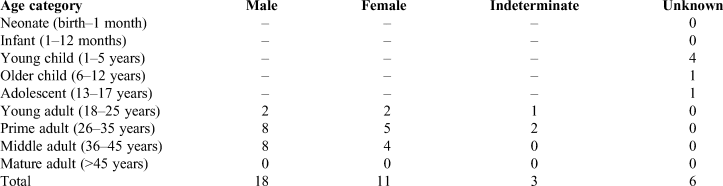
The skeletal assemblage represented the remains of at least 65 individuals (54 articulated inhumations, the single urned cremation burial, fragments of disarticulated bone from four grave fills, four ditch fills and one pit, and a fragment of cremated human bone from one grave fill).Footnote 51 Of these 65 individuals, 56 were adults and nine were juveniles; 13 were female, 22 were male, 6 were of indeterminate sex and 22 were unsexed (table 2). Although some caution should be exercised since a quarter of the adults could not be assigned to a more specific age category due to poor preservation and/or the absence of diagnostic elements, it is striking that almost half were prime adults, aged 26–35 years; a large proportion were middle adults, aged 36–45 years, and there were none above this age group. Post-cranial indices and adult male stature were within the expected range for the period but adult female stature was low, falling c. 10 cm below the average.Footnote 52 The predominance of males over females is typical for a Roman urban or semi-urban cemetery, although given the large proportion of skeletons at Chapel Lane that could not be sexed the discrepancy may not be significant. Neonate and infant individuals were completely absent, and a similar pattern was found in the A46 Improvement Scheme excavation on the opposite side of the Fosse Way, where the burials comprised adult inhumations with the exception of one adolescent female aged 15–17 years old.Footnote 53 In contrast to this pattern, numerous infant burials were found placed in and around buildings in A46 Improvement Scheme excavation area DE3002, c. 150 m north of the Chapel Lane burials.Footnote 54 Most of these dated to the middle and late Roman phases, and adult inhumations were largely absent apart from one late Roman individual. It is probable that neonates and infants were consistently buried close to the home, while those of a certain age and older were buried away from the main domestic area. The practice of burying infants in and around buildings during the Roman period is fairly common and there are many examples of infants found sealed within successive floor layers and others overlain by domestic debris.Footnote 55 The absence of infants at Chapel Lane may therefore be explained by their having been buried closer to the focus of domestic occupation, which presumably lies unexcavated on the road frontage.
age and sex distribution of the cemetery population

Indeterminate = sexually dimorphic characteristics mixed; unknown = no sexually dimorphic characteristic present.
Health and environment
In general, the health of the population is typical of other Roman-period assemblages, with rates of dental and skeletal pathology consistent with those reported for other Romano-British populations, although crude dental pathological prevalence was at the high end of the expected range. It should be noted that data collection in general (and hence interpretation) was hindered by high levels of fragmentation and incompleteness.
The most common skeletal pathology was extra-spinal osteoarthritis (OA). This is commonly observed in archaeological populations, although its anatomical distribution and prevalence in Romano-British populations is highly variable.Footnote 56 Almost a third of all adult skeletons at Chapel Lane had OA in one or more joints. Adults from the older age categories (prime and middle adult) were increasingly affected by the condition, and males were much more likely to exhibit OA than females. The acromio-clavicular joint was most commonly affected (16.67 per cent true prevalence rateFootnote 57 for both the left and right joints). Clinically, OA in this location is more common in elderly patients and is thought to be largely age progressive.Footnote 58 Prevalence of OA in the acromio-clavicular joint is low in Romano-British assemblages (an average of 1.51 per cent TPR for Roman Britain).Footnote 59 However, the high TPR at Chapel Lane could be influenced by the low number of acromio-clavicular joints present overall: two out of a total of twelve joints were affected (left and right combined). The higher prevalence has therefore probably been influenced by poorer preservation, high levels of fragmentation, and general absence of the parts of skeletal elements that comprise this joint, that is the acromion of the scapula and lateral end of the clavicle.
Dental health was poorer than average for the period, with most types of dental disease falling within the upper end of the range of normal variation. The most common dental pathologies were calculus (permanent dentition 60.27 per cent TPR) and periodontal disease (16.0 per cent TPR). Prevalence of dental caries was also higher than average for the period. The observed patterns are suggestive of poor oral health coupled with consumption of more cariogenic foods than recorded for the population at the A46 Improvement Scheme and comparative populations from the wider country such as Bletsoe, Bedfordshire, and Lankhills, Winchester, though it should be noted that the latter is from the south of England, where factors such as geographical variation may also influence differences in oral health.
Evidence of non-specific infection and inflammation was completely absent in adult female individuals, with only males and skeletons of indeterminate sex exhibiting such lesions, e.g. periosteal new bone formation. Prevalence and severity of periosteal new bone formation in archaeological populations can be indicative of adaptation/maladaptation to environmental conditions, in particular poor sanitation, malnutrition and general health stressors. As such, its presence or absence is often used as an indicator of the general health of the population.Footnote 60 With this in mind, the evidence from Chapel Lane suggests that females may have been less susceptible to such stressors. However, erosion and abrasion of the cortical surfaces of the bones may also have eradicated evidence of periosteal new bone formation in this group (especially subtler lesions). In this respect, observed prevalence of periostitis among the Chapel Lane individuals should be viewed as a minimum rate.
Males were also much more likely than females to have one or more healed fractures. This pattern is also borne out in the observed comparative data, and generally in data across Roman Britain.Footnote 61 The types of fractures observed were caused by a variety of direct or indirect mechanisms, with no overt evidence for interpersonal violence. Of note are three skeletons that exhibited similar rotational ankle fractures, which are relatively uncommon clinically.Footnote 62 Commonly cited causes of these types of fractures include falls and sporting injury (e.g. during running or jumping onto a twisted foot or ankle), and the instances at Chapel Lane are similarly likely to be accidental, although the occurrence of the same injury in three individuals suggests that the cause was some common activity, and may have been occupational.Footnote 63
Also of note was the high prevalence of modifications to the leg bones that are typically associated with individuals who habitually adopt a squatting posture. Changes in the ankle were represented by lateral tibial squatting facets (left = 5/6, 83.3 per cent; right = 5/8, 62.5 per cent). These changes are observable as a small anterior extension of the distal tibial joint surface, and they are likely to be caused by habitual extreme movement involving hyperdorsiflexion at the ankle, that is, bending of the foot upward towards the shin.Footnote 64 The rates observed at Chapel Lane are higher than expected, especially compared to the larger cemetery population at Lankhills, where lateral squatting facets were present on 14/246 (5.7 per cent) of left tibiae and 18/242 (7.4 per cent) of right tibiae.Footnote 65 Such modifications may have been related to the undertaking of everyday habitual work or rest postures.Footnote 66
Diet
In general, patterns of dental health are shown to worsen in the Romano-British period compared to the preceding Iron Age, which may relate to a lack of oral hygiene in conjunction with an increase in the consumption of foods that contain sucrose (e.g. honey, wine and a fermented grape juice known as sapa).Footnote 67 Starchy foods may also have a cariogenic effect when consumed in large quantities in combination with sugar (the combination of sugar and starch together is considered to be more cariogenic than sugar alone).Footnote 68 Thus, the higher prevalence of dental caries observed in the Chapel Lane population may be indicative of increased consumption of sugary foods, possibly in conjunction with foods containing starch, compared to the other similar populations. Caries prevalence at Chapel Lane should be seen as a minimum rate considering that it is impossible to deduce how many carious teeth were lost ante-mortem.
Compared to other data, crude prevalence of dental enamel hypoplasia was quite high, with a third of dentate skeletons exhibiting hypoplastic lesions; this higher rate is consistent with findings from the A46 Improvement Scheme, where crude rates were even more elevated.Footnote 69 However, per-tooth prevalence at both sites was much lower, suggesting that while a higher proportion of the population exhibited lesions, fewer teeth per person were affected. Furthermore, the ages at which lesions were likely to develop could broadly be divided into two groups: in the deciduous teeth (below the age of nine months) and in the permanent teeth (between the ages of three and five years).
Affected young children in these age brackets are thus likely to have suffered periods of low-level physiological stress in the form of illness, nutritional deficiency and/or metabolic disruption during these times. The clustering of individuals with hypoplastic lesion development around the age of three to five years is interesting as this may relate to weaning. Reduced breast milk consumption and introduction of new solid foods can potentially expose young children to new pathogens, in addition to which weaning foods of lesser nutritional quality than the previously consumed breast milk can put a child at risk of nutritional stress.Footnote 70
Males were almost twice as likely to exhibit cribrous lesions in the eye sockets than their female counterparts. While presence of cribra orbitalia has been linked to the development of iron-deficiency anaemia or vitamin B12 deficiency,Footnote 71 and orbital lesions exhibiting bone growth beyond the outer table are most likely to be associated with anaemia; none of the lesions exhibited by the Bingham population expressed this.Footnote 72 As the precise cause of cribra orbitalia is unclear, interpretively this pattern can only suggest that males and females were subject to different types of health stressors. This does fit, however, with the assertion that males may have been more vulnerable to physical stress than females.Footnote 73
Studies have highlighted the influence of factors such as settlement type (i.e. rural versus non-rural) and diet on population health. For example, research into health in late Roman Britain has shown that populations from rural sites are likely to have poorer health and diet than their urban counterparts.Footnote 74 Migration should also be considered by way of explanation; observed health and dietary differences in population subsets may also be reflective of a childhood spent elsewhere. This interpretation could apply to Bingham; however, the sample is small and the (albeit limited) isotope results (see below) suggest that the population may chiefly comprise people who were born and raised in the local area.
The cremation burial
The burnt bone assemblage comprises one urned cremation burial and one fragment of residual cremated long bone from an inhumation grave. Cremated bone from the burial weighed a total of 232.2 g, with most of this (222.2 g) from inside the urn and the remaining 10.1 g from soil immediately around the urn. This falls below the weight range cited by McKinley for archaeologically recovered cremation burials (600–900 g),Footnote 75 but it is uncertain whether this was due to the evident truncation of the burial by ploughing. Alternatively, this low bone weight could suggest that only some of the cremated individual was deposited, the rest being taken elsewhere. During excavation of the burial it was noticed that there was a lack of charcoal, which could suggest that the cremated bone fragments were hand-picked from the pyre for deposition within the burial, deliberately excluding any form of pyre debris or fuel ash.
Osteological indicators of age and sex were very limited. The size and morphology of the bone fragments were consistent with those of an adult, aged over 18 years, and the rounded shape of the orbital margin fragment was in keeping with that of a male individual. However, as this was the only sexually dimorphic trait available, the estimation must be regarded as very tentative.
Strontium and oxygen isotope analysis of tooth enamel
Ten skeletons were sampled for stable isotope analysis, primarily to establish whether Anglo-Saxon burial 794 (below) was a non-local migrant from a population with a different geographical origin to the Romano-British burials. Either a second molar or premolar was sampled from each individual, and the ratio of strontium and oxygen isotopes determined in order to investigate likely childhood geographic origin.
The data from this site are compared with those from other data sets from contemporary burials at Catterick, Gloucester, London, Winchester and York in figure 9.Footnote 76 The Chapel Lane oxygen isotope data generate a very tight grouping of data with a small interquartile range and no outliers, in contrast to the other datasets. The small size of the Chapel Lane dataset might play a role in this, but equally it could support a local origin and possibly support an argument for an isotopically stable water source such as a well into a well-equilibrated aquifer. The strontium isotope range from the Chapel Lane individuals, including 794, is consistent with an origin within a 30 km radius of the site.Footnote 77 However, the values are not unusual and can be found elsewhere in the UK and the continent.
Results of the isotope analysis: (a) the 87Sr/86Sr isotope composition of the Chapel Lane samples and comparative Roman UK populations represented by box-and-whisker plots; (b) the δ18O CARBVSMOW isotope composition of the Chapel Lane samples and comparative Roman UK populations represented by box-and-whisker plots. (Comparative data from Chenery et al. Reference Chenery, Müldner, Evans, Eckardt and Lewis2010; Reference Chenery, Eckardt and Müldner2011; Reference Chenery, Pashley, Lamb, Sloane and Evans2012; Eckardt et al. Reference Eckardt, Chenery, Booth, Evans, Lamb and Müldner2009; Evans et al. Reference Evans, Stoodley and Chenery2006; Leach et al. Reference Leach, Eckardt, Chenery, Müldner and Lewis2010; Montgomery et al. Reference Montgomery, Knüsel, Tucker and Bonogofsky2011; Müldner et al. Reference Müldner, Chenery and Eckardt2011.)

POSTSCRIPT TO THE CEMETERY: A FIFTH/SIXTH-CENTURY BURIAL IN A ROMAN WELL
The burial of an individual suffering from leprosy (794), radiocarbon dated to cal. a.d. 425–565 (95.4 per cent confidence),Footnote 78 in the top of Roman well 790 provided a striking postscript to the use of the area for burial during the Roman period. This was an adolescent aged 13 to 17 years, who had been buried in a pit dug into the top of the well, lying directly on the surface of the shaft's stone lining (fig. 10). Pottery from the construction packing of the well indicated that it was dug sometime after the middle of the second century, but the sherds from its backfill were not sufficiently diagnostic to establish when it went out of use. However, all the material was definitely Roman and, since activity associated with the roadside enclosures apparently ceased before the end of the fourth century, there was presumably some period of disuse before the burial was inserted. A handmade bowl of fifth/sixth-century date was found in close proximity to the skeleton and is likely to have been deliberately placed as a grave good; it may be significant that the form of the urn was consistent with vessels commonly used as containers for contemporary cremations. Both the radiocarbon date and the dating of the urn indicate that the burial dates from the earliest part of the Anglo-Saxon settlement of the region, which appears to have comprised a piecemeal process, with only limited evidence for Anglo-Saxon material from settlements or cemeteries in Nottinghamshire before the sixth century.Footnote 79 Isotopic results for this individual are consistent with the local environment, and thus it is likely that skeleton 794 spent their childhood in the local area and was not a first-generation migrant, if indeed they were of Germanic rather than British descent (although non-local origin in a location with a similar environment cannot wholly be ruled out).
Fifth/sixth-century inhumation 794 inserted into the top of Roman well 790.

The skeleton was particularly notable for the presence of specific infectious lesions consistent with a diagnosis of leprosy, which is a most uncommon find for this period. Characteristic lesions were observed in the facial bones of the skeleton (fig. 11). Despite some taphonomic abrasion, the margins of the nasal aperture were rounded and eroded/reabsorbed both inferiorly and around the sides of the aperture. Increased abnormal vascularity was apparent on the inferior and superior sides of the palate in the left and right sides of the maxilla. It should be noted that the observed oral porosity was compared to skeletons from the same site, not affected by oral disease, in order to rule out the possibility these were caused by normal variation. In addition, the aforementioned periosteal new woven bone was present in the right superior surface of the palate (just posterior to the margin of the inferior nasal aperture). Lytic lesions were also present in this area. These are consistent rhinomaxillary syndrome bone changes associated with a diagnosis of leprosy.Footnote 80 Several other pathognomic changes, besides rhinomaxiallary syndrome, are also associated with leprosy (e.g. reabsorption of the alveolar process and intranasal structures, ante-mortem loss of the anterior teeth), but these were not observed in this individual. Other infectious changes were present elsewhere in the skeleton which may be associated with leprosy, but these are not diagnostic and may instead pertain to some other (non-specific) infectious condition. Alternative diagnoses (e.g. an unidentified systemic infection, late-onset congenital treponematosis or other treponemal disease such as venereal syphilis) still cannot be wholly ruled out, but the leprosy diagnosis should be regarded with a degree of confidence.Footnote 81
Skeleton 794: rounded, eroded margins of the nasal aperture, plus periostitis and lytic lesions affecting the superior and inferior maxillary palate. All consistent with rhinomaxillary syndrome and a diagnosis of leprosy.

Although the first written records of leprosy in Britain date to the tenth century,Footnote 82 the earliest reported archaeological cases date to the Roman period.Footnote 83 Though the frequency of leprosy in Britain does appear to increase slowly from the Roman period onwards, it is not until the twelfth century that infection rates begin to peak.Footnote 84 The number of cases dating to the post-Roman/early Saxon period is very small, and they tend to be located in the southern half of England. Examples include a fifth/sixth-century burial of a leprous male aged around 21 to 35 years old at Great Chesterford, Essex,Footnote 85 a possible sixth-century instance from Beckford in Worcestershire (formerly Gloucestershire),Footnote 86 seventh-century cases from Burwell and Edix Hill in CambridgeshireFootnote 87 and Eccles in Kent,Footnote 88 and a seventh- to eighth-century skeleton from Tean in the Isles of Scilly.Footnote 89 Given this evidence, the probable leprosy diagnosis in early fifth- to mid sixth-century skeleton 794 from Chapel Lane is rare for this period, and previously unattested as far north as Nottinghamshire at this time. It is possible that this condition, and perhaps more significantly any visible disfigurement associated with it, was the reason behind the decision to bury skeleton 794 in a seemingly isolated location, rather than in the community cemetery, wherever that may lie. The juxtaposition of the burial and well is unlikely to be coincidental, but the circumstances that led to this arrangement can only be guessed at, although presumably the backfilled well remained visible on the ground surface. The burial was at the bottom of a substantial pit, although it was not entirely certain whether it lay at the base of the pit or was already in place and had been disturbed by the pit, which might explain why much of the middle of the skeleton was missing. Neither is it certain what had happened to the upper part of the well lining, which was absent to a depth of c. 0.5 m. Indeed, one possible scenario is that the burial was opportunistically interred within a pit that was initially dug in order to obtain stone from the lining, just as the upper part of the stonework had evidently been robbed from wells 192, 568 and 884.
Evidence of activity in the area had markedly reduced from the late Roman period. Both Oswald and Todd argued that Margidunum was largely abandoned following the end of the Roman period, although small quantities of early Anglo-Saxon pottery from both their excavations suggest an ephemeral presence remained.Footnote 90 Further Anglo-Saxon finds, although still few in number, were recovered during fieldwalking surveys along the Fosse Way.Footnote 91 It has also been suggested that some of Todd's late Roman inhumations found cutting the earthworks around Margidunum could be early Anglo-Saxon, though there is no conclusive evidence of their date.Footnote 92 Signs of early Anglo-Saxon habitation in the wider landscape are equally scarce but nonetheless present. Since Newton villa has not been excavated, any possibility of continued post-Roman use of the building complex is unknown. Excavation between the villa and the Fosse Way, however, has discovered a few Anglo-Saxon features. The most significant of these was a sunken-featured building located about 250 m north-west of Margidunum.Footnote 93 The feature contained some late Roman/early Anglo-Saxon glass, an Anglo-Saxon cruciform brooch and a wide selection of fifth/sixth-century pottery representing at least 48 vessels. Two pits were discovered further south close to the western side of the Fosse Way, one to the north of the current excavations and the other to the south. The nearest Saxon settlement of any significance has more recently been found about 2.3 km to the south-west at Saxondale, where an enclosure and several pits were accompanied by a fifth/sixth-century cremation cemetery featuring at least 19 burials.Footnote 94
The selection of a disused Roman feature within an abandoned settlement as an appropriate location for this burial is striking and was presumably a consequence of the contemporary community's attitude toward the deserted site – be it positive or negative. The relative paucity of identifiably early Anglo-Saxon material may imply that Nottinghamshire continued to be populated by communities derived from the Roman population into the sixth century,Footnote 95 and it is therefore possible that skeleton 794 was buried by a community that viewed the abandoned settlement as the home of their forebears. A study on the reuse of Roman sites for the burial in the early Anglo-Saxon period has suggested that such instances reflect places of perceived importance in the contemporary landscape rather than simply the opportunistic use of abandoned space.Footnote 96 An example of the significance attached to Roman remains occurred at Newark, where reused Roman vessels appear to have been regarded as desirable containers in which to bury Anglo-Saxon cremations.Footnote 97 Alternatively, if the presence of the urn within the burial at Chapel Lane indicates that the community identified with a more recently arrived community, they may have felt no connection to the former settlement and considered it to be the work of a distinctly different community, in which case the apparent exclusion of the individual from normative Anglo-Saxon burial locations may suggest some form of exclusion from wider society.Footnote 98 It is notable in this context that the burial does not correspond with any of the categories of ‘deviant burial’ that Reynolds has defined for the early Anglo-Saxon period, defined by a prone position or evidence for decapitation, stoning or amputation,Footnote 99 and which he associated with superstitions related to fear of the dead and a desire to ‘lay potentially troublesome individuals in the grave without fear of their returning to inhabit the world of the living’.Footnote 100 However, Reynolds stressed that even these types of abnormal burials were usually placed within the community burial ground, which makes the location of skeleton 794 all the more unusual.Footnote 101
In summary, the placement of this individual within an abandoned Roman settlement and burial ground appears to have been significant, as was the deposition in the abandoned well, which was deemed more appropriate than digging a grave for the body. It is possible that the fact that this individual had contracted leprosy made them a social outcast. The exact reasoning behind the burial in this particular location, however, must remain open to debate.
DISCUSSION: CHAPEL LANE AND THE MARGIDUNUM COMMUNITY
ORIGINS AND DEVELOPMENT OF MARGIDUNUM
The contribution that the excavation results can make to discussion of the early phases of Margidunum is limited, particularly due to the paucity of dating evidence from the earliest features. The origins of the settlement have been much debated since Oswald first posited that the defensive circuit belonged to a fort and associated this with the establishment of the Fosse Way as a defensive line, which he attributed to Ostorius Scapula in c. a.d. 48.Footnote 102 This debate has clear relevance to discussion of the origins and development of small towns more widely and demonstrates the complex interplay of factors that may have been at work. Traditionally these settlements were thought to have developed from vici outside early forts,Footnote 103 but more recent research has emphasised their role as a response to socio-economic developments among the native British population, whether as an evolution from a pre-Roman settlement or a new foundation.Footnote 104 Although Oswald's attribution of the visible defences at Margidunum to an initial military phase is no longer tenable, the second element of the placename, dunum, is generally accepted as indicating the presence of a fort.Footnote 105 A military presence is further indicated by the small quantities of metalwork of military character from his and Todd's excavations, including an arrowhead and belt and harness attachments from Oswald's excavations and a pilum head and a possible spear butt from Todd's.Footnote 106 In addition to this, the Claudio-Neronian date of the earliest pottery is consistent with occupation during this military phase, dated by Todd to c. a.d. 50/55 to 70.Footnote 107 If Todd was correct in interpreting the V-shaped ditch he excavated outside the northern limit of the later town defences as part of the defences of a fort situated to the north, then the early material both he and Oswald uncovered was situated outside it and is likely to derive from either military activity within an (unidentified) annex attached to the fort or a civilian vicus. The character of this occupation is unclear, although the large quantities of iron slag and ironstone reported by Oswald suggest that iron-smelting was a significant activity, perhaps in the context of military supply. The contemporary activity identified in Todd's Newton Lane trench, however, indicates occupation at least 275 m from the fort, albeit not necessarily extending continuously along the intervening road frontage. It is inconceivable that activity associated with the fort could have been this extensive, so most of this must have been civilian in character. A comparable instance of early development has recently been excavated at Alchester, on Akeman Street in Oxfordshire, and demonstrates that such occupation could be localised and transitory rather than necessarily representing spatially and temporally continuous development. Here occupation alongside a road that led from Alchester toward the neighbouring town of Dorchester-on-Thames appears to have been abandoned after the road was superseded by a more direct route across the moor during the second century, while suburban settlement north of the walled town is predominantly late Roman in date.Footnote 108 Indeed, extramural settlement at Alchester appears to have been focused on adjacent road junctions rather than extending outward radially from the town, and to have shifted over time as the relative importance of the various routes changed. It is plausible that at Margidunum the early occupation at Newton Lane and A46 excavation area DE3002 similarly represent discontinuous areas of localised occupation rather than systematic expansion from a central core.
In addition to the putative military origin of Margidunum, an official influence on the development of the settlement may have taken the form of a mansio or mutatio of the cursus publicus or the residence of an administrative officer such as a beneficiaries consularis or regionarius, as was suggested by Todd.Footnote 109 Ernest Black has argued convincingly that at towns with an apparent military origin, the presence of a mansio that continued in use after the army moved on may have served an important role in the intermediate period between the military and civilian settlement, the requirement to service travellers providing motivation for the population to remain.Footnote 110 He suggested that Oswald's Schola and associated buildings (Buildings L–M in Todd's classification) may be such a structure on account of their relative opulence.Footnote 111 In this reconstruction, the Schola, Building L, provided stalling for animals, indicated by an internal drainage gully and soakaway, while accommodation was located in the adjacent Building M, which included heated rooms. The presence of poorly understood timber buildings beneath the (putatively Hadrianic) main buildings may indicate an early, potentially military origin for whatever installation they represent, and subsequent construction of a building during the fourth century indicates a long history. However, it is possible to object that the buildings do not appear to have had the courtyard layout that characterises mansiones and Leary and Baker instead posited a religious function related to the associated pool. Regardless of whether this group of buildings was a mansio, it is probable that such an establishment existed somewhere at Margidunum, and indeed its inclusion in the Itineraries suggests a role in the transport network or some form of official status.
The peopling of the nascent vicus during the military phase may have incorporated camp followers who arrived with the army, but there was definitely a pre-Roman population locally who may also have contributed to it, whether through choice or compulsion. The farmstead excavated on the A46 Improvement Scheme west of the defended area came to an end at around this time,Footnote 112 and ditch 1017 and the ditches excavated on the opposite side of the Fosse Way in A46 Improvement Scheme Area DE3001, which have been argued here to form part of an arrangement of boundaries pre-dating the construction of the road, may have formed part of its landholding. The undated curvilinear gully and pits at the northern end of the excavation area may similarly have been part of a pre-vicus native settlement, the gully perhaps being an element of a roundhouse, since their position some 50–60 m from the road makes them unlikely to be associated with the subsequent roadside settlement. The construction of the road and fort would certainly have displaced the populations of these native settlements, as no doubt happened to communities throughout the new province, and they may have found a new home in the vicus.
The establishment of the plots at Chapel Lane during the middle of the second century may have been contemporary with the replacement of the roundhouses at excavation area DE3002 with rectangular buildings, representing part of a wider re-organisation of the extramural area. The regularity of the plots that were established at this time, and the apparently identical corresponding arrangement on the west side of the Fosse Way that was exposed by the A46 Improvement Scheme, suggest that they were laid out in a single episode of planned development. This appears to have occurred at a time of widespread disruption to settlement patterns in Britain, during the decades after c. a.d. 120, when communities throughout much of the province appear to have gone through a period of flux, encompassing an overall increase in settlement numbers but also abandonments and reorganisation of individual sites, before settling down into the arrangement that was to remain in place into the fourth century.Footnote 113 The causes of this phenomenon are by no means certain, and may have been manifold and regionally varied, but they surely represent a re-organisation of economic structures associated with the province attaining more or less its definitive geographic form, with substantial permanent garrisons in the north and west that needed to be supplied from the rest of the country, and with the concurrent formation of villa estates.Footnote 114 The increase in settlement numbers suggests that a rising population may also have been a factor, possibly driven by the annual cohort of 800 to 1600 retiring legionaries, many of whom would have chosen to remain in the province in which they had served.Footnote 115 Nucleated settlements of a range of sizes, including roadside settlements such as Margidunum, were significantly affected by these changes due to their potential role as centres at which livestock and other produce were gathered or as staging posts along the transport network, and this may have been the context for the expansion and rationalisation of facilities indicated by the construction of the plots at Chapel Lane. Similar developments can be seen at comparable settlements where the extramural areas have been investigated. This is exemplified at Ilchester, where an area of first-century occupation south-west of the town that had been buried by alluvial deposits was brought back into use by the laying out of rectilinear arrangements of ditched boundaries that extended back from the Fosse Way on either side, with at least one stone-footed building located on the road frontage.Footnote 116 As at Margidunum, burials were subsequently inserted along the rear boundaries during the late Roman period. At Towcester, first-century occupation in the form of ditched fields containing small circular structures localised to the west side of the road running south-west toward Alchester was replaced around a.d. 170 when a more coherent arrangement of rectilinear boundaries was laid out that, as at Chapel Lane, formed parallel arrangements on both frontages.Footnote 117 Rectangular buildings of timber or cob on unmortared stone foundations were constructed by the roadside, their orientation parallel to the road rather than gable-end-on suggesting that there was little pressure on space in the newly created suburban area. Cropmark evidence has enabled a wide area of the Roman landscape south of Alchester to be reconstructed and has demonstrated that following (or associated with) the laying out of the road across Otmoor at the end of the first century, a whole-scale re-organisation of the landscape took place, with small plots fronting onto the road and larger fields behind, as well as an area around a conquest-period parade ground that remained ‘blank’ and may have been retained under military or municipal control.Footnote 118 Dating evidence is limited, but the roadside plots at this location were most likely laid out at the same time as the road and reworked after a.d. 120.
The evidence from Chapel Lane and the previous excavations at Margidunum demonstrates that the formation and development of the vicus was a dynamic process, probably driven by several factors, providing a case study that may be useful in the wider analysis of the origins of roadside settlements. The initial military presence indicates that the army chose the specific location on a prominent hill on the road between the legionary bases at Leicester and Lincoln at a junction with the road that branched off the Fosse Way and extended to the crossing of the River Trent at East Bridgford. The perpetuation of the settlement after the army had moved on may be associated with the presence of a mansio, where services were provided to travelling officials and where livestock and produce from the surrounding area were gathered for transport to supply the province's garrison and urban population.
THE CHARACTER OF THE SETTLEMENT AT CHAPEL LANE
The character of the remains at Chapel Lane was more akin to structures and refuse found on rural farms than urban centres, and it is likely that the population of the roadside enclosures was primarily engaged in agricultural production. There was certainly no indication of specialised production of goods for sale to passing travellers or for trade in a putative market within the town. Further along the road frontage, the occupants of the buildings in A46 Improvement Scheme Areas DE3002 were engaged in iron smithing, malting and repairs to samian vessels,Footnote 119 but the small scale of these activities indicates that they were not a major component of the economy and were secondary to farming. The evidence from the burials, too, presents a picture of a population with the hard-working lives typical of Romano-British peasants, with osteological evidence for physiological stress, childhood illness/nutritional deficiency, and in some instances pathological changes occasioned by habitual squatting that was presumably labour-related. The possibility that some were enslaved cannot be ruled out, although these would be extremely difficult to distinguish from the rest bioarchaeologically. Furthermore, the age profile of the burials, including an absence of any individual aged over 45 years, appears to indicate that they experienced shortened lifespans (although a quarter of the adults could not be assigned to a specific age category). The simple burial rites and the rarity of grave goods may also be indicators of the general poverty of this community.
Although the mainstay of the population's livelihood was probably farming, the location of the settlement on the road, and particularly its linear arrangement, which provided every plot with access to the frontage, suggests that such access was considered essential to their function. It may be significant, therefore, that there was no evidence for breeding of livestock within the plots in the form of neonatal deaths; this suggests that these activities took place away from the road and that the roadside enclosures were more involved in gathering of livestock and produce for trans-shipment. The use of proxies such as pottery as evidence for the movement of more perishable agricultural goods has demonstrated that produce from the Midlands was being moved both northward to the military zone and south to London,Footnote 120 and the community at Chapel Lane may have been contributing to this. The location of the town roughly halfway between Leicester and Lincoln, and approximately a day's travel from each, means that it was probably an important stopping point and a conduit for people, goods and information travelling between the two towns, and potentially that it was part of the longer transport network between the agricultural south and the garrisons of the north. This, more than exploitation of passing trade, may have been the reason behind the positioning of settlement on the road frontage. The paucity of objects imported from elsewhere, however, suggests that the community gained little material benefit from such trade.
Two communities?
A final point that should be made regarding settlement at Margidunum is the possibility that we are seeing evidence for two distinct communities, or at least two separate elements within the town's population. It has been mentioned above that the simplicity and uniformity of the burials at Chapel Lane contrast with the graves excavated by Todd in what is believed to be part of an extramural cemetery outside the south-west gate of the defences. The presence of two graves with crudely made lead coffins suggests that the extramural cemetery included individuals of greater wealth or status than the population at Chapel Lane. At the opposite end of the spectrum, an individual who had been decapitated and laid prone is evidence that a wider range of individuals and burial practices may be represented. A possibly similar contrast may be visible at Ilchester, between the burials mentioned above along the ditched boundaries to the rear of the roadside plots south-west of the town and the cemetery outside the north gate at Northover House.Footnote 121 The burials to the rear of the plots were very similar to those at Chapel Lane, being located along boundary ditches, with a little under half the 60 excavated graves provided with a wooden coffin and rites including four prone burials, four decapitated and six flexed. Grave goods other than hobnailed footwear were rare, although a range of items was present including pottery, coins, two knives and a small number of other metal objects. Excavation at Northover House was very limited, under evaluation conditions, and only eight of the many graves exposed in plan were fully excavated, so nothing can be said of the status of the majority, but the site clearly represents a formally arranged cemetery, quite different to the burials south-west of the town. A high status for at least part of the cemetery population was indicated by three individuals interred in lead coffins within stone sarcophagi.
There is also a significant contrast between the defended area and roadside plots in the character of the buildings. Little evidence for buildings was found at Chapel Lane, probably because the excavation area did not extend close enough to the road frontage, but Area DE3002 of the A46 Improvement Scheme uncovered a sequence in which roundhouses built in the late first and early second century were succeeded by small rectangular timber buildings, quite different from the architecture of the buildings within the defended area, where stone-founded strip buildings appear to have been the norm from the outset. Indeed, window glass, painted plaster, roof tile and architectural stone found by Oswald suggests that structures of a distinctly Roman form were present in the defended area from a very early date, and buildings here appear to have always been predominantly stone. The evidence from the defended area therefore suggests a population whose lifestyles were quite different from those of the peasant farmers at Chapel Lane, and who may have been more directly engaged in whatever official installation was situated there. At Margidunum this distinction appears to have been present from the founding of the settlement, before the defences were constructed, and was probably an important factor in deciding which parts to include within the defences. Different treatment of these two groups may be seen both in the decision on which areas to enclose, which presumably focused on the official structures, and in the apparent disregard with which part of the settlement was demolished to clear the ground for construction of the rampart. The size of the area enclosed within defences varied greatly between settlements, which Black has attributed to their being the product of individual initiatives rather than a coherent programme, albeit the general principle of providing defended points along the routes of the cursus publicus for the security of travellers and wagon trains may have been decided centrally.Footnote 122 He drew particular attention to the very small defended area at Margidunum, as well as that at Neatham, as examples where the concern was with protecting an official establishment at the heart of the settlement rather than the entire occupied area.
CONCLUSION
In summary, the sequence revealed at Chapel Lane gives us a clear insight into the development of Margidunum as a small town and into the lives of those who occupied the roadside plots lining the Fosse Way on the town's peripheries. Although the skeletal remains indicate lives that were subject to the health stresses of a relatively impoverished existence, the occupants of the Chapel Lane plots were involved in productive strategies that were probably very much connected with the broader economic and political structures of Roman Britain. The difference between the walled area of Margidunum, represented in both the cemeteries and the built environment, may be indicative of quite stark social differentiation present within the community. The Chapel Lane excavations, alongside previous interventions at Margidunum, thus add important new information to our growing understanding of the small towns of Roman Britain.
ACKNOWLEDGEMENTS
The authors would like to thank Barratt and David Wilson Homes, who funded the excavation and publication, and Simon Mortimer of RPS Group, who commissioned it on their behalf. Thanks are also extended to Conservation Officer James Bate, who monitored the work on behalf of Rushcliffe Borough Council, for his advice and patience. Particular thanks go to all the Oxford Archaeology staff who worked on the project. This article draws on reports on the pottery by Edward Biddulph, the coins by Paul Booth, the objects of metal, glass and shale by Ian R. Scott, the ceramic building material by Cynthia Poole, the worked stone by Ruth Shaffrey, the slag and related high-temperature material by Lynne Keys, the charred plant remains by Sharon Cook, the charcoal by Julia Meen and the fish remains by Rebecca Nicholson. Charles Rousseaux prepared Figures 1, 2 and 4, Magdalena Wachnik took the photographs of the skeletal pathologies for Figures 7, 8 and 11, and Charles Rousseaux and Lucy Gane formatted the illustrations for Britannia.