Introduction
Corporate philanthropy has become an important strategic tool for family firms, particularly in China (e.g., Ge & Micelotta, Reference Ge and Micelotta2019; Jin & Hu, Reference Jin and Hu2024; Pan, Weng, Xu, & Chan, Reference Pan, Weng, Xu and Chan2018). A key scholarly debate centers on how family firms differ from nonfamily firms in their philanthropic behavior, yet empirical findings remain inconsistent. Some studies suggest that family firms engage more actively in philanthropy than their nonfamily counterparts (Li, Au, He, & Song, Reference Li, Au, He and Song2015), while others report the opposite (Campopiano, De Massis, & Chirico, Reference Campopiano, De Massis and Chirico2014). These inconsistencies highlight the need to examine the heterogeneity in philanthropy among family firms, which has been overlooked in prior research. A fundamental question, therefore, persists: what drives some family firms to engage more in corporate philanthropy than others? Previous studies have identified a range of drivers, including altruistic motives like empathy (Muller, Pfarrer, & Little, Reference Muller, Pfarrer and Little2014), spirituality (Bhatnagar, Sharma, & Ramachandran, Reference Bhatnagar, Sharma and Ramachandran2020), and guilt (Ji, Huang, & Li, Reference Ji, Huang and Li2021), as well as strategic motives, such as reputation enhancement (Brammer & Millington, Reference Brammer and Millington2005), legitimacy acquisition (Wang & Qian, Reference Wang and Qian2011), institutional conformity (Ge & Micelotta, Reference Ge and Micelotta2019), and political connections (Zhang, Marquis, & Qiao, Reference Zhang, Marquis and Qiao2016).
Recent research has begun to explore the influence of transgenerational succession on strategic philanthropy in family firms. Transgenerational succession is a central concern for these firms, and many family founders exhibit strong transgenerational succession intention – a profound desire to pass the business on to the next generation, particularly to their children (He & Yu, Reference He and Yu2019; Huang, Chen, Xu, Lu, & Tam, Reference Huang, Chen, Xu, Lu and Tam2020). Reflecting this, prior research has shown that such intention motivates parent-incumbents to spend more on corporate philanthropy (Li et al., Reference Li, Au, He and Song2015). However, a pressing challenge is the ‘willing successor’ dilemma, that is, the absence of a successor willing to take over the business (Parker, Reference Parker2016). This issue is particularly acute in China, where the former one-child policy reduced the availability of potential heirs (Cao, Cumming, & Wang, Reference Cao, Cumming and Wang2015; Zhu & Zhou, Reference Zhu and Zhou2022). Consequently, parent-incumbents’ transgenerational succession intention can only materialize if their children have succession willingness (De Massis, Kotlar, Chua, & Chrisman, Reference De Massis, Kotlar, Chua and Chrisman2014; Huang, Chen, et al., Reference Huang, Chen, Xu, Lu and Tam2020). The presence of a willing successor can thus be highly inspiring for the incumbents of Chinese family firms. While recent studies have investigated the impact of transgenerational succession on family firm philanthropy, they have primarily focused on philanthropy during and after succession (He & Yu, Reference He and Yu2019; Pan, Weng, Xu, & Chan, Reference Pan, Weng, Xu and Chan2018; Zhang, Lin, Huang, Djafarova, & Ren, Reference Zhang, Lin, Huang, Djafarova and Ren2024). This focus, however, overlooks the philanthropic activities that occur before succession.
To fill this research gap, we investigate how perceived child-successors’ willingness affects parent-incumbents’ corporate philanthropy. Drawing on socioemotional wealth (SEW) theory, we propose that perceived child-successors’ willingness increases parent-incumbents’ transgenerational succession anticipation, which is defined as the subjective probability of preserving SEW through transgenerational control. This anticipation, in turn, motivates parent-incumbents to engage in philanthropy as a strategic tool to proactively build a legacy for their children and pave the way for future succession. We thus posit transgenerational succession anticipation as a key mechanism through which perceived child-successors’ willingness drives corporate philanthropy by parent-incumbents.
Corporate philanthropy offers multiple benefits that support transgenerational succession, including enhancing the firm’s reputation, securing sociopolitical legitimacy, mitigating business risks, and accumulating family capital (Jin & Hu, Reference Jin and Hu2024; Muller & Kräussl, Reference Muller and Kräussl2011; Wang & Qian, Reference Wang and Qian2011). These benefits are critical for ensuring successful intergenerational transition and generating long-term spillover effects on the child-successor. While philanthropic activities may divert resources that could otherwise fund family welfare, the long-term survival of the family firm and the associated preservation of SEW depend on factors like sociopolitical legitimacy, risk management, and access to external resources. Corporate philanthropy is thus viewed as a ‘necessary cost’ for achieving transgenerational succession. As Gómez-Mejía, Haynes, Núñez-Nickel, Jacobson, and Moyano-Fuentes (Reference Gómez-Mejía, Haynes, Núñez-Nickel, Jacobson and Moyano-Fuentes2007) argued, family incumbents are willing to accept a certain degree of financial loss to avoid SEW losses. Therefore, we propose that parent-incumbents who perceive their children as willing to take over the firm tend to engage more in corporate philanthropy.
Furthermore, the parent-incumbent’s anticipation of transgenerational succession is highly susceptible to the external institutional environment, particularly a hostile one. A significant yet frequently overlooked hostile institution is the risk of state expropriation – the infringement of firm assets by the state or its agents (Jia & Mayer, Reference Jia and Mayer2017). State expropriation heightens parent-incumbents’ concerns about the potential failure of the family firm, thereby undermining their transgenerational succession anticipation and intensifying fears of SEW loss (Bammens, Hünermund, & Andries, Reference Bammens, Hünermund and Andries2022). By integrating institutional theory with the SEW perspective, we contend that state expropriation attenuates the positive effect of child-successors’ willingness on parent-incumbents’ corporate philanthropy. We empirically test these propositions using data from a national survey of Chinese family firms.
This study makes three contributions. First, our study sheds new light on the relationship between transgenerational succession and family firm philanthropy by highlighting the role of child-successor willingness, rather than passively treating it as given, in shaping philanthropy before succession. Prior research has predominantly examined the impact of transgenerational succession on family firm philanthropy during and after succession (He & Yu, Reference He and Yu2019; Pan et al., Reference Pan, Weng, Xu and Chan2018; Zhang et al., Reference Zhang, Lin, Huang, Djafarova and Ren2024), leaving it unclear how philanthropy unfolds before succession. Our findings show that perceived child-successors’ willingness motivates parent-incumbents to engage more in philanthropy before succession. By doing so, our study not only complements previous studies but also differs greatly from them.
Second, we contribute to the literature on family firm succession by identifying transgenerational succession anticipation as a key mechanism that explains how child-successors’ willingness affects parent-incumbents’ philanthropic engagement. While prior research has uncovered mechanisms through which transgenerational succession influences family firm behavior, such as parental altruism (Zhu & Kang, Reference Zhu and Kang2022), myopic loss aversion (Li, Bruton, Li, & Wang, Reference Li, Bruton, Li and Wang2022), power transfer (Huang, Chen, et al., Reference Huang, Chen, Xu, Lu and Tam2020), and transgenerational control uncertainty (Dorsch, Jaskiewicz, Combs, & Wulf, Reference Dorsch, Jaskiewicz, Combs and Wulf2023), our study offers and tests a fresh mechanism, that is, transgenerational succession anticipation. We provide evidence that change in parent-incumbents’ anticipation of transgenerational succession is the core mechanism underlying the relationship between successor willingness and corporate philanthropy.
Finally, we advance SEW research by identifying the institutional conditions under which the preservation of SEW becomes less relevant to family firms. Previous SEW research has concluded that family firms are willing to accept financial losses to avoid SEW losses (Chirico, Gómez-Mejia, Hellerstedt, Withers, & Nordqvist, Reference Chirico, Gómez-Mejia, Hellerstedt, Withers and Nordqvist2020; Gómez-Mejía et al., Reference Gómez-Mejía, Haynes, Núñez-Nickel, Jacobson and Moyano-Fuentes2007). We challenge and extend this view by incorporating the role of the external institutional environment. Specifically, by examining the moderating effect of state expropriation, our findings suggest that parent-incumbents tend to increase corporate philanthropy to preserve SEW only when there is no serious threat of state expropriation. In doing so, our study contributes to a more nuanced understanding of SEW theory in family firms, wherein the internal succession willingness and the external institutional environment interact to determine SEW preservation.
Theoretical Background and Hypotheses Development
Motives for Corporate Philanthropy in Family Firms
Corporate philanthropy has been widely studied in the broader management literature, yet its examination within the specific context of family firms remains limited. Given the prevalence of family firms and their vital role in China’s economy (Jin & Hu, Reference Jin and Hu2024; Ma & Luo, Reference Ma and Luo2022), understanding the drivers of family firm philanthropy warrants greater scholarly attention. Existing research presents two primary perspectives: a few studies examine philanthropy through an altruistic lens (e.g., Bhatnagar et al., Reference Bhatnagar, Sharma and Ramachandran2020), but the majority emphasize its strategic value (e.g., Dou, Zhang, & Su, Reference Dou, Zhang and Su2014; Jiang & Min, Reference Jiang and Min2023). Within this strategic framework, corporate philanthropy is often characterized as an instrument used by family firms to preserve the SEW – defined as the ‘non-financial aspects of the firm that meet the family’s affective needs’ (Gómez-Mejía et al., Reference Gómez-Mejía, Haynes, Núñez-Nickel, Jacobson and Moyano-Fuentes2007: 106).
Given the vital role of transgenerational succession in preserving SEW across generations, it has long been a central focus of family business research (Dorsch et al., Reference Dorsch, Jaskiewicz, Combs and Wulf2023). Within the Chinese context, scholars have increasingly examined how transgenerational succession affects family firm philanthropy. A stream of this research focuses on the parent-incumbent’s transgenerational succession intention and demonstrates that such intention stimulates greater corporate philanthropy, as it serves as a means to maintain or accumulate SEW (Li et al., Reference Li, Au, He and Song2015).
Other studies contend that the success of transgenerational succession hinges more critically on the willingness of child-successors to assume leadership (Sharma, Chrisman, & Chua, Reference Sharma, Chrisman and Chua2003). Accordingly, prior research has shown that during and after the succession process, family firms are more inclined to engage in philanthropy strategically to consolidate the leadership transition (He & Yu, Reference He and Yu2019; Pan et al., Reference Pan, Weng, Xu and Chan2018; Zhang, Lin, Huang, Djafarova, & Ren, Reference Zhang, Lin, Huang, Djafarova and Ren2024). However, these studies overlook a fundamental prerequisite: the presence of a willing successor. When a willing successor exists, the family firm’s operations can continue, and as a result, the anticipated SEW gains will be sustained. By contrast, without a willing successor in the first place, family firms may be forced to abandon the perpetuation of the family dynasty (Dou et al., Reference Dou, Zhang and Su2014; Sharma et al., Reference Sharma, Chrisman and Chua2003). We still know little about how the presence of a willing child-successor influences the parent-incumbent’s philanthropic behavior before succession. This gap in our understanding of the presuccession phase merits urgent scholarly attention.
‘Willing Successor’ Problem and Transgenerational Succession Anticipation in Family Firms
Since the inception of SEW theory, it has been widely applied to explain phenomena unique to family firms (Calabrò, Torchia, Gómez-Mejía, Pongelli, & Lohe, Reference Calabrò, Torchia, Gómez-Mejía, Pongelli and Lohe2025). SEW theory argues that controlling families usually use the anticipated gains and losses in SEW dimensions, rather than purely financial considerations, as a primary reference point in strategic decision-making (Gómez-Mejía et al., Reference Gómez-Mejía, Cruz, Berrone and De Castro2011; Zellweger, Kellermanns, Chrisman, & Chua, Reference Zellweger, Kellermanns, Chrisman and Chua2012). SEW comprises five dimensions: family members’ identification with the firm, emotional attachment, binding social ties, family control and influence, and renewal of family bonds to the firm through dynastic succession (Berrone, Cruz, & Gómez-Mejía, Reference Berrone, Cruz and Gómez-Mejía2012). These dimensions reflect distinct affective endowments, and their relative importance varies as well, thereby exerting differing influences on family firm behavior (Gu, Lu, & Chung, Reference Gu, Lu and Chung2019).
Prior SEW research indicates that parent-incumbents often prioritize the dimension of ‘family dynasty’ – perpetuating the family dynasty through transgenerational succession – over other dimensions (Zhang & Dong, Reference Zhang and Dong2025). This tendency is especially true in China, where many family firms adhere to Confucian patrimonial principles (Huang, Chen, et al., Reference Huang, Chen, Xu, Lu and Tam2020). A central custom of these patriarchal family firms is passing leadership to the family incumbent’s children, with the goal of ensuring dynastic continuity to preserve SEW (Gómez-Mejía et al., Reference Gómez-Mejía, Cruz, Berrone and De Castro2011; Zellweger et al., Reference Zellweger, Nason, Nordqvist and Brush2013). However, successful transgenerational succession depends not only on the parent-incumbent’s intention to transfer leadership but also, and more critically, on the child-successor’s willingness to assume it (Garcia, Sharma, De Massis, Wright, & Scholes, Reference Garcia, Sharma, De Massis, Wright and Scholes2019; Huang, Chen, et al., Reference Huang, Chen, Xu, Lu and Tam2020; Sharma et al., Reference Sharma, Chrisman and Chua2003).
Transgenerational succession is typically structured as a three-phase process: identifying potential successors, grooming them, and transitioning the leadership role (Le Breton-Miller, Miller, & Steier, Reference Le Breton-Miller, Miller and Steier2004; Zhao, Carney, Zhang, & Zhu, Reference Zhao, Carney, Zhang and Zhu2020). The most critical challenge in this process is finding a willing successor (Parker, Reference Parker2016), which is particularly acute in Chinese family firms. A large cohort of first-generation founders is approaching retirement, and an estimated three-quarters of Chinese family firms are entering a leadership transition phase. By contrast, only approximately 20% of second-generation members express interest in takeover (Zhu & Zhou, Reference Zhu and Zhou2022). The absence of a willing successor reduces the prospect of dynastic continuity and often forces firms into liquidation or distressed sales (Kodama, Murakami, & Tanaka, Reference Kodama, Murakami and Tanaka2021). Various endeavors that the parent-incumbent makes for preserving its descendants’ SEW will be in vain. It is estimated that every year, tens of thousands of small businesses cease operations due to the lack of successors. Consequently, lacking a willing successor lowers the parent-incumbents‘ anticipation of transgenerational succession, leading them to avoid or scale back long-term investments (Cao et al., Reference Cao, Cumming and Wang2015).
When a willing successor exists, parent-incumbents anticipate a potential transgenerational succession and are thus more likely to adopt a long-term orientation. They may proactively prepare the family firm for sustained success before their successors’ eventual takeover. Huang, Lee, Lyu, and Zhao (Reference Huang, Lee, Lyu and Zhao2020) found that the relaxation of China’s one-child policy increased family incumbents’ anticipation of multiple potential heirs, thereby strengthening their bequest motives–the desire to accumulate economic wealth for future succession. In this context, presuccession philanthropy serves as a strategic action to build a healthy and reputable firm capable of thriving under the next generation. We therefore argue that the presence of a willing child-successor acts as a key catalyst for corporate philanthropy before succession. Nevertheless, prior research has predominantly examined family firm philanthropy during and after succession (He & Yu, Reference He and Yu2019; Pan et al., Reference Pan, Weng, Xu and Chan2018; Zhang et al., Reference Zhang, Lin, Huang, Djafarova and Ren2024). It remains unclear whether parent-incumbents engage in philanthropy before succession when they anticipate a future transgenerational succession.
This study addresses this gap by examining how perceived child-successors’ willingness to take over the family firm influences parent-incumbents’ corporate philanthropy. Grounded in SEW theory, we propose that the anticipation of transgenerational succession arising from child-successor willingness motivates parent-incumbents to engage in philanthropy to build a legacy for their children. Therefore, we introduce transgenerational succession anticipation as the central mechanism linking successor willingness to presuccession corporate philanthropy.
Perceived Child-Successors’ Willingness and Parent-Incumbents’ Corporate Philanthropy
Drawing on SEW theory, we propose that when parent-incumbents perceive their children as willing to take over the firm, they tend to engage more in philanthropy before succession. First, as Chinese family firms were often painstakingly established under unfavorable institutional conditions, the first-generation founders have invested considerable effort and endured numerous ups and downs (Jin & Hu, Reference Jin and Hu2024). They exhibit a particularly strong motivation to preserve their SEW through dynastic perpetuation. When a willing child-successor exists, parent-incumbents anticipate greater SEW gains associated with potential transgenerational succession. To facilitate this future succession, they are more likely to undertake presuccession philanthropy. As Shanine, Madison, Combs, and Eddleston (Reference Shanine, Madison, Combs and Eddleston2023) argued, in family firms that successfully transition to the second generation, the seeds for that success are partially sown long before the succession occurs. Hence, philanthropic investments must be made well in advance because they take a considerable amount of time to yield SEW-related returns (Dou et al., Reference Dou, Zhang and Su2014).
Second, although Chinese family firms have gained legal recognition, many parent-incumbents still fear that potential policy reversals might once again delegitimize their firms (Jin & Hu, Reference Jin and Hu2024; Ma & Parish, Reference Ma and Parish2006). The presence of a willing successor intensifies this concern, as it magnifies the potential SEW losses resulting from the firm's failure (Bammens et al., Reference Bammens, Hünermund and Andries2022). Parent-incumbents have a stronger motivation to avoid SEW losses than to pursue gains (Gómez-Mejía et al., Reference Gómez-Mejía, Cruz, Berrone and De Castro2011). Corporate philanthropy serves as a risk-mitigation mechanism. By exhibiting benevolence, countering negative perceptions, and enhancing trustworthiness in the eyes of the public and government (Du, Reference Du2015), philanthropy provides insurance-like protection for firms (Ge & Micelotta, Reference Ge and Micelotta2019), helps firms garner the ‘benefit of the doubt’ during heightened scrutiny (Cennamo, Berrone, Cruz, & Gómez-Mejía, Reference Cennamo, Berrone, Cruz and Gomez–Mejia2012) and maintain ‘license to operate’ (Ge & Micelotta, Reference Ge and Micelotta2019). Consequently, parent-incumbents are willing to bear the financial costs associated with philanthropy and utilize it to proactively shield the firm from political risk and the associated SEW losses.
Third, the sustained success of Chinese family firms, which is the key to the growth of SEW, relies heavily on the first-generation founder’s personal spirit, commitment, capabilities, and guanxi (Zhu & Kang, Reference Zhu and Kang2022). These intangible assets are difficult to transfer to the child-successors. Consequently, child-successors usually underperform their parent-predecessors after succession in terms of profitability and market value (e.g., Pan, Weng, Xu & Chan, Reference Pan, Weng, Xu and Chan2018; Zhao, Carney, Zhang & Zhu, Reference Zhao, Carney, Zhang and Zhu2020). To avoid potential SEW losses, parent-incumbents may take proactive measures in advance to ensure the family firm remains robust after being transferred to their children. For this reason, they may attempt to mitigate potential performance decline by engaging in presuccession philanthropy, which has been proven to enhance firm performance (Wang & Qian, Reference Wang and Qian2011; Zhao & Zhang, Reference Zhao and Zhang2020). Moreover, philanthropy helps increase the longevity of family firms by creating patient capital – ‘financial capital that is invested without threat of liquidation for long periods’ (Sirmon & Hitt, Reference Sirmon and Hitt2003: 343). Through these actions, parent-incumbents lay the groundwork for a healthier and more resilient firm for their child-successors, thereby safeguarding the long-term SEW preservation. Hence, we propose that:
Hypothesis 1 (H1): Perceived child-successors’ willingness to take over the family firm is positively related to parent-incumbents’ corporate philanthropy.
Institutional Threats to Transgenerational Succession Anticipation
Today, China continues to face institutional voids, characterized by relatively unconstrained state power and weak property rights protection. This institutional environment creates opportunities for government officials, often driven by personal interests, to expropriate private property and assets without a legal basis (Jia & Mayer, Reference Jia and Mayer2017; Zhou, Ge, Li, & Chandrashekar, Reference Zhou, Ge, Li and Chandrashekar2020). Chinese family firms are particularly vulnerable to such state expropriation due to their comparatively weak political standing and inferior ownership structures (Du, Lu, & Tao, Reference Du, Lu and Tao2015; Li, Meng, & Zhang, Reference Li, Meng and Zhang2006). In turn, they lack effective means to counter these institutional threats (Cull & Xu, Reference Cull and Xu2005). Severe state expropriation significantly undermines parent-incumbents’ anticipation of successful transgenerational succession, thereby heightening their fears of potential SEW losses. By integrating institutional theory with the SEW perspective, we predict that the threat of state expropriation attenuates the positive effect of perceived child-successors’ willingness on presuccession philanthropy by parent-incumbents.
First, severe state expropriation disrupts the operational continuity of firms and diverts critical resources away from productive investments, ultimately eroding firm profitability; some firms might even be forced to cease operations as a result (Jia & Mayer, Reference Jia and Mayer2017; Marquis & Qiao, Reference Marquis and Qiao2020). Even if the leadership is successfully transferred to the child-successor, severe expropriation would still cause fatal damage to the family firm’s long-term viability. Such survival threats decrease the parent-incumbent’s anticipation of transgenerational succession while increasing the prospect of substantial SEW losses. When immediate financial losses are compounded by prospective SEW losses, the overall detrimental effect of state expropriation is further amplified. Consequently, parent-incumbents’ motivation to engage in presuccession philanthropy aimed at paving the way for their child-successors may be substantially weakened.
Second, government officials often rely on observable cues to identify target firms for profit extraction and to determine the extent of such extraction (Zhou et al., Reference Zhou, Ge, Li and Chandrashekar2020). The amount of a firm’s philanthropic donations may inadvertently signal its resource abundance and financial health, thereby making the firm a more attractive target for state expropriation. These prospective SEW losses under threatening institutional conditions heighten the salience of security needs (Bammens et al., Reference Bammens, Hünermund and Andries2022). Meanwhile, when anticipating substantial SEW losses, parent-incumbents become more reluctant to bear additional financial losses (Gómez-Mejía et al., Reference Gómez-Mejía, Haynes, Núñez-Nickel, Jacobson and Moyano-Fuentes2007). They tend to reduce philanthropic giving to avoid unnecessary costs. Thus, parent-incumbents have a strong incentive to scale back highly visible philanthropy to reduce unwanted attention and financial costs. They may also use alternative strategies to mitigate expropriation risks, such as diversifying business operations across industries (Du et al., Reference Du, Lu and Tao2015) or expanding into different geographic regions (Jia & Mayer, Reference Jia and Mayer2017). This will also further reduce parent-incumbents’ willingness to engage in philanthropy. Taken together, we propose:
Hypothesis 2 (H2): The positive effect of child-successors’ willingness on parent-incumbents’ corporate philanthropy is weaker when the severity of state expropriation is higher.
Methods
Data and Sample
China provides an ideal empirical context in which to test our hypotheses. Our primary data source is a nationwide survey of Chinese privately owned enterprises, jointly conducted by the Privately Owned Enterprises Research Project Team in collaboration with three official organizations. The strong official backing may have encouraged respondents to provide accurate and honest answers, thereby reducing the likelihood of imprecise or fabricated responses. Since its inception in 1993, the survey has been administered approximately every two years.Footnote 1 Questionnaires were implemented through face-to-face structured interviews with the primary owners of each firm, randomly selected across all provinces and industries (Ji et al., Reference Ji, Huang and Li2021). Although the questionnaires maintained high consistency over the years, they were modified from year to year. Unlike other versions, the 2016 survey included items that enabled the construction of our key explanatory variables. Therefore, the 2016 wave, which captured information up to the end of 2015, is appropriate for our hypothesis testing.
The survey provides a reliable database on Chinese family firms and has been extensively used in prior studies published in leading journals (e.g., Ji et al., Reference Ji, Huang and Li2021; Jia & Mayer, Reference Jia and Mayer2017; Marquis & Qiao, Reference Marquis and Qiao2020). Consistent with established practices in prior research on Chinese family firms (Ge & Micelotta, Reference Ge and Micelotta2019; Li et al., Reference Li, Au, He and Song2015), we identified a firm as family-owned if a single family held at least 30% of the shares. The original sample contained 8,114 observations; however, after excluding firms with less than 30% family ownership and those with extensive missing values in key variables, 1,798 family firms remained. To assess nonresponse bias, a series of t-tests was conducted, which revealed no significant mean differences in salient characteristics between respondents and nonrespondents.
Dependent Variable
Corporate philanthropy
In our study, corporate philanthropy was measured as the total amount of philanthropic donations made by a family firm. The survey asked family owners to report the exact amount donated in 2015. Since this variable was highly right-skewed, we calculated the logarithm of philanthropic donations as the dependent variable (Ge & Micelotta, Reference Ge and Micelotta2019; Ji et al., Reference Ji, Huang and Li2021; Wang & Qian, Reference Wang and Qian2011). Among the family firms in our sample that engaged in philanthropy, the average donation was approximately ¥152,143, accounting for 2.18% of net profit and 0.10% of total sales.
Independent and Moderating Variables
Successor willingness
The survey included the following question to measure perceived child-successors’ willingness: ‘Are your children willing to take over the business’? We constructed a dummy variable, successor willingness, coded as 1 if the parent-incumbent reported that at least one child was willing to continue the family firm, and 0 otherwise. This measurement directly captures the parent-incumbents’ perception of their children’s willingness to take over the firm. In our sample, 34% of parent-incumbents indicated that at least one of their children would like to continue the family firm.
State expropriation
The moderator examined in this study is state expropriation. The survey included a question asking family incumbents to report the total amount of all unauthorized levies (Tan Pai in Chinese) paid in 2015, which reflects the severity of state expropriation experienced by the family firm. Following established approaches (Jia & Mayer, Reference Jia and Mayer2017), state expropriation was operationalized as the total amount of unauthorized levies. Due to the variable’s strong right-skewness, we used a natural logarithmic transformation to approximate a normal distribution (Zhou et al., Reference Zhou, Ge, Li and Chandrashekar2020).
Control Variables
To ensure that the observed effect of successor willingness was not biased by omitted variables, a set of variables was included. First, we controlled for several characteristics of the parent-incumbent, as demographic attributes may influence his/her philanthropic behavior. Prior research has indicated that the incumbent’s intention to transfer the family business to the next generation motivates philanthropic engagement (Li et al., Reference Li, Au, He and Song2015). Therefore, we included parent-incumbents’ transgenerational intention, a dummy variable coded as 1 if they expressed a clear desire to pass management or ownership control to their children, and 0 otherwise. We also controlled for incumbents’ gender (1 = male; 0 = female), age (calculated as the difference between the birth year and the survey year), and education (ordinal variable: 1 = middle school or below; 2 = senior high school or vocational school; 3 = junior college; 4 = university; 5 = postgraduate; 6 = doctoral degree), as these factors have been shown to influence corporate philanthropy (Ge & Micelotta, Reference Ge and Micelotta2019). Since political capital may affect philanthropic engagement, we incorporated political connection, a dummy variable equal to 1 if the incumbent served as a member of the People’s Congress or the Chinese People’s Political Consultative Conference, and 0 otherwise (Jin, Jiang, & Hu, Reference Jin, Jiang and Hu2023).
In addition, as higher family ownership may enhance an incumbent’s motivation and authority to make philanthropic donations (Dou et al., Reference Dou, Zhang and Su2014), we controlled for family ownership, measured as the percentage of equity held by the controlling family. Furthermore, we incorporated three firm-level characteristics. Firm size was operationalized as the natural logarithm of the total number of employees (Li et al., Reference Li, Au, He and Song2015). Firm age was the difference between the year of a firm’s registration and the survey year (Ji et al., Reference Ji, Huang and Li2021). As going public may influence philanthropic behavior due to increased visibility, we also controlled for listed status, a dummy variable coded as 1 if the firm was listed on a stock exchange, and 0 otherwise.
We controlled for four key financial indicators that clearly influence corporate philanthropy. Return on assets (ROA) was included to account for firm profitability, calculated as net profits divided by assets. Asset turnover ratio, reflecting operational efficiency, was measured as the ratio of sales to assets (Jia, Reference Jia2016). Slack resource was incorporated and calculated as the ratio of net profits to revenues (Berrone, Fosfuri, Gelabert, & Gómez-Mejía, Reference Berrone, Fosfuri, Gelabert and Gómez-Mejía2013). A firm’s resource availability for philanthropy may be affected by its leverage, which was measured as the debt-to-asset ratio. Since philanthropic donations may vary across sectors, we also controlled for industry effects using a set of dummy variables. Finally, we included Confucian culture at the provincial level, which was measured as the number of jinshi weighted by the provincial population (Ji et al., Reference Ji, Huang and Li2021), to account for regional cultural influences.
Estimation Method
In this study, we used the propensity score matching (PSM) method to deal with the potential endogeneity concern related to child-successor willingness. PSM helps alleviate the endogeneity problem by matching firms that receive treatment or not on the observable confounds, thereby eliminating spurious results caused by these confounds (Rosenbaum & Rubin, Reference Rosenbaum and Rubin1983). We used a logistic model to predict the likelihood of selection into treatments (successor willingness = 1) with all the control variables. We then calculated the propensity score for each firm, i.e., its predicted probability of having a willing child-successor. Based on these scores, we constructed a matched sample of family firms with and without a willing successor. To determine which propensity scores were high enough for inclusion in the matching sample, we used nearest-neighbor matching with a common caliper of 0.25 standard deviation (Ji et al., Reference Ji, Huang and Li2021).
Tests confirmed that the overall matching quality was good. In the matched sample, child-successor willingness can be considered as randomly assigned to different family firms, and we had ruled out selection on these observable variables. The results were as follows: (a) t-tests of each variable between the two groups suggested that all differences were insignificant at the 5% level after matching, below the accepted threshold of 5%; and (b) the pseudo-R2 of the model after the matching was extremely small. We made statistical adjustments by clustering standard errors in all regression models. In addition, all continuous variables were winsorized at the 1% and 99% levels to minimize the influence of outliers.
Results
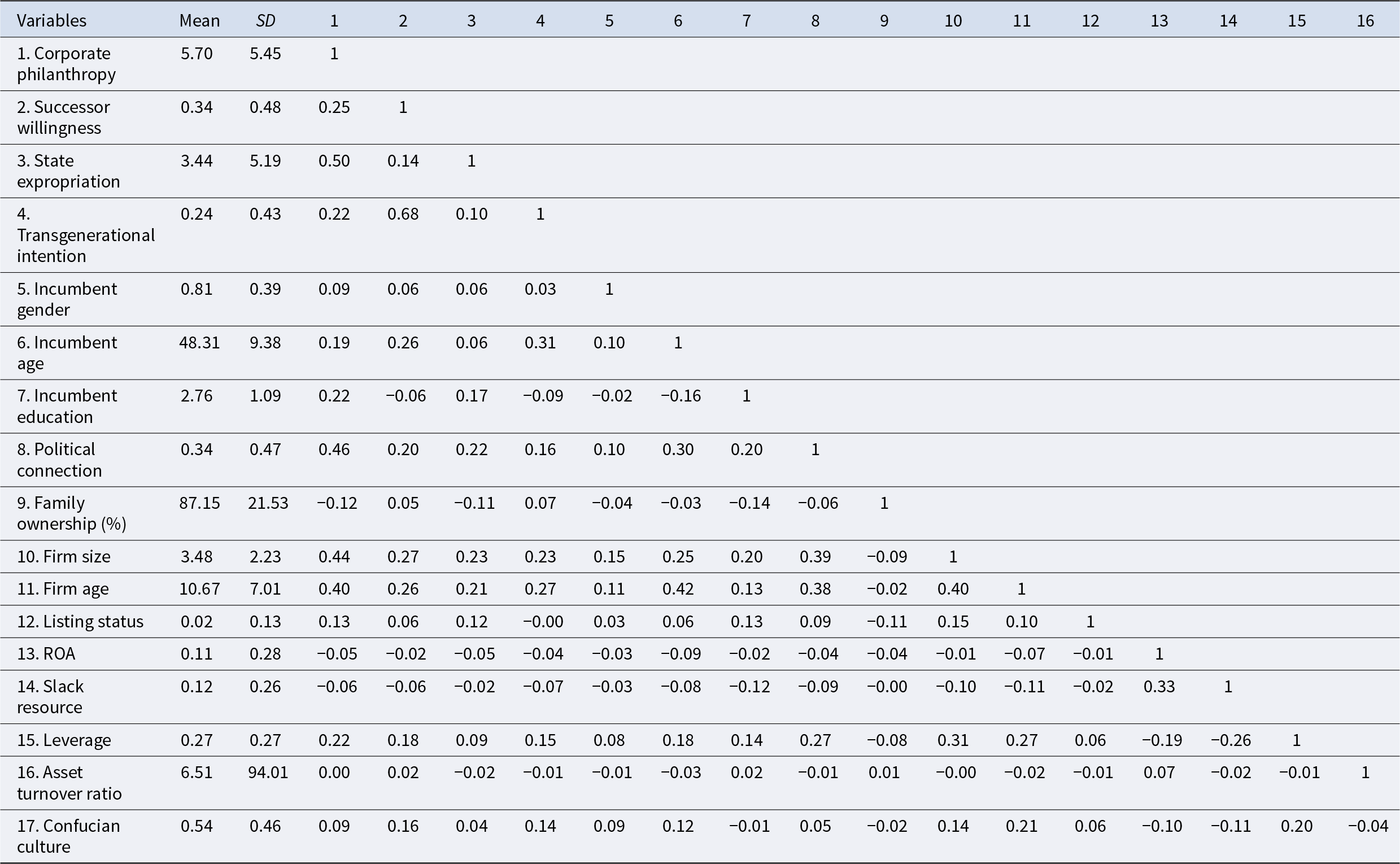
Table 1 reports the descriptive statistics and correlations of the variables except the industry dummies. We can see that the highest correlation is observed between successor willingness and transgenerational intention, which aligns with existing literature suggesting that parent-incumbents’ intention to hand over the family firm and child-successors’ willingness to take over are mutually influential (Huang, Chen, et al., Reference Huang, Chen, Xu, Lu and Tam2020; Sharma et al., Reference Sharma, Chrisman and Chua2003). To assess potential multicollinearity, we computed variance inflation factors (VIFs). The mean VIF score was 1.30, with a maximum value of 1.95, well below the general threshold of 10. This indicates that multicollinearity does not pose a threat to our analyses.
Descriptive statistics and correlation matrix

Table 1 Long description
Descriptive statistics list each variable with its mean and standard deviation, followed by a correlation matrix across variables numbered 1 through 16. Corporate philanthropy has mean 5.70 and SD 5.45; successor willingness mean 0.34 SD 0.48; state expropriation mean 3.44 SD 5.19; transgenerational intention mean 0.24 SD 0.43. Incumbent characteristics include gender mean 0.81 SD 0.39, age mean 48.31 SD 9.38, and education mean 2.76 SD 1.09; political connection mean 0.34 SD 0.47. Firm characteristics include family ownership percent mean 87.15 SD 21.53, firm size mean 3.48 SD 2.23, firm age mean 10.67 SD 7.01, and listing status mean 0.02 SD 0.13. Performance and finance measures include ROA mean 0.11 SD 0.28, slack resource mean 0.12 SD 0.26, leverage mean 0.27 SD 0.27, and asset turnover ratio mean 6.51 SD 94.01. Selected correlations include corporate philanthropy with state expropriation 0.50, with political connection 0.46, with firm size 0.44, and with firm age 0.40; successor willingness with transgenerational intention 0.68; incumbent age with firm age 0.42; firm size with firm age 0.40; ROA with slack resource 0.33; leverage with slack resource negative 0.26 and with ROA negative 0.19. Confucian culture is listed with mean 0.54 SD 0.46 and correlations including with firm age 0.21, with leverage 0.20, and with successor willingness 0.16.
Notes: N = 1,798. |Correlations| ≥ 0.05 are statistically significant at P < 0.05.
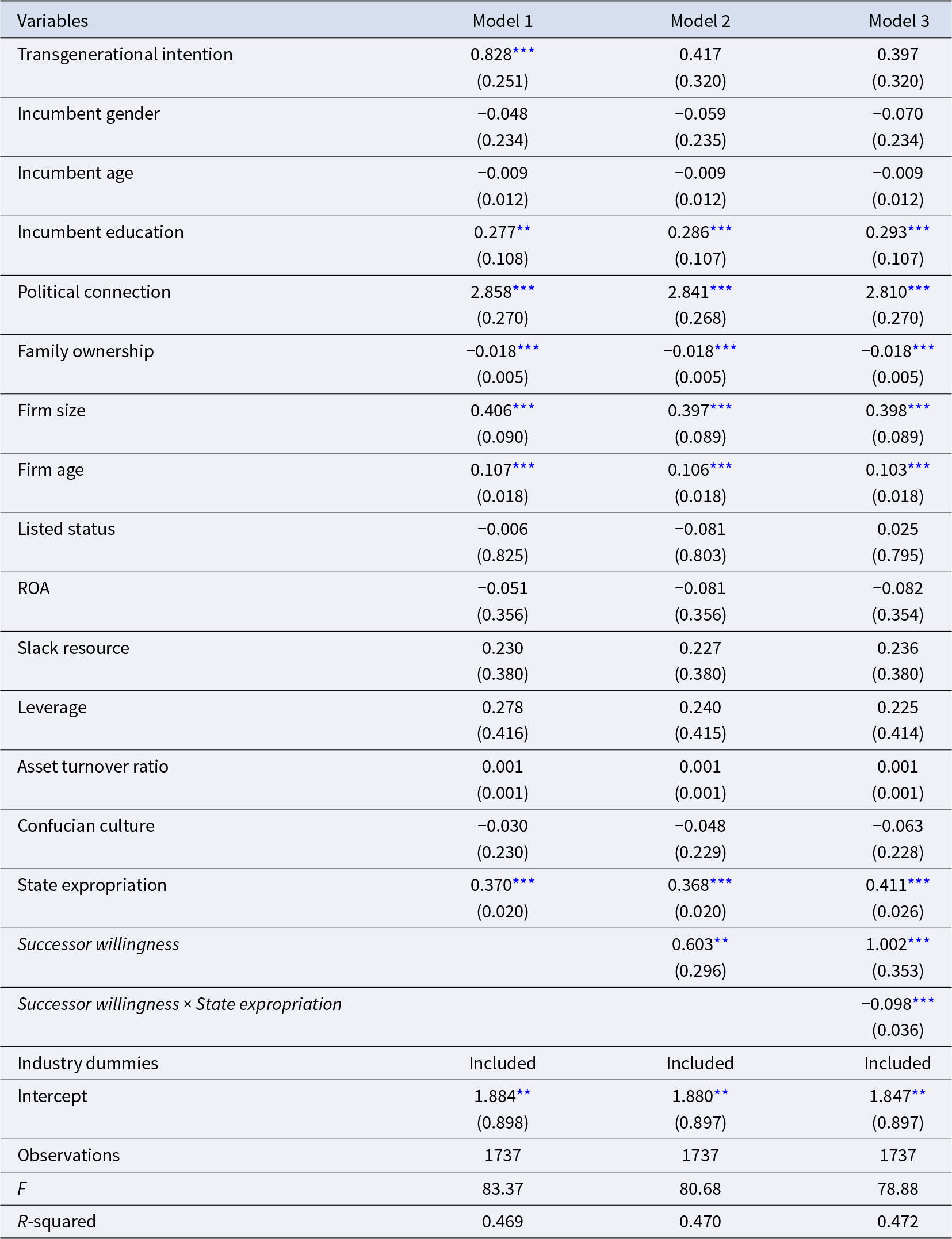
Table 2 presents the results of the PSM model predicting corporate philanthropy. Model 1 shows the baseline model including only control variables. Model 2 introduces the independent variable, i.e., successor willingness, to test H1. Model 3 adds the moderating variable, i.e., state expropriation, to examine its interaction with successor willingness.
PSM estimates of the effect of successor willingness on corporate philanthropy
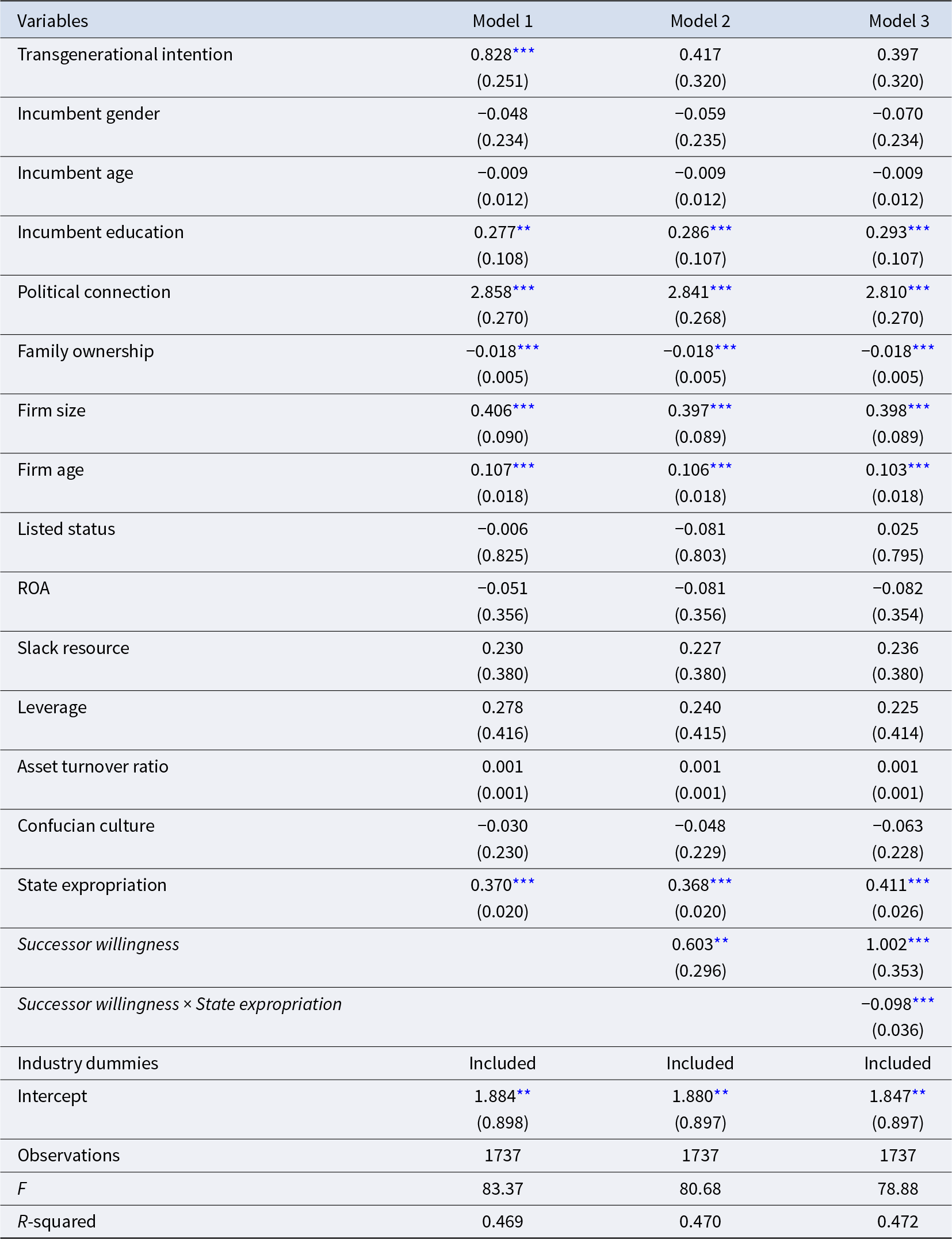
Table 2 Long description
Three regression models report coefficients and standard errors in parentheses for corporate philanthropy, with columns labeled Model 1, Model 2, and Model 3. Transgenerational intention is 0.828 with three stars in Model 1, then 0.417 in Model 2 and 0.397 in Model 3, with standard errors 0.251, 0.320, and 0.320. Incumbent gender ranges from minus 0.048 to minus 0.070, incumbent age is minus 0.009 in all three models, and incumbent education is 0.277 with two stars in Model 1, 0.286 with three stars in Model 2, and 0.293 with three stars in Model 3. Political connection is 2.858, 2.841, and 2.810, each with three stars, while family ownership is minus 0.018 with three stars in all models. Firm size is 0.406, 0.397, and 0.398, each with three stars, and firm age is 0.107, 0.106, and 0.103, each with three stars. Listed status is minus 0.006, minus 0.081, and 0.025; ROA is minus 0.051, minus 0.081, and minus 0.082; slack resource is 0.230, 0.227, and 0.236; leverage is 0.278, 0.240, and 0.225; asset turnover ratio is 0.001 in all models; and Confucian culture is minus 0.030, minus 0.048, and minus 0.063. State expropriation is 0.370 with three stars in Model 1, 0.368 with three stars in Model 2, and 0.411 with three stars in Model 3, with standard errors 0.020, 0.020, and 0.026. Industry dummies are included, the intercept is 1.884 with two stars, 1.880 with two stars, and 1.847 with two stars, and each model reports 1737 observations with F values 83.37, 80.68, and 78.88 and R squared values 0.469, 0.470, and 0.472.
Notes:
* P <0.10, **P < 0.05, ***P < 0.01; Standard errors are reported in parentheses.
In Model 1, we can see that transgenerational intention has a positive and significant effect on corporate philanthropy (β = 0.828, P < 0.01), consistent with the findings of prior research on Chinese family firms (Li et al., Reference Li, Au, He and Song2015). H1 predicts that child-successors’ willingness is positively related to parent-incumbents’ corporate philanthropy. As reported in Model 2, the coefficient for successor willingness is positive and significant (β = 0.603, P < 0.05). Thus, H1 is supported. All else being equal, parent-incumbents with a willing child-successor made approximately 82.7% more philanthropic donations than those without a willing child-successor.Footnote 2 In terms of economic significance, this 82.7% difference is both statistically and practically meaningful. For example, if the average donation among Chinese family firms without a willing child-successor is 100,000 yuan, the average donation among those with a willing child-successor is approximately 182,700 yuan. This is indeed a substantial investment, particularly for these small and medium-sized family firms in China. Interestingly, and contrary to prior research (Li et al., Reference Li, Au, He and Song2015), the effect of transgenerational intention on corporate philanthropy becomes insignificant in Model 2. This is consistent with our theory, which argues that parent-incumbents’ philanthropic behavior is more strongly driven by their child-successors’ willingness to take over the family firm, rather than by their own intention to hand over the firm.
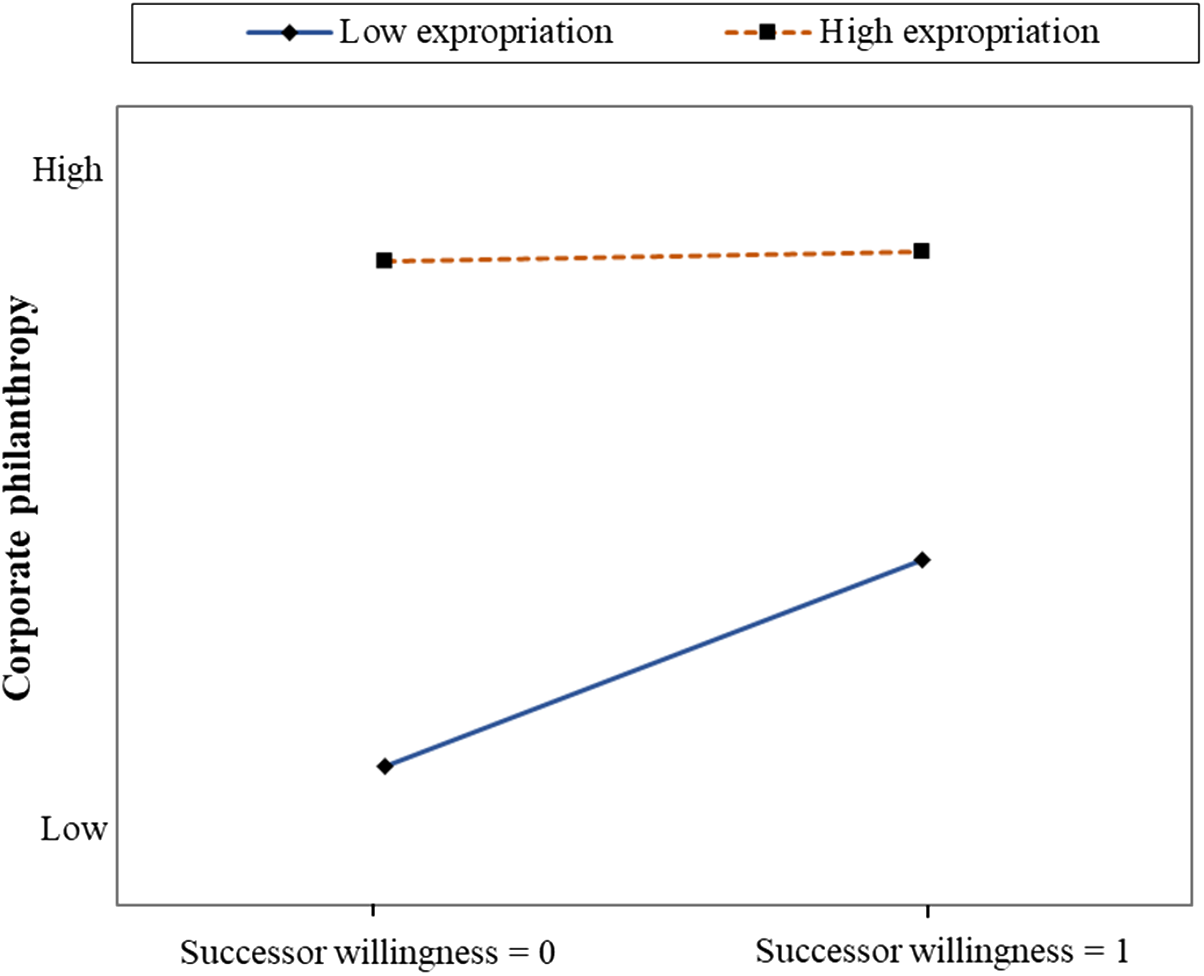
H2 predicts that state expropriation attenuates the positive effect of perceived child-successors’ willingness on parent-incumbents’ corporate philanthropy. Model 3 in Table 2 presents the results of testing H2, which shows that the interaction term between successor willingness and state expropriation is negative and significant (β = − 0.098, P < 0.01). Figure 1 illustrates this moderating effect, clearly showing that as the severity of state expropriation increases, the positive effect of perceived child-successors’ willingness on philanthropic donations made by parent-incumbents becomes substantially weaker. Thus, H2 is strongly supported.
The moderating effect of state expropriation on the effect of successor willingness on corporate philanthropy

Robustness Checks
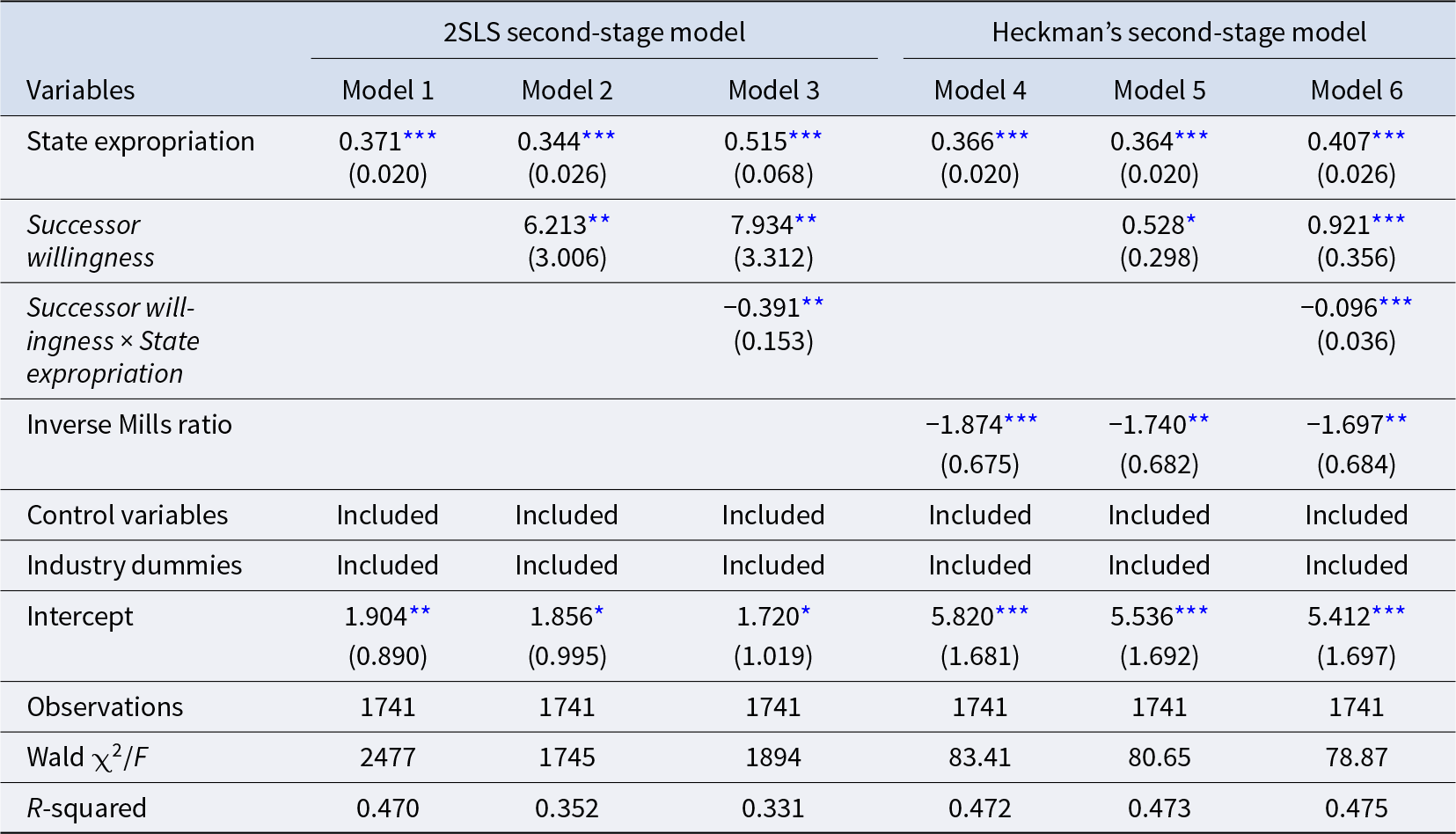
We conducted additional analyses to assess the robustness of our findings. First, beyond the endogenous nature of child-successor willingness, reverse causality could represent another source of endogeneity. To address these concerns, we employed a two-stage least squares (2SLS) instrumental variable approach (Li & Vermeulen, Reference Li and Vermeulen2021). We instrumented successor willingness using the parent-incumbent’s number of adult children, based on the rationale that a larger number of children increases the likelihood of having a willing successor (Cao et al., Reference Cao, Cumming and Wang2015). This instrument is a strong predictor of the endogenous variable (i.e., child-successors’ willingness) but is uncorrelated with the error term in the primary model. As expected for a valid instrument, the first-stage results show a significant positive correlation between the number of adult children and successor willingness (β = 0.051; P = 0.000). The F-statistic (F = 112.23; P = 0.000) far exceeds the commonly accepted threshold of 10, strongly supporting the validity of our instrument. Models 1–3 in Table 3 present the second-stage results of the 2SLS analysis, which remain consistent with our main findings.
Estimating the effect of successor willingness on corporate philanthropy using alternative approaches to endogeneity
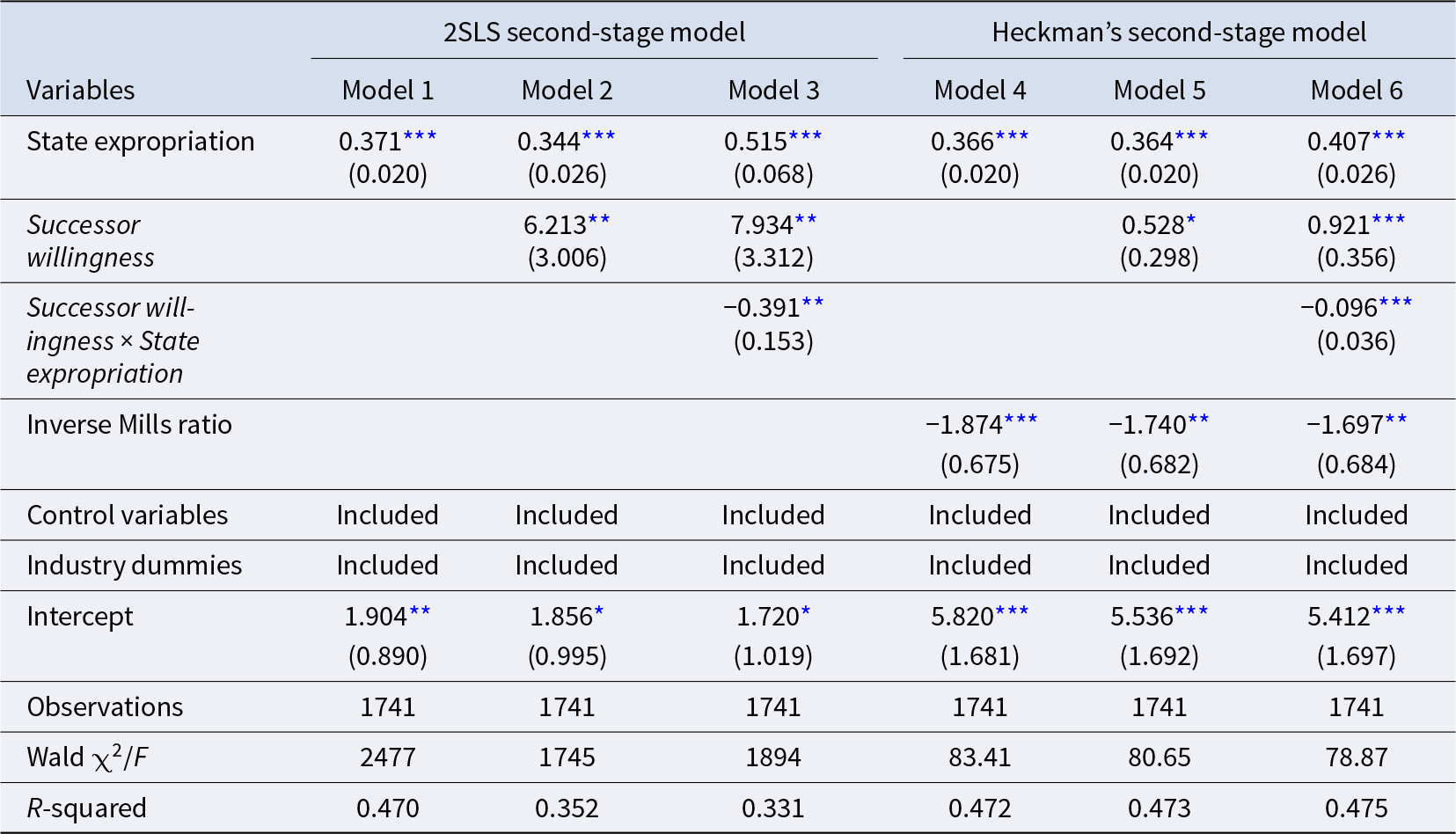
Table 3 Long description
Six regression models are reported under two column groups, 2SLS second-stage model with Models 1 to 3 and Heckman′s second-stage model with Models 4 to 6. For successor willingness, Model 2 reports 6.213 with standard error 3.006 and Model 3 reports 7.934 with standard error 3.312; in the Heckman group, Model 5 reports 0.528 with standard error 0.298 and Model 6 reports 0.921 with standard error 0.356. The interaction row, successor willingness times state expropriation, appears in Model 3 as minus 0.391 with standard error 0.153 and in Model 6 as minus 0.096 with standard error 0.036. The inverse Mills ratio appears only in Models 4 to 6, with coefficients minus 1.874, minus 1.740, and minus 1.697, and standard errors 0.675, 0.682, and 0.684 shown on the next line. Control variables and industry dummies are listed as included in every model. The intercept is 1.904 with standard error 0.890 in Model 1, 1.856 with standard error 0.995 in Model 2, 1.720 with standard error 1.019 in Model 3, 5.820 with standard error 1.681 in Model 4, 5.536 with standard error 1.692 in Model 5, and 5.412 with standard error 1.697 in Model 6. Observations are 1741 for all models; Wald chi-squared or F values are 2477, 1745, 1894, 83.41, 80.65, and 78.87, and R-squared values are 0.470, 0.352, 0.331, 0.472, 0.473, and 0.475.
Notes:
* P < 0.10, **P < 0.05, ***P < 0.01; Standard errors are reported in parentheses.
Second, we implemented a Heckman two-stage model as an alternative method to address endogeneity concerns. In the first stage, using the number of adult children as an instrument, we estimated a probit model to predict the likelihood of having a willing child-successor, from which we derived the inverse Mills ratio. In the second stage, we used the predicted value of the successor-willingness variable in place of this variable and estimated models of the dependent variable on the independent variable, the moderator, the inverse Mills ratio, and the control variables. The results of the second-stage Heckman analysis, reported in Models 4–6 of Table 3, further confirm that our main findings remain robust and unchanged.
Third, if any children of the parent-incumbent are involved in the family firm’s management (i.e., child involvement), a multigeneration leadership takes place (Dorsch et al., Reference Dorsch, Jaskiewicz, Combs and Wulf2023). This implies that the firm has entered the formal succession phase (Pan et al., Reference Pan, Weng, Xu and Chan2018), thereby disrupting our focus on the presuccession stage and the mechanism of transgenerational succession anticipation. To ensure the theoretical consistency of our sample, we excluded family firms in which parent-incumbents’ children were participating in day-to-day management. The results from the retained sample are presented in Table 4, which demonstrate that our findings remain consistent.
PSM estimates of the effect of successor willingness on corporate philanthropy using sample without children involvement
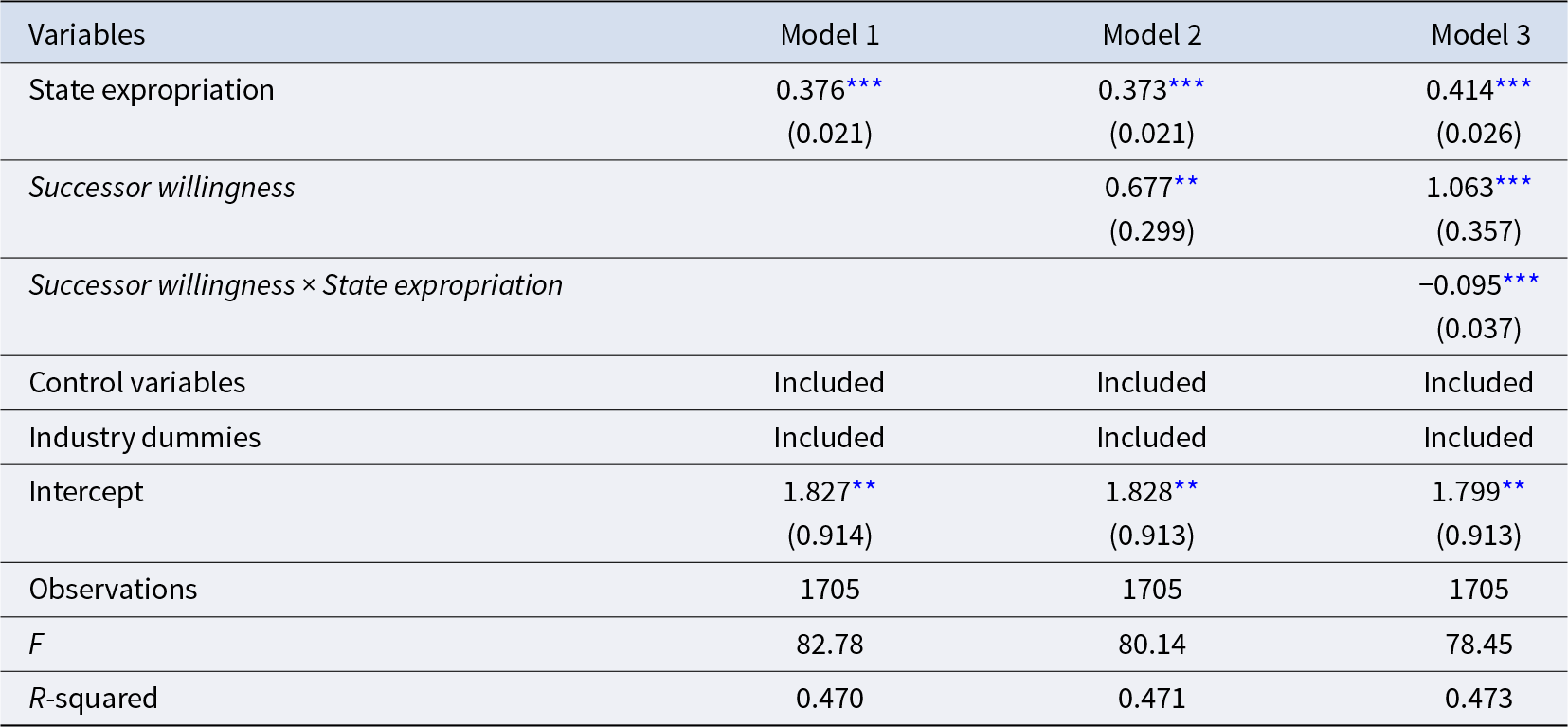
Table 4 Long description
Three regression models report coefficients and standard errors in parentheses for State expropriation, Successor willingness, and their interaction, plus model statistics. For State expropriation, coefficients are 0.376 with standard error 0.021 in Model 1, 0.373 with 0.021 in Model 2, and 0.414 with 0.026 in Model 3, each marked with three stars. Successor willingness is not listed in Model 1, then is 0.677 with standard error 0.299 in Model 2 marked with two stars, and 1.063 with 0.357 in Model 3 marked with three stars. The interaction term, Successor willingness times State expropriation, appears only in Model 3 as negative 0.095 with standard error 0.037, marked with three stars. Control variables and Industry dummies are included in all three models. The Intercept is 1.827 with standard error 0.914 in Model 1, 1.828 with 0.913 in Model 2, and 1.799 with 0.913 in Model 3, each marked with two stars. Observations are 1705 for all models; F values are 82.78, 80.14, and 78.45; R squared values are 0.470, 0.471, and 0.473.
Notes:
* P < 0.10, **P < 0.05, ***P < 0.01; Standard errors are reported in parentheses.
Fourth, following previous studies (Ge & Micelotta, Reference Ge and Micelotta2019; Li et al., Reference Li, Au, He and Song2015), we used a more lenient (20%) and stringent (50%) threshold of family ownership as alternative cutoff points to identify family firms, respectively. After excluding samples that did not meet these ownership criteria, we re-ran the analyses. The results remain consistent with our main findings, supporting the robustness of our findings to varying definitions of family ownership.
Finally, we used an alternative measure of corporate philanthropy to test the robustness of our hypotheses. Because larger firms generally have greater capacity to make charitable donations, we scaled philanthropic donations by firm sales (Li et al., Reference Li, Au, He and Song2015; Pan et al., Reference Pan, Weng, Xu and Chan2018) to control for the effect of firm size. The results using this normalized measure produced consistent results. It should be noted, however, that corporate philanthropy typically accounts for a small proportion of a family firm’s total sales, which may result in a small effect size.
Discussion
A central challenge faced by family firms is the ‘willing successor’ dilemma (Liu, Zhu, & Wang, Reference Liu, Zhu and Wang2024; Parker, Reference Parker2016). This study examines how the presence of a willing child-successor affects parent-incumbents’ corporate philanthropy. Using data from a national survey of Chinese family firms, we find that perceived child-successors’ willingness increases parent-incumbents’ anticipation of transgenerational succession and, in turn, motivates them to engage in presuccession philanthropy. However, state expropriation poses institutional threats to this anticipation, thereby attenuating the positive effect of child-successor willingness on presuccession philanthropy. These findings offer important theoretical and practical implications.
Theoretical Contributions
This study makes several contributions to the literature. First, we advance research on the relationship between transgenerational succession and family firm philanthropy by uncovering the critical role of child-successor willingness in driving philanthropy before succession. While transgenerational succession constitutes a multistage process (Lee, Zhao, & Lu, Reference Lee, Zhao and Lu2019), prior studies have predominantly focused on corporate philanthropy during and after succession (He & Yu, Reference He and Yu2019; Pan et al., Reference Pan, Weng, Xu and Chan2018; Zhang et al., Reference Zhang, Lin, Huang, Djafarova and Ren2024). We extend this literature by examining the impact of child-successors’ willingness on parent-incumbents’ presuccession philanthropy. This focus offers two advantages. First, our study shifts scholarly attention to the presuccession stage and highlights the need to consider the specific phase of the succession process when understanding family firm philanthropy. Second, we shift attention from the parent-incumbent’s transgenerational succession intention to the child-successor’s succession willingness, indicating that the successor’s willingness should not be passively regarded as a given. By uncovering these parent–child dynamics before succession, our work opens a new avenue for theoretical development on the succession-philanthropy relationship.
This study also challenges and complements the prevailing view that parent-incumbents’ transgenerational succession intention is the primary driver of family firm behavior, such as philanthropy (Li et al., Reference Li, Au, He and Song2015). Prior research argues that parent-incumbents’ behaviors depend on both their own intention to hand over the family firm and their child-successors’ willingness to take over. However, our findings show that it is the child-successor’s willingness, rather than the parent-incumbent’s transgenerational succession intention per se, that has a significant effect on family firm philanthropy. By redirecting scholarly attention from incumbent-centered succession intention to successor-centered succession willingness, our study provides a more complete and balanced understanding of the relationship between transgenerational succession and corporate philanthropy.
Second, this study contributes to the family firm succession literature by introducing a novel succession-induced mechanism, namely, transgenerational succession anticipation. Prior research on the effect of transgenerational succession on family firm behavior has identified mechanisms such as parental altruism (Zhu & Kang, Reference Zhu and Kang2022), myopic loss aversion (Li et al., Reference Li, Bruton, Li and Wang2022), power transfer (Huang, Chen, et al., Reference Huang, Chen, Xu, Lu and Tam2020), and transgenerational control uncertainty (Dorsch et al., Reference Dorsch, Jaskiewicz, Combs and Wulf2023). We extend this stream of research by proposing and testing a distinct theoretical mechanism – transgenerational succession anticipation. This mechanism is grounded in parent-incumbents’ anticipation of potential transgenerational succession triggered by the presence of willing child-successors. Our findings confirm that this heightened anticipation is the key reason for the increase in philanthropic donations by parent-incumbents. By doing so, we provide a new and powerful lens for explaining behavioral heterogeneity in family firms, thus enriching research on family firm succession.
Finally, our study contributes to SEW research by identifying an institutional boundary for SEW theory. Previous studies focusing on internal dynamics have consistently suggested that family firms are willing to bear risks of financial losses to preserve SEW (e.g., Chirico et al., Reference Chirico, Gómez-Mejia, Hellerstedt, Withers and Nordqvist2020; Gómez-Mejía et al., Reference Gómez-Mejía, Haynes, Núñez-Nickel, Jacobson and Moyano-Fuentes2007; Li et al., Reference Li, Au, He and Song2015). However, not all family firms are committed to preserving SEW, suggesting that other factors are needed to help explain when they are motivated to pursue SEW. We address this gap by considering the external institutional environment in which the family firm operates. Our findings show that when the state expropriation becomes more severe, parent-incumbents’ motivation to preserve SEW through philanthropic engagement will decrease. Thus, our contingency framework offers theoretical and empirical evidence that a comprehensive understanding of SEW preservation should take into account both the internal transgenerational succession and the external institutional environment.
Practical Implications
Our study offers practical implications for Chinese family firms. Echoing Shanine et al. (Reference Shanine, Madison, Combs and Eddleston2023) observation that the seeds of successful succession are often sown long before the actual transition, we suggest that transgenerational succession planning should commence as early as possible. Addressing the ‘willing successor’ dilemma can motivate parent-incumbents to pursue long-term strategic investments, including presuccession philanthropic activities. It should be noted, however, that larger philanthropic donations enhance a firm’s perceived credibility and generosity in the eyes of stakeholders, thereby amplifying the benefits derived from such contributions (Cuypers, Koh, & Wang, Reference Cuypers, Koh and Wang2016). To fully leverage these advantages, parent-incumbents having willing child-successors should consider making substantial donations as a visible signal of their commitment. This is particularly critical for small and medium-sized family firms in China, where stakeholder trust and sociopolitical legitimacy are essential for sustained success.
While prior research emphasizes that family incumbents’ philanthropic behavior is influenced by their own intention to hand over the family firm, our findings indicate that such behavior is more fundamentally driven by their child-successors’ willingness to take over. This insight holds particular relevance in the context of Chinese family firms, where strong patriarchal authority often leads parent-incumbents to presume that their children will naturally assume leadership. They may focus extensively on enhancing their children’s competencies – for example, by sending them to prestigious Western institutions – while overlooking the critical need to foster emotional commitment and genuine willingness to continue the family firm. Our findings suggest that parent-incumbents should devote greater attention to identifying and nurturing a willing successor through sustained parental support, mentorship, and emotional engagement.
It is also important to note that under threats of state expropriation, the strategic value of corporate philanthropy may be substantially diminished, challenging the conventional wisdom that philanthropy can reliably mitigate institutional adversity. We suggest that family firms should adopt a more nuanced and flexible approach to strategic philanthropy, one that is sensitive to the specific institutional environment in which they operate. In supportive institutional conditions, family firms may leverage presuccession philanthropy as an integral component of long-term succession planning. However, in hostile environments marked by severe state expropriation, firms should exercise greater caution, such as reducing philanthropic visibility to avoid undesirable governmental attention or prioritizing evasive strategies to reduce expropriation exposure.
Our study also offers valuable implications for policymakers. Policymakers may consider reforming educational curricula to include activities such as voluntary service and organized visits to family firms as part of experiential learning programs. These initiatives could enhance potential successors’ understanding of and identification with family firms, thereby increasing their willingness to join or eventually take over such firms. By fostering the overall level of succession willingness among younger generations, policymakers can indirectly encourage parent-incumbents to engage in more long-term investments, such as philanthropic donations, which in turn may help ensure that local communities continue to benefit from family firms’ continued operations, both economically and socially.
Chinese family firms play a vital role in the national economy, yet they remain particularly vulnerable to extensive expropriation of assets and profits, which may undermine both firm survival and regional economic development (Jia & Mayer, Reference Jia and Mayer2017). Policymakers should take proactive measures to reduce and deter arbitrary expropriation within their jurisdictions. First, strengthening legal protections for property rights and legacy assets would enhance parent-incumbents’ perception of security and reinforce their anticipation of successful transgenerational succession. This heightened anticipation can motivate long-term-oriented decisions and investments, including philanthropic donations. Second, to prevent unchecked governmental takings, expropriation procedures should be made more transparent and subjected to clearer standards, such as public notification, due process, and fair compensation. Third, a critical reform would involve realigning performance incentives for local governments by incorporating not only short-term fiscal metrics but also long-term indicators such as sustainable investment, community welfare, and philanthropic contributions.
Limitations and Future Research Directions
This study has several limitations that offer fruitful avenues for future research. First, a family firm’s public visibility can significantly influence its philanthropic behavior (Ge & Micelotta, Reference Ge and Micelotta2019; Wang & Qian, Reference Wang and Qian2011). As few family firms in our survey sample are publicly listed, low visibility may lead to an underestimation of the impact of successor willingness on philanthropy. The cross-sectional data also limit the ability to pinpoint the underlying causation. Future studies could employ panel data from publicly listed family firms to complement and extend our findings. Second, since the survey primarily captured responses from parent-incumbents, our measurement of child-successor willingness is based solely on the perception of the parent-incumbents, rather than on the reports from their children. We acknowledge this as a limitation and encourage future research to collect direct responses from child-successors to improve this critical construct. For the same reason, we also lack detailed information on other individual attributes of the child-successors. We recommend that future work incorporate characteristics of potential successors, such as their age, educational background, prior experience, and personal values, to better understand their role in shaping presuccession strategies. Third, while we identify state expropriation as a key boundary condition influencing transgenerational succession anticipation, other institutional factors may also affect this mechanism. Future investigations could explore additional contingencies to refine and contextualize our theory. Finally, given that our sample consists of Chinese family firms, the generalizability of our findings to developed economies may be limited due to substantial institutional differences. Further cross-national comparative research is needed to examine whether our findings hold across different national contexts.
Data availability statement
The data for this study are available in Open Science Framework at https://osf.io/kdj9e/
Acknowledgements
We sincerely thank Professor Dali Ma, the Senior Editor, and the anonymous reviewers for their exceptional guidance and unwavering support during the review process.
Funding statement
This study is financially supported by the National Natural Science Foundation of China (Grant Number: 72502022), the Postdoctoral Fellowship Program of CPSF (Grant Number: GZC20250463), the Fundamental Research Funds for the Central Universities, CHD (Grant Number: 300102235101), and Xi’an Science and Technology Program—Soft Science Research Project (Grant Number: 25RKYJ0043).
Ruijie Jin (jinruijie0426@163.com) is an assistant professor at the School of Economics and Management, Chang’an University. His research interests include corporate social (ir)responsibility, innovation management, corporate governance, and strategic management, with a particular focus on family business. His papers have appeared in leading journals, such as Entrepreneurship Theory and Practice, Journal of Business Research, and Asia Pacific Journal of Management.
Lei Guo (guolei201801@xjtu.edu.cn) is an associate professor at the School of Economics and Finance, Xi’an Jiaotong University. His research interests include innovation management and digital economy. His papers have appeared in leading journals, such as Asia Pacific Journal of Management, Journal of Manufacturing Technology Management, and Technology Analysis & Strategic Management.
Xiaoxian Jiang (jiangxiaoxian6688@163.com) is an assistant professor at the School of Economics Management, Xi’an Technological University. Her research interests include product iterative innovation, digital innovation, senior entrepreneurship, and strategic management. Her papers have appeared in leading journals, such as Journal of Business Research and IEEE Transactions on Engineering Management.
Lulu Shi (lulu.shi5@icloud.com) is an assistant professor at the School of Economics and Management, Xi’an University of Posts and Telecommunications. Her research interests include corporate misconduct, strategic alliance, and innovation management. Her papers have appeared in leading journals, such as Journal of Business Ethics and Technological Forecasting and Social Change.