Introduction
Bilingualism is an ordinary phenomenon as the world is becoming more integrated. More and more people at all levels of society are bilingual. Research indicates bilingualism shapes human behavior, brain structure, and brain functions. Bilinguals have been reported to have better cognitive control ability relative to monolinguals, which proponents refer to as a “bilingual advantage” (Bialystok, Reference Bialystok2017; Bialystok, Craik, Green & Gollan, Reference Bialystok, Craik, Green and Gollan2009). There is an on-going contentious debate on this issue, however. Some researchers claim that this advantage does not exist or exists only under specific circumstances and, thus, cannot be generalized to large populations (García-Pentón, García, Costello, Duñabeitia & Carreiras, Reference García-Pentón, García, Costello, Duñabeitia and Carreiras2016; Paap & Greenberg, Reference Paap and Greenberg2013; Paap, Johnson & Sawi, Reference Paap, Johnson and Sawi2015).
Such mixed findings make drawing conclusions about bilinguals difficult. The complexity and variability of bilingualism potentially compounds the problem. Some speakers learn their second language (L2) early while others learn their L2 late. Some are balanced bilinguals while others are unbalanced. Some bilinguals are immigrants who learn and use L2 for survival. Some bilinguals are interested individuals looking for personal advancement and do not speak their L2 in daily communication. Considering the potential for great variety and that experience can shape behavior and the brain, it is possible that these different experiences result in the inconsistencies seen in the bilingual advantage literature. The current paper focuses on a unique aspect of the research to date by looking at L2 learners of the same L1 background. This methodology may mitigate complications resulting from unmatched relevant variables such as immigrant status, L1, and cultural background, as differences in demographic features potentially confound the results (Paap, Sawi, Dalibar, Darrow & Johnson, Reference Paap, Sawi, Dalibar, Darrow and A. Johnson2015; Valian, Reference Valian2015).
Supporting a bilingual advantage
A large body of research suggests that bilinguals demonstrate an advantage on cognitive control tasks compared to monolinguals (Bialystok, Reference Bialystok2016; Bialystok et al., Reference Bialystok, Craik, Green and Gollan2009; Vega-Mendoza, West, Sorace & Bak, Reference Vega-Mendoza, West, Sorace and Bak2015). Cognitive control is the ability to control behavior and thought by maintaining focus on or switching goals and plans while, at the same time, ignoring irrelevant information. Miyake, Friedman, Emerson, Witzki, Howerter, and Wager (Reference Miyake, Friedman, Emerson, Witzki, Howerter and Wager2000) propose, furthermore, that cognitive control is a unitary construct comprising core components including inhibition, mental set shifting, and working memory updating. Green and Abutalebi (Reference Green and Abutalebi2013) propose the Adaptive Control hypothesis, which distinguishes eight control processes: goal maintenance, conflict monitoring, interference suppression, salient cue detection, selective response inhibition, task disengagement, task engagement, and opportunistic planning. Most studies have followed these frameworks and examined the bilingual advantage across these different components.
The bilingual advantage presumably originates from the experience of using two languages. When a target language is in use, it is believed that a bilingual's two languages are activated and in competition (Costa, Caramazza & Sebastian-Galles, Reference Costa, Caramazza and Sebastian-Galles2000; De Bot, Reference De Bot2000; Kroll, Bobb, Misra & Guo, Reference Kroll, Bobb, Misra and Guo2008). To successfully use the target language, bilinguals adopt a language control mechanism to monitor and/or inhibit the non-target language (Green, Reference Green1998; Green & Abutalebi, Reference Green and Abutalebi2013). This management depends, at least partly, on cognitive control in the general domain (Abutalebi & Green, Reference Abutalebi and Green2007). Thus, it is possible that a long-term bilingual experience would enhance non-linguistic cognitive control. This idea is supported by findings that bilinguals of various ages have better ability in different components of cognitive control relative to monolinguals. These different components include inhibition, as measured by the Simon task (Bialystok, Craik, Klein & Viswanathan, Reference Bialystok, Craik, Klein and Viswanathan2004; Bialystok & Matin, Reference Bialystok and Martin2004), conflict monitoring as measured by the Flanker task (Costa, Hernandez, Costa-Faidella & Sebastian-Galles, Reference Costa, Hernandez, Costa-Faidella and Sebastian-Galles2009), and mental set shifting as measured by a Task Switch paradigm or the Wisconsin Card Sorting Test (WCST) (Prior & MacWhinney, Reference Prior and MacWhinney2010; Xie & Dong, Reference Xie and Dong2017). Bilinguals have also evidenced greater neural network efficiency relative to monolinguals as seen in greater proportion of white/grey matter (Abutalebi, Canini, Della Rosa, Green & Weekes, Reference Abutalebi, Canini, Della Rosa, Green and Weekes2015; Mechelli, Crinion, Noppeney, O'Doherty, Ashburner, Frackowiak & Price, Reference Mechelli, Crinion, Noppeney, O'Doherty, Ashburner, Frackowiak and Price2004). This is thought to delay the onset of dementia among older adult bilinguals (Bialystok, Craik & Freedman, Reference Bialystok, Craik and Freedman2007; Olsen, Pangelinan, Bogulski, Chakravarty, Luk, Grady & Bialystok, Reference Olsen, Pangelinan, Bogulski, Chakravarty, Luk, Grady and Bialystok2015).
Supporting bilingual/monolingual parity
As mentioned, there is substantial controversy regarding the existence of a bilingual advantage. Some scholars argue that the evidence is not compelling and that an advantage does not exist or, at best, is restricted to very specific circumstances (Paap & Greenberg, Reference Paap and Greenberg2013; Paap, Johnson et al., Reference Paap, Johnson and Sawi2015). For example, in a seminal review, Hilchey and Klein (Reference Hilchey and Klein2011) concluded that the bilingual advantage in previous studies on inhibition was sporadic or absent. Some researchers also point out a bias against null-result findings (de Bruin, Treccani & Della Sala, Reference de Bruin, Treccani and Della Sala2015) minimizing the publication of studies indicating no cognitive advantage for bilinguals. In a recent meta-analytic review of both published and unpublished research synthesizing 152 studies and 891 comparisons, Lehtonen, Soveri, Laine, Järvenpää, de Bruin, and Antfolk (Reference Lehtonen, Soveri, Laine, Järvenpää, de Bruin and Antfolk2018) suggest that healthy bilingual adults do not show a bilingual advantage in different components of cognitive control such as in inhibition, shifting, working memory, monitoring, and attention.
In an example of null bilingual advantage findings despite a sizable number of young-adult participants, Paap and Greenberg (Reference Paap and Greenberg2013) compared 122 bilingual and 151 monolingual undergraduate students. They looked at different components of cognitive control including inhibition, monitoring, and shifting across the Simon task, the Color Shape task, the Antisaccade task and the Flanker task. The Simon, Flanker, and Antisaccade task results showed no main group effect. There was also no bilingual advantage in inhibition or monitoring even when highly proficient bilinguals were compared to monolinguals and when SES (reflected by parental education) was matched. On the Color Shape switching task, no bilingual advantages were found for mixing costs, indicating monitoring ability, or switching costs, indicating switching ability, when highly proficient bilinguals were compared to monolinguals matched on SES.
In another large study Gathercole, Thomas, Kennedy, Prys, Young, Vinas Guasch, Roberts, Hughes, and Jones (Reference Gathercole, Thomas, Kennedy, Prys, Young, Vinas Guasch, Roberts, Hughes and Jones2014) compared 650 Welsh–English simultaneous and 557 early sequential bilinguals to 354 English monolinguals aged three through 90 years. Participants performed three cognitive control tasks including a card sorting task, a Simon task, and a metalinguistic judgment task whereby participants judged sentence grammaticality and made corrections when sentences were not grammatical. Results showed little support for a bilingual advantage in inhibitory control/inhibition (reflected in the Simon and metalinguistic judgment tasks), switching (reflected in the card sorting task), or monitoring (reflected in global reaction time). Similarly, Von Bastian, Souza, and Gade (Reference von Bastian, Souza and Gade2015) examined whether 118 young-adult bilinguals’ inhibitory control, conflict monitoring, shifting, and general cognitive performance were related to three continuous dimensions (age of acquisition, proficiency, and usage), by administering Simon, Flanker, Stroop, Color Shape switching, Squares, Keep-track, and memory tasks. A series of linear mixed-effects models analyses revealed no evidence of significant predictions for inhibitory control, conflict monitoring, shifting, or general cognitive performance.
Interpreting mixed findings
How can science reconcile the inconsistency? Firstly, consider that the null results discussed above may be closely related to participant heterogeneity. For example, Paap and Greenberg's (Reference Paap and Greenberg2013) bilingual participants spoke 30 different languages with English as their L2, whereas the monolinguals were native English speakers. The participants, therefore, were not comparable in their L1 and cultural backgrounds. Von Bastian et al.’s (2015) bilingual participants also varied in their language background. Most of the participants reported German as their first language (L1), but reported 14 different L1s altogether. Participants’ L2s, similarly, included 14 different languages. Gathercole et al.’s (Reference Gathercole, Thomas, Kennedy, Prys, Young, Vinas Guasch, Roberts, Hughes and Jones2014) participants varied widely in age (from three to 90 years). These factors may have greatly confounded the results. As Valian (Reference Valian2015) suggests, participant-relevant factors such as cultural background, age, SES, and IQ potentially affect cognitive control.
Secondly, consider that while some researchers such as Paap, Johnson et al. (Reference Paap, Johnson and Sawi2015) see the inconsistencies as evidence of no bilingual advantage, others do not. Bialystok (Reference Bialystok2016), for example, claims null evidence does not mean negative evidence. She describes what she calls the “haze” in bilingual advantage research as being secondary to the subject matter itself (bilingualism), not the inconsistent findings. Bialystok believes the answer regarding the existence of the bilingual advantage will become more apparent with more data. The authors of this paper agree with Bialystok that the want of clarity regarding the bilingual advantage can be attributed to factors of bilingual complexity. The complexity and variability, which potentially cloud research results, may account for the inconsistency of bilingual advantage evidence seen in the literature.
Finally, most bilingual advantage research compares bilinguals and monolinguals, but not different bilingual groups. Comparing bilingual groups may bring clarity and help identify factors contributing to possible cognitive advantages. In determining, in particular, how different proficiency levels affect cognitive control we may better understand the nature of the bilingual advantage. Such a comparison may also better explain bilingual versus monolingual processing differences. In order to compare the differences of cognitive control between bilingual groups we need to identify which aspect of bilingualism may significantly affect cognitive control.
The role of language proficiency
Language proficiency is a core aspect of bilingualism. Without sufficient proficiency, a bilingual advantage may not emerge (Mishra, Reference Mishra2014). As language proficiency is dynamic, we might see cognitive control changes accordingly as there is evidence of a significant relationship between L2 proficiency and cognitive control (Chen, Zhou, Uchikoshi & Bunge, Reference Chen, Zhou, Uchikoshi and Bunge2014). While all age ranges merit investigation, the discussion in the current review focuses on young-adult bilinguals with mature, intact cognitive systems.
We can see how language proficiency contributes significantly to cognitive control among young adult bilinguals in a study by Khare, Verma, Kar, Srinivasan and Brysbaert (Reference Khare, Verma, Kar, Srinivasan and Brysbaert2012). Comparing Hindi–English bilinguals with a mean age of 18.5 years, the size of an attentional blink effect was reported to be stronger in bilinguals with higher relative to lower L2 proficiency. The attentional blink task is a type of cognitive control procedure whereby participants are instructed to look for a white-colored English letter (i.e., T1) in a rapid serial visual presentation stream with 14 black distractor letters (i.e., T2) and type in the white letter at the end of the trial. The accurate detection of T1 and T2 is considered to reflect the efficiency of reactive inhibition (Colzato, Bajo, van den Wildenberg, Paolieri, Nieuwenhuis, La Heij & Hommel, Reference Colzato, Bajo, van den Wildenberg, Paolieri, Nieuwenhuis, La Heij and Hommel2008). Mishra, Hilchey, Singh, and Klein (Reference Mishra, Hilchey, Singh and Klein2012) also investigated the role of L2 proficiency in distinguishing bilinguals’ cognitive control performance. Two groups of Hindi–English young adult bilinguals age 19.5-22.1 years who differed in L2 (English) proficiency performed a target detection task. Participants reported the presence of a target (a white disk) by pressing the space bar on a keyboard as quickly as possible and withheld from responding when no target was presented. Higher-proficiency bilinguals performed faster in overall reaction time than lower-proficiency bilinguals. A better performance indicates a more efficient disengagement of attention from task-irrelevant inputs.
To look at a broader capacity of cognitive control, Vega-Mendoza et al. (Reference Vega-Mendoza, West, Sorace and Bak2015) examined late, unbalanced, young-adult bilinguals, mean ages 18.75–22.44, with differing L2s versus monolinguals. They assessed three aspects of attention, verbal fluency, and L2 proficiency. In experiment one, three groups were compared, namely English monolinguals (n=18), English–Spanish bilinguals (n=16), and multilinguals (n=17) who spoke at least one other language in addition to English and Spanish. The results indicated that all groups were similar in the verbal fluency task as well as the sustained attention and attentional switching tasks. Bilinguals and multilinguals, however, outperformed monolinguals in selective attention.
In experiment two, Vega-Mendoza et al. (Reference Vega-Mendoza, West, Sorace and Bak2015) merged the bi- and multilingual groups into one general group of bilingual speakers. This group was then categorized into first-year or fourth-year undergraduate bilinguals (n=32, n=37 respectively) to compare to the monolingual groups (n=24, n=22 respectively). The results revealed that both first- and fourth-year undergraduate bilinguals performed better than monolinguals in selective attention. In attentional switching, however, while there was no difference between first-year bilinguals and monolinguals, a bilingual advantage was seen for fourth-year bilinguals. Such results suggest that different aspects of advantage may emerge at different stages of language acquisition as L2 proficiency improves. This indicates a significant contribution of L2 proficiency to cognitive control enhancement.
Some studies, however, report null effects of language proficiency in enhancing cognitive control. For example, Rosselli, Ardila, Lalwani, and Vélez-Uribe (Reference Rosselli, Ardila, Lalwani and Vélez-Uribe2016) compared 40 balanced and 34 unbalanced Spanish–English bilinguals with 40 English monolinguals (mean age=26.1 years) on language proficiency, intelligence, and nonverbal executive functions (working memory, updating, shifting, and inhibition). Results showed no support for a bilingual advantage. Regression analyses revealed that the intelligence score as measured by Wechsler Adult Intelligence Scale was a better predicator of cognitive control than was language proficiency.
Other studies report that language switching experience, rather than high L2 proficiency, determines a bilingual advantage in cognitive control related to interference resolution or monitoring (Becker, Schubert, Strobach, Gallinat & Kuhn, Reference Becker, Schubert, Strobach, Gallinat and Kuhn2016; Verreyt, Woumans, Vandelanotte, Szmalec & Duyck, Reference Verreyt, Woumans, Vandelanotte, Szmalec and Duyck2016) and mental set shifting (Dong & Liu, Reference Dong and Liu2016; Dong & Xie, Reference Dong and Xie2014). Verreyt et al. (Reference Verreyt, Woumans, Vandelanotte, Szmalec and Duyck2016), for example, examined the influence of language switching experience and language proficiency on cognitive control through Flanker and Simon tasks comparing three groups of bilinguals who differed in L2 proficiency and language switching experience. The participants were 28 unbalanced bilinguals (20.7 years old), 17 balanced non-switching bilinguals (20.9 years old), and 20 balanced switching-bilinguals (21.7 years old). The results revealed that L2 proficiency was not a significant influence on cognitive control whereas language-switching experience was. The balanced, switching-bilinguals outperformed both other groups and the balanced, non-switching and the unbalanced group did not differ.
In another study with a large participant sample that shows promise for investigating proficiency is that of Dong and Xie (Reference Dong and Xie2014). We investigated the influence of language switching and L2 proficiency on cognitive control with a Flanker and a mental set-shifting task (i.e., the WCST) among 154 unbalanced college-age Chinese–English bilinguals. Two bilingual groups who differed in L2 proficiency and two interpreting groups who differed in language switching experience (consecutive interpreting experience) were compared.
The Dong and Xie (Reference Dong and Xie2014) results revealed no difference across groups on the Flanker task. On the card-sorting task, however, bilinguals with interpreting experience performed better than bilinguals without such experience and the greater the amount of interpreting experience, the more significant the contribution to mental set shifting. We argued that the null effect of L2 proficiency on the Flanker task might be due to the small L2 proficiency gap between groups. It is unknown, however, what level is needed for a cognitive control advantage to manifest in behavioral measures. The L2 proficiency gap between the two non-interpreting bilingual groups in this study was only five points (19.4 versus 24.4). A larger language proficiency gap may have produced significant differences.
In sum, there is debate in the literature regarding whether or not bilinguals have a cognitive advantage over monolinguals secondary to their use of two languages. There is also debate regarding what neural processes comprise the possible advantage. In an attempt to help answer these questions, the present study investigates aspects that have been under-addressed in the literature to date. Considering the complexity of bilingualism, degree of L2 proficiency is the focus of this investigation. Despite mixed results regarding proficiency in the literature, highlighting this aspect of bilingualism with careful control of variables understood to impact cognitive control such as language use, education, IQ, age of acquisition, age, and SES is of great importance. Specifically, we address the following questions:
1) Whether or not L2 proficiency influences cognitive control among young adult bilinguals.
2) Whether or not demographic variables such as IQ, SES, age, and education predict cognitive control among young adult bilinguals.
Materials and methods
Participants
The study participants were 103 English major, junior year students (nine males) from Jiangxi Normal University with a mean age of 21.23 years who spoke Mandarin as their L1. All began formal education around age six years, began to learn English around age 10 years, and had been learning English for about 11 years at the time of the study. All participants had passed the university English exam with high scores (i.e., more than 120 out of 150 points), which was a requirement for admission. All participants also reported their demographic characteristics and language learning history via an adapted questionnaire (Marian, Blumenfeld & Kaushanskaya, Reference Marian, Blumenfeld and Kaushanskaya2007). To include an L2 proficiency range, participants were distributed into three groups, Low-, Middle-, and High-L2, based on a proficiency test described below. All participants took part in the experiment for course credit with written, informed consent. Rights were protected according to the ethics approved by the Academic Committee of the university.
Inclusion criteria were designed to be distinct from the previous literature in that all participants were in their early twenties, a time in which cognitive control abilities are at a peak in their development and cognitive control difference detection is more difficult than at other ages (Bialystok et al., Reference Bialystok, Craik, Green and Gollan2009). This would provide a strong case that proficiency predicts cognitive control should differences manifest. Participants were also more homogeneous than in most previous studies that included mainly immigrants with heterogeneous L1s and native cultures. Finally, the bilinguals in this study differed from immigrant bilinguals in other studies living in English speaking countries or countries where English is readily used such as India and some African countries in that these study participants learned and spoke English primarily in classroom settings. It was not necessary or even culturally acceptable for them to use English in daily communication. In the academic setting, the participants had about 16 hours of English classes each week, 16 weeks per semester, two semesters a year.
Demographic measures
L2 proficiency test
To measure L2 proficiency, we adopted an objective English verbal fluency test, in which participants were asked to name as many words as possible within 60 seconds across three categories (jobs, sports, animals). Categorical verbal fluency is considered to be an objective indicator of vocabulary size in the tested language (Bialystok et al., Reference Bialystok, Craik, Green and Gollan2009). Chinese was not assessed as all the participants were native speakers who used the language regularly in daily life.
Intelligence (IQ) test
There is evidence that intelligence may be a significant factor affecting cognitive control (Rosselli et al., Reference Rosselli, Ardila, Lalwani and Vélez-Uribe2016; Valian, Reference Valian2015). To control the influence of intelligence, a Chinese version of the Ravens Advanced Progressive Matrices (Li, Reference Li1989; Raven, Court & Raven, Reference Raven, Court and Raven1977) was used to measure intelligence. This test is widely used with multilinguals as it is not affected by language background, culture, or learned knowledge. The task requires participants to complete 72 patterns by choosing the correct missing segment from several choices within 40 minutes.
Socio-economic status (SES)
Socio-economic status is considered to be another important factor contributing to cognitive control, especially among children, as family interaction, income, or parental education may affect how children's cognitive control is developed (Valian, Reference Valian2015). Studies report that children from lower SES families perform worse in cognitive control conditions compared to their higher SES counterparts (e.g., Hook, Lawson & Farah, Reference Hook, Lawson and Farah2013; Segretin, Lipina, Hermida, Sheffield, Nelson, Espy & Colombo, Reference Segretin, Lipina, Hermida, Sheffield, Nelson, Espy and Colombo2014). In the current study, all participants were college students with no working experience and, thus, no personal income. Following previous research (e.g., Wermelinger, Gampe & Daum, Reference Wermelinger, Gampe and Daum2017), parental education level was used as an approximate indicator of SES. Parental education level was based on a scale from 1–7 that included, 1-limited literacy, 2-primary school, 3-middle school, 4-high school, 5- bachelor's degree, 6-master's degree, and 7-doctoral degree.
Cognitive control tasks
Two cognitive control tasks including a Flanker task and the WCST were employed and consistent in design to the previous literature described earlier. The Flanker task is designed to assess different components of cognitive control including inhibition and conflict monitoring. The WCST is also designed to measure different components of cognitive control and, in particular, mental set shifting, which it reflects most primarily. We examined inhibition, conflict monitoring, and mental set shifting as these components of cognitive control have been widely discussed in the previous literature as mentioned above.
Flanker task
The Flanker task (Eriksen & Eriksen, Reference Eriksen and Eriksen1974) is a widely used measure of cognitive control, including the ability to suppress responses that are inappropriate in a given situation (e.g., Festman & Munte, Reference Festman and Munte2012; Luk, Anderson, Craik, Grady & Bialystok, Reference Luk, Anderson, Craik, Grady and Bialystok2010) and the ability to monitor a context where incongruent and congruent trials are mixed (e.g., Costa et al., Reference Costa, Hernandez, Costa-Faidella and Sebastian-Galles2009). In this task, participants were required to judge the direction of a target symbol (red chevron) by pressing a designated button. The target red chevron was flanked by three types of symbols at each side including: 1) black chevrons pointing in the same direction as the target symbol (congruent condition); 2) black diamond symbols that did not have any shape similarity to the target red chevron (neutral condition); or 3) black chevrons pointing in the opposite direction (incongruent condition).
Flanker trials were designed in two blocks in E-prime 2.0 computer software, following Dong and Xie's (Reference Dong and Xie2014) design. Participants began with a practice block of nine trials with feedback in the form of a ‘smiling face’ or ‘frowning face’ following successful or unsuccessful trials respectively. In each trial, a fixation stimulus of “+” appeared for 250 ms. Then one of the three stimulus conditions, presented in random order, appeared for 2000 ms. Participants pressed buttons corresponding to the direction of the stimulus red chevron. A new trial would appear following the participant's response or after 2000 ms. Once a participant performed with an accuracy rate above 80% to help ensure focused attention on the task, the formal experimental blocks began. The experimental blocks consisted of 108 trials and followed the same format as the practice trials except that there was no feedback.
Wisconsin Card Sorting Test (WCST)
The WCST is considered to be the most widely applied task used to measure mental set shifting (e.g., Barceló & Knight, Reference Barceló and Knight2002; Moriguchi & Hiraki, Reference Moriguchi and Hiraki2009). Mental set shifting is the executive function of shifting back and forth between multiple tasks, operations, or mental sets (Monsell, Reference Monsell and Bruce1996). The test is a classification task whereby participants deduce category rules based on simple feedback of response correctness. The test includes four stimulus cards: one with one red triangle, one with two green stars, one with three yellow crosses, and one with four blue circles. For each trial, these four cards are presented in a horizontal line in the upper half of a computer screen while a single response card, displaying a constellation selected from these colors and shapes, is presented in the lower half. For example, if the response card is “one green cross” and the implied rule is color, then the correct response will be pressing the designated button corresponding to the stimulus card “two green stars”.
Following Dong and Xie's (Reference Dong and Xie2014) design, the WCST was programmed in E-prime 2.0. Each trial began with a fixation point of “+” for 1000 ms followed by the picture cards. Participants selected the stimulus card they believed matched the response card by pressing a corresponding key on the computer keyboard. They would then see the word “correct” or “incorrect” for 1000 ms depending on their response. Unknown to the participants, the category pattern or sorting rule would change every five to nine trials. Each participant began with a 12-trial practice session to ensure task protocols were understood. The full task included 128 trials with an option to take a break halfway though.
Results
Demographic characteristics
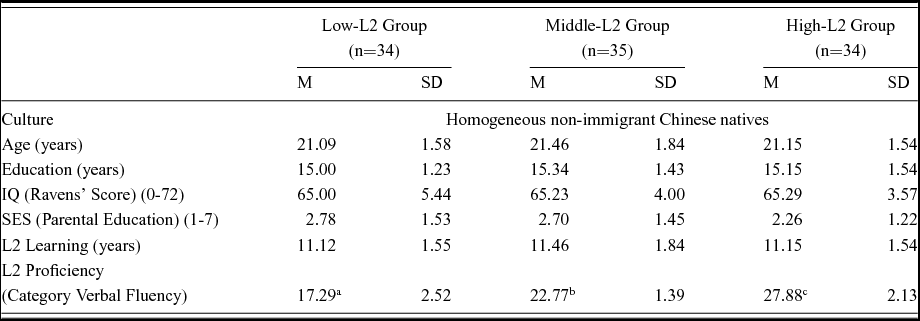
Demographic characteristics are detailed in Table 1. An ANOVA analysis of L2 proficiency and other controlling variables revealed that L2 proficiency differed significantly (ps < .001) among the three groups with scores of 17.29 (the Low-L2 Group), 22.77 (the Middle-L2 Group), and 27.88 (the High-L2 Group) respectively. There were no significant differences regarding age, education, IQ, and SES, however (ps > .05).
Characteristics of participant groups

Note. Different superscripts (a, b, and c) indicate significant differences across groups at p < .001 level.
Cognitive control tasks
Data trimming
Flanker task response times were calculated excluding errors and correct responses that fell three standard deviations outside the mean time for each subject in each condition. These accounted for 2.0% of the total responses. For the WCST, calculations of completed categories, overall errors, and types of errors were analyzed independently.
Flanker task
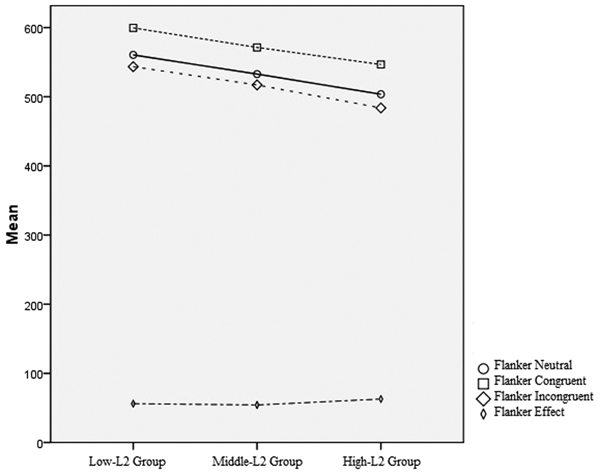
Following previous research (e.g., Bialystok et al., Reference Bialystok, Craik, Klein and Viswanathan2004; Costa et al., Reference Costa, Hernandez, Costa-Faidella and Sebastian-Galles2009), we compared two indices across the three groups on the Flanker task. Firstly, we calculated the response time differences between incongruent trials and congruent trials (the Flanker effect) as an indicator of inhibition. Secondly, we calculated the overall response times in each condition as an indicator of conflict monitoring. Group data are shown in Figure 1.
Flanker task performance across groups

A general linear model ANOVA analysis using repeated measures with group (Low-L2, Middle-L2, High-L2) as a between-subject variable and condition (congruent, neutral, incongruent) as a within-subject variable was run to determine differences across conditions and groups. Greenhouse-Gesser results of within-subjects effects revealed a significant effect of condition, F (1.973, 197.287) = 105.167, p< .001, η² = .513. Planned comparisons showed that all participants responded more quickly in the congruent condition (514.83 ms) than in the neutral (532.29 ms), F (1, 100) = 16.964, p <.001, η² = .145, and the incongruent conditions (572.49 ms), F (1,100) = 194.916, p< .001, η² = .661. Participants also responded more quickly in the neutral condition (532.29ms) than in the incongruent condition (572.49 ms), F (1,100) = 109.418, p < .001, η² = .522.
There were no group differences in inhibition. There were also no group and condition interactions (ps > .05). However, there were significant performance differences across groups. A test of between-subjects analysis showed a significant group effect, F (2,100) = 3.323, p = .040, η² = .062, observed power = .617. ANOVA analyses revealed that group differences in each condition of the Flanker task were significant or marginally significant with the following results: the congruent condition, F (2,100) = 3.325, p = .040; the neutral condition, F (2,100) = 3.354, p = .039; and the incongruent condition, F (2,100) = 2.690, p =.073. Further post-hoc analyses revealed that the High-L2 Group performed faster than the Low-L2 Group in the congruent, neutral, and incongruent conditions (p = .012, p = .023, p = .011 respectively). The High-L2 group evidenced somewhat faster response times than the Middle-L2 group in the neutral (503.57 ms vs. 532.78 ms), congruent (483.81 ms vs. 517.08 ms), and incongruent (546.66 ms vs. 571.30 ms) conditions, but these did not reach significance (ps > .05). Similarly, the Middle-L2 Group tended to be faster than the Low-L2 Group in the neutral (532.78ms vs. 560.51 ms), congruent (517.08ms vs. 543.52ms), and incongruent (571.30 ms vs. 599.56ms) conditions, but also without reaching significance (ps > .05).
Overall, these results showed there were no group differences in inhibition, but that there were group differences in conflict monitoring as reflected by the overall response time in each condition. This occurred, however, only when the magnitude of L2 proficiency reached a particular point.
WCST
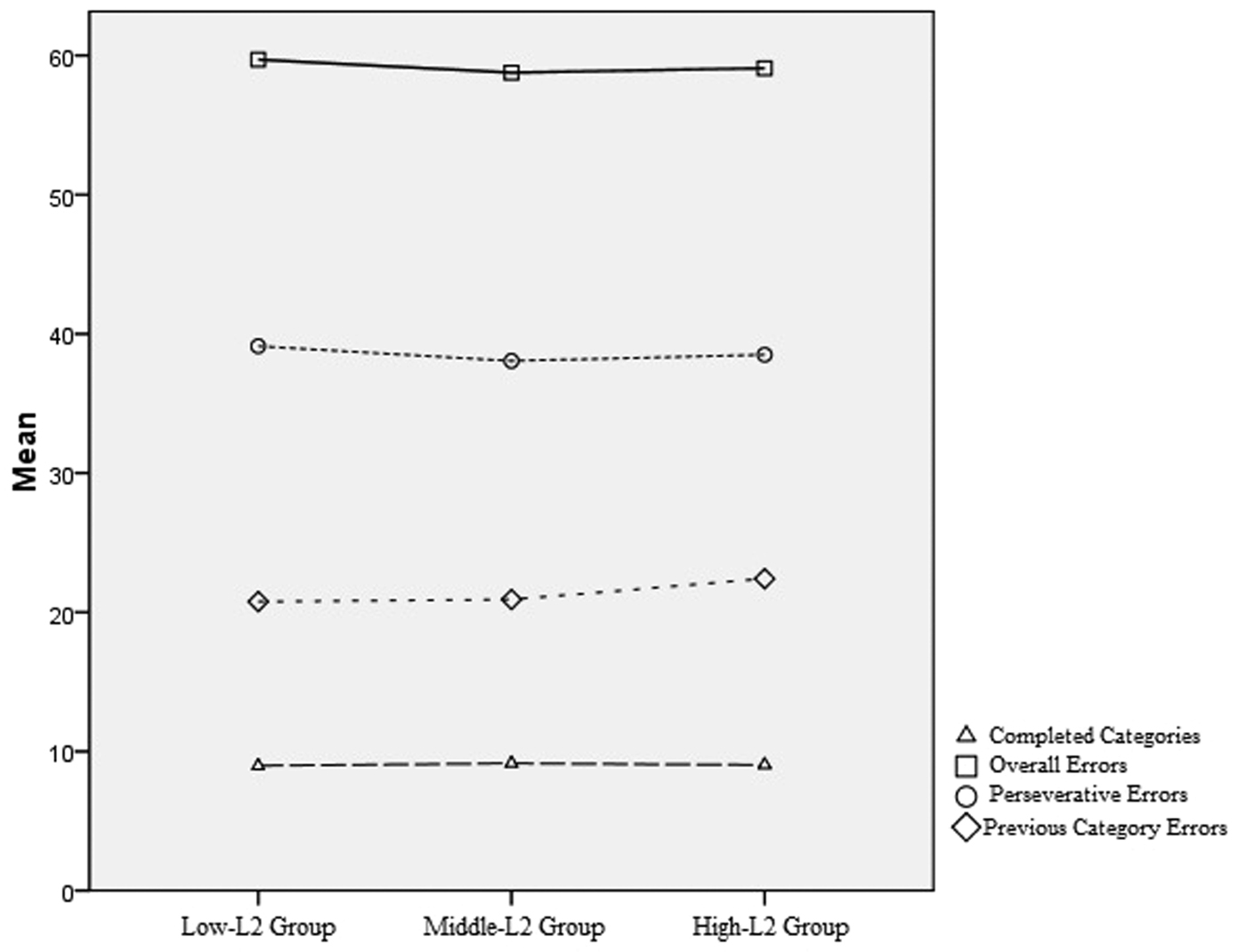
Consistent with previous research (e.g., Dong & Xie, Reference Dong and Xie2014; Yudes, Macizo & Bajo, Reference Yudes, Macizo and Bajo2011), we compared two categories of the WCST results: global performance and local performance. The test results are shown in Figure 2.
WCST performance across groups

Global performance
Global performance includes two indices: completed categories (the total number of correct categories participants complete) and overall errors (the total number of errors participants make). There are 19 categories altogether and one completed category indicates that a participant completed at least five consecutive trials correctly. ANOVA analyses results indicated no significant group differences for completed categories, F (2,100) = .022, p = .978 and no significant group differences for overall errors, F (2,100) = .034, p = .967.
Local performance
Local performance indicates the different types of errors participants make in the task. Of all the errors, some are random, while others are perseverative in which participants fail to change to a correct mental rule after receiving negative feedback. Perseverative errors can be further divided into perseverations of the immediately preceding category, called previous category errors, and perseverations to a different category, called different category errors (Hartman, Bolton & Fehnel, Reference Hartman, Bolton and Fehnel2001; Dong & Xie, Reference Dong and Xie2014; Yudes et al., Reference Yudes, Macizo and Bajo2011). Previous category errors indicate that participants continue sorting cards according to the previous category dimension despite feedback that the response is wrong. This also indicates that participants are not sufficiently flexible to change the mental set to a new rule. Different category errors indicate that participants realize the previous rule is no longer correct, but their attempt to infer a new rule is not successful. ANOVA analyses revealed that there were no group differences for the perseverative errors, F (2,100) = .035, p = .965, and no group differences for the previous category errors, F (2,100) = .125, p = .883. Thus, while the three groups differed in L2 proficiency, they did not differ in mental set shifting as tested by the WCST.
Correlation and multiple regression analyses
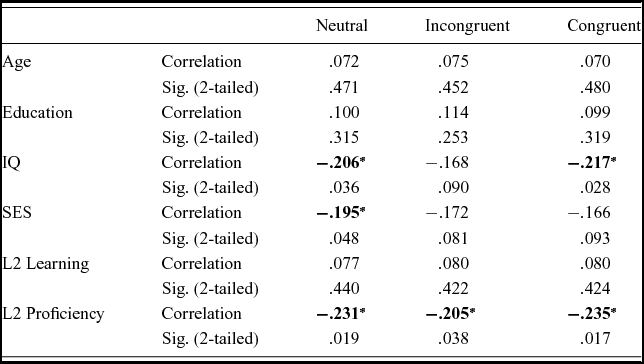
As cognitive control may be affected by multiple factors including a participant's age, education, SES, IQ, years of L2 learning, and L2 proficiency, we conducted correlation and multiple regression analyses to determine the relationships between cognitive control and these variables. See results in Table 2.
Pearson correlations between participants' characteristics, L2 proficiency and Flanker task performance (N=103)

The analyses revealed that only three variables correlated significantly with the Flanker task performance: SES, IQ, and L2 proficiency. Socioeconomic status correlated negatively in the neutral condition only (R = −.195, p = .048). Intelligence correlated negatively in the neutral (R = −.206, p = .036) and congruent (R = −.217, p = .028) conditions. More importantly, L2 proficiency correlated negatively in all conditions (congruent: R = −.235, p = .017; neutral: R = −.231, p = .019; incongruent: R = −.205, p = .038). These results indicate that higher SES, IQ, and L2 proficiency are associated with faster speed on the Flanker task. The other variables did not reach significance (ps >.05).
To further verify the roles of L2 proficiency and other factors in relation to the Flanker task performances, the data were analyzed treating these factors as continuous variables. We conducted multiple regression analyses by entering L2 proficiency and other control variables as independent variables. Response times on congruent, neutral, and incongruent trials were entered separately as dependent variables.
Regression analysis of the congruent trials
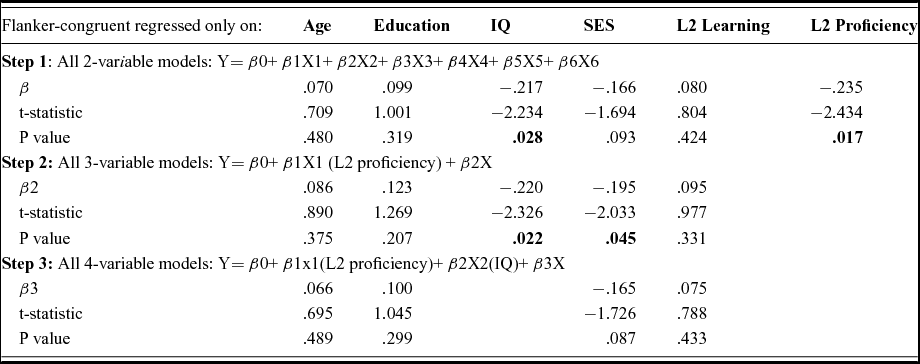
All independent variables were entered individually into a regression model with the Flanker congruent-condition response times as the dependent variable. The results showed that two variables (IQ, L2 proficiency) individually contributed significantly to task performance. As L2 proficiency had the highest absolute t-value (t = −2.434, p = .017), it was selected for the first analysis run. From this first run, the resulting model was defined as Y= β0+ β1X (L2 proficiency), R = .235, adjusted R 2 = .046, F = 5.923, p = .017. For the second step, the three-variable models showed that IQ had the largest t-value (t = −2.326, p =.022). This yielded a model of Y= β0+ β1X1 (L2 proficiency) + β2X2 (IQ), R = .322, adjusted R 2 = .086, F = 5.796, p = .004. For the third step, the four-variable models showed that, at the 5% significance level, none of the variables added to the model had a significant t-value. The stepwise regression was, therefore, terminated. The final multiple regression model was thus specified as Y= β0+ β1X1 (L2 proficiency) + β2X2 (IQ) + ε, R = .322, adjusted R 2 = .086, F = 5.796, p = .004. See Table 3 for the congruent condition regression results.
Steps and results of multiple regression analyses in the Flanker congruent condition

To summarize, the analyses revealed that IQ individually contributed significantly to the Flanker task-congruent condition performance (t = −2.234, p = .028), but L2 proficiency individually contributed more significantly to the congruent condition (t = −2.434, p = .017). The stepwise multiple regression results showed that when L2 proficiency and IQ were both added to the model, it accounted for the results best.
Regression analysis of the neutral trials
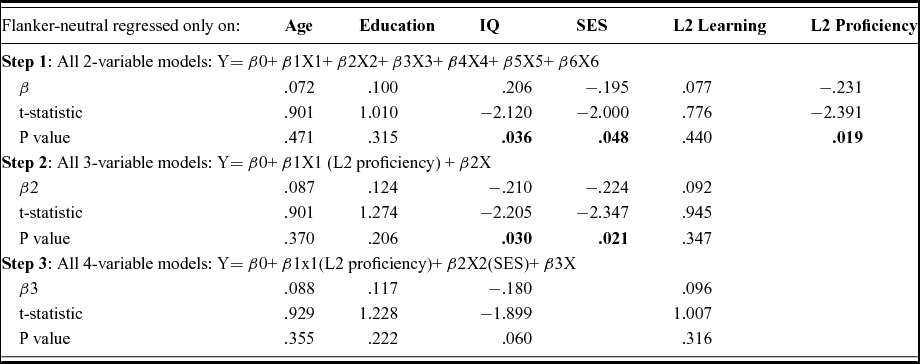
Independent variables were first entered individually into a regression model with the Flanker neutral-condition response times as the dependent variable. The results of this first-step regression model showed that three variables (IQ, SES, L2 proficiency) individually contributed significantly to the neutral condition on the Flanker task performance. Having the highest absolute t-value (t = −2.391, p = .019), L2 proficiency was selected for the first analysis run. From this first run, the resulting model was defined as Y= β0+ β1X (L2 proficiency), R = .231, adjusted R 2 = .044, F = 5.717, p = .019. For the second step, the three-variable models showed that SES had the largest t-value (t = −2.347, p = .021). Thus, the model was Y= β0+ β1X1 (L2 proficiency) + β2X2 (SES), R = .321, adjusted R 2 = .085, F = 5.740, p = .004. For the third step, the four-variable models showed that, at the 5% significance level, none of the variables added to the model had a significant t-value. The stepwise regression was, therefore, terminated. The final multiple regression model was thus specified as Y= β0+ β1X1 (L2 proficiency) + β2X2 (SES) + ε, R = .321, adjusted R 2 = .085, F = 5.740, p = .004. See Table 4 for the neutral condition regression results.
Steps and results of multiple regression analyses in the Flanker neutral condition

To summarize, SES individually contributed significantly to the Flanker task-neutral condition performance with t = −2.000, p = .048, but L2 proficiency individually contributed more significantly to the neutral condition with t = −2.391, p = .019. The stepwise multiple regression results showed that when L2 proficiency and SES were both added to the model, it accounted for the results best.
Regression analysis of the incongruent trials
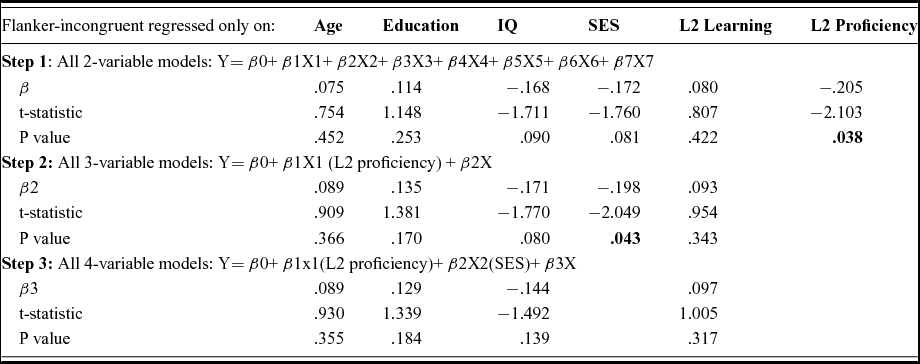
Independent variables were entered individually into a regression model with the Flanker incongruent-condition response times as the dependent variable. The results of the first-step regression models showed that only L2 proficiency individually contributed significantly to the incongruent condition of the Flanker task. Second language proficiency had the highest absolute t-value (t = −2.103, p = .038), so was selected for the first analysis run. From this first run, the resulting model was defined as Y= β0+ β1X (L2 proficiency), R = .205, adjusted R 2 = .032, F = 4.422, p =.038. For the second step, the three-variable models showed that SES had the largest t-value (t = −2.094, p = .043). The resulting model was Y= β0+ β1X1 (L2 proficiency) + β2X2 (SES), R= .284, adjusted R 2 = .062, F = 4.380, p =.015. For the third step, the four-variable models showed that, at the 5% significance level, none of the variables added to the model had a significant t-value. The stepwise regression was, therefore, terminated. The final multiple regression model was thus specified as Y= β0+ β1X1 (L2 proficiency) + β2X2 (SES) + ε, R = .284, adjusted R 2 = .062, F = 4.380, p =.015. See Table 5 for the incongruent condition regression results.
Steps and results of multiple regression analyses in the Flanker incongruent condition

To summarize, individually, only L2 proficiency contributed significantly to the Flanker task incongruent condition with t = −2.103, p =.038. The stepwise multiple regression results showed that when L2 proficiency was included in the model as the major predictor, SES was also a minor predictor (p = .022). When L2 proficiency and SES were both added as predictors, it accounted for the results best.
After conducting multiple stepwise regression analyses, we can conclude that among all the potential factors, L2 proficiency was the strongest predictor of the Flanker task performance in all three conditions. Moreover, two other factors were also significant contributors, at least in some conditions. Socioeconomic status was a significant predictor of the Flanker task performance in both neutral and incongruent conditions. Intelligence was also a significant predictor of the Flanker task performance, but only in the congruent condition. The overall results indicate that among young adult Chinese–English bilinguals L2 proficiency, SES, and IQ were reliably significant predictors of the Flanker task performance in terms of speed with respective degrees of significance (i.e., L2 proficiency > SES > IQ).
Discussion
The current study investigated whether L2 proficiency significantly contributes to cognitive control differences among young adult Chinese–English bilinguals by administering the Flanker task and the WCST. Relevant variables including age, SES, education, IQ, and L2 learning history were carefully controlled across three experimental groups. The Flanker task results showed that the High-L2 Group performed significantly faster than the Low-L2 Group in all conditions, whereas there were no differences between other groups. There was, however, a faster tendency for High versus Middle and Middle versus Low-L2 speakers. On the WCST, no differences were found across the three groups.
As language proficiency is a continuous rather than categorical variable, we conducted multiple stepwise regression analyses to further investigate what factors might predict the Flanker task performance among the participants. The results indicated that, in terms of speed, L2 proficiency was a significant performance predictor for all three conditions, SES was a significant performance predictor for the neutral and incongruent conditions, and IQ was a significant predictor for the congruent condition for all participants.
Advantage in conflict monitoring (faster speed)
The definition and best measurement protocols of conflict monitoring are not well-determined in the field, leading to controversies. Miyake et al. (Reference Miyake, Friedman, Emerson, Witzki, Howerter and Wager2000), for example, did not include monitoring in their studies and assumed that monitoring is a subcomponent of both switching and updating. Green and Abutalebi (Reference Green and Abutalebi2013), in contrast, included conflict monitoring as one of the eight sub-components of cognitive control in language use in which bilinguals need to monitor a conflict in order to maintain a current goal or for efficiently selecting a target. Costa et al. (Reference Costa, Hernandez, Costa-Faidella and Sebastian-Galles2009) argued for the theoretical existence of the bilingual advantage in conflict monitoring. They proposed that a reaction time advantage reflects enhanced skill navigating tasks that mix different trial types (e.g., congruent and incongruent trials), which parallels the continuous monitoring behavior bilinguals do to use the appropriate target language when communicating.
While there is no consensus regarding the definition of conflict monitoring or how to best measure it, it is clear that conflict monitoring is related to the response time in performing a task measuring the process. Thus, to be objective, for this discussion we regard faster processing/performance speed to be an indicator of better conflict monitoring. The current study revealed that the High-L2 Group performed faster than the Low-L2 Group on all conditions of the Flanker task and that L2 proficiency was the main contributor to this performance over all other demographic characteristics. This advantage result is consistent with previous research. Hilchey and Klein's (Reference Hilchey and Klein2011) review, for example, summarizing related studies concluded that a bilingual advantage in interference control (inhibition) is rare, but a bilingual advantage in global response time effects (faster speed) is robust. Our findings are also consistent with Bialystok et al. (Reference Bialystok, Craik, Klein and Viswanathan2004) who found that Tamil–English, Cantonese–English, and English–French bilinguals performed faster than English monolinguals in congruent and incongruent conditions of the Simon task. The present study, similarly, found that the bilingual speed advantage was reliable for the congruent, neutral, and incongruent conditions, though in a Flanker task.
Some differences have manifested, however, with the current study, which demonstrated the advantage employing distinct methodological approaches. The Bialystok et al. (Reference Bialystok, Craik, Klein and Viswanathan2004) study ran balanced middle- and older-age bilinguals in their 40 and 70-year age ranges, whereas the current study ran unbalanced young adults in their 20s. Additionally, although the Simon and Flanker tasks are frequently employed for cognitive control measures, there may be differences regarding the actual construct that is measured, as one specific cognitive control task does not necessarily predict the differences of those indicated by another (e.g., Paap & Greenberg, Reference Paap and Greenberg2013).
Also paralleling the present study is the Costa et al. (Reference Costa, Hernandez, Costa-Faidella and Sebastian-Galles2009) paper mentioned earlier. Recall that these authors compared bilingual and monolingual undergraduate students in two versions of a Flanker task by changing the ratio of congruent trials and incongruent trials. One version required low monitoring with 8% congruent trials versus 92% congruent trials. The other version required high monitoring with 50% congruent trials versus 75% congruent trials. The outcomes revealed a bilingual advantage in overall speed in congruent and incongruent conditions, but only in the high-monitoring condition. This suggests that when a task makes high monitoring demands, bilinguals perform faster than monolinguals. However, in the current study the congruent, neutral, and incongruent trials were presented randomly. The results showed an advantage in global speed for bilinguals with higher L2 proficiency. Moreover, where Costa et al. compared monolinguals and bilinguals, the current study compared bilinguals with different L2 proficiencies. It is conceivable that the performance differences between groups with varied L2 proficiencies would mirror that of monolinguals and bilinguals. This is because, as findings in this study support, experience with language is what is relevant.
The present study expands on our previous work that looked at performance differences regarding language use and proficiency. As outlined above, using the same Flanker task, Dong & Xie (Reference Dong and Xie2014) measured cognitive control differences among four bilingual groups. The study compared two groups with consecutive interpreting experience and two control groups who differed in L2 proficiency, but had no interpreting experience. Important to this paper is that no differences manifested between the control groups. An insufficient L2 proficiency difference between the control groups may have led to the null findings. The proficiency differences in the 2014 study paralleled those of the Low-L2 Group versus the Middle-L2 Group and those of the Middle-L2 Group versus the High-L2 Group in the current study. That is, in Dong and Xie the L2 proficiency gap was only five points between groups (i.e., 19.4 versus 24.4, measured by the same verbal fluency test). In the current study, when the L2 proficiency gap reached 10.59 points, that between the Low- and High-L2 proficiency groups, the Flanker task difference reflecting cognitive control was significant. When the gap was smaller, not exceeding 5.5 points, the Flanker-task performance differences did not reach significance.
Other studies adopting different, non-Flanker tasks described as engaging conflict monitoring also consistently showed a bilingual advantage in this process (Morales, Padilla, Gomez-Ariza & Bajo, Reference Morales, Padilla, Gomez-Ariza and Bajo2015; Teubner-Rhodes, Mishler, Corbett, Andreu, Sanz-Torrent, Trueswell & Novick, Reference Teubner-Rhodes, Mishler, Corbett, Andreu, Sanz-Torrent, Trueswell and Novick2016). Considering the results of the current study and the literature cited above, we suggest that the relationship between bilingualism and cognitive control at faster response times is significant even among young adult bilinguals, and that L2 proficiency, in particular, contributes significantly to the bilingual speed advantage. When a bilingual advantage is not seen in young adults, it may be because of the participant heterogeneity problematic in bilingual research or because of ceiling effects as young adults have the highest cognitive control skills relative to other age groups.
It is interesting to note the lack of interaction between group and condition in the Flanker task despite the High-L2 Group's faster performance over the Low-L2 Group in all conditions. There were differences among the three task conditions, but these differences were similar across the groups (i.e., participants were all faster in the congruent relative to the neutral condition and faster in the neutral condition relative to the incongruent condition). The results also indicated, however, that participant group as a single factor contributed significantly to the performance differences in all conditions. The High-L2 Group performed significantly faster than the Low-L2 Group. This was the case, not just in the incongruent conditions where there is intense conflict information, but also in the neutral condition where there is no conflict and in the congruent condition where there is facilitation. The bilingual advantage in the incongruent trials may come from more efficient conflict resolution processing and the advantage in the neutral and the congruent trials could be the result of a more efficient monitoring processing system that governs whether conflict resolution is required or not (Costa et al., Reference Costa, Hernandez, Costa-Faidella and Sebastian-Galles2009).
Advantage in inhibition (inhibitory control)
Previous studies on the bilingual advantage are largely based on the framework of Green's (Reference Green1998) Inhibitory Control Hypothesis. The hypothesis suggests that bilinguals are better at inhibiting irrelevant information or responses and, thus, have better inhibition or conflict resolution skills than monolinguals. Some studies provide evidence that bilinguals have better performance in tasks requiring inhibitory control than monolinguals (e.g., Bialystok et al., Reference Bialystok, Craik, Klein and Viswanathan2004; Carlson & Meltzoff, Reference Carlson and Meltzoff2008; Carlson, Moses & Breton, Reference Carlson, Moses and Breton2002; Costa, Hernandez & Sebastian-Galleset, Reference Costa, Hernandez and Sebastian-Galles2008; Crivello, Kuzyk, Rodrigues, Friend, Zesiger & Poulin-Dubois, Reference Crivello, Kuzyk, Rodrigues, Friend, Zesiger and Poulin-Dubois2016). However, Hilchey and Klein (Reference Hilchey and Klein2011) point out in their review of the literature that, while many studies examined inhibitory control in bilinguals, only a few reported bilingual advantages. They also point out that when there is an advantage, it is more markedly pronounced in middle-aged and elderly bilingual groups. Our Flanker task results are consistent with this review in that no group difference of inhibitory control manifested as measured by response time differences between congruent and incongruent trials.
Some scholars argue, nonetheless, that inhibition cannot be easily dissociated from other cognitive control processes. This may explain the inconsistencies in the literature and the present study regarding a bilingual advantage in inhibitory control. Different studies may be engaging varying degrees of other processing components despite attempts to the contrary. Miyake et al. (Reference Miyake, Friedman, Emerson, Witzki, Howerter and Wager2000) argued that there are three core components of cognitive control: inhibition, shifting, and working-memory updating. They proposed that these processes are moderately correlated, but clearly separable. This suggests that different tasks may be used to measure each cognitive control component independently. This is a difficult undertaking as the problems of task impurity and interactions among the putative cognitive control components still remain. While it is acceptable to say that the Flanker task can be used to measure inhibition, it does not mean it measures only inhibition. As Valian (Reference Valian2015) put it, “No task measures just one process” (p.7); so completing a single task requires different components of cognitive control, and their coordination may be an essential part of the task performance.
While Miyake et al. (Reference Miyake, Friedman, Emerson, Witzki, Howerter and Wager2000) argued that inhibition, shifting, and working-memory updating were separable, Miyake & Friedman (Reference Miyake and Friedman2012) later postulated that this is not the case for all components of cognitive control. In their new theoretical framework, called Unity and Diversity, inhibition is considered to be the common factor underlying all cognitive control components. This common factor ensures that individuals have the ability to actively maintain task goals and goal-related information and can effectively bias lower-level processing. If this theory holds, then inhibition could be a common factor underlying conflict monitoring. From this perspective, perhaps our findings may also reflect an inhibition advantage.
While some researchers have focused on inhibition, Bialystok (Reference Bialystok2017) by contrast, argues that bilingual advantages should be attributed to attentional control. In such an approach, based on neural networks, attention is separate from other processing systems. This viewpoint contends that there are three primary attention networks: sustained, selective, and executive and that cognitive subcomponents such as working memory, set switching, and inhibitory control are not isolated as in the Miyake et al. (Reference Miyake, Friedman, Emerson, Witzki, Howerter and Wager2000) model. Bialystok posits that under Miyake's componential view it is difficult to make progress on the study of bilingual advantage.
Advantage in mental set shifting (switching)
The current study does not provide evidence for a bilingual advantage in mental set shifting given there were no group differences on the WCST. Previous research, however, has shown that bilinguals perform better than monolinguals in similar tasks (e.g., Bialystok, Reference Bialystok1999; Bialystok & Martin, Reference Bialystok and Martin2004; Carlson & Meltzoff, Reference Carlson and Meltzoff2008). Prior and MacWhinney (Reference Prior and MacWhinney2010), for example, adopted a Color-Shape switch task to compare monolinguals’ and bilinguals’ switching ability and found that bilinguals incurred smaller switching costs than monolinguals. In a more recent study, Xie and Dong (Reference Xie and Dong2017) compared Chinese–English bilinguals and Chinese monolinguals on the WCST and found that bilinguals performed better than monolinguals by completing more categories and making fewer errors. However, in the current study we found no differences between groups that differed in L2 proficiency, although a monolingual group was not included.
This inconsistency may be related to bilinguals’ specific language use experience. Previous studies found that bilinguals who switch languages more often or who have received intensive interpreting training have higher ability in mental set shifting than those who switch less (e.g., Bialystok & Poarch, Reference Bialystok and Poarch2014; Dong & Liu, Reference Dong and Liu2016; Dong & Xie, Reference Dong and Xie2014; Hervais-Adelman, Moser-Mercer & Golestani, Reference Hervais-Adelman, Moser-Mercer and Golestani2011; Prior & Gollan, Reference Prior and Gollan2011; Yang, Hartanto & Yang, Reference Yang, Hartanto and Yang2016; Yudes et al., Reference Yudes, Macizo and Bajo2011). The results of the current study are not consistent with these findings and, instead, indicate that L2 proficiency does not significantly predict mental set shifting ability. The present results, however, are consistent with studies that also found no bilingual advantage in mental set shifting (e.g., Anton, Dunabeitia, Estevez, Hernandez, Castillo, Fuentes, Davidson & Carreiras, Reference Anton, Dunabeitia, Estevez, Hernandez, Castillo, Fuentes, Davidson and Carreiras2014; Gathercole et al., Reference Gathercole, Thomas, Kennedy, Prys, Young, Vinas Guasch, Roberts, Hughes and Jones2014; Paap & Greenberg, Reference Paap and Greenberg2013). The discrepancy may lie in the fact that the bilinguals in the current study did not have much language-switching experience as we discuss below. This is an important consideration as cognitive control may be modulated by specific language experience.
Participants from the current study were learning English as a foreign language with no need for switching languages in daily life. They typically practiced speaking English only in Oral English class. They had no need to alternate between languages as translators, interpreters, and other bilinguals do. This might explain the lack of advantage in mental set shifting. However, as we did not include Chinese monolinguals, we cannot rule out the possible existence of a general bilingual advantage in mental set shifting as tested in Xie & Dong (Reference Xie and Dong2017) since bilinguals typically have switching experience and monolinguals who speak only one language do not. In the current study, all participant groups had the same English learning experience, degree of education, SES level, and only differed in L2 proficiency level. We believe, therefore, that the lack of WCST performance difference is closely related to the lack of difference in language switching experience across the groups.
Some scholars may argue that L2 proficiency differences come from variations in innate learning ability, with other aspects being equal. Learning ability, however, is a comprehensive concept that comprises different constructs such as intelligence, cognitive abilities, and foreign language learning aptitude (Grigornko, Sternberg & Ehrman, Reference Grigornko, Sternberg and Ehrman2000). To control the influence of learning ability as much as possible, we matched participants on IQ. Moreover, in our previous studies in which L2 proficiency was matched, we found that bilinguals with interpreting experience had an advantage in mental set shifting (as tested by WCST) relative to bilinguals without such experience (Dong & Xie, Reference Dong and Xie2014). Bilinguals with public speaking experience were also found to have an advantage in conflict monitoring (as tested by the Flanker task) relative to bilinguals without such experience (Xie & Dong, Reference Xie and Dong2017). These results suggest that specific language experience, instead of language learning ability, contributes significantly to cognitive control differences.
The present study indicates that L2 proficiency significantly predicts conflict monitoring (the response times in each Flanker task condition), but not inhibition (the response time differences between Flanker task congruent and incongruent conditions) or mental set shifting (WCST performance). As discussed in the introduction, L2 proficiency contributes to cognitive control in different ways under different circumstances. In some studies, L2 proficiency is associated with monitoring or switching, but in others, it is associated with conflict resolution or working memory capacity. The discrepancies may be secondary to the fact that, as L2 proficiency improves, additional factors may impact cognitive control. For example, some studies suggest that the way language is used may be an important factor influencing cognitive control (e.g., Green, Reference Green2011; Yang et al., Reference Yang, Hartanto and Yang2016). When L2 proficiency improves, learners will likely change their language use patterns. As a result, the interaction between language proficiency and usage patterns should be studied with respect to their contributions to different components of cognitive control.
SES, IQ and cognitive control
The ANOVA analyses revealed that the High-L2 Group performed significantly faster than the Low-L2 Group in all conditions of the Flanker task, which indicates that higher L2 proficiency is associated with better conflict monitoring ability. We carefully matched the groups on age, education, IQ, SES, and L2 learning history. Since the three groups differed only in L2 proficiency, we can largely attribute the Flanker differences to proficiency. Influences of other variables are not precluded, however, as L2 proficiency is a continuous not a categorical variable. To identify which factors may contribute to Flanker performance differences, we included all independent variables in step-wise regression models. The results showed that L2 proficiency contributed significantly to the Flanker performance in all three conditions, SES contributed significantly in the neutral and the incongruent conditions, and IQ contributed to the congruent condition. The reason why SES matters for the neutral and the incongruent conditions and IQ matters only for the congruent condition remains unknown, calling for more research to uncover contributing factors.
These findings, however, are consistent with previous research. Studies have shown that children and adult bilinguals perform better than monolinguals at both low and high levels of SES (review in Bialystok, Reference Bialystok2017). Some studies showed that SES is a significant factor affecting cognitive control (e.g., Segretin et al., Reference Segretin, Lipina, Hermida, Sheffield, Nelson, Espy and Colombo2014; Valian, Reference Valian2015). Participants with higher SES tend to have better cognitive control abilities (e.g., Calvo & Bialystok, Reference Calvo and Bialystok2014; Gathercole, Kennedy & Thomas, Reference Gathercole, Kennedy and Thomas2015; Hook et al., Reference Hook, Lawson and Farah2013). IQ is another important factor affecting cognitive control (e.g., Diamond, Reference Diamond2013). Better cognitive control is linked to higher scores on intelligence tests (e.g., Checa & Fernandez-Berrocal, Reference Checa and Fernandez-Berrocal2015; Lee, Lo, Li, Sung & Juan, Reference Lee, Lo, Li, Sung and Juan2015). For these reasons, SES and IQ are standard variables that are controlled for in this field of research.
Finally, it is important to note that our participants were largely female college students. There were only nine males out of 103 participants. This unbalanced gender profile is not ideally representative of the general population. It is, nonetheless, representative of college students who major in English as a foreign language in China.
Conclusion
The current study expands, refines, and confirms previous findings on bilingualism and cognitive control. Our results provide evidence that a bilingual advantage in cognitive control can be observed among high L2-proficient young adult unbalanced Chinese–English bilinguals, but only regarding conflict monitoring, not inhibition or mental set shifting. Multiple regression analyses indicated that L2 proficiency, SES, and IQ significantly contribute to cognitive control when they are treated as continuous variables. Future research is encouraged to explore how social, cultural, and linguistic contexts may affect the emergence of a bilingual advantage in different ways.