Introduction
Cucumber (Cucumis sativus L.) is an economically important vegetable crop ranking 7th in world vegetable production (FAO STAT, 2019). However, frequent occurrence of powdery mildew (PM) infection significantly reduces the yield (30–50%) and quality of cucumber fruits in both greenhouse and field conditions (Fernández et al., Reference Fernández, Leblon, Wang, Haddadi and Wang2021). PM is caused by an obligate biotrophic fungus Podosphaera fusca (Fr.) Braun & Shishkoff (or Sphaerotheca fuliginea Schlech ex Fr. Poll), and is probably the most common and conspicuous disease of cucumber (Zhang et al., Reference Zhang, Zhu and Zhou2020). The symptoms are characterized by the appearance of whitish, talcum-like, powdery fungal growth on leaf surfaces, petioles and stems (Perez-Garcia et al., Reference Perez-Garcia, Romero, Fernandez-Ortuno, Lopez-Ruiz, De Vicente and Tores2009). The availability of a wide range of hosts and optimal temperatures between 25 and 30°C make PM occurrence more frequently in tropical and subtropical areas (Lebeda et al., Reference Lebeda, Kristkova, Sedlakova, Coffey and McCreight2011; He et al., Reference He, Li, Pandey, Yandell, Pathak and Weng2013).
Currently, the usage of fungicides is the most widely followed method of disease control, but factors like high labour cost and toxic effects on the environment make it an injudicious choice to adopt (Moparthi and Bradshaw, Reference Moparthi and Bradshaw2020). The most desirable and cost-effective way of combating diseases is the production of cucumber hybrids carrying multiple disease resistance (Fukino et al., Reference Fukino, Yoshioka, Sugiyama, Sakata and Matsumoto2013). Although a number of resistant (R) accessions from South and East Asia have been identified and utilized to develop new R varieties, but resistance to PM still remains insufficient (Morishita et al., Reference Morishita, Sugiyama, Saito and Sakata2003). Incomplete PM resistance having recessive and polygenic inheritance has been reported in cucumber (Panstruga and Schulze-Lefert, Reference Panstruga and Schulze-Lefert2002; Pérez-García et al., Reference Perez-Garcia, Romero, Fernandez-Ortuno, Lopez-Ruiz, De Vicente and Tores2009). The limited availability of molecular markers linked to important horticultural traits has constrained further cucumber improvement. Hence, the development of new informative molecular markers linked to desirable fruit traits is vital for the effective selection and development of new cultivars (Shimomura et al., Reference Shimomura, Sugiyama, Kawazu and Yoshioka2021).
Cucumber, believed to have originated in India about 3000 years ago, was cultivated in the South and East of the Himalayas forming the Asiatic group (Kroon et al., Reference Kroon, Custers, Kho, Den Nijs and Varekamp1979; Ramachandran and Narayan, Reference Ramachandran and Narayan1985). Till now, no comprehensive study for the collection, characterization and screening of PM resistance in C. sativus was reported from Northern Himalayas. The current study reported characterization of locally collected (from Northern India) and exotic germplasm for PM resistance to identify tolerant (T) genotypes under both natural and artificial conditions.
Materials and methods
Field screening for PM resistance
A total of 140 genotypes of cucumber were used for PM characterization. Out of these 101 genotypes were collected from local areas of Jammu and Kashmir and India (online Supplementary Table S1), while another 39 genotypes consisting of varieties and advanced lines were imported from Asian Vegetable Research and Development Center (AVRDC), Taiwan and U.S. National Plant Germplasm System (USNPGS), USA (online Supplementary Table S2). It is to state that the landraces were procured from farmers under the Protection of Plant Varieties and Farmers Rights Act (PPVFRA) with access and benefit-sharing provisions to farmers. The experiments were conducted at Sher-e-Kashmir University of Agricultural Sciences and Technology of Jammu, India, over for 2 years during the summer seasons of 2016 and 2017. The germplasm comprising 101 genotypes was screened for PM resistance under natural epiphytotic conditions of Jammu (online Supplementary Table S1) in a randomized block design with three replications for each of the genotypes. Two genotypes as checks Pusa Barkha (GS13) and Punjab Naveen (GS48) were used as spreader/infector rows to ensure a uniform spread of the disease. The disease severity for PM was recorded on a scale of 0–5 (Ransom et al., Reference Ransom, Briens and Glass1991). Genotypes with no disease were recorded as ‘0’, ‘1’ for genotypes with trace levels of infection, ‘2’ for mildew colonies confluent on some leaves with no visible stem infection, ‘3’ for many (up to 50%) leaves completely covered with mildew and stems infected, ‘4’ for most (>50%) leaves covered with mildew and ‘5’ for all leaves severely affected. Ratings were based on the assessment of five plants per replication using the following scale:
Per cent disease index (PDI) was calculated as per the formula:

Based on the PDI value, the germplasm in the population was classified into five groups namely highly resistant (HR) (0–15%), moderately resistant (MR) (16–25%), T (26–35%), susceptible (S) (36–50%) and highly susceptible (HS) (>50%).
Artificial screening for PM resistance
The highly and MR genotypes from field screening along with the imported germplasm (59 genotypes) were screened under artificial conditions as well (online Supplementary Table S2). The germplasm imported from USNPGS has been reported to be R to PM (Block and Reitsma, Reference Block and Reitsma2005). The cucumber plants were infected with Spharotheca fuliginea under artificially controlled conditions by a method adopted by Ma et al. (Reference Ma, Cui, Qiang and Sun2002). An isolate of the fungus was obtained from naturally infected field-grown cucumber plants, and identified by observing its morphology and spore structure under a microscope with the aid of available literature. The seeds of cucumber were sown in flowerpots of 30 cm in diameter, which were placed in a greenhouse with a temperature range of 20–25°C. The isolate was maintained on the young plants of Pusa Barkha and Punjab Naveen (checks). The infection was observed visually by leaf disc assay as proposed by Cohen (Reference Cohen1993) as well as using the PDI value on three plants. The discs were inoculated by conidial suspension as well as by dusting of powdery mass on the adaxial side of the discs cut from third and fourth true leaves. The disease severity on discs was recorded 5–8 days after inoculation and rated as 0 = non-infected; 1 = only hyphae present; 2 = hyphae upto 50 conidiophores per disc (heavy sporulation). The sporulating discs ranking 2 and 3 were considered as S and 1 as R. The response of leaf discs to whole plants was also observed. The whole plants were dusted with heavily infected leaves.
SSR genotyping
Genomic DNA was isolated from young green leaves of cucumber following CTAB method (Doyle and Doyle, Reference Doyle and Doyle1990). The quality and concentration of extracted DNA were checked by agarose gel electrophoresis and nanodrop. A total of eight PM-linked SSR markers from previous studies were used for molecular characterization of 19 R/T/S lines selected following field and artificial screening (online Supplementary Table S1 and Table 1) (Sakata et al., Reference Sakata, Kubo, Morishita, Kitadani, Sugiyama and Hirai2006; Hai-ying et al., Reference Hai-ying, Zhen-guo, Ai-jun, Feng, Yong-jian and Yong2008; Xu et al., Reference Xu, Yu, Xu, Shi, Lin, Xu, Qi, Weng and Chen2016). The PCR products were analysed for the presence of alleles linked to previously identified resistance genes/QTLs. PCR amplification was performed in a 15 μl reaction mixture as reported by Dar et al. (Reference Dar, Mahajan, Lay and Sharma2017). The PCR reagents used were procured from PROMEGA, WI USA. The amplifications were carried out in thermal cycler (Make: Eppendorf, nexus GX2) with an initial denaturation of 94°C for 5 min, followed by 35 cycles of 94°C for 15 s, 55–60°C for 30 s and 72°C for 30 s, and a final extension at 72°C for 7 min. Amplified products were separated using 3% agarose gel with 100 bp ladder (Thermo Scientific, SM0241), and gels were documented by DNR Bio-Imaging System MiniLumi.
List of reported linked markers used in the present study

Results and discussion
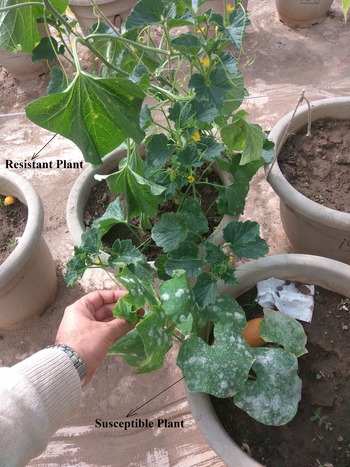
Reasonable genetic diversity has already been reported among the collected cucumber genotypes using SSR markers which could further be exploited in various cucumber improvement programmes (Dar et al., Reference Dar, Mahajan, Lay and Sharma2017). In the present study, a total of 140 genotypes (online Supplementary Tables S1 and S2) of cucumber were screened for PM resistance under field (101 genotypes) and artificial (59 genotypes) conditions consecutively for 2 years. As per disease reaction, these were grouped as HR, MR, T, S and HS. A total of nine genotypes (GS16, GS41, GS70, GS72, GS73, GS79, GS88, GS92, and GS96) were observed to be HR under field conditions (online Supplementary Table S1) as their PDI value ranged from 2.55 to 11.65. As many as 12 and 23 genotypes were grouped as MR and T genotypes with their PDI ranging from 15.60 to 23.50 and 26.15 to 34.60, respectively. Pitchaimuthu et al. (Reference Pitchaimuthu, Souravi, Ganeshan, Kumar and Pushpalatha2012) had screened 42 genotypes of cucumber under open field conditions and reported varied PDIs and had advised repeating of screening the lines under artificial conditions to confirm the results. Henceforth, all the HR genotypes and two of the MR genotypes along with exotic germplasm were subjected to artificial screening for PM under controlled conditions (online Supplementary Table S2). However, under controlled conditions, the majority of the genotypes succumbed to susceptibility and only GS140 was reported to be HR, whereas GS148 (EC904102), GS16 and GS70 were found to be MR and GS169 (EC904253) was found to be T (online Supplementary Table S2, Figs. 1 and 2). Similar results were observed in the leaf disc assay also and there was no sporulation observed in the GS140 and was therefore rated as R (online Supplementary Table S2). Whereas, GS148, GS16 and GS70 showed some hyphae and were rated as 2 but were recorded as S. These R genotypes can further be exploited in breeding programmes to transfer PM resistance. The accession, PI 197088 (GS180), which has been exploited extensively for varietal development and reported to be R was found to be HS with a disease rating of 3 in all the screened plants with disease severity of 83.33%, suggesting a wide diversity of pathogen. Zhang et al. (Reference Zhang, Gu, Zhang and Zou2007) reported disease indexes in a continuous distribution among the individuals from R to S phenotypes, which implies that the PM resistance is controlled by multiple genes in cucumber. Thus, it can be said that sole resistance to PM must not be considered as a pest management strategy rather be considered as a part of an integrated pest management strategy. The R lines so identified must be involved in cucumber improvement programmes aimed at the development of improved cultivars through marker-assisted breeding.
Severity of powdery mildew disease-induced under artificial conditions.

Comparative reaction of powdery mildew on susceptible and resistant genotypes.

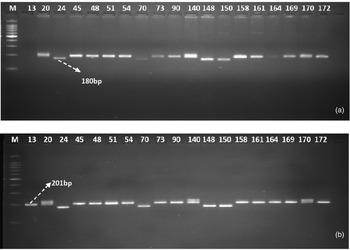
Out of eight PM-linked SSR markers, only five markers (Table 1) (C31, C80, C162, SSR16472 and SSR16881) amplified the allele reportedly linked to PM. An allele (127 bp) of SSR16881 was observed to be associated with the lowest disease severity of 37.65% which could further be exploited or verified for linkage in segregating populations. Similarly, an allele (180 bp) for another marker (C80) was found to be associated with 45.83% disease severity, however, the reported linked allele of 200 bp for the marker C31 also amplified the linked allele of 201 bp, and G148 amplified the allele of 180 bp (Table 2, Fig. 3). Hai-ying et al. (Reference Hai-ying, Zhen-guo, Ai-jun, Feng, Yong-jian and Yong2008) have reported SSR97 and SSR273 to be linked to the PM R gene at the genetic distances of 5 and 13 cM, respectively. Several reports indicate the involvement of more than one gene for PM resistance in some cucumber accessions (Zhang et al., Reference Zhang, Anarjan, Win, Begum and Lee2021). Longzhou et al. (Reference Longzhou, Xiaojun, Run, Junsong, Huanle, Lihua, Yuan and Lihuang2008) identified five QTL (pm1.1, pm1.2, pm2.1, pm2.2 and pm5.1) for PM resistance in cucumber that can lay a foundation for breeding PM-R varieties by marker-assisted selection. Fukino et al. (Reference Fukino, Yoshioka, Sugiyama, Sakata and Matsumoto2013) evaluated PM resistance of the recombinant inbred lines and successfully validated four QTL (pm3.1, pm5.1, pm5.2 and pm5.3) by using populations derived from the selfing of residual heterozygous lines. Liu et al. (Reference Liu, Gu, Lu, Liu, Miao, Bai and Zhang2021) detected 13 loci (pmG1.1, pmG1.2, pmG2.1, pmG2.2, pmG3.1, pmG4.1, pmG4.2, pmG5.1, pmG5.2, pmG5.3, pmG5.4, pmG6.1, and PmG6.2) associated with PM resistance by genome-wide association study. They suggested that markers linked to QTL will be useful for introducing PM resistance into commercial cultivars to enhance resistance. Thus on the basis of the polymorphism reported between the R lines and S commercial varieties/lines, further studies might be carried for the development of mapping populations and establishing genetic linkage of putative genes/QTLs (Table 2). The R genotypes in which the alleles of linked markers could not be amplified may be supposed to carry putative novel QTLs of PM resistance.
Genotyping of resistant and susceptible genotypes with reported linked markers (a) C-80 and (b) C-31 (Numbers in the gel picture signifies the genotype codes with prefix GS, for more information about cucumber genotypes, please consult online Supplementary Material; M is a 100 bp ladder).

Genotyping of R, T and S genotypes with reported linked markers

HR, highly resistant; MR, moderately resistant; T, tolerant; S, susceptible; HS, highly susceptible; P, polymorphic; M, monomorphic; H, heterozygous allele; X, no result; # = same genotypes-no comparison.
Linked markers SSR16472, C35 and SSR97 were monomorphic, whereas for SSR273 both the R genotypes (GS140 & GS148) were heterozygous, while GS140 was heterozygous (–) with C31.
Conclusion and future scope
Screening of 140 genotypes under field and artificial conditions identified only a few lines R to PM. While, GS140 (EC904094) was found to be R; GS148 (EC904102), GS16 and GS70 were identified as MR, whereas GS169 (EC904253) was found to be T lines, which can be further exploited in breeding programmes to transfer PM resistance. Among the eight SSR markers, only C31, C80, C162, SSR16472 and SSR16881 amplified the reported linked allele. Broadly, it could be inferred that mere resistance will not be feasible for total crop protection, thus the use of R varieties should be considered as a part of an integrated pest management approach. However, R lines/varieties can be useful where the threat from specific pests and diseases is very high. The germplasm shall be made available to potential users after a proper material transfer agreement. Hence, the promising accessions observed in the present study can serve as tools in the breeding programmes for PM resistance. The associated markers could further be verified for their linkage using the mapping populations on the basis of contrast parents in the present study.
Supplementary material
The supplementary material for this article can be found at https://doi.org/10.1017/S1479262121000605.
Acknowledgement
The authors thank DBT (Project sanction No. BT/ PR11500/PBD/16/1101/2014) for providing financial support for conducting the research. The authors are also grateful to farmers and various sources from where the germplasm has been procured (online Supplementary Tables S1 & S2).
Authors contribution
SS and AAD designed and conducted the experiments, and equally contributed to the manuscript. SG and RS assisted in result analysis. SS, AAD and SG wrote and edited the manuscript.
Conflict of interest
The authors declare that there is no such conflict of interest.