Introduction
Anxiety is a condition of great public health importance (Bryant et al., Reference Bryant2013) that affects a significant number of older people and it is a source of increasing personal, economic and societal costs (Wolitzky-Taylor et al., Reference Wolitzky-Taylor, Castriotta, Lenze, Stanley and Craske2010). The results of a systematic review done by Bryant et al. (Reference Bryant, Jackson and Ames2008) show that the prevalence of anxiety disorders in the older adult population ranges from 1.2% to 14%, while the estimated prevalence of clinically significant anxiety symptomatology ranges from 15% to 52.3%. In addition, “anxiety symptoms are an almost daily experience” in older adults (Schaub and Linden, Reference Schaub and Linden2000). Even though these figures are high, they may not reveal the true scope of the presence of anxiety problems or anxiety symptomatology in older persons. This is because the diagnostic criteria, as well as the assessment procedures used, may lead to an under-diagnosis of anxiety (Bryant et al., Reference Bryant, Jackson and Ames2008), in the same way that methodological issues (e.g. differences in the operationalization of anxiety) may make it difficult to clarify the magnitude of the problem (Wolizky-Taylor et al., Reference Wolitzky-Taylor, Castriotta, Lenze, Stanley and Craske2010).
Anxiety symptoms are more frequent in older adults than are symptoms of depression (Bryant et al., Reference Bryant, Jackson and Ames2008), although comorbidity between the disorders in this age group is high. This comorbidity is associated with poor social functioning and, in the case of comorbidity with generalized anxiety disorder, with increased risk of suicidal ideation (Lenze et al., Reference Lenze2000).
Furthermore, anxiety problems, including generalized anxiety disorder and low levels of anxiety or subthreshold symptoms, are associated in older adults with increased risk of physical and functional disability, psychiatric comorbidity, increased medication intake (Gonçalves et al., Reference Gonçalves, Pachana and Byrne2011), and decreases in well-being and life satisfaction (Ayers et al., Reference Ayers, Sorrell, Thorp and Wetherell2007).
Research on the behavioral correlates of anxiety symptomatology in older adults is sparse. Anxiety symptoms in the older adult population have been found to be associated with physical frailty (Delbaere et al., Reference Delbaere, Crombez, Vanderstraeten, Willems and Cambier2004) and higher levels of healthcare utilization (Porensky et al., Reference Porensky2009). Functional limitations (Gonçalves et al., Reference Gonçalves, Pachana and Byrne2011) and lower levels of physical activity (Teixeira et al., Reference Teixeira, Vasconcelos-Raposo, Fernandes and Brustad2013) have also been linked with anxiety. Conversely, longitudinal data show that physical activity (mostly leisure-time physical activity) seems to be protective against the development of anxiety and depressive disorders in older adults (Pasco et al., Reference Pasco2011) and, in fact, leisure activity has been found to be a predictor of mental well-being in an eight year follow-up study (Lampinen et al., Reference Lampinen, Heikkinen, Kauppinen and Heikkinen2006).
Interestingly, avoidance of physical activity (Delbaere et al., Reference Delbaere, Crombez, Vanderstraeten, Willems and Cambier2004) and, more generally, avoidance coping (Ayers et al., Reference Ayers, Petkus, Liu, Patterson and Wetherell2010), are related to persistent anxiety symptomatology in older adults. Experiential avoidance, or the tendency to avoid or escape from negative internal experiences (e.g. negative emotions) (Hayes et al., Reference Hayes2004) has also been found to be associated with anxiety symptomatoloty in older adults, and it has been shown to have a moderating role in the relationship between self-reported health problems and both anxiety and depressive symptomatology (Andrew and Dulin, Reference Andrew and Dulin2007).
The experience of symptoms of anxiety in older adults has been also linked with variables related to their social behavior or their involvement in social activities and relationships. Specifically, negative associations have been found between anxiety and perception of emotional support in well-functioning older adults (Mehta et al., Reference Mehta2003), whereas positive relationships have been detected between anxiety and loneliness in older adults (Vink et al., Reference Vink2009), and a tendency towards “keeping things inside” as a strategy to cope with conflicts and negative events (Cohen et al., Reference Cohen, Magai, Yaffee and Walcott-Brown2006). There are other interesting variables related to social behavior whose relationship with anxiety symptomatology has not been sufficiently explored in older adults. Capitalization on pleasant events has been defined as the process of sharing information about positive personal events with other people, and has been found to be an important positive emotion regulation strategy which may enhance meaningful connections and intimacy with others in college undergraduates (Langston, Reference Langston1994). Capitalizing has been found to be associated with increased daily positive affect, over and above the impact of the pleasant event itself (Gable et al., Reference Gable, Reis, Impett and Asher2004), life satisfaction (Quoidbach et al., Reference Quoidbach, Berry, Hansenne and Mikolajczak2010) and improved immune response (Labott et al., Reference Labott, Ahleman, Wolever and Martin1990) in the general population. Hence, capitalizing on positive events can have the effect of augmenting the rewarding consequences of pleasant events in people of different ages (Algoe and Heidt, Reference Algoe and Heidt2009). However, its association with anxiety symptomatology has not been explored to date, as far as the authors know.
Considering the findings presented above, and assuming that behavioral indicators may be highly relevant for understanding and treating anxiety in older adults, the aim of this work is to analyze differences in anxiety symptomatology among older adults depending on their profile in different behavioral indicators: health variables (vitality and physical function), activity variables (pleasant activities and watching TV), emotional variables linked to behavioral patterns (loneliness and boredom), social variables (perception of social support and capitalizing on positive experiences by discussing them with others) and an emotion-regulation variable, namely, experiential avoidance. These indicators were hypothesized to be either adaptive/functional or maladaptive/dysfunctional, as follows: a) Adaptive indicators: health variables, pleasant activities, social support and capitalizing on positive experiences: b) Maladaptive indicators: watching TV, emotional indicators (boredom and loneliness) and experiential avoidance. We hypothesized that potentially adaptive, maladaptive and vulnerable profiles in the assessed variables will be identified, and that anxiety symptomatology will be associated with maladaptive profiles.
Methods
Participants
The sample of this study was composed of a convenience sample of 395 people aged 60 or more (mean = 71.62; S.D. = 6.96) from social and cultural centers from the Red Cross organization in Madrid (Spain). Most of them were women (70.1%), married (51.1%) or widowed (27.8%). The mean number of years of formal education completed was 12.59 (S.D. = 8.92).
Measures
In addition to participant's age, gender, marital status and years of formal education completed, the following variables were measured:
Anxiety. Anxiety symptomatology was measured using the Spanish version (Márquez-González et al., Reference Márquez-González, Losada, Fernández-Fernández and Pachana2012) of the Geriatric Anxiety Inventory (Pachana et al., Reference Pachana, Byrne, Siddle, Koloski, Harley and Arnold2007). It is a 20 item scale (e.g. “I worry a lot of the time”) measuring anxiety symptoms in older people, with response categories of “agree” or “disagree”. The GAI has displayed good to excellent psychometric properties, and a cut-point of 8/9 has been suggested for classifying the absence or presence of clinically significant anxiety (Pachana et al., Reference Pachana, Byrne, Siddle, Koloski, Harley and Arnold2007). The internal consistency (Cronbach's alpha) for this scale in the current study was .91.
Vitality and physical functioning. The Spanish version of the Short Form-36 Health Survey (SF-36, Medical Outcomes Study, MOS; Ware and Sherbourne, Reference Ware and Sherbourne1992) by Alonso et al. (Reference Alonso, Prieto and Antó Boque1995) vitality and physical functioning subscales were administered. The vitality subscale is composed of four items (e.g. “During the past four weeks did you have a lot of energy?”) with response options ranging from 0 (none of the time) to 5 (all of the time). The physical functioning subscale is composed of ten items (“Does your health now limit you walking more than a mile?”) with response options ranging from 0 (no, not limited at all) to two (yes, limited a lot). For each subscale, items are transformed on to a scale from 0 (worst health) to 100 (best health). Cronbach's alpha for the vitality subscale in this study was .82 and for physical functioning subscale .90.
Social support. Social support was measured with the psychosocial support questionnaire (PSQ; Reig et al., Reference Reig, Ribera and Miquel1991), a six item questionnaire (e.g. ‘When I need it, there is always someone to encourage me and show affection’) that assesses the frequency of social, emotional, and instrumental support. The answers range from 0 (‘never’) to 3 (‘very often’). The internal consistency (Cronbach's alpha) for this scale in this study was .82.
Experiential avoidance. The Action and Acceptance Questionnaire (AAQ; Hayes et al., Reference Hayes2004; Spanish version by Barraca, Reference Barraca2004), a 9 item questionnaire (e.g. “Anxiety is bad”) “designed to assess a high need for emotional and cognitive control, avoidance of negative private events, inability to take needed action in the face of private events, and forms of cognitive entanglement, such as excessively negative evaluations of private experiences or negative self-references” (Hayes et al., Reference Hayes2004; pp. 556–557) was administered. The internal consistency (Cronbach's alpha) obtained in the original study was .70 (Hayes et al., Reference Hayes2004). Cronbach's alpha obtained in the present study for the AAQ was .51.
Leisure. Frequency of leisure was measured through an adaptation of the leisure time satisfaction scale (Stevens et al., Reference Stevens2004). This scale assesses participants perceived participation in six leisure activities over the past month (e.g. “How often have you taken part in hobbies or other social activities?”). Item scores ranged from 0 (not at all) to 4 (a lot). Internal consistency (Cronbach's alpha) of the scale in this study was .72.
Loneliness, boredom and capitalizing on positive experiences (commenting on the pleasant activities that have been engaged in) were measured through single items (“Do you feel lonely?”, “Do you get bored?” and “Do you talk with others about the pleasant activities that you have done?”) with response options of 0 (never or almost never), 1 (sometimes), 2 (many times) and 3 (always or almost always). Watching television was measured through a single item (“In a normal day of your life, how many hours do you watch TV?”) with the following response options: 0 (less than one hour), 1 (between 1 and 2 hours), 2 (between 2 and 3 hours) and 3 (more than 3 hours).
Procedure
Red Cross cultural and social centers in Madrid (Spain) offer diverse courses and recreational activities for older people (e.g. literature, internet, painting, yoga), who attend these activities voluntarily. A collaboration agreement between the Rey Juan Carlos University and some of these centers allowed for implementation of mental health screenings in order to identify older adults who may benefit from psychoeducational interventions. Users who wished to participate were required, after providing written informed consent, to complete an assessment protocol. The study was approved by the Ethics Committee at the Universidad Rey Juan Carlos (Madrid) and the Red Cross. Two trained psychologists were present during the assessments in order to answer possible questions from the participants.
Data analysis
Following a cross-sectional design and with the aim of identifying homogeneous groupings in the sample considering participants’ scores on the variables measured, a Euclidean distance matrix was calculated, and a hierarchical clustering analysis was performed using Ward´s method. Prior to cluster determination all variables were standardized using z-scores in order to make them comparable and to avoid undesirable scale effects.
A first exploratory analysis revealed a reasonable structure consisting of 5 clusters, which was subsequently selected, based on the information contained in the dendrogram which depicts the existence of possible natural clusters (see Figure 1). Outliers were identified in a preliminary analysis (using Average Linkage method) but were neither treated nor excluded since they did not interfere with the possible solutions.
Cluster dendrogram using Ward method. Dashed line identifies the 5 cluster solution.

Results
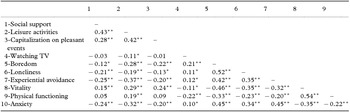
The principal aim of this study was to analyse differences in anxiety symptomatology between participants depending on profiles based on physical health, activities, emotional and social variables. The correlations between variables for the whole sample are shown in Table 1.
Correlations between the assessed variables

*p < .05; **p < .01
All the assessed variables have shown significant associations in the expected direction with anxiety, with the exception of the number of hours watching TV (r = 0.09; p = 0.05), which showed no significant association with anxiety. This way, anxiety was positively associated with boredom, loneliness and experiential avoidance, and negatively related with social support, frequency of leisure activities, capitalization on pleasant events, vitality and physical functioning.
Clustering analysis suggested the existence of 5 clusters, as shown in Figure 1.
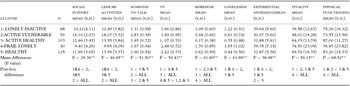
Means and standard deviations of the assessed variables for each obtained group are shown in Table 2, which also includes information regarding the comparison (ANOVA) between the clusters in those variables (F value and post-hoc comparisons).
Means,standard deviations, and differences between means in the assessed variables for each cluster group

**p < .01; Bold: higher scores; Underlined: lower scores
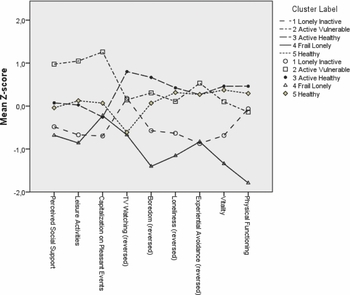
A graphic of the standardized mean scores of the identified clusters is presented in Figure 2. Scores on variables hypothesized to be maladaptive (TV watching, boredom, loneliness and experiential avoidance) were reversed, so that the graphic could offer a clearer picture of the profiles.
Standardized mean scores of the obtained clusters in the variables of interest.

As can be seen in Figure 2, there were two clusters (1 and 4) which may represent particularly vulnerable profiles, as compared to other potentially more adaptive or positive (clusters 2, 3 and 5).
Cluster 1 (N = 68) was labelled lonely inactive, as it included participants who reported low scores on social support, leisure activities and capitalizing on pleasant activities (lower scores than clusters 2, 3 and 5), and high scores on boredom and loneliness (higher scores than those clusters). Lonely inactive participants had the highest mean score in experiential avoidance (significantly higher than those obtained by all the active clusters) and showed low scores in physical functioning and vitality, significantly lower than clusters 3 and 5.
Cluster 4 (N = 40) was labeled frail lonely and represents a particularly vulnerable profile of participants, similar to that of lonely inactive with regard to social support and leisure activities, but with significantly lower scores than that cluster on health variables (vitality and physical function) and higher scores on boredom and hours watching TV. In fact, frail lonely showed the least functional profile among all clusters in these variables.
Clusters 3 (N = 103) and 5 (N = 125) represent very similar clusters which were labeled, respectively, active healthy and healthy. These clusters showed the highest mean scores on health variables, and adaptive scores on the rest of variables. The only differences between them are that active healthy (Cluster 3) participants reported significantly lower scores on hours watching TV, boredom and capitalization on pleasant events that healthy participants.
Finally, cluster 2 (N = 59) was labeled active vulnerable due to their high scores on social support, leisure activities and capitalization on them which are, however, accompanied by low scores in vitality and physical functioning, which are lower than those of the other adaptive clusters (clusters 3 and 5), but higher that that of frail isolated participants (cluster 4). Active vulnerable participants also reported a higher level of boredom than active healthy people.
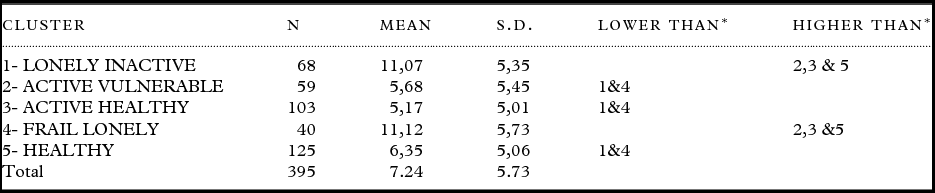
Focusing on the main objective of the study, significant differences between clusters were found with respect to self-reported anxiety symptoms (F = 20.90; p < .01; see Table 3). Specifically, participants with the lonely inactive (cluster 1) and frail lonely (cluster 4) profiles reported significantly higher scores in anxiety symptomatology that those with the active vulnerable (cluster 2), active healthy (cluster 3), and healthy (cluster 5) profiles.
Means, standard deviations and differences in anxiety by cluster group

*p < .01
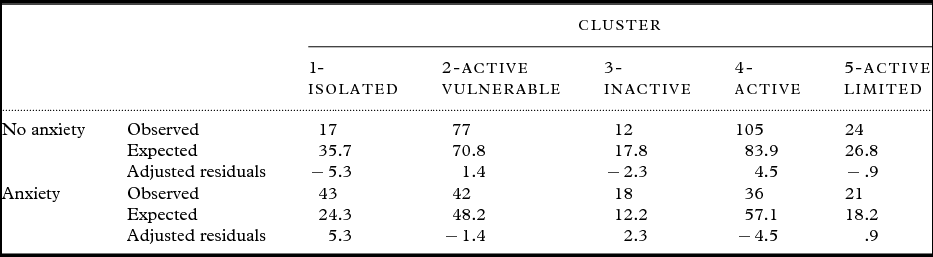
In order to test if there were differences between the obtained clusters in the number of cases with clinically significant anxiety levels (according to the GAI cut-off score), a chi-square test was performed. Given that the chi-square was significant (ᵪ2 = 47.15; p < .000), differences between cluster groups were examined through the analysis of the standardized adjusted residuals (absolute values higher than 1.96 are indicative of significant differences). The obtained results (see Table 4) show that the lowest number of cases with clinically significant anxiety levels was found in the active healthy cluster (cluster 3). By contrast, a high proportion of cases with clinically significant anxiety levels were found in the lonely inactive (cluster 1), followed by the frail lonely (cluster 4) profiles.
Cases with clinically significant anxiety levels by cluster group

Differences between cluster groups in sociodemographic variables were also analyzed through ANOVAs and chi-square tests. Healthy participants (cluster 5) were more likely to be men (ᵪ2 = 15.3; p < 0.01) and married (ᵪ2 = 27.70; p < 0.05). In contrast, active vulnerable participants are more likely to be women and widowed. A specially higher proportion of widowed participants was also found in frail lonely participants (cluster 4), and a more single people were identified among active healthy (cluster 3) participants. With regard to age and education, significant differences were also found between the identified clusters. Frail lonely participants (cluster 4) were older than participants from the other clusters (mean age = 75.4; s.d = 7.36) (F = 3.82; p < 0.01). Active healthy (cluster 3) participants reported a significantly higher education level than lonely inactive (cluster 1), frail lonely (cluster 4) and healthy (cluster 5) participants (F = 4.68; p < 0.01). Active vulnerable (cluster 2) people also showed a higher level of education than frail lonely people (cluster 4).
Discussion
The results of this study seem to support the hypothesized association between the experience of anxious symptomatology and maladaptive behavioral patterns in older adults. Anxiety levels in older adults are significantly related in the expected directions to all the behavioral indicators analyzed in this study: health variables (vitality and physical function), activity variables (leisure activities), emotional variables linked to behavioral patterns (loneliness and boredom), social variables (perception of social support and capitalizing on positive experiences) and experiential avoidance. The only exception has been found regarding the number of hours watching TV, which has failed to show a significant association with anxiety. Despite this finding, this study also identifies significant associations between time spent watching TV and some of the assessed variables, which go in the expected direction: TV watching is inversely associated with frequency of leisure activities and health variables, while positively related with loneliness, boredom and experiential avoidance.
To our knowledge, this is the first study to demonstrate a significant inverse association between capitalization on pleasant events and anxiety in older adults. Capitalizing on pleasant events is also inversely associated with boredom, loneliness and experiential avoidance, and positively related with social support, frequency of leisure activities and vitality. These results highlight the adaptiveness of this strategy for the elderly, which can contribute to amplify the rewarding effects of the realization of pleasant activities (Algoe & Heidt, Reference Algoe and Heidt2009) and foster their connection to and intimacy with other people (Langston, Reference Langston1994). This study, thus, suggests the relevance of considering this variable both in the assessment and in the interventions designed to treat or prevent anxiety and other emotional problems in older adults.
The highest correlations with anxiety have been found for two emotion-related variables, namely, experiential avoidance and the feeling of boredom. The associations between anxiety and the frequency of leisure activities and loneliness are also high. It is interesting to note that these four variables (experiential avoidance, boredom, leisure activities and loneliness) are also significantly associated with each other, which supports the existence of behavioral patterns defined by these indicators. One explanation for these interrelationships may be that experiential avoidance as a regulation strategy may trigger older adults´ avoidance of particular leisure and social activities over time, eventually leading to feelings of loneliness and boredom. This hypothesis, however, should be explored in future experimental or longitudinal studies on this matter. Such longitudinal work could further illuminate the influence of changes in levels of physical health and functional ability over time on coping styles, leisure activities and social support, and the impact of these changes on mental health, particularly anxiety.
Findings of this study suggest that a significant proportion of participants (72.65%) showed an adaptive behavioral profile, with relatively high levels of vitality and physical functioning and low levels of anxiety (Means Range = 5.17–6.35). These participants are integrated in three slightly different profiles, called active vulnerable (n = 59; 14.93% of the global sample), active healthy (n = 103; 20.07%), and hyealthy (n = 125; 31.64%). This result suggests the positive conclusion that the majority of older adults in this community-dwelling sample displayed relatively adaptive patterns of behavior and appropriate levels of functioning. Scores in the active healthy and healthy profiles of older adults on health variables (vitality and physical functioning) were even higher than previously reported scores on these variables among adults (including younger adults) in the general population (Brazier et al., Reference Brazier1992). In general, our findings seem to be in line with the results obtained by Balboa-Castillo et al. (Reference Balboa-Castillo, León-Muñoz, Graciani, Rodríguez-Artalejo and Guallar-Castillón2011), who found that increased levels of leisure-time physical activity (e.g. walking and dancing) and lower levels of leisure-time sedentary behavior (e.g. watching TV) were related with better health related quality of life in older adults (e.g. higher physical functioning and vitality). These results suggest, however, that the association between behavioral activation and physical health is not a simply linear one: a profile of older adults has been identified (active vulnerable; cluster 2) with the highest scores on social support and behavioral activation, but with significantly lower physical functioning than active healthy participants and reporting higher level of boredom than this profile. It is interesting to note that, as compared to the other adaptive profiles, the active vulnerable group contained a particularly high proportion of women who, in line with most gerontological research (e.g. Newman and Brach, Reference Newman and Brach2001), present relatively more health problems than do men, and which may affect their vitality and physical functioning, although this may be mitigated by the presence of a partner (Pachana et al., Reference Pachana, McLaughlin, Leung, Byrne and Dobson2011). In this regard, this profile is also the one who showed the highest proportion of widowed participants. Taking all this into account, active vulnerable participants may represent active older adults who experience health limitations that could be starting to affect their emotional well-being, as suggested by a slightly higher level of feelings of boredom, as compared to active healthy participants. If this was the case, boredom may represent an alerting signal indicating difficult transitions in older adults´ life, which may benefit from psychological interventions aimed to help older adults to perform a flexible readjusting of goals related to leisure and recreational activities (Wrosch et al., Reference Wrosch, Scheier, Miller, Schulz and Carver2003).
The present study adds evidence supporting that behavioral activation (leisure activities, capitalization on them, less TV watching) is related to better emotional outcomes, such as a lower likelihood of reporting loneliness, boredom and experiential avoidance. The inverse associations identified between feelings of boredom and loneliness and older adults´ physical functioning and vitality are consistent with previous data showing the significant correlations between these feelings and negative functional outcomes for older persons (Losada et al., Reference Losada, Márquez-González, García-Ortíz, Gómez-Marcos, Fernández-Fernández and Rodríguez-Sánchez2012).
It is important to note that older adults with active healthy and active vulnerable profiles had a higher level of formal education than other less adaptive profiles, a characteristic which may represent a protective factor which could partially explain the relatively high functionality and lower level of anxiety found in these profiles. The third adaptive profile, termed healthy participants, seems to be very similar to the active healthy one, with the only difference that healthy participants reported more TV watching and more boredom. Again, feelings of boredom seem to represent an important marker of the differences between clusters. The data revealing a particularly higher proportion of men among healthy subjects, and a lower educational level in this profile than in the active healthy one may help to understand the differences between these clusters.
In clear contrast with the adaptive profiles described in the above paragraphs, two less adaptive profiles of participants, less frequent than the adaptive ones, were identified. Clearly, the most vulnerable profile is represented by frail lonely participants (cluster 4) (N = 40; 10.12% of the global sample), which presented with the lowest scores on vitality and physical functioning (lower than those reported for people older than 65 years in the Brazier et al. (Reference Brazier1992) study). As this profile is composed of older adults with a higher mean age than those in the other profiles, its higher physical frailty may reflect the inverse association between age and physical health. Furthermore, this profile also presents the highest mean score in boredom and time spent watching TV.
The other vulnerable profile has been called lonely inactive (N = 68; 17.21% of the global sample). Older adults included in this profile, together with frail lonely participants, showed the lowest mean scores on social support, leisure activities and capitalization on pleasant events, as well as the highest mean scores in loneliness, experiential avoidance and anxiety. In contrast with frail lonely, lonely inactive presented a medium-high level of physical functioning. However, despite this level of physical functioning, lonely inactive participants´ vitality scores were rather low, which suggests the influence of social and emotional variables in the perception of vitality. Furthermore, this profile, once again, shows the complex relationship between physical health variables, on one side, and emotional and social indicators, on the other: older adults with relatively appropriate levels of psychical functioning show, however, an emotional vulnerability (anxiety and feelings of boredom and loneliness) which seem to be related with particularly dysfunctional behavioral patterns: low frequency of leisure activities, low capitalization of pleasant events and high experiential avoidance, among other indicators.
Stereotyped visions of aging may lead clinicians to think that anxiety and its manifestations (e.g. avoidance of activities) are normal in later life (Bryant et al., Reference Bryant2013). Results from the present study are inconsistent with this stereotype, and support the notion that “anxiety and its manifestations need to be viewed within the broader canvas of multiple influences on a happy and healthy old age” (Bryant et al., Reference Bryant2013). Even though the cross-sectional nature of this study precludes us from making causal assumptions, the results suggest the potential importance of leisure activities, capitalizing on positive events, social support and emotion-related variables such as boredom, loneliness and experiential avoidance when assessing anxiety in older adults, as well as the convenience of including them as relevant targets in interventions aimed at decreasing anxiety levels in this population. Specifically, the two profiles of older adults showing significantly higher levels of anxiety, namely, lonely inactive and frail lonely, share the following characteristics: high levels of experiential avoidance, loneliness and boredom, and a low frequency of leisure activities. This consideration, together with the data that these four variables are among the most highly correlated with anxiety in this study, point to its particular involvement in the experience of older adults´ anxiety. Experiential avoidance has been found to be very related with personality variables such as neuroticism (Gámez et al., 2011) and, likewise this trait, it has shown to be very associated to anxiety (Bond et al., Reference Bond, Hayes, Baer, Carpenter, Guenole, Orcutt, Waltz and Zettle2011). As suggested before, experiential avoidance may facilitate older adults´ progressive avoidance of particular leisure and social activities over time, eventually leading not only to feelings of loneliness and boredom, but also to the development, maintenance or strengthening of anxiety.
Taken together, the results of this study suggest that anxiety in older adults seems to be linked not only nor mainly to poor health (physical functioning and vitality), but also to dysfunctional social behavior (few leisure activities and low capitalization on them), negative emotions derived from these patterns (loneliness and boredom) and a dysfunctional emotion-regulation strategy, namely: experiential avoidance. Hence, this study contributes to improve our understanding of older adults´ anxiety, raising evidence regarding the potential role of variables which have not been sufficiently explored previously (e.g. capitalization of pleasant events, boredom or loneliness, etc.). Taking a step beyond the mere identification of single indicators, behavioral patterns of variables have been detected through cluster analysis, which suggest the existence of more and less adaptive profiles of older adults defined by behavioral, social and emotional variables and with different correlates with regard to the experience of anxiety.
Behavioral techniques or strategies such as behavioral activation or increasing engagement in pleasant activities have been included in successful interventions for reducing late-life anxiety (e.g. Wetherell et al., Reference Wetherell, Sorrell, Thorp and Patterson2005). The results of this study suggest that helping older adults to cope better with their physical limitations and to improve their social functioning in order to get enough social support and amplify the positive experiences derived from pleasant activities (capitalization), may also be useful ways of reducing anxiety levels in this population. However, it should be taken into account that involvement in activities per se, although rated by patients as one of the most helpful strategies for dealing with anxiety symptoms, may sometimes serve as an unhelpful avoidance strategy that in the long run, may maintain rather than reduce anxiety (Wetherell et al., Reference Wetherell2009).
It is important to take into account some important limitations of the study. First, the exploratory nature of the cluster analysis performed in the study, together with the inherent limitations of the method of statistical analysis, suggest the need for cautious interpretation of these results. Future studies are needed which, using different statistical methods, shed light on the nature of the specific contributions of the assessed variables and on their inter-relationships. Second, the sample of this study was composed of high-functioning older adults who attended social and cultural courses, and who voluntarily agreed to participate in the study, and so may not be generalizable to other elderly populations with increased rates of anxiety problems (e.g. Petkus et al., Reference Petkus, Gum and Wetherell2013). The activities offered by the Red Cross centers (e.g. literature, internet, painting, yoga) may be attractive to a certain profile of older adults. In this sense, active older adults may be overrepresented in our sample, and the mean number of years of formal education reported by the participants may be considered high when compared with other studies done with Spanish older adults (e.g. the SHARE project: Brunello et al., Reference Brunello, Fort, Schneeweis and Winter-Ebmer2011). A more representative sample could yield a different cluster structure than the one obtained in this study. Third, although some authors have pointed out that the distinction between anxiety and depression in older adults is “minimally meaningful” (Wetherell et al., Reference Wetherell, Gatz and Pedersen2001), and other authors highlight the need to distinguish between older people with anxiety and depression (Vink et al., Reference Vink2009), the lack of diagnostic information prevent us from concluding that the psychosocial factors associated with anxiety are different than those that could be associated with depression or mixed anxiety and depression. In addition, we found differences between participants as a function of age, which may introduce biases in the interpretation of the results due to differences in anxiety presentation associated with age (Pachana et al., Reference Pachana, McLaughlin, Leung, Byrne and Dobson2012). Although the identified profiles of active older adults (active healthy, healthy and active vulnerable) have been considered as representative of adaptiveness in older adulthood, with generally positive scores in measures such as physical function, vitality or loneliness and social support, there is a significant number of people (28.9% of participants with these profiles) in these clusters who, according to the GAI cut-score, may be presenting with clinically significant anxiety. Finally, the measures of behavioral activation used in this study are very limited and exclusively based on older adults´ self-report. Also, the results related to the variable experiential avoidance should be interpreted with caution considering the low alpha coefficient obtained for the AAQ (.51), that may result in part from the complexity of the construct of experiential avoidance (Bond et al., Reference Bond, Hayes, Baer, Carpenter, Guenole, Orcutt, Waltz and Zettle2011). A need for multimethod research in this field is evident, and studies including not only self-report measures but also objective ones such as accelerometry (ActiGraph) and other types of activity monitors (pedometers or GPS devices) (Colbert et al., Reference Colbert, Matthews, Havighurst, Kyungmann and Schoeller2011) will likely offer a more complete picture of the role of activity in older adults´ well-being and adaptation.
Despite these limitations, this study provides clear empirical evidence of the existence of behavioral patterns associated with the experience of anxiety in older adults. These behavioral patterns should be considered when assessing older adults with clinical or subclinical anxiety problems. Furthermore, they may be amenable to change through interventions aimed to prevent anxiety in older adults or helping them reduce this emotional state.
Conflict of interest
none.
Description of authors’ roles
Andrés Losada and María Márquez-González both worked on the design of the study and its implementation, the data analysis and the writing of the paper. Nancy A. Pachana and Julie L. Wetherell collaborated in the writing of the paper. Virginia Fernández-Fernández and Celia Nogales-González collaborated in the implementation of the study and in the writing of the paper. Miguel Ruiz-Díaz collaborated in the data analysis and in the writing of the paper.
Acknowledgments
This work has been made possible by collaboration with Cruz Roja Española, Centro de Mayores Reina Sofía (Spanish Red Cross, Reina Sofia Day Centre for Senior Citizens). We thank all the staff and participants from the center for making it possible. The study was funded within the framework of Project PSI2009-08132, from the Ministry of Science and Innovation, and Project PSI2012-31293, from the Ministry of Economic and Competitiveness.