Introduction
Iranian immigrants are highly educated and well integrated into the German labor market.Footnote 1 They are assumed to have high educational and high occupational aspirations. However, not much is known about second generation Iranian higher education graduates and the mechanisms that lead to their labor market integration. Data from previous research could not quantitatively analyze second generation Iranian graduates as the case numbers were too low. As a result, only descriptive or qualitative reports about Iranian higher education graduates (be it first or second generation) in Germany are available.Footnote 2 The KOAB project (see Data and Methods section) allows for comparing the job success of second generation Iranian graduates with other immigrants and Germans without migration background.Footnote 3 We address two research questions.
-
1. Do second generation Iranian graduates have higher aspirations than other second generation immigrants or Germans?
-
2. How are the aspirations of second generation Iranian graduates related to their labor market success?
The higher education graduates in our study are the German-based descendants of Iranian immigrants (“second generation”Footnote 4). Different origins are connected to different immigration stories, different social selectivity, different levels of perceived discrimination and different paths of assimilation. Therefore, we contrast the second generation higher education graduates of Iranian, Polish, Russian, Turkish, and Kazakh ancestry.
Job success of immigrants is part of their structural assimilation.Footnote 5 Structural assimilation is the placement in different systems of the society, e.g. educational system, labor market.Footnote 6 Phases of assimilation can be seen as followed: cultural (especially language), structural (education and occupation), social (e.g. contacts and especially intermarriage with Germans), emotional (identification with the values of and the newly adopted country in general).Footnote 7 Participation in the labor market is often seen as the most important aspect of integration.Footnote 8 The career success of second generation immigrants, especially of those with a higher education degree, is a far less scrutinized topic than their educational attainment.Footnote 9 But higher education is increasingly important for the fulfillment of life chances.Footnote 10 With the increasing age of the second generation in Germany, analyzing job success becomes relevant.Footnote 11
Background: Iranians in GermanyFootnote 12
The graduates in our study are descendants of Iranians from mainly two forms of migration influx. Until the end of the 1970s, most of the Iranian immigrants were students or merchants, whereas after the Islamic revolution in 1979 many Iranians came to Germany as refugees. Their migration is due to various reasons (e.g. political oppression, belonging to a persecuted ethnic or religious minority). Nevertheless, hope for educational attainment was still part of the refugee story. For example, universities in Iran were closed between 1980 and 1983 due to the Islamic Cultural Revolution. Many of the refugees belonged to the urban middle and upper classesFootnote 13 and therefore had a high level of education. Especially for the less rich urban middle class, Germany is highly attractive for studying as it is relatively cheap compared to the United States or the United Kingdom.Footnote 14 As another reason, Iranians especially sent their male children to Germany and other countries to save them from the war against Iraq.
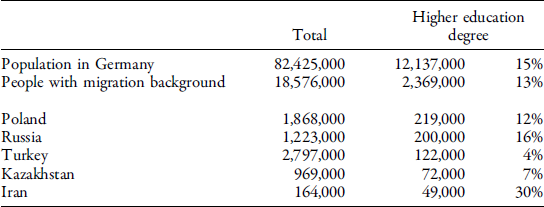
Although Iran is a Muslim country, many Iranians (in general, no matter which generation) in Germany (40 percent) state that they do not belong to a religion.Footnote 15 And among the Iranian Muslims only a third is “highly religious.”Footnote 16 Migrants from other Muslim countries are far more religious.Footnote 17 Thus, the Iranian immigrants differ from the biggest migrant group in Germany, the Turkish, who often originated from religious families with a low level of education (see Table 1). According to Koopmans, immigrants and the success probability of their integration in Germany is based on their classification as ethnic Germans or foreigners.Footnote 18 Many immigrants from the former Soviet Union, such as Kazakhstan,Footnote 19 and from Poland are of German descent. They were integrated more easily: e.g. they got travel costs refunded and easy access to German citizenship. In contrast, Turkish immigrants were mainly foreign workers and Iranians refugees. This classification of immigrants had severe consequences, as naturalization used to be quite difficult.Footnote 20 For example, as a foreigner in Germany, you rarely met authorities (e.g. teachers or police officers) with foreign background but only (ethnic) Germans.Footnote 21

Source: Statistisches Bundesamt [Federal Statistical Office] (2016), based on Mikrozensus, own display.
When getting German citizenship, Iranians can nowadays keep their Iranian citizenship while the Turkish generally have to abandon their Turkish citizenship.Footnote 22 This unequal treatment is based on German naturalization procedures. Germany normally wants to avoid double citizenship.Footnote 23 In some cases – e.g. if it is very difficult to abandon the original citizenship it can be kept. Thus, compared to Turkish immigrants, Iranians do not face loyalty problems when getting German citizenship.Footnote 24
Official data for Germany (Table 1) and the existing literature show the high educational attainment of IraniansFootnote 25 compared to Germans and other immigrants. Farrokhzad summarizes existing literature when assuming that the high aspirations of Iranian immigrants are transmitted to the second generation.Footnote 26 However, large quantitative analyses concerning the occupational aspirations of second generation Iranians and their labor market situation do not exist so far.
Existing Studies and Theory
Aspirations
Aspiration is generally defined as a “cognitive orientational aspect of goal-directed behavior.”Footnote 27 As Iranians are assumed to be career-oriented,Footnote 28 this study focuses on extrinsic aspirations (or career-advancement goals). Occupational aspiration can be divided into extrinsic and intrinsic:Footnote 29 extrinsically oriented people aim for a high income and fast occupational promotion. Intrinsically oriented people care about interesting and challenging work. As Abele and Spurk point out, career-advancement goals “are important elements in the conceptualization of life goals … and respective career-advancement goals are important elements in the work values literature.”Footnote 30 Furthermore, career-advancement goals have an impact on income and hierarchical status. Interestingly, high extrinsic aspirations can lead to higher objective but less subjective career success (career satisfaction).Footnote 31
Significant others (such as parents) are assumed to influence one’s aspirations.Footnote 32 Children are assumed to aim to reproduce the status of their parents.Footnote 33 Empirical studies show that parental expectations concerning the future of their children are transmitted to their children: educational plansFootnote 34 as well as occupational aspirations.Footnote 35 People with higher socioeconomic background have higher aspirations for their own educational career.Footnote 36 Thus, these theories and related evidence suggest that a higher social background is a major factor for having higher aspirations. For immigrants, however, these explanations are not the whole story. They are assumed to have high aspirations even if they have a low level of education. Second generation Iranians are a special case as they often originate from a background of higher education (see Table 1). Other people with a migration background in Germany also have generally higher aspirations than Germans but originate from a lower educational background.Footnote 37
There are several examples of immigrant groups in Europe that have higher aspirations than the native population. In Germany, pupils of Turkish background have higher aspirations;Footnote 38 in the Netherlands, the children of Turkish, Surinamese and Moroccan parents go to higher school tracks than the Dutch (controlled for social background and academic performance).Footnote 39 The same is true for second generation North Africans in France.Footnote 40 One of the very few studiesFootnote 41 that analyzes second generation Iranian pupils in more detail shows that, controlling for social background, they perform better at school (in terms of grades) than other second generation immigrants and natives. Furthermore, they choose academic tracks over vocational tracks more often than those without a migration background.
Several theories might explain the higher aspirations of immigrants:Footnote 42
-
1. Immigrant optimism due to selection bias: immigrants might be a selective group concerning aspiration for success.Footnote 43 Compared to people who stay in the home country they could be more motivated. This theory assumes that especially the highly motivated leave the home country, which creates a positive selection of high-aspiration migrants in the target country. Further, immigrants know that the hurdles for good education in their home country can be high. So even if the first generation struggles to get into good jobs, they see this as a price worth payingFootnote 44 and are optimistic that their children can succeed.
-
2. Varying reference: immigrants might relate the achievement of their children to cultural and language barriers as a consequence of their migration. So they have a higher subjective probability of success even when facing objective problems. They compare their achievement with their assumed cognitive potential and not with, for example, actual grades at school. The comparison group at school could be other students with a migration background. This strategy helps them find evidence of their own improvement.Footnote 45
-
3. Information deficit: Immigrants do not know the educational system in the target country thoroughly.Footnote 46 They have unrealistic, high expectations and they might not know the possible rewards for the vocational track in Germany. Instead, they would choose the assumed higher prestigious academic track, i.e. they go to university.Footnote 47
-
4. Blocked opportunities: Immigrants foresee that they and their children are discriminated against in the educational system and on the labor market.Footnote 48 This is then fought by the second generation students via overcompensation.Footnote 49
According to the outlined theoretical explanations we assume that second generation Iranians have higher occupational aspirations than Germans without a migration background even after controlling for social background. Several of the mentioned theories seem plausible. Iranian immigrants have often left Iran due to the educational breakdown in Iran and originate from the highly aspirational Iranian middle class. Therefore, they might be positively selected. And as education was temporarily blocked in Iran, they might see existing hurdles in Germany as easy to overcome. The vocational education in Germany is not well known in the world. Iranians might therefore directly aim for the higher academic tracks that lead to high-prestige jobs. In the Netherlands, where Iranians are in a similar situation as in Germany, they report high levels of perceived discrimination (despite western orientation, high levels of education and labor market participation).Footnote 50 This might push them to work extra hard.
Job success
Occupational attainment is closely related to human capital.Footnote 51 As the possession of human capital is not always clear to employers, academic qualifications serve as an important productivity signal.Footnote 52 In Europe, education is closely linked to occupational attainment. A higher education degree means more human capital, but can also serve as a signal. Among higher education graduates the field of study is related to job success, e.g. income.Footnote 53 In Germany, France and Great Britain a higher academic degree is related to the probability of being employed and ending up in a job with higher status.Footnote 54 Some second generation immigrants in Europe (Turks in Germany, Maghrebians in France) are worse off than natives in getting a job and especially a high position. Second generation Indians in Great Britain are a positive exception as they succeed in getting into higher positions than natives after controlling for social background.
For ethnic minorities, besides social background and human capital, there might be additional influences on job success. They might achieve lower success due to discrimination. Different field experiments show that immigrants (be they first or second generation) in Europe are discriminated against in the labor market.Footnote 55 Koopmans shows, however, that the Muslim minority in Europe tends to live in a segmented sphere (use of home language, home media), which affects job success negatively.Footnote 56 As in other studies, we cannot test the discrimination hypothesis directly. Often, discrimination is assumed if all other explanations are already tested and there is still a gap in job or educational success between natives and immigrants.Footnote 57 Sociocultural closure seems to be more the case for Turkish immigrants.Footnote 58 Thus, social background, field of study and job aspirations will be included in our analysis of the relationship between immigration background and job success.
Research questions
Against the outlined background, we try to answer the following research questions:
-
1. First we analyze if the occupational aspirations of second generation Iranians are higher than those of Germans and other migrants (even if we control for socioeconomic background).
-
2. Subsequently, we investigate if the career success (objective: income, subjective: job satisfaction) of second generation Iranian higher education graduates is different from that of other second generation immigrants or Germans without a migration background. We further investigate by multivariate analyses how their aspirations are related to success in their careers.
Data and Methods
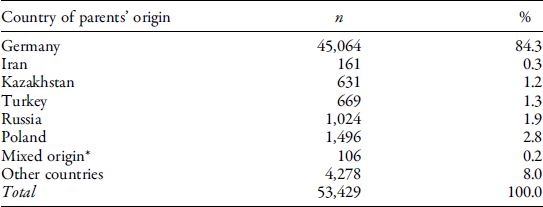
We analyzed the career success of higher education graduates in the years 2011 to 2015 of about eighty higher education institutions in Germany. We use data from the KOAB project (German Tracer Studies Co-Operation Project).Footnote 59 This project started in 2007 with the cohort of graduates of the year 2006. Every year between fifty and seventy higher education institutions participate in the survey. Response rates are between 30 and 50 percent. The study is conducted as a full census: questionnaires are sent to every graduate of these institutions. The survey uses standardized questionnaires and is mainly conducted online. It delivers extensive data to study- and job-related issues (study episodes, study conditions, competencies, first job characteristics, actual job situation) and to the graduates’ situation before entering the higher education system (parental education, high school education). In 2011, detailed information regarding the migration background (i.e. parents’ country of birth) has been included. The survey is conducted 1‒2 years after graduation. This means that the graduates are able to share their experiences about their first job. Only graduates in full-time positions are included in our analyses (Table 2).
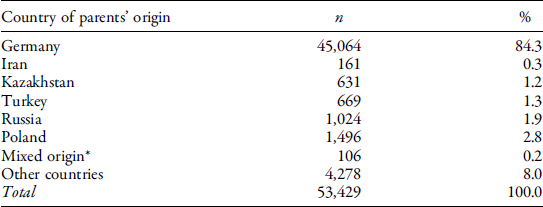
*Parents from different countries (Iran, Kazakhstan, Turkey, Russia and Poland).
Source: KOAB 2011‒15, own calculations.
Our paper refers to the following groups: second generation Iranian graduates (at least one parent born in Iran), other second generation graduates (Turkish, Polish, Russian and others), Germans without a migration background (Table 2). Second generation is defined as at least one parent born in the specific country.Footnote 60 Only graduates with a German high school certificate are part of the framework. International graduates who entered with a foreign certificate are excluded. We control for social background by including a variable indicating the parental education.Footnote 61 Career success was measured as income (objective indicator) and as job satisfaction (subjective indicator). Income will be logarithmized in the regression analysis. We use a single item measure for job satisfaction.Footnote 62 The reliabilityFootnote 63 (r = 0.73) of this item is acceptable according to a test‒retest study.Footnote 64
The questionnaire contains two questions concerning extrinsic occupational aspirations: “How important are the following occupational aspects for you in general?” and “To what extent do the following aspects apply to your current job situation?” Both questions contain three items (High income, Good career prospects, A coordinating and managerial role) used for a scale of extrinsic aspirations. The extrinsic aspirations can thus be analyzed in three ways:
-
1. Job aspirations as value orientations (How important are the following occupational aspects for you in general? Reliability: Cronbach’s alpha = 0.72).
-
2. The perceived reality of the job (To what extent do the following aspects apply to your current job situation? Reliability: Cronbach’s alpha = 0.68).
-
3. The difference between these two questions, i.e. the perceived fulfillment of the job aspirations (Reliability: Cronbach’s alpha = 0.68).
We will use cross-tabulations to analyze the background characteristics and the study situation of the second generation Iranian graduates. To analyze the aspirations and job success in more depth, we conduct linear regressions. The analyzed outcome (e.g. income) will be regressed on several predictors (e.g. country of origin, field of study, aspirations) and control variables (e.g. gender). Then we can see if there is a relationship between a predictor and the outcome (e.g. a certain field of study is related to higher satisfaction).
Results
Before analyzing the research questions, we show the general situation of second generation Iranian graduates. In line with official federal data, the second generation Iranian graduates in our study come from a higher educational background (Table 3), compared to other second generation immigrants and Germans. Second generation Turkish graduates have the lowest educational background.

*At least one parent with a higher education degree. Higher education means a degree from a university of applied science or a university, thus a tertiary academic track; the specific German vocational education that takes about three years is not called higher education.
Source: KOAB 2011‒15, own calculations; n = 53,429.
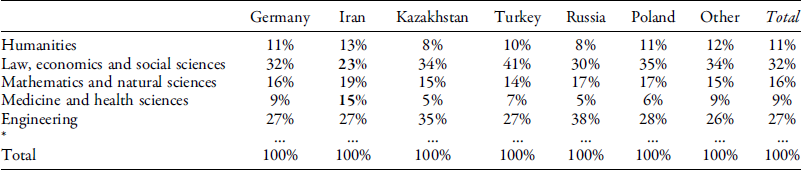
Second generation Iranian graduates choose slightly different fields of study in higher education than Germans and other second generation immigrants (Table 4). They very often study medicine (including a high share of dentistry). Further, more detailed, analyses show that the relatively low share in the field of study “Law, economics and social sciences” is due to a low number of second generation Iranian graduates in economics.

*Other fields of study not displayed due to low case numbers.
Categories are based on the German Federal Statistical Office.
Source: KOAB 2011‒15, own calculations; n = 53,429.
Taking into account all graduates (not only full-time employed as in the rest of the paper), second generation Turkish graduates and to a lesser extent also second generation Iranians are overrepresented in neither having a job nor being in some form of education, especially compared to Germans (Table 5). This information has to be kept in mind as the further analyses (e.g. on income) are based on graduates that have a full-time job.

* In this paper only full-time employed graduates are considered. This table is based on all available data to show the percentage of graduates without a formal position.
“Only working”: Having a job in the survey period and not conducting further studies.
“Working and studying”: Having a job in the survey period and also conducting some further studies, e.g. a doctorate.
“Only studying”: Conducting some further studies in the survey period, but not having a job.
“Neither working, nor studying”: At the time of the survey, the respondent has no job and is not in further education.
Source: KOAB 2011‒15, own calculations.
Multivariate analyses
It is sometimes suggested (see above) that high aspirations simply reflect the social background. As the educational background of second generation Iranian graduates is quite high and furthermore their fields of study (and therefore jobs) are different to those of Germans and other second generation graduates, we have to control for these variables when analyzing job aspirations. Other authors report that graduates with a migration background have higher aspirations independent of their social background.Footnote 65 In this paper, we analyze three forms of extrinsic occupational aspiration (see Data and Methods section):
-
1. Value orientations measure the individual importance of job aspirations in general—no matter if they are actually fulfilled.
-
2. Perceived reality of the job means to what extent these aspects of the job aspirations apply to the job situation.
-
3. Perceived fulfillment of the job aspirations means the difference between 2 and 1.
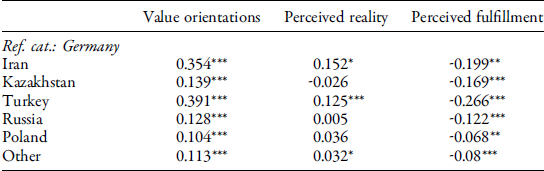
Our analyses concerning extrinsic occupational aspirations show that second generation Iranian and Turkish graduates have higher aspirations in terms of higher extrinsic value orientations than Germans and other second generation graduates (Table 6)—even controlling for parental education, field of study and the current job situation. Interestingly, they have higher values on “perceived reality” but lower values on “perceived fulfillment.” Their “value orientations” are so high that even though they think that they have a relatively good job their aspirations are less fulfilled than those of German and other second generation graduates. Thus, in general, second generation Iranian and Turkish graduates show a quite similar aspiration pattern when controlling for background characteristics.

Source: KOAB 2011‒15, own calculations; n = 53429; ***p < 0.001; **p < 0.01; *p < 0.05.
Controlled for background, gender, field of study, academic performance, job characteristics.
Value orientation: mean index of three items on a five-point scale (1 = “low aspirations” to 5 = “high aspirations”).
Perceived reality: mean index of three items on a five-point scale (1 = “bad job situation” to 5 = “good job situation”).
Perceived fulfillment: Difference of “perceived reality” and “value orientations” (‒4 = “much lower than aspired to” to + 4 = “much higher than aspired to”).
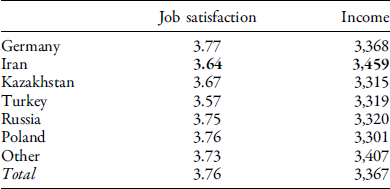
Our second research question is aimed at the career success (income and job satisfaction) of second generation Iranian graduates and the possible role of extrinsic aspirations. Descriptive analyses (Table 7) show only small differences for both career success indicators. Multivariate analyses will analyze these indicators more deeply.

Source: KOAB 2011‒15, own calculations; n = 53,429.
Job satisfaction: scale from 1 = “very unsatisfied” to 5 = “very satisfied.”
Income: (€, gross, monthly, full-time position).
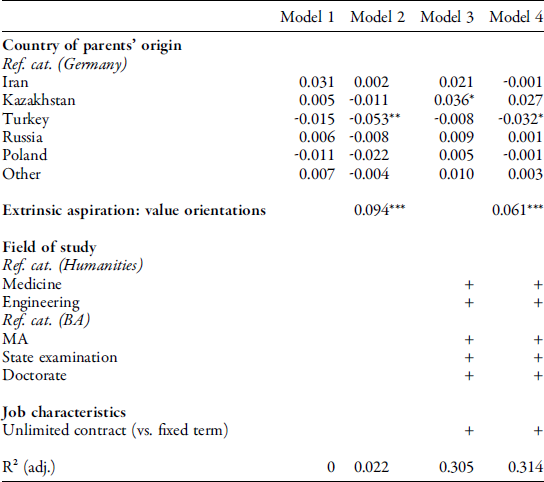
Further regression analyses show the effect of origin on income (Table 8). In model 2, the extrinsic aspirations (value orientations) are introduced. They are positively correlated with income. In models 3 and 4, we see that field of study as well as job characteristics are important to earn a high income. For example, not surprisingly, medicine—which is often chosen by second generation Iranian graduates—has a positive relationship with income. Interestingly, after introducing the extrinsic aspirations (models 2 and 4) the relationship of Turkish origin with income becomes significantly negative. If we do not control for aspirations, there is no significant relation. Thus, their higher aspirations help them to compensate for negative factors, which are not included in the model (e.g. discrimination). We can see this because, after controlling for aspirations, comparing second generation Turkish graduates to the reference category (Germans), the coefficient for the Turkish graduates becomes negative.

Source: KOAB 2011‒15, own calculations; n = 53,429; ***p < 0.001; **p < 0.01; *p < 0.05; + = positive effect; ‒ = negative effect.
Controlled for further background, academic performance, study and job characteristics.
Concerning second generation Iranian graduates, there is no significant relationship with income (the coefficient decreases in models 2 and 4 but is not significantly negative in any of the models).
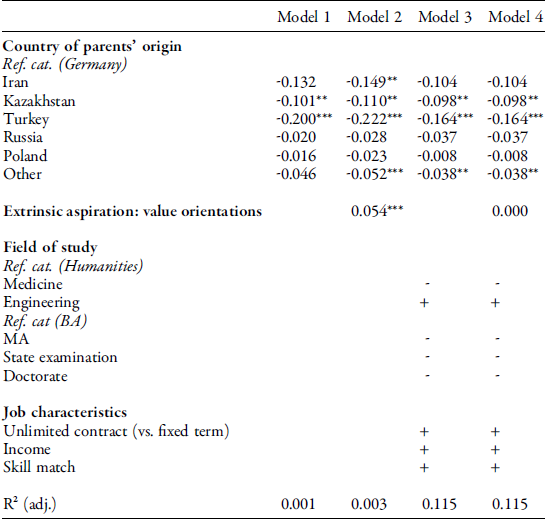
Linear regressions for job satisfaction are shown in Table 9. Iranian graduates’ job satisfaction is only significantly lower on a 10 percent level in model 1 (not indicated). In model 2, extrinsic aspirations are introduced. This leads to a lower (now significant) job satisfaction for second generation Iranian graduates. However, the explanatory power (R²) of model 2 is quite low. Higher aspirations have a small positive relationship with job satisfaction. Models 3 and 4 show that other characteristics are especially important for job satisfaction, e.g. income and skills match. Taking field of study as well as job characteristics into account, second generation Iranian background no longer shows a significant relationship with job satisfaction. Thus, not surprisingly, job characteristics are more important for job satisfaction. Interestingly, medicine has a negative relationship with job satisfaction. Concerning the second generation Turkish and Kazakh graduates, an unexplained effect remains. Even in the full model, controlling for background, field of study and job characteristics, as well as including aspirations, they still have lower job satisfaction. Remembering that second generation Turkish and Kazakh graduates (and second generation Iranians also) have a very low perceived fulfillment of their aspirations, this pattern makes sense. Even if they have the same job situation, they perceive a lower fulfillment than their counterparts (see above, Table 6).Footnote 66

Source: KOAB 2011‒15, own calculations; n = 53,429; ***p < 0.001; **p < 0.01; *p < 0.05; + = positive effect; ‒ = negative effect.
Controlled for further background, academic performance, study and job characteristics.
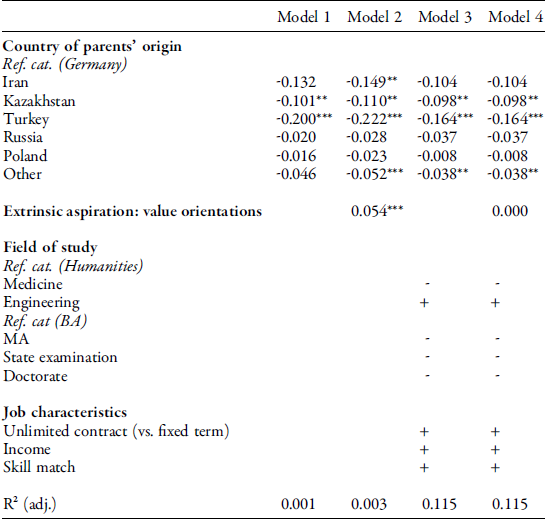
To investigate further, we use perceived fulfillment of extrinsic aspirations to explain the lower satisfaction (Table 10). We see that this model has more explanatory power (higher R²). Perceived fulfillment has a strong relationship with job satisfaction. The relationship of second generation Iranian background with job satisfaction (being significant on a 10 percent level in model 1) increases drastically when introducing the perceived fulfillment of the job aspirations (models 2 and 4). Thus, the low perceived fulfillment can partly explain the low job satisfaction of second generation Iranian and other second generation graduates (Turkish, Kazakh). Other characteristics are, of course, also important for job satisfaction, e.g. income and skill match (models 3 and 4).

Source: KOAB 2011‒15, own calculations; n = 53,429; ***p < 0.001 **p < 0.01; *p < 0.05; + = positive effect; ‒ = negative effect.
Controlled for further background, academic performance, study and job characteristics.
Conclusion
High educational and occupational aspirations of Iranian immigrants are often assumed, as well as their transmission to the second generation. Our analyses show that second generation Iranian graduates have higher extrinsic occupational aspirations than most other migrant groups in Germany and native Germans. Only second generation Turkish graduates have similarly high aspirations. Second generation Iranian graduates have a high share of fields of study leading to prestige and high incomes (medicine, dentistry). Parents of second generation Iranian graduates have a higher educational background than Germans, while parents of second generation Turkish graduates, as the prominent migrants in Germany, have the lowest educational background. According to our results, aspirations are not only due to the social background. The aspirations of second generation Iranian graduates remain high even after controlling for background, field of study and job characteristics.
We analyzed two crucial indicators of career success: objective (income) and subjective (job satisfaction). The descriptive results show only a slightly higher income and a slightly lower job satisfaction for second generation Iranian graduates compared to Germans and other second generation graduates (only Turkish graduates are more unsatisfied). But these are only bivariate results. Concerning income, linear regressions show that field of study and further study and job characteristics are relevant for career success. The extrinsic aspirations also show a positive relationship. The relationship of second generation Iranians stays insignificant throughout the models for income. Thus, there is no unexplained negative relationship that could be due to discrimination, closed communities or other mechanisms not included in the analysis (whereas in the final model second generation Turkish graduates earn less than Germans).
Concerning job satisfaction, the extrinsic aspirations themselves are not important in the full model. The real job situation (i.e. income and skill match) seems to be more important. But our analyses also show that the perceived fulfillment of job aspirations can partly explain the lower job satisfaction of second generation Iranian graduates. The jobs that they have now do not seem to fulfill their high aspirations. Further research should examine which jobs are suited to the aspirations of second generation Iranians, if they can get them, or if the aspirations are unrealistically high.
With regard to assimilation theory, our study shows that second generation Iranians seem to follow a straight path towards full integration. The structural assimilation of higher education graduates of the second generation does not differ in a negative way from Germans. Thus, they seem to follow the mainstreamFootnote 67 and assimilate culturally and economically into German society, which is supported by the general assimilation theory.
Concerning migration studies in Germany, the two frequently analyzed groups of guest workers and “immigrants with ethnic German background” is not enough. The mentioned groups share further characteristics. For example, Turkish guest workers have darker skin and hair color and practice a different religion. Ethnic Germans resemble Germans in appearance, religion and cultural background. Iranians and their descendants do not fit into these categories. Iranians are not very religious and are highly educated. The role of religion should be studied further.Footnote 68 High subjective religiosity can be linked to low educational achievement.Footnote 69 Thus, second generation Iranians are often not easy to categorize. Our analysis and the contemporary refugee situation in Germany forces migration researchers to open the field for further groups and to investigate different factors, not only ethnic and social but also psychological and religious.
ORCID
Lars Müller http://orcid.org/0000-0003-3811-0144