Introduction
There is little doubt that the language of policy debate in South Africa is changing as the country proceeds through its second decade of democracy. Although political debates surrounding the expansion of social assistance have been a feature since 1994 (Netshitenzhe, Reference Netshitenzhe2002), the first decade largely embodied the discourse of poverty alleviation and redistribution. The second decade, however, is increasingly characterised by concerns about rising expenditure and ‘handouts’, and the language of ‘welfare dependence’ has resonated more vigorously in recent years. Despite its constitutional commitment and policy initiatives to ensure income security (ANC, 1994; SADC, 2003), criticism of the government for spending too much on social grants (recurrent social assistance) has grown, and there are calls from within and outside its ranks to resist further expansion (DSD, 2006a). In his 2007 State of the Nation Address, President Thabo Mbeki emphasised the importance for government to be ‘continuously focused on the task to ensure that as many of our people as possible graduate out of dependence on social grants’, while South Africa's Finance Minister, Trevor Manuel, was recently reported in Business Day (2008) to have ‘warned against a culture of dependency’. Several resolutions from the 2007 ANC Polokwane conference exemplify the concerns:
Beyond poverty alleviation, interventions must seek to develop exit programmes that capacitate households and communities to empower themselves. Grants must not create dependency and thus must be linked to economic activity. Many of these households and communities remain trapped in poverty . . . are dependent on the state. (www.anc.org)
There are several reasons for the mounting concern but chief among them are the combined pressures of mass unemployment and rising expenditure on social assistance. In October 2008, unemployment in South Africa, using the official definition, stood at 23 per cent. If we include ‘discouraged workers’ (those who want work but are not actively looking for it), the figure rises to somewhere between 36 and 41 per cent (Stats SA, 2008) – one of the highest unemployment rates in the world. Moreover, almost 60 per cent of those identified as formally unemployed have been unemployed for more than a year (Stats SA, 2008). Despite this, there is little provision available through the social security system. The social insurance pillar is very restricted, providing only limited cover through the Unemployment Insurance Fund to fewer than 10 per cent of workers. The social assistance pillar, though more extensive, is available mainly for those low-income individuals who are exempt from the labour market due to age (old age grant and child support grant) or disability (disability grant). There are currently no dedicated grants for able-bodied people of working age who are unemployed.
Despite this, there is growing media and political concern that the existing social grant system might nevertheless act as a disincentive to the unemployed in seeking work (Daniels, Reference Daniels2006; DSD, 2007). Anxieties about the rapid increase in up-take of grants during the past few years, especially the child support grant (CSG) and the disability grant (DG) and the ensuing increase in government spending, are prominent (ANC, 2007; DSD, 2006a; Martin, Reference Martin2005). By mid 2008 12.7 million grants were being paid, covering at least 28 per cent of the population and amounting to 3.5 per cent of GDP. No other developing country redistributes as large a share of its GDP through social assistance programmes. Initiated in 1998, the CSG is means-tested and available to the primary caregiver of eligible children under the age of 15 years. It is now (2009) worth R230 per child per month (R190 in 2006) and is claimed on behalf of over 8.2 million children. The DG is also means-tested and is available to any working-age adult who due to mental or physical disability is incapable of entering the labour market. It is currently (2009) set at R960 per month. The number of DGs rose from about 600,000 in 2000 to over 1.4 million in 2008 (SASSA, 2008).
While many consider that the increase in up-take of grants reflects the government's commitment to poverty alleviation (Meth, Reference Meth2004; Lund, Reference Lund2008; Whitworth and Noble, forthcoming), others have voiced concerns about the financial sustainability of the current system and some unintended effects or perverse incentives. Increasingly prominent is anxiety that social grants might act as a disincentive to the unemployed in seeking and obtaining work, and create a ‘culture of dependency and entitlement’ (DSD, 2006b).
International evidence about dependency
Debates about whether the provision of material support to the unemployed undermines their work motivation are, of course, not unique to South Africa, and have permeated all systems of social security – in particular, systems reliant on means-testing. Contemporary debates frequently take their departure from the ‘underclass thesis’ made prominent by Charles Murray and others during the 1980s (Murray, Reference Murray1984; Mead, Reference Mead1986). In simplified terms, this argues that among the population of the poor there is a significant group whose situation is driven by their own behavioural failings; in particular, that they have little or no attachment to the labour market. Paid work is not valued, and individuals are content to derive their income from state transfers. Central to this thesis is the criticism that social security facilitates passivity and dependence among the poor; welfare helps to perpetuate poverty rather than alleviate it.
The northern hemisphere now possesses a well-documented literature on this subject. Several studies of welfare dynamics in the USA and the UK find that the majority of social assistance recipients exit these states relatively quickly (Bane and Ellwood, Reference Bane and Ellwood1994; Noble et al., Reference Noble, Smith, Cheung, de Moor, Smith and Whitlock1998; Burchardt et al., Reference Burchardt, Le Grand, Piachaud, Hills, Le Grand and Piachaud2002; Evans et al., Reference Evans, Eyre, Millar and Sarre2003). Others have argued that if unemployment benefits do affect work motivation, the effect is limited since most benefits tend to be restricted both financially and in terms of the conditions imposed on receipt (Atkinson and Morgensen, Reference Atkinson and Morgensen1993). Since systems are designed to minimise their relative attractiveness, if there is a theoretical potential to ‘tip the balance’ in favour of non-work, it is rarely realised in practice (Spicker, Reference Spicker2006). Handler (Reference Handler2003) suggests that, on the contrary, because benefits facilitate job search, they reduce benefit duration. Research which has focused more on the attitudes and aspirations of the long-term unemployed has also provided little evidence that welfare provision weakens people's underlying commitment to having a job. Dean and Taylor-Gooby's (Reference Dean and Taylor-Gooby1992) UK study found no evidence of an alternative ‘work-shy’ culture among welfare users, but rather that the long-term unemployed shared the same work orientation of the mass of the population, while Gallie and Paugam's (Reference Gallie and Paugam2000) comparative study of EU countries found that the unemployed in each of the 15 European states attached greater importance to having a job than those who were actually in paid work. The level of benefit was of little relevance; in fact, those countries which had the most generous welfare arrangements were among those where the unemployed demonstrated the highest levels of employment attachment.
The evidence from South Africa
Most of the research on these issues relates to the industrialised world where poverty and unemployment are more limited and the social security system more expansive than in South Africa. How generaliseable the findings are for the South African case is therefore still to be determined. While there is a growing body of SA research confirming the importance of social grants for poverty reduction (Case and Deaton, Reference Case and Deaton1998; Case et al., Reference Case, Hosegood and Lund2003), some studies have turned up mixed results regarding possible perverse labour market incentives.
A few have argued that social grants have had perverse effects – for example, resulting in a reduction in remittances from children living away from home (Jensen, Reference Jensen2003) or causing a sharp drop in labour participation in recipient households (Bertrand et al., Reference Bertrand, Mullanaithan and Miller2003; Dinkelman, Reference Dinkelman2004) – leading some to argue that the ‘state needs to carefully consider the incentives it provides under its various welfare programmes’ (Ranchod, Reference Ranchod2006). Others have challenged these findings and their meaning. Like Bertrand et al., Klasen and Woolard (Reference Klasen and Woolard2005) and Muller (Reference Muller2007) find that pension income is associated with lower labour force participation rates, but argue that the effect is due to the distortion of household formation processes rather than a dependency culture (that is, those without work and means of support gravitate towards relatives who have some social assistance). Other studies have identified channels through which social grants might lead to improved labour market outcomes (Williams, Reference Williams2007). They may enable poor individuals to make high-return investments that cash constraints would otherwise prohibit, such as facilitating job searches (Kingdon and Knight, Reference Kingdon and Knight2000; Schoër and Leibbrandt, Reference Schoër and Leibbrandt2006); financing migration (Posel et al., Reference Posel, Fairburn and Lund2006); managing negative shocks (Booysen, Reference Booysen2004); funding small enterprise creation (Lund, Reference Lund2002); and improving productivity through better health, nutrition and training (Samson et al., Reference Samson, Babson, Haarmann, Haarmann, Khathi, Mac Quene and Van Niekerk2002).
Against this background, this study explores a range of issues relating to attitudes towards social assistance and paid work in South Africa. The research is important for several reasons. Relatively little is known about the factors which affect the motivation or decision-making processes of those on the margins of the labour market or how the worlds of welfare and work interact within the South African context. Moreover, the evidence base that does exist relates mostly to the old age grant (OAG). Comparatively little is known about the employment effects of the CSG and DG despite the fact that they are the main grants available to those of working age, and they are growing at the fastest rates. Lastly, although attitudes to work are central to any discussion about the work motivation of the unemployed, they are rarely studied directly. This research seeks to address these gaps and combines both quantitative and qualitative data sources (Surender et al., Reference Surender, Ntshongwana, Noble and Wright2007; Noble et al., Reference Noble, Ntshongwana and Surender2008). The study surveys the views of a cross-section of South African citizens about the labour market, the social grants system and their relationship, and compares the attitudes of those in and outside the formal labour market. An in-depth qualitative component also explores the viewpoint of grant recipients, directly examining their values, attitudes and experiences.
Methodology
Qualitative fieldwork took place during a six-month period between June and December 2006, and consisted of 39 focus group interviews with a total of 386 individuals. Two of South Africa's nine Provinces, the Eastern Cape and the Western Cape, were selected because they provided a combination of relevant characteristics: rural/urban mix, high/low employment rate, access to employment training programmes, and the opportunity to explore the issue of economic migration in some detail as there is significant population movement between the two Provinces. The Western Cape has the lowest (formal) Provincial unemployment rate (18 per cent) while the Eastern Cape experiences one of the highest (27 per cent) (Stats SA, 2008).
Nineteen group interviews were held in the Western Cape with CSG and DG recipients, and 20 in the Eastern Cape. Given the limited scale of the study, the qualitative work focuses only on the Black African population since this group forms the majority of South Africa's population and the majority of grant recipients. Group size ranged between eight and 12, and included female and male grant recipients. Participants were recruited via local grant administration offices and community organisations. Although this part of the study did not aim to be a representative sample, the sample was balanced for gender, age and grant type as much as possible by inviting equal numbers of each of these constituencies to participate. All interviewees were of working age (16–64) and formally unemployed, although some were in work/training projects and a small minority undertook ‘micro-business’ activities, such as selling fruit or sweets. Almost all participants had direct experience of migration, either from rural to urban areas within the Eastern Cape or across Provinces from the Eastern Cape to the Western Cape.
The survey analysis is based on data from a module which was included in the Human Sciences Research Council's (HSRC) 2006 South African Social Attitudes Survey. This annual survey has been running since 2002. Respondents were selected using the HSRC's nationally representative ‘Master Sample’. There were 2,939 respondents. The questions in the module were in part informed by the earlier qualitative study. Differences in attitudes between population groups,Footnote 1 income groups, and between the unemployed and the wider population were all explored. Only differences that were significant (p < 0.05) are reported.
As 25 per cent of respondents did not answer the income question in the module, or reported that they were uncertain of the household income, it was not possible to produce a reliable poverty indicator using equivalised household income. Instead, an alternative question was used to distinguish ‘the poor’ from ‘the non-poor’: ‘Would you say that you and your family are (1) Wealthy (2) Very comfortable (3) Reasonably comfortable (4) Just getting along (5) Poor or (6) Very poor’, as it has been demonstrated elsewhere to correspond well with equivalised household income status (Wright, Reference Wright2008). For analysis purposes, categories (1), (2) and (3) were collapsed into the ‘non-poor’; category (4) was left as is; and categories (5) and (6) were collapsed into ‘poor’.
Our category of ‘workless’ includes both the ‘official unemployed’ and ‘discouraged workers’ and the economically inactive who are of working age (that is, 18–59 inclusive for women and 18–64 for men). In some analyses, ‘the unemployed’ (using the expanded definition of the official unemployed plus discouraged workers) is used as an analytical category. When examining attitudes to social grants and their relationship to work, additional analysis was conducted to look at differences in attitude between those respondents in households in receipt of grants and other households.
Results
The importance of work
In order to explore the extent to which paid work is valued across South African society, we examined the extent to which it was perceived to bestow dignity. In response to the statement ‘A person has to have a job to have dignity’, the majority (68 per cent) either agreed strongly (27 per cent) or agreed (41 per cent). Of the 22 per cent who disagreed, there were no significant differences by population group. We might have expected those without jobs to have held differing views, perhaps due to defensiveness or because they had adapted to their circumstances. However, we did not find that the workless had significantly different views from the employed.
All those who were unemployed were asked to comment on the proposition that ‘I feel alright about being out of work because so many people are out of work too.’ Despite some differences between population groups, the vast majority (86 per cent) disagreed/strongly disagreed (88 per cent of Black Africans disagreed). Those in work were asked to comment on statements relating to their view of work. A high percentage of employed people (78 per cent) felt it was important to ‘hang on to a job even if you do not really like it’. There was also agreement that work promotes integration and overcomes isolation; 70 per cent agreed/agreed strongly that ‘I work because working is the normal thing to do’, and 66 per cent that work provides ‘a sense of belonging to the community’. In terms of type of earnings from a job, there was no aversion to taking a low wage job if it would improve their position in the long run; 82 per cent of all respondents (and 80 per cent of ‘non-poor’ and 83 per cent of ‘poor’ respondents) agreed/strongly agreed that they would do so.
Overall, the message that most strongly emerged from focus-group respondents was that there were no jobs, and virtually all 386 participants had been unemployed for several years. All expressed a desperate desire and need for work.
There are no jobs. You can have R200 in hand, you go up and down using it for transport looking for work until the money's finished. Still no job. You sacrifice buying even food in the house, save the R200 to look for work. There are no jobs, no domestic work, no factory work. (Female, CSG, Mdantsane)
There was little to distinguish gender groups or those receiving either grant. Despite childcare commitments, women respondents were as eager for employment opportunities as men.
I am not working, my mother is not working and my sister is not working. We try by all means to get jobs but it is difficult. I would leave my child with my mother and go to work but there is no work. (Female, CSG, Crossroads)
Although not required to look for work, many DG recipients nevertheless insisted that they would prefer to work than receive a grant. They argued that though their health needs necessitated more flexibility and assistance from employers, they still had many useful skills and would welcome more opportunities.
They must also create jobs for the disabled people. I would love to get another job . . . I would do many tasks such as make toys . . . but I cannot work in the farms, I am disabled, I would fall. (Female, DG, Makhaza)
Overall, it was apparent that lack of work negatively dominated all interviewees’ lives; morale was low, and there was little optimism about the future.
We don't know what to do, but we know we will do anything if they give us a chance . . . we are all starving here and we are desperate. (Male, DG, Mncotsho)
Job seeking and barriers to employment
Overall, 81 per cent of unemployed survey respondents stated that they were looking for work, although focus-group discussion suggested that many work-seeking strategies such as standing at road junctions, going door to door or placing advertisements in local papers were ineffective. While most used social networks to find work, in the focus groups the issue became expressed in largely negative terms, broadly framed as nepotism and seen as a barrier to employment. In every focus group, it was argued that an individual could only get a job through family or social contacts and networks. Accounts moved between resigned despondency and active frustration, but the message was always the same: it was impossible to access work without ‘insider’ help.
If they do not know you, you don't get a job . . . When there are jobs available, the factory managers ask their own staff to bring people – though there are people standing at the gate. They would pass all of you and take people who are known by those people who are already working there . . . Most of the time you don't even hear of a vacancy. There's a lot of nepotism. (Male, CSG, Makhaza)
Several interviewees raised the role of employment agencies and described how most employers (when not hiring through informal networks) hired only those referred from private agencies. This was again voiced as a barrier rather than an aid, since respondents could not afford the fees.
Another thing that works against us are the agencies . . . The agency wants you to pay R300 before they can do anything for you – where are you going to get that amount . . . And even the salary you get – it is shared with the agency. (Male CSG, Newlands)
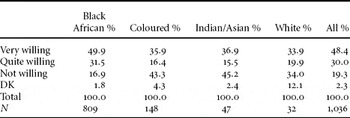
The principal work-seeking strategy employed by respondents was ‘economic migration’. Among unemployed survey respondents, over 81 per cent of the Black African population would be very or quite willing to move to find work (Table 1). A smaller percentage of other population groups (between 52 per cent and 54 per cent) would be prepared to do so.
‘How willing would you be to move to a different area to find a job?’

Source: SASAS, 2006. Group analysed: unemployed respondents by population group (P < 0.001).
Among the 17 per cent of survey respondents who had moved to another province or municipality within the last five years, 61 per cent moved to find work. A much higher incidence of migration prevailed among focus-group respondents, almost all of whom had migrated from rural Eastern Cape regions. Reasons for migration varied, although the search for employment was again the predominant motivation.
I am from East London – I have been here for more than seven years now and I came to look for a job. (Male CSG, Crossroads)
Because there are no jobs in Tsomo, I felt I should come try this side. (Male CSG, Mdantsane)
There were also several instances of temporary migration. For example, prohibitive transport costs meant that a number of women left their families in townships or rural areas to reside at their place of domestic employment. Although this typically caused stress within families, there was universal agreement that not having an income was even worse.
You are not going to tell your wife not to leave home to work in town, what are you all going to stay at home for? It's bad, people are scattered all over. It's painful to the family . . . problems come out when families are not together . . . but we must endure this to support our families. (Male CSG, Mdantsane)
In terms of whether migrants were successful in finding work, many focus-group respondents felt disappointed that despite the huge effort of migration, only menial work or ‘piece jobs’ were obtained in most instances.
It made sense before, but now there are no jobs anywhere . . . it is the same here as back there. (Male, CSG, Old Crossroads)
The overwhelming majority of employed survey respondents expressed an intention to immediately look for work if they lost their job (90 per cent), although the unemployed were pessimistic about the prospects, with 61 per cent thinking that there was no real chance of them getting a job in the area. We therefore examined in greater detail the barriers to work respondents faced. For those seeking work, the largest perceived obstacle to employment was that there were no or too few jobs available (61 per cent). However, respondents also identified a number of additional barriers that compounded the situation. A fifth of survey respondents gave ‘not enough qualifications’ and 12 per cent gave ‘not enough relevant experience’ as reasons for not getting a job.
Survey respondents were very willing to train to get the necessary skills and this was particularly evident within the Black African community, with over 80 per cent being ‘very or quite willing’ to get training if they became unemployed. Focus-group discussion about the question of skills and training as a route to employment, however, was more ambivalent. For many, while more training would always be helpful, it was not a panacea. Training agencies were mainly privately run and unaffordable for most, and there were several anecdotes that even those with training and certificates of one kind or another were unemployed along with everyone else.
After you complete the training with a certificate in your hand – the problem is getting a job after that – they will ask you if you have experience . . . sometimes they want three years experience . . . we are now sitting with our certificates. (Female, CSG, Old Crossroads)
Transport costs were frequently cited as a significant barrier both to job searches and actual employment. Respondents appeared cut off and isolated from local job markets. Living in townships or settlements outside the main centres of work, they argued that the cost of taxis or buses made it extremely hard to go in search of or retain work.
We have to use public transport which costs money and leaving children behind – so it is difficult for us to hear if there is a factory offering jobs in Parrow. (Female, CSG, Crossroads)
The taxi fare is R20 every day . . . you would end up working only for the taxi fare. (Female, CSG, Mncotsho Village)
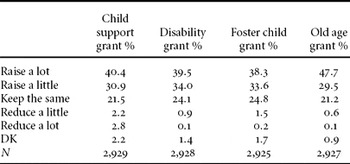
‘Should social grant amounts be raised even if it means higher taxes?’

Source: SASAS, 2006. Groups analysed: all respondents.
Attitudes to social security
In order to discover general perceptions about grants, the survey began by asking whether claimants were ‘deserving’ in the sense that most people receiving grants ‘desperately need the help’. All groups (82 per cent) overwhelmingly supported the statement. We also asked all respondents whether there was any support for extending the cover of social assistance. There was general agreement about the need for government to spend more money on existing social grants for the poor even if it meant higher taxes. Although the ‘non-poor’ group were slightly less willing to support this, nevertheless 59 per cent agreed and nearly 63 per cent of those currently in work supported the proposition. If we look at those whose households are currently receiving grants, 72 per cent agree or strongly agree with the proposition. When couched in support for specific grants, there is even more support for raising the level of grants.
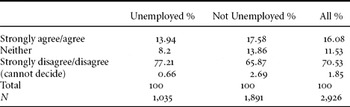
When asked whether they consider themselves better off claiming grants than working, 75 per cent of the unemployed disagreed with the proposition. The grant that has generated most controversy in terms of ‘disincentivising’ work is the CSG. We accordingly asked respondents for their views about whether specifically ‘the CSG is too high and discourages people from finding jobs’. There was little support for this notion, with over 70 per cent of all groups either disagreeing or strongly disagreeing with the proposition. Interestingly, the responses of those where CSG was received in the household were not significantly different from households where no CSG was in payment.
‘The child support grant is too high and discourages people from finding a job’

Source: SASAS, 2006. Group analysed: all respondents by unemployed (P<0.0005).
When discussed in more depth in focus groups, the perceptions about the CSG varied, and the topic produced strong reactions. Criticism of young mothers and their alleged misuse of the grant were often expressed, mostly by male and older respondents.
Yes, we do hear these things. For example . . . young people spend this money on liquor. They don't buy anything for the child . . . Some would disappear with their boyfriends leaving babies with their (grand) parents with nothing. (Male, CSG, Newlands)
Although interviewees mainly reported hearing anecdotal stories locally or from the media (rather than knowing of cases personally), nevertheless there was a strong sentiment that many CSG recipients were ‘abusing the system’. Subsequently, several commentators advocated replacing the cash grant with vouchers.
If maybe the child could get a hamper of food every month, nappies directly to the child, or the government could give vouchers, that would be good . . . that way, the child will benefit from it. (Male, CSG, Crossroads)
However, despite criticism surrounding the perceived misuse of the CSG, there was strong consensus among all groups that the CSG did not act as a barrier to employment or encourage recipients to become ‘dependent’ on it. Almost all interviewees thought that it was impossible for the CSG to engender a ‘dependency culture’ or discourage employment simply because of its small value in relation to a family's total needs.
There's no way you won't want to work in order to live on R190 a month. When you work, you earn more than that. Yes . . . we are used to poverty, but there's no way you won't work only to depend on R190. By the time the R190 comes, your child needs a multitude of things from milk to shoes. You buy shoes and other small things, after that it's finished. (Female CSG, Mdantsane)
There was stronger support for the DG grant among focus-group interviewees. In the main, people felt that it was fair that someone who could not participate in the labour market due to disability or ill health should be supported by the State.
The government has done a good thing . . . disabled people were struggling before the grant. After getting the grant, there is a difference. A disabled person can become a decent person . . . eat, wash and even have insurance – all the things they are unable to do before. I can see the difference now. (Female, CSG, Khayelitsha)
As with the CSG, very few respondents supported the notion that the DG encouraged individuals not to seek employment.
Some people say these hurtful things . . . it is also in the Daily Dispatch . . . but no one will sit down and not seek employment because they are getting a grant. (Female, DG, Newlands)
Rather, many DG recipients were extremely eager to find work and felt frustrated about the double burden of being both disadvantaged in the labour market and being accused of being ‘scroungers’. Several argued that procedures were stringent, and the grant could not be accessed unless a doctor deemed it was appropriate.
You don't choose to be on the DG. The doctor puts you on it. When the doctor feels that you have regained your strength, he tells you that you can now go back to work. (Female, DG, Langa)
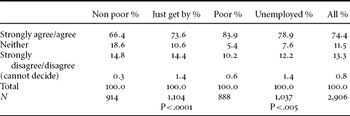
Finally, in the absence of social grants for the able bodied of working age, we asked people's views about whether some form of income support should be made available for all who were unemployed. Table 4 shows widespread popular backing for the idea that ‘people who can't get work deserve help in the form of social grants’ (74 per cent of respondents). Interestingly, a higher proportion of the poor (84 per cent) supported the idea than the unemployed themselves (79 per cent).
‘People who can't get work deserve help in the form of social grants’

Source: SASAS, 2006. Groups analysed: all respondents by self-assessed poverty (p < 0.001) and the unemployed as a subset.
These findings were reflected in the focus groups. Most individuals supported the introduction of an unemployment benefit, arguing that it would be a lifeline to communities who are otherwise destitute.
I think that government should introduce a grant for people who don't have jobs so hunger amongst people would cease. (Female, CSG, Langa)
We are desperate . . . we need it. (Female, CSG, Mncotsho)
Rather than being a net drain, some argued that UB might actually facilitate job-seeking by providing transport money or pump-priming for small business initiatives. The strongest and most frequent argument for supporting the unemployed, however, was that it would reduce crime.
I think that would be a right thing to do because the reason why we have so much crime is because people are not working – at least people will be able to buy food . . . people do bad things not that they want to buy drugs, but because they are starving. (Male, DG, Makhaza)
Correspondingly, several argued that an extension of social grants would strengthen community solidarity; the current grant system was divisive as only some of those in need received support, and this produced enmity and conflict within communities.
We don't get along with each other because of starvation. People are jealous of one another. If they see you with Shoprite groceries because you have got your CSG, people become very jealous . . . I think a grant for everyone is good because it brings back love to the people since everyone gets something. (Female, CSG, Makhaza)
When asked whether unemployment grants might undermine recipients’ work motivation, respondents repeated the same arguments made earlier in relation to the CSG or DG: most commonly, that the level of the grant was never likely to be high enough for this to be a serious threat. Focus-group interviewees also echoed the survey responses that work had a number of benefits apart from income, including social contacts, health, fitness, empowerment and self-esteem, and would therefore always be preferable to unemployment.
Everyone would prefer to have a job – with a job you have hope and a vision . . . it is more than just food and clothing. (Male, DG, Makhaza)
The disadvantage with this grant is that you are not doing anything – you are just sitting at home. But when you work you are able to stretch your mind and body . . . you learn a lot of skills and get experience. (Male, DG, Khayelitsha)
It is notable, however, that as with questionnaire respondents a significant minority of focus-group participants voiced concerns about the provision of grants for the unemployed.
I do not agree that people should get this money . . . People will not seek for jobs as they know they will be getting this grant. (Female, DG, Khayelitsha)
Even the people who work – will also seek the grant . . . they will cheat and seek for this grant, even though they are working. (Male, CSG, Mdantsane)
Opposition to the idea also centred on affordability and corruption. Many argued that the burden placed on taxpayers would be unsustainable and unfair, and questioned the economic feasibility of unemployment benefits in a context of mass unemployment and poverty.
An unemployment grant for all of us would be impossible . . . the government can't afford such a thing. I'd love to have such a grant but there are too many unemployed people. (Male CSG, Mdantsane)
However, those who were sceptical about the extension of benefits to the unemployed agreed with other respondents that, in the final analysis, it was jobs that people wanted; the solution lay in the creation of more jobs. Although grants may provide essential support in the absence of employment, work remained everyone's preferred option.
All these arguments about grants would cease if there was work . . . they exist because people are desperate and fighting amongst themselves . . . If there can be jobs made available, nothing more we will ask for. We just want work. That is it. (Male, CSG, Crossroads)
Discussion
Much of the debate in South Africa about poverty alleviation continues to be framed within a discourse which sets social grants and paid employment in opposition to one another as possible solutions. The results from this study suggest that this is a false dichotomy. The key findings show that both those in and out of work placed a high value on paid employment, and all groups agreed that work promotes dignity. Despite prolonged and high levels of structural unemployment, joblessness had not become ‘normalised’, and the unemployed were extremely motivated to get work. Evidence of labour market attachment was actively demonstrated in the widespread levels of economic migration, despite the disruption and cost to families. There was no discernable differentiation between population groups in terms of work motivation. Women, as well as those claiming the DG, were as eager to find work as non-disabled men. Moreover, the level of the replacement ratio (benefit worth) did not seem to affect the work ethic; there was no difference in motivation between those on the lower CSG or higher level DG.
Almost all grant recipients would prefer to have a job rather than remain unemployed, irrespective of the introduction of an unemployment grant and the amount of such a grant. People were willing to take a low-paid job if it allowed them to enter the labour market and was a stepping stone to something better. Not only would employment offer better financial rewards and security, it was also universally viewed as an important source of personal satisfaction and social integration. Financial incentives and calculations about ‘trade-offs’ were not of central importance in explaining people's chances of finding work. Rather, the most important explanation for unemployment forwarded in both the survey and focus-groups was straightforwardly the lack of available jobs. Other explanatory factors in accounting for people's labour market chances included: the absence of qualifications, skills and training; access to a level of finance that facilitates job search; and to informal networks that provide information. Having a household or family member in employment seemed to be particularly crucial in providing contacts and links to work openings. In a context of mass unemployment and job scarcity, the importance of social networks, social capital and nepotism in employment outcomes is increasingly evident here as in other research (Surender and Van Niekerk, Reference Surender and Van Niekerk2008; Cichello, Reference Cichello2006; du Toit and Neves, Reference du Toit and Neves2006, Francis, Reference Francis2006).
Among these findings, two particularly striking issues emerge. Despite recent research evidence that those receiving grants do not, in fact, spend the money frivolously (De Koker et al., Reference De Koker, de Waal and Vorster2006), the debates and perceptions about the ‘misuse’ of grants circulating in the media and wider society were evident among grant recipients themselves. The finding that benefit claimants held quite punitive views towards other social security claimants and endorsed popular resentment towards others in a similar position is evident in other research in the Northern hemisphere (Dean and Taylor-Gooby, Reference Dean and Taylor-Gooby1992).The authors posit that the lack of solidarity among social security recipients was in part a consequence of the ‘corrosive effects’ of the claiming experience itself (that is, the climate of hostility and suspicion to which claimants are subjected creates internal tensions and contradictions). Other evidence suggests that, in many cases, the most insecure groups favour discriminatory practices against themselves because economic insecurity and competition erodes principles of equity and solidarity (ILO, 2004). A recent study on sources of resentment among poor white people in England supports this, and suggests that racial and intra-class resentment is in part borne out of competition for resources (Garner et al., Reference Garner, Cowles, Lung and Stott2009). Whether driven by psychological factors or material conflict, it is striking that even in the historical and political context of South Africa, in circumstances where one might have anticipated higher degrees of solidarity among the poor, self-censure was evident. However, it is equally important to note that despite some criticisms of how the CSG grant was being used, there was strong agreement that neither the CSG nor DG encouraged dependency or acted as a barrier to work. Although often conflated in media reports, the two issues were completely separate and unrelated in the views of study participants. (By ‘misuse’, respondents referred not to fraud or false claims, but that the grant money was spent by some on ‘inappropriate’ things, mostly alcohol.)
Perhaps similarly strikingly, there was popular support across all groups for extending social assistance for the unemployed; indeed, for some questions a higher proportion of those in work than the unemployed were sympathetic to the idea. The majority of all respondents were in favour of such a policy, even if it entailed higher taxes, and all groups overwhelmingly believed that claimants deserved and desperately needed the support. These findings are contrary to the presupposition that attitudes towards policies of redistribution in post-Apartheid South Africa might be significantly differentiated along racial lines. They concur somewhat with other research which also shows that white respondents proved to be more generous than African or coloured respondents in terms of the absolute sums they suggested should be paid by the government as social assistance to the unemployed (Seekings and Nattrass, Reference Seekings and Nattrass2005) or in terms of the standard of living deemed to be acceptable for the South African population at large (Wright, Reference Wright2008). Various explanations emerge, such as richer respondents can afford to be more generous (in absolute if not relative terms), guilt, and the belief that redistribution might prevent social and civil conflict (Seekings, Reference Seekings2007).
Conclusion
The findings here appear to counter recent concerns about potential unintended effects of the current grant system and raise considerable doubt about the importance that is frequently attached to the influence of the benefit system in affecting work motivation. Grant recipients did not subscribe to a distinctive dependency culture but to mainstream values and aspirations, and their attitudes were not an important factor in accounting for their unemployment or grant status. While some benefit claimants subscribed to popularly promoted prejudices about other social assistance claimants, the most important factors in reducing people's chances of finding employment were perceived by all respondents to be linked to the structural conditions of the labour market and the wider economy rather than the motivational characteristics of the unemployed and the arrangements of the grant system.
Acknowledgements
We thank the SA government's Department of Social Development and the UK Department for International Development for funding the qualitative component of this study, and the Human Sciences Research Council for including a module on ‘Attitudes to Work and Social Security’ in their 2006 SA Social Attitudes Survey. We also thank the editors and referees for their helpful comments.