I. INTRODUCTION
The right to trial by jury and the requirement of proof beyond a reasonable doubt are two of the most fundamental commitments of American criminal law. The right to trial by jury guarantees each criminal defendant a jury trial, and the state is required to prove the defendant's guilt beyond a reasonable doubt in order to obtain a conviction. Both commitments are often celebrated together as the bulwark of individual liberty against government oppression and wrongful convictions, and they frequently travel together in the United States Supreme Court doctrine.Footnote 1 The question this article asks is how the two are related, that is, whether disagreement among jurors implies anything one way or the other about whether the beyond a reasonable doubt standard has been satisfied.
The closest the Supreme Court has come to addressing the question of jury disagreement and its relationship to reasonable doubt is Johnson v. Louisiana, decided in 1972. Johnson held, by a five-to-four vote, that a guilty verdict produced by a nine-to-three vote on a criminal jury is consistent with the beyond a reasonable doubt requirement.Footnote 2 Justice White, who delivered the opinion of the Court, reasoned that “disagreement of three jurors does not alone establish reasonable doubt” and that a nonunanimous verdict does not “indicate infidelity to the reasonable-doubt standard.”Footnote 3 Justice Marshall, who dissented, wrote: “[W]hen a jury votes nine to three for conviction, . . . it does violence to language and to logic to say that the government has proved the defendant's guilt beyond a reasonable doubt.”Footnote 4 Justice Douglas similarly suggested that a “9:3 or 10:2” vote for a guilty verdict indicated that there was “still a lingering doubt about that verdict.”Footnote 5 Justice Blackmun joined the majority's opinion but nevertheless stated that he “disfavor[ed]” the nonunanimous system “as a matter of policy.”Footnote 6
To start thinking about jury disagreement and its significance, consider the following oft-quoted statement from Henry Sidgwick:
Since it is implied in the very notion of Truth that it is essentially the same for all minds, the denial by another of a proposition that I have affirmed has a tendency to impair my confidence in its validity. . . . For if I find any of my judgments, intuitive or inferential, in direct conflict with a judgment of some other mind, there must be error somewhere: and if I have no more reason to suspect error in the other mind than in my own, reflective comparison between the two judgments necessarily reduces me temporarily to a state of neutrality.Footnote 7
Sidgwick may be making a psychological report here, but we may treat it as an epistemic principle.
In recent years, there has been an explosion of interest among philosophers about the epistemological significance of disagreement. Several philosophers have developed theses that resemble Sidgwick's, and they in turn have attracted a significant critical commentary.Footnote 8 Drawing on this literature, this article addresses the following questions: What is the relationship between disagreement and doubt, and what is the appropriate attitude for jurors to have toward disagreement and the proper standard of proof during deliberation?
This article proceeds as follows. Section II considers the “equal-weight view” and its implications for the unanimity rule in criminal jury decision-making. The equal-weight view says that, roughly speaking, when people disagree on a topic, each view should be given equal weight. After introducing the equal-weight view and its appeal, Section II discusses how the equal-weight view would interact with the beyond a reasonable doubt requirement. Section II concludes that with certain assumptions, the equal-weight view calls for the unanimity rule as a way of enforcing the beyond a reasonable doubt requirement.
Section III then asks whether the equal-weight view, as described in Section II, is an attractive ideal for jury deliberation in criminal cases. After considering whether aspects of the current practice reflect the equal-weight view at least in parts, Section III distinguishes between factual elements and moral elements in crime definitions. Jurors, when applying crime definitions to particular cases, make determinations both about historical facts—concerning questions about what happened—and about normative issues—concerning the evaluative significance of what happened—through moral terms like “reckless,” unjustifiable,” “depraved,” “cruel,” and “heinous,” which are common in criminal law. Section III then argues that while the equal-weight view should guide the jurors in determining factual issues, it is not the correct model for moral issues, not only because the equal-weight view seems to imply that acquittals are appropriate in many cases involving controversial moral questions but also because requiring the jurors to follow it would undermine the basic justification for having the criminal jury as an articulator and enforcer of morality.Footnote 9
II. THE EQUAL-WEIGHT VIEW AND THE UNANIMITY RULE
A. Significance of Disagreement: The Equal-Weight View
Here is a sampling of some recent restatements of Sidgwick's argument. Richard Feldman argues that often, in situations in which “intelligent people with access to the relevant available information come to incompatible conclusions, . . . suspension of judgment is the epistemologically proper attitude.”Footnote 10 David Christensen also argues that when we disagree with our peers, we should “adjust[] our beliefs in the direction of those peers with whom we disagree.”Footnote 11 Adam Elga similarly argues in favor of what he calls “the equal weight view,”Footnote 12 according to which, when you “come to a conclusion . . . . and then find out that your friend has come to the opposite conclusion,” you should “give your friend's assessment equal weight, and think that it is no more likely that you're right than she is.”Footnote 13
So, when “intelligent people with access to the relevant available information come to incompatible conclusions,” why is it the case that “suspension of judgment is the epistemologically proper attitude,” in Feldman's terms, or that we should “adjust[] our beliefs in the direction of those peers with whom we disagree,” in Christensen's terms? Here is an example from Elga to motivate this conclusion:
You and a friend are to judge the same contest, a race between Horse A and Horse B. Initially, you think that your friend is as good as you at judging such races. In other words, you think that in case of disagreement about the race, the two of you are equally likely to be mistaken. The race is run and the two of you form independent judgments. As it happens, you become confident that Horse A won, and your friend becomes equally confident that Horse B won.Footnote 14
Elga concludes from considering this example as follows: “When you find out that you and your friend have come to opposite conclusions about a race, you should think that the two of you are equally likely to be correct.”Footnote 15
According to Christensen, who holds a similar view, it would be “implausibly closed-minded . . . toward the beliefs of others” for one to “dismiss the significance of the opinions of otherwise rational people with whom one disagrees.”Footnote 16 Feldman similarly argues that someone who maintains his position when facing disagreements must have something like the following thought: “You have an insight according to which ~P is true. I have one according to which P is true. It's reasonable for me to believe P in light of all this because my insight supports P.”Footnote 17 The problem with such a view is that the fact that I believe something cannot be taken as a basis for that belief. Therefore, if I maintain my belief in a proposition despite the disagreement, it must be because I feel that I am entitled to believe what I believe just because it is what I believe. And that seems suspect.
Of course, it is possible, when you and I disagree, that you are the one in error, and not me. But that does not help us avoid the overall conclusion. As Christensen argues:
[M]y discovering that my friend has reached what seems to me to be the wrong conclusion does constitute evidence that she has made a mistake, and thus does give me reason to trust her opinion less than I ordinarily would. However, another point needs equal emphasis: the fact she disagrees with my prediction also constitutes evidence that I have made a mistake.Footnote 18
That is, again assuming that both people involved are “generally reliable thinkers who have studied the same evidence,” their disagreement could mean that at least one of them has made a mistake, but in that case “the explanation in terms of my friend's mistake is no more reasonable than the explanation in terms of my mistake,”Footnote 19 “given that “[t]he mere fact of disagreement . . . cannot show that I am the one who ‘must have’ the epistemic edge.”Footnote 20 Christensen concludes that “I should acknowledge this by moving my belief toward hers”Footnote 21 and thus “split the difference.”Footnote 22
B. The Equal-Weight View and Criminal Jury
One real-world institutional setting in which we may test the equal-weight view is the criminal jury. Perhaps because the criminal jury is a familiar setting in which a group of people deliberates on an important question that is narrow and well-defined—whether the defendant is guilty—philosophers frequently mention it as an example of a site of peer disagreement. For instance, Gideon Rosen observes, “When a jury or a court is divided in a difficult case, the mere fact of disagreement does not mean that someone is being unreasonable.”Footnote 23 Similarly, Thomas Kelly asks us to imagine that “[y]ou and I are attentive members of a jury charged with determining whether the accused is guilty,” and that “I find myself quite confident that the accused is guilty . . . while you find yourself equally confident of the opposite.”Footnote 24 Kelly then asks, “once you and I learn that the other has arrived at a different conclusion . . ., how (if at all) should we revise our original views?”Footnote 25
In order to consider the significance of disagreement among jurors, we should start by noting some defining features of the criminal jury, at least in the United States. First, the burden of proof is extremely demanding. In order to convict a person, the government has the burden of convincing the jurors of the defendant's guilt beyond a reasonable doubt. “Beyond a reasonable doubt” is sometimes defined as demanding a type of certainty that is not “absolute” or “mathematical” certainty, but somewhat lower than that, for a juror to vote in favor of a guilty verdict.Footnote 26 Lawyers and judges have sometimes assigned numerical values to the idea of “beyond a reasonable doubt.” Given that absolute certainty is unrealistic and not required, we should start from the position that the required probability of guilt for a juror to vote to convict is high, but less than 1. A frequently mentioned number is 0.9, though people's understanding of the standard varies.Footnote 27
Second, jurors do not have a verdict unless they unanimously agree to a verdict, “guilty” or “not guilty.” As shown above in Johnson v. Louisiana, not all jurisdictions require that every juror agree in order to convict or acquit, but unanimity is the rule in federal cases and in most states.Footnote 28 If a jury fails to reach a verdict, a mistrial is declared, at which point the government must decide whether to retry, negotiate a new plea deal, or decline to prosecute.Footnote 29 Third, the size of a criminal jury is typically twelve.Footnote 30
Given a typical twelve-person jury, what is the implication of the equal-weight view for jury deliberations? We can start by assuming that the beyond a reasonable doubt standard requires, for a juror to be warranted in voting to convict, the probability of guilt to be 0.85 or more. (This assumption will be adjusted later.) Consider the following scenario:
Case 1: In a criminal trial, after extensive deliberation including discussion of evidence, the jurors take a vote. Eleven vote “guilty,” and one person votes “not guilty.” The eleven people who are voting “guilty” are quite certain, and they would each place the probability of guilt at 0.9. The lone dissenter is also quite certain in the opposite direction, and she would place the probability of guilt at 0.2.
There is a disagreement here, and according to the equal-weight view, we need to give each voice an equal weight, so the average probability of guilt is 0.84.Footnote 31 Therefore, the dissenter has to adjust her probability of guilt way up from 0.2 to 0.84, but everyone else has to revise his or her probability of guilt downward from 0.9 to 0.84. Since 0.84 is less than 0.85, all twelve are now obliged to vote to acquit. This example demonstrates the combined power of the equal-weight view and the beyond a reasonable doubt requirement. Eleven people have to adjust their probability of guilt slightly, but that slight adjustment requires them to change the vote from one thing to another.
Although the ability of the beyond a reasonable doubt requirement to require people to change their guilty votes to not-guilty votes is impressive and is consistent with at least a commonsense understanding and a popular image of the criminal jury in action, the picture suddenly changes if we adjust the probability of guilt held by the juror who wants to vote not guilty. Consider the following:
Case 2: In a criminal trial, after extensive deliberation including discussion of evidence, the jurors take a vote. Eleven vote guilty, and one person votes not guilty. The eleven people who are voting guilty are quite certain, and they would each place the probability of guilt at 0.9. The lone dissenter is also quite certain in the opposite direction, and she would place the probability of guilt at 0.3.
The only difference between Case 1 and Case 2 is the dissenter's assessment of the probability of guilt. The dissenter in Case 2 is slightly less certain of the defendant's innocence than the dissenter is Case 1. The average for the group in this case is 0.85, which is, by assumption, the minimum required for a vote for a guilty verdict. So in this variation, everyone has to adjust his or her probability of guilt to 0.85, including the dissenter who has to go from 0.3 to 0.85. The eleven voting guilty do not need to change their votes, but the dissenter has to go from not guilty to guilty.
That the lone dissenter ends up going along with the fellow jurors under the operation of the equal-weight rule may disturb those who are attached to the romantic image of a holdout juror keeping all other jurors honest, but at the same time, if eleven people are confident enough of their votes and the dissenter is not so confident of her initial vote (probability of guilt being 0.3, not 0.2), then the ultimate outcome in favor of an unanimous guilty verdict might in fact be the correct answer for the institution to generate. Table 1 gives other possible scenarios.
TABLE 1Footnote 32

I note two things about these possibilities. First, the initial votes by themselves do not tell us whether the ultimate outcome will be a conviction or an acquittal. We may end up with a guilty or a not-guilty verdict from an (initial) 11-to-1 vote, we may end up with a guilty or a not-guilty verdict from a 10-to-2 vote, we may end up with a guilty or a not-guilty verdict from a 9-to-3 vote, and so on. Which way the ultimate outcome goes depends on confidence levels of the jurors in their initial judgments.
Second, even if the initial vote is as evenly split as 6 to 6, a guilty verdict is still a possibility as long as those who initially vote not guilty have a low level of confidence. Intuitively, what would it mean for a person to vote not guilty but assess the probability of the defendant's guilt to be 0.7, which is fairly high? Such a person may believe that the defendant is guilty but is not certain enough to vote to convict, given the high burden of persuasion that the government carries. Whether this is a desirable outcome or not depends on whether a situation of a 6-to-6 vote in which six people are 90 percent certain of the defendant's guilt and six people are 70 percent certain of the defendant's guilt should generate a conviction or an acquittal as a normative matter.
One can get a handle on how normatively attractive this set of outcomes is by comparing the equal-weight view to alternative rules. To that end, consider Table 2.
TABLE 2Footnote 36

Following the literature, I label the position that the fact of disagreement should not lead one to revise his or her view the “steadfastness” view.Footnote 33 Under the steadfastness view and assuming unanimity as the requirement, there is no “splitting the difference” or moving one's belief to another's, so if there is a disagreement, then the disagreement shall remain, and the jury being unable to reach a unanimous verdict, the outcome is a mistrial due to a hung jury. Under the steadfastness view with a supermajority rule (say, requiring nine guilty votes for a conviction),Footnote 34 we of course end up with a different pattern of results, as indicated in the last column of the table.Footnote 35
It is worth noting here that the equal-weight view, under which a unanimous verdict is guaranteed (with a complication we consider in detail below), is not always more defendant-friendly than the results that would obtain under the supermajority voting rule, which is typically considered less defendant-friendly than the unanimity rule. For example, as noted above, even if the initial vote is six in favor of a guilty verdict and six against, a guilty verdict is a theoretical possibility under the equal-weight view, whereas the steadfastness view under the supermajority voting rule would produce a hung jury under that scenario.
Now, these outcomes may be an artifact of the fact that I assume a juror is warranted in voting to convict when he or she assesses the probability of the defendant's guilt to be 0.85 or above. Perhaps the outcomes Tables 1 and 2 suggest cannot tell us anything useful about the significance of the equal-weight view for criminal juries if we are working with the wrong assumption. That is, perhaps a probability of 0.85 for there to be a guilty verdict is set too low, and the correct number is 0.9. So Table 3 assumes that the beyond a reasonable doubt standard allows a juror to vote to convict only when the probability of guilt is 0.9 or above.
TABLE 3Footnote 37

With the new assumption, the outcomes look different. At any time there is a disagreement, under the equal-weight view the defendant is to be acquitted. The assumption of 0.9 as the required probability of guilt for a vote to convict is powerful. Even if the initial vote is 11 to 1 and the probability of guilt assigned by the dissenter is as high as 0.8, the average probability of guilt (0.89), would not be high enough to prevent an acquittal. And if the probability of guilt assigned by the dissenter is lower than 0.8, then the average probability of guilt of course is correspondingly lower (down to 0.83 where the probability of guilt according to the dissenter is 0.1). The equal-weight view accordingly appears to vindicate Justices Marshall's and Douglas’ views in Johnson. As noted above, Justice Marshall wrote: “[W]hen a jury votes nine to three for conviction, . . . it does violence to language and to logic to say that the government has proved the defendant's guilt beyond a reasonable doubt.”Footnote 38 Justice Douglas similarly wrote that a “9:3 or 10:2” vote for a guilty verdict indicated that there was “still a lingering doubt about that verdict.”Footnote 39 As Justices Marshall and Douglas argued, disagreement does imply doubt, according to the equal-weight view, in this context.Footnote 40
This discussion also implies that if the equal-weight view is correct as an epistemic principle, and beyond a reasonable doubt is so demanding that a probability of 0.9 at least is required for a vote to convict, then the supermajority rule should not be the voting rule for criminal juries. Why is this? If it is in fact the case that every juror practices the equal-weight view, then the voting rule should not matter because we would end up with a unanimous verdict each time. The problem arises only if jurors depart from the equal-weight view and adopt the steadfastness approach instead. Table 3 shows that when jurors use the steadfastness approach, the jury would be hung under the unanimity rule in every case of disagreement, whereas the jury would convict sometimes, acquit sometimes, and be hung sometimes under the supermajority rule.
If the equal-weight view is correct, and assuming that jurors sometimes use the equal-weight view and sometimes use the steadfastness approach, then under the supermajority rule, some cases that should end as acquittals according to the equal-weight view would end as convictions, namely in cases of 11-to-1, 10-to-2, and 9-to-3 votes. This is a problem. The unanimity rule may then be advisable as a way of turning such false convictions into mistrials by forcing hung juries. Of course, the unanimity rule would also turn what would otherwise be correct acquittals (that is, acquittals endorsed by the equal-weight view and produced under the supermajority rule for jurors who are steadfast, such as nine voting not guilty and three voting guilty) into mistrials, but a false mistrial is not as problematic as a false conviction, given that the prosecutor can try again and the defendant puts off a conviction for another day. Therefore, the unanimity rule would be the correct rule to prevent against false convictions, and the downside of the rule—hung juries—is tolerable.
Is this argument just another way of restating the argument that it is better to let guilty go free (or at least to fail to convict for the time being since mistrials sometimes lead to retrials) than convict the innocent? A common justification given for the beyond a reasonable doubt requirement is encapsulated in the “Blackstone ratio,” which states that it is better for ten guilty men to go free than for one innocent man to be convicted.Footnote 41 If we look at the last two columns of Table 3, someone who believes that we should always err in favor of acquitting and against convicting might also pick the unanimity rule as the decision rule simply because the Steadfastness with Unanimity column lists fewer convictions than the Steadfastness with Supermajority column.
The argument advanced here is different. Under the conventional view, the unanimity rule may be defended as simply another way of making convictions difficultFootnote 42 or at least sticking to the idea that false convictions are to be avoided even if the costs of such avoidance in terms of false acquittals are substantial.Footnote 43 The argument here is different, because the equal-weight view serves as the basis for the proposition that the Equal-Weight View column represents a series of correct answers on the question of guilt, and the only remaining question is, assuming that the Equal-Weight View column is not achievable because of the jurors’ expected failure to apply the equal-weight view consistently, which column represents the second-best solution. The answer, as explained, is the Steadfastness with Unanimity column; the unanimity rule prevents convictions of those who ought to be acquitted, with the tolerable downside of producing mistrials of those cases that would have ended in acquittals under the supermajority rule. The trade-off here is thus between the cost of convicting the innocent and the cost of failing to reach a verdict regarding the innocent, and the argument is that the former outweighs the latter.
Of course, much of this depends on what assumptions we make. I have been assuming that the probability of guilt required in order to vote to convict is in fact not only the minimum but also the maximum probability of guilt each juror assigns. If it turns out that those who are convinced of the defendant's guilt are more convinced than the standard requires (say 0.95), then the conclusions we can draw would also have to change. How convincing is the analysis given so far thus depends on how plausible is the assumption of 0.9 as the upper limit of confidence for the jurors who seek to vote to convict. I do not defend this numerical assumption here and merely note that I am seeking not a mathematical proof but a plausible account as to why a legal system subscribing to the equal-weight view might institute the juror-unanimity rule in criminal cases by making certain assumptions. But in order to examine the account in favor of the unanimity rule, we do need to take a closer look at some of the other assumptions of the model, namely those that underlie the equal-weight view.
C. The Equal-Weight View and Epistemic Peers
Despite some initial plausibility of the equal-weight view (or views like it), it is obvious that not every instance of disagreement calls for revising one's view in the way the equal-weight view counsels. If I have a disagreement with a normal five-year-old, for instance, about the meaning or spelling of a word or the answer to a simple math problem, it would not make sense for me to revise my beliefs in response to such disagreements. Or if I guess tomorrow's weather on the basis of the recent general weather pattern and find out that a meteorologist is making a different prediction of tomorrow's weather, it would make sense for me to revise my prediction but not for the meteorologist to revise his or her belief on the basis of my view. Therefore, only certain sorts of disagreement should compel one to revise one's views—namely disagreements among “epistemic peers.”
Who are “epistemic peers”? Feldman discusses disagreement among “intelligent people with access to the relevant available information.”Footnote 44 Christensen similarly talks about disagreements with a friend when the friend is “just as well informed as I am,” and when he and the friend “are equally intelligent and rational” with “no general reason . . . to think either of is especially likely to be particularly good, or bad, at reacting to evidence on this particular topic.”Footnote 45 Elga makes similar assumptions that the person whose view you disagree with is someone who is “as good as you at evaluating” the claims at issue and has access to the same information.Footnote 46
Although the formulations differ in important ways,Footnote 47 the basic idea is clear enough. In order to know whether a person is an epistemic peer, we need to ask two questions: What evidence does he or she have access to? And how cognitively capable is he or she? The analysis in the previous section assumes that jurors are epistemic peers to one another, and now we need to examine that assumption more closely.
Here are some preliminary reasons to think that jurors should be treated as epistemic peers. First, as far as the requirement of having access to the same evidence is concerned, the criminal jury may be as close to the ideal of all having access to the same evidence as it gets in the real-world setting, given the amount of control lawyers and judges have over the evidence that is presented to jurors.Footnote 48 And considering the jury selection process, which eliminates from the jury those who have a special insight into the case (say, those who witnessed the incident in question), it is unlikely that there is someone on the jury who has special access to relevant evidence.Footnote 49
Second, one's fellow jurors may also be cognitively capable enough to be one's epistemic peers, although this issue is a little more complicated. We might say that there are least two aspects to the issue of cognitive capacity: lack of bias and intelligence. Again, given the jury selection process, those who may be obviously biased about a case (say, those who are from the same family as parties to the case) would not sit on the jury for the case.Footnote 50 The issue of “intelligence” is trickier, given that the jury selection process is not designed to assess intelligence levels of different citizens. At the same time, we should acknowledge that the legal system certainly proceeds as if jurors are intelligent enough to be entrusted with these decisions. To say the least, though, this requirement seems to call for individualized determinations of whether a particular juror is an epistemic peer, given that it is unclear whether the jury selection process is designed to deliver intelligent jurors.
Let us now examine when disagreements among those who are not epistemic peers arise in the jury context. In the discussion that follows, I call such people “epistemic others.” Let us assume an 11-to-1 vote in favor of a guilty verdict. Consider the following possibilities:
Nullifier: The dissenter agrees with everyone else that the defendant is guilty but is still going to vote to acquit because she has an objection to the law or the decision to prosecute.
In this case, there is no genuine disagreement about the defendant's guilt, meaning that on the question of the defendant's guilt, there is no peer-disagreement-based reason for anyone to change his or her mind.Footnote 51
Juror from Outer Space: The dissenter turns out to be obviously in error, where his failure to reason or grasp reality is so serious that the fellow jurors need not place any weight on his opinion. For instance, he may hold an obviously erroneous view on the question of whether a bullet travels in a straight line or has the ability to go around objects.
The second case is a case of genuine disagreement but it also is easy, because in such situations of obvious error or cognitive malfunction, one can dismiss the viewpoint of the juror who holds the erroneous view, and there is no reason for the eleven to change their views.Footnote 52
Apparently Mistaken Juror: The dissenter here is not obviously unreasonable, like the Juror from Outer Space, but is apparently mistaken from the perspective of the eleven jurors. They believe, with confidence of 0.9, that the defendant is guilty, so anyone who disagrees with them of course must have made an error in reasoning.
The case of the Apparently Mistaken Juror is tricky for the equal-weight view, as it can quickly become self-undermining. On one hand, if a person can ignore whomever he disagrees with (and not treat him as a peer) on the basis of the fact that he strongly disagrees with him, then the original justification for the equal-weight view—which is to take seriously the possibility that one is in error when facing disagreement—seems to be undermined. Recall Christensen's original argument that “[t]he mere fact of disagreement . . . cannot show that I am the one who ‘must have’ the epistemic edge”Footnote 53 and the conclusion that “I should acknowledge this by moving my belief toward hers”Footnote 54 and thus “split the difference.”Footnote 55 At the same time, we often encounter situations where a person who has appeared otherwise reasonable expresses a view that appears incorrect and loses credibility and status as an epistemic peer.Footnote 56 A theory about dealing with disagreement that cannot give an account of such a common phenomenon is probably defective.
Proponents of the equal-weight view are aware of this problem and have proposed various solutions. Christensen says that in some cases “disagreement may be discounted substantially without begging the question,” as “[s]ome beliefs—such as high confidence that one is the messiah—are recognized signs of mental derangement.”Footnote 57 Elga similarly points out that in “realistic cases, one reasonably discounts opinions that fall outside an appropriate range” and cites as an example a weather forecaster who predicts that “it will rain eggplants tomorrow.”Footnote 58 But of course these are the kinds of easy cases that I categorize above as the “Juror from Outer Space.” The question is what to do in cases of disagreement where a person strongly believes that the one who disagrees with him on a subject is mistaken, not mentally ill.
And even in some of those cases, it may make sense to disregard disagreement. Christensen gives an example of splitting a check with a friend at a restaurant. You think $43 is the correct number, but your friend says the correct amount is $450, much higher than the entire bill. Does the equal-weight view suggest you move your “belief toward hers” and “split the difference”? The answer is no. Christensen explains that ignoring the disagreement in this case is not inconsistent with the equal-weight view, which is based on the idea that in many cases of disagreement, “the explanation in terms of my friend's mistake is no more reasonable than the explanation in terms of my mistake.”Footnote 59 In contrast, in the case of the obviously wrong calculation of one's share at a restaurant, the error demonstrates that “the best explanation of [the] disagreement . . . lies in [the] friend's error.”Footnote 60 Elga makes a similar argument about arguments characterized as “utterly insane” or “obviously out of the ballpark.”Footnote 61
With this possibility in mind then, let us revisit this thought:
Apparently Mistaken Juror: The dissenter here is not obviously unreasonable, like the Juror from Outer Space, but is apparently mistaken from the perspective of the eleven jurors. They believe, with confidence of 0.9, that the defendant is guilty, so anyone who disagrees with them of course must have made an error in reasoning.
In this example, the eleven jurors, who are very confident in their belief that the defendant is guilty, encountering the dissenting juror, may disregard the dissenting juror if they think that the dissenting juror's conclusion is so unlikely to be the case that the juror must have made a mistake. One could certainly imagine a situation like this. Perhaps the defendant's guilt is so clear—say, there is incontrovertible evidence—that the dissenting juror's vote, no matter what his or her rationale may be, must be understood as either a clear error or a vote to nullify. In either situation, it would be correct for the eleven jurors not to revise their beliefs.
But is that the only possibility in cases where we see disagreements among jurors? It does not seem that way. Take the recent Etan Patz murder trial, which ended in a hung jury with eleven voting to convict and one voting to acquit.Footnote 62 The holdout juror subsequently explained his vote and stated that he “didn't feel the evidence was solid enough to vote guilty” because “[a] lot of the things you have to believe for [the defendant] to be guilty just don't add up” and that he believed the defendant was “vulnerable to say a false confession.”Footnote 63 Apparently the other eleven jurors did not agree with him, but the holdout juror's account does not seem obviously false or not so obviously false to warrant ignoring his views. Assuming that the holdout juror believed the other eleven jurors to be epistemic peers—and, given that he said that there were days when he was “definitely thinking, ‘I could vote guilty on this,’”Footnote 64 this seems to be a safe assumption—then it seems that the rational thing to do would have been to place equal weight on each of the opinions, in which case we end with the conclusion that the defendant is probably guilty but the belief cannot be held with enough confidence to satisfy the beyond a reasonable doubt requirement. The correct outcome there, then, would have been for everyone to vote to acquit.
So it seems that in situations of disagreements among jurors (say, eleven to convict, one to acquit), according to the equal-weight view, two different outcomes are possible. The disagreement may mean that the jurors may or may not adjust depending on how outlandish the dissenting juror's view is (or whether the dissenting juror is nullifying). This discussion means that we need to revise some of the implications of the equal-weight view that I propose above. It is not the case that anytime there is a disagreement, under the equal-weight view, the defendant is to be acquitted. Depending on the applicable voting rule, disagreements among jurors are not necessarily inconsistent with a hung jury or a conviction.
Similarly, the conclusion that the equal-weight view vindicates Justices Marshall's and Douglas’ views in Johnson needs to be refined. Justice Marshall said, “[W]hen a jury votes nine to three for conviction, . . . . it does violence to language and to logic to say that the government has proved the defendant's guilt beyond a reasonable doubt.”Footnote 65 But as shown above, even under the equal-weight view, the eleven jurors need not revise their beliefs and may stay at 0.9 level of confidence for guilt even when facing a disagreement. because that twelfth juror may be nullifying, from outer space, or apparently mistaken. It seems that this consideration in turn validates Justice White's statement in Johnson that “disagreement of three jurors does not alone establish reasonable doubt” and that a nonunanimous verdict does not “indicate infidelity to the reasonable-doubt standard.”Footnote 66
The remaining question, then, is what the introduction of the possibility of disagreement among epistemic others implies about the conclusion previously reached about the desirability of the unanimity rule.
D. The Equal-Weight View and Criminal Jury Revisited
Consider Case 3, which is a variation of Case 1.
Case 3: In a criminal trial, after extensive deliberation including discussion of evidence, the jurors take a vote. Eleven vote guilty, and one person votes not guilty. The eleven people who are voting guilty are quite certain, and they would each place the probability of guilt at 0.9. The lone dissenter is also quite certain in the opposite direction, and she would place the probability of guilt at 0.1 (and is thus not voting to nullify).
As discussed above, assuming the beyond a reasonable doubt standard to require 0.9 level of confidence for conviction, the outcome under various approaches could look like the first row (“Epistemic Peers”) in Table 4.
The first row of Table 4, as indicated, assumes that the twelve jurors are epistemic peers. How would the results differ, then, if, say, the lone dissenter is not an epistemic peer of the eleven but an epistemic other? To simplify, let us say that the eleven jurors in favor of conviction place no weight on the dissenter's view (and that the dissenter does not place any weight on the others’ view), though this assumption is be relaxed later on. The second row (“Epistemic Others”) in Table 4 indicates the outcome.
TABLE 4Footnote 67

The last two columns, showing the outcome under the equal-weight view with the unanimity rule and with the supermajority rule, indicate what would happen under different voting rules with the equal-weight view. If all jurors are epistemic peers, the unanimity rule and the supermajority rule generate the same outcome in situations of disagreement. The outcomes differ only when jurors who are epistemic others disagree. Under the unanimity rule we would have a hung jury, whereas under the supermajority rule we would end up with a guilty verdict. How should we decide between these two rules?
If one subscribes to the view described above as the conventional view that seeks to make convictions difficult, one would pick the unanimity rule here, since that rule would result in fewer convictions and consequently fewer false convictions. But that is not a satisfying principle. One way to guarantee that we do not convict the innocent is by simply not convicting anyone ever, and that is clearly not the correct answer.Footnote 68 It will not do simply to identify the option that convicts fewer every time there is a choice to be made.
On the other hand, the supermajority rule is attractive here, as it seems to generate the intuitively correct outcome when the vote is 11 to 1. Either it is the case that the dissenting juror is an epistemic peer, in which case the defendant is acquitted through the application of the equal-weight view, or the dissenting juror is an epistemic other of the eleven-person majority, in which case the defendant probably ought to be convicted unless we have a special reason to be suspicious of the eleven-person majority. Why force a hung jury in such a situation when the dissenting juror is likely from outer space or apparently mistaken?
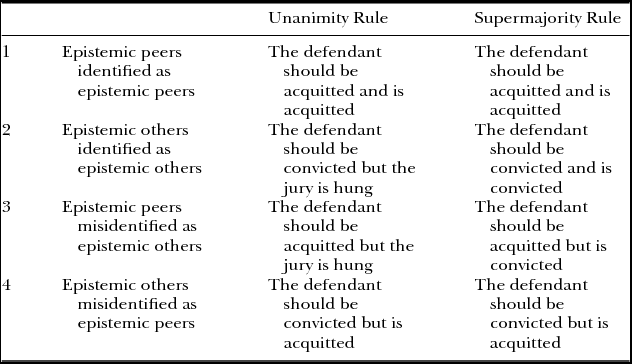
It turns out there may be a reason. To see this, we should start by asking how reliable jurors are likely to be when they determine whether the disagreement they are having is among epistemic peers or epistemic others. There are four possibilities. Jurors may correctly identify epistemic peers as epistemic peers and epistemic others as epistemic others. Or jurors may misidentify epistemic peers as epistemic others or misidentify epistemic others as epistemic peers. Table 5 illustrates what happens under the four possibilities, assuming the facts of Case 3 (11 to 1 vote in favor of conviction).

The choice between the unanimity rule and the supermajority rule does not make a difference if epistemic peers are correctly identified as epistemic peers (row 1) or if epistemic others are misidentified as epistemic peers (row 4). If epistemic peers are correctly identified as epistemic peers, those who ought to be acquitted would be acquitted under either voting rule. On the other hand, if jurors judge those who disagree with them to be epistemic peers when they are in fact epistemic others, then those who ought to be convicted would be acquitted under either the unanimity rule or the supermajority rule (row 4).
The choice of the voting rule does make a difference if jurors correctly identify epistemic others as epistemic others (row 2) or if jurors misidentify epistemic peers as epistemic others (row 3). If jurors correctly identify epistemic others as epistemic others, the unanimity rule would produce a hung jury even though the defendant ought to be convicted, whereas under the supermajority rule those who ought to be convicted would be convicted. On the other hand, if jurors judge those who disagree with them to be epistemic others when they are in fact epistemic peers, under the unanimity rule those who ought to be acquitted would face a mistrial, and under the supermajority rule those who ought to be acquitted would end up being convicted.
So whether we pick the unanimity rule or the supermajority rule, it appears that we would end up with some undesirable outcomes. If we pick the unanimity rule, we might end up creating mistrials where there ought to be convictions or acquittals, whereas if we pick the supermajority rule, we might be convicting people who ought to be acquitted. How should we decide which way to go? One answer to the question is that this is not a question we can settle without knowing how people generally behave, but at the same time we may further hypothesize as follows: jurors who are 90 percent certain of a defendant's guilt are unlikely to see genuine epistemic peers as epistemic peers. While in this article this proposition cannot go beyond the status of a hypothesis, it seems very plausible that those who feel certain of a defendant's guilt are likely to dismiss those who disagree with them as being unreasonable and that jurors are likely to err in the direction of identifying epistemic others even when they are disagreeing with epistemic peers.
If this hypothesis is true, then, as mentioned above, the situation described in row 3 of Table 5 (epistemic peers misidentified as epistemic others) is a real possibility and more likely to happen than the situation described in row 4 (epistemic others misidentified as epistemic peers). And if that happens, those who ought to be acquitted would end up being convicted under the supermajority rule. The supermajority rule is no longer so attractive, then. Even if there is disagreement among epistemic peers and thus an acquittal is called for, the supermajority rule would end up permitting a conviction of the defendant. A solution to this problem is to institute the unanimity rule, which has the effect of producing a mistrial instead of an acquittal in situations where jurors overidentify epistemic others. This, of course, is an error, too, and is problematic, but a hung jury instead of an acquittal is not as serious as convicting a person who ought to be acquitted.
But what if the jurors are good at identifying epistemic others and do not overidentify epistemic peers as epistemic others? If that is the case, then the unanimity rule would be producing mistrials for defendants who probably ought to be convicted, and we should recognize that as a problem as well. It seems to me, though, that the problem of convicting the innocent plus the likely overidentification of epistemic others should lead us to choose the rule of unanimity, given that when a person who ought to be convicted receives a mistrial, a prosecutor can try the case again. Therefore, the analysis so far suggests that given the assumptions of the validity of the equal-weight view as an epistemic principle and of the tendency for jurors to overidentify epistemic others, we ought to favor the unanimity rule as a way of protecting against such a tendency. But I concede that the case for unanimity is not airtight.
There is one more thing to consider. We have so far assumed that the equal-weight view is correct and that the jurors apply it and we have arrived at the conclusion that the unanimity rule is desirable because of jurors’ tendency to overidentify epistemic others. What if we now relax the assumption that the jurors apply the equal-weight view? Table 6 shows that when jurors use the steadfastness approach, the jury would convict under the supermajority rule when the vote is 11 to 1, whereas the jury would be hung under the unanimity rule when the disagreement is among epistemic others, which is the same set of outcomes we would get under the equal-weight view. Therefore, introducing the possibility of disagreement among epistemic others makes the supermajority rule not as problematic as we saw above.
TABLE 6Footnote 69

At the same time, the problem identified above remains. If the jurors use the steadfastness approach when the disagreement is among epistemic peers, then under the supermajority rule, some cases that should end as acquittals according to the equal-weight view would end as convictions. The unanimity rule is then needed as a way of turning such false convictions into mistrials by forcing hung juries, as shown above.
In sum, assuming that the equal-weight view is valid, we should adopt the unanimity rule as a way of enforcing the beyond a reasonable doubt requirement not only because of jurors’ tendency to overidentify epistemic others but also because of jurors’ likely failure to apply the equal-weight view consistently.
E. Epistemic Peers, Epistemic Others, and Those In-Between
Above I assume that one is either an epistemic peer, in which case the equal-weight view applies, or an epistemic other, in which case the view held by the other is entirely discarded. Let us consider what happens if we relax that assumption. So far we are making the assumption that when we have, say, an 11-to-1 vote, there are only two possibilities: the eleven voting in favor regard the dissenter either as an epistemic peer or as an epistemic other whose view should not be given any weight. Of course, whether one defers to another need not be an all-or-nothing proposition. The appropriate weight to place on others’ views may differ depending on a variety of factors.Footnote 70 We might then ask what would happen if the weight given to the dissenter varies between 0 and 1. Table 7 represents, from the perspective of those voting to convict and applying the equal-weight view (though no longer equal, as we are primarily interested in the process of updating one's views due to peer disagreement), how their beliefs might change depending on how much weight they place on the dissenting juror's view.
TABLE 7Footnote 71

According to this table, if those voting to convict do not entirely dismiss the dissenter as an epistemic other deserving of no weight and place even a little bit of weight on the dissenter's view, they should change their votes and vote to acquit instead. Therefore, relaxing the all-or-nothing assumption where one is considered to be either an epistemic peer or an epistemic other does not change the conclusion reached above, especially if one assumes the tendency to overidentify epistemic others.
The picture becomes a bit more complicated, though, if we start changing the level of confidence the dissenter has about the defendant's innocence. There will be times, for instance, when giving the dissenter some weight would not lead members in the majority to change their votes.
For instance, in the first row of Table 8, if the dissenter assigns 0.6 to the probability of guilt, then the new average probability of guilt for the juror in the majority is still 0.90 (rounded up from 0.89729 . . .), assuming the juror in the majority assigns the weight of 0.1 to the dissenting juror. However, if the majority juror assigns just a little more weight to the dissenting juror, the average probability of guilt drops to 0.89 (rounded down from 0.89464 . . .), indicating that just a little bit of deference to the juror who thinks that the defendant is guilty but is not certain enough to vote in favor of conviction should lead the jurors in the majority to change their votes. Even if the dissenting juror assigns the probability of guilt at a value as high as 0.8, if the majority jurors place some weight, say 0.6, on the dissenter, we end with the conclusion that the jurors in the majority must change their votes, given the average probability of guilt of 0.89 (rounded down from 0.89482 . . .).
TABLE 8Footnote 73

Unsurprisingly, then, the overall conclusion does not change. If the fact of disagreement leads a juror to revise his or her assessment of guilt, a juror initially in favor of a guilty verdict would often need to change his or her vote and vote to acquit instead. If we combine that insight with the assumption that jurors tend to overidentify epistemic others (or to underweigh the opinions of those they disagree with), then the conclusion follows that the unanimity voting rule should be instituted as a way of protecting from conviction those defendants who ought to be acquitted.
F. Is Any of This Realistic?
One major objection to the argument made so far might be that the way in which the jury decision-making process is portrayed is highly unrealistic. This objection may be expressed in several different ways.
First, some may object to the idea of interpreting “beyond a reasonable doubt” as designating a high probability of guilt expressed in numerical terms. Scholars and courts have expressed some uneasiness about quantifying reasonable doubt, and the main concern is that giving it a number would be equivalent to, in Laurence Tribe's words, “formulating an ‘acceptable risk of error,’” which “would interfere seriously with [the] expressive role of the demand for certitude” found in criminal law.Footnote 75 Second, some may object that the picture of jury deliberation presented here is unrealistic because although we ask jurors to reach different levels of certainty when they consider their votes, we do not ask them to state their confidence levels (“0.4 probability of guilt” and so on) during deliberation. Third, even if we assume that the jurors can express their levels of confidence in a person's guilt in terms of numbers, it seems unrealistic that they can do it in such a fine-grained way that they can distinguish between, say, 0.89 and 0.84.
When considering these objections, it is important to remember a few features of the argument. First, the argument here is not that the beyond a reasonable doubt requirement should be explained in terms of numerical values to jurors or the public. Second, the argument does not depend on the assumption that jurors actually assign numerical values to their levels of confidence. Third, the argument does not depend on the assumption that the jurors in their deliberations apply the equal-weight view. The analysis does, however, depend on the views that it would be rational for jurors to think in terms of probabilities of guilt and that it would be rational for the jurors to apply the equal-weight view. The analysis concludes that if the equal-weight view is correct as an epistemic principle and the beyond a reasonable doubt requirement is so demanding that a probability of at least 0.9 is required for a vote to convict, then the supermajority rule should not be the voting rule for criminal juries and the unanimity rule should be the rule, precisely because the jurors may not behave rationally. That is, the recommendation of the unanimity rule is based on the assumptions that the jurors fail to apply the equal-weight view consistently and that the jurors tend to overidentify epistemic others, which lead us to the conclusion that the unanimity rule offers the best solution, given the jurors’ failures to be consistently rational.
The unanimity rule is, in other words, a way of forcing jurors to approximate outcomes that would be reached if they were to behave rationally; it turns false convictions (that is, convictions that ought to be acquittals) into mistrials. Therefore, Tribe's point that putting a number on the standard of proof can undermine the public's confidence in the criminal justice system does not apply here; the argument, at least as given so far, does not advocate that we quantify the standard of proof when communicating with the public. The objection that jurors do not in fact put numbers on the standard of proof or on their confidence levels as they deliberate is also inapplicable because the argument does not depend on the assumption that they in fact do such a thing. The question that the analysis does raise is whether we should encourage jurors to behave in that way, and the next section explores this question.
III. SHOULD WE IMPLEMENT THE EQUAL-WEIGHT VIEW FOR CRIMINAL JURIES?
Now that we have an understanding of the implications of the equal-weight view for the criminal jury practice, we should now consider whether the equal-weight view is a realistic or attractive ideal for jury deliberation in criminal cases. That is, up to now, as noted above, we have been assuming that jurors may or may not be applying the equal-weight view in their deliberations. The question now is whether the legal system should instruct the jurors to apply the equal-weight view.
Now, the equal-weight view implies that in situations of disagreement about such facts, it would be rational for jurors to become less certain about their beliefs, and, given the stringency of the beyond a reasonable doubt requirement, a rational juror would vote to acquit, assuming that the disagreeing person is an epistemic peer. The beyond a reasonable doubt requirement is controversial,Footnote 76 but this particular implication of the equal-weight view seems compelling in the way it coheres with the standard justifications for the requirement. There is more to it than that, of course, and we should start by noting that there are indications that the current system has already incorporated some insights of the equal-weight view.
A. Do Aspects of Our Current Practice Already Reflect the Equal-Weight View?
1. The Equal-Weight View and Reasonable Doubt Instructions
First, as discussed above, whether a disagreement should lead to a vote of not guilty turns on whether the disagreement is among epistemic peers. One question, then, is whether our jury system has the resources to instruct jurors to adjust their votes by considering whether the disagreement that they are facing, if any, is among epistemic peers. It seems to me that we may already be telling jurors to try to decide whether they are facing epistemic peers or others when there is disagreement.
Consider the following, which are some standard reasonable doubt instructions:
-
If . . . you think there is a real possibility that he is not guilty, you must give him the benefit of the doubt and find him not guilty.Footnote 77
-
Proof beyond a reasonable doubt is proof that precludes every reasonable hypothesis except guilt and is inconsistent with any other reasonable conclusion.Footnote 78
-
[I]t is a doubt for which a reason can be assigned.Footnote 79
-
It is a doubt for which you can . . . conscientiously give a reason.Footnote 80
-
It is a doubt that a reasonable person hearing the same evidence would have.Footnote 81
-
[I]f the jury views the evidence in the case as reasonably permitting either of two conclusions, one of innocence, the other of guilt, the jury should . . . adopt the conclusion of innocence.Footnote 82
These are not phrased in terms of epistemic peerhood, but these instructions could be interpreted as a way of telling the jurors how to assess whether the disagreeing juror's viewpoint is “reasonable,” in which case one ought to treat it as a disagreement among epistemic peers.
How would these instructions then apply to a case the first Etan Patz trial? In the first Etan Patz trial, eleven jurors wanted to convict, and one person wanted to acquit. Now imagine that the eleven jurors consulted the definition of “proof beyond a reasonable doubt” to decide whether this is the kind of disagreement that ought to produce an acquittal. One definition says that proof beyond a reasonable doubt is “proof that precludes every reasonable hypothesis except guilt.” Another instruction tells the juror that if she “views the evidence in the case as reasonably permitting either of two conclusions, one of innocence, the other of guilt,” then she must vote to acquit. Yet another says that reasonable doubt is “a doubt that a reasonable person hearing the same evidence would have.” Each one of these definitions may be thought of as a way of telling the jurors to determine whether the disagreement they are facing is one among epistemic peers, and phrases like “reasonable hypothesis,” “reasonably permitting,” and “reasonable person” are doing that work. If they think the dissenting juror is an epistemic peer, they ought to acquit; otherwise, they need not acquit.
2. The Equal-Weight View and Postconviction Review
It is also worth discussing whether the analysis presented here can illuminate the way in which convictions are reviewed for insufficiency of evidence. The Supreme Court, in Jackson v. Virginia, addressed the question of whether the constitutional requirement of proof beyond a reasonable doubt had constitutional implications for the standard of review for guilty verdicts and held that the challenge to a guilty verdict on the grounds of the insufficiency of the evidence is successful, “if it is found that upon the record evidence adduced at the trial no rational trier of fact could have found proof of guilt beyond a reasonable doubt.”Footnote 83 This means that even if the reviewing judge disagrees with the jury and thinks that that there is reasonable doubt as to the defendant's guilt, the judge cannot set aside the jury's verdict on the basis of that alone. The judge also must find that no rational jury would have convicted.
The Jackson standard is a highly deferential standard, and one may see it as inconsistent with the view presented here. To see this, consider Table 9.
TABLE 9Footnote 84

To simplify, let us assume a single reviewing judge and a unanimous verdict. If a defendant has been found guilty, there are twelve people who assess the probability of guilt to be at 0.9. If the reviewing judge is sympathetic to the jury's verdict yet is unconvinced beyond a reasonable doubt of the defendant's guilt and puts the probability of guilt at, say, 0.8, then, as “the thirteenth juror,” the judge's misgivings bring the average probability of guilt down to 0.89, below the 0.9 threshold for beyond a reasonable doubt, which would then call for setting aside the verdict and even acquitting the defendant.
Does the equal-weight view, then, imply that Jackson was wrongly decided? That conclusion would be too quick. The question of the appropriate standard of review involves several considerations, one of which is the assumption by our legal system that “it is the responsibility of the jury—not the [reviewing] court—to decide what conclusions should be drawn from evidence admitted at trial.”Footnote 85 The original Jackson Court showed its sensitivity to the issue in stating that “the standard announced today does not permit a court to make its own subjective determination of guilt or innocence,”Footnote 86 that under the standard, “the factfinder's role as weigher of the evidence is preserved,”Footnote 87 and that the “criterion . . . impinges upon ‘jury’ discretion only to the extent necessary to guarantee the fundamental protection of due process of law.”Footnote 88 The Court more recently observed that “[b]ecause rational people can sometimes disagree, the inevitable consequence of this settled law is that judges will sometimes encounter convictions that they believe to be mistaken, but that they must nonetheless uphold.”Footnote 89
The Jackson Court, of course, had a few other options as it considered the proper level of deference to the initial verdict. The first option is the approach whereby the reviewing court would “ask itself whether it believes that the evidence at the trial established guilt beyond a reasonable doubt.”Footnote 90 The second approach is the approach considered here, which is just like the first approach but with the equal-weight view applied. (In other words, the first approach is just like the second approach but applies the steadfastness view.) The third approach is the deferential standard articulated in Jackson, under which the conviction is upheld if the reviewing court finds that a rational jury could have found in favor of a guilty verdict. The fourth approach is an approach that the Jackson Court considered but rejected, according to which, “a conviction based upon a record wholly devoid of any relevant evidence of a crucial element of the offense charged is constitutionally infirm.”Footnote 91
So these are at least four approaches (and these approaches can be made even more complex) at varying levels of deference to the jury, but none of them are required by the equal-weight view. We are interested, of course, in the question of guilt and innocence, and the equal-weight view is relevant to that interest, but there may be other structural considerations, such as institutional reasons to shield the jury's considered judgments from second-guessing, given the important role of the criminal jury in the system, that are also relevant in deciding which level of deference is appropriate.Footnote 92 Though a complete analysis of the proper standard of review in this context is beyond the scope of this article, we can at least give an account of the Jackson standard in terms of epistemic peers.
As we see in Table 9, if the equal-weight view applies and the reviewing court disagrees with the guilty verdict, it appears, assuming that the jurors are the judge's epistemic peers, that the overall average probability of guilt has to be adjusted. The Jackson rule can be interpreted as a directive to the reviewing courts to first ask if the jurors are epistemic peers and not to disturb the verdict if the answer to that question is yes. However, considering all the evidence in the record, if the jury's decision is so far off base that they qualify as epistemic others, perhaps akin to a group of Apparently Mistaken Jurors, then the reviewing court may set aside the jury's verdict at that point. Perhaps this level of deference—where decisions made by epistemic peers are respected even if one believes them to be wrong—is appropriate in order to maintain the multitiered system of courts and reviews, or alternatively, perhaps it is underprotective of the due-process requirement of proof beyond a reasonable doubt. The equal-weight view does not suggest an answer one way or another.
3. Conclusion
The claim here is not that our jury practice is an implementation of the equal-weight view. Given the uncertainty over what the standard actually does,Footnote 93 it would be foolish to take a strong interpretive position like that. The claim, rather, is that the fact that the equal-weight view requires those practicing it to tell epistemic peers and epistemic others apart need not be a problem, given that such a requirement seems to run parallel to the language in our jury instructions that may be telling jurors to do something at least similar and parallel to the way in which appeals on the basis of the insufficiency of the evidence are reviewed. The question remains, though, whether we should bring out these aspect of our jury practice more explicitly with a conscious goal of implementing the equal-weight view for criminal juries. In order to answer that question, we need an even closer look at the equal-weight view and its operation in criminal law.
B. Does Implementing the Equal-Weight View Require Jurors to Assign Numerical Probabilities of Guilt?
As discussed above, the argument in favor of the unanimity rule presented in Section I did not assume that jurors assign numerical values to their levels of confidence. But if we were to implement the equal-weight view and instruct jurors accordingly, would we have to know whether it would be realistic to ask jurors to state their confidence levels (“0.4 probability of guilt” and so on) during deliberation? The answer is no. The explanation can be seen in Table 10.
TABLE 10Footnote 95

Table 10 shows that if 0.9 is the required level of probability of guilt for a vote to convict, then we need not worry about identifying precise confidence levels of jurors. Because the required level of confidence for a vote to convict is so high, nothing of practical significance turns on each juror's confidence level, unlike the situation where the minimum required probability of guilt was 0.85, where the confidence levels, as shown above, make a big difference. In practical terms, this means that there is no need to ask jurors to state their confidence levels to implement the equal-weight view in practice. If there is disagreement, one must vote to acquit unless disagreement is among epistemic others, in which case one may keep one's vote unchanged.
This conclusion does not change even if we start from the assumption that jurors are more likely to assign only rough probabilities. Alec Walen, for instance, says that while “jurors have no basis for saying that a defendant's guilt is 90% likely as opposed to 95% likely,” “[t]here is no reason to doubt that jurors can distinguish, relatively reliably, cases in which the evidence would suggest that the defendant's guilt is nearly 100% certain (essentially conclusive evidence), roughly 90% certain (very strong evidence), roughly 70% certain (moderately strong evidence), roughly 50% certain (equivocal evidence) and so on.”Footnote 94 Even if we limit ourselves to just these numbers (except 100%, which I assume is not typical), we end with the same outcome as we can see in Table 11.
TABLE 11Footnote 96

Therefore, the conclusion that there is no need to ask jurors to state their confidence levels to implement the equal-weight view in practice remains unchanged, even if we assume that jurors can identify levels of confidence only in rough quantities.
All of this, though, assumes that whether one updates one's views as a result of disagreement or not is an all-or-nothing matter in the sense that one places equal weight on each epistemic peer and places no weight at all on epistemic others. As discussed in Section II.E, that need not be the case, as epistemic peerhood can be a matter of degree. If one does not place equal weight on each peer but adjusts the amount of weight for each person depending on what one sees in that person, then the confidence level of each juror could make a difference, in certain limited circumstances, as one makes a decision as to whether to change one's vote due to disagreement. Now, it is inevitable that some of the subtleties would have to get lost at the implementation stage. But given the fact that a juror initially in favor of a guilty verdict would often need to change his or her vote and vote to acquit instead and given the assumption that jurors tend to overidentify epistemic others (or underweigh the opinions of those they disagree with), it seems to me that the equal-weight view could be implemented, with few drawbacks, without requiring jurors to state their confidence levels.
C. The Equal-Weight View and Moral Elements
1. The Equal-Weight View and Moral Disagreements
One feature of the criminal jury's decision-making process that the discussion so far has obscured is that crime definitions typically contain different types of elements. There are several types of questions that fact finders are tasked with in criminal trials, such as “What crime was committed?” “Did the defendant commit the crime?” “What did the defendant do?” And “Did what the defendant do constitute a crime?” These questions overlap, but the reason they are phrased slightly differently is because sometimes it is clear that a crime was committed (a person was killed), and the question is whether the defendant can be linked to the crime (Was O.J. Simpson the killer?), whereas at other times there is little dispute about whether the government has identified the correct defendant, and the important questions that remain are exactly what the defendant did (Did Martha Stewart tamper with potential evidence?) and whether what the defendant did constituted a crime and which crime (Did Dharun Ravi invade his roommate's privacy, and if so, was there bias intimidation?)
Deciding these cases requires reconstructing historical facts. Far more than that, however, is often involved in determining whether a person's conduct meets the definition of a crime. Take one of the definitions of “murder in the second degree” in New York law, for instance: “A person is guilty of murder in the second degree when under circumstances evincing a depraved indifference to human life, he recklessly engages in conduct which creates a grave risk of death to another person, and thereby causes the death of another person.”Footnote 97 Under this definition, the prosecution has to prove that (1) “under circumstances evincing a depraved indifference to human life,” (2) an individual “recklessly engage[d] in conduct,” (3) “which create[d] a grave risk of death to another person,” and (4) thereby “cause[d] the death of another person.” In order to decide whether these elements have been proven, jurors must determine what happened, such as what the defendant exactly did and how it led to a person's death. But the jurors’ determinations of “recklessly,” “grave risk,” “depraved indifference to human life,” and “cause” involve more than simply determining what bodies occupied what spaces at what time, what kinds of movements such bodies engaged in, and what differences such movements made in the world. Jurors also have to determine whether terms like “recklessly,” “grave risk,” “depraved indifference,” and “cause” are appropriate descriptors of relevant features of the world, and such judgments involve making moral evaluations.Footnote 98
Therefore, when applying crime definitions to particular cases, different kinds of determinations must be made about historical facts—or questions about what happened—and about norms—or about the evaluative significance of what happened. And the definition of second-degree murder in New York is not an outlier. Moral or normative terms such as “reckless,” “unjustifiable,” “depraved,” “grave,” “cruel,” “wanton,” “heinous,” “debased,” “perversion,” and “impair or debauch the morals” are routine in criminal law.Footnote 99 Moral or normative elements generally have the following characteristics. Like the terms “unjustifiable,” “reasonable,” “depraved,” and “cruel,” they are vague and evaluative. Such terms are rarely defined precisely and instead invite the fact finder to make moral judgments in the process of determining whether the terms apply to the conduct in question. And they are typically applied to individual cases by trial judges and juries without detailed guidance from appellate decisions and legislation.Footnote 100
Such moral or normative elements constitute a subset of the category of what is commonly called “mixed questions of fact and law” by lawyers.Footnote 101 Some moral philosophers, following Bernard Williams, refer to such terms as “thick concepts.”Footnote 102 Williams's own examples are terms such as “coward,” “lie,” brutality,” and “gratitude.”Footnote 103 As Williams explains, thick concepts are “action-guiding” in the sense that they are “characteristically related to reasons for action,” as “[i]f a concept of this kind applies, this often provides someone with a reason for action.”Footnote 104 They are, however, called “thick” concepts because they are “thick” with descriptive attributes, which make the concepts “world-guided” as well as “action-guiding.”Footnote 105 Others have explained “thick concepts” in similar terms. Jonathan Dancy says that “thick concepts somehow hold together a property and an attitude . . . or, as it is also sometimes put, description and evaluation.”Footnote 106 Allan Gibbard says “[a] term stands for a thick concept if it praises or condemns an action as having a certain property.”Footnote 107
Williams uses the term “thick concepts” in order to contrast them with “thin” ethical concepts such as “good,” “right,” and “ought,” which are “thin” in the sense of having little descriptive content.Footnote 108 The distinction between “thick” and “thin” concepts is controversial, especially because Williams has used the distinction to criticize contemporary ethical theorizing for relying mostly on thin concepts and neglecting thick concepts. Because so much of theoretical import seems to turn on the argument that many important ethical concepts for contemporary ethical theorists are “thin” as opposed to “thick” and hence indicative of defects in contemporary ethical theorizing, Williams's account invites the objection that the distinction is not always easy to draw.Footnote 109 For instance, Samuel Scheffler, who mentions “privacy,” interests,” and “consent” as examples of concepts of some importance to contemporary ethical theories, observes that “every single one of the[se] concepts . . . appears to be determined to at least some extent by what the world is like,” and argues that “it is impossible confidently to classify various of the concepts on the list as either thick or thin.”Footnote 110 T.M. Scanlon, too, has pointed out that “ethical theories typically deal with a variety of moral concepts including well-being, consent, and specific rights, such as rights to privacy, all of which seem to have considerable empirical content,” and concludes that “the contrast in empirical content between thick and think concepts is at most one of degree.”Footnote 111
For our purposes, this particular philosophical controversy is of little moment, because the distinction we are interested in is the distinction between factual and moral terms, whereas the debate over the distinction between thin and thick concepts presupposes that both types of concepts have some descriptive and prescriptive aspects, with the main disagreement being over how much description is necessary for a concept to go from thin to thick. What is relevant for our purposes is the similarity between such moral terms, whether they are properly classified as “thin” or “thick,” and moral terms in crime definitions. Because of the ways in which the factual and moral aspects intertwine in these terms, disagreements about whether a concept applies to a person or to a person's conduct tend to assume a particular shape.
For largely factual questions like “Did the man stab his ex-wife to death?,” there can be a disagreement among fact finders, and the nature of this disagreement would generally be about what factual inferences to draw from available evidence. A leather glove was found at the scene of the crime and it was the same type of glove worn by the defendant. Does the presence of the glove point toward guilt? What if the glove does not fit the defendant? Perhaps the glove has fit in the past but no longer fits because of a medical condition. Or maybe it is because the glove shrank after having absorbed blood. Or, even if the glove actually belonged to the defendant, it was planted at the scene of the crime by a cop in order to frame the defendant. If there is a disagreement about the significance of the glove, it would have to do with the ways in which the glove is or is not related to the crime. In most criminal trials, we are trying to piece together what happened after the fact, given the available evidence. The role of the fact finders is to use various types of evidence (witness testimony, documents, and physical evidence) to draw correct inferences and develop answers to these questions, and the field of evidence law is full of rules about what types of evidence may be considered and what inferences may be drawn from them.
Disagreements about moral elements, however, do not always look this way. Say jurors are having a disagreement about whether a particular form of corporal punishment was “cruel.” Let us assume that two jurors agree on exactly what happened in terms of how many blows were delivered, how much pain was likely felt, whether the blows were delivered intentionally or accidentally, and so on. Yet there can remain some disagreement between the two as to whether there was cruelty in the defendant's behavior. Disagreements about factual matters, then, may be resolved by more fact-finding. Disagreements about moral matters, however, can persist, as moral disputes—as to whether something is cruel or not—cannot always be settled through more fact-finding. It is true that many moral disagreements are actually factual disputes, and many moral disagreements disappear once people have the facts straight, but disagreements as to whether some act is cruel or not can remain even after all the facts have been put on the table.
In this sense, moral elements resemble thick concepts. Like moral elements in crime definitions, when two people disagree on whether a moral concept applies, the disagreement can be purely evaluative, in the sense that one's attitude toward the thing can determine whether the concept in question applies to the thing.Footnote 112 Or, as others have put it, “with the thick, evaluation partly determines description,”Footnote 113 because “[i]n order to trace the contours of the ethical concept's applicability we have to understand its evaluative point,”Footnote 114 and this is because “[t]he uses of words or terms expressing thick concepts . . . involve a commitment to an underlying normative or evaluative judgment.”Footnote 115
It is true that it is not always easy to draw a distinction between moral and factual terms, but the fact that there are line-drawing problems does not by itself erase the distinction between the question of whether a person was occupying a particular space at a particular moment and the question of whether the person engaged in a behavior appropriately described as “cruel.” Given that there is such a distinction, and given that moral terms, as described so far, are common in crime definitions, the question of how the presence of moral terms raises distinctive issues for law can be addressed—at least for now—without being bogged down by the question of exactly how to draw the distinction between elements that are moral and those that are not. So the relevant question for our purposes now is how the equal-weight view handles disagreements that are morally inflected.
To explore this issue, let us focus on the idea of “consent,” which as we saw above, is often described as a moral term in discussions of thick concepts.Footnote 116 More specifically, consider the following facts from Commonwealth v. Berkowitz, a controversial 1994 case from Pennsylvania.Footnote 117 Berkowitz, the defendant in the case, and the complainant were college students and had mutual friends and acquaintances. Before the day of the incident at issue in this case, Berkowitz and the complainant talked on a few occasions, once shortly after the complainant attended a school seminar on the question, “Does ‘no’ sometimes mean ‘yes’?,” and twice afterward when she stopped by Berkowitz's room while intoxicated, once lying down on his bed. During that first conversation after the seminar, the complainant asked Berkowitz how large his penis was. One day, the complainant went to visit a friend in his dormitory room and found not her friend but only Berkowitz, who was the friend's roommate. Berkowitz asked her to stay, and she stayed and talked for a while with him. The two parties professed different understandings of what happened next. It is uncontroverted that Berkowitz initiated physical contact and that the complainant said “no” multiple times to him throughout sexual acts that culminated in intercourse. The complainant also stated that Berkowitz “put” her on the bed with something that was “kind of like a push” and that he then got on top of her, which meant that she “couldn't . . . go anywhere.” Berkowitz did not deny that she said “no” repeatedly but said that she “warmly responded to his advances by passionately returning his kisses” and was “whispering . . . no's” while moaning “amorously . . . passionately.”Footnote 118
At issue in the case was whether there was sufficient evidence to convict the defendant in the case of the crime of rape. So let us now imagine a jury considering the rape charge. The jury in the original case was working with a particular definition of rape that was in force at the time, but here are two possible definitions:
Rape Definition 1: A man is guilty of rape “if he (a) uses force or the threat of force (b) to engage in sexual intercourse with a woman (c) without the woman's consent and (d) knows or can reasonably be expected to know the woman does not consent.”
Rape Definition 2: A man is guilty of rape “if he (a) engages in sexual intercourse with a woman (b) without the woman's consent” where the term “consent” means words or overt actions indicating a freely given agreement to have sexual intercourse,” and “if a man engages in conduct that satisfies the definition of rape, a mistaken belief that the woman consented is not a defense.”
Using these definitions, people may disagree about whether someone like Berkowitz should be convicted of the crime of rape.
Fortunately, we do not have to work with such guesses, as there is an actual study on this case done by Dan Kahan.Footnote 119 Kahan's study took a national sample of 1,500 American adults who were representative of the general population in terms of race, gender, income, and education level. The study presented summaries of testimonies from the two individuals in the Berkowitz case and asked the participants to answer various questions concerning the incident described by the testimonies.Footnote 120
One of the questions the study asked was whether the participants agreed with the statement that the man in the case “should be found guilty of rape.”Footnote 121 Different groups were asked this question with different definitions of rape, the two I presented above and two additional definitions.Footnote 122 Across all the groups (that is, aggregating responses from groups with different definitions of rape), 57 percent agreed with the statement and 43 percent disagreed with the statement.Footnote 123 Depending on the definition of rape, the percentage of those who answered that the man should be convicted of rape ranged between 53 percent and 65 percent of the respondents.Footnote 124 And in the aggregate again, 24 percent stated that they strongly agreed with the statement, and 15 percent stated that they strongly disagreed with the statement.Footnote 125 So it appears that we see a robust disagreement within the population on this issue, and that there is a significant number of people who hold strong views.
This is an example of a case where the disagreements at issue do not seem to be simple factual disagreements. The facts may be somewhat murky, and additional details and background information may be useful, but there are also normative disagreements about what constitutes rape and, when applying the legal definitions, what constitutes “force or threat of force,” “without consent,” “can reasonably be expected to know the woman does not consent,” or “words or overt actions indicating a freely given agreement to have sexual intercourse.” All of these questions are like thick concepts discussed above in that one's evaluative perspective can determine the applicability of such terms.Footnote 126 The question for our purposes is what ought to happen in such situations of disagreement according to the equal-weight view.
Take a look again at Table 4. This table assumes that there is an 11-to-1 vote on the question of guilt, since that is the strongest possible scenario to convict while allowing for a strong disagreement. Under the equal-weight view, when the jurors face the sort of disagreement over whether there someone like Berkowitz should be convicted of rape and the disagreement is among epistemic peers, those who feel strongly that he ought to be convicted need to lower the confidence in their belief and those who feel the opposite need to do the same with regard to their beliefs. The Epistemic Peers row of the table indicates that the jurors ought to vote to acquit, since their confidence in their belief in the defendant's guilt would not be high enough.
But the other possibility of course is that the disagreement is not among epistemic peers. How so? Here are some possibilities shown above.
Juror from Outer Space: The dissenter turns out to be obviously in error, where his failure to reason or grasp reality is so serious that the fellow jurors need not place any weight on his opinion. For instance, he may hold an obviously erroneous view on the question of whether a bullet travels in a straight line or has the ability to go around objects.
If the jurors who think Berkowitz is a rapist believe that those who disagree with them are obviously insane, then they can ignore the one person who would acquit him. It seems to me, though, as a general matter, that those who would acquit Berkowitz cannot be dismissed so easily, given that among the 1,500 Kahan's study surveyed, 42.5 percent thought he was not guilty. Those who would acquit him might still be mistaken, but their belief is not as obviously wrong as the belief “that one is the messiah”Footnote 127 or the prediction that “it will rain eggplants tomorrow.”Footnote 128
If the Juror from Outer Space is not an option, what about this one?:
Apparently Mistaken Juror: The dissenter here is not obviously unreasonable, like the Juror from Outer Space, but is apparently mistaken from the perspective of the eleven jurors. They believe, with confidence of 0.9, that the defendant is guilty, so anyone who disagrees with them of course must have made an error in reasoning.
Is this a possibility? It is not clear. The example we consider above for this possibility is Christensen's example of splitting a check at a restaurant, where your friend comes up with a number for each person's share that is higher than the bill itself. This would be the kind of mistake that Elga might call “utterly insane” or “obviously out of the ballpark.”Footnote 129 One could imagine a person thinking as follows: “Berkowitz is clearly a rapist. The complainant said ‘no’ repeatedly, and he ignored it. ‘No’ means ‘no.’ Anyone who thinks that Berkowitz did not rape is clearly in error in thinking that a person who says ‘no’ is consenting.” Following this logic, then, the eleven jurors may dismiss the one dissenting juror in the case as simply having gotten it wrong.
One problem with this answer is that it seems to require dismissing a large chunk of the population as holding an “insane” view. This may not be a problem as a general matter, but it may be a problem for the equal-weight view for the reason already discussed above. That is, if a person can ignore the opinion of anyone whose view he or she finds “utterly insane,”Footnote 130 then it is unclear why one would want to subscribe to the equal-weight view in the first place, given its initial appeal as a philosophy that eschews “unfounded confidence” and offers “a valuable strategy for coming with our known infirmities.”Footnote 131 The strategy of ignoring those one disagrees with because they are “utterly insane” then seems to reintroduce the problem of “unfounded confidence.” As Jennifer Lackey asks, “For isn't it the case that the most impassioned sexists typically find arguments on behalf of women's rights laughable, the most devout racists find the view of proponents of equality crazy and the most committed homophobes find the idea of granting homosexuals even the most basic indignities perverse”?Footnote 132
There is another option for proponents of the equal-weight view. Elga argues that in many controversial cases (say, implicating issues like the ones Lackey mentions), “the disputed issues are tangled in clusters of controversy.”Footnote 133 And those with whom you disagree on one controversial issue tend to be the ones who also have different views from yours on closely related issues. What would such closely related issues be in the case of rape? Maybe the juror who thinks Berkowitz ought to be acquitted also thinks that women often falsely accuse men of rape because of shame or guilt or regret over sex acts that they consented to; that women often say “no” when they mean “yes” because they do not want to appear “easy” and want to be “talked into it”; that men are expected by the society to ignore what women say and be aggressive and forge ahead in order to be respected; and so on. The equal-weight view, as mentioned above, is motivated by the idea that in many cases of disagreement, “the explanation in terms of my friend's mistake is no more reasonable than the explanation in terms of my mistake.”Footnote 134 So when considering a controversial rape case, if your fellow juror likely is someone who would come out the wrong way on a cluster of related issues, he is not an epistemic peer on this issue because he is more likely than you are to be wrong on this issue as well.Footnote 135
The idea that people's views on particular rape cases often go hand in hand with their attitudes toward closely related issues is supported in Kahan's study, where he finds that those who subscribe to “a hierarchical world view, as opposed to an egalitarian one,” were more likely to find the defendant to be not guilty, and vice versa,Footnote 136 and that “the individuals most inclined to form pro-defendant perceptions are hierarchical women.”Footnote 137 By “hierarchical” or “egalitarian,” Kahan means “how favorably or unfavorably disposed individuals are toward a social order that features differentiation and stratification of social roles based on observable and largely fixed characteristics (including race, gender, sexual orientation, and class).”Footnote 138 And Kahan elaborates that those who have a “hierarchical” outlook tend to believe that “[m]en . . . are entitled to exercise authority over women, whose status depends on successfully discharging domestic responsibilities,” and tend to view with “suspicion and contempt” “a woman who engages in sex outside of marriage.”Footnote 139 So the fellow juror who wants to acquit Berkowitz may make statements along these lines during deliberation. Or, even if you do not know the juror's attitudinal orientation, you may be able to guess that he or she is someone with whom you do not see eye to eye on most related issues. Either scenario may give a juror a reason not to treat the dissenter as an epistemic peer.
As a number of philosophers point out, it is not clear whether this response works.Footnote 140 First, is it not the case that we have here just another case of peer disagreement where the disagreement is not just about the issue of whether a crime of rape occurred but also about a cluster of related issues? If so, perhaps the equal-weight view would counsel a person holding a cluster of beliefs about related issues to reduce his confidence in his entire outlook. In Kahan's terms, perhaps one ought to question one's own hierarchical or egalitarian outlook instead of dismissing those whose general outlook differs from one's own as epistemic others. If this objection goes through, then we are back to the conclusion that the jurors in the case we are discussing ought to vote to acquit in the end.
Second, dismissing those with a different outlook from yours as epistemic others seems too quick. It may be the case that jurors who disagree on the question of whether someone like Berkowitz ought to be convicted of rape still share enough in common to qualify as epistemic peers. As Sarah McGrath points out in a similar context: “We would expect them to agree, for example, that slavery is morally abhorrent, that is wrong to cause others pain for the sake of one's own amusement, that lying is prima facie wrong, and about countless other issues.”Footnote 141
Third, on persistently controversial issues, there are often reasonable positions on both sides, and intelligent and well-informed people can often be found on both sides.Footnote 142 I present the case for acquittal of Berkowitz in a particularly unappealing way above in order to motivate the idea that only epistemic others would hold a belief like that. But of course we can present the contrarian view more positively in terms of the importance of refraining from punishing people for a crime as serious as rape when there may be an honest and reasonable misunderstanding as to the existence of consent. In the Kahan study itself, “40% of the subjects . . . indicated that they agreed that ‘[d]espite what she said or might have felt after, [the woman in the case] really did consent to sexual intercourse.”Footnote 143 Even if one is inclined to find the purported misunderstanding on the part of Berkowitz to be neither credible nor reasonable, one would have to be in denial to fail to recognize what Stephen Schulhofer has called an “inconvenient truth”:
[M]istakes—including reasonable mistakes—are not impossible or even rare. Sexual communication is so often indirect and contradictory that it is a wonder mistakes do not occur more often. What seems certain is that miscommunication about sexual desires is entirely commonplace. If we consider actual behavior of real people in our world as it stands, mistakes about consent, including mistakes about the meaning of “no,” are undoubtedly frequent. And sometimes, in some settings, those mistakes will be “reasonable,” even from the perspective of many women.Footnote 144
Kimberly Ferzan has similarly observed:
[W]e understand that there are contexts in which people say things they do not mean. A woman who takes her partner's “no” to mean “yes” may be accurately assessing her partner's willingness to engage in intercourse or other sexual contact. Similarly, silence may be misinterpreted. A man may believe that his partner's silence is acceptance or coyness when it is, in fact, “frozen fright.”Footnote 145
Given the possibility of such misunderstandings, one might reasonably believe that interpreting an ambiguous signal, in good faith, as an implicit consent may not rise to the level of culpability that warrants punishment and blame attached to a rape conviction. So the strategy of dismissing those one disagrees with on such controversial issues as epistemic others seems, again, to be in considerable tension with the motivations behind the equal-weight view.
Therefore, it appears that criminal cases that involve making decisions about controversial moral questions would frequently have to end in acquittals if we were to follow the equal-weight view. The only way to avoid this implication is for jurors to dismiss those who disagree with them on moral questions as epistemic others, which may be warranted in some cases, but not all. For some, then, the fact that the equal-weight view suggests that someone like Berkowitz may have to be acquitted may be sufficient to reject it as a jury deliberation ideal. To come to the conclusion, though, we would need to establish as a normative matter that someone like Berkowitz ought to be convicted, and that is not an obviously correct position to take. The following section, though, raises more concerns about the equal-weight view that do not rely on taking this position.
2. The Equal-Weight View for Factual Questions but Not for Moral Questions
To address the question of whether the equal-weight view is an attractive ideal for jury deliberation, we need to separate factual and moral elements of crime definitions. Should the equal-weight view apply to both types of issues? The answer is no. The equal-weight view should guide the jurors in determining factual issues but not moral issues.
As discussed above, there are several types of questions that jurors are tasked with in criminal trials, such as “What crime was committed?” “Did the defendant commit the crime?” “What did the defendant do?” And “Did what the defendant do constitute a crime?” Many of these are factual questions as to what exactly happened. And for factual questions like “Did the man stab his ex-wife to death?” there can be disagreements among jurors, and the equal-weight view implies that in such situations of disagreement it would be rational for jurors to revise their beliefs and become less confident about their conclusions, and, given the high standard of proof that the beyond a reasonable doubt requirement demands, a rational juror would vote to acquit, assuming that the disagreeing person is an epistemic peer. As noted above, this conclusion seems correct given the purposes of the beyond a reasonable doubt requirement, but this impression remains only as long as we are discussing factual elements and disagreements about facts.
Things look different when we are dealing with moral elements. The jurors who revise their beliefs and end up voting differently because of disagreement about the kinds of factual matters that criminal jurors generally deal with can say, “I believe x but I could be wrong about it,” and go on with the rest of their lives. This is not to say that all factual issues are like that. As discussed below, on controversial public-policy issues that are endlessly debated, such as climate change, childhood vaccinations, and gun control, relevant empirical evidence may be interpreted differently by different people depending on the various moral, cultural, and ideological commitments they have. Factual decisions that jurors make are generally not like that, because the evidence jurors consider tends to have implications only for the cases they themselves are deciding. Sometimes factual revelations can turn a person's world upside down, and the world of literature is full of such moments. But jurors do not decide such questions, either. As a general matter, jurors considering criminal cases do not have a personal stake in, say, the question of the factual significance of the glove found at the scene of the crime. Moral disagreements—at least the types jurors generally have—are not like that.
Say jurors are having a disagreement about whether a particular form of corporal punishment was “cruel” or a sexual encounter was “consensual.” If the jurors are told at the end that they are not to make the decision on the basis of moral beliefs they in fact subscribe to, the cost of such a decision is high. Jurors may feel confident in their moral judgments, but the equal-weight view seems to imply that it would be irrational for them to act according to such judgments if they encounter disagreement. Why is this a problem?
In order to see why this is a problem, we need to reexamine a core justification for the jury system. The case for delegating particularized moral judgments to juries has been made by many scholars. Juries in criminal cases are tasked not only with fact-finding but also with “the power to elaborate the governing norms underlying criminal laws from the perspective of the community and its sense of moral blameworthiness.”Footnote 146 It is thus often argued that the jury serves as the community's moral conscience in bringing the community's ordinary moral sentiments to bear on specific cases.Footnote 147
With that institutional setting as the backdrop, now consider what we do when jurors make moral judgments. First, as a general matter, when making moral judgments, we think and talk about fundamental, weighty issues. People take morality seriously. As T.M. Scanlon puts it, when we make moral judgments, we refer to standards and, “each of us regards the standards to which we refer as authoritative and binding—as standards which we have good reason to regard as outweighing all others, and whose violation is proper grounds for feelings of guilt and shame.”Footnote 148 Therefore, when jurors make moral judgments, they are considering matters of some importance, as they are committing themselves to a set of implications about how they think people are required to behave and different ways in which people are prohibited from behaving.
Now this may appear to be an overstatement, and it may indeed be. Whether one should leave a tip for a person who shines one's shoes, for instance, may implicate moral questions, but it may also be relatively costless for people to go with one answer or another. And this is not the right place to defend sweeping generalizations about the fact and value distinction. For the purposes of this article, though, it is sufficient to note that that the kinds of moral questions criminal jurors consider are important and to be taken seriously.
Second, as alluded to above, a person's moral judgment on a particular question does not stand isolated from her beliefs on other issues. Many controversial cases, as mentioned above, “are tangled in clusters of controversy,”Footnote 149 in Elga's phrasing, and how people evaluate such issues corresponds to different, broader worldviews that people generally subscribe to, as Kahan documents.Footnote 150 Whether a given criminal defendant was at the crime scene as accused of by the prosecutor is an issue on which a person can change her mind with minimal damage to everything else she believes in. Revising her views on a particular moral issue, by contrast, often requires rethinking other, related things that are embedded in her web of beliefs, attitudes, and emotions. As Philip Pettit puts it, “[y]ou can come to think that the car went through on the green without revising any of your other beliefs . . . [b]ut you cannot come to think that [, say,] . . . abortion is not grievously wrong, without a range of adjustments in other matters of belief.”Footnote 151 In other words, unlike factual questions that arise in criminal cases, which tend to be about that particular case and do not generally have any deeper implications, how a moral question is decided in a criminal case has the potential to reverberate through one's life because of the way the question is embedded in one's web of belief.
Third, when we make moral judgments, we engage those parts of ourselves that are sensitive to aspects of the world that provoke moral emotions and thinking, and in the case of jurors, they are dealing with real, not hypothetical, situations. An important aspect of what it means to be a person with a good moral character is to be sufficiently sensitive and responsive to features of the world that are morally relevant.Footnote 152 A person who witnesses an act of cruelty or unkindness or injustice but appears indifferent or even delighted or amused is morally defective. So, when the legal system asks jurors to make a moral judgment, we are putting them to a test in a sense and asking them to bare their souls or make themselves vulnerable to others’ moral evaluative stance. They are in a vulnerable position because, depending on how they come out, there is a risk that they would be judged by others to be morally defective. What sorts of factual conclusions a person arrives at can be revealing about a person's general perspective on the world as well, but there is much less risk in the factual context because one can occlude one's moral views by burying them in a jumble of factual observations.
In short, the types of moral questions jurors address tend to be important, embedded, and reflective of the person holding them, and these three features give gravitas to the task of making moral judgments in the context of a criminal trial. Given the seriousness of the task, the legal system should treat each juror's moral judgment with appropriate respect. The equal-weight view counsels that the jurors revise their views and “split the difference” in such situations when facing disagreement, and a directive that tells jurors to vote on the basis of adjusted views as if they are their own fails to treat each view with such respect. Instead, it sends a confusing, if not offensive, message that the views that these jurors hold on such weighty matters are somehow optional and can be ignored at will, as they may be asked to vote against them, which can have a highly disorientating and deflationary impact on the jurors and in turn undermine the basic justification for the jury as an articulator and enforcer of morality.
Of course, it should go without saying that jurors ought to conduct their moral deliberations carefully and responsibly. We want them to slow down, to consider the other side, to deliberate carefully, and to reach thoughtful conclusions, as opposed to make decisions on the basis of, say, blanket prejudice against minority groups. And there is nothing wrong with the practice of reflecting on one's own moral beliefs and questioning them when facing disagreements.Footnote 153 The point is that requiring that the jurors follow the equal-weight view is far more demanding than that.
It is also true that the justification for the criminal jury is often presented in terms of the jury as a stand-in for “the community”—that what matters ultimately is what the jury as a group concludes and not what any particular individual juror believes.Footnote 154 Given the group setting of the jury, would these institutional costs outlined in fact materialize when jurors clearly understand that they are there as a group and that their individual voices have to be combined and translated as a group decision in the end? Why can the equal-weight view not simply be such a procedure to aggregate different individual votes to produce a group decision without undermining the logic of the jury system?
The answer is that instructing to a juror to follow the equal-weight view is equivalent to instructing her to revise her view and vote on the basis of that new, revised view when facing disagreements as if the new view is her own view. The kinds of problems I outline here come about only when each juror is told to vote differently from his or her conscience due to disagreement. There is no problem like that if a juror votes differently from the others and the ultimate outcome is a hung jury, even though the group decision is different from the individual decision, because each juror votes according to his or her belief. In sum, the equal-weight view may imply a correct course of action when handling factual disagreements but it fares poorly when it comes to handling moral disagreements.
3. Perceptions of Facts and Moral Commitments
Some may object that moral questions are not the only questions that are important, embedded, and reflective in the ways that I described, and that factual judgments share the same features in that, roughly speaking, people may be as committed to seeing the facts in a particular way in the same way they are committed to seeing moral dimensions of the world in a particular way. On its face, this objection can seem silly. What possible commitments might I have that could lead me to want to believe that the desk I am sitting at is about a foot away from me as opposed to two feet away or that the light in my office is on as opposed to off? Recently, though, there have been more sophisticated articulations of the view that one's factual perceptions can be heavily influenced by values one holds, and the objection that my concerns about moral questions cut broadly and impact factual, as well as moral, judgments may rise from such views. I consider two such views, which we may call the “cultural cognition” view and the “epistemic injustice” view. The “cultural cognition” view is the one espoused by Dan Kahan, whose study is discussed above, and his sometime co-authors. “Epistemic injustice,” on the other hand, is taken from the title of a recent book by Miranda Fricker.Footnote 155
In the same article about the Berkowitz case described above, Kahan describes his general view about the relationship between factual perceptions and moral commitments this way:
[I]ndividuals face strong psychological pressure to fit their perceptions of how the world does work to their shared appraisals of how the world should work: forming beliefs at odds with their core values exposes them to dissonance and risks putting them in conflict with others whose opinions of them affect both their material and emotional well-being. As a result, even when individuals of diverse cultural values are exposed to the same sources of evidence—eyewitness statements, expert opinions, and even videotaped recordings of key events—they can hear and see very different things.Footnote 156
Kahan calls this phenomenon “identity-protective cognition.”Footnote 157
If Kahan is right about the ways in which people tend to form factual beliefs that are consistent with their values, then whatever arguments I am making against instructing jurors to adjust their moral judgments consistent with the equal-weight view may seem to apply to factual judgments as well. However, this conclusion does not follow from Kahan's arguments. Although Kahan and his numerous co-authors argue that people's factual perceptions are often shaped by their values or identities, the kinds of “facts” they focus on in order to make their case are special kinds of facts. The “facts” that Kahan discusses are not like the fact of the matter about the best explanation of, say, the presence of a glove at the scene of a crime. Kahan discusses two kinds of facts.
The first kind is the kind of facts on which people have heavy ideological stakes, such as, as mentioned above, childhood vaccinations, climate change, and gun control.Footnote 158 Because jurors are as a general matter not tasked with assessing empirical evidence bearing such large public-policy implications, Kahan's argument that “identity-protective cognition” leads people to interpret these facts one way or another for the most part does not apply to the topic of this article. It is possible that certain factual issues implicate broader ideological commitments that jurors have. Consider beliefs like “Women do not lie about being raped,” and “Cops always lie about shooting in self-defense after killing young black men.” It is possible that some jurors would have trouble reaching a conclusion contrary to these beliefs without doing violence to them, but, for the most part, jurors should be able to see that these beliefs are generalizations to which there can be exceptions. They do not have the comparable option of seeing exceptions when their moral beliefs seem to dictate an answer in one way.
The second kind of facts that Kahan and his co-authors consider are, however, closer to the topic of this article, as they are routinely considered by jurors. And those are issues, as we saw above, such as whether a man “reasonably understood” a woman as “consenting to sex,”Footnote 159 whether a person “killed in self-defense,”Footnote 160 whether a person fleeing from cops “drove in a manner that put” members of public or the police at “great” or “serious” “risk of death,”Footnote 161 whether it was “worth the danger to the public for the police to engage in a high-speed chase” of a person fleeing the cops and whether they “should have tried to find and arrest him later,”Footnote 162 how much “the parties were at fault for the risk posed to the public by the chase,”Footnote 163 and whether the danger the person's fleeing “posted to the police and the public justified” the police officer's decision to “end the chase in a way that put [the driver's] life in danger.”Footnote 164
Even though Kahan and his co-authors repeatedly and dramatically describe these as factual questions that are answered differently depending on one's values, they are more accurately classified as moral questions (often featuring “thick concepts” as discussed above), given that they all have heavily evaluative components. And, of course, the objection that factual perceptions are heavily influenced by one's values in the same way one's moral perceptions reflect one's values loses much of its force if the label “factual” in factual judgments that are supposedly value-dependent turns out to mean something other than “factual” and actually means “moral.” The objection based on the cultural-cognition theory thus misses the mark.
Another might object that factual judgments, like moral judgments, can be embedded in a person's belief system by relying on Miranda Fricker's work on epistemic injustice. Fricker's central arguments concern what she calls “testimonial injustice,” which results from “prejudicial credibility deficit.”Footnote 165 Prejudicial credibility deficit arises when one assigns less credibility to a speaker due to prejudices one holds, and when such a prejudice corresponds to the speaker's social identity as a woman or a person of color, Fricker classifies the credibility deficit that is assigned to the speaker as “identity-prejudicial credibility deficit.”Footnote 166 So if a juror is not inclined to believe a female speaker testifying in a rape case because the juror believes that women often lie about being raped, the speaker would be a victim of epistemic injustice inflicted on her due to the “identity-prejudicial credibility deficit” assigned to her by the juror. Since much of what takes place in a trial is jurors listening to testimonies about historical facts and making credibility judgments about such testimonies, one might say that this shows the ways in which people's factual judgments can be motivated by a set of values they hold,Footnote 167 and such motivated factual judgments would be an instance of factual judgments being “embedded” like moral judgments.
The answer to this objection is that there is a difference between a situation where one's perception of facts in the world is influenced by other beliefs one holds and a situation where revising one's perception of facts would require revising a number of other beliefs one holds. Fricker's argument as described so far speaks to the former situation. As to the latter situation, Fricker speaks to it in her discussion of how one ought to cope with one's own prejudice. She explains that:
When the hearer suspects prejudice in her credibility judgment . . . she should shift intellectual gear out of spontaneous, unreflective mode and into active critical reflection in order to identify how far the suspected prejudice has influenced her judgment. . . . If she finds that the low credibility judgment she has made of a speaker is due in part to prejudice, then she can correct this by revising the credibility upwards to compensate.Footnote 168
The relevant aspect of this prescription for our purposes is that the act of “revising the credibility upwards to compensate” need not threaten other views that one may hold about the world, given that the credibility judgment that matters is about people testifying in that particular case, and one may still hold whatever generalizations one might be motivated to retain about ways of the world. Unless one encounters evidence in a trial that the earth is flat or that the laws of physics cease to exist on certain stoves in an ordinary home, implications of particular factual judgments one makes in a typical trial are limited to that particular trial. Therefore, even if one may be motivated to believe or disbelieve particular witnesses due to one's prior emotional commitments, ignoring such initial inclinations need not be costly. As noted above, it is not the same in moral judgments.
IV. SUMMARY AND CONCLUSION
This article addresses two questions. First, it discusses the relationship between the equal-weight view and the unanimity rule in criminal jury decision-making and concludes that the equal-weight view calls for the unanimity rule as a way of enforcing the beyond a reasonable doubt requirement. Second, it asks whether the equal-weight view is an attractive ideal for jury deliberation in criminal cases and argues that the equal-weight view should guide the jurors in determining factual issues, but not moral issues. The second argument raises a number of questions. As I suggest above, aspects of the beyond a reasonable doubt standard may be plausibly interpreted as an implementation of the equal-weight view. What the second argument then suggests is that we may need to rethink the beyond a reasonable doubt requirement and the unanimity requirement regarding moral elements, but such implications are beyond the scope of this article to explore.Footnote 169