1. Introduction
The relation among method, concept, and theory is complicated. I seek to shed light on that relation by considering the additional challenges that arise in reconstructing phylogeny simultaneously at multiple levels of the hierarchy, rather than at a single level. How does this complicate the task of phylogenetic inference, and how might it inform and shape the conceptual and theoretical foundations of phylogenetics?
The initial contours of these challenges can be grouped into two main projects: epistemological and ontological. How do patterns at one level of the biological hierarchy inform us of patterns at other levels? This is complicated by the presence of multilevel genealogical discordance, namely, when the pattern of phylogeny at one level of the biological hierarchy fails to map onto patterns at other levels. As the degree and kinds of discordance between levels increases, so too do the challenges for inferring phylogeny. How might (or should) discordance be incorporated into phylogenetic methodology and theory? How much can or should this discordance be accounted for in phylogeny reconstruction? How does discordance affect our phylogeny, lineage, and species concepts?
To address these challenges, I recommend adopting a levels of lineage perspective, that is, a set of commitments about the structure of evolutionary lineages that provide resources for addressing the methodological, theoretical and conceptual challenges raised by reconstruction of multilevel lineages. This offers a lens through which the interplay of method, theory, and concepts may be understood in systematics, which, in turn, provides data for a more general account.
I begin with a brief sketch of the levels of lineage perspective, followed by a discussion of the epistemological challenges of producing multidimensional trees, that is, how incorporating information about different kinds of discordance complicates phylogenetic inference. I then consider the ontological implications of multilevel lineages, characterizing them as complex multiply decomposable objects. This reveals a payoff of the levels of lineage perspective: recognition that biological objects do not simply grade into one another over space and time but over levels of hierarchy as well. This complicates how we conceive of the edges and boundaries of biological objects and offers a reboot of the entrenched species problem and a theoretical basis for a constrained pluralism of species, lineages, and phylogenies.
2. The Levels of Lineage Perspective
Specifying the levels of lineage perspective more precisely will provide the resources to identify the theories, concepts, and methods at play in reconstructing multilevel lineages and help make sense of the challenges that arise. The levels of lineage perspective is a commitment to the following propositions:
• The biological world is hierarchically organized;
• A level of the biological hierarchy is constituted by lineage-generating entities;
• Parts of the biological hierarchy are constituted by and constitutive of other parts of the hierarchy;
• Genealogical discordance is exhibited between levels;
• No single level of lineage offers a privileged perspective of phylogeny.
Some of these are obviously more controversial than others. The point is not to defend these commitments or even to make the case that they are widely held, rightly or not, among phylogeneticists (although I think they are). Rather, it is simply to stipulate the perspective being taken as a backdrop. Let's consider each proposition briefly.
2.1. The Biological World Is Hierarchically Organized
This is an empirical claim, although the facts are in dispute; for example, Ereshefsky (Reference Ereshefsky1992) and Dupré (Reference Dupré1995) adopt different pluralist stances toward the hierarchy, whereas Potochnik and McGill (Reference Potochnik and McGill2012) suggest replacing “levels” with “scales,” arguing that this better reflects causal significance and interaction. Those disputes aside, in a levels of lineage perspective the hierarchical organization is understood as a product of evolution and so, in part, demands an evolutionary explanation; for example, why this hierarchy, rather than a different one, or one at all? This requires the adoption of a diachronic approach, aligning this commitment with diachronic treatments of evolutionary processes, mechanisms, and structures (e.g., Griffiths Reference Griffiths1974; Maynard-Smith and Szathmáry Reference Maynard-Smith and Szathmáry1998; Griesemer Reference Griesemer2000b; Szathmáry Reference Eörs2000; Okasha Reference Okasha2006; Godfrey-Smith Reference Godfrey-Smith2009). Explaining, describing, and understanding the patterns of hierarchical organization from a phylogenetic perspective sets the research and conceptual problems of the perspective.
2.2. A Level of the Biological Hierarchy Is Constituted by Lineage-Generating Entities
Not just any biological entity will generate a lineage—only those that satisfy certain criteria. What those criteria are, of course, is highly contentious. This is typically framed as a problem of reproduction (Hennig Reference Hennig1966; Griesemer Reference Griesemer2000a, Reference Griesemer2000b; Godfrey-Smith Reference Godfrey-Smith2009) and may be generalized across levels, for example, microbes (Dupré and O'Malley Reference Dupré and O’Malley2009), colonies (Hamilton, Smith, and Haber Reference Hamilton, Smith, Haber, Gadau and Fewell2009), evolutionary individuals (Janzen Reference Janzen1977), or clades (Okasha Reference Okasha2003; Hamilton and Haber Reference Hamilton and Haber2006). Bouchard (Reference Bouchard2008) adopts a broader framework of differential persistence, regarding reproduction as simply one kind of growth or lineage maintenance. This provides novel (although controversial) ways to account for microbial, colony, and population-level lineages (Simpson Reference Simpson1961; Wiley Reference Wiley1978; Bouchard Reference Bouchard2010).
2.3. Parts of the Biological Hierarchy Are Constituted by and Constitutive of Other Parts of the Hierarchy
These part-whole relations are biological, not logical (Haber Reference Haber, Bouchard and Huneman2013). Interpreting these relations is central to characterizing the entities, processes, mechanisms, and structures of biology in a levels of lineage perspective. This captures a fundamental component of the individuality thesis (Ghiselin Reference Ghiselin1974; Hull Reference Hull1976, Reference Hull1978). Hull notes how this commitment complicates evolutionary processes: “A simple characterization of the units that function in evolution is further complicated by the fact that the units at various levels of organization are related by the part-whole relation, and the functions that they perform are both multiple and variable” (Reference Hull1976, 184). Martens (Reference Martens2010), Okasha (Reference Okasha, Calcott and Sterelny2011), and Haber (Reference Haber, Bouchard and Huneman2013) extend this complication to biological objects, arguing that some organisms are parts of or constituted by other organisms. This commitment is iterative, although a regress may be avoided by specifying maximal and minimal levels, for example, a maximal clade or minimal reproducer (Griesemer Reference Griesemer2000b; Gánti Reference Gánti, Griesemer and Szathmáry2003).
2.4. Genealogical Discordance Is Exhibited between Levels
This is an empirical claim about the fidelity of phylogenetic patterns exhibited between levels of the biological hierarchy. Simply put, lineages are leaky, and monophyly at one level of the biological hierarchy does not ensure that the parts of that level will share the same pattern of ancestry and evolution. This is especially notable for microbial organisms, given the extensive presence of lateral gene transfer (Doolittle and Bapteste Reference Doolittle and Bapteste2007). Yet discordance is exhibited across the levels of hierarchy, and accounting for it is a central levels of lineage problem (see Doyle Reference Doyle1992; Maddison Reference Maddison1997; Degnan and Rosenberg Reference Degnan and Rosenberg2006; Avise and Robinson Reference Avise and Robinson2008; Velasco Reference Velasco2008; Dupré Reference Dupré2010; Ereshefsky Reference Ereshefsky2010, among others). Rather than explain away genealogical discordance as a bug, this commitment recognizes it as a feature of the biological hierarchy. Then these discordance patterns may be studied and perhaps explained or predicted by theory; for example, discordance should be unsurprising on multilevel selection. This is the challenge of incorporating multilevel genealogical discordance into phylogenetic methodology, theory, and concepts.
2.5. No Single Level of Lineage Offers a Privileged Perspective of Phylogeny
This is a conceptual commitment and, perhaps, the most controversial of those listed here. It applies Wimsatt's (Reference Wimsatt, Schaffner and Cohen1972) work describing reduction and multiple decomposability of complex objects to phylogenetics. It may independently be derived from pluralist stances (e.g., Ereshefsky Reference Ereshefsky1992; Dupré Reference Dupré1995), although pluralism is neither necessary nor sufficient for this commitment.
In addition to these commitments, it will be useful to introduce the following terminology:
Multidimensional Tree: A representation or model of phylogeny including more than one level of the biological hierarchy;
Multilevel Lineage: A lineage consisting of multiple levels of lineages.
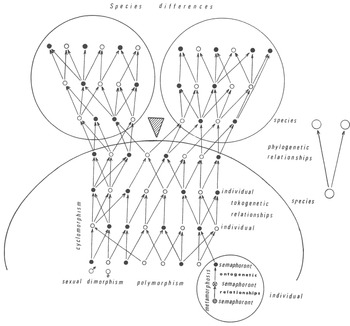
The former may be used to represent the latter, although it need not necessarily endorse a commitment to multilevel lineages. Multidimensional trees are not new. Hennig uses them to introduce phylogenetic concepts and theory and to represent the internal structure of lineages, including organismal and developmental lineages (see fig. 1). This suggests that a levels of lineage perspective has persisted from the root of phylogenetics.
Multidimensional trees have been used from the foundation of phylogenetics. Hennig used them to introduce phylogenetic theory and concepts (Reference Hennig1966, fig. 6, from Phylogenetic Systematics. Copyright 1979 by the Board of Trustees of the University of Illinois. Used with permission of the authors and the University of Illinois Press).

3. Multidimensional Trees
Phylogeneticists typically suppress the internal structure of phylogenies in order to clearly focus on a single level (e.g., species or population lineages). Idealization of this sort is hardly unique in the sciences and, arguably, may be central to its success (Cartwright Reference Cartwright1983; Giere Reference Giere1997; Teller Reference Teller2001). Reconstructing multilevel lineages with multidimensional trees reveals some of this internal structure and introduces additional methodological hurdles in phylogeny reconstruction. One reason for this is genealogical discordance. Discordance has several causes, including lineage sorting (or deep coalescent events), gene duplication and extinction, horizontal (or lateral) gene transfer (HGT/LGT), hybridization, and recombination (Degnan and Rosenberg Reference de Queiroz, Howard and Berlocher2009). Each carries its own unique epistemic challenges (Maddison Reference Maddison1997), although here I consider how genealogical discordance more generally complicates phylogenetic inference.
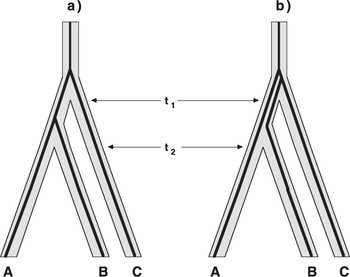
Phylogeneticists take genealogical discordance seriously, and advances in technology (theory, etc.) are permitting a deeper look at the internal structure of phylogenies. This is plainly seen as coalescent theory is applied to populations and used to infer phylogeny. Briefly, multispecies coalescent techniques permit the reconstruction of species- (or population-) level phylogeny through analysis of the internal structure of populations (Kingman Reference Kingman1982; Hudson Reference Hudson1983; Tajima Reference Tajima1983). This introduces additional complications for phylogenetic inference. If the shape of the containing tree is short (in number of generations) and wide (in effective population size), then lineage sorting (or deep coalescence) will produce genealogical discordance among gene, organismal, population, and species phylogenies (Pamilo and Nei Reference Pamilo and Nei1988). Avise and Robinson (Reference Avise and Robinson2008, 503) call instances of this hemiplasies, a concept they introduce to capture how “idiosyncratic lineage sorting can lead to fundamental discordances between gene trees and organismal (species) trees” (see fig. 2). Although homologous, hemiplasies appear as homoplasies and may confound phylogenetic inference.
Avise and Robinson (Reference Avise and Robinson2008, fig. 1, by permission of Oxford University Press) introduced the term hemiplasy to capture instances of discordance due to lineage sorting (or deep coalescence): a, the gene and species trees are concordant, and homology is apparent; b, a deep coalescent event presents homologous genes as homoplasies. This is a hemiplasy.

Accounting for genealogical discordance in phylogeny reconstruction effectively adds more parameters along which parsimony (or likelihood or probability) may be disputed. For example, were we simply considering hemiplasies (or HGT, etc.), by what metric should we evaluate what counts as a more parsimonious explanation of genealogical discordance? Should we simply count the number of hemiplasies, selecting the tree requiring the fewest, or should we select the tree requiring the simplest model of evolution that explains the presence of those events? Either case demands a trade-off. In the former, fewer hemiplasies may entail more complex models, whereas in the latter a simpler model may entail more hemiplasies. This is not different in kind from arguments over simple application of parsimony to homology and homoplasy (Felsenstein Reference Felsenstein2004), although accounting for discordance increases the number of parameters along which this argument occurs. Maddison (Reference Maddison1997) offers considerations along these lines, speculating what parsimony and maximum likelihood approaches to inferring species trees from gene trees in the presence of discordance might look like.Footnote 1
Unfortunately, recent studies suggest that accounting for discordance is unlikely to be a simple addition of parameters. Degnan and Rosenberg (Reference Degnan and Rosenberg2006, Reference de Queiroz, Howard and Berlocher2009) demonstrate that under certain conditions, hemiplasies may outnumber homologies and confound phylogenetic methods such as the multispecies coalescent. That is, when the most common gene tree is discordant with the species tree, a simple parsimony weighting of hemiplasies will systematically select the wrong species tree with ever increasing support as data accumulate (they describe such cases as wicked forests). Whether these positively misleading errors are likely to manifest with other causes of genealogical discordance is currently not known, although in each case the biological facts are likely to be complicated and demand similar accommodation and analysis in our phylogenetic theories, concepts, and methods.Footnote 2
Whether these various sources of discordance should be considered independently or whether a mixed strategy that simultaneously considers all sources is preferable is both a theoretical and a methodological problem. This is akin to asking whether sources of discordance should be treated as independent parameters or as a more dynamic interdependent bunch. Although not different in kind from the sorts of epistemological debates phylogeneticists wrestle with in single-level phylogenetic inference, discordance escalates the problem exponentially. For example, developing methods for these competing strategies requires development of models of evaluation, which, in turn, draw on phylogenetic theory and concepts (which may themselves require refinement in light of discordance). Again, the interplay of method, theory, and concept is on display.
To summarize, the theories, concepts, and methods that are part of the levels of lineage perspective together frame and identify research problems. These are sensitive to empirical facts and feed back into one another as data are accommodated, discovered, or explained. Conceptually, the internal structure of trees was exploited to establish phylogenetic theory and develop phylogenetic methods (e.g., Hennig Reference Hennig1966). The possibility of genealogical discordance is entailed by numerous biological theories that are more or less well integrated with phylogenetics (e.g., HGT by microbial biology, lineage sorting by coalescent theory).Footnote 3 As the extent of the presence of kinds of genealogical discordance became better known, methods and theories were refined to account for these facts, and more subtle phylogenetic concepts were proposed to capture the theoretically significant patterns and objects previously categorized too bluntly. Together, this provides a snapshot of the interplay of theory, concept, and methods in science.
4. Multilevel Lineages
What is being represented by multidimensional trees? What is a multilevel lineage? A level of the biological hierarchy is constituted by lineage-generating entities, which themselves are constituted by and constitutive of other lineage-generating entities. A lineage, then, will both contain other lineages and be a part of a broader lineage. This is an iterative definition, bottoming out and topping off at minimal and maximal lineages, respectively. The latter will be something like a maximal clade (or segment thereof); the former is generated by minimal lineage-generating biological entities, although what those might be is unsettled.Footnote 4 Candidates include self-replicating RNA (Cech Reference Cech1986) and chemotons (Gánti Reference Gánti, Griesemer and Szathmáry2003). Given the diachronic approach implicit in the levels of lineage perspective, it is no accident that these coincide with entities hypothesized in origin-of-life research (e.g., Dupré and O'Malley Reference Dupré and O’Malley2009)Footnote 5 Furthermore, these lineages are embedded one in another in complicated patterns that may function as either explanans or explanandum of other biological patterns and processes.
A lot may be said of multilevel lineages. Here the focus will be on specifying multilevel lineages as complex objects in terms of multiple decomposability. This carries implications for species, lineage, and phylogeny concepts and permits a constrained pluralism. The upshot is recognizing that biological gradients apply over levels of the hierarchy, in addition to the more familiar gradients that extend over time and space.
4.1. Multiple Decomposability
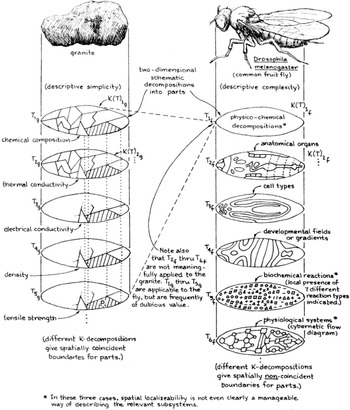
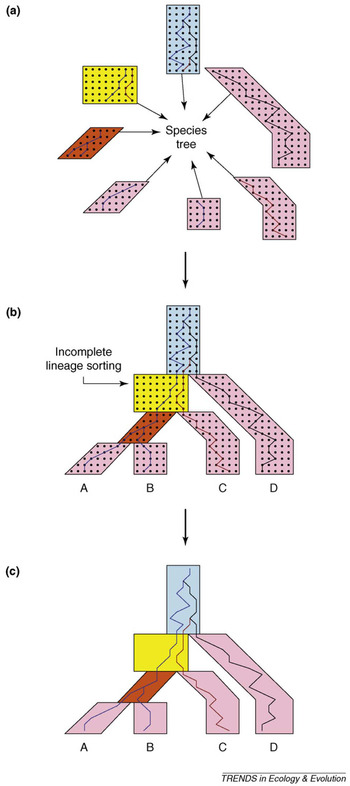
Wimsatt (Reference Wimsatt, Schaffner and Cohen1972) introduced the notion of multiple decomposability (fig. 3). In the levels of lineage perspective, lineages are recognized as genealogically discordant multilevel objects. These are in part constituted by other lineages and themselves constitutive of lineage-generating entities. These lineages occupy the various levels of the biological hierarchy and are discordant in ways that bear tracking.Footnote 6 Furthermore, at least some levels of the biological hierarchy overlap in complex ways, with different decompositions tracking those various patterns; that is, lineages are multiply decomposable, and phylogeneticists exploit this fact (compare figs. 3 and 4).
Wimsatt's (Reference Wimsatt, Schaffner and Cohen1972, fig. 1, with kind permission from Springer+Business Media B.V.) depiction of complexity and multiple decomposability.

Degnan and Rosenberg's (Reference de Queiroz, Howard and Berlocher2009, fig. 1, reprinted with permission from Elsevier) depiction of the multispecies coalescent. This displays various decompositions of the species tree and the discordances that arise.

It should hardly be surprising that lineages are multiply decomposable. Wimsatt uses organisms as paradigmatic examples of complex objects (i.e., those that are multiply decomposable). Organisms are complex, in part, due to the fact that they are composed of many kinds of lineage-generating parts.Footnote 7
Furthermore, organisms themselves generate lineages, at the level of populations, demes, and species. Given both the complexity of ways in which organisms and their parts move and interact through these various lineages and that organisms themselves are multiply decomposable, we should expect that higher-level lineages would retain this feature of decomposability.
That multilevel lineages are multiply decomposable carries ontological implications. First, it offers a means of cashing out pluralism about species, especially if species are conceived of as segments of lineages of organisms (or populations or breeding groups, etc.). The various decompositions may produce multiple (inconsistent) patterns of ancestry. This observation may provide a way to break through the entrenched logjam that is the so-called species problem (or, to give due credit, buttress the ontological aspect of Ereshefsky's [Reference Ereshefsky1992] eliminative pluralism). Debates over species concepts, at times, turn on patterns that persist in lower-level entities. Presuming a single decomposition, or that one decomposition offers a privileged perspective, generates unwarranted conflict and may wrongly entail a monist position on species (or, for that matter, lineages). This need not be the case. Biologists might recognize multiple decompositions, and appropriately regard them as equally (or variously) informative yet still wish to assign to one (or more) of those decompositions the rank of species. This, though, is a matter of ranking versus grouping, that is, a matter of which groups ought to be designated with the rank “species.” That is a slightly different dispute, and one many are eager to move past (e.g., Mishler Reference Mishler and Wilson1999).
4.2. Extending Gradients
If species are lineages (regardless of sort), and lineages are multiply decomposable, then there will be no simple object to identify as a species. Even diachronic approaches (e.g., de Queiroz Reference Degnan and Rosenberg1998; Harrison Reference Harrison, Howard and Berlocher1998) will be too static. The gradient along which species extend on these views is over time and space; that gradient must be extended over the levels of hierarchy as well.Footnote 8
Ultimately, this is reminiscent of Sober's (Reference Sober1980) treatment of populations but applied to phylogenetics. Just as Sober rejects the natural state model in favor of variance as central to our concept of a population, and Wimsatt rejects a privileged decomposition, so too should we reject an absolute phylogeny. Maddison recognizes the ontological implications of adopting a levels of lineage perspective:
When we take a sample from a population and try to understand a statistical distribution by calculating means and variances, we do not single out all of the samples whose values differ from the mean as disagreeing with the mean. They are simply part of the variance, part of the distribution. A simple phylogenetic tree diagram with sticklike branches represents only the mean or mode of a distribution. Phylogeny has a variance as well, represented by the diversity of trees of different genes. This variance does not represent uncertainty due to ignorance or measurement error; it is an intrinsic part of phylogeny's nature. (Reference Maddison1997, 533)
It is certainly tempting to stipulate one level as the Archimedean point around which the rest of phylogeny flows. But this is a mistake, if we accept Wimsatt's lesson about multiple decomposability and the lack of privileged perspective. This is the phylogenetic analogue to Sober's contrast of population thinking to the natural state model view. Just as we abandoned Newton's notion of absolute space for relativity, the lesson to draw here is that there is no absolute phylogeny, no privileged perspective from which all others derive. We can just as well hold organismal as interbreeding population lineages constant, and, indeed, this is just what population geneticists do (e.g., Avise and Wollenberg Reference Avise and Wollenberg1997; Coyne and Orr Reference Coyne and Orr2004). That conflicts with other evolutionary histories (of organisms or genomes, etc.) may arise is not an indicator of incoherence but of facts in need of explanation (contra Velasco Reference Velasco2008). This is part and parcel of the complexity of biology, and hardly unique to phylogenetics. Indeed, insofar as there are laws in biology, their utility is often most perspicacious when they fail to hold true (e.g., Mendel's laws of inheritance or the Hardy-Weinberg equilibrium). Why should phylogenetics be different? That the edges and boundaries of biological objects grade into each other over space and time is well appreciated. The lesson here is that biological gradients also span levels of hierarchical organization. The added dimensions of how we ought to conceive of biological objects are, admittedly, difficult to grasp. Yet recognizing this challenge is the first step, and the levels of lineage perspective, along with multidimensional trees and a rich multilevel lineage concept, provides the resources to account for this complexity.
5. Conclusion
Recall that the initial framing concerned the interplay of method, concept, and theory in science. I considered how this plays out in systematics when phylogeneticists aim to reconstruct phylogeny, not at a single level but simultaneously at multiple levels of the hierarchy. Methods of phylogeny reconstruction require both a theoretical and a conceptual basis. Incorporating coalescent theory into phylogeny reconstruction is attractive for various reasons; for example, it permits a point of contact between phylogenetics and population genetics. Using the multispecies coalescent to reconstruct phylogenies, though, draws bare the underlying genealogical discordance exhibited between gene trees and species or population trees and demands refining existing methods or developing new techniques. Furthermore, under some circumstances the discordance is so great as to generate a positively misleading error, that is, wicked forest anomaly zones. This reinforces the need to account for genealogical discordance in our lineage, species, and phylogeny concepts in order to offer plausible biological interpretations of these findings. This reconceptualization, in turn, demands further refinement of phylogeny reconstruction in order to appropriately capture the complexity of multilevel lineages in multidimensional trees.