Introduction
Weed management in large-scale conventional potato production heavily relies on mechanical control of young weed seedlings that occurs when the potato plants are hilled near the emergence timing, followed by residual herbicide application. Weeds that escape those tactics are sometimes treated with herbicides after weed and crop emergence and before potato canopy closure, but management options are minimal after canopy closure (Johnson and Colquhoun Reference Johnson and Colquhoun2019). The herbicides available for such use are limited, particularly those targeting broadleaf weeds. Additionally, weed resistance to some long-standing potato herbicides has become rather widespread, as is the case with metribuzin (Heap Reference Heap2021). Finally, some herbicides labeled for potato are limited in use on coarse-textured, low organic matter soils to reduce groundwater contamination risk (Colquhoun et al. Reference Colquhoun, Chapman, Gevens, Groves, Heider, Jensen, Nice, Ruark and Wang2020).
The potential use of protoporphyrinogen oxidase (PPO)-inhibiting herbicides was the subject of much potato weed management research in the late 1990s (Grichar et al. Reference Grichar, Beslar and Brewer2003; Hutchinson et al. Reference Hutchinson, Boydston, Ransom, Tonks and Beutler2005a, 2005b; Valenti and Auwarter Reference Valenti and Auwarter2011; Wilson et al. Reference Wilson, Nissen and Thompson2002). However, the vast majority of the published research was conducted in the West and Pacific Northwest in the United States, where precipitation during the growing season is far less than in the upper midwestern United States, and therefore soil moisture is managed primarily with supplemental irrigation. Similar research in the upper Midwest potato production regions at the presently labeled herbicide rates indicated a high potato crop injury risk in the form of delayed emergence and foliar distortion when the herbicide application occurred during cool weather or was followed by unpredictable high-precipitation events (Heider and Colquhoun Reference Heider and Colquhoun2010). Similarly, in a study conducted in Texas, significant potato crop injury resulted in yield reductions at one of three study sites when sulfentrazone was applied at 110 to 280 g ha−1, and the authors attributed the potato herbicide response to an irrigation event 2 d after herbicide application (Grichar et al. Reference Grichar, Beslar and Brewer2003).
With such experiences in mind, the PPO-inhibiting herbicides sulfentrazone, flumioxazin, and fomesafen include potato on some commercial product labels, but with qualifiers and restrictions related to crop injury risk on coarse-textured, low organic matter soils in particular and where variable and high-precipitation events are commonplace. For example, sulfentrazone use is not currently allowed in potato grown in soils with less than 1% organic matter, and some flumioxazin product labels allow use on potato in some U.S. states but not in production regions where high-precipitation events and cool soils around the application timing are common.
Given the lack of potato weed management options and crop injury risk from PPO-inhibiting herbicides, our objectives were to determine rates of fomesafen, flumioxazin, and sulfentrazone that control weeds safely in potato grown on coarse-textured soils in Wisconsin. The ability to maintain weed control levels while reducing rate is important to avoid increasing the risk of allowing escaped weeds to reproduce, a key step in unintentionally selecting for herbicide-resistant weeds.
Materials and Methods
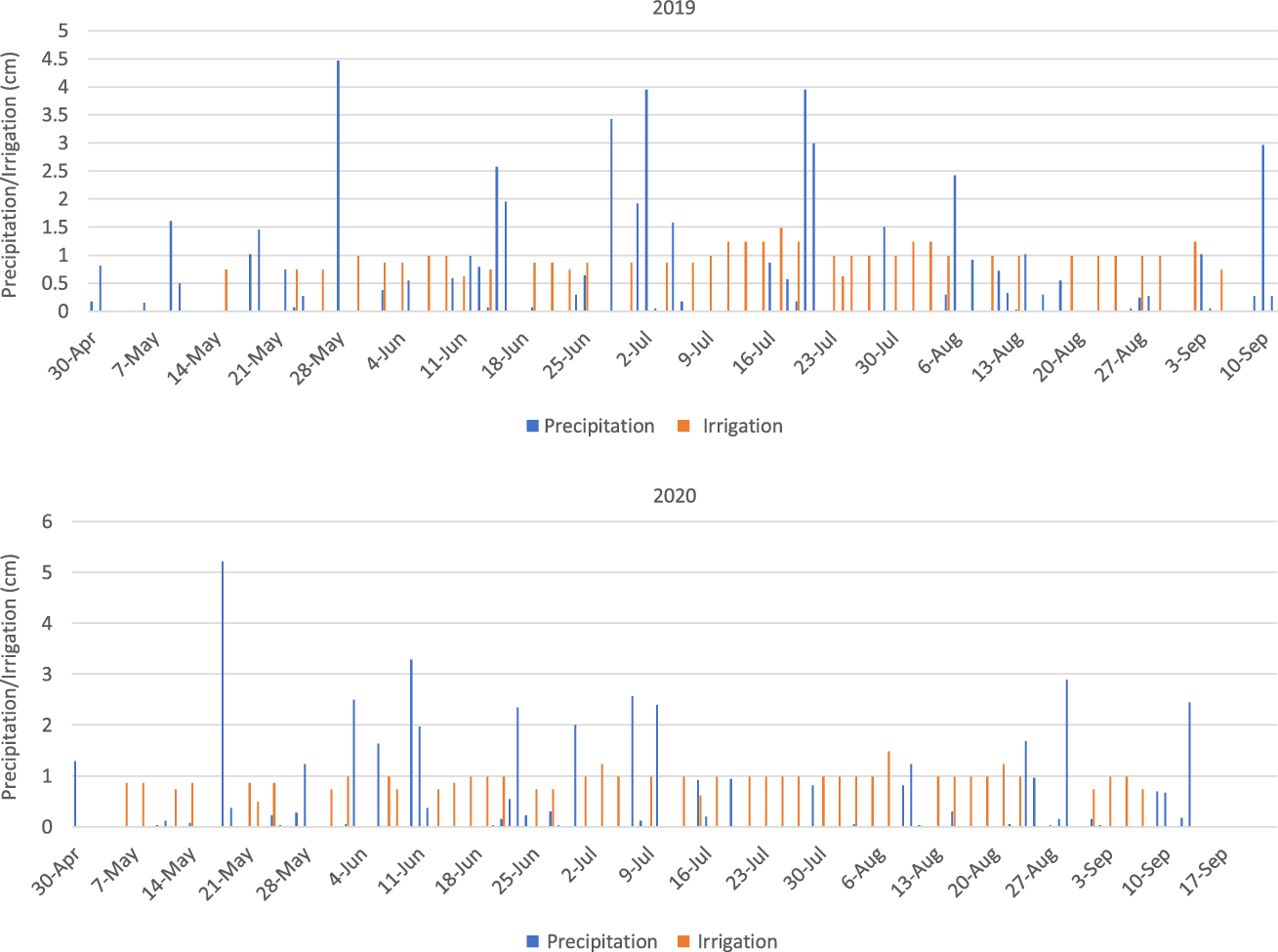
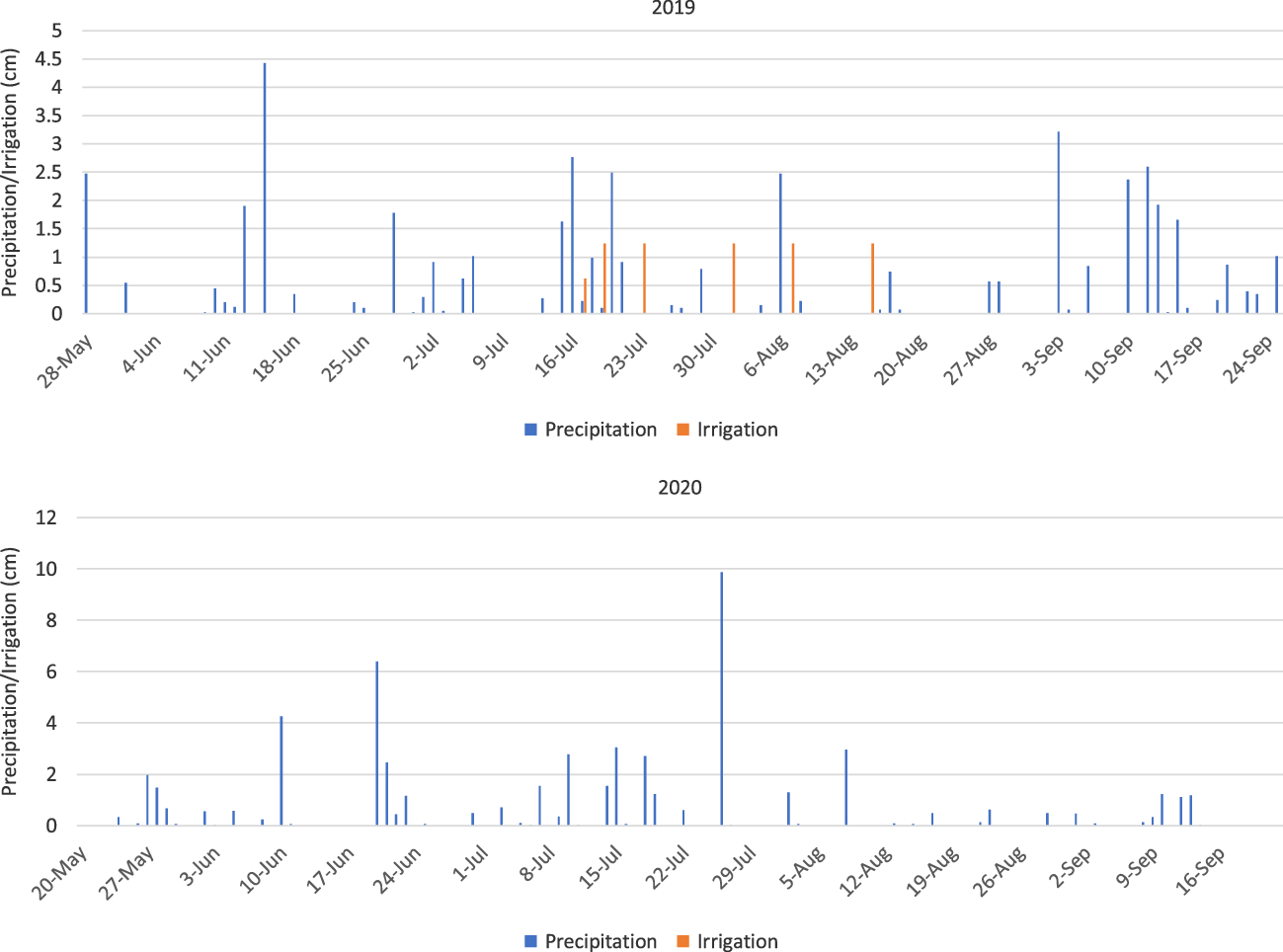
Studies were conducted in the 2019 and 2020 growing seasons at the University of Wisconsin Hancock Agricultural Research Station in Hancock, WI (44.1196°N, 89.5355°W) and the Langlade County Agricultural Research Station in Antigo, WI (45.1596°N, 89.1116°W). The soil texture at Hancock was a Plainfield loamy sand (sandy, mixed, mesic Typic Udipsamments) with 1% organic matter and pH 6.5. The soil texture at the Antigo site was an Antigo silt loam (coarse-loamy over sandy or sandy-skeletal, mixed, superactive, frigid Haplic Glossudalfs) with 3% organic matter and pH 5.2. Soil moisture was monitored, and supplemental irrigation was delivered to replace evapotranspiration water loss through a pivot system at the Hancock location and via a traveling irrigation gun at Antigo. Precipitation and irrigation data were collected at the study sites (Figures 1 and 2).
Precipitation and irrigation at the study location in Hancock, WI, in 2019 and 2020.

Precipitation and irrigation at the study location in Antigo, WI, in 2019 and 2020.

The studies were arranged in a randomized complete block design with four replications of each treatment at the Hancock site and three replications at the Antigo site. Individual plots measured 3.7 by 6.1 m with four potato rows spaced 0.9 m apart at Hancock and 1.8 by 6.1 m with two potato rows spaced 0.9 m apart at Antigo. ‘Russet Burbank’ and ‘Pike’ potato varieties were grown at the Hancock and Antigo locations, respectively, in both study years. B-sized whole potato tubers were used as seed and warmed to ambient temperature 3 d before planting, as is the local standard. Studies were planted on April 30 in both years at Hancock and May 25, 2019, and May 20, 2020, at Antigo.
Herbicides were applied with a tractor-mounted air-pressure sprayer at Hancock and a backpack CO2-pressure sprayer at Antigo, both calibrated to deliver 187 L ha−1 at 186 kPa with TeeJet® XR8003VS nozzle tips (Spraying Systems, Wheaton, IL). Three PPO-inhibiting herbicides were evaluated at three rates, each based on those reported in the literature noted earlier: fomesafen (140, 280, and 420 g ai ha−1; Reflex®, Syngenta Crop Protection, Greensboro, NC), flumioxazin (18, 36, and 54 g ai ha−1; Chateau SW®, Valent USA, Walnut, CA), and sulfentrazone (35, 70, and 105 g ai ha−1; Spartan 4F®, FMC Corporation, Philadelphia, PA). Fomesafen was not included in the studies at the Hancock location, as it falls within a regionally prohibited zone described on the herbicide label and based on groundwater contamination risk (Anonymous 2021). These PPO-inhibiting herbicides were compared with the current regional industry standard metribuzin (420 g ai ha−1; Metribuzin 75DF®, Makhteshim Agan of North America, Raleigh, NC). All treatments were mixed with S-metolachlor (1.1 kg ai ha−1; Dual Magnum®, Syngenta Crop Protection) and applied immediately after potato hilling with a custom built two-row hiller when potato plants were covered by 10 cm of soil in the hill. Herbicides were applied on May 20, 2019, and May 22, 2020, at Hancock and June 7, 2019, and June 4, 2020, at Antigo. All other production practices, including irrigation and fertilizer and maintenance insecticide and fungicide applications, followed typical commercial practices (Colquhoun et al. Reference Colquhoun, Chapman, Gevens, Groves, Heider, Jensen, Nice, Ruark and Wang2020).
Potato injury and weed control by species were visually estimated on a scale of 0% (no injury) to 100% (plant death). Potato tubers were machine harvested approximately 2 wk after desiccation and machine-graded by mass at Hancock and market size at Antigo and then weighed (on September 11, 2019, and September 24, 2020, at Hancock and September 27, 2019, and September 22, 2020, at Antigo). Additionally, nonmarketable cull potatoes (misshapen, green, and/or diseased) were hand separated and weighed at both locations. With the exception of cull potatoes, all other tuber grade categories are considered marketable among various outlets ranging from seed potatoes for B-size tubers to fresh market pack and processed fries for large tubers. The studies were analyzed independently by year and location. Treatment data were subjected to ANOVA using the PROC GLM procedure in SAS (v. 9.4, SAS Institute, Cary, NC). Data complied with ANOVA requirements related to homogeneity of variety and residual normality. Means were separated using Fisher’s LSD at P = 0.05.
Results and Discussion
Precipitation and Irrigation
At the Hancock, WI, study location on coarse-textured loamy sand soils, six precipitation events occurred in 2019 that exceeded 2.5 cm (Figure 1). In 2019, herbicide treatments were applied to soils noted as dry at the surface and moist at the 5- and 10-cm depths (data not shown), and the next substantive rainfall exceeding 2.5 cm was 8 d after treatment (DAT). In 2020, four precipitation events occurred that exceeded 2.5 cm, but notably, 5.2 cm of precipitation was recorded on May 18, just 4 d before the herbicide treatment application to soils noted as moist from the surface to the 10-cm depth. The next rainfall to exceed 2.5 cm was at 19 DAT.
At the Antigo, WI, location on silt loam soil, five precipitation events exceeding 2.5 cm occurred in both 2019 and 2020 (Figure 2). However, total precipitation was 56.5 cm in 2020 compared with 46.4 cm in 2019 and was wet enough in 2020 that supplemental irrigation was not needed throughout the season. The first precipitation event after herbicide treatment that exceeded 2.5 cm was at 8 and 6 DAT in 2019 and 2020, respectively, and no 2.5-cm or greater precipitation events occurred between planting and herbicide treatment in either year.
Potato Tolerance to PPO-inhibiting Herbicides
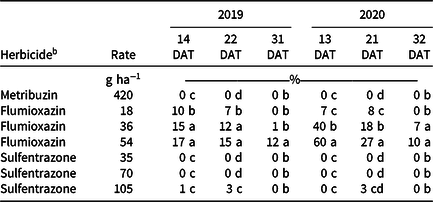
At the Hancock location, potato injury increased with flumioxazin rate and was particularly severe in 2020, where the initial injury at 13 DAT was 40% and 60% at the middle and highest rate, respectively (Table 1). In 2019, injury at all flumioxazin rates persisted through 22 DAT. By 31 DAT, injury greater than the S-metolachlor plus metribuzin treatment was only observed when flumioxazin was applied at the highest rate. In 2020, injury was still greater than the standard for both the middle and highest flumioxazin rate when evaluated at 32 DAT. Potato injury from sulfentrazone was minimal across rates and did not exceed 3% at any evaluation timing in either year.
Visual estimation of potato injury in 2019 and 2020 studies conducted at the Hancock Agricultural Research Station in Hancock, WI.a

a Means followed by the same letter do not significantly differ (P = 0.05, LSD). No significant differences were observed for parameters that do not include letters. DAT, days after treatment.
b All treatments were mixed with S-metolachlor (1.1 kg ai ha−m) and applied immediately after potato hilling and before emergence. Potato injury was estimated on a scale of 0% (no injury) to 100% (crop death).
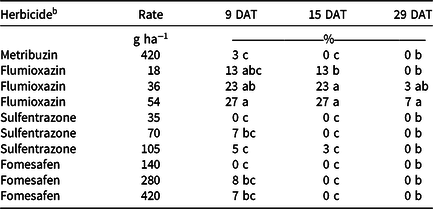
While no injury attributable to herbicides was noted in 2019 at the Antigo, WI, location on a silt loam soil (data not shown), the injury rate response and persistence after flumioxazin application in 2020 was similar to that noted in Hancock in the same year (Table 2). Injury from sulfentrazone application at the middle and highest rate was 7% and 5%, respectively, when evaluated at 9 DAT, but comparable to where metribuzin was applied by 15 DAT. Similarly, injury from fomesafen at the middle and highest rate was less than 10% when evaluated at 9 DAT but nonexistent at subsequent evaluation timings.
Visual estimation of potato injury in studies conducted in 2020 at the Langlade County Agricultural Research Station in Antigo, WI.a

a Means followed by the same letter do not significantly differ (P = 0.05, LSD). No significant differences were observed for parameters that do not include letters. DAT, days after treatment.
b All treatments were mixed with S-metolachlor (1.1 kg ai ha−m) and applied immediately after potato hilling and before emergence. Potato injury was estimated on a scale of 0% (no injury) to 100% (crop death).
Weed Management
From a weed control perspective, all herbicide programs were outstanding and provided complete control at the Antigo location in both years and at the Hancock location in 2020 (data not shown). In Antigo in 2019, common lambsquarters (Chenopodium album L.) control was greater than 90% and similar among all treatments, and in 2020, complete control was noted in all herbicide treatments. In Hancock in 2020, common lambsquarters, common ragweed (Ambrosia artemisiifolia L.), hairy nightshade [Solanum villosum (L.) Mill.], and redroot pigweed (Amaranthus retroflexus L.) were all completely controlled by all herbicide treatments. A few differences in weed control among treatments were noted in Hancock in 2019 (Table 3). In general, both flumioxazin and sulfentrazone (both with S-metolachlor) provided better control of common lambsquarters and hairy nightshade than metribuzin plus S-metolachlor. Flumioxazin at the high rate (with S-metolachlor) controlled common ragweed better than metribuzin plus S-metolachlor, and flumioxazin at any rate controlled common ragweed better than sulfentrazone at all rates.
Visual estimations of weed control at 31 d after treatment in studies conducted in 2019 at the Hancock Agricultural Research Station in Hancock, WI.a

a Means followed by the same letter do not significantly differ (P = 0.05, LSD). No significant differences were observed for parameters that do not include letters. Spotted smartweed, Polygonum persicaria L.
b All treatments were mixed with S-metolachlor (1.1 kg ai ha−1) and applied immediately after potato hilling and before emergence. Weed control by species was estimated on a scale of 0% (no injury) to 100% (plant death).
Potato Tuber Yield
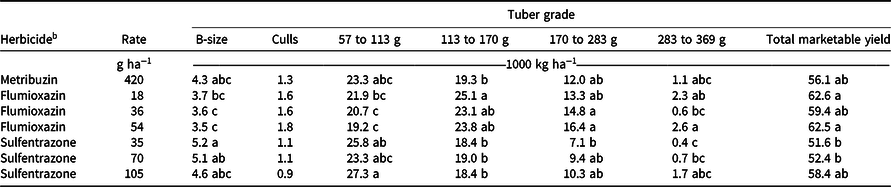
In 2019 at the Hancock location no differences in tuber yield between the metribuzin standard and where sulfentrazone or flumioxazin were applied were observed for B-size, cull, or any tuber weight category, with the exception of the 113- to 170-g tuber category (Table 4). In that case, yield was greater where flumioxazin was applied at the lowest rate compared with where metribuzin was applied. Similarly, tuber yield across the grade categories was similar among rates for both flumioxazin and sulfentrazone. However, several differences were noted between flumioxazin and sulfentrazone. B-size tubers were greater where sulfentrazone was applied at the lower two rates than where flumioxazin was applied at the highest two rates, possibly related to differences in common ragweed control with these treatments. Marketable tuber yield was greater where flumioxazin was applied at the lowest and highest rate than where sulfentrazone was applied at the two lowest rates.
Potato tuber yield in studies conducted in 2019 at the Hancock Agricultural Research Station in Hancock, WI.a

a Means followed by the same letter do not significantly differ (P = 0.05, LSD). No significant differences were observed for parameters that do not include letters.
b All treatments were mixed with S-metolachlor (1.1 kg ai ha−m) and applied immediately after potato hilling and before emergence.
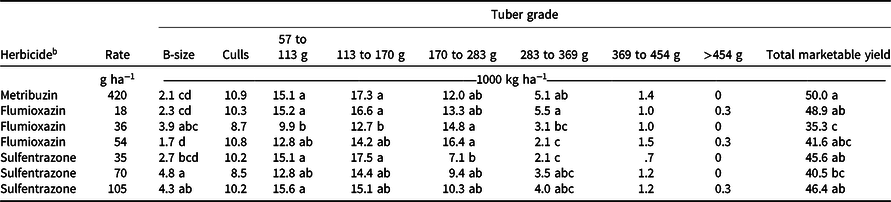
In contrast in 2020 at the Hancock location, a few differences in tuber yield were noted between the metribuzin standard and where PPO-inhibiting herbicides were applied (Table 5). B-size tuber yield was greater when sulfentrazone was applied at the middle and highest rate compared with where metribuzin was applied. Tuber yield for both the 57- to 113-g and 113- to 170-g categories was lower where flumioxazin was applied at the middle rate compared with the metribuzin standard, and thus marketable yield was the lowest in this study year. In general, there was quite a bit of variability across tuber yield categories in this study year, as is quite typical in potato.
Potato tuber yield in studies conducted in 2020 at the Hancock Agricultural Research Station in Hancock, WI.a

a Means followed by the same letter do not significantly differ (P = 0.05, LSD). No significant differences were observed for parameters that do not include letters.
b All treatments were mixed with S-metolachlor (1.1 kg ai ha−m) and applied immediately after potato hilling and before emergence.
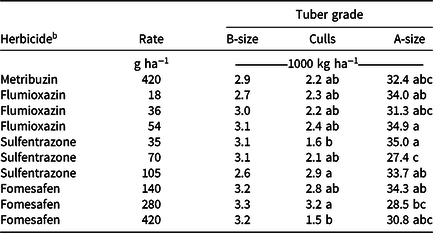
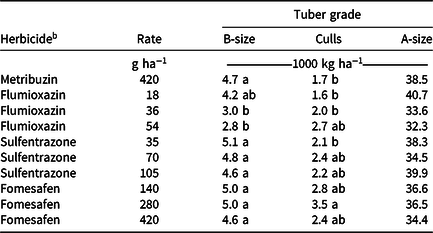
In 2019 at the Antigo location, no differences between PPO-inhibiting herbicide treatments and the metribuzin standard were observed (Table 6). Marketable tuber yield (A-size) was greater where flumioxazin was applied at the highest rate and sulfentrazone at the lowest rate compared with where sulfentrazone was applied at the middle rate. In 2020 at the Antigo location, fewer B-size tubers produced where flumioxazin was applied, with the exception of the lowest rate of flumioxazin (Table 7). No differences were observed among treatments in total marketable (A-size) tuber yields.
Potato tuber yield in studies conducted in 2019 at the Langlade County Agricultural Research Station in Antigo, WI.a

a Means followed by the same letter do not significantly differ (P = 0.05, LSD). No significant differences were observed for parameters that do not include letters.
b All treatments were mixed with S-metolachlor (1.1 kg ai ha−m) and applied immediately after potato hilling and before emergence.
Potato tuber yield in studies conducted in 2020 at the Langlade County Agricultural Research Station in Antigo, WI.a

a Means followed by the same letter do not significantly differ (P = 0.05, LSD). No significant differences were observed for parameters that do not include letters.
b All treatments were mixed with S-metolachlor (1.1 kg ai ha−1) and applied immediately after potato hilling and before emergence.
Results suggest three primary new areas of knowledge gained in this work. Soil texture plays a major role, greater than anticipated by the authors, in risk of PPO-inhibiting herbicide injury in potato as it relates to high-precipitation events. For example, in 2020 at the Antigo silt loam location, there were five precipitation events across the season that exceeded 2.5 cm, including one at 6 DAT, and a seasonal total precipitation that was more than 10 cm greater than the previous year. Despite this excessive moisture and initial potato injury with some herbicide treatments, by 29 DAT, injury was less than 10%, and total marketable tuber yield at harvest was similar among treatments. In contrast, in 2020 at the Hancock loamy sand location, there were four precipitation events across the season that exceeded 2.5 cm, and potato injury was as much as 60%.
It is hypothesized that the high amount of injury from flumioxazin in 2020 was largely caused by precipitation before herbicide application and not after. In 2020, there was a 5.2-cm precipitation event recorded 4 d before herbicide treatment but then not another exceeding 2.5 cm until 19 DAT. Given that the potato plants were covered by about 10 cm of soil at hilling and the herbicide was applied immediately after that, it is not likely that inadequate soil coverage accounted for this injury. Practically, this knowledge could be used to reduce rates when herbicide treatments closely follow high-precipitation events, especially on higher water-holding soils, in addition to monitoring forecasts for the time period at or soon after the anticipated application timing, as is instructed on some current herbicide labels. This hypothesis should be tested in additional research sites and years that would allow for broader data across climatic and soil texture variables.
Finally, this work documents the fine line between yield reduction presumably caused by reduced weed control and yield reduction assumed to be related to herbicide injury. This delineation between adequate weed control and consistent crop safety may differ by soil texture and environmental conditions, supporting the notion that custom-tailored weed management may become more necessary as high-precipitation events become more common in upper midwestern U.S. agricultural systems.
Acknowledgments
The authors express appreciation to the Wisconsin Potato Industry Board for their support of this work. No conflicts of interest are declared.