

Introduction
Contemporary global economic governance is characterised by broad institutional diversity. States regulate some markets through international regimes organised around traditional international organisations. Other areas have seen the rise of networked-based cooperation among domestic regulatory agencies. In others still, we find private sector-led industry self-regulation. The observable ‘varieties of cooperation’ in global markets are a puzzle for which we have so far no satisfying explanation. Most existing literature has focused on one governance cluster at a time. Conventional international organisations, institutions, and regimes remain the central focus of most work in International Political Economy (IPE).Footnote 1 In parallel, international legal scholars have revived interest in transgovernmental networks among domestic regulators, a form of cooperation characterised above-all by its technocratic character.Footnote 2 Separately, a vibrant literature has developed around private sector international governance via self-regulation, industry standard setting, and codes-of-conduct.Footnote 3 While research in all three areas has greatly contributed to our understanding of global governance, the critical questions of why, when, and where we are most likely to see one type of governance rather than another remain largely unanswered.
This study argues that broad observable patterns of global governance are produced by the interaction of specific configurations of domestic regulatory institutions with the forces of market globalisation. A micro-institutional revolution has swept the political economies of the advanced countries. The ‘positive state’ of the post-war era is giving way to what observers call the ‘regulatory state.’Footnote 4 Governments are replacing command-and-control regulation, frequent intervention, and outright ownership of key industries with arms-length steering of market competition through regulatory agencies, expert commissions, and self-regulatory schemes run by industry.Footnote 5 What we are seeing internationally are the ramifications of these domestic trends. The more governments in leading markets delegate sweeping regulatory authority to independent agencies or private bodies, and the more industries regulated by such actors experience market globalisation, the more we should expect new forms of global governance such as regulatory networks and private regimes to flourish. Conversely, in areas where economic management remains supervised largely by elected officials, conventional international cooperation featuring interstate bargaining prevails.
This study makes two important contributions. First, by highlighting under which conditions we are most likely to see a particular type of governance, it bridges and reconciles three existing, largely independent research streams. Much existing work on global governance types has been inward-focused and has tended toward linear projections. Scholars of transgovernmental cooperation expect regulatory networks to become the preferred tool for global governance, spreading to many areas requiring international coordination.Footnote 6 In parallel, students of private governance are convinced dwindling state power will inevitably drive the rise of private authority in international relations – what one observer calls the ‘privatization of global governance’.Footnote 7 In contrast, the consensus among mainstream IPE scholars, whether in the realist, liberal, or constructivist tradition, is that existing international organisations and institutions are not only resilient, but that states continue to rely on them to address new challenges posed by globalisation.Footnote 8 At face-value, the three perspectives are incompatible.Footnote 9 Yet taking the analysis to the domestic level reconciles these views, as domestic institutional analysis can explain growing global institutional diversity and why such diversity will persist.
The article's second contribution is a thorough integration of domestic institutional analysis into the study of global economic governance. The analysis of domestic regulatory institutions has been neglected in the literature on globalisation and governance.Footnote 10 In an influential review, Frieden and Martin note that the ‘most challenging questions in IPE have to do with the interaction of domestic and international factors as they affect economic policies and outcomes.’ Yet ‘endogenizing two such complicated levels is extremely complex, and progress has been made in small steps at best.’Footnote 11 Economic globalisation is frequently defined as the cross-border integration of formerly distinct domestic markets.Footnote 12 If domestic markets collectively comprise the new global economic playing field, it seems reasonable to ask whether, and if so how, actors and institutions charged with domestic market regulation shape evolving global governance.Footnote 13 The study of observable ‘varieties of cooperation’ is thus an ideal setting to drive research at the intersection of domestic and international politics forward.
The article proceeds as follows. Building on seminal work by Keohane and Nye, the first section develops a typology of four distinct clusters of global economic governance: interstate-, transgovernmental-, and transnational forms of regulatory cooperation, and market governance.Footnote 14 The next section identifies some limitations of existing work and offers domestic institutional analysis as a corrective. Subsequently, I outline a domestic institutional model of global economic governance. Based on a simple matrix of domestic market regulation ideal-types, I hypothesise causal pathways that link institutions in leading domestic markets to corresponding forms of global governance. The hypothesised mechanisms are subsequently evaluated through a structured, focused case comparison of regulatory cooperation in securities, Internet domain names, and intellectual property, as well as prevailing market governance over hedge funds. The final section concludes and outlines areas for future research.
Varieties of cooperation
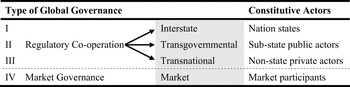
‘International economic integration’, as Kahler and Lake note, ‘is producing a new fabric of global governance that displays many variations and shadings’.Footnote 15 Making sense of larger patterns necessarily requires aggregation, which, by definition, implies focusing on only a limited set of distinguishing characteristics. Forms of governance in global markets could be distinguished among several dimensions. Previous work has focused on characteristics such as issue- and membership scope, the extent of authority delegated to the supranational level, and the precision of rules.Footnote 16 The downside of such functional characterisations is that they underemphasise the political diversity across governance forms rooted in variation among participating actors.Footnote 17 To expand available perspectives, this study focuses on governance clusters distinguished above-all by the character of their constitutive actors (see Figure 1).
Four ideal-types of governance in global markets.

Interstate
International organisations with critical economic governance functions, such as the WTO, IMF, ITU, or OECD, are comprised of nation states. Besides negotiating tariffs, states rely on the WTO to supply and enforce a broad range of rules, including the regulation of technical barriers to trade, intellectual property, and subsidies. The IMF plays a critical role in the regulation of international currency markets. The ITU supplies important technical standards to facilitate global interoperability of telecommunications. The OECD, lastly, is the forum through which industrialised nations have agreed on common rules for foreign investments and the collection of taxes on cross-border e-commerce. Clearly, the list could be extended. These institutions certainly differ in many respects. Yet they also have a lot in common: all are public international organisations, established through international treaties, are comprised of nation states, are usually embedded in broader international regimes, and tend to promulgate their rules through treaties, conventions, or agreements that have the status of public international law.Footnote 18 Most existing literature focuses on this form of cooperation. Nation states create international institutions to enable mutually beneficial cooperation. Institutions lower transactions costs, make commitments credible, and lengthen the shadow of the future.Footnote 19 Because nation states are the constitutive actors underpinning this form of cooperation, I refer to it as ‘interstate’.
Transgovernmental
Transgovernmental networks, which differ sharply from conventional interstate governance, are an increasingly prominent alternative for global market regulation. The constituent actors of the Basle Committee on Banking Supervision, the International Competition Network (ICN), or the International Organization of Securities Commissions (IOSCO) are sub-state regulatory agencies – central banks, anti-trust regulators, or securities commissions – not nation states. International legal scholars in particular have called attention to the rapid spread of regulatory networks in the post-Cold War era. ‘The state is not disappearing’, Slaughter argues, ‘it is disaggregating into its separate, functionally distinct parts. These parts – courts, regulatory agencies, executives, and even legislatures – are networking with their counterparts abroad, creating a dense web of relations that constitute a new, transgovernmental order.’Footnote 20
Earlier research on transgovernmentalism in the 1970s chartered new ground by establishing what Slaughter calls the ‘hydra-headedness’ of the modern nation state, that is, the existence of multiple independent centres within the state from which foreign relations are conducted.Footnote 21 Keohane and Nye defined transgovernmental relations as ‘sets of direct interactions among sub-units of different governments that are not controlled or closely guided by the politics of the cabinet or chief executives of those governments.’Footnote 22 This gives transgovernmental cooperation a distinctly ‘technocratic’ flavour of technical problem-solving among like-minded officials coping with a shared set of challenges.
Institutionally, transgovernmental networks differ considerably from conventional interstate governance. While such networks often have coordinating secretariats, these are usually private bodies – such as the Bank for International Settlements for the Basle Committee or IOSCO's Madrid-based secretariat – and not public international organisations.Footnote 23 Unlike public international organisations, the networks do not emanate from international treaties, nor do their promulgations have the status of public international law. Rather, domestic regulators use them to harmonise standards and establish best practices that participants voluntarily incorporate into domestic regulatory practice. By setting common reserve requirements for banks, the Basle Committee has been tremendously influential in global financial markets.Footnote 24 ICN and IOSCO are particularly active in the fields of enforcement cooperation and regulatory best practice diffusion.Footnote 25 According to proponents, transgovernmental networks are ‘fast, flexible and decentralised – attributes that allow them to function particularly well in a rapidly changing information environment.’Footnote 26 International lawyers in particular therefore see them as the critical building block of the ‘architecture of international cooperation’ in an era of globalisation.Footnote 27
Transnational
Private, self-regulatory initiatives constitute a third empirical cluster of global governance. Whereas interstate and transgovernmental cooperation feature public constitutive actors – nation states in the former and sub-state regulatory agencies in the latter – ‘transnational’ cooperation is led by private, non-state actors. The International Standards Organization, for example, is a private body comprised of national standardisation organisations that shapes competition in many industries.Footnote 28 Through its development of International Accounting Standards, the International Accounting Standards Board plays a similarly pivotal role in financial markets.Footnote 29 The Internet Corporation for Assigned Names and Numbers, which is charged with market regulation and technical management of Internet domain names, is only the most visible of a whole range of private international bodies that govern the Internet.Footnote 30 These private bodies, and many more like it, represent the sharpest contrast with the conventional interstate form of global governance. While some are rather ad-hoc, many are so thoroughly established that experts refer to them as ‘private international regimes.’Footnote 31
What accounts for the apparent spread of private, self-regulatory initiatives at the international level? Scholars studying the rise of private authority near-unanimously point to dwindling state power.Footnote 32 As Haufler argues, ‘If governments cannot develop transnational institutions for rulemaking, then new forms of international governance must be created […] The demand for rules to govern commerce has given rise to a variety of sources of supply, and one of the most significant and growing sources of international governance is the private sector itself.’Footnote 33 Yet in much of this literature, the link between allegedly dwindling state power and growing private influence is taken for granted, rather than demonstrated. Indeed, some recent studies suggest that private and public power in global governance may be complementary, or even that private power is only exercised at the behest of powerful states.Footnote 34
Market
Market governance, lastly, prevails internationally in the absence of formal regulatory cooperation. The principal difference between market governance and formal cooperation is that rules in the former are set individually by firms – rather than by third-party industry or government bodies – and are enforced by the market through consumer behaviour.Footnote 35 As Spar shows, market governance does not mean anarchy and is quite common, particularly in new markets at the ‘technological frontier.’Footnote 36 Over time, however, growing value creation and appropriation raises the stakes and makes formal regulation more likely. In this case, governments settle whether to exercise regulatory authority over maturing markets directly or whether to delegate it to existing or newly created public regulatory agencies or private bodies. Drawing mostly on principal-agent theory, a rich literature has developed around the process of regulatory delegation in the American government and comparative politics subfields of political science.Footnote 37 Governments tend to delegate domestic regulatory authority to solve commitment problems, to deal with technical complexity or asymmetric information, or to shift blame unto unelected technocrats. However, as recent work shows, functional pressures alone do not explain decisions to delegate, nor do they fully determine the resulting institutional design.Footnote 38 Delegation decisions have to be seen in their political context against the background of underlying functional logics. If governments decide to create regulatory authority over a new economic domain, their subsequent decision whether or not to delegate domestic regulatory authority, and if so to whom, shapes ensuing global governance as explained below. Market governance on the international level is thus a primordial, often transitory form of global governance prior to more formal regulatory cooperation.
Competing views, limited insight
Previous work offers limited analytic leverage for ‘varieties of cooperation’ in global economic governance. This is because most research has focused on one governance cluster at a time, neglecting intriguing questions about the causes and consequences of stark institutional variation. Regime theory has generated important insights about the role of international institutions in facilitating cooperation. Rarely, however, have regime theorists ventured beyond interstate politics to explore alternative forms of cooperation led by non-state or sub-state actors. This is not to say that domestic politics have been entirely ignored. Putnam's ‘two-level game’-model, for example, deliberately links domestic and international politics.Footnote 39 In this depiction, government officials simultaneously negotiate in the international and domestic arenas and skillful bargaining can turn domestic constraints into international assets. While applicable to foreign activities led by chiefs-of-government or their designates in conventional interstate domains such as trade policymaking, the model fits less comfortably other areas of global governance, such as financial market regulation or standard setting, where domestic regulators or private actors directly engage in international coordination. Similarly, prominent research on the role of domestic legislative institutions in channelling interests remains within the interstate paradigm and ignores other domestic actors and their international roles.Footnote 40 Assessing the state of the literature, Frieden and Martin note that current work ‘requires heroic assumptions and simplifications’ of domestic politics. Moreover, we need ‘models of domestic-international interaction […] to address more issue areas than international trade, where they have been developed most successfully.’Footnote 41
Research on transgovernmental networks and private international regimes similarly encounters limitations. For too long, students of alternative forms of global governance have sought to demonstrate that alternatives to interstate regimes exist and that they matter. Where and why alternative governance forms emerge, however, and why not in all areas of global governance, are critical unanswered questions. For instance, what explains the sudden increase in transgovernmental cooperation? Have states become more ‘hydra-headed’, to use Slaughter's phrase? The Securities and Exchange Commission (SEC), an independent regulatory agency, has led US securities regulation since the 1930s, but regulatory cooperation in the industry began in the 1980s and has only become meaningful in the 1990s. What translates domestic hydra-headedness into international institutional diversity? Furthermore, the rise of transgovernmental cooperation led by domestic regulators fits uncomfortably with the claim in the private regime literature that dwindling state power drives an unstoppable rise of private authority in global governance.
A notable exception to the inward-orientation of much existing literature is recent work in a rational functionalist tradition. Functionalist studies of international institutional design are deliberately comparative and encompassing of institutional diversity.Footnote 42 Functionalist approaches focus on the underlying collective action problems and externalities that generate demand for particular institutions.Footnote 43 The character of the problem – seen in its strategic context – shapes the requirements for institutional design.Footnote 44 While this research has generated important insights into underlying economic dynamics, the application of ex post functional reasoning can obscure the ex ante political dynamics that produce particular outcomes.Footnote 45 For instance, whereas the Clinton Administration wanted the private sector to lead global governance of the Internet's Domain Name System (DNS), the vast majority of countries preferred more formal governmental oversight. Why the US prevailed is a political and not a functional question. It is therefore useful to combine functional reasoning with an analysis of the political context, interest constellations, and policy dynamics that produce global governance. This requires integrating domestic politics more fully into the analysis than in previous work because domestic politics is the principal arena in which actors and interests confronted with the challenges of globalising markets assess options and formulate response strategies.
The domestic institutional foundation of global governance
A domestic institutional perspective on global governance takes domestic regulatory institutions in the largest, most important market as the starting point. How a domestic market is regulated determines who can leverage domestic market access in pursuit of a global regulatory agenda, thereby defining the constitutive actors for regulatory cooperation and thus setting policy areas on distinct governance trajectories. Institutional diversity in the domestic realm thus drives a corresponding diversification of forms of global governance. In areas where domestic regulatory authority has been formally delegated to powerful autonomous bodies, such as regulatory agencies or private actors, we are likely to see transgovernmental networks or private regimes. In contrast, interstate governance is most common in areas where domestic regulatory authority has not been delegated and is instead dispersed over multiple legislative, executive, and adjudicative institutions. Where there is no formal domestic authority or it is dispersed in the private sector, market governance prevails internationally.
Following Simmons, I argue that the construction of global market governance in a given area usually begins with demands by one jurisdiction, or a small coalition, on others.Footnote 46 Two distinct demand drivers can be distinguished, both of which are direct results of cross-border market integration. On the one hand are instances of regulatory spill-over and competition.Footnote 47 As borders become porous, arbitrage opportunities emerge that can challenge the authority of domestic regulators, particularly in countries with high standards.Footnote 48 Leading governments respond with efforts to export domestic rules to avoid a race to the bottom, often with the support of domestic business coalitions concerned about competitive disadvantages resulting from uneven global playing fields.Footnote 49 On the other hand we find demand for regulatory harmonisation across jurisdictions or the development of entirely new international rules. Frequently, business itself leads the push because regulatory heterogeneity and conflicting rules mean higher transactions costs. But even when most stakeholders agree that harmonisation would be beneficial, they often have conflicting preferences about how to coordinate the infrastructure for global commerce.Footnote 50 This is why power matters. Power, in the context of global economic governance, is principally a jurisdiction's ability to leverage access to its domestic market in pursuit of its preferred international outcome.Footnote 51 A jurisdiction's power to shape global governance in a given area thus depends on the size and attractiveness of its domestic market, as well as on its regulators' ability to effectively exclude from that market.Footnote 52
If a jurisdiction controls a large and attractive market, and its regulators are institutionally empowered to exclude foreign firms from it, it can assume the role of ‘lead regulator’ in a given area of global governance. Lead regulators decisively shape international outcomes because they can define the ‘reversion point’ for international bargaining. The reversion point, according to Richards, is the ‘set of marketplace rules that will result if there is no new international agreement.’Footnote 53 Certainly an assumption that there is only one lead regulator in a given area is rather restrictive. Empirically, however, we do frequently witness a single large jurisdiction in the driver's seat. Furthermore, the notion of ‘lead regulator’ does not presume a preponderance of market power in a given industry; rather, it assumes that efforts to construct international regulatory institutions begin when regulators in charge of a sizeable domestic market respond to pressure from domestic interest groups by putting demands on foreign jurisdictions. The study's central argument is that if a jurisdiction can play the role of lead regulator in a given area, the character of its domestic regulatory institutions decisively and systematically shapes the form of global governance in that area. In its current formulation, areas where there is no clear lead regulator or where two or more equally powerful jurisdictions have sharply diverging preferences fall outside the framework's scope. I return to this limitation in the conclusion.
Previous work has highlighted the importance of domestic politics for international outcomes. Putnam has shown how the prospect of domestic ratification shapes international bargaining dynamics.Footnote 54 Milner examines how domestic institutions channel interests in the preference formation stage.Footnote 55 Mattli and Büthe highlight the importance of domestic and international institutional complementarities.Footnote 56 This study expands on this work by showing how domestic regulatory institutions in leading markets systematically shape patterns of global economic governance. How a domestic market is regulated affects global governance in three important ways. First, domestic institutions filter and refract global pressures.Footnote 57 Depending on the character of domestic market regulation, globalisation-induced challenges can either undermine existing regulatory authority, which creates incentives for deliberate export or extraterritorial application of domestic regulation, or create demand for new international market rules. Secondly, how a domestic market is regulated defines the arena in which political actors mobilise in response to international challenges, affects who has access to policymaking, and thus shapes the character of resulting policies.Footnote 58 Thirdly, domestic regulatory institutions affect power in international bargaining because they determine whether regulators can leverage domestic market access in pursuit of their preferred international policies. For this regulators must have the formal statutory authority to exclude from the domestic market and they need the resources and capabilities to implement and monitor such policies.Footnote 59 Only jurisdictions whose domestic regulators are institutionally empowered to leverage market access can play the role of lead regulator in a given area of global governance. Where such domestic authority is lacking, its creation is a necessary first step before a jurisdiction can effectively push for the establishment of robust international regulatory institutions.
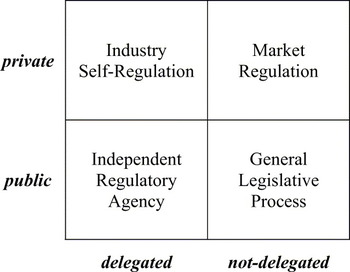
To systematically link domestic regulatory actors and – institutions in leading markets to patterns of global governance, I characterise domestic regulatory regimes along two dimensions: first, whether regulatory authority is located in the public or the private sector; and secondly, whether it has been delegated to a specific regulatory institution or whether it has not been delegated and is instead exercised by various legislative, executive, and adjudicative institutions. Following Thatcher and Stone Sweet, I define delegation as ‘an authoritative decision, formalized as a matter of public law, that (a) transfers policy making authority away from established, representative organs […] to (b) a non-majoritarian institution, whether public or private.’Footnote 60 The resulting ideal-types permit a parsimonious distinction among four different forms of domestic market regulation, including regulation by independent agencies (public/delegated), industry self-regulation (private/delegated), and regulation through the general legislative process with reliance on the judicial system for enforcement (public/not-delegated) (see Figure 2). The fourth cell – private/not-delegated – captures domestic markets that have not yet been formally regulated. Here, market incentives and consumer preferences provide the principal check on corporate behaviour. Many new industries at the ‘technological frontier’ initially operate this way.Footnote 61 Once the stakes increase, for business and society, formal regulation becomes more likely. Viewed through the prism of this model, new industries thus appear in the upper-right hand corner. If formal regulation happens – either through detailed legislative rule-making or by the delegation of regulatory authority to a new or existing public or private body – the industry in question migrates to one of the other three boxes.
Four ideal types of domestic regulation.

The model facilitates a systematic analysis of the domestic regulatory stakeholders most affected by globalisation in a given industry, the political arena in which stakeholders cope with regulatory conflict, and what it takes to leverage market access in pursuit of international solutions. Systematic variation across types of domestic market regulation determines the constitutive actors of nascent regulatory cooperation, thereby setting policy areas on distinct governance trajectories.
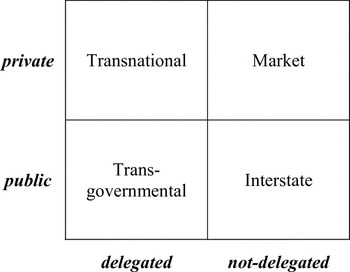
In areas where globalisation-induced regulatory challenges confront an independent regulatory agency that is institutionally empowered to exclude from a large and attractive domestic market (lower left-hand quadrant), the agency will respond to domestic pressure for global regulation with efforts to address the challenge autonomously in a manner consistent with the domestic status quo. Failing to do so risks triggering the involvement of other domestic political actors, which risks jeopardising the agency's position at home.Footnote 62 A domestic-institutionally empowered agency can leverage domestic market access and thus define the reversion point for formal or informal international bargaining. If the agency successfully leverages market access to draw its foreign counterparts into regulatory cooperation, global governance in the industry unfolds with a transgovernmental form (see Figure 3).
Domestic regulation and types of global governance.

A similar logic applies to regulatory authority delegated to a private sector institution (upper left-hand quadrant). If regulatory authority in an area has been delegated to the private sector and private actors enjoy a high degree of domestic autonomy, they will seek to extend private governance internationally. Successful global governance in the area consequently assumes a transnational form. Private actors have a strong incentive to extend self-regulation globally, as reliance on governments to confront new challenges could undermine private sector leadership at home.
In areas where domestic regulatory authority has not been delegated and is instead exercised by several different public rulemaking and enforcement institutions (lower right-hand quadrant), no single domestic regulatory actor can leverage market access in pursuit of a global solution. The task of coping with market globalisation thus moves up, away from technocrats or private actors, and toward cabinet-level authorities involved in international affairs, such as trade, commerce, or foreign ministries. This upward shifting of authority domestically changes the foundation of global governance. If cabinet-level institutions can leverage marketaccess to draw their counterparts into regulatory cooperation, global governance in the area unfolds along an interstate trajectory.
Lastly, in areas governed by the market alone (upper right-hand quadrant), where domestic authority is dispersed and in private hands, formal global governance will only occur after a stable domestic regulatory framework has been established. In the meantime, just as in the domestic setting, market governance prevails internationally.
Figure 3 sums up the hypothesised relationship of domestic market regulation and ensuing global governance in a given area. This analytic tool systematically maps types of domestic regulation against forms of global governance that are most likely to result if the causal mechanisms sketched above are correct. The argument can be summarised in the following four propositions:
Proposition 1: Exclusion power over a large and attractive domestic market is a critical source of power in formal or informal bargaining over global economic governance;
Proposition 2: Domestic public (private) regulators to whom market exclusion power has been delegated in a particular area confront challenges resulting from market globalisation autonomously by working with their foreign counterparts, thereby setting the area internationally on a transgovernmental (transnational) governance trajectory;
Proposition 3: Lack of a domestically-empowered sub-state or non-state regulatory actor in an area means cabinet-level offices must conduct foreign economic relations in the area, which sets global governance on an interstate trajectory;
Proposition 4: Lack of formal domestic regulatory authority in an area means market governance prevails internationally.
The following section offers an empirical evaluation of the argument through a structured, focused case comparison of evolving global governance in four areas.Footnote 63 As Mahoney, Hall, and George and Bennett have shown, this methodology is particularly well-suited to scrutinise hypothesised causal mechanisms during the theory development stage.Footnote 64 The empirical part analyses the origins, development, and institutionalisation of transgovernmental governance of securities, transnational governance of Internet domain names, and interstate governance of intellectual property. A fourth empirical section illustrates the absence of formal regulation and prevalence of market governance in the hedge funds sector.
Three reasons underpin the case selection. First, in all cases global governance is fairly recent, having evolved since the 1980s in response to new globalisation-induced regulatory challenges. In the securities and domain name fields, there simply was no regulatory cooperation prior to the events traced below. In intellectual property, governments constructed an entirely new market regulatory regime in the early 1990s anchored on the WTO. Hedge funds, lastly, are a most recent phenomenon that has so far eluded formal regulation, domestically and internationally. Secondly, the cases offer particularly stark institutional contrasts. This is advantageous because evidence of a common causal pathway despite considerable cross-case variation of the independent and dependent variables strengthens confidence in the findings.Footnote 65 Finally, in all three cases featuring institutionalised cooperation, the same country, the US, was the leader and principal promoter of formal global governance. Employing cases featuring the same ‘lead regulator’ is methodologically useful because it helps to hold potentially intervening variables constant.Footnote 66 At this early stage, the benefit of controlling such variables can be traded off against the obvious downside, the perception that the argument is US-centric and could perhaps be limited to US-initiated global governance. I return to this limitation in the conclusion.
Scrutinising global governance
Securities
Global securities markets feature transgovernmental governance. A dense network of institutionalised direct cooperation among domestic securities regulators ensuresthat financial market integration does not undermine high levels of investor protection. The network is anchored by the International Organization of Securities Commissions (IOSCO), which is, despite its name, a private secretariat and not a public international organisation. IOSCO's more than one hundred members are autonomously-acting regulatory agencies and securities commissions, not nation states. Cooperation agreements among them are informal Memoranda of Understanding (MoU), not formal treaties. And rules promulgated by the network are voluntarily adopted into member agencies' practices, rather than formally ratified.
This peculiar form of governance has its origins in domestic regulatory dynamics in the US, the world's largest and most attractive securities market. US domestic market regulation is a clear example of the delegated/public type. In 1934, Congress delegated regulatory authority over US securities markets to the SEC, an independent regulatory agency. Over time, the SEC's power and expertise grew. It can autonomously investigate potential violations of US securities law, impose fines, and back up its rulings and regulations with sweeping control over domestic market access. When financial globalisation in the early 1980s threatened to undermine the agency's ability to uphold strict domestic standards, it was therefore already institutionally empowered to address the challenge directly by initiating the construction of global regulatory institutions. Through the SEC's international efforts, the US assumed the role of lead regulator in global securities markets.Footnote 67 At the same time, by reaching out directly to its foreign counterparts rather than relying on the president, state department, or Congress to find a solution, the SEC maintained its domestic independence and set global governance on a transgovernmental trajectory.
Regulatory cooperation in the industry began after the SEC, in 1981, detected two cases of likely insider trading that were the largest in its history.Footnote 68 In both instances, the trail led to Swiss banks, and both times the banks – citing Swiss banking secrecy laws – refused to reveal who had placed the orders. The SEC eventually sued the US subsidiary of one of the banks in New York Federal Court and obtained a broadly favourable ruling. Despite its ability to eventually compel information release, the two cases highlighted the vulnerability of America's high regulatory standards in globalising securities markets.Footnote 69 Insider trading was not illegal in Switzerland, nor was it in most other jurisdictions. In bilateral negotiations, the Swiss proposed to address the issue through an informal MoU that would regulate future information sharing and enforcement cooperation.
Although the SEC signed an MoU with Swiss authorities in 1982, the experience prompted more aggressive thinking on how to defend US standards in globalising markets. The agency's proposed solution became known as ‘waiver-by-conduct’, a rule stipulating that any foreigner trading in US markets – simply by placing an order – agreed to waive all protection afforded under foreign banking secrecy laws.Footnote 70 Access to America's vast securities markets was to be contingent not only on compliance with US rules, but also on explicit waiving of foreign privileges at odds with those rules.
The debate over waiver-by-conduct defined the ‘reversion point’ for international negotiations and completely changed international bargaining dynamics.Footnote 71 By drawing up the policy, the SEC signalled to foreign authorities its determination to firmly defend US standards. The threat of US market exclusion thus loomed large when the agency approached foreign authorities from countries with large trading volumes in the US to negotiate MoUs based on the Swiss precedent.Footnote 72 Between May 1986 and August 1988, the SEC negotiated and signed MoUs with authorities from Japan, the UK, Canada, and Brazil, all of which agreed to help the SEC combat instances of cross-border securities fraud. Through these direct regulator-to-regulator agreements, the SEC laid the foundation for network-based securities cooperation observable today.
MoUs certainly are more flexible, cheaper and easier to negotiate, and less intrusive than formal international treaties, as functionalists would stress.Footnote 73 But this is not the entire story. For the SEC, MoUs also have the decisive advantage of leaving it in sole charge of foreign relations in this area.Footnote 74 Seeking a more formal, interstate arrangement through cabinet-level foreign- or trade authorities would have undermined the agency's independence at home. Moreover, such help from above was also not necessary, as the agency already had the expertise and, most importantly, the statutory authority to exclude from the US market. It thus had considerable leverage over foreign governments. Overall, the SEC signed close to fifty MoUs with foreign regulators. The model caught on. Following the SEC's lead, by the end of the 1990s, a total of over 250 bilateral MoUs had been concluded among securities regulators around the world, firmly institutionalising network-based transgovernmental governance.Footnote 75
The second pillar of transgovernmental governance has been coordination and rule harmonisation within IOSCO. With considerable SEC help, IOSCO has become the leading international forum for securities regulators.Footnote 76 IOSCO has adopted a benchmark set of securities regulations, harmonised non-financial disclosure rules, and endorsed the use of International Accounting Standards by foreign issuers. Failure to reach an agreement on capital adequacy standards for securities firms has been its only setback.Footnote 77 The episode powerfully illustrates the importance of domestic regulatory dynamics in the US for the evolution of global governance in the industry. They are the key to understanding the SEC's interests and its power, and the reason why the SEC, ultimately, prevailed.
Negotiations over capital adequacy standards began in 1989 but broke down in 1992 when SEC Chairman Richard Breeden rejected European proposals that would have lowered US standards.Footnote 78 The SEC's interest in international cooperation centred on information sharing and enforcement cooperation to plug supervisory gaps in globalising markets. The agency was far less interested in international harmonisation, particularly if that meant lowering US standards to accommodate others.Footnote 79 Its control over the world's largest securities market gave the SEC confidence that others would have to adjust to its standards, not vice versa. As Breeden explained in 1992 when asked about foreign, particularly German, requests to be permitted to list on US exchanges without having to comply with stringent US rules:Footnote 80
They can wait forever […] This isn't a problem for us. In the last three years we have had 149 new foreign companies come to our market. In London and Tokyo, the number has actually declined […] If the Germans want to sit on the sidelines while everyone else in the rest of the world is financing in the US market, that's their decision. There's no shortage of foreign listings in the US.
Breeden's veto effectively stalled European efforts to undermine US standards in the name of harmonisation. He thus ensured cooperation would continue to emphasise enforcement assistance and investor protection, as opposed to strategies to reduce systemic risk that have dominated central bank cooperation. The substantive agenda of cooperation was thus not functionally determined. Rather, it was the outcome of a political struggle in which the SEC – thanks to its control over the world's largest and most attractive securities market – prevailed. What had been the agency's domestic mission since the 1930s – to protect investors by ensuring market transparency and combating fraud – thus also formed the agenda for evolving transgovernmental cooperation.
In conclusion, it is evident that the form and function of US domestic securities regulation has decisively shaped the form and function of global governance in this area. This is because globalisation-induced regulatory challenges confronted a powerful, independent regulatory agency in the US whose control over the world's largest and most attractive securities market enabled it to play the role of global lead regulator. By leveraging market access – effectively threatening non-cooperative jurisdictions with exclusion from the US market – the SEC managed to craft global governance structures consistent with its domestic mission. And in doing so, it ensured governance in the industry would evolve along a transgovernmental, as opposed to interstate or transnational, trajectory.
Internet domain names
Governance of the Internet's domain name system (DNS) – a complex database containing the names and numeric addresses of Internet sites – is a prime example of transnational governance. The DNS is managed by a global network of mostly private, non-state domain name registries that is presided over by the Internet Corporation for Assigned Names and Numbers (ICANN), a California-based private non-profit.Footnote 81 As The Economist notes, ICANN is ‘a new type of international organisation: an industry trying to regulate part of itself, across the globe, with little or no input from national governments.’Footnote 82 While national governments are not actively involved in day-to-day global DNS regulation, the US government played a critical role in the establishment and subsequent institutionalisation of transnational governance. It was the Clinton administration's decision to formally delegate domestic regulatory authority to a private body that set global DNS governance on a transnational – as opposed to transgovernmental or interstate – trajectory. The US was able to decisively shape global governance in this area because the US domain name market was by far the largest in the world. Moreover, because it controlled the root server system that sits on top of the DNS hierarchy, US officials – and now the private body to which the Clinton administration delegated regulatory authority – effectively controlled access to the vast domain name market. The ability to exclude noncompliant firms from this market has given ICANN tremendous leverage in dealing with foreign authorities.
A functionalist account would stress that DNS governance consists of mundane coordination in a technologically-complex and rapidly changing environment, something the private sector presumably does best. Yet DNS governance is anything but mundane. The DNS is one of the Internet's few central access points and tied up with its administration is the regulation of the global market for Internet domain names, trademark protection, and even questions of statehood in cyberspace.Footnote 83 Moreover, process tracing reveals that delegation to the private sector was above-all a political choice. The Clinton administration could have delegated domestic regulatory authority to a new or existing public regulatory agency. It could also have sought an interstate framework by letting the UN-affiliated International Telecommunications Union (ITU) take the lead, as many foreign governments suggested. Global governance would have evolved very differently. Instead, the US opted for domestic delegation to the private sector to cement a domestic political compromise between Internet pioneers and new commercial players. Despite numerous attempts since 2002 by a broad coalition of governments to place DNS governance under intergovernmental oversight, private governance prevails.Footnote 84 Anchored on a private/delegated domestic regulatory regime in the US, the largest and most important domestic market, private international self-regulation has proven remarkably resilient.
The evolution of the market for Internet domain names – such as yahoo.com or bbc.co.uk – is a classic example of what Spar calls a market at the technological frontier.Footnote 85 The case powerfully illustrates how a new market emerges and how the path to global governance runs through domestic politics. Internet domain names existed for two decades prior to the Internet's commercialisation without formal regulation because a domain name market simply did not exist. There was merely technical administration, for domain names were not the valuable commodities they became during the dot.com boom. Technical administration of domains, which initially involved only keeping track of assigned numbers, was organised by Jon Postel, an Internet pioneer. Postel delegated administrative authority for every branch of the tree-like, hierarchical DNS database to ‘the first responsible person who ask[ed] for the job’.Footnote 86 This included authority for specific country-code suffixes such as .uk, .de, or .jp, which Postel had created at the behest of foreign scientists who preferred geographic identifiers to the generic suffixes .net, .org, and .com that were popular in the US. By 1993, still two years before the Internet's breakthrough, Postel – who acted as the Internet Assigned Numbers Authority (IANA), a body he had created to provide his work with an official-looking façade – had made more than one hundred such delegations, usually to network engineers like himself.
The market for domain names began in 1995. That year, a US government research agency gave Network Solutions, Inc., a private company that had since 1993 served as the monopoly registry of names ending in .com, .org, and .net and that ran the authoritative ‘A’ root server, permission to charge a $50 annual registration fee. The Internet boom turned NSI's monopoly into a cash-cow and the small company into a multimillion dollar enterprise. The engineers who had created the DNS sensed they were losing control and tried to undercut NSI. First Postel sought to break NSI's monopoly by proposing more than a hundred new suffixes and awarding registry licenses to NSI rivals. When this unilateral move met fierce resistance, Postel and his associates joined forces with the ITU, trademark groups, and leading Internet firms to develop an international regulatory framework. Their goal was to turn the existing informal network of technical coordination into a full-fledged global regulatory regime.Footnote 87
With its lucrative monopoly threatened, NSI embarked on a fierce lobbying campaign in Washington, arguing that Postel's IANA lacked regulatory authority over the DNS. The Clinton administration agreed, formally claimed DNS authority for the US government, and established an Interagency Working Group to develop plans for a ‘contractually based self-regulatory regime.’Footnote 88 It thus decided to formally create regulatory authority over the DNS and to subsequently delegate its exercise to the private sector. Alternatively, it could have delegated regulatory authority to a new or existing public regulatory agency. Global DNS governance would have evolved very differently, most probably approximating the transgovernmental model of globally-networked regulatory agencies seen in the securities industry. Instead, delegation to the private sector set the industry on a transnational trajectory of global governance.
What explains the decision to delegate to the private sector? A functionalist argument would stress the technical complexity of DNS governance and the need for quick adjustment to rapidly changing market dynamics. Presumably, the private sector is better suited for this than public bureaucrats. But in light of the DNS's strategic importance in the global information infrastructure, several influential US policymakers opposed handing control over such a critical resource to the private sector.Footnote 89 While arguments about the relative efficiency of different institutional options certainly mattered, the outcome was thus not functionally determined. Rather, the Clinton administration opted for industry self-regulation for reasons of strategic interest, political expediency, and ideology. Clinton's advisors were convinced that leading US Internet and e-commerce firms would benefit from private sector leadership. The government was also unwilling to take on simultaneously Postel's group of Internet pioneers and new private sector interests led by NSI. Lastly, and perhaps most importantly, Clinton's Internet policy team was convinced that lack of government involvement had been key to the Internet's success.Footnote 90
In 1998, the US Department of Commerce announced plans to create a private, US-based non-profit to take over the existing IANA functions and the administration of the root server system from NSI. As a sign of reconciliation, Postel was to lead the new organisation. Since ICANN, as the new body became known, was to control the root server system, it would formally control access to the domain name market, something IANA had lacked. Market access control, as ICANN's first president Esther Dyson notes, is the organisation's principle source of power: ‘[ICANN] is not a government in the traditional sense […] Its only power is through contracts with the entities it regulates. They don't have to sign these contracts although they don't get access to the facilities that ICANN oversees – the domain name, for one – unless they do.’Footnote 91 Leveraging market access through its control of the root server system thus gives ICANN the ability to define the reversion point in bargaining with foreign domain name registries, making it the regime's pivotal player.
Created in October 1998, ICANN has used its domestically-rooted leverage to formalise its relationship with NSI and countless domain name registries around the world. These predominantly private, non-state actors participate in global regulation through ICANN's governing and advisory panels. While private governance is thus firmly institutionalised globally, ICANN – and the transnational regime over which it presides – remain contested. Developing countries in particular demand greater government control over this critical piece of infrastructure.Footnote 92 They criticise that the US government retains too much influence over the private regime. Various UN agencies have repeatedly offered to assume ICANN's functions, which would give market governance a formal interstate character. But the US government stands firmly behind the private body to which it has delegated regulatory authority. Unwilling to change its domestic regulatory regime, the US has repeatedly faced down international critics and thereby preserved private governance globally.Footnote 93
Intellectual property
The 1980s and 1990s saw the construction of an entirely new international regulatory regime for intellectual property. The regime is based on the WTO, an international treaty organisation; regulatory rules have the status of public international law; and the members are nation states, not sub-state regulatory agencies or private actors. Global governance of intellectual property is thus a prime example of traditional interstate regulatory cooperation.
Intriguingly, the new regime is anchored by the world's principal trade regulator even though there is a specialised UN agency for intellectual property, the World Intellectual Property Organization (WIPO) in Geneva. Koremenos, Lipson, and Snidal argue that ‘[t]he obvious place to handle intellectual property rights would be [WIPO], but the countries that generate most patents chose to move the issue to the WTO because it offered better enforcement mechanisms.’Footnote 94 While this is true, the functionalist ‘forum switch’ argument misses what is genuinely new about global governance in this area. The real innovation is the formal linking of trade and intellectual property – two areas of policy and of the law that had been entirely separate for more than a century – to boost international intellectual property protection. This innovative ‘trade-based’ strategy has its origins in the US, the world's largest producer of intellectual property, and preceded the ‘forum switch’ by more than a decade.Footnote 95 Process tracing reveals that US regulators initially pursued this strategy purely through bilateral channels. In fact, there was domestic opposition to a WTO-based multilateral agreement.
What explains the linking of trade and intellectual property law in the US? Process tracing shows that the ‘trade-based’ strategy emerged as an institutional solution to the problem of fragmented domestic intellectual property regulation. There was no single domestic intellectual property regulator institutionally empowered to leverage market access to obtain better foreign protection of US rights, as was the case with the SEC in securities for example. Constructing robust global governance therefore required the prior establishment of a domestic institutional mechanism for internal coordination and external projection of US regulatory authority. Policymakers provided just such a mechanism in the 1980s when they followed industry proposals to formally link trade and intellectual property law, thereby putting the cabinet-level Office of the US Trade Representative (USTR) in charge of international relations in this area. This domestic institutional innovation set the stage for trade-based interstate governance of intellectual property in the 1990s.
In the early 1980s, owing to growing product mobility across borders, US firms increasingly suffered from foreign intellectual property infringement. While many countries were parties to WIPO-administered treaties, governments had considerable latitude in their implementation. Enforcement was consequently weak. US efforts to strengthen enforcement were blocked by developing country majorities within WIPO. The problem, as one former government official put it, was that US regulators could not exact a price for developing country reform opposition.Footnote 96 The lack of leverage was due to the prevailing decentralisation of US regulatory authority in the field of intellectual property and the resulting weakness of US regulators in international negotiations. Congress had never delegated sweeping regulatory authority over intellectual property to a powerful agency capable of acting autonomously, as it had done in the field of securities, for instance. Though it is common to speak of intellectual property regulation, there is neither a single intellectual property regulator, nor a single body of intellectual property regulations. Instead, there are separate rules governing patents, trademarks, and copyright. Rulemaking and administration are similarly characterised by fragmentation. Neither the US Patent and Trademarks Office nor the US Copyright Office is an independent regulatory agency. They are administrators of existing law and have few, if any, independent rulemaking and enforcement powers.Footnote 97 Moreover, a substantial amount of rules are made by Congress itself, and on the enforcement side, the courts and private self-regulatory bodies play major roles.
Against this fragmented domestic institutional background, piracy of US satellite television broadcasts in the Caribbean emerged in the early 1980s as a new form of copyright infringement.Footnote 98 The case is symptomatic of regulatory challenges associated with globalisation. New technologies, that extended the physical reach of US television signals beyond the country's borders, exposed US copyright owners to foreign piracy because copyright law differed across countries and international enforcement was weak. Hollywood was alarmed. On behalf of leading studios, some Washington lawyers drafted a barely noticed amendment to the 1983 Caribbean Basin Economic Recovery Act – an initiative granting non-communist Caribbean countries preferred access to the US market – whose renewal the Senate debated at the time. The amendment, which required beneficiary countries to protect US copyrights, patents, and trademarks, was adopted at committee level and made it into the final bill. According to Braithwaite and Drahos, ‘[T]he significance of the event was, hardly surprisingly, not widely appreciated. […] It was a classic case of legal entrepreneurship.’Footnote 99 Owing to business efforts, trade and intellectual property law were thus formally linked to improve foreign protection of US rights.
Building on the precedent, and following additional business lobbying, Congress further amended US trade law in 1984 and 1988 to empower USTR to include foreign intellectual property standards in evaluation criteria for preferred US market access and to impose sanctions on countries tolerating infringement.Footnote 100 This required USTR to work closely with the multiple public and private domestic actors involved in US intellectual property regulation. The trade body thus became the institutional mechanisms for the external projection of US regulatory authority in this area. It did this by leveraging US market access. As the country's top trade policymaker, it routinely threatened to exclude non-compliant countries or firms from US markets. The legislative reforms of 1984 and 1988 formally enabled USTR to apply this strategy to intellectual property. The institutionalisation of foreign intellectual property policy-making at the cabinet level, in turn, laid the foundation for interstate market governance.
USTR's domestic institutional empowerment shifted the reversion point for international bargaining. Several countries that had previously resisted change substantially improved intellectual property enforcement in response to threats of bilateral US trade sanctions. At this point, US domestic interests split. US copyright holders were content with the solution.Footnote 101 Influential patent holders, however, wanted to use the newfound lever to force higher international patent standards. Sixteen US CEOs formed the Intellectual Property Committee (IPC) and lobbied government officials in the US, but also in Europe and Japan, to pursue a multilateral intellectual property deal as part of the Uruguay trade round.Footnote 102 US copyright holders initially resisted, fearing a multilateral agreement could lower copyright standards. They dropped their opposition only after USTR gave reassurances that substantive copyright rules would not be touched.
Developing countries strongly opposed any discussion of intellectual property in the context of trade negotiations. But with the help of their European and Japanese allies, US negotiators managed to put intellectual property on the GATT agenda. For the actual negotiation, USTR led a delegation of domestic patent and copyright officials, as well as IPC industry advisors. According to participants, domestic intellectual property officials were thrilled to finally have real leverage over developing countries, something they had lacked in WIPO negotiations led by the State Department.Footnote 103 USTR, in turn, was happy to count on expert support. Together, the US delegation broke developing country opposition with a carrot-and-stick approach that offered a multilateral trade agreement as the lesser of two evils compared to unilateral trade sanctions.Footnote 104
Having unilaterally shifted the reversion point for international bargaining through domestic institutional capacity building and subsequent leveraging of market access, the US secured the TRIPS agreement, a deal which would have been unthinkable a few years earlier. The result is not only a robust global regulatory regime consistent with US domestic standards and highly beneficial to US and European producers, but also the firm institutionalisation of interstate governance.Footnote 105 TRIPS has given cabinet-level trade authorities around the world a leading role in domestic intellectual property regulation.Footnote 106 When developing countries sought modifications of prevailing intellectual property rules post-TRIPS, they did so in the context of WTO trade negotiations.Footnote 107 In parallel, as further multilateral tightening has proven difficult, the US has sought to strengthen intellectual property protection through bilateral trade treaties.Footnote 108 Interstate governance of intellectual property via the international trade regime is thus firmly entrenched. In conclusion, domestic institutional innovation – the linking of trade and intellectual property law to equip a system of fragmented domestic intellectual property regulation with sweeping market exclusion power – has enabled the US to decisively shape both the form and function of global governance in this area.
Hedge funds
This final empirical section illustrates the fourth ideal type of domestic market regulation – private/not-delegated – and its implications for global governance by examining the rise of hedge funds, one of the most important recent trends in global financial markets. Just prior to the worst of the financial crisis, in the summer of 2008, there were more than 11,000 funds managing about $2.5 trillion in assets.Footnote 109 Yet despite the economic stakes and the heightened scrutiny in the aftermath of the crisis, hedge funds are so far not subject to formal government regulation or comprehensive industry self-regulation. Instead, market governance prevails in leading markets, such as the US, and internationally.
Hedge funds are private investment vehicles that are characterised by aggressive investment strategies, high leverage, and often high returns. Whereas mutual- or pension funds are generally open to the investing public, hedge funds are closed investment partnerships available only to a privileged few. And whereas managers of mutual- or pension funds must comply with stringent regulation to protect investors, hedge funds are virtually free from formal oversight. Each fund establishes its own rules and investors can choose among them, a clear example of market governance. Consequently, little is known in public about the underlying investment strategies and their systemic implications. However, the sheer amount invested in and by such funds has prompted governments to consider formal regulation. Germany has called for some ‘regulatory baby steps’ including compulsory registration, greater transparency, and higher net-worth requirements for investors.Footnote 110 But under the Bush administration, the US, by far the largest market, resisted calls for greater domestic oversight and refused to push for international rules.Footnote 111
International efforts have not gone beyond preliminary discussions organised separately by the Basle Committee, the Financial Stability Forum, and the IMF. Interestingly, proposed solutions have reflected the respective organisations' existing missions.Footnote 112 The Basle Committee, which has harmonised reserve requirements for banks, has proposed similar requirements for hedge funds. The FSF, in which IOSCO-affiliated securities regulators play a leading role, has stressed enforcement cooperation to plug supervisory gaps. And the IMF has tried to make the case for a formal international agreement.
A domestic institutional perspective suggests that market governance will prevail internationally as long as domestic regulation in key markets remains dispersed and in private hands. However, formal delegation of regulatory authority over the hedge fund industry in key markets such as the US to an existing regulator, for instance the SEC, or a newly created agency, could enable the US to play the role of lead regulator and drive global governance toward the transgovernmental form. Owing to the industry's global character, domestic regulators would have to work closely with their foreign counterparts, spurring networked cooperation. Domestic regulatory change from private/not-delegated to public/delegated would thus induce a shift internationally from market governance to transgovernmental governance. Alternatively, the domestic delegation of regulatory authority to a powerful private regulator could catalyse the rise of private global governance, provided the US government can fend off foreign demands for government oversight, as it did in the domain name case. In either case, the critical political struggle will be domestic. Internationally, market governance will prevail until domestic regimes have changed to anchor an alternative, more formal type of global governance.
Assessing the argument
Four very different types of governance in four very different areas are remarkably similar in terms of their institutional evolution. In all cases, globalisation drives the economic integration of formerly distinct national markets. This generates demand for global governance, either to address problems of regulatory spillover or to provide harmonised market rules. In all three cases featuring institutionalised regulatory cooperation, formal authority to exclude from the domestic market has been a critical source of power, enabling the US to play the role of lead regulator (Proposition 1). Provided the domestic market is sufficiently large and attractive, such control bestows the ability to define the reversion point for international bargaining. For several decades prior to globalisation, the SEC had enjoyed market exclusion powers over the world's leading securities market. The agency effectively leveraged this authority to coax foreign authorities into enforcement cooperation and information sharing agreements. Subsequently, it relied on the same source of power to resist substantive harmonisation and to keep the agenda for cooperation focused on its domestic priorities. It thereby shaped both form and function of global governance in the securities field. Similarly, in the case of Internet domain names, ICANN's authority stems from its control over the root server systems and its resulting de facto market exclusion power. This power, which it obtained when the US government formally delegated regulatory authority over the DNS to it, has made ICANN the pivotal player and worldwide anchor of private domain name governance. Lastly, in the case of intellectual property, the initial lack of market exclusion power had rendered US efforts to strengthen WIPO conventions ineffective in the 1970s and early 1980s. Only after domestic institutional innovation had formally empowered USTR to leverage market access in pursuit of foreign intellectual property protection did a new international regulatory regime based on US preferences become possible.
As hypothesised, the structure of domestic market regulation systematically shapes how control over market access can be leveraged and thereby determines the constitutive actors of nascent regulatory cooperation. The cases show that in areas featuring an independent public or private regulatory body that combines domestic regulatory authority with control over market access, successful regulatory cooperation takes, respectively, a transgovernmental or transnational form (Proposition 2).
In intellectual property, in contrast, a single powerful domestic regulator was lacking. None of the multiple institutions involved in domestic intellectual property regulation had market exclusion power, rendering initial efforts futile. While USTR did enjoy such powers, it lacked both formal authority and technical knowledge in the field of intellectual property. Domestic institutional innovation brought the two pieces together. USTR became the de facto coordinator of the various institutions involved in US domestic intellectual property regulation and relied on its pre-existing market exclusion power to force foreign adjustment through bilateral channels, as well as multilaterally through the WTO. In doing so, it drove the institutionalisation of interstate governance in this area (Proposition 3).
Lastly, the hedge fund case suggests that firmly-established domestic regulatory authority is a prerequisite for international regulatory cooperation. Since hedge funds remain unregulated in leading markets, international efforts have not moved beyond general debates about the potential systemic risk posed by highly-leveraged and non-transparent investment funds. For the time being, market governance thus prevails internationally (Proposition 4).
Conclusion
An examination of domestic regulatory institutions in leading markets provides a compelling explanation of observable ‘varieties of cooperation’ in global economic governance. How a domestic market is regulated determines who can leverage market access to bring about a global solution. Across the advanced economies, domestic market regulation is undergoing a transformation. The positive state is giving way to the regulatory state, as governments delegate formal regulatory authority to arms-length independent regulatory agencies or private sector-led self-regulatory schemes. This domestic diversity increasingly carries over to the international level, visible in the rise of transgovernmental regulatory networks and private international regimes. Yet not all areas of economic management will see domestic delegation. In these areas, we should expect conventional interstate governance to prevail.
Sceptics might object that the domestic institutional explanation for observable ‘varieties of cooperation’ could merely mask underlying functional pressures. A third, functionalist variable could be causing variation at both the domestic and the international levels. Yet as a growing empirical literature shows, while functional pressures matter, they alone do not appear to determine the form of domestic market regulation.Footnote 113 For instance, the US was virtually alone for many years in leaving securities market regulation to an independent regulatory agency. Alternative models thrived in several leading financial centres. It is true that the ‘SEC model’ has spread in recent years.Footnote 114 But this could be equally due to market globalisation raising the costs of ‘inefficient’ alternatives, as economists would argue, or to normative isomorphism that has nothing to do with efficiency, as sociologists claim.Footnote 115 In either case, the time lag alone suggests that political variables operating against the backdrop of economic pressures can be critically important.Footnote 116 Moreover, based on functionalist reasoning, a good case could be made for a powerful, independent intellectual property regulator that could impose sanctions on foreign violators of US rights or for a public Internet domain name regulator to balance market regulation with critical security concerns. But domestic US intellectual property- and domain name regulation look very differently, largely because of the politics surrounding their creation and subsequent evolution.
The study's findings are important because they provide the basis for bridging so far largely separate literatures. The important questions are not whether new forms of global governance such as networks or private regimes exist and whether they matter, but rather when, where, and why we are most likely to see one form of governance rather than another. This study has traced the origins to ‘varieties of cooperation’ to specific configurations of domestic institutional variables that link to broad patterns of global governance via a common set of causal mechanisms.
The results also highlight boundary conditions for Putnam's two-level game. Two-level game dynamics are most prevalent in policy areas featuring domestic regulatory authority that is public and has not been delegated. Here, chief executives or cabinet officials indeed serve as the principal interface between domestic and international arenas. Policy areas that have seen the delegation of regulatory authority to public agencies or private bodies, in contrast, are likely to defy the model. In these cases, domestic sub- or non-state actors are directly and simultaneously involved in domestic and international politics.Footnote 117
In addition, the results recast the discussion on the causes and consequences of private authority in global governance. Much existing work views the rise of private regimes as a direct consequence of declining state power in global markets. In contrast, this study finds important roles for the state in all forms of global governance. Global interstate governance of intellectual property only became possible after Congress had given new powers to USTR. Likewise, by working with foreign regulators, the SEC has strengthened its own position as a public regulator as well as that of its foreign counterparts. In the domain name field, private leadership originated in the US government's decision to delegate authority to the private sector. Hedge funds, lastly, have so far not seen government assertion of authority, but for the most part this is a conscious political decision. In short, the evidence suggests that the relationship of private and public power in global governance is not zero-sum. Often, the two not only complement but indeed reinforce one another.
Clearly this study has limitations. Future research should scrutinise the two-way interaction of domestic regulatory change and global governance. The focus has been on the effects of domestic institutions on global governance. However, global change can likewise trigger domestic institutional adjustment. Furthermore, the empirical focus on cases where the same country, the US, has been in the driver's seat is an important limitation. Future research should investigate domestic-international interactions in areas where Europe has led, such as environmental- or food safety regulation.Footnote 118 The same is true for cases where a US domestic regulatory model has clashed with an institutionally distinct European model, as has been the case, for example, with data privacy regulation.Footnote 119 In this case, Europe was unable to force domestic institutional change in the US. European regulators did leverage access to the European market, however, to force US officials to agree to a ‘Safe Harbor’ model. Moreover, European officials have forced domestic regulatory change in more than two dozen other jurisdictions.Footnote 120 The same variables thus appear to be at play, even though additional factors may have to be taken into account to fully explain the resulting form of global governance.
The dual drivers of globalisation and technological change will continue to push new economic domains onto the international political agenda. Earlier work has had little to say about broad and systematic variation of global governance in these domains. This study has shed light on puzzling ‘varieties of cooperation’ by identifying critical domestic institutional variables that systematically shape patterns of global governance. As the study shows, crossing the domestic-international divide and integrating concepts from the fields of comparative and international political economy is essential if research is to keep up with policy dynamics in globalising markets.