Introduction
As native speakers, we make considerable efforts to accommodate our speech to the needs of non-native listeners, a phenomenon known as foreigner talk. Native speakers talking to non-native listeners tend to speak slower and louder than when speaking to native listeners. Also, they show less vowel reduction, avoid idiomatic expressions, or use high frequency words and simple syntactic constructions. Natives talking to non-natives also include more repetitions and clarifications (for a review see Wooldridge, Reference Wooldridge2001; see also Arthur, Weiner, Culver, Lee & Thomas, Reference Arthur, Weiner, Culver, Lee and Thomas1980; Ferguson, Reference Ferguson1971; Henzl, Reference Henzl1979; Long, 1983; Nelson, Reference Nelson1992; Ramamurti, Reference Ramamurti1980; Scarborough, Dmitrieva, Hall-Lew, Zhao & Brenier, Reference Scarborough, Dmitrieva, Hall-Lew, Zhao and Brenier2007; Tarone, Reference Tarone1980). Here we focus on the acoustic adjustments that characterize foreign talk to investigate its impact on one pervasive phenomenon in dialogue, namely word reduction (see Aylett & Turk, Reference Aylett and Turk2004; Baker & Bradlow, Reference Baker and Bradlow2009; Bell, Gregory, Brenier, Jurafsky, Ikeno & Girand, Reference Bell, Gregory, Brenier, Jurafsky, Ikeno and Girand2002; Jurafsky, Bell, Gregory & Raymond, Reference Jurafsky, Bell, Gregory and Raymond2001). In particular, we assess whether word reduction is affected by the acoustic adjustments of foreigner talk.
One way to explore word reduction is repetition in a given communicative interaction. Repeated words are characterized by having shorter durations, reduced intensities and narrower pitch as compared to when words are introduced for the first time in the discourse (see Baker & Bradlow, Reference Baker and Bradlow2009; Bell et al., Reference Bell, Gregory, Brenier, Jurafsky, Ikeno and Girand2002; Bell, Jurafsky, Fosler-Lussier, Girand, Gregory & Gildea, Reference Bell, Jurafsky, Fosler-Lussier, Girand, Gregory and Gildea2003; Clark & Haviland, Reference Clark, Haviland and Freedle1977; Fowler & Housum, Reference Fowler and Housum1987; Gregory, Raymond, Bell, Fosler-Lussier & Jurafsky, Reference Gregory, Raymond, Bell, Fosler-Lussier and Jurafsky1999; Lieberman, Reference Lieberman1963; Samuel & Troicki, Reference Samuel and Troicki1998; Watson, Arnold & Tanenhaus, Reference Watson, Arnold and Tanenhaus2008). Beyond single words, repetition also leads to the shortening of referential expressions, meaning that the first time that a referent is introduced in the discourse, it tends to be longer and more explicit than its subsequent times (Ariel, Reference Ariel1990; Chafe, Reference Chafe1994; Galati & Brennan, Reference Galati and Brennan2010; Grosz, Joshi & Weinstein, Reference Grosz, Joshi and Weinstein1995; Gundel, Hedberg & Zacharski, Reference Gundel, Hedberg and Zacharski1993).
Crucially, word reduction has two particular features that deserve attention to deepen our understanding of foreigner talk. First, reduced words are identified as referring to a previously mentioned entity, and this has a positive effect in the listener's comprehension as it signals that the focus is on the same referent than before and no new information is introduced (see Birch & Clifton, Reference Birch and Clifton1995; Terken & Noteboom, Reference Terken and Nooteboom1987). In the context of foreigner talk, it might seem obvious that speakers would reduce words and keep the listener on track. However, reducing words implies reduced articulation in speech, which may lead also to a loss of intelligibility (Bard & Aylett, Reference Bard and Aylett1999; Fowler & Housum, Reference Fowler and Housum1987; Lieberman, Reference Lieberman1963), which could have harmful effects on non-natives’ language comprehension.
The only evidence of the production of word reduction in the context of communicative difficulties comes from clear speech. Clear speech is used, for example, when speakers talk to listeners having a perceptual difficulty (e.g., hearing problems). Baker and Bradlow (Reference Baker and Bradlow2009) asked participants to read paragraphs containing repeated words in two registers: plain and clear speech. The results showed that clear speech led to longer overall durations than plain speech. Importantly, repeated words were shortened in both plain and clear speech, which signals the existence of word reduction regardless of the linguistic difficulties of the interlocutor. The results of Baker and Bradlow (Reference Baker and Bradlow2009) suggest that word reduction might also be present in foreigner talk. However, their study involved single participants reading out loud as if they were talking to someone; therefore it is important to test whether the same occurs in the communicative context in which the speaker is more likely to take into consideration the limitations of his/her interlocutor.
Additionally, the work of Bradlow and Alexander (Reference Bradlow and Alexander2007) can support the possibility that non-native speakers benefit from word reduction. Native and non-native listeners performed a sentence-in-noise recognition task, and non-natives were as able as natives to benefit from contextual information when provided with a clear signal. However, it is still possible that non-natives have trouble decoding an attenuated acoustic signal due to potential difficulties in their second language. That is, non-native speakers have performed worse than native speakers in speech recognition studies that provided with background noise or reverberation in comparison to more favorable listening conditions (see Nábelek & Donahue, Reference Nábělek and Donohue1984; Takata & Nábelek, Reference Takata and Nábělek1990; Mayo, Florentine & Buus, Reference Mayo, Florentine and Buus1997; Meador, Flege & MacKay, Reference Meador, Flege and MacKay2000; Rogers, Lister, Febo, Besing & Abrams, Reference Rogers, Lister, Febo, Besing and Abrams2006). This poorer performance could be explained by the lower experience of the non-native at any level of language (Bradlow & Alexander, Reference Bradlow and Alexander2007). If the lower experience of non-natives jeopardized their speech comprehension, the pragmatic contribution of reduction might be irrelevant as long as the listener is not able to decode the words.
Here we expand the studies of Baker and Bradlow (Reference Baker and Bradlow2009) and Bradlow and Alexander (Reference Bradlow and Alexander2007) by exploring how word reduction is affected in the context of foreign talk and in a communicative setting.
Our study involved two speakers engaged in a collaborative “map” task (we use this terminology for the sake of simplicity; see “Procedure” for more details). There were two groups. One of the speakers was always a Spanish native speaker. However, the difference between groups is that the other participant (a confederate) was either a Spanish native speaker or an English native speaker interacting in his second language, Spanish. Therefore, we explored how word reduction behaves in “native” conversational settings (between two native speakers) and, crucially, in the context of foreigner talk (between a native and a non-native speaker). We contemplate two possibilities. First, that native speakers would not reduce words when talking to non-natives in order to keep speech more intelligible. Second, that natives could both reduce words and enhance speech through foreigner talk. We subscribe to the second possibility due to the previous evidence supporting foreigner talk (Campbell, Gaskill & Vander Brook, Reference Campbell, Gaskill, Vander Brook and Henning1977; Ferguson, Reference Ferguson1971; James, Reference James1986; Lattey, Reference Lattey1981) and the interaction between word reduction and clear speech in word duration (as in Baker & Bradlow, Reference Baker and Bradlow2009).
Method
Participants
28 Spanish native speakers, students at the Universitat Pompeu Fabra in Barcelona (mean age: 28.3 years, sd: 5.81; 17 female) took part in the experiment (15 participants were assigned to interact with a native speaker and 13 with a foreign speaker). They received 7 euro for their participation. All participants had normal or corrected-to-normal vision and none of the participants reported having any speech or hearing impairments.
Two confederates aided in the study. The Spanish native confederate was a monolingual young female. The foreign speaker was a young American male, non-native speaker of Spanish.
Procedure
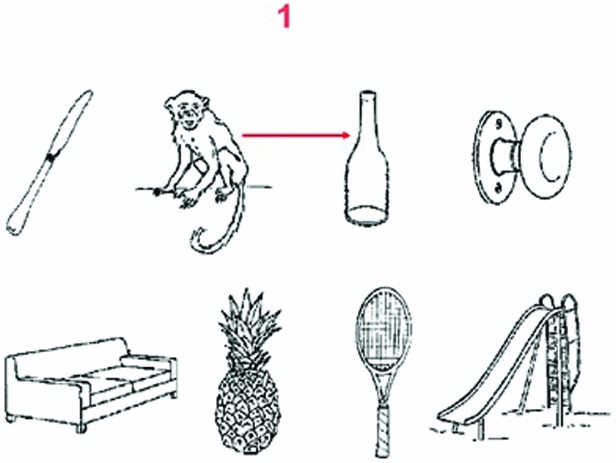
We adapted Fraundorf, Watson and Benjamin's (Reference Fraundorf, Watson and Benjamin2015) collaborative map task. The speaker was presented with a sequence of 6 “maps” (see Figure 1), plus a practice map, showed on a computer screen using DMDX (Forster & Forster, Reference Forster and Forster2003). In each map, there were two arrays of four objects, four were displayed in a string in the upper part of the map and four in the lower part, where two objects were linked in eight consecutive steps per map. Each object was involved in two different links, whose direction could be horizontal (two objects in the same string in the upper or lower part of the screen), vertical (two objects in the same axis in different strings from the upper to the lower or from the lower to the upper part of the screen) or diagonal (two objects in different axis in different strings from the upper to the lower or from the lower to the upper part of the screen).
depicts an example of a map used by native/native pairs and native/non-native pairs. Concretely, the figure shows the map seen by the speaker in a computer screen. Listeners had the same maps in paper with no links (in this case, an arrow from the monkey to the bottle).

The confederate (listener) had exactly the same 6 maps (plus the practice map) that the speaker had, but printed on paper and with no links between the objects. The task of the speaker was to tell the listener which were the two linked objects and in which direction, by giving instructions aloud of the type “go from the monkey (object 1) to the bottle (object 2)”. Then the task of the listener was to draw an arrow linking the two mentioned objects. For the “native/native” interaction, the listener was always the same female Spanish confederate. For the “native/non-native” interaction, the confederate was always the same American native male speaker, non-native speaker of Spanish. Two actions were taken in order to offer cues about the proficiency of the listener. First, as the dyad was introduced, the experimenter asked the confederate for how long he had lived in Spain. The confederate always answered “for about a year” (in Spanish). Secondly, there were several moments (marked in the map, and randomized across subjects) during the task where the confederate showed confusion through questions like “from where did you say? /to where did you say?”. Each instruction remained on the screen until the speaker pressed the spacebar, once the instruction was uttered. Participants were seated face to face in a soundproof booth and they could not see each other's map. Analyses of utterances were blind to the experimenter. There were a total of 96 utterances per participant (6 maps x 8 objects per map x 2 mentions per object). The task lasted approximately 20 minutes.
Stimuli
Items consisted of 48 Spanish words, which were mentioned twice (see Appendix 1). They were randomly distributed regarding 1) the map to which a particular item belonged to (6 options); 2) the order in which the items were displayed in the map's arrays (8 options); 3) the order in which the items were mentioned (2 options) and 4) the other item with which they were paired (7 options). Half of the items were mentioned in first place within the sentence of instruction and half of the items were mentioned in second place (that is, in half of the occasions the instruction would be “go from the monkey to the bottle”, whereas on the other half “go from the bottle to the monkey”). This feature was randomized between participants. Repetitions were not immediate through maps but there were between 1 and 13 intermediate words between mentions (depending on the randomization in the mention order). Drawings were selected from several sources (including the Snodgrass database (Snodgrass & Vanderwart, Reference Snodgrass and Vanderwart1980) and the International Picture Naming Project (Szekely, Jacobsen, D'Amico, Devescovi, Andonova, Herron, Lu, Pechmann, Pleh, Wicha, Federmeier, Gerdjikova, Gutierrez, Hung, Hsu, Iyer, Kohnert, Mehotcheva, Orozco-Figueroa, Tzeng, Tzeng, Arevalo, Vargha, Butler, Buffington & Bates, Reference Szekely, Jacobsen, D'Amico, Devescovi, Andonova, Herron, Lu, Pechmann, Pleh, Wicha, Federmeier, Gerdjikova, Gutierrez, Hung, Hsu, Iyer, Kohnert, Mehotcheva, Orozco-Figueroa, Tzeng, Tzeng, Arevalo, Vargha, Butler, Buffington and Bates2004).
Measures indexing word reduction
We used word duration and intensity as proxies for word reduction. Values were extracted using Praat version 5.3.15 (Boersma & Weenink, Reference Boersma and Weenink2008). Word duration is reported in milliseconds (ms) reflecting the mean in duration for the whole word. Word intensity is reported in decibels (dB) reflecting the mean in intensity for the whole word. Word duration was extracted manually focusing on the beginning and end of the word and by listening carefully to each word and examining the visual waveform. Once duration is selected, intensity can be obtained automatically in Praat (Boersma & Weenink, Reference Boersma and Weenink2008). Duration and intensity were extracted in a blind way so it was not possible to know whether the word referred to a first or to a second mention.
Data analysis
Data obtained regarding the measures of duration and intensity were analyzed by fitting independent Generalized Linear Mixed Effects models with the lme4 library in R (Bates, Maechler & Dai, Reference Bates, Maechler and Dai2008; see also Baayen, Davidson & Bates, Reference Baayen, Davidson and Bates2008; R Development Core Team, 2010). First, for each of these measures, datapoints 2.5 standard deviations above or below participants’ mean were identified as outliers and discarded from the analysis. The two factors of interest, Mention and Group, were contrast-coded and centered.
Duration and intensity were analyzed separately. Different models (maximum likelihood fit) were compared step-wise by means of log likelihood tests to identify the optimal linear mixed-effects model (Barr, Levy, Scheepers & Tily, Reference Barr, Levy, Scheepers and Tily2013). In particular, we applied a forward model comparison, from the simplest model including one fixed factor (Mention/Group) and random intercepts (Subjects/Items) to a more complex model including fixed factors, random intercepts and random slopes. In addition to our variables of interest, Mention and Group, models included other variables such as the Cognate Status of the words, the Distance between words (from 1 to 13) and Lexical Frequency, which might have an impact on word reduction (see, for instance, Gregory et al., Reference Gregory, Raymond, Bell, Fosler-Lussier and Jurafsky1999; Jurafsky et al., Reference Jurafsky, Bell, Gregory and Raymond2001). Model comparison was done in two steps. First, we selected the optimal linear mixed model including fixed factors and random intercepts. Second, the obtained model was compared with models including random slopes for subjects and items. For both measures, a model including Mention and Group and the interaction between Mention and Distance between mentions as fixed factors, Subjects and Items as random intercepts and random slopes (Mention for subjects and Distance between mentions for items) turned out to be a more optimal model (Duration: AIC = 22258; χ2 = 6.5, p = .03; Intensity: AIC = 9517; χ2 = 403, p = .03). Note that the model did not include the interaction between our factors of interest, Mention and Group, suggesting that these two factors were not significantly inter-dependent (therefore no significant interaction between them is expected). Thus, the results report the main effects of Mention, Group and Distance between mentions and the interaction between Mention and Distance.
Results
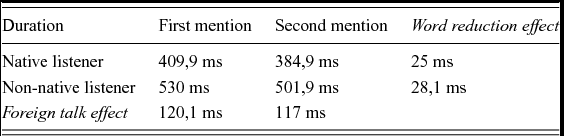
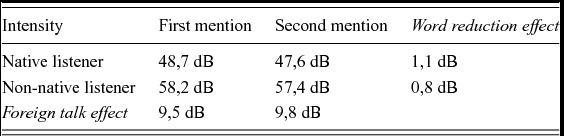
The results for duration and intensity for the two experimental groups and the corresponding mixed models analyses are reported in Tables 1 and 2 respectively. Data from natives speaking to natives in the first mention were considered as the intercept (baseline condition) against which the other levels were compared. Coefficient estimates and t-values (lmer.test package in R) are reported in the results section. The model included observations from 48 items and 28 participants. Note that positive coefficient and t-values indicate an increase for a given measure while negative indicates a decrease.
First mentions' values, second mentions' values and foreigner talk effect for Duration.

First mentions' values, second mentions' values and foreigner talk effect for Intensity.

Duration (measured in ms)
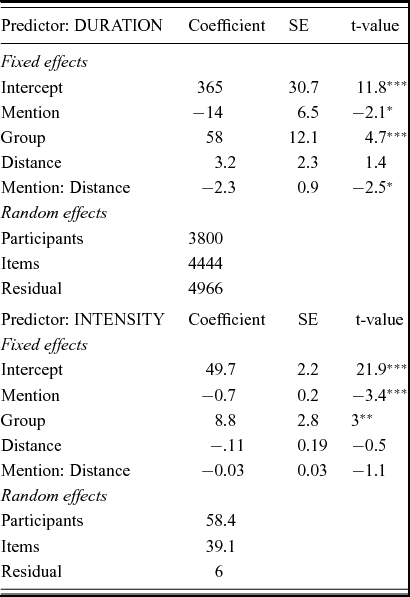
As indicated in Table 1, the duration of the words was reduced significantly from the first to the second mention (β = −28.2, SE = 6.8, t-value = −4.1, p < .001). Moreover, as indicated by the effect of Group (β = 58, SE = 13.2, t-value = 4.3, p < .001), the duration of the words was longer in those interactions involving non-native listeners. This result can be taken as an indication of foreign talk. The interaction between Mention and Distance between mentions was significant (β = −2.3, SE = 0.9, t-value = −2.5, p < .001) suggesting that word reduction was greater for those words with a short lag between mentions.
Intensity (measured in dB)
As indicated in Table 2, word intensity was higher in the first than in the second mention (β = −1.3, SE = 0.2, t-value = −4.7, p < .001), and it was also higher in the non-native group (β = 4.4, SE = 1.4, t-value = 3.04, p < .001), indicating the presence of foreigner talk. No other effect or interaction resulted significant (see Table 3 for more details on Duration and Intensity).
Coefficient and significant t-values (significance codes: 0 ‘***’ 0.001 ‘**’ 0.01 ‘*’ 0.05 ‘.’ 0.1 ‘ ’ 1) for the predictors Duration and Intensity.

Discussion
We explored whether foreigner talk affects the magnitude of the word reduction phenomenon in an interactive setting. We asked participants to perform a map task, in which a native speaker gave directions aloud to a native or to a non-native confederate listener. Three main observations were made. First, native speakers performed foreigner talk when speaking to non-native listeners for both duration and intensity: in other words, they spoke more slowly and loudly to non-natives. Second, native speakers reduced words when such words have been already introduced in the conversation: that is, second mentions have a shorter duration and higher intensity. Third, the magnitude of the word reduction effect was similar in the two types of interactions. We also observed that word reduction for duration was stronger when there was a short lag between mentions. This particular aspect would be congruent with accounts such as the dual process model (Brown & Dell, Reference Brown and Dell1987; Bard, Anderson, Sotillo, Aylett, Doherty-Sneddon & Newlands, Reference Bard, Anderson, Sotillo, Aylett, Doherty-Sneddon and Newlands2000), where reduction is driven by automatic processes as priming. Hence, priming effects would be stronger if the distance between mentions is short.
The presence of foreigner talk shows that native speakers take the characteristics (and maybe, the needs) of listeners into consideration. This evidence is congruent with previous findings on foreigner talk for duration and intensity (Chaudron, Reference Chaudron1979; Henzl, Reference Henzl1979; Nelson, Reference Nelson1992; Ramamurti, Reference Ramamurti1980, Scarborough et al., Reference Scarborough, Dmitrieva, Hall-Lew, Zhao and Brenier2007). Very relevantly, the current results show the word reduction phenomenon in a communicative scenario for duration and intensity in both native/native and in native/non-native interactions. Our results also extend previous findings as those by Baker and Bradlow (Reference Baker and Bradlow2009) and Bradlow and Alexander (Reference Bradlow and Alexander2007) and challenge previous literature that has considered duration as the main and most reliable indicator to address word reduction – in comparison to intensity (Fowler & Housum, Reference Fowler and Housum1987; Isaacs & Watson, Reference Isaacs and Watson2010; Lam & Watson, Reference Lam and Watson2010).
With respect to word reduction as a feature of foreigner talk (or the interaction between foreigner talk and word reduction), word duration and word intensity were reduced in a comparable way for native and non-native listeners. Therefore, foreigner talk and word reduction did not interact. As we already mentioned, reducing second mentioned words when talking to a non-native could be a double-edged sword. It can benefit the listener as it signals the informational status of words (as in “this word is new” or “this has already been presented”; Birch & Clifton, Reference Birch and Clifton1995; Dahan, Tanenhaus & Chambers, Reference Dahan, Tanenhaus and Chambers2002; Fowler & Housum, Reference Fowler and Housum1987; Terken & Noteboom, Reference Terken and Nooteboom1987). However, as reduction involves hypo-articulation, it can challenge intelligibility (Bard & Aylett, Reference Bard and Aylett1999; Fowler & Housum, Reference Fowler and Housum1987; Lieberman, Reference Lieberman1963) and lead to miscommunication as non-native speakers have lower experience than natives at any level of language (Bradlow & Alexander, Reference Bradlow and Alexander2007). Our study suggests that although word reduction is performed, native speakers aid non-natives through foreigner talk. This is in line with previous evidence supporting foreigner talk (Campbell et al., Reference Campbell, Gaskill, Vander Brook and Henning1977; Ferguson, Reference Ferguson1971; James, Reference James1986; Lattey, Reference Lattey1981) and also fits with related literature showing the interaction between word reduction and clear speech in word duration (Baker & Bradlow, Reference Baker and Bradlow2009).
To conclude, with a novel approach, our study replicates previous findings on foreigner talk and word reduction and shows that these effects coexist in native/non-native interactions. This result posits some limits to the foreign talk phenomenon by showing that word reduction is insensitive to the communicative adjustments that speakers make in the context of foreigner talk.
Supplementary Material
For supplementary material accompanying this paper, visit https://doi.org/10.1017/S1366728917000402
Appendix
List of words employed in the study and their properties.