Introduction
Through a series of tragic events, contemporary Iraq has become an ideal place in which to test the thesis that severe insecurity leads to xenophobia. Building on a long research tradition to which political scientists, psychologists and historians have contributed, Inglehart and Inglehart and Welzel argue that “existential security”—the feeling that survival can be taken for granted—is conducive to interpersonal trust, tolerance of foreigners and other out-groups, openness to social change, and a pro-democratic political culture.1
Conversely, they argue, existential insecurity is conducive to 1) xenophobia and 2) strong in-group solidarity. The fact that insecurity is linked with intolerance of out-groups has been demonstrated repeatedly in history, when demagogues have manipulated mass fears to build strong in-group feeling and rejection of out-groups.In recent decades, the people of Iraq have experienced exceptional levels of insecurity. After taking power in 1968, Saddam Hussein launched a reign of terror designed to eliminate all potential rivals. He then invaded neighboring countries; Iraq was at war with Iran from 1980 to 1988, and then invaded Kuwait, leading to the first Gulf War in 1991 and the second Gulf War in 2003. The result was massive casualties, severe economic disruption and, eventually, international economic sanctions. A low standard of living was exacerbated by the unpredictability and fear of living under a harshly repressive government. In 2003 foreign military intervention ended Saddam's regime but brought disorder, widespread unemployment, chronic shortages of electric power and clean water, and almost daily terrorist attacks.
In recent years, the Iraqi public has experienced a severe sense of existential insecurity. Though Iraqi life expectancy is by no means the lowest in the world, there seem to be a widespread feelings that life has become unpredictable and society is falling apart. In recent years, Iraq has been the target of more terrorist activity than any other country in the world. During the three years after September 11, 2001, thousands of people were killed in terrorist attacks around the world. Over half of these deaths occurred in Iraq.2
These figures are from a September 2, 2004 NBC News report.
Deaths from terrorist attacks are far more salient than those from other causes. The September, 2001 attacks in the U.S. caused almost 3,000 deaths. They brought an enormous amount of media coverage and widespread anxiety, and led to major changes in how American society operates, from security procedures at airports, to the suspension of long-standing legal norms concerning search and imprisonment, to the invasions of Afghanistan and Iraq. The 38,000 deaths in automobile accidents and 350,000 premature deaths from smoking that occurred in the U.S. in that same year passed almost unnoticed, though they killed vastly larger numbers of people. Terrorism is designed to cause anxiety and it has been uniquely successful in doing so.
Terrorism is not the only factor that has contributed to a pervasive sense of insecurity and xenophobia in Iraq, but it has played a major role. Regional differences in the prevalence of xenophobia within Iraq provide one indicator of this fact. The terrorist attacks in post-Saddam Iraq have been overwhelmingly concentrated in the Arab regions, and the Kurd region has been relatively free from them. Nevertheless, the Kurds suffered almost genocidal persecution under Saddam, and—as we will see—they show one of the world's highest levels of xenophobia. But the Arab regions of Iraq show levels of xenophobia that are almost twice as high as those found in the Kurdish region, and far higher than in any other country for which data are available. Thus, insecurity in Iraq seems to reflect both long-term factors linked with the reign of Saddam, and short-term factors linked with the disorder and terrorism that have prevailed since his fall. Since we do not have time series data, it is impossible to measure their relative impact in a conclusive fashion, but the Kurd-Arab comparison suggests that both types of factors are important.
Data from the World Values Survey support the hypothesis that xenophobia and insecurity are linked.3
Inglehart et al. 2004.
For a detailed description of this dimension and how it is measured, see Inglehart and Welzel, 2005: ch. 2.
This article tests these hypotheses. As we will see, evidence from a recent representative national survey of the Iraqi public, carried out in connection with the World Values Surveys, strongly supports these expectations.5
This article is based on a representative national survey of the Iraqi adult public carried out in November/December, 2004 (N = 2,325). Fieldwork was supported by the National Science Foundation and carried out by the Independent Institute for Administration and Civil Society Studies, Baghdad, directed by Munqith M. Daghir. The overall response rate was 89 percent. For additional details on Iraqi fieldwork, see the Appendix to this article. The Iraqi data are compared with the latest available wave of data from the World Values Surveys and the European Values Surveys, most of which were carried out in 1999–2001. For details concerning these surveys, see Inglehart et al. 2004 and http://worldvaluessurvey.org.
Although we do not have evidence from earlier surveys that would make it possible to compare these findings with Iraqi society at earlier times, it seems highly unlikely that these characteristics have been a permanent feature of Iraqi society. Prior to Saddam's regime, Iraq was economically one of the more developed Islamic countries, with a relatively highly educated population and with women playing a more active role in economic and social life than in many other Islamic societies. We strongly suspect that the high levels of xenophobia and out-group rejection found today reflect, in large part, the extreme insecurity experienced in recent years. The empirical evidence makes it clear that today, Iraq is characterized by the highest level of xenophobia found in any of the more than 80 societies that have been investigated by the Values Surveys.
Theoretical Background
Inglehart and Welzel argue that there is a pervasive tendency for existential insecurity to produce intolerance and xenophobia.6
Inglehart and Welzel 2005.
Adorno et al. 1950; Christie and Jahoda 1954; cf. Feldman and Stenner 1997; Whitley 1999; and Duckitt 1989.
From an historical perspective, the Iraqi worldview has been shaped by a series of military coups in 1958, 1963, and 1968, which made military seizure of power the principal means of regime change.8
Political instability was compounded by sharp internal ethnic divisions, based on both ethnicity, pitting Kurds against Arabs, and religion, with Sunni confronting Shi'a. Until recently, the Sunni Arab minority monopolized political power. Initially, their rule rested on Sunni domination of the army, but they extended their power through nationalization of the banks, insurance companies, and large industrial firms. Massive oil revenues enabling the regime to develop a powerful modern repressive apparatus. All of these factors may have contributed to a sense of insecurity and intolerance of outsiders.From another perspective, Gibson; Rohrschneider; Sniderman and Carmines; and Sniderman, Peri, de Figuerido, and Piazza have explored the ways in which economic and physical insecurity lead to intolerance of outgroups.9
Their analyses fit the Iraqi case rather well. Moreover political scientists have often noted the tendency for publics to close ranks behind their nation's leader in time of international conflict—the most recent case being the sharp rise in support for President George W. Bush after the terrorists attacks of September 11, 2001.10See Baum 2002; Bowen 1989; Brody 1991; Callaghan and Virtanen 1993; Edwards and Swenson 1997; Hetherington and Nelson 2003; Krosnick and Brannon 1993; MacKuen 1983; Oneal and Bryan 1995; Parker 1995; and Sigelman and Conover 1981.
McNeill 1982, 382.
Out-group rejection is not necessarily based on fear of the specific out-group: under conditions of insecurity, people tend to cling to the old familiar rules and reject social change—with relatively powerless excluded groups such as women, ethnic minorities, or homosexuals being excluded all the more intensely when a society experiences severe existential insecurity.
Findings
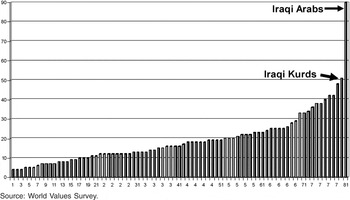
As figure 1 indicates, the Iraqi public currently displays exceptionally high levels of xenophobia. Repeated waves of the Values Surveys have asked representative national samples of the publics of more than 80 societies the question, “On this list are various groups of people. Could you please sort out any that you would not like to have as neighbors?” One of the options on the list was “immigrants/foreign workers.” Figure 1 shows the percentage of the public who indicated that they would not want to have foreigners as neighbors, in countries on all six inhabited continents. A more specific version of this question was asked in Iraq: the public was asked about various specific groups of foreigners, ranging from Westerners (the Americans, British and French) to neighboring Islamic publics (Iranians, Turks, Kuwaitis and Jordanians) and also including various groups within Iraqi society.

Percentage rejecting foreigners as neighbors in 80 societies.
Perhaps not surprisingly under current conditions, the nationalities of the two main occupying powers were highly unpopular: Americans and British were both rejected as neighbors by overwhelming majorities of 87 percent among the Iraqi public as a whole. But the French—although their government had strongly resisted the invasion of Iraq—were only slightly less unpopular; fully 84 percent of the Iraqi public said they would not like to have French people as neighbors (this number is used as the basis for the comparisons in figure 1). As hypothesized, under current conditions the Kurds are substantially less likely to reject foreigners than their Arab compatriots, but both groups show extremely high levels of xenophobia in international perspective. Iceland and Brazil ranked lowest, with only 4 percent of the public saying they would not like to have foreigners as neighbors. In Canada, Australia and Sweden, the figure was 5 percent; in the U.S. it was 9 percent. In the median country, 16 percent rejected having foreign neighbors, but the figure ranged as high as 48 percent in Bangladesh (another society with high levels of existential insecurity). The Iraqis ranked still higher, with 51 percent of the Kurds, and fully 90 percent of the Arab-speaking Iraqis rejecting having French neighbors. The Iraqis also rejected the publics of nearby predominantly Islamic countries to a remarkable degree. While the percentages rejecting “foreigners” in other countries ranged from 4 percent to 48 percent, fully 61 percent of the Iraqi public said that they would not want Turks as neighbors, and 55 percent said they would not want Iranian neighbors (the Kurds being somewhat more tolerant of foreigners than their Arab compatriots in every case). The only foreign nationality that was not rejected by a majority of the Iraqi public was the Jordanians, an ethnically similar nationality that has maintained close supportive ties with the Iraqis. But even here, 44 percent of the Iraqi public said that they would not want to have Jordanians as neighbors—an extremely high level of rejection by global standards.
In keeping with our expectation that insecurity leads to in-group solidarity, the Iraqi public does not reject most groups within Iraqi society as neighbors—but they reject foreigners to a degree that is virtually unknown in other societies throughout the world, including more than a dozen predominantly Islamic countries.
In non-Islamic societies, respondents were asked whether they would prefer not to have Islamic neighbors. Although the question about immigrants or foreign workers refers to a relatively broad group, this one has a specific target, like the questions asked in Iraq. The responses range from 6 percent in Argentina to a high of 59 percent in Hungary, with a median level of 17 percent saying they would not like to have Muslim neighbors. Most publics are somewhat more likely to reject the idea of having Muslims as neighbors than foreigners in general, but nowhere does the level of rejection begin to approach the 85 percent level of rejection that the Iraqi public expressed for the French, or the 87 percent rejection for the British and Americans. In only two non-Islamic societies does a majority say that they would not like to have Muslims as neighbors, and even there the level of rejection is lower than the level that the Iraqis expressed toward the Turks, a neighboring Islamic people.
Foreigners are not the only out-group that the Iraqi public currently tends to reject. Although they constitute a majority of the population in most societies, women have historically been an out-group, viewed as second-class citizens and excluded from power. In this case, rejection of out-groups is not so much based on fear of that specific group, as on fear of social change: under conditions of insecurity, people tend to cling to the old familiar rules, whatever they are. Respondents to the World Values Surveys were asked whether they agreed with the statement that “On the whole, men make better political leaders than women do.” In the median society, 52 percent of the public agreed that men make better political leaders than women. But here again the Iraqi public took an extreme position—with 93 percent of the Iraqi Arabs agreeing that men make better political leaders than women, a higher proportion than is found in any other society for which data are available. Again, the Iraqi Kurds are significantly less likely to have a patriarchal outlook than their Arab peers (72 percent agreed), but both groups rank high in international perspective.
This outlook does not seem to be a permanent feature of Iraqi society. Historically, Iraqi women have had more opportunity to pursue higher education and careers than was true in of women many other Islamic societies.12
But in recent years, Iraq has experienced what might be regarded as a tragic field experiment on what happens when people experience severe existential insecurity—and one result is the highest level of support for gender inequality on record.Facing severe existential insecurity, people tend to close ranks against outsiders. Closing ranks brings obedience to authority and rigid adherence to group norms. Individual autonomy is minimized; loyalty and conformity are stressed. Another battery in the Values Surveys provides a useful indicator of group norms. The respondents were asked: “Here is a list of qualities that children can be encouraged to learn at home. Which, if any, do you consider to be especially important?” The respondent was shown a list of ten goals, from which he or she might select up to five. One of the themes in this battery involved the respondent's relative emphasis on individual autonomy versus group conformity. For example, one of the qualities a child might be encouraged to learn was Independence. Iraqi Arabs were unlikely to emphasize independence: only six publics ranked lower than them in emphasizing it. The Iraqi Kurds, on the other hand, ranked slightly above the international median in emphasizing independence.
But the Iraqi Arabs are more likely to emphasize Obedience than the publics of any of the 80 other societies for which data are available—and the Kurds also emphasize obedience very strongly. Furthermore, Iraqi Arabs were more likely to emphasize Religious faith than any other public for which data are available; here again, although the Kurds rank significantly lower than the Arabs, they rank high in international comparison. Overall, if we subtract the percentage emphasizing independence from the percentage emphasizing obedience and religious faith, the Iraqi Arabs emphasize conformity to authority and group norms, rather than individual autonomy, more heavily than any other public in the world. As expected, the Iraqi Kurds emphasize conformity less strongly than their Arab compatriots, but they rank relatively high in global perspective. Once again, let us emphasize that we do not view the extreme emphasis on obedience and conformity currently found among Iraqi Arabs as a permanent characteristic of that group; it is almost certainly influenced by their recent experience of extreme existential insecurity.
Severe existential insecurity leads to rigid adherence to traditional social norms—and the most central social norms are the ones codified in a society's religion. Accordingly—although most observers would agree that, prior to Saddam's seizure of power, Iraq was one of the more secular Arab societies; and although Saddam's Baath Socialist Party advocated secularism13
—we would expect the Iraqi public today to place relatively strong emphasis on religion. The evidence supports this expectation. The Values Surveys asked, “For each of the following, indicate how important it is in your life. Would you say it is ‘Very important,’ ‘Rather important,’ ‘Not very important,’ or ‘Not at all important’?” They were shown a list that included Family, Friends, Leisure time, Politics, Work, and Religion.Across the 80 societies for which we have data, the percentage saying that religion is Very important in their lives ranges from a low of 3 percent to a high of 98 percent. In this context, fully 97 percent of the Arab Iraqis say that religion is very important in their lives. Only Indonesia ranks higher, and only by an insignificant margin. In a pattern that is by now familiar, the Iraqi Kurds fall well short of the extreme position of their Arab peers, but still rank among the world's most religious publics.
Needless to say, a society's emphasis on religion does not simply reflect the extent to which it is currently under stress; religious belief also reflects deep-rooted cultural traditions that change only slowly. While some societies place relatively little emphasis on religion, Islamic societies in general and Arab societies in particular, tend to emphasize religion strongly. There is a wide gap between the relatively secular Islamic societies that experienced communist rule (such as Albania, Azerbaijan and Kyrgyzstan), and the other Islamic societies, which include eight of the ten most religious societies for which we have data. In important part, the strong emphasis on religion currently found among the Iraqi public seems to reflect Iraq's heritage as an Islamic, largely Arab, society. The extreme position currently taken by the Iraqi Arabs on many variables almost certainly reflects the influence of long-term cultural influences to some extent—but the evidence strongly suggests that it also reflects the impact of the intense existential insecurity they have experienced in recent years. Formerly viewed as relatively secular, the Iraqi Arabs today seem to emphasize religion more strongly than virtually any other people in the world.
Each country's respondents were asked whether they agreed with the proposition that “atheists are unfit for public office.” Here again, the Iraqi Arabs rank near the top: only the Pakistanis outrank them in emphasis on religion as a prerequisite for public office. Following a familiar pattern, the Iraqi Kurds rank significantly below the Arabs, but nevertheless are among the highest-ranking publics on this variable. As suggested earlier, we attribute this difference, at least in part, to the political autonomy and less extreme insecurity that the Kurds have experienced in since 1991.
As hypothesized, the Iraqi public currently shows a strong tendency to reject outsiders and adhere to traditional values. Now let us examine another aspect of this syndrome: in-group solidarity. Each public was asked, “How proud are you to be [YOUR NATIONALITY]?” We find that—despite severe internal divisions that have led many Kurds to want to leave Iraq altogether—the Iraqi public as a whole expresses relatively strong feelings of national pride. Moreover, when we filter out the Kurdish minority (only 34 percent of whom express strong national pride), we find that fully 86 percent of the Arab Iraqis say they are “very proud” to be Iraqi. Only five of the 86 publics for which we have data ranked higher (and each of them was besieged in one way or another). The strong national pride expressed by the Iraqi public can hardly be interpreted as an expression of satisfaction with how well their country was doing: when this survey was carried out, conditions could hardly have been worse. It seems to be a defiant expression of solidarity against outsiders.
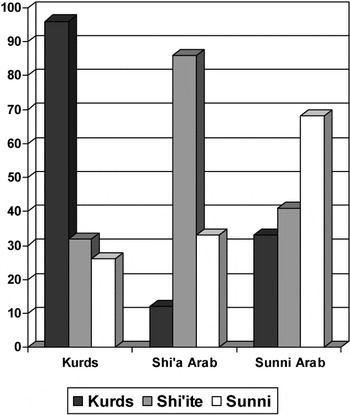
The Iraqis also show extremely high levels of solidarity with their specific ethnic group (i.e., the Sunni Kurds, Sunni Arabs or Shi'a Arabs). As figure 2 indicates, 86 percent of the Shi'ites say that they trust other Shi'ites “a great deal”; the corresponding figures are 68 percent among the Sunni Arabs and 96 percent among the Kurds. These figures are exceptionally high in international perspective. Among the publics of the European Union countries, for example, the percentage expressing strong trust in their own nationality ranges from 20 percent among the Italians to a high of 58 percent among the Irish14
These data are from Commission of the European Union 1994.

Inter-ethnic trust in Iraq.
The Iraqis have a strong sense of in-group solidarity, but they differentiate sharply between their own ethnic group and other groups within Iraqi society, as figure 2 also illustrates. The median percentage of Iraqis who strongly trust the other Iraqi ethnic groups is 33 percent; the median percentage of Iraqis who strongly trust their own ethnic group is 86 percent. By comparison, the median percentage of European Union publics who consider their own nationality to be “very” trustworthy is 48 percent;15
The 1990 World Values Survey asked the publics of 41 societies around the world to what extent they trusted people of their own nationality. The media proportion saying they “trusted them completely” was 20 percent. This figure is not comparable with those cited above because it is based on five response categories (including a mid-point indicating “I neither trust nor distrust them”) rather than the four categories used above. But the evidence from these surveys does nothing to undermine the conclusion that the Iraqis currently have reasonably high levels of trust in their own nationality. The highest levels of “complete trust” in one's own nationality are found in Turkey and India, with 50 percent and 55 percent, respectively: these levels are twice as high as those found in any West European country.
Implications
The Iraqi public currently shows intense rejection of out-groups and intense in-group solidarity. What is the outlook for the successful establishment of democracy?
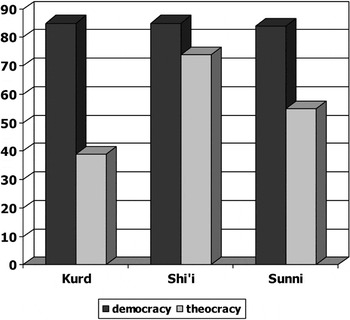
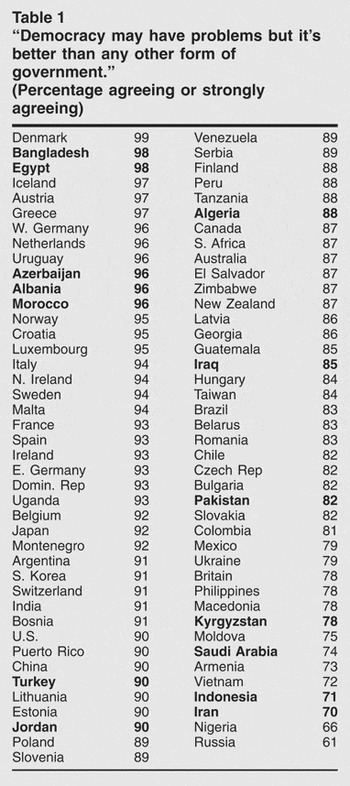
Let's start with the good news. At this point in history, solid majorities of publics throughout the world see democracy as the best form of government. This has not always been the case. During most of the twentieth century, alternatives to democracy such as fascism and communism had massive support. And today, in Islamic societies, theocratic government has widespread appeal. But in the contemporary world, in every country for which we have data, most people aspire to democracy. Our respondents were asked a series of questions about the problems of democracy, inquiring whether democracies were ineffective at running the economy or in keeping order; immediately after reviewing these problems, they were asked whether they agreed or disagreed with the statement that “Democracy may have problems, but it's better than any other form of government.” Solid majorities of the public in every country agreed with this statement, as table 1 demonstrates. The 14 Islamic societies included in our surveys rank anywhere from near the top to near the bottom, but in every one of them, a solid majority says that democracy is the best form of government. In beleaguered Iraq, in face of violent opposition, and despite antagonism toward the Western democracies, fully 85 percent of the public said that democracy was the best form of government, and there is no significant difference between Iraqi Kurds and Arabs on this point. This is an important and encouraging fact. See figure 3.

Support for democracy vs. support for Islamic government.
“Democracy may have problems but it's better than any other form of government.”

But the situation is more complex than this might seem to indicate. Support for democracy is not incompatible with support for absolute rule by the religious authorities: logically, the two might seem incompatible, but a large part of the Iraqi public has positive feelings toward both kinds of government. The Iraqis were asked, “I'm going to describe various types of political systems and ask what you think about each of them as a way of governing this country. For each one, would you say it is a very good, fairly good, fairly bad, or very bad way of governing this country?” Among five alternatives, the two leading choices were “Having a democratic system” and “Having an Islamic government, where religious authorities have absolute power.” Although support for democracy is widespread, there is also substantial support for rule by religious authorities. Among the Kurds, for example, 92 percent said that a democratic system would be “very good” or “somewhat good”; but 36 percent gave similar positive ratings to “an Islamic government where religious authorities have absolute power.” Among Sunni Arabs, the balance was closer: 85 percent gave positive ratings to a democratic system, but more than half also gave positive ratings to an Islamic theocracy. The Shi'ite Arabs were even more closely divided: almost 90 percent had positive feelings toward a democratic system—but more than 70 percent thought that an Islamic theocracy would be good. Even among the Shi'ite Arabs democracy has more support than Islamic theocracy, but democracy is definitely not “the only game in town,” in Linz and Stepan's terms.16
Linz and Stepan 1978.
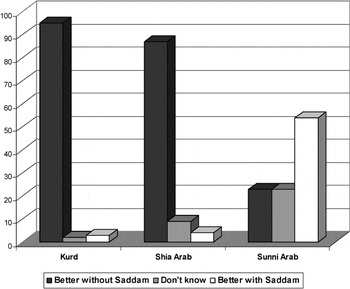
Democracy in Iraq is also threatened on another front. Our respondents were asked “On the whole, would you say that Iraq would have been better off if Saddam had stayed in power, or is Iraq better off without him?” The vast majority of the Kurds—95 percent—said that Iraq was better off without Saddam (as figure 4 indicates). And an overwhelming majority (87 percent) of the Shi'ite Arabs also felt that Iraq was better off without Saddam; only four percent thought Iraq would have been better off if he had stayed in power, while nine percent were uncertain. But among the Sunni Arabs, a narrow majority (53 percent) said that Iraq would have been better off if Saddam had stayed in power; the rest were evenly divided between thinking that Iraq was better off without Saddam, and being uncertain. If one wished to put a positive spin on this, one might point out that, even among the Sunni Arab minority (constituting roughly one-fifth of the population), only half could be described as Saddam loyalists. But this is a large enough group to cause massive disruption, making stable democracy difficult to attain.

Is Iraq better off without Saddam?
Democracy in Iraq is threatened by support for Islamic rule among the Shi'ite Arabs, and by nostalgia for Saddam among the Sunni Arabs. But the fact that support for each of these alternatives is limited to one segment of the population limits its potential. Iraq's natural pluralism creates difficulties but it also provides checks and balances.
Alternative Explanations: Economic Development, Islam and Existential Insecurity
The facts are clear. The Iraqi public in general, and the Iraqi Arabs in particular, currently show the highest levels of xenophobia found among the 80 societies for which data are available. They also show the most sexist outlook and the most intense emphasis on religion among these 80 countries, together with extremely high levels of in-group solidarity.
The reasons why they have this outlook can be debated. We attribute it to the exceptionally high levels of existential insecurity that the Iraqis have experienced from the time Saddam came to power in 1968 to the present. But it might be argued that exceptionally high levels of xenophobia, sexism, and intense religiosity have always characterized Iraqi society—that they are somehow a part of the Iraqi national character. We do not have the time series survey data that would be needed to refute this claim, but historical evidence provides no support for it. Prior to 1968, Iraq was one of the most prosperous Islamic countries with a relatively well-educated and socially integrated female population. Iraqi society was relatively tolerant of its Jewish minority and had a relatively relaxed brand of Islam—and from the time he took power, Saddam's regime advocated secularism. None of this would lead one to expect the intense xenophobia, sexism and religiosity that we find today. We suggest that contemporary Iraq constitutes a natural experiment on the impact of extreme existential insecurity.
Inglehart and Welzel argue that because economic scarcity is an important source of existential insecurity, low levels of economic development tend to be linked with xenophobia and rejection of outsiders; conversely, high levels of economic development are conducive to tolerance, support for gender equality and generalized interpersonal trust.17
Inglehart and Welzel 2005.
The results indicate that economic development is linked with levels of xenophobia; a society's per capita GNP by itself, explains 15 percent of the variation in rejection of foreigners among 80 societies. When we add a dummy variable for Iraq, the adjusted R-squared rises to 49 percent, explaining an additional 34 percent of the variance. On the other hand, when we add a dummy variable that reflects whether a given society is Islamic or non-Islamic, it explains only an additional 6 percent of the variance. A society's level of economic development and the presence of an Islamic heritage both have significant effects on its level of xenophobia—but by far the strongest explanatory variable is whether the society is Iraq or not.
Let us illustrate this in concrete terms. In “low income societies” (as defined by the World Bank) the average percentage rejecting foreigners as neighbors is 23 percent; in “lower middle income societies” the figure is 25 percent; among “upper middle income societies” the figure is 19 percent; and in “high income societies” it is only 11 percent—less than half the level in low-income societies. As expected, xenophobia is linked with economic development.
Iraq falls into the lower middle income category, but among Iraqi Kurds, fully 51 percent reject foreigners—double the mean figure for lower middle income societies; and among Iraqi Arabs, 90 percent reject foreigners—almost four times the mean figure for lower middle income societies. The Iraqis are far more xenophobic than their economic level would predict.
On the other hand, an Islamic cultural heritage has only a modest impact on xenophobia. Among Islamic societies other than Iraq, 28 percent reject foreigners—only slightly above the overall mean for lower middle income societies. But among the Iraqi public as a whole, 82 percent reject foreigners—almost three times as many as among other Islamic societies.
In short, economic insecurity apparently does contribute to xenophobia—but the Iraqi public shows much higher levels of xenophobia than their economic level (or Islamic heritage) would predict. Some nation-specific factor is making the Iraqi public far more xenophobic than any of the 80 other nations for which we have data. The most obvious factor seems to be the extreme insecurity that the Iraqi public has been experiencing now and for many years. Saddam's reign of terror and repeated wars, followed by military occupation and daily terrorist attacks have all probably contributed to an extreme sense of insecurity and it is impossible to isolate the effects of each of these factors with any precision. Nevertheless, the contrasting patterns found in the Kurdish and Arab regions of Iraq hint at the relative weight of long-term and current conditions. For the Kurdish region suffered more heavily under Saddam than the Arab region, but more recently their roles have been reversed. With this in mind, the 26 point margin by which Iraqi Kurds exceed the mean for middle income societies might be attributed to the impact of the long-term insecurity linked with the terror and wars of the Saddam regime, while the 39 point margin by which Iraqi Arabs exceed the Kurdish level might be attributed to the conditions of the post-Saddam era (including invasion, foreign occupation, and almost daily terrorist bombings).
Conclusion
Evidence from Iraq supports the hypothesis that severe existential insecurity gives rise to both xenophobia and rejection of outgroups, and to strong in-group solidarity. The high levels of xenophobia and rejection of outgroups that currently exist in Iraq, may hinder the emergence of stable democracy, for there is strong evidence that tolerance, trust, and an egalitarian outlook are conducive to democracy.18
Inglehart and Welzel 2005.
Despite threats that anyone who took part in the elections would be killed, and in the face of suicide bombers attempting to infiltrate the polling places, on Election Day in January 2005, millions of Iraqis turned out to vote. Although 300 terrorist attacks took place that day, fully 58 percent of those eligible to vote did so—a higher rate of turnout than in most U.S. presidential elections. In our survey, 85 percent of the Iraqi public said that “democracy may have problems, but it's better than any other form of government.” Their commitment to democracy seems genuine. They were willing to risk their lives for it.
Postscript: Updated Findings from 2006
The authors carried out another survey in Iraq in April 2006, interviewing a nationally representative sample of 2,701 Iraqi adults, with support from the National Science Foundation. The results update the findings presented in this article, and strengthen their interpretation. The basic thesis of the article is that insecurity is conducive to xenophobia. The new findings show that from 2004 to 2006, a sense of insecurity increased among the Iraq public—and feelings of xenophobia rose with it. A comparison of findings from the two surveys reveals the following information.
- The percentage of Iraqis who strongly agreed that “in Iraq these days life is unpredictable and dangerous” rose from 46 percent in 2004 to 59 percent in 2006. This change varied by ethnicity but there was an increasing sense of insecurity among all major ethnic groups.
- During the same period, feelings of xenophobia rose among the Iraqis. The percentage of Iraqis who would not like to have Americans as neighbors went up from 87 percent in 2004 to 90 percent in 2006. The comparable figures were 87 percent and 90 percent for the British, and 84 percent and 90 percent for the French, respectively. People from other Islamic countries also became increasingly unwelcome as neighbors: the percentage of Iraqis who did not wish to have Iranians as neighbors increased from 55 percent to 61 percent between the two surveys, and the comparable figures were 50 percent and 59 percent for Kuwaitis, 59 percent and 71 percent for the Turks, and 43 percent and 61 percent for Jordanians.
Appendix: Fieldwork in Iraq
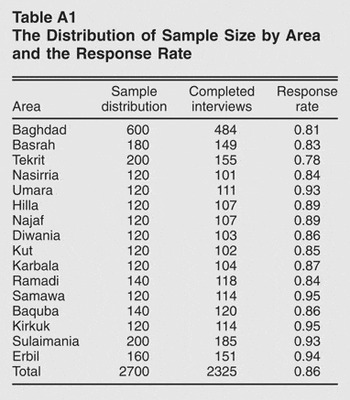
Face-to-face interviews were conducted with 2,325 Iraqis in November–December, 2004. A total of 2,700 Iraqis were selected for interviews, of whom 2,325 or 89 percent of the total, actually participated in the study. Table A1 shows the distribution of the sample by area and the response rate. This survey replicated key items from the World Values Survey, supplemented with a battery of questions developed for use in Islamic countries and with additional items that address the specific issues related to current social conditions of Iraq. This questionnaire was discussed with our Iraqi colleagues, and then translated and back-translated from Arabic to English by a person who had not seen the original English version. The result was compared with the original English version, resulting in some modifications. It was then pre-tested with a small sample of Iraqi respondents. The authors then formulated the final version of the questionnaire in light of suggestions received from our Iraqi colleagues.
Table A1: The Distribution of Sample Size by Area and the Response Rate