Introduction
Behavioral and psychological symptoms of dementia (BPSD) such as apathy, depression, agitation, and aggression are common, presenting in 70%–90% of individuals with dementia (Lyketsos et al., Reference Lyketsos, Steinberg, Tschanz, Norton, Steffens and Breitner2000). BPSD can present at any stage of dementia, although prevalence typically increases with disease progression. Early stages are characterized by symptoms such as depression, anxiety, apathy, and irritability, whilst later stages usually involve delusions, hallucinations, disinhibition, and wandering (Lopez et al., Reference Lopez2003).
Two-thirds of individuals with dementia reside in the community, therefore the majority of family caregivers are confronted with BPSD (Ballard and Cream, Reference Ballard and Cream2005). BPSD are a primary cause of burden, distress, reduced mental health, and quality of life for caregivers (Teri et al., Reference Teri, Truax, Logsdon and Pearson1989; Aneshensel et al., Reference Aneshensel, Pearlin and Schuler1993; Ballard et al., Reference Ballard, Lowery, Powell, O’Brien and James2000), as well as being predictive of institutionalization (Steele et al., Reference Steele, Rovner, Chase and Folstein1990). BPSD are often considered the most challenging part of the caregiving experience, having a greater influence on psychological well-being than cognitive or functional impairments (Black and Almeida, Reference Black and Almeida2004). Valid and reliable assessment of BPSD is therefore crucial. Measures include the Revised Memory and Behavior Problem Checklist (Teri et al., Reference Teri, Truax, Logsdon, Uomoto, Zarit and Vitaliano1992), and the Behavioral Pathology in Alzheimer's Disease Rating Scale (Reisberg et al., Reference Reisberg1987). However, the Neuropsychiatric Inventory (NPI; Cummings et al., Reference Cummings, Mega, Gray, Rosenberg-Thompson, Carusi and Gombein1994) is widely acknowledged as the gold-standard measure of BPSD in dementia research.
Several authors (e.g. Steffen et al., Reference Steffen, McKibbin, Zeiss, Gallagher-Thompson and Bandura2002) have applied the self-efficacy (SE) theory to explain the experiences of caregivers of individuals with dementia and the variability in their capacity to cope with difficulties such as BPSD. SE is a potentially modifiable construct that has implications for family caregiver quality of life, mental and physical health (Gignac and Gottlieb, Reference Gignac and Gottlieb1996). SE is the belief that one can perform capably in a given situation (Bandura, Reference Bandura1977). It includes beliefs about an individual's ability to “mobilize the motivation, cognitive resources, and courses of action needed to meet situational demands” (Bandura and Wood Reference Bandura and Wood1989, p. 408). Bandura (Reference Bandura1977) claimed interventions to aid BPSD management must both facilitate skill development and augment SE to use the skills.
Caregiver SE varies with caregiver characteristics and psychosocial factors. Depp et al. (Reference Depp, Sorocco, Kasl-Godley, Thompson, Rabinowitz and Gallagher-Thompson2005) found that adult child caregivers report higher SE than spouses, which might be related to the multiple roles occupied by adult-children. Greater dementia severity is associated with increased dependency, functional impairment, BPSD severity and frequency, and thus higher levels of caregiver distress (Baumgarten, Reference Baumgarten1989). Therefore, more severe dementia and more frequent and severe BPSD are likely to be associated with reduced caregiver SE for managing such behaviors. Negative psychological outcomes such as depression are associated with reduced SE; low SE is thought to be associated with emotional vulnerability and negative cognitions (Gignac and Gottlieb, Reference Gignac and Gottlieb1996).
Today, measures of SE are typically partitioned into subscales corresponding to the most challenging caregiving tasks. The Revised Scale of Caregiving Self-efficacy (RSSE; Steffen et al., Reference Steffen, McKibbin, Zeiss, Gallagher-Thompson and Bandura2002) has proved to be a popular instrument of caregiver efficacy in recent years. Domain-specific measures of SE have greater predictive ability than generic measures, and have greater capacity to facilitate more informed theoretical models of caregiver adaptation (Bandura, Reference Bandura, Urdan and Pajares2006). At present, there is no measure of caregiver efficacy for the management of BPSD. The aim of the study was to develop and evaluate the psychometric properties of a scale measuring caregiver efficacy for managing behavioral and psychological symptoms in dementia.
Methods
Study design
This study is a psychometric evaluation of a scale developed to measure caregiver efficacy for managing BPSD. Data were collected as part of the baseline interviews for the SHIELD (Support at Home: Interventions to Enhance Life in Dementia) Carer Supporter Programme study (Charlesworth et al., Reference Charlesworth2011). Recruitment sites were in community settings in South East England. Ethical approval was provided by the Outer North East London Research Ethical Committee.
Participants
The sample comprised 245 family caregivers and their relatives with dementia. To be eligible, participants had to be primary family caregivers, supporting a relative with dementia within the community, at least 18 years of age, and have a non-paid caregiving role. Participants were recruited through primary and secondary healthcare, health professionals, voluntary organizations, and social services. Written informed consent was obtained from both family caregivers and individuals with dementia.
Data collection/procedures
Trained researchers conducted interviews with family caregivers. The Caregiver Efficacy Scale and other standardized psychometric instruments were administered. For each participant, scales were administered by one researcher at one time point, with the order of scales remaining constant. Demographic information was collected from family caregivers and individuals with dementia, including age, gender, level of education, ethnicity, relationship type, and dementia severity.
Measures
Measures were administered in the order described below.
The Neuropsychiatric Inventory (NPI; Cummings et al., Reference Cummings, Mega, Gray, Rosenberg-Thompson, Carusi and Gombein1994) evaluates 12 behavioral disturbances in dementia: delusions, hallucinations, depression, anxiety, agitation/aggression, euphoria, disinhibition, irritability/lability, apathy, aberrant motor activity, sleep disturbance, and appetite and eating disorders. It is favored due to its distinct semi-structured approach. All items are dementia-specific, behavior-based, and grouped into domains each comprising a screening question, thus facilitating ease of administration. Each domain captures frequency, severity of BPSD, and caregiver distress. Frequency is rated on a scale of 1 (occasionally) to 4 (very frequently), severity is rated from 1 (mild) to 3 (severe), and caregiver distress is rated from 0 (no distress) to 5 (extreme or very severe). Total scores are calculated by multiplication of the frequency and severity for each symptom and the addition of all item scores, with a range of 0–144. The distress score total is calculated by the sum of all the individual domain scores, with a range of between 0 and 60. The validity and reliability of the NPI has been demonstrated (Cummings, Reference Cummings1997).
The Caregiver Efficacy Scale
The administration procedure for the NPI was followed, and if caregivers reported the presence of a particular BPSD they were asked to report their SE in dealing with that behavioral problem. The Caregiver Efficacy Scale was developed by the addition of a single four-response item to each domain of the NPI. For example, “How confident are you in dealing with the aggressive/agitated behavior?” Responses range from 4 (not at all confident), 3 (fairly confident), 2 (confident), and 1 (very confident). The four-point scale and responses were chosen for their simplicity and compatibility with the likert-type responses of the NPI. The efficacy item is reverse scored, with a high score indicative of a greater lack of SE (low SE) and a low score indicative of greater efficacy (lower lack of efficacy) to respond to BPSD. Reverse scoring was chosen to remain compatible with the Caregiver Distress Scale of the NPI, with a higher score indicative of greater caregiver distress. The caregiver SE total is the sum of the efficacy scores for each BPSD, with the score ranging between 0 and 48.
The NPI was chosen due to its prevalence in dementia research, its reliability and validity, as well as its ability to capture information relating to behavior frequency, severity, and caregiver distress. This made it possible to evaluate caregiver SE in relation to varying task demands. In developing a valid and reliable measure of SE, there were important methodological issues to consider (Bandura, Reference Bandura, Urdan and Pajares2006). It was important that items related to “can do,” as opposed to “will do,” as SE involves perceived capability, and the term “confidence” was used as opposed to “self-efficacy” to ensure that caregivers understood what was being asked.
The Negative impact scale of the Carers of Older People in Europe Index (COPE-Index; McKee et al., Reference McKee2003) is a seven-item measure of informal caregivers subjective perceptions of negative aspects of caregiving. It has good reliability and validity.
The Revised Scale for Caregiving Self-Efficacy (RSSE; Steffen et al., Reference Steffen, McKibbin, Zeiss, Gallagher-Thompson and Bandura2002) is a measure of caregiving efficacy over three domains: obtaining respite, responding to disruptive behaviors, and controlling upsetting thoughts. The scale consists of 15 items, each evaluating perceived confidence to complete a task on a scale of 0%–100%. The scale was designed for caregivers of people with dementia and has good reliability and validity.
The Hospital Anxiety and Depression Scale (HADS; Zigmond and Snaith, Reference Zigmond and Snaith1983) is a 14-item self-report scale that evaluates the severity of anxiety (seven items) and depression (seven items) and has good reliability and validity in a range of contexts.
The Negative Affect Scale (PANAS; Watson et al., Reference Watson, Clark and Tellegen1988) is a ten-item mood scale measuring negative affect. Participants are asked to rate the extent to which they have felt each mood state within a specific time frame along a five-point scale. The scale has good reliability and validity.
The Clinical Dementia Rating Scale (CDR; Hughes et al., Reference Hughes, Berg, Danziger, Coben and Martin1982) was used to evaluate dementia severity. This is a global scale with good validity and reliability developed to stage the severity of dementia. It is completed retrospectively to rate cognitive performance in six domains: memory, orientation, judgment and problem solving, community affairs, home and hobbies, and personal care.
Data analysis
The Statistical Package for Social Sciences Version 20 Software was used to carry out the analyses. The missing value analysis found data were missing completely at random X2 (1,350, N = 245) = 346.348, p = 1.000. Expectation maximization was used to impute missing values within participant measures at a 10% missing level. For example, if one item was missing from a ten-item score, the item was imputed from the others items. Within cases, there was little variation in variable completion by caregivers, the number of complete responses for variables ranged between 240 and 245. Data distribution for all variables was evaluated using the Kolmogorov–Smirnov test, and all data were found to be non-normally distributed.
Internal consistency
Internal consistency is the extent to which items evaluate a common characteristic, and this was evaluated using Cronbach's α coefficient. Coefficient values range between 0 and 1, with greater values indicative of greater reliability. Values of 0.80 are typically accepted as indicative of good internal consistency (Prince, Reference Prince1998).
Factor analysis
An exploratory principal component analysis (PCA) was performed to investigate the factor structure and construct validity of the Caregiver Efficacy Scale. SE is not a global construct, but a set of beliefs related to distinct domains of functioning (Bandura, Reference Bandura, Urdan and Pajares2006). However, SE theory suggests that SE can be transferred across domains involving similar skills. It is therefore expected that the PCA will demonstrate SE for dealing with BPSD to be a multifactor construct, as level of SE will be similar for behavior problems involving similar skills.
Suitability for the PCA was evaluated through inspection of Bartlett's test of sphericity, and the Kaiser–Meyer–Olkin (KMO) measure of sampling adequacy, inter-item correlations, and normality distributions. A direct oblimin oblique rotation was performed to aid interpretation by maximizing the loading of items on dominating factors, while keeping the number of factors fixed. Eigenvalues and variances for each of the factors were determined, with the number of factors extracted determined by examining the scree plot for a change in curve direction (Catell's scree test; Catell, Reference Catell1966) and Kaiser's criterion (eigenvalues that exceed one retained). An exploratory approach toward factor extraction was adopted, and a three-factor solution proved the best fit of the data (Tabachnick and Fidell, Reference Tabachnick and Fidell1996).
Concurrent validity
Concurrent validity is the degree to which an instrument correlates with other “gold standard” measures of the same construct. For this purpose, performance on the Caregiver Efficacy Scale was compared with subscales of the RSSE using the non-parametric Spearman's correlation coefficient.
Construct validity
Spearman's correlation coefficient was used to evaluate construct validity. Construct validity refers to whether an instrument measures the intended theorized construct. To evaluate convergent validity (whether a correlation exists where one would expect to find one), the relationship between the Caregiver Efficacy Scale and other standardized psychosocial factors, including negative caregiver outcomes such as depression, anxiety, negative affect, negative impact, distress, and dimensions of the NPI, such as BPSD severity and frequency, was examined. It was expected that a lack of caregiver efficacy would be associated with negative outcomes, greater distress, and increased BPSD severity and frequency.
Criterion validity
The extent to which the level of caregiver SE varied with dementia severity, level of depression, and relationship-type was examined using the non-parametric Kruskal–Wallis test and Mann–Whitney U test. It was expected that a lack of caregiver SE would be associated with greater dementia severity, the presence of caregiver depression, and being a spousal caregiver. In addition, those caregivers in the highest quartile for SE scores were compared to those in the lowest quartile using Mann–Whitney U tests and Pearson's χ2 to determine if these groups differed in caregiver characteristics or other variables, such as relationship-type, dementia severity, depression, anxiety, negative impact, and negative affect. It was expected that those with low SE would have lower psychological well-being, be caregiving for an individual with greater dementia severity and have a spousal relationship with the care recipient.
Results
Participant characteristics
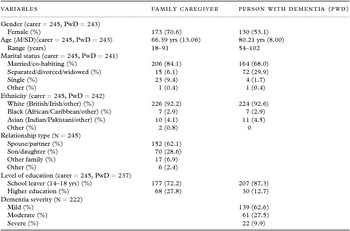
The sample comprised 245 family caregivers and their relative with dementia (Table 1). One hundred and seventy-three (70.6%) family caregivers were female, 226 (92.2%) white British, and the mean age was 66 years (SD = 13.06). One hundred and fifty-two (62%) family caregivers were spouses, and 70 (29%) were sons/daughters. One hundred and thirty (53%) care recipients were female, 224 (93%) were white British, with a mean age of 80 years (SD = 8.00). Most care recipients had mild-to-moderate dementia (90%).
Participant descriptive characteristics

NPI profile
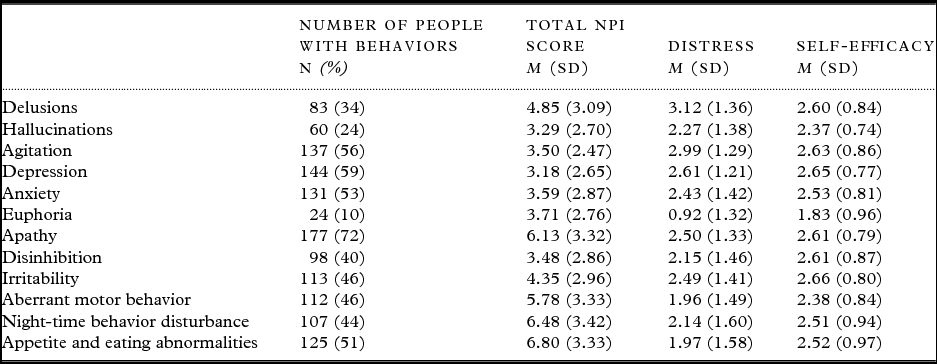
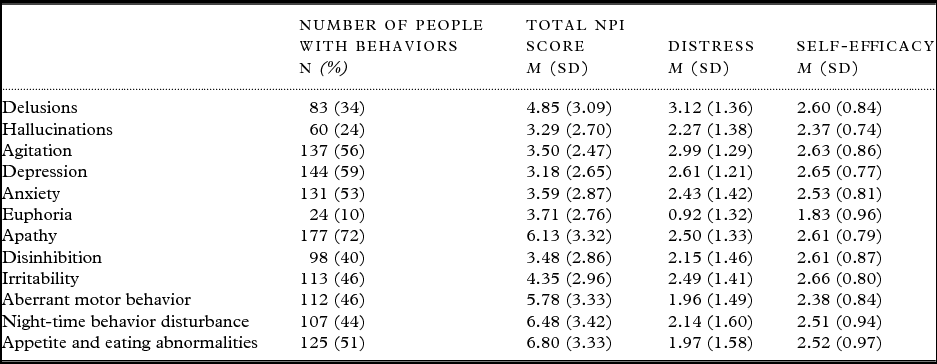
The mean number of BPSD reported by family caregivers was five (range 0–12, SD = 2.82). The most common BPSD (Table 2) were apathy (72%), depression (59%), and agitation (56%), and the least common were euphoria (10%), hallucinations (24%), and delusions (34%). The BPSD with the highest total scores were found to be appetite and eating abnormalities, night-time behavior disturbances, and apathy, while those with the lowest total scores were depression, hallucinations, and disinhibition. The symptoms associated with the most caregiver distress were delusions and agitation, while those that invoked the least distress were euphoria, aberrant motor behavior, and appetite and eating abnormalities.
Dimensions of the NPI, including NPI total, severity and frequency scores, caregiver distress, and caregiver self-efficacy
Caregiver Efficacy Scale profile
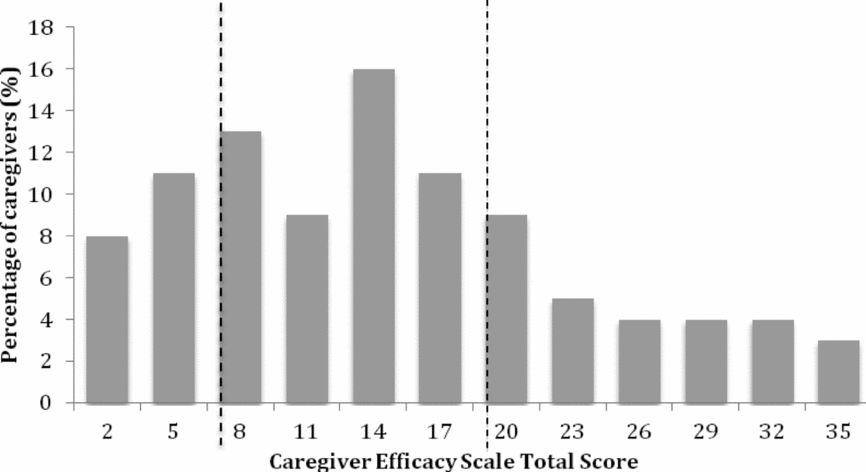
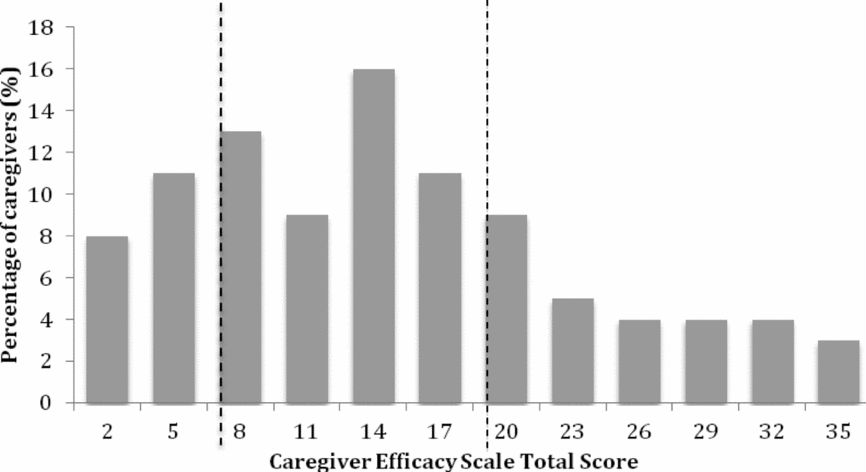
The distribution of caregiver efficacy scores, including lower and upper quartiles, is shown in Figure 1. Quartiles were calculated to indicate levels of high and low SE. The lower quartile was found to be 7, with scores below this indicative of high SE, and the upper quartile was 19, with scores above this indicative of low SE.
The distribution of Caregiver Efficacy Scale scores for family caregivers. The dotted lines are indicative of the upper and lower quartiles for the Caregiver Efficacy Scale total scores (lower quartile = 7 and upper quartile = 19).
As demonstrated in Table 2, family caregivers had the greatest SE for managing euphoria, hallucinations, and aberrant motor behavior, and the lowest efficacy for responding to irritability, depression, and agitation. Table 2 allows comparison of the total NPI Scale, Caregiver Distress Scale, and Caregiver Efficacy Scale for each symptom. The pattern of scores differed between these scales, which is indicative that each of these scales measures a different construct. For example, the highest mean SE scores were for managing euphoria and hallucinations, while the lowest were for irritability and depression; caregiver distress was highest for delusions and agitation, and lowest for euphoria and aberrant motor behavior. The highest mean NPI score was for night-time behaviors and appetite and eating abnormalities, and the lowest was for depression and hallucinations.
Internal consistency
Cronbach's α coefficient was 0.79, indicating adequate internal consistency and homogeneity of the individual test items. All but one corrected item-total correlations were greater than 0.3, this being euphoria.
Concurrent validity
A lack of caregiver efficacy as measured by the Caregiver Efficacy Scale significantly correlated with lower SE for obtaining respite (r = −0.268, p = 0.000), responding to disruptive behavior (r = −0.386, p = 0.000), and controlling upsetting thoughts (r = −0.384, p = 0.000).
Construct validity
Strong correlations were found between the Caregiver Efficacy Scale and all of the dimensions of the NPI; correlations with the total NPI score, BPSD frequency (r = 0.869, p = 0.000), severity (r = 0.883, p = 0.000), and caregiver distress were highly statistically significant. Significant correlations were found between lack of caregiver efficacy and poor psychological well-being, including depression (r = 0.362, p = 0.000), anxiety (r = 0.376, p = 0.000), negative affect (r = 0.411, p = 0.000), and negative impact (r = 0.392, p = 0.000).
Criterion validity
The Kruskal–Wallis test demonstrated level of caregiver efficacy for managing BPSD varied with dementia severity (p = 0.028); with moderate dementia there was reduced SE (M = 15.79) compared to mild dementia (M = 12.54). There was no difference in level of SE between moderate and severe dementia (M = 15.27). The Mann–Whitney U test found level of caregiver efficacy for managing BPSD varied with level of depression (p = 0.004); those who were not depressed (scored below 11 on the HADS) had greater SE (M = 13.33), while those who were borderline or depressed (11 or greater on the HADS) had lower SE (M = 17.94). The Mann–Whitney U test found that level of caregiver efficacy for managing BPSD did not vary with relationship type (spouse/partner or son/daughter: p = 0.695).
Comparison of the upper and lower quartiles of SE scores demonstrated that groups differ with respect to several variables. Mann–Whitney U tests found the upper quartile (low SE) to have greater dementia severity (p = 0.005), depression (p = 0.000), anxiety (p = 0.000), negative affect (p = 0.000), and negative impact (p = 0.000) when compared to the lower quartile (high SE). Pearson's χ2 demonstrated no difference in relationship type [χ2 (1) = 0.064, p = 0.800].
Factor analysis
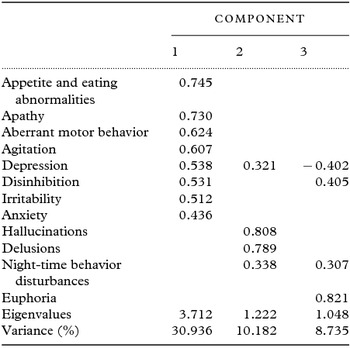
The KMO measure of sampling adequacy was appropriate at 0.846 and Bartlett's test of sphericity was significant, [X2 (66, N = 245) = 540.672, p = 0.000]. A three-factor solution of the 12 items was selected (Table 3), accounting for 49.85% of the variance. The first factor related to mood and hyperactivity (30.94% of the total variance) and included items such as appetite and eating abnormalities, apathy, aberrant motor behavior, agitation, depression, disinhibition, irritability, and anxiety. The second factor related to psychosis and night-time disturbance (10.18% of the variance) and included items relating to hallucinations, delusions, and night-time behavior disturbances, and the final factor comprised euphoria (8.74% of the variance).
Factors and eigenvalues for the Caregiver Efficacy Scale

Comparable loadings on different factors were found for night-time behaviors in factors two (0.338) and three (0.307), depression in factors one (0.538), two (0.321), and three (−0.402), and disinhibition in factors one (0.531) and three (0.405). Removal of these domains from the respective factors did not significantly improve internal consistency, so these items were retained.
Discussion
The results demonstrate the Caregiver Efficacy Scale for measuring SE for managing BPSD has adequate psychometric properties when administered alongside the NPI. The scale should be administered in conjunction with the NPI to be both valid and reliable, and to allow level of SE to be considered in relation to varying task demands (BPSD severity and frequency). The scale comprises cut-off points to indicate high and low caregiver SE, and the semi-structured format of the scale allows ease of administration.
Internal consistency
Internal consistency of the Caregiver Efficacy Scale was adequate. Euphoria was the only item that had a corrected item-total correlation below 0.3, which may be a result of its extremely low prevalence. However, it is widely recognized that self-efficacy is task specific, therefore it was not necessary for the items to form a homogenous scale. Caregiver efficacy is built on experiences of specific situations, and varies with contextual factors (Bandura, Reference Bandura1997).
NPI profile
The most common BPSD were apathy, depression, and agitation, which is consistent with the findings of Cummings (Reference Cummings1997). This pattern might be a result of this study sample being predominantly categorized as mild-to-moderate dementia because BPSD typically vary with dementia stage. The pattern in degree of caregiver efficacy toward the different BPSD might be a result of the lower prevalence of euphoria and hallucinations, and the greater prevalence of depression and agitation. The pattern of caregiver efficacy does not appear to be related to the pattern in total BPSD scores nor the pattern of caregiver distress, which suggests that the scales measure different constructs.
The Validity of the Caregiver Efficacy Scale
The Caregiver Efficacy Scale demonstrated adequate concurrent validity; it showed a similar correlation with the RSSE subscales of SE for controlling upsetting thoughts and responding to disruptive behavior. However, its correlation with obtaining respite was lower. Associations were not large enough to suggest the scales are evaluating the same efficacy beliefs; the Caregiver Efficacy Scale evaluates efficacy for managing BPSD, while the RSSE subscales evaluate efficacy relating to other caregiving domains. The SE for responding to disruptive behavior subscale evaluates primarily memory-related problems and is designed for caregivers of individuals with moderate-to-severe dementia. However, the study sample was predominantly comprised of caregivers of individuals with mild dementia, therefore the subscale might not be applicable to this sample. Furthermore, it was found that the RSSE subscale of efficacy for responding to disruptive behavior had much lower correlations with the NPI dimensions compared to the Caregiver Efficacy Scale. This demonstrates that SE beliefs in one domain are not equivalent to another domain, and also stresses the importance of developing the Caregiver Efficacy Scale to evaluate SE relating specifically to BPSD that is applicable to caregivers of individuals at any stage of dementia.
Factor analysis of the Caregiver Efficacy Scale demonstrated the construct validity of the scale as a multifactor construct. The 12 items were grouped into three factors, labeled “mood and hyperactivity,” “psychosis and night disturbance,” and “euphoria.” Although all items demonstrated high factor loadings (above 0.3), some of the items loaded similarly on several of the factors, and such data did not support its partitioning into subscales. Furthermore, the factor structure varied widely with dementia severity. The potential partitioning of the Caregiver Efficacy Scale into subscales is a subject for future research. In addition, the factor “euphoria” requires further exploration given the low corrected item-total correlation and its appearance as a single item factor, which might be an artifact of the extremely low incidence of euphoria reported by caregivers.
The Caregiver Efficacy Scale demonstrated adequate construct validity; there was a strong relationship between the Caregiver Efficacy Scale and dimensions of the NPI, indicating that the greater number of times a caregiver is faced with a BPSD and the greater challenge it poses, the lower SE a caregiver has for managing that BPSD. The strong association between lack of caregiver efficacy and greater distress upholds the validity of the scale, as with greater distress associated with a particular behavior, one would expect lower confidence. The finding that lack of caregiver efficacy was associated with reduced psychological well-being, including negative affect, depression, and anxiety, supports existing research (e.g. Gignac and Gottlieb, Reference Gignac and Gottlieb1996). The conceptual model of Bandura (Reference Bandura1997) recognizes that SE influences caregiver outcomes by altering affective, motivational, and cognitive mechanisms, leading to behavioral and emotional regulation. Hence, at a low level of caregiver efficacy for managing BPSD, there might be more negative appraisals, reduced motivation, and a lack of persistence in coping behaviors, leading to greater distress, negative affect, and emotional vulnerability.
The Caregiver Efficacy Scale demonstrated adequate criterion validity. The finding that depressed caregivers had lower SE is in parallel with existing research concerning low SE and reduced psychological well-being (Gignac and Gottlieb, Reference Gignac and Gottlieb1996). The association between greater dementia severity and lack of caregiver efficacy for managing BPSD was expected because severity is typically associated with greater BPSD frequency, severity, and caregiver distress. Baumgarten (Reference Baumgarten1989) found that with greater dementia severity, there is correspondingly greater caregiver distress, therefore one would expect reduced efficacy for managing BPSD. However, the relationship between dementia severity and SE appeared to plateau at the moderate stage, which might be due to the small number of individuals diagnosed with severe dementia in the sample or the fact that BPSD are most challenging while the care recipient remains active (Chiriboga et al., Reference Chiriboga, Weiler, Nielsen, Biegel and Blum1990). As expected, comparison between the upper and lower quartiles of SE scores demonstrated these caregivers differ in anxiety, depression, negative affect, negative impact, and dementia severity: those with low SE have reduced psychological well-being and care for an individual with greater dementia severity. Although there was no difference in level of SE according to relationship-type, this might be a result of the large number of spousal caregivers in the sample.
Methodological considerations
There were several methodological limitations. Data were non-normally distributed and less powerful non-parametric tests were used, as opposed to transforming data. With such a large sample, a cautious approach must be taken with interpretation, as clinical significance is not equivocal to statistical significance, with the large sample increasing the chances of finding significant correlations. Study participants were largely white British; subsequently the findings may not prove generalizable to other populations. There are challenges in definition and quantification of BPSD, and these difficulties must be recognized in measuring SE for managing BPSD. The development of a measure of caregiver efficacy for managing BPSD might be constrained by ceiling effects or by the use of a four-point response scale, since narrow response scales may lack sensitivity and reliability (Bandura, Reference Bandura, Urdan and Pajares2006). Evaluation of the construct validity of the Caregiver Efficacy Scale was limited by the fact that discriminant validity was not assessed.
Implications for practice and clinical use
This study provides a psychometric underpinning for the use of the Caregiver Efficacy Scale in clinical practice. It is hoped the scale might aid the identification of areas of low SE for managing BPSD and therefore allow interventions to be directed toward areas of difficulty, as well as aid identification of those caregivers at greater risk of poorer outcomes, who will benefit from SE-related interventions. The Caregiver Efficacy Scale might also be of use in evaluating interventions intended to improve caregiver efficacy in managing BPSD. This is important given that SE is a potentially modifiable psychological construct (Bandura, Reference Bandura1997), and might provide a powerful avenue to influence well-being. It is also crucial given the prevalence of BPSD and the associated poor outcomes associated for both caregivers and individuals with dementia. In turn, this scale might have economic implications in delaying care recipient institutionalization.
Implications for caregiving theory
The development of the Caregiver Efficacy Scale might prove of value for caregiving theory, to augment understanding of how SE beliefs influence variability in caregiver outcomes and facilitate informed conceptual models of caregiver adaptation. Conceptual models typically incorporate generic SE, despite the widely acknowledged domain-dependent nature of efficacy beliefs. Caregiving theory therefore appears to be constrained by existing measures of SE and the lack of valid domain-dependent measures. The development of the Caregiver Efficacy Scale for managing BPSD might allow these specific efficacy beliefs to be incorporated within conceptual models, to advance theory.
Implications for research
The Caregiver Efficacy Scale offers promise for use in research settings. This scale might make it possible to explore how the degree of caregiver efficacy varies with time since onset of BPSD, as one could expect SE to vary depending on how long caregivers have been dealing with a particular symptom. A further potential avenue for research for which the Caregiver Efficacy Scale might prove of value is in the exploration of positive and negative caregiver appraisals of BPSD, appraisals of the changeability of BPSD, and SE for managing BPSD. Caregiver efficacy beliefs for dealing with BPSD might be closely related to caregiver appraisals of whether BPSD are part of the dementia, whether symptoms can be altered, and whether caregivers make positive or negative appraisals of symptoms. With greater SE, caregivers might perceive BPSD as challenges to overcome, but with lower efficacy beliefs they make more negative appraisals (Bandura, Reference Bandura1997).
Finally, the Caregiver Efficacy Scale may in the future allow exploration of the relationship between the awareness of the individual with dementia and caregiver efficacy for managing BPSD. Clare (Reference Clare2002) claimed that the perception of the extent to which the person with dementia is aware helps to determine the way one responds to that individual. Awareness of BPSD within dementia may influence the level of caregiver efficacy in dealing with these symptoms, as awareness may be closely related to whether the caregiver perceives the behavior as modifiable.
Future research
The Caregiver Efficacy Scale might aid the identification of predictors of SE for responding to BPSD, and it might make it possible to explore the relationship between caregiver efficacy for managing BPSD and coping. To develop the scale further, the psychometric properties can be evaluated in different populations to determine its generalizability.
Conclusion
The addition of an efficacy question to each domain on the NPI produces a measure of caregiver efficacy for managing BPSD that has adequate reliability and validity, supporting the use of this scale in a British population. This appears to be the first psychometrically validated scale specifically designed to evaluate caregiver efficacy for managing BPSD. This might have important implications for understanding adaptation to the caregiving experience, and have practical value in designing improved interventions tailored according to areas of difficulty. This is of particular importance due to the prevalence and burdensome nature of BPSD and given the widely recognized need to develop measures of SE beliefs related to tasks that caregivers find most challenging.
Conflict of interest
None.
Description of authors’ roles
N. Crellin was responsible for designing the study, data collection, carrying out the statistical analysis, and writing the paper.
G. Charlesworth and M. Orrell were responsible for advising on the study design, overseeing data collection, supporting the statistical analysis, and assisting with the writing of the paper.
Acknowledgments
This research was conducted as part of the Support at Home – Interventions to Enhance Life in Dementia (SHIELD) Research Programme. The grantholders are Professors Orrell (UCL), Woods (Bangor), Challis (Manchester), Moniz-Cook (Hull), Russell (Swansea), Knapp (LSE), and Dr Charlesworth (UCL). The sponsor of this research program is North East London NHS Foundation Trust.
This work was supported by the National Institute of Health Research (NIHR) under its program grants for Applied Research scheme (RP-PG-060-1083). The views expressed in this publication are those of the author(s) and not necessarily those of the NHS, the NIHR, or the Department of Health.
An earlier version of part of this statistical analysis was presented at the 27th International Conference of Alzheimer's Disease International in London (March 2012).
The NPI is copyright-protected (Jeffrey L. Cummings, M.D.). All rights reserved.