I
When, beginning on June 22, 1941, German forces sliced through Soviet defenses, Soviet citizens severed their ties with the Stalinist state.Footnote 1 In the Western Borderlands, annexed in 1939–1940 as a result of the Hitler-Stalin pact, locals welcomed the invaders with bread and salt as liberators from the Bolshevik yoke.Footnote 2 Red Army men hailing from these regions left their posts and went home. Soldiers from the pre-1939 Soviet territories stationed in Ukraine deserted, too, reasoning that the Bolsheviks had “sucked our blood for twenty-five years, enough already!” A group of two hundred soldiers, including an outspoken Siberian, “decided to force our way back, at all cost, toward the Germans.” When army commissars tried to stop them, “[w]e killed them and moved on.”Footnote 3 Further East, collective farmers in the pre-1939 territories greeted the German “liberators” in some localities, while displaying a “wait-and-see” attitude in others.Footnote 4 One day after the start of the war an inhabitant of Leningrad region reacted to the news of his mobilization by threatening the official bearing the news with a revolver, exclaiming “I will not fight for Soviet Power, I will fight for Hitler!”Footnote 5 Urban dwellers rejoiced at the arrival of the long-awaited apocalypse, believing that “the fascists kill Jews and Communists, but don't touch Russians.”Footnote 6 As Moscow descended into panic in October 1941, crowds stopped functionaries leaving the city, pulled them out of their cars, assaulted them, and scattered the contents of their luggage on the ground. “Beat the Jews,” yelled the crowd, and protesting their non-Jewishness did not help the victims; to the mob, “Jew” and “functionary” were one and the same.Footnote 7 On October 19, workers struck in Ivanovo, an industrial center with a long tradition of militancy. Excited by the spectacle of the advancing Germans and the apparent inability of the Stalinist leadership to stop them, rioters destroyed administrative and Party buildings and beat up state and Party activists, including the first secretary of the region. They demanded “Soviets without communists,” while discussing seriously whether life would be better under Hitler or Stalin.Footnote 8 Meanwhile, back at the frontline, where news of the “massive beating up of Jews” in Moscow quickly spread, the state's enforcement agencies arrested soldiers voicing their discontent.Footnote 9 They also ensured that both the confused and the hostile would fight. By October 10, People's Commissariat Internal Affairs (NKVD) forces had detained 657,364 soldiers separated from their units. The majority were returned to the front and thrown back into battle; 25,878 were arrested, 10,201 of them shot.Footnote 10
II
When, beginning on June 22, 1941, German forces sliced through Soviet defenses, Soviet citizens reaffirmed their connection to the Stalinist state. Adolescents joined fire-fighter brigades, organized civil defense units, and attempted to volunteer for the army. Children joined retreating army units who “adopted” them as mascots.Footnote 11 Young women flocked to recruitment points en masse, trying to enlist to defend the socialist fatherland, as did men, old and young.Footnote 12 Moscow residents were optimistic. “Hitler has miscalculated this time,” noted the worker Mineev during the first days of the war, “because the entire laboring people is ready for the defense of the Soviet Union. Every laborer will fight for victory over fascism.”Footnote 13 Frontline soldiers and their commanders, meanwhile, resisted the Wehrmacht's onslaught doggedly, tenaciously, often in completely desperate circumstances. When surrounded, Red Army men fought their way out of encirclement, if at all possible, to rejoin the fight against the invader.Footnote 14 It seemed that prewar divisions were forgotten and the country had come together in what Geoffrey Hosking has called the “crystallization” of national consciousness.Footnote 15 And this patriotism, as Amir Weiner has stressed, had a particularly Soviet tint. Soviet citizens thus had “something to die for.” Soon, as the German way of war in the East showed its whole ghastly nature, they also had “a lot to kill for.”Footnote 16
III
Two beginnings for one war: the first stressing disaffection, opposition, and resistance; the second focusing on support, enthusiasm, ideological consensus. Both empirically correct, and yet both wrong in their universalism. The stories of defiance, opposition, and even resistance to Stalinism stand in glaring contrast to the Soviet master narrative about this “Great Patriotic War,” where Soviet citizens stood shoulder to shoulder with their government, fighting united against the Fascist invader, defending socialism, Stalin's state, and the homeland.Footnote 17 “Another people” would have thrown out the government and appointed a new one, claimed Stalin. “But the Russian people did not do that, because it believed in the correctness of the policies of its government.” Hence, all the suffering and sacrifice in the fight against Germany.Footnote 18 As if “the Soviet people”—bereft of the freedoms of expression, assembly, and organization—could have sacked the government. As if the government would have heeded, had “the Soviet people” somehow managed to find a common voice and asked. The stories of defiance, then, satisfy the historian's desire to see beyond appearances and, leaving Plato's cave, perceive reality as it “really was.” Such Rankean satisfaction, however, comes at the price of discounting the evidence of some who were there, and for whom the official story was the very essence of the war itself.Footnote 19 Historians, therefore, are half right when they prefer to follow such protestations more than the evidence of discontent.Footnote 20 Others can be guided by different witnesses who stress compulsion and the fact that German barbarism made the Stalinist regime appear as the smaller evil.Footnote 21
This essay sketches the contours of an ongoing debate about loyalty and disloyalty within the Soviet Union at war. It documents the emerging view that both loyalty and disloyalty were substantial minority positions, while the majority of Soviet subjects were focused on survival for themselves and their families (Sections VII and VIII). I begin with a critique of accounts of support for the Soviet war effort, which are deeply entangled with a debate between “totalitarians,” “revisionists,” and “post-revisionists” internal to anglophone Russian history (Sections IV, V, and VI), before moving to more complex recent approaches in Sections VII and VIII. The final section concludes by arguing that opposition led to resistance only when ordinary people perceived the state to be weak.
War experience and behavior, then, were ordered by long-term histories that were not only structured by ethnicity and gender—two aspects of social organization at the forefront of historical discussion today—but also by social position.Footnote 22 The demise of Marxism, and the sustained critique cultural historians directed at vulgar base-superstructure models, has left this aspect of social organization somewhat under-investigated. Historians of the Soviet Union today routinely dismiss class as a meaningful category of analysis. “The Bolshevik attachment to the idea of class, and the political uses they made of it,” the argument goes, “corrupted it as a sociological category.”Footnote 23 These are important interventions in a literature often misleadingly inspired by Marxist questions. Meanwhile, however, the pendulum has swung in the other direction, with the result that historians sometimes present one particular social group pars pro toto of Soviet society more generally. As we will see, social stratification of life choices and the experience of exploitation of many and the advancement of some—”class” for short—played an enormous role in the ways ordinary people related to the Soviet state and its war effort.Footnote 24
IV
One of the first non-Soviet scholarly accounts stressing the loyalty of Soviet citizens was published, in 1996, by Robert Thurston as something of an afterthought to his study of life in the 1930s. Thurston followed Stalin in arguing that victory showed the regime had the support of the population; the war, he claimed, was the “acid test” for Stalinism.Footnote 25 An empirical roadblock was the mass surrenders of 1941, which both Martin Malia and Robert Conquest had interpreted as evidence of widespread discontent.Footnote 26 Thurston countered by citing military reasons for giving up—poor leadership, inadequate training, lack of supplies, the demoralizing effect of German air superiority, “tank fright,” high casualties, disintegrating primary groups, battle fatigue, and the desperation of being surrounded and cut off from one's own side in a “cauldron” battle. He concluded that there “was no massive disloyalty among Soviet soldiers during the war.” Thurston had more trouble explaining away evidence of civilian discontent and expectations of liberation by the Germans, leading one critic to note that “the data that Thurston offers against his own argument … all but overwhelm the argument itself.”Footnote 27 Such ambivalence disappeared in a revised version of the chapter, which was published in 2000 as a stand-alone article. “Considerable evidence,” Thurston now claimed, “indicates that voluntary support for the Soviet state predominated” from the beginning of the war. Younger people, in particular, were “more loyal” than their elders and “of course, the vast majority of the army was young.” The “argument that surrendering troops acted out of disloyalty” was now declared “unacceptable.”Footnote 28
Thurston's argument was driven by polemical logic. The bone of contention was “the totalitarian model,” more specifically the work of Robert Conquest on the Great Terror of the 1930s. Conquest had put Stalin front and center in his explanation of the genesis of the terror and presented the rest of Soviet society as victimized by the regime. The terror “habituated” the population “to silence and obedience, to fear and submission.” At the same time, by alienating Soviet citizens from the regime, the terror did the work of the Germans. “Far from the Great Purge eliminating a Soviet fifth column,” Conquest wrote, “it laid the foundation for one throughout the country in 1941 to 1945. This was the first war fought by Russia in which a large force of its citizens joined the other side.”Footnote 29 Part of a movement of social historians “revising” the “totalitarian model,” Thurston attempted to demonstrate instead that people were neither atomized by fear nor voluntarily joining the Germans. The result was, probably unintentionally, an embrace of major tenets of the Soviet war myth, in particular the proposition of a fundamental ideological unity between Stalin and his people.
V
Roger Markwich and Euridice Cardona's Soviet Women on the Frontline affirms Thurston's “acid test” thesis through the study of young military women, “a more manageable sample” of maybe one million people as opposed to the totality of the nearly thirty-five million who made up Stalin's fighting machine.Footnote 30 Extrapolating from their experience, the authors conclude that the “overwhelming majority of Soviet citizens remained loyal to their country, society and state, even after the catastrophic defeats Stalin's Red Army suffered in the first eighteen months of the war.”Footnote 31 The huge changes enforced by Stalin's regime encouraged social mobility, opened educational opportunities, and hence fostered loyalties to the “Socialist motherland.” These are neither new nor very contentious claims: That the 1930s opened up pathways of social advancement for a large number of people who became something of a social constituency for Stalin and his regime is now widely accepted, and that there was a potent group of women among the beneficiaries of the Stalin revolution is also well documented.Footnote 32
Deducing from the self-selected group of women-volunteers to their entire “generation,” however, and from there to Soviet citizens more generally, is methodologically problematic. Ideologically committed supporters of Soviet socialism were indeed a “decisive core of Soviet society” but they were not representative of the “overwhelming majority” of the population.Footnote 33 Markwick and Cardona's women were, with a few exceptions, upwardly mobile, urbanized, educated, and members of the Communist Youth League, as they document in detail.Footnote 34 These “young, urbanized, politically active, literate women” who were “in the forefront of the volunteers in June 1941”Footnote 35 were extreme statistical outliers: Only thirty-three percent of Soviet citizens lived in cities in 1941;Footnote 36 about half of the eligible age group remained outside the Komsomol by 1945, even after a massive expansion during the war.Footnote 37 According to the 1937 census, half of the population was illiterate;Footnote 38 and the upwardly mobile were a minority within an incredibly poor population.Footnote 39 Not all women were volunteers—probably more than half of them were conscripted—but even they were “primarily Russian, urban, young, educated … and Komsomol members,” a demographic profile quite similar to that of male volunteers.Footnote 40
The strength of Markwick and Cardona's book lies in providing a thick description of the varieties of war experiences of female combatants. Here, their study not only supersedes earlier approaches to Soviet women in the military,Footnote 41 but also parts way with its immediate predecessor, Anna Krylova's monograph exploring the history of those within “the technical and specialized elite of Soviet armed forces,” who lived out “unconventional female … identities.”Footnote 42 These highly trained female soldiers were colorful outliers within an army dominated numerically by conscripted peasant-infantrymen.Footnote 43 Even among women in uniform, they were an elite. Between half a million and just over a million women served in the armed forces during the war, depending on what categories are included.Footnote 44 Unlike Markwick and Cardona, Krylova is not interested in the majority, the “medics, doctors, nurses, clerks, translators, radio, telephone, and telegraph operators.” Instead, she focuses on the maybe 120,000 women who served in active combat roles in “a specialized, technically demanding, and machine-dependent modern war.”Footnote 45 This was the experience of a minority, though. While most of “Krylova's women” participated in the war of machines, by 1943 only about twenty percent of the army was highly mechanized and mobile units. The rest were “the Red Army's imposing bludgeon,” which, to the very end of the war, relied largely on older forms of transport: trains, horses, and forced marches.Footnote 46
Life in this infantry was brutal, exhausting, and unmechanized, and the experience of most military women was not much better that that of their male comrades. In some aspects it was considerably worse, as Markwick and Cardona document at length.Footnote 47 The dark aspects of the story are not entirely absent from Krylova's account, despite its focus on the more prestigious arms. Like in a Socialist Realist novel, however, hardships are represented as obstacles overcome by self-realizing heroines. Because of the elite nature of the arms involved in Krylova's account, these came, by and large, not from the factories or collective farm fields, but from the ranks of the new Soviet intelligentsia. They would have been among those who opposed the 1936 antiabortion legislation; their majority comprised “students at technical institutes and universities: future engineers, chemists, biologists, meteorologists.”Footnote 48 Many of them wrote memoirs and were mentioned in those of their comrades in arms, a literature which, together with a close reading of official discourse, forms the backbone of Krylova's exploration. The book is thus a reminder that cultural history has the tendency to gravitate toward “symbolically rich artifacts” and thus to “displace our gaze from the poor and powerless … to those more favored.”Footnote 49
VI
The prominence of cultural history in the recent discussions of the war points to a major interpretive shift in the field of Soviet history as a whole. When Thurston published his contentious book in 1996, indeed, he was already fighting the previous war. The big battles about the challenge social history posed to the study of the Soviet dictatorship had run their course in the 1980s, and the “revisionists” had become the tenured professorate in American universities. Hence, it was their turn to be challenged by a group of younger scholars, the “post-revisionists.” And many of the revisionists had meanwhile changed their focus from studying support for Stalin' regime to opposition and resistance to it.Footnote 50 What ensued has been called the “resistance debate,” which pitted (“post-revisionist”) cultural historians against (“revisionist”) social historians.Footnote 51 Paradoxically, the post-revisionist critique of revisionism produced a position not unlike Thurston's revision of totalitarianism: In polemically countering the thesis of widespread disaffection, both ended up embracing Stalin's thesis of ideological unity between the regime and its people. While Thurston claimed that Soviet citizens supported the regime because it represented their fundamental fears, interests, and desires,Footnote 52 the post-revisionists began with the hypothesis that official discourse was everywhere, unavoidable, and without any alternatives. Slowly but surely, however, the best scholarship moved away from such unsustainable claims to more nuanced and more complex appreciations of what it meant to be a communist under Stalin.Footnote 53
Much of this debate played itself out in studies about the 1930s. Until Krylova's book, only Amir Weiner ventured beyond 1939, to enter the war and postwar years. Soviet soldiers, argued Weiner, were unable to imagine an alternative political system, because they “were born into a Soviet system where they acquired their worldview, language, and manner of conduct.” Subject to “the most intense acculturation and coercion drives in modern history,” they knew “no other alternative system.” The only available options, he implies, were Fascism and Nazism, which “were hardly attractive for Soviet citizens.” The frontline men and women “were, by and large, products of the Soviet system and one could not in good faith expect most of them to question the high politics and philosophical dimensions of the polity that raised them.”Footnote 54
Not all evidence fits this thesis, and Weiner even quotes an incident of clear and explicit criticism of Stalinism—but only to dismiss it as irrelevant:
In some rare cases the war led individuals, remarkably high-ranking officers, to question the fundamentals of the system. In private conversations, two of these individuals … went as far as to challenge the premise of collectivized agriculture, which they argued should be replaced by the market and a ‘true democratic system.’ These, however, were isolated cases and arguments still beyond the comprehension of most contemporaries, who lacked, among other things, viable channels to disseminate their discontent. The transformation of personal assessments into political generalizations, as well as articulation of political identities and agendas outside the Soviet realm, would have to wait much longer.Footnote 55
Criticism of “the premise of collectivized agriculture,” however, was by no means restricted to “rare cases”—before, during, or after the war. A large-scale interview project of Soviet citizens displaced by the war, known as the Harvard Interview Project, found nearly universal condemnation of the kolkhoz system during the prewar years.Footnote 56 Throughout the 1930s, rumor predicted war with the outside world, a welcome apocalypse to bring liberation from collective farms and communists.Footnote 57 Such sentiments did not disappear once Armageddon materialized. During the dark days of October 1941, Quartermaster-Technician of the First Rank Golosov remarked, “The peasantry will not fight for Russia, because it has been ruined by the collective farms. You see, Bukharin was right about the peasantry in this respect: private property should have been protected.”Footnote 58 Rank-and-file soldiers expressed similar sentiments during the first months of the war,Footnote 59 and in 1942, the soldier Doronin noted that it “would be better if we were living now as we lived before 1929. As soon as they introduced the kolkhoz policy everything went wrong. I ask myself—what are we fighting for? What is there to defend?” Frontline soldiers complained “about the collective farms, and how it was necessary to sweep them all away when the war was won.”Footnote 60 Knowing of such moods, generals approached even top Party leaders, such as Nikita Khrushchev, advising “that soldiers wouldn't die for land that they didn't actually own.”Footnote 61 And people not only talked, but acted. During the early phases of German occupation of Leningrad region, when Soviet control had collapsed but was not yet replaced by its German equivalent, the spontaneous “dissolution of kolkhozi from below” was widespread.Footnote 62 In another sector of the old Soviet heartland, Kalinin region, in November 1941, even Communist Party members distributed collective farm animals.Footnote 63 And after the war, the population's wishful thinking expressed itself in rumors of the imminent dissolution of the hated kolkhozes.Footnote 64
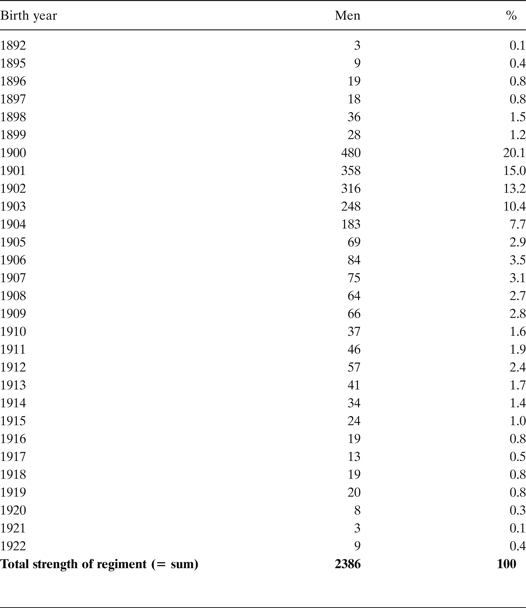
The inspiration for such opposition came not only from exposure to non-Soviet realities beyond the borders during the war. Many remembered a different political and moral economy, and talked about it. Neither were “the majority of the fighting men” born into the Soviet system, nor were the surviving veterans all “young men,” and thus unable to remember life before Soviet socialism.Footnote 65 Men born between 1890 (or even, according to one source, 1885) and 1927 were drafted into the wartime armed forces,Footnote 66 and while the older of these cohorts tended to serve in support roles, there were combat soldiers in their forties and even in their fifties.Footnote 67 In 1942, the 1236th Rifle Regiment was dominated by men in their late thirties and early forties (Table 1), with thirty-nine percent in their thirties, fifty-three percent forty and older, and only three percent born in the year of the October revolution or after.
Age Composition of 1236th Rifle Regiment, 372nd Rifle Division, Early 1942

Data from a Soviet document obtained by German military intelligence. The division had been formed on November 26, 1941 in Siberia.
Source: German Military Archive (BA-MA) RH 19 III/444, folio 236.
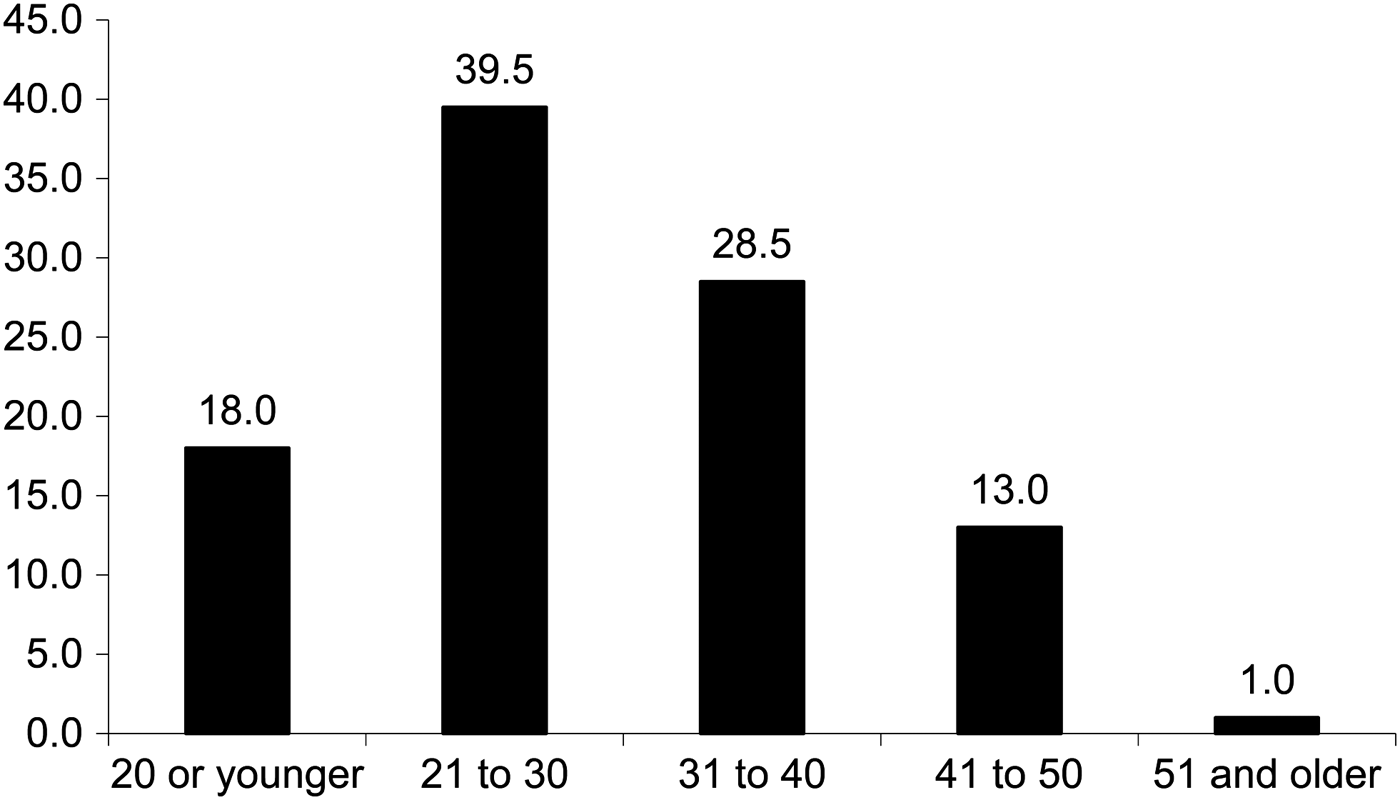
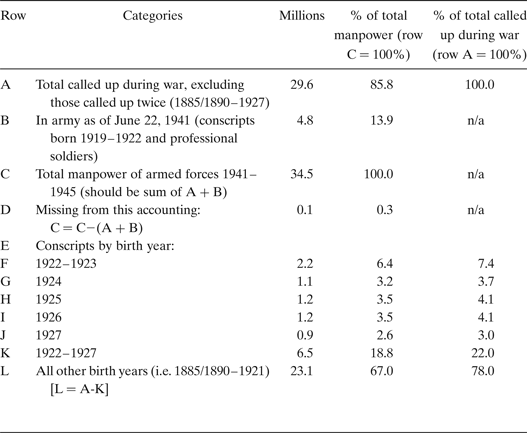
No overall age statistics of combat troops are available, making it hard to judge how typical this regiment was. The published data on the age of wartime conscripts only shows that those 19 and younger in 1941 constituted nineteen percent of the total who served during the war and twenty-two percent of all called up from the start of the war (Table 2). Loss statistics, however, imply that the 1236th Rifle Regiment's reliance on mature men was no exception (Chart 1): Only eighteen percent of those killed, missing in action, or not returning from captivity were twenty or less years of age; forty-three percent were older than thirty; fourteen percent older than forty; and one percent older than fifty. Many troops thus must have had recollections of Tsarism, even more of the New Economic Policy of the twenties, and only a minority had really not seen any other regime than Stalin's before they entered the outside world in 1939 and 1944.Footnote 68 True, they all had “passed through” the “formative experiences” of the Soviet system. This background might have made them “a tough people who could and did endure difficulties,”Footnote 69 as John Barber and Mark Harrison argued in 1991,Footnote 70 and Richard Overy in 1997;Footnote 71 but whether or not it made them loyal to Stalin's regime is another matter altogether.
Demographic losses of Red Army in Great Patriotic War by age group (percent). Source: G. F. Krivosheev, “Poteri vooruzhennykh sil SSSR,” Liudskie poteri SSSR v period Vtoroi Mirovoi voiny. Sbornik statei (St. Petersburg, 1995), 78.

Age Structure of Wartime Conscripts

Sources: V. V. Gradosel'skii, “Komplektovanie Krasnoi Armii riadovym i serzhantskim sostavom v gody Velikoi Otechestvennoi voiny,” Voenno-istoricheskii zhurnal No. 3 (2002): 6–12; G. F. Krivosheev, “Poteri vooruzhennykh sil SSSR,” in: Liudskie poteri SSSR v period Vtoroi Mirovoi voiny. Sbornik statei (St. Petersburg, 1995), 71–96, here: 74; “Mobilizatsiia Vooruzhennykh Sil SSSR,” in: Velikaia Otechestvennaia voina 1941–1945. Entsiklopediia, ed. M. M. Kozlov et al. (Moscow: Sovetskaia, 1985), 452.
VII
Most historians agree that political repression limited the possibility for resistance. It is also clear that some people—even “remarkably high-ranking officers”—had at times quite radical oppositional attitudes. The bones of contention are the following: (1) Does a clear preference for single farming (which was very common), ranting against the lack of democracy (which was relatively common), and striking for “Soviets without communists” (which did happen) amount to the expression of a “political alternative”? (2) Does personal communication between family, friends, workmates, or frontline comrades constitute a “channel to disseminate discontent”? These are matters of judgment.Footnote 72 The third and final question, however, is empirical: How frequent were negative moods? Weiner confines them to “some rare cases,” and Markwick and Cardona follow him in the assumption that the “overwhelming majority of Soviet citizens remained loyal.”Footnote 73
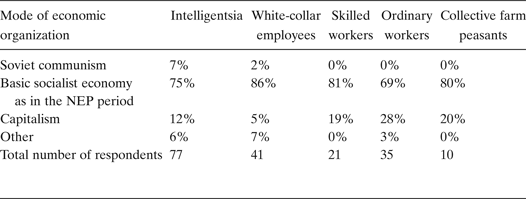
The Harvard Interview Project, by contrast, saw both extremes of the political spectrum as quite substantial groups. It concluded that a significant minority (largest among workers and smallest among white-collar employees) desired “capitalism” while only a much smaller group (no workers or collective farmers and only seven percent among the intelligentsia) was content with the “Soviet communism” of the prewar years. The overwhelming majority in each social group saw pre-Stalinist socialism as the best alternative (Table 3). Of course, there are problems with the sample size. There was also an inherent bias in these interviews against declaring one's loyalty to comrade Stalin and for embracing capitalism. For one, the interviewees were displaced persons who had actively refused to return to their country after the war. Therefore, one would expect outright supporters of Stalin's regime to be rare in this group. Secondly, respondents were likely to misrepresent their political views in line with what they thought the interviewers wanted to hear: The DPs, after all, needed visas to stay in the West and had reason to be suspicious of those interviewing them. Hence, the group of pro-capitalists was probably smaller in actuality. Given this Cold War context of the interviews, one would indeed conjecture that a very large share would declare loyalty to Capitalism and hostility to Socialism, if only for instrumental reasons. That so few did, however, strengthens the case for taking these results seriously.Footnote 74
Preferred Mode of Economic Organization among Respondents of the Harvard Interview Project (personal interviews)

Source: Alex Inkeles and Raymond Bauer, The Soviet Citizen. Daily Life in a Totalitarian Society (Cambridge, MA, 1961), 243.
We could now check the negative side of the spectrum through a systematic qualitative and quantitative study of the case files for anti-Soviet agitation (paragraph 58–10 of the criminal code), held in the Russian state archive.Footnote 75 Timothy Johnston's study of the meanings of Sovietness in the war and postwar years is the closest we have thus far. Johnston selected a sample of 250 case files, covering the years 1939–1953, part of an expansive source base on popular moods. His research confirms the existence of a wide field of possible political thought in the war and postwar Soviet Union. His varied and rich source base, moreover, allows him to go beyond a merely qualitative description of possibilities to make informed guesses about the relative share of such attitudes in the population. “Most Soviet citizens,” Johnston concludes, “neither supported [n]or resisted Soviet power, they simply got by.”Footnote 76
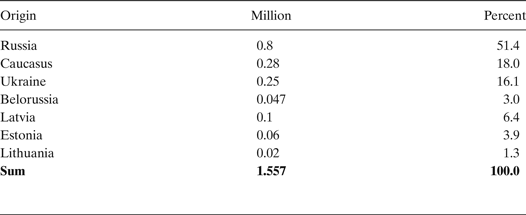
This diagnosis radicalizes the conclusions of the Harvard Interview Project, affirming more recent research on the 1930s.Footnote 77 The behavior of Soviet citizens during the Nazi occupation further supports this thesis. As Alexander Hill has observed, “a significant minority of the civilian population” collaborated “energetically” with the Germans, opposed by another “significant minority,” at the other end of the political spectrum, who supported the Soviet underground.Footnote 78 An estimated 68.4 million Soviet citizens were subjected to German occupation.Footnote 79 At most, 1.6 million citizens served as military auxiliaries in the Wehrmacht, SS, police, and other units (see Table 4) and hundreds of thousands in the civilian administration;Footnote 80 meanwhile 1.1 million joined the Soviet partisan movement on occupied territory throughout the war, with another 1.5 million registered in the “partisan reserve.” (Because of heavy losses, partisan numbers never reached 0.3 million at any point in time.)Footnote 81 The local armed groups fighting their own war against Soviets and Nazis alike made up a similarly small share of the population:Footnote 82 support and size of the insurgency varied by region and time, topping overall at maybe 1.6 million fighters.Footnote 83 At most, then, ideological warriors of the various sides tallied 5.8 million, or 8 percent of the population, a number that must be smaller in reality, as many fighters changed sides, sometimes repeatedly.Footnote 84 Well over 90 percent of Soviets under German occupation, then, attempted to avoid “openly committing themselves to either side.”Footnote 85 Such shares suggest, in the words of Karel Berkhoff, that “the totalitarian ideologies had only a minor effect on the mental outlook of ordinary people.” Most held “nonattitudes:” They had no “clear preferences” but tried to survive by finding an “exit” from such dangerous political choice.Footnote 86
Soviet Citizens Fighting with the Germans, 1941–1945

Source: Rolf-Dieter Müller, An der Seite der Wehrmacht. Hitlers ausländische Helfer beim ‘Kreuzzug gegen den Bolschewismus’ 1941–1945 (Frankfurt, 2010), 242.
VIII
A similar conclusion is reached by the most complete recent investigation into Why Stalin's Soldiers Fought.Footnote 87 Roger Reese has made his name with major studies of the Red Army at the intersection of social and military history,Footnote 88 a background that serves him well in delving into what he calls Soviet “military effectiveness”—the ability to continue fighting. Rejecting both extremes of the historiographical divide, he points out that there are “indeed hundreds of thousands of cases that support” either the thesis of support or the interpretation stressing resistance to Stalinism. However, “there are millions more that fall at various points in between.Footnote 89
About four million Soviet citizens volunteered to fight against the Germans; another group of 4.4 million refused to fight. The vast majority (seventy-five percent of those serving in the regular armed forces) fell between these poles, but the “rate of dereliction of duty through desertion or draft evasion” was significantly higher than in their British or US counterparts.Footnote 90 While people of all circumstances could be found at any point on this continuum, the extremes had, on aggregate, a rather clear demographic profile: young urban, and educated Russians (including skilled workers) were more likely to volunteer, while non-Russians, older men, and peasants were more prone to be found at the other end of the spectrum.Footnote 91 Soviet citizens' choices, meanwhile, cannot be reduced to Stalinism vs. anti-Stalinism or Socialism vs. anti-Socialism, just as the choices to stay or to leave when the Germans approached,Footnote 92 or to serve the occupiers once they were there were motivated in complex ways.Footnote 93 People fought for Stalin, Socialism, or Russia, the homeland or their native city, to defend women and children and to avenge the death of loved ones or conationals; many simply did as they were told, subjecting themselves to the authority of the state, while others saw the defense against aggression as a just war; many hoped that the war would usher in a more humane kind of socialism, devoid of coercion, terror, and collective farms, while others hoped to redeem their own or their family members' past “sins.” Whatever the reasons for closing the ranks, only a minority was enthusiastic about fighting, and the volunteers of 1941 remained a distinct minority, despite their visibility.Footnote 94
Given the majority's lack of martial enthusiasm, it was the mobilizational capacities of the Soviet state that made the difference. The ability of the Soviet military to continue fighting was ensured by a “core” of committed fighters, who held the army together. Educated and urbanized, overwhelmingly ethnically Russian, often beneficiaries of the Soviet project, these were the “young urban workers and students, the communists, the Komsomolets and Komsomolkas, and the professional soldiers”Footnote 95 —the kind of people, indeed, studied also by Krylova, Markwick, and Cardona. This core was confronted not only with a minority disaffected enough to commit treason during the war, but also with “the majority of people with well-founded doubts, skepticism, or anger against the regime” who nevertheless “managed to subordinate those feelings to the idea that there was hope for change, or to the realization that a Nazi victory would not improve their lot. Many prudently kept quiet about their hopes for a Soviet defeat and went along with the crowd to avoid persecution.”Footnote 96 Through the agency of the committed core, the Soviet state managed to cajole, convince, flatter, and threaten “just enough” of the wavering majority to fight. Never, however, did the state manage to either command the loyalty of all, or even to mobilize the entire population. In the end, indeed, “it was a rather close run to keep enough men in the field to get the job done.”Footnote 97
Reese demonstrates that the state was not always at the center of people's decisions to fight or not to fight. “Personal or family circumstances, ideology, life experience, the immediate war situation, social factors, institutional factors, and many others, usually in combination, all affected people's thinking.”Footnote 98 He concurs with Thurston insofar as the question of the 1941 surrenders are concerned, which can be explained by military factors (Chapters 3 and 4); at the same time, he points out, the mass surrenders do not show loyalty to Stalin either. Reese puts more stress on the importance of the primary group of frontline comrades for sustaining morale than other scholars, who sometimes claim it did not exist. In the Red Army these groups were not identical with military units, but rather small networks of close friends, “the most significant” factor in ensuring combat participation.Footnote 99 At the same time, however, they also undermined military organization, as they did not reinforce the formal structure (as in the German army, for example) but “unified subgroups at the expense of the cohesion of the larger military organization.”Footnote 100 Arguably, indeed, they were the transposition into the military world of a central tool of civilian life: In their struggle to survive and get ahead, Soviet citizens bonded with people they learned to trust and to rely upon. Once in the military, they did just the same, and for similar reasons.Footnote 101
IX
The extent to which hostile attitudes could transform into defiant behavior also varied according to the perceived weakness of the Soviet regime.Footnote 102 Both the Ivanovo strikers and the loud-mouthed, big-fisted Moscow anti-Semites of 1941 did not acquire their opposition against “those up there” overnight.Footnote 103 Ivanovo had a long tradition of worker militancy, which did not evaporate after Stalin took control of the Soviet state.Footnote 104 And anti-Semitism was a well-entrenched plebeian attitude going back to the turn of the century at least.Footnote 105 What they did acquire—rather suddenly, indeed—was the sense that the regime was weak, that maybe help was on its way, that the persistent rumors of liberating apocalypse, which had haunted popular conversations throughout the 1930s, had finally come to pass. Once this moment of weakness passed, oppositional attitudes no longer led to acts of resistance. Instead, the demonstrated tenacity of Stalin's state and his army now encouraged participation in the war effort. “The one thing that finally turned the tide of morale to the positive once and for all,” writes Reese, “was the realistic prospect of victory in the near future.”Footnote 106
Soviet citizens, then, rallied to the winning side, whatever their ideological preferences. Virtually all non-Soviet studies of the partisan movement agree that there was little popular support for the fledgling Red guerilla movement in the first months of the war.Footnote 107 Instead of fighting or mobilizing the locals to support them, small and ineffectual partisan groups, to quote the complaint of a political officer, “conspired, dug in, became filthy, grew beards, invented pseudonyms, so the population would not identify them as activists.” The reasons were, in Bogdan Musial's words,
…many and diverse, including dilettantism in the creation of partisan groups and units, poor motivation among the partisans themselves, which often led to desertion to the enemy, and lack of support from the population, who, on the contrary, often enough helped the German occupiers in their fight against the partisans.
Victims of Stalinism could be “instrumentalized” by the Germans in their struggle with the nascent guerrilla movement, an enlistment of locals that “largely succeeded” in 1941.Footnote 108 Historians disagree on the exact moment when the tide turned and on the extent to which German behavior made a difference. (Although it is hard to discount the reasoning of the always insightful Dr. Goebbels, who noted in April 1942, that the initially welcoming attitude “has changed completely in the course of months” because “we have hit the Russians, and especially the Ukrainians, too hard on the head.”)Footnote 109 But most studies agree that Soviet victories on the battlefield mattered greatly for the growing popularity of Stalin's guerillas.Footnote 110 In the Leningrad region significant numbers only attempted to join from the fall of 1943, when Soviet victory became all but certain.Footnote 111 In Belorussia, too, the vast majority of partisans simply chose the winning side, joining in 1943 (nearly sixty-one percent) or 1944 (fifteen percent).Footnote 112
Stalin's Soviet Union, then, did not win the war against Germany because the majority of the population was loyal to the regime or swayed by its propaganda.Footnote 113 It won this war because the state managed to survive the crisis of 1941 (partially because of its ability to improvise, partially because of the behavior of the Germans), to mobilize a committed core of supporters, and to produce enough equipment and conscript enough men and women to overcome the German aggressors in a war of attrition. It was the survival of the mobilizational state and its continued ability to direct a substantial number of the population that mattered most, not what those mobilized thought or felt.Footnote 114
Indeed, had it been up to the feelings of the peasant majority, it is questionable if Stalin's regime would have survived the war. Forced into collective farms, robbed of their most enterprising leaders, and exploited mercilessly, the rural population continued to flee to the cities, where—as in Ivanovo—they became unskilled workers living miserable lives in unsanitary, overcrowded, and dilapidated towns with little or no amenities. The war and postwar world saw them continue to fight for the their own survival and that of their families, and to attempt to eke out a marginally better existence by searching for jobs all over the Soviet Union, in an effort to find better housing or better food elsewhere.Footnote 115 Insofar as this struggle for survival left any space for politics, the war did not suddenly turn these exploited masses into supporters of the regime responsible for their woes. Peasants remained severely underrepresented among Red Army volunteers, and even among the partisans of 1944 their share did not approach their percentage in the general population.Footnote 116 After the war, too, little love was lost for the regime among the lower orders. While many in the intelligentsia sobbed over the death of Stalin in 1953, those who expressed their satisfaction with the leader's end tended to be workers and peasants.Footnote 117 “What a good day is today! We're burying Stalin: one swine fewer,” exclaimed a pattern maker, who had celebrated a little too much for his own good and was subsequently arrested.Footnote 118 Stalin might have won the war, but not the hearts and minds of all his subjects.