Introduction
The urgent need to increase livestock production in sub-Saharan Africa in order to keep pace with expected increases in demand for meat and milk is very topical (Delgado et al., Reference Delgado, Segrant, Steinfeld and Courbois1999a, Reference Delgado, Rosegrant, Steinfeld, Ehui and Courboisb). Breed improvement provides key entry points for increasing production and productivity in cattle populations (Ouma, Reference Ouma2005). The functions required of indigenous cattle influence the selection of traits for genetic improvement. Knowledge of traditional animal breeding practices and techniques is important to develop sustainable genetic improvement schemes under smallholder settings (Wuletaw, Ayalew and Sölkner, Reference Wuletaw, Ayalew and Sölkner2006). The issue, however, is how to design sustainable breeding schemes for indigenous breeds under inherent tropical conditions (Rege et al., Reference Rege, Marshall, Notenbaert, Ojango and Mwai2011) where resources are limited, and feed availability as well as quality vary greatly depending on the breed type of animals, geographical location and season. Well-designed breeding programmes including crossbreeding schemes enable effective utilization of desirable characteristics of the breeds or strains involved (López-Villalobos, Reference López-Villalobos1998).
In developing countries, such as Ethiopia, where the majority of indigenous cattle are raised for multipurpose production and service functions, developing breeding programmes entails the selection of multiple priority traits and their precise definition (Haile et al., Reference Haile, Tegegne, Ayalew, Noah and Dessie2011). Regardless of the scale of the operation, designing of genetic improvement programmes involves careful analysis of the short- and long-term objectives for improvement, as well as the socio-economic and environmental contexts in which the programmes are to operate (FAO, Reference Rischkowsky and Pilling2007; p215–241). Breeding objectives need to be defined in the context of the existing production conditions, applicable legal frameworks and current relevant market relations (Belihu, Reference Belihu2002). Traditional breeding practices, such as controlled mating, selection of breeding males or keeping pedigree information determine the extent to which expressed breeding goals can be achieved (Bittner et al., Reference Bittner, Bruch, Awugichew, Gnatouang, Grisar, Hoffler, Schreiber and Volkmann2000).
In developing countries, many important functions of livestock are embedded in traits that are not traded in the market (Scarpa et al., Reference Scarpa, Ruto, Kristjanson, Radeny, Drucker and Rege2003). These important traits can be revealed through surveys of farmers' trait preferences and assessment of livestock production systems. Only a few priority traits that can help optimize the overall gain should be considered as objective traits in order to design simple but effective breeding plans for easy implementation under farmers' conditions. Involving livestock producers in the identification of these traits and incorporating the identified traits in the design of breeding plans encourage them to actively participate in their implementation (Duguma et al., Reference Duguma, Mirkena, Haile, Iñiguez, Mwai, Tobbo, Rischkowsky, Sölkner and Wurzinger2010). Elucidation of objective traits using the tools with active involvement of producers can result in appropriate livestock genetic improvement that truly reflects owners' preferences (Duguma et al., Reference Duguma, Mirkena, Haile, Iñiguez, Mwai, Tobbo, Rischkowsky, Sölkner and Wurzinger2010). On that basis, as part of a larger study (Chebo, Reference Chebo2012), this study set out to survey traditional breeding practices of cattle keepers of Gamo Gofa Zone in Southern Ethiopia to reveal farmers' trait preferences and lay the ground for design of appropriate improvement schemes.
Materials and methods
The study area
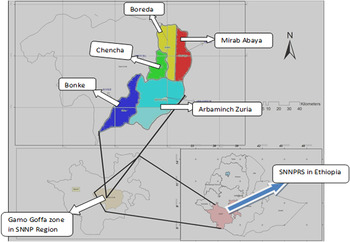
This study follows an earlier study on phenotypic characterization of the Gamo Highland and Gamo Lowland cattle in Gamo Goffa Zone of Southern Ethiopia (Chebo, Reference Chebo2012; Chebo, Ayalew and Wuletaw, Reference Chebo, Ayalew and Wuletaw2013). The study area (Figure 1) is described in detail in the earlier report (Chebo, Ayalew and Wuletaw, Reference Chebo, Ayalew and Wuletaw2013). Topography of the study area is characterized by undulating landscapes and variable climate. The total human population in the Zone was reported recently to be about 1.6 million (CSA, 2008/09) with an average population density of 80 inhabitants per km2. The estimated livestock population in 2010 was 1.44 million cattle, 800 thousand sheep, 337 thousand goats, 128 thousand equines and 1.1 million chickens (CSA, 2010/11).
Location of the study area.

Farming practices of the study area are mainly mixed crop–livestock type, with crops being more dominant in the higher altitude areas and livestock being more significant in lowland areas. In the highlands, cattle provide traction power for ploughing crop fields and manure as fertilizer, whereas crop harvest leftover and residue is used to feed livestock. Sheep are important sources of cash; mules are used as pack animals. In the lowland areas, cattle are regarded as the most important livestock asset followed by goats, poultry and donkeys, and provide milk, meat, cash, traction power and socio-economic values (Chebo, Reference Chebo2012).
Sampling and data collection
Based on information generated through single rapid exploratory field visits of the Zone coupled with key informant interviews and review of available secondary information, the 15 districts were categorized into three groups matching the highlands, mid-altitude areas and the lowland areas of the study area. Three sample districts (Bonke, Chencha and Boreda) from highlands and two districts (Arba-Minch Zuria and Mirab-Abaya) from lowlands were purposively selected for actual data collection, by taking into account the dominant agro-ecological zone of the districts, local knowledge on cattle population types and size of the cattle populations. As reported earlier (Chebo, Ayalew and Wuletaw, Reference Chebo, Ayalew and Wuletaw2013), cattle populations of the mid-altitude areas did not show distinct features that make them different from those of the highland and lowland areas and instead appeared to have intermediate features of the other two types. Therefore, samples were not taken from mid-altitude districts.
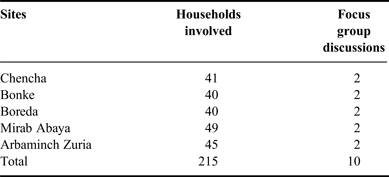
Sampling of study households took account of early indications noted during the rapid survey and key informant interviews that cattle keepers attach high value to adaptation to local environment and milk production. From each of the five study districts, cattle raising villages were randomly selected, and in each of these only cattle farmers who at the time of the survey were maintaining lactating cows were purposively selected for formal interviews using semi-structured questionnaires. These are a subset of sample herds selected for phenotypic characterization of the cattle population (Table 1). The questionnaires covered socio-economic characteristic of the sample households, cattle husbandry practices, herd structure and dynamics, cattle trait preferences, breed choices, breeding practices and constraints in cattle production. From 40 to 49 questionnaires per district were completed. Local agricultural extension staff who speak the local language were trained together and administered the questionnaires. In addition, within each district two focus group discussions involving 8–12 selected key informant farmers per session were facilitated by the researcher in the presence of the local agricultural extension officers. The topics for discussion were cattle trait preferences of the locality, practices for selection of replacement breeding stock, level of control of cattle breeding processes and known undesirable characteristics of cattle.
Sample households and group discussions by study districts.

Statistical analysis
Data were transcribed into computer for checking and processing using MSExcel© before detailed analysis using descriptive statistics of SAS (2002) version 9.0.
Results and discussion
Herd size and sex and age structure
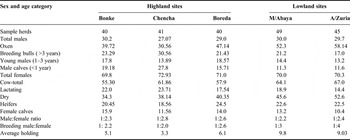
The mean cattle herd size per sample district ranged from 3.3 in Chencha to 9.8 in Mirab Abaya, with an overall mean for the study area of 6.83 cattle per household (Table 2). This average is similar to that of the 7.4 cattle/household reported by Tassew and Seifu (Reference Tassew and Seifu2009) for Mecha district of Amhara Region, an agrarian district. It is also within ranges of mean values of 5–14 cattle/household reported by Tadesse (Reference Tadesse2005) for South and North Wollo zones of Amhara Region and 2.82–7.44 cattle/household reported by Wuletaw (Reference Wuletaw2004) from highland districts of South and North Gondar zones, but much lower than the 44.76 cattle/household for largely pastoral lowland district. The overall average cattle holding is higher than 5.2 heads per household reported by Taye, Ayalew and Hedge (Reference Taye, Ayalew and Hedge2007) for Sheko breed in Benchi Maji zone of Southern Ethiopia. As presented in Table 2, the proportion in the herd of female cattle ranged from 69.8 to 72.9 percent, whereas that of males ranged from 27.07 to 30.2 percent. A larger proportion of the males are oxen, followed by breeding bulls. Commonly, young bulls not needed for breeding are either castrated or sold out by about sexual maturity. The overall adult male to female ratio ranged from two to three females per one breeding male for highland and two to four breeding females to one breeding male for lowland sites (Table 3). The average breeding male-to-female ratio indicated lower number of bulls per cow available compared with the 1:1.97 reported by Mukasa-Mugerwa (Reference Mukasa-Mugerwa1989) for Ethiopian highlands, but higher than that of 1:1.02 to 1:1.07 reported by Getachew (Reference Getachew2006) for Awi, East and West Gojjam zones and 1:1.04 to 1:1.73 reported by Tadesse (Reference Tadesse2005) for South and North Wollo zones.
Age and sex structure (%) of sample cattle herds by breed type and site.

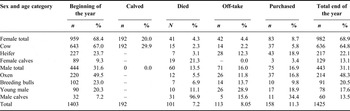
Annual cattle herd dynamics (frequency and percentages) of the study area reconstructed from recalls of herd owners.

Based on recalls of cattle herd owners, annual herd dynamics within sample cattle herds was calculated (Table 3). During the reference year, there was a slight (1.56 percent) net increase in cattle numbers. Overall mortality during the year was 7.2 percent, due mainly to very high levels of especially male but also female calf mortality.
The proportion of herds disposed of in the form of sale, gift and transfer (altogether referred to in Table 3 as off-take) was 8 percent overall, but 16 percent among males and only 4.4 percent for females. On the other hand, farmers purchased 45 more animals than they sold during the year, and hence net production was actually negative during the reference year. It was noted that in the study area animals are sold just to meet immediate cash needs, i.e. distress sales, rather than as means of continual income.
Functions of indigenous cattle
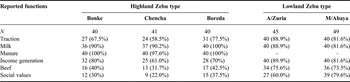
The major functions of cattle of the highlands of the study area are manure, milk, income generation (albeit small and intermittent), traction power, meat and social values in that order of importance. In the lowlands, on other hand, manure does not appear on the list of main functions, whereas milk, traction power, income generation, meat and social value are identified as more or less equally important (Table 4).
Frequency (percent in brackets) of reported functions of cattle by cattle type and district.

Trait preferences
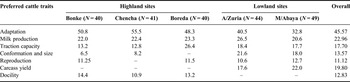
Adaptation to local environment (i.e. variability in weather, type and seasonality of feed supply as well as disease and parasite burden) was the most preferred trait (45.6 percent) of cattle in all five sites, followed by milk production (23 percent) and traction capacity (17.7 percent) (Table 5). Reflecting the low emphasis placed on the traits, carcass yield did not appear on the list of preferred traits in the highland sites, as was docility in the lowlands sites. Getachew (Reference Getachew2006) reported a similar preference for adaptation traits of local cattle of Eastern and Western Gojjam Zones of central Ethiopia. Wuletaw (Reference Wuletaw2004) also reported a similar but much wider variation in cattle trait references in an adjacent area in Northwestern Ethiopia, ranging from 20 to 96 percent for adaptation and from 0 to 50 percent for milk production. It is interesting to note that despite the long-established and common tradition of using cattle for traction in the study areas of all the three studies, traction did not rank high on the list of preferred traits. One possible explanation for this is the worsening feed scarcity especially during the long dry seasons as crop fields encroach into communal pastures. Under these circumstances, cattle keepers place higher importance to their adaptation to local environment to continue to produce and reproduce, rather than for instance to body size and conformation.
Respondents' reported cattle trait preferences (per cent).

Criteria for selecting breeding animals
Focus group discussions revealed that cattle keepers select breeding animals mainly for milk production, reproduction, body conformation and coat colour. Milk production capacity is assessed based on production history (of animal and its parents), large navel flap, medium size of dewlap, large udder, well-placed teats and thin slender neck. Farmers give more weight to known milk production levels than to body size of the cow.
Reported criteria for identifying better reproducing cows include displaying clear signs of heat, attainment of early sexual maturity, early age at first calving, short calving interval and good milk production. Animals with history of abortion are selected against. Bulls with long prepuce and good libido during mating are considered good for reproduction.
Body conformation traits considered for selecting replacement breeding heifers include size and attachment of the udder, teat placement, size of the navel flap and thin legs.
Black coat colour of cattle is a preferred attribute in the highland areas which have cool and seasonally cold weather. In contrast, farmers of lowlands select against cattle with black coat colour, even when milk production and body size are much better. It was also noted that local market prices are strongly influenced by coat colour.
Mating practices
Except for some areas where cross-breeding with Holstein Friesians has been promoted since the 1990s through artificial insemination and bull services, technical services in cattle breeding from local agricultural extension offices has been very limited. Mating of cattle is mostly uncontrolled and free. This is similar to the report by Wuletaw (Reference Wuletaw2004) and Getachew (Reference Getachew2006) from Northwestern Ethiopia. Cited reasons for uncontrolled mating are lack of awareness of possible options (60.4 percent), shortage of grazing land (32 percent), shortage of labour and scarcity of breeding bulls (7.2 percent). Some farmers in the highland areas are aware of the consequences of mating their cows with unknown bulls, and attempt to control mating mainly to ensure that cows give birth during the wet season when feed is relatively more abundant. Of those who practice controlled mating, including artificial insemination, 23.6 percent of respondents mate cows soon after detecting signs of heat, 28.7 percent within half a day after the first sign of heat, 36.5 percent within a day and the rest 11.2 percent take cows to mate after 2 days. Some of these farmers practice tethered feeding of the cows and reported that these cows manifest clear physical signs when they are in heat, such as restlessness, bellowing, mucus discharges and swelling of the vulva, lifting up of the tail, reduction in milk yield and frequent urination.
Reported sources of breeding bull are own herd (21 percent), neighbour (52 percent), relatives (14 percent) and sometimes paid bull service (13 percent). Purposeful rearing and management of breeding bulls is not a common practice in the study area.
Feeds and feeding management
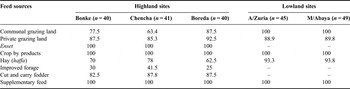
Communal and private unimproved natural pastures are the major source of animal feed in the study area (Table 6). Farmers indicated that more and more pasture land is being converted into cropping fields. Communal pastures are more common in the lowland areas, and often groups of cattle herds are tended together on communal lands known locally as “wude”.
Reported frequency (per cent) of use of major feed resource for cattle by district.

During the cropping season, especially in the highlands, cattle are fed tethered on the fringes of crop fields; both grazing lands and labour are scarcer during the cropping season than the dry season. Farmers say tethering allows better control of animals from otherwise straying into gardens.
Throughout the study area, selected cattle are supplemented with a variety of feeds such as spent grain of local brew (Atella), natural mineral leak (bolle), leaf of a local staple known as Enset (Ensete Ventricosum), bamboo leaf, vines and leaves of sweet potato and leftover grains. Enset leaves are fed to all classes of cattle especially during the dry season. Farmers believe Enset is particularly good for lactating cows. Improved forages such as elephant grass, vetch, clover, tree Lucerne, Sesbania and Desmodium species are grown and used by a few model farmers in the highland districts. Feed conservation is commonly practiced in the form of crop residues (cereal straws) and hay in both highlands and lowlands areas. During the traction season, oxen are supplemented with barley and wheat grain, natural mineral leak, Enset, straw of barley and wheat and even raw sliced potato, signifying the importance they attach to farm traction. Fattening cattle and lactating cows are also fed purchased agro-industrial by-products such as mill run as well as kitchen residue.
Water is often freely available from streams and springs. During the peak dry season herders take cattle to river watering points two to three times per day.
Housing
Two types of cattle housing practices were observed in the study area. In the cool highland areas cattle are sheltered in houses, mostly in a sector of the family house, but in the warmer lowland areas cattle are kept overnight in simple fenced open kraals, locally known as Dirsa, with no separation for calves, near homesteads.
Reported animal health problems
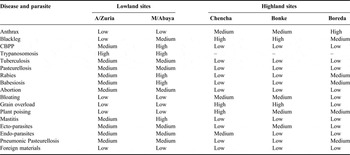
The common animal health problems of cattle as reported by sample cattle owners and local extension staff involved in this study were classified to known diseases based on local names of the reported problems as well as knowledge of reported symptoms. The relative reported prevalence of these problems are presented in Table 7, and are discussed further under three categories: infectious diseases, parasites and nutritional ailments.
Reported level of prevalence of diseases and parasites of cattle across the study sites.

Infectious diseases
Blackleg or black quarter
Blackleg is known in lowlands of the study area as “Abagorba” and in highlands it is called “Kantso or Tsilike”. Occurrence is common during dry periods of the year from December to March. The reported symptoms are depression, anorexia, rumen stasis, high fever, tachycardia and marked lameness with pronounced muscle swelling of the upper part of the affected leg.
Young animals were said to be more susceptible to the disease. Farmers use both traditional and veterinary drugs to treat diseased cattle. The traditional way of treating is slashing of the gas pockets with sharp blade or knife to draw the pus and wash the localized site with salt followed by smoking or burning the wound with hot metal plate. Sometimes a smear of ground garlic, sesame and salt is applied on the wound. After the treatment, farmers keep the animals without drinking water for a few days in the traditional belief that healing would progress faster when the animal stays thirsty.
Anthrax
Anthrax is reported to be fairly common with low to high relative prevalence across districts. It is known locally as “Abasanga” or “Tsade”. Reported symptoms such as abrupt onset of fever, trembling, haematuria and blood-tinged diarrhoea are used to confirm that this disease is indeed Anthrax. All groups of cattle are infected. Veterinary treatment is sought from assistant veterinarians and animal health technicians based at district agricultural extension offices when animals are suspected of having contracted the disease. Increasingly rare traditional ways of treating diseased animals involve cutting skin open using sharp objects at body parts that show signs of shivering to draw (dark) blood in the belief that it would limit disease progression. The wound is then treated with garlic juice and salt. Sample communities are now aware of the possible risk of disease cross-infection to humans but no case of human infection was reported.
Tuberculosis
This disease was reported as having low to medium relative prevalence in the sample districts, affecting all classes of cattle throughout a year. It was said to occur more often in overcrowded cattle barns both during the dry and wet seasons. No traditional treatment practices were reported or known in the study area, and farmers invariably seek veterinary treatment or administer illicit drugs that are often available in rural village kiosks.
Rabies
Rabies is known to also affect cattle in the study area, especially in lowland villages located close to forested and bushy areas frequented by sick stray and wild dogs. Disease occurrence was reported to be on the decline with the clearing of natural forests and bush lands, but its reported prevalence in the sample districts ranges from low to high. Diseased animals are likely to die from it and the carcass of dead animals is condemned and disposed off promptly in the belief that the disease can be transmitted to humans.
Contagious bovine Pleuro-pneumonia (CBPP)
The disease was said to be prevalent mainly in lowland areas. Fever, loss of appetite, difficult breathing, chronic coughing when forced to move and standing with the elbows apart were identified as common symptoms of the disease.
Disease outbreak is expected in the study area with reported prevalence by district ranging from low to high during the dry season when pastures have deteriorated and animals are in poor body condition. Farmers reported that there is no known effective treatment for the disease and they continue to use traditional ways of treating diseased animals with herbs.
Pneumonic Pasteurellosis (shipping fever)
Shipping fever is known in the study area as one triggered by severe stress, for instance, on excessive work load on cattle during the traction season and long trekking of animals to distant markets. The disease was characterized by depression, loss of appetite, fever, increased respiratory rate and shallow respiration.
Parasites
Both internal and external parasites of cattle were reported to occur in the study area with low to medium prevalence (Table 7). The two major internal parasites were Fasciola and Trypanosoma. Among the ectoparasites mentioned were ticks, lice, leech and mange mites.
Trypanosomosis was reported to be a prevalent disease in the lowland districts where communal pastures are known to have low to medium challenge levels of the vector Tsetse fly, Glossina spp.
Leeches are common endoparasites in wet areas and often found attached to the underside of the tongue. Farmers remove the parasite manually using hot ash or alcohol.
Lice infestations occur at beginning of wet season, most commonly on young calves. Traditionally farmers smear the infested area with tobacco juice mixed with mud.
Nutritional ailments
Bloating and grain overload were the most commonly reported cases of non-infectious ailments in the study area. Bloating occurs very commonly during the rainy season when bloat producing legumes grow abundantly. Grain overload or rumen acidosis is a common incident during the grain harvest season when cattle accidentally ingest large quantities of readily digestible wheat and barley grains especially in the highlands. Farmers treat sick cattle with drenching of juice of local herbs mixed with salt.
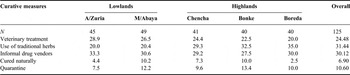
Cattle farmers use a variety of curative means to treat their sick animals (Table 8). The frequency of reported use of veterinary treatment from public and private clinics ranged from 20 to 29 percent between the sample districts. Popular drugs are widely marketed informally in the sample districts through village kiosks and unauthorized drugs vendors. A greater proportion of the lowland farmers tend to use traditional herbs.
Reported frequency of use of curative measures by cattle farmers to deal with known diseases and parasites by sites.

Conclusions
Cattle production of the study area is subsistence oriented and characterized by mixed crop-livestock farming in which cattle provide the traction and manure to support crop production and the crop residues serve as supplementary sources of feed for cattle. Management inputs on cattle are minimal, although cattle play multiple production and service roles in support of rural livelihoods.
Straight pure breeding is a common breeding practice in all study sites except Bonke and Chencha districts where some cross-breeding with Holstein Frisians is known to occur. Reported mating practices in the study districts are mostly uncontrolled, but some in the highland areas also practice artificial insemination with Holstein Friesian semen for dairy improvement. Expansion of cropland, diminishing feed resources, prevalence of various diseases and parasites, poor housing management, weak extension and training service were some of reported constraints of cattle production in the study area. For these cattle farmers to realize greater benefits from their cattle, the current husbandry and breeding practices should be gradually improved.
Acknowledgements
This paper is a part of the completed M.Sc. thesis of the first author under the academic supervision of the other authors, which was completed at Bahir Dar University, Bahir Dar, Ethiopia in June 2012. The Ethiopian Ministry of Education and Bahir Dar University jointly covered incremental costs of this study. Numerous cattle farmers and agricultural extension staff in the study area supported this study by sharing their knowledge and opinion and by granting permission for use of that information for purposes of this study, for which we express our sincere gratitude.