Introduction
The population of older adults in Canada is growing rapidly (Statistics Canada, 2019a). By the year 2024, one in five Canadians will be over 65 years of age (Statistics Canada, 2019a). According to the Ontario Long Term Care Association (OLTCA, 2019), over 115,000 people reside in long-term care (LTC) across Ontario. Increased life expectancies of Canadian seniors have advanced the agenda to ensure quality of life (QOL) of LTC residents (Statistics Canada, 2019b). Unfortunately, extensive literature reviews revealed challenges to maintain residents' optimal QOL (Kuske et al., Reference Kuske, Hanns, Luck, Angermeyer, Behrens and Riedel-Heller2007; Castle, Reference Castle2012; Backhaus et al., Reference Backhaus, Verbeek, van Rossum, Capezuti and Hamers2014; Duan et al., Reference Duan, Mueller, Yu and Talley2020). This puts an increasing demand on policy makers and researchers to operationalise the concept of QOL, and to develop and evaluate interventions that could optimise QOL for residents living in LTC (Duan et al., Reference Duan, Mueller, Yu and Talley2020). The purpose of this paper is to describe the impact of an organisational culture change approach, Neighbourhood Team Development (NTD), on LTC residents' self-reported QOL.
The concept of QOL in LTC is becoming increasingly important in the strive for high-quality care delivery and models (Morris et al., Reference Morris, Declercq, Hirdes, Finne-Soveri, Fries, James, Geffen, Kehyayan, Saks, Szczerbińska and Topinkova2018). However, knowledge gaps related to QOL in LTC remain, including defining and measuring QOL, and evaluating potential interventions to increase QOL for residents (Robertson et al., Reference Robertson, Cooper, Hoe, Hamilton, Stringer and Livingston2017). The World Health Organization (2019: para 2) defined QOL as the individual's ‘perception of their position in life in the context of the culture and value systems in which they live and in relation to their goals, expectations, standards and concerns’.
Measuring QOL in LTC is a challenging process for a variety of reasons. First, QOL is a subjective and individualised experience, making it difficult to reach consensus on how to define QOL for all residents (Sullivan and Asselin, Reference Sullivan and Asselin2013). Furthermore, van Leeuwen et al. (Reference van Leeuwen, van Loon, van Nes, Bosmans, de Vet, Ket, Widdershoven and Ostelo2019: para 4) emphasises the imperative of the individual resident perspective, rather than an observational perspective, to measure QOL as ‘knowing what older adults themselves find important in life, is necessary to align the goals of care services to their expectations’. However, the majority of LTC residents in Canada have some form of dementia, which makes it challenging for residents to self-report their QOL.
Despite its importance, minimal research is available on resident QOL in LTC (Kehyayan et al., Reference Kehyayan, Hirdes, Tyas and Stolee2015). One of the main underlying reasons for poor QOL in LTC is the fact that LTC has long followed a biomedical model of care (Longino et al., Reference Longino, Murphy and Hendricks2020), focusing on the medical treatment of the resident, where residents and families are rarely engaged in care decisions. However, a sector-wide culture change movement has urged LTC homes to adopt innovative care models to improve residents' QOL (Lima et al., Reference Lima, Schwartz, Clark and Miller2020). Culture change promotes an environment focused on caring and improving resident QOL through resident and staff empowerment (Chisholm et al., Reference Chisholm, Zhang, Hyer, Pradhan, Unruh and Lin2018). Research suggests that culture change has the potential to improve resident QOL and is also associated with positive clinical outcomes such as a lowered incidence of restraint use in LTC (Hartmann et al., Reference Hartmann, Palmer, Mills, Pimentel, Allen, Wewiorski, Dillon and Snow2017).
Culture change, as described by Hartmann et al. (Reference Hartmann, Snow, Allen, Parmelee, Palmer and Berlowitz2013), is a focus on resident choice, autonomy and meaningful engagement. In addition, culture change also involves staff empowerment, communication, inter-disciplinary collaboration, non-hierarchical leadership and a home environment.
Examples of culture change initiatives in LTC include: (a) Eden Alternative (Burgess, Reference Burgess2009), (b) Wellspring Innovative Solutions (Kehoe and Van Heesch, Reference Kehoe and Van Heesch2003), (c) Greenhouse (Ausserhofer et al., Reference Ausserhofer, Deschodt, De Geest, van Achterberg, Meyer, Verbeek, Strømseng Sjetne, Malinowska-Lipien, Griffiths, Schlüter, Ellen and Engberg2016), and (d) the Holistic Approach to Transformational Change (White-Chu et al., Reference White-Chu, Graves, Godfrey, Bonner and Sloane2009). While the literature contains examples of culture change being implemented, there is limited research available on agreed-upon culture change approaches, evaluation and strategies for measuring the impact of culture change in LTC (Sturdevant et al., Reference Sturdevant, Mueller and Buckwalter2018).
In Canada, several organisations claim to implement culture change in LTC (Bourbonnais et al., Reference Bourbonnais, Ducharme, Landreville, Michaud, Gauthier and Lavallée2018); however, there is little published literature on this work. A new organisational approach to culture change is NTD. NTD is based on, with permission, The Eden Alternative's ‘Neighbourhood Guide’, a guide licensed by Vivage Quality Health Partners (Boscart et al., Reference Boscart, Ploeg, Sidani, Heckman and Dupuis2012). The Eden Alternative (2014) is dedicated to changing culture in LTC and to increase QOL through the empowerment of residents, staff, volunteers and family members. The Eden Alternative (2014; Burgess, Reference Burgess2009) philosophy promotes the building of elder-centred communities through transforming organisational practices that provide person-directed care, resulting in a ‘life worth living’ for residents.
In 2012, authors developed and rolled out NTD as a multi-site component intervention including training all team members in resident-centred care (Boscart et al., Reference Boscart, Ploeg, Sidani, Heckman and Dupuis2012). Building on The Eden Alternative (2014), NTD combines the principles of culture change and innovative LTC models, and holds promise to increase QOL by focusing on cross-functional teams, consistent staffing assignments and resident-centred care (Boscart et al., Reference Boscart, Sidani, Poss, Davey, d'Avernas, Brown, Heckman, Ploeg and Costa2018b). The core components of NTD include: (a) maintaining the dignity and independence of residents, (b) consistent staffing, (c) cross-functional teams, (d) resident-centred care, (e) empowering team members, and (f) the physical neighbourhood design (Boscart et al., Reference Boscart, Sidani, Ploeg, Dupuis, Heckman, Luh Kim, d'Avernas and Brown2019). A focus is placed on maintaining the dignity and independence of residents while promoting best practices and work within a team (Boscart et al., Reference Boscart, Ploeg, Sidani, Heckman and Dupuis2012). Each neighbourhood within a village has a consistent staff team and a Neighbourhood Coordinator (NC). All members of the team are seen as equal, thus removing the hierarchy in LTC. The NC acts as a coach for the team, mentoring team members and promoting QOL through self-directed neighbourhood teams in a care environment focused on delivering resident-centred caring and respecting residents' autonomy (Boscart et al., Reference Boscart, Ploeg, Sidani, Heckman and Dupuis2012). NTD started with an organisation-wide commitment to designate assigned teams and the appointment of NCs. The leadership team and all NCs received an in-depth three-day workshop. Subsequently, the NCs and directors provided NTD to their teams through monthly meetings. Team members from each neighbourhood attend a monthly gathering, led by the NC, to promote team development (Boscart et al., Reference Boscart, Ploeg, Sidani, Heckman and Dupuis2012). Topics and content of NTD development follow the NTD guidebook (Carson et al., Reference Carson, Brown, d'Avernas and Dunn2015) and include the organisational mission, team-building skills, quality improvement, conflict resolution, recognising valuable contributions and models of leadership. Overall findings of this implementation can be found elsewhere (Boscart et al., Reference Boscart, Sidani, Ploeg, Dupuis, Heckman, Luh Kim, d'Avernas and Brown2019).
A large study was conducted across Ontario to evaluate the impact of NTD on residents, family, team members and organisational outcomes (Boscart et al., Reference Boscart, Ploeg, Sidani, Heckman and Dupuis2012). Interviews and focus groups provided qualitative data for the study, as well as observations and recording of interactions. Quantitative data were collected through the use of the Resident Assessment Instrument–Minimum Data Set 2.0 (RAI-MDS 2.0) admission and quarterly data, surveys and quality indicators (Boscart et al., Reference Boscart, Ploeg, Sidani, Heckman and Dupuis2012). This article focuses on findings of a sub-analysis to explore changes in residents' QOL following the implementation of NTD.
Methods
The large, three-year study evaluating the feasibility of NTD in LTC and its impact on resident-centredness took place between March 2013 and August 2016 (Boscart et al., Reference Boscart, Davey, Ploeg, Heckman, Dupuis, Sheiban, Luh Kim, Brown and Sidani2018a).
Setting
The larger NTD study took place across a large organisation of for-profit LTC homes in Ontario, Canada. Data were available from six LTC homes, serving 192 residents in each home.
Participants
All residents, their families and staff within these six homes were invited to participate in the larger study. Study information was provided to all potential participants in the form of emails, pamphlets and posters. Research assistants obtained informed consent from those who agreed to participate. In total, 1,149 residents from these six LTC homes were recruited in the larger study.
For this subgroup analysis, resident data were included if they met the following inclusion criteria: (a) presenting with a Cognitive Performance Scale (CPS) score equal to 3 or less (indicating no to moderate cognitive impairment), (b) provided informed consent, and (c) completed the interRAI Self-Report QOL Survey for Long Term Care Facilities (SQOL-LTCF) (Morris et al., Reference Morris, Declercq, Hirdes, Finne-Soveri, Fries, James, Geffen, Kehyayan, Saks, Szczerbińska and Topinkova2018) during time-point 1 (between August 2011 and December 2012) and time-point 2 (between January 2014 and November 2015) (Boscart et al., Reference Boscart, Ploeg, Sidani, Heckman and Dupuis2012). Exclusion criteria included: (a) being acutely ill with a poor trajectory, (b) moderate to severe cognitive impairment (a CPS score of 4 or more), (c) an inability to complete the SQOL-LTCF at both times, and (d) palliative.
Data sources
Data collection commenced in August 2011 and continued until November 2015. Data sources included RAI-MDS 2.0: (a) demographic data (gender, age, marital status), (b) cognitive status, and (c) length of stay. The RAI-MDS 2.0 is standardised, reliable, valid and used internationally, allowing comparison amongst facilities (Morris et al., Reference Morris, Moore, Jones, Mor, Angelelli, Berg, Hale, Morris, Murphy and Rennison2003; Hirdes et al., Reference Hirdes, Ljunggren, Morris, Frijters, Soveri, Gray, Bjorkgren and Gilgen2008). This assessment is mandated in LTC for quality monitoring purposes (Freeman et al., Reference Freeman, Spirgiene, Martin-Khan and Hirdes2017).
QOL data were collected through the SQOL-LTCF (Morris et al., Reference Morris, Declercq, Hirdes, Finne-Soveri, Fries, James, Geffen, Kehyayan, Saks, Szczerbińska and Topinkova2018). The internal validity of an extended version of the self-reported SQOL-LTCF has been shown to be valid (Cronbach's alpha = 0.93) in residents with a mild to moderate cognitive impairment (Kehyayan et al., Reference Kehyayan, Hirdes, Tyas and Stolee2015). The SQOL-LTCF consists of ten QOL domains including: (a) privacy, (b) food and meals, (c) safety and security, (d) comfort, (e) autonomy, (f) respect, (g) responsive staff, (h) staff–resident bonding, (i) activity option, and (j) personal relationships (Morris et al., Reference Morris, Declercq, Hirdes, Finne-Soveri, Fries, James, Geffen, Kehyayan, Saks, Szczerbińska and Topinkova2018). Each item is scored from 0 to 4 where higher responses indicate increased QOL.
Team members received detailed training to facilitate QOL data collection including:
(a) confidentiality considerations, (b) ethical considerations, (c) SQOL-LTCF training, (d) interview preparation, and (e) interview principles. Team members met with each resident once a year to complete the QOL scale in person. NTD started in March 2013, so as a result of the above inclusion criteria and data collection schedule, the selected sample included residents with a minimum exposure to NTD of nine months, whereas the maximum exposure of residents to NTD was up to 32 months at time-point 2.
Data analysis
The pre–post-analysis compared a cohort of LTC residents from August 2011 to December 2012 to a cohort two years later in January 2014 to November 2015. A descriptive analysis was conducted on all demographics, cognitive status and length of stay.
Combined, the 31 items on the SQOL-LTCF provide a composite score to demonstrate QOL. By treating the Likert SQOL-LTCF data as continuous and pairing data from time-points 1 and 2, a paired t-test was used to determine the change in QOL scores over time, as this is an appropriate statistic for comparing mean values between two matched samples of parametric datasets (Xu et al., Reference Xu, Fralick, Zheng, Wang, Tu and Feng2017). SPSS software was used to perform all data analysis.
This subgroup analysis was approved by the Conestoga College Research Ethics Board and the McMaster University Integrated Research Ethics Board. REB approval for this subgroup analysis was approved through an amendment to the original application.
Results
The sample for the larger study consisted of 1,149 residents across six villages who met the inclusion criteria. At baseline, 966 QOL assessments were completed on residents in six villages. At time-point 2, there were 1,017 QOL assessments completed on residents. This resulted in a sample of 232 participants who presented with paired data retrieved at both time-point 1 (August 2011 to December 2012) and time-point 2 (January 2014 to November 2015) data collection times; overall, 20.2 per cent of the larger study was included in this subgroup analysis.
Reasons for ineligibility included severe cognitive impairment (30% of total sample) and being acutely ill with a poor trajectory (50% of total sample). In total, 731 responses were missing out of 14,384 possible responses on the SQOL-LTCF, indicating that 5.1 per cent of the total data were missing. The number of missing items per item on the SQOL-LTCF ranged from 1.5 to 17.7 per cent. The range of missing data on one scale ranged from 0 to 22 items. When analysing the missing data per item, the item ‘Staff act on my suggestions’ and ‘I tend to be happier than most other people’ had the highest rates of missing data with 17.7 and 13.8 per cent, respectively, compared to the items ‘Staff take the time to have a friendly conversation with me’ (1.5%) and ‘I get the services I need’ and ‘I feel my possessions are safe’ (both at 1.9%) with the lowest rates of missing data.
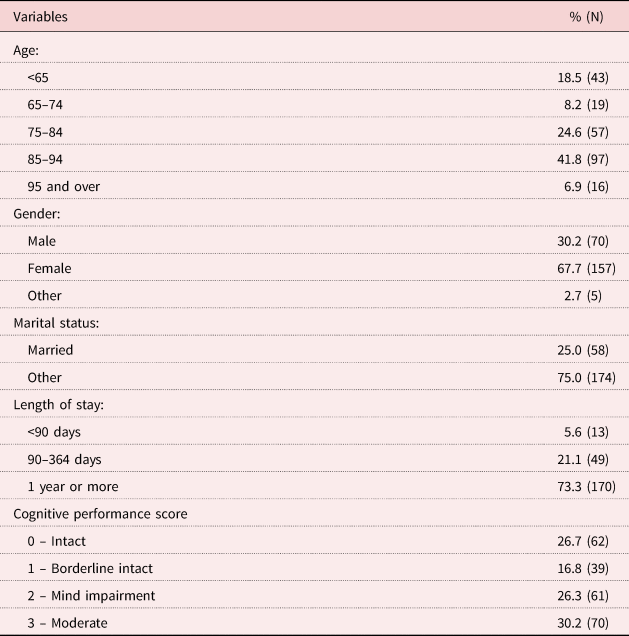
With respect to resident demographic characteristics, residents (N = 232) were largely female (68%), between the ages of 85 and 94 (42%) and unmarried (75%). Over 56 per cent of the participants demonstrated mild to moderate cognitive impairment (CPS score of 2 or 3). Most residents had a length of stay over one year (73%). Table 1 describes the demographic characteristics of the sample.
Demographic characteristics of residents

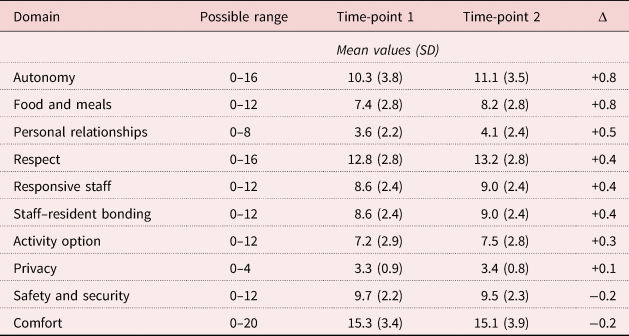
With respect to QOL scores, there was an increase of +0.8 points (p = 0.0034) between time-point 1 QOL scores (90.3 (standard deviation (SD) = 15.5 out of 124) and time-point 2 (91.1 (SD = 17.5) out of 124), indicating that residents' QOL increased after the implementation of NTD.
An exploration of QOL subscales showed an increase in eight of the ten QOL domains from time-point 1 to time-point 2. Generally, scores were very high across domains and all changes were less than 1 point on the scale. The decreases in QOL scores were within the domains related to safety and security (from 9.7 to 9.5 out of 12) and comfort (from 15.3 to 15.1 out of 20). Table 2 describes the changes in subscales over time.
Quality of life scores pre- and post-Neighbourhood Team Development implementation, by domain

Notes: Time-point 1: August 2011 to December 2012. Time-point 2: January 2014 to November 2015. SD: standard deviation.
Given that the implementation of NTD occurred as per intervention protocols (Boscart et al., Reference Boscart, Sidani, Ploeg, Dupuis, Heckman, Luh Kim, d'Avernas and Brown2019) and given that this is only one of the many sub-analyses performed, one can assume that there was an overall improvement in QOL scores for residents cared for within NTD.
Discussion
This article reports on changes in residents' QOL following an organisation-wide culture change intervention called NTD. Overall, findings indicate that residents' QOL scores improved during and after NTD implementation. An increase (+0.8 points, p = 0.0034) in the QOL scores suggests that NTD had a positive impact on resident centredness and care. NTD promotes consistency amongst staff caring for residents, thereby enhancing continuity of care. Consistent assignments allow for staff to have a deeper relationship with residents, providing opportunities to optimise care and QOL for the resident.
There is some evidence that NTD and other culture change models increase residents' QOL, yet few LTC homes have care models that prioritise QOL assessment as a quality indicator. Only 60 per cent of LTC homes in Ontario chose to focus on resident satisfaction as a priority quality indicator for the 2015/2016 Quality Improvement Plans for Health Quality Ontario (2016). There is a real need to address residents' QOL as a priority area for care modelling and practices within LTC.
This paper contributes new insights to the literature on a culture change model and residents' QOL in LTC. Study findings indicate that culture change, such as NTD, can improve QOL for LTC residents.
This subgroup analysis has several noteworthy strengths and limitations. Strengths include the large sample size and data collection across six different LTC homes. Importantly, the study used a standardised, reliable and valid measure for assessing QOL (Kehyayan et al., Reference Kehyayan, Hirdes, Tyas and Stolee2015, Reference Kehyayan, Hirdes, Tyas and Stolee2016; Morris et al., Reference Morris, Declercq, Hirdes, Finne-Soveri, Fries, James, Geffen, Kehyayan, Saks, Szczerbińska and Topinkova2018). An assessment system such as the one implemented has great value as it allows for regular comparisons between and across populations in different care settings at a national and international level (Carpenter and Hirdes, Reference Carpenter and Hirdes2013). Furthermore, the SQOL-LTCF can be linked to the RAI-MDS, a collection of standardised scales to assess the clinical status of residents comprehensively (interRAI, 2017) and explore contributors or inhibitors for optimal QOL. Lastly, the study confirmed that QOL can be assessed in residents with a mild to moderate cognitive impairment, and through a self-reporting survey (Stites et al., Reference Stites, Karlawish, Harkins, Rubright and Wolk2017). While missing data ranged from 1.5 to 17.7 per cent per item, this is not uncommon in gerontological studies because of natural decline related to end of life (Gardette et al., Reference Gardette, Coley and Andrieu2007).
Limitations of this analysis include LTC homes within one geographical location only, which could limit the generalisability of findings. However, the sample demographics provide a good representation of Ontario and Canadian LTC home residents, as confirmed by the OLTCA (2019) which reported that 99 per cent of residents in Ontario LTC homes have some form of cognitive impairment and the Canadian Institute for Health Information (CIHI) describing that approximately 40 per cent of residents in Canadian LTC are documented as having severe or very severe cognitive impairment as scored on the CPS. Residents 85 years and older make up almost 60 per cent of the seniors in LTC living with dementia (World Health Organization, 2012; CIHI, 2021).
An additional limitation to be mentioned is the absence of a control group, presuming that some of the observed effects may have been related to other factors as well, including strong leadership involvement and organisational ‘buy-in’. Furthermore, this sub-analysis is limited in that it only explored changes in two separate resident cohorts at two different time periods. Lastly, there is limited capacity within a single study to explore the optimal measurement of QOL, as well as the value of NTD. Other articles have addressed the value of the NTD model (Boscart et al., Reference Boscart, Davey, Ploeg, Heckman, Dupuis, Sheiban, Luh Kim, Brown and Sidani2018a, Reference Boscart, Sidani, Poss, Davey, d'Avernas, Brown, Heckman, Ploeg and Costa2018b, Reference Boscart, Sidani, Ploeg, Dupuis, Heckman, Luh Kim, d'Avernas and Brown2019).
Conclusion
This paper confirms that residents' QOL can be improved when cared for within NTD, an organisational culture change approach. This study is unique as it is the first to evaluate the effect of NTD on residents' QOL in LTC in Canada. Culture change interventions, when implemented organisation-wide, in an evidence-based and sustainable manner, can have measurable impact on resident outcomes including QOL, a concept difficult to measure in these settings. Using the SQOL-LTCF, authors found an increased QOL score post-NTD implementation, an ultimate goal for anyone living and working in LTC. LTC homes ought to be encouraged to use QOL as a key outcome measure for innovative approaches in care modelling and practices.
Financial support
This work was supported by The Canadian Institutes of Health Research Operating Grant (grant number 137020). The funders had no influence on the study design, data collection, analysis, interpretation of data or the writing of the manuscript.
Conflict of interest
The authors declare no conflicts of interest.
Ethical standards
This subgroup analysis was approved by the Conestoga College Research Ethics Board (REB-118) and the McMaster University Integrated Research Ethics Board (0739D). REB approval for this subgroup analysis was approved through an amendment to the original application.