


Introduction
Psychotherapy is a dynamic interpersonal process in which a therapist and client must find ways of working together to alleviate the client's mental distress. Generating an empirical understanding of this process has been an enduring challenge. Across a range of different approaches to psychotherapy, some common features are thought to relate to therapeutic outcome (Rosenthal and Frank, Reference Rosenthal and Frank1956; Rosenzweig, Reference Rosenzweig1936; Stiles, Shapiro and Elliott, Reference Stiles, Shapiro and Elliott1986). One such feature is the interaction between therapist and client. It is unclear, however, whether the social interactions through which therapy are delivered are themselves sufficient for therapeutic benefit, whether they are a means for accomplishing a therapeutic end, or whether good relationships result from positive progress made in therapy (Barber, Reference Barber2009; DeRubeis, Brotman and Gibbons, Reference DeRubeis, Brotman and Gibbons2005; Hardy, Cahill and Barkham, Reference Hardy, Cahill, Barkham, Gilbert and Leahy2007).
In spite of decades of research, no definitive understanding has emerged about the independent role of factors common to all psychotherapeutic approaches, such as the therapist-client relationship, and specific factors like the therapeutic approach that is used (Barber, Reference Barber2009; DeRubeis et al., Reference DeRubeis, Brotman and Gibbons2005; Hardy et al., Reference Hardy, Cahill, Barkham, Gilbert and Leahy2007; Shaw et al., Reference Shaw, Elkin, Yamaguchi, Olmsted, Vallis and Dobson1999; Strunk, Brotman, DeRubeis and Hollon, Reference Strunk, Brotman, DeRubeis and Hollon2010; Wampold, Reference Wampold2005; Webb, DeRubeis and Barber, Reference Webb, DeRubeis and Barber2010). This is perhaps not surprising, given that such factors can be inter-related (Barber, Reference Barber2009; Castonguay and Holtforth, Reference Castonguay and Holtforth2005). The therapeutic relationship is, after all, the domain through which a range of therapeutic activities are accomplished, including those specific to a particular approach (Castonguay, Constantino, McAleavey and Goldfried, Reference Castonguay, Constantino, McAleavey, Goldfried, Muran and Barber2010; Sharpless, Muran and Barber, Reference Sharpless, Muran, Barber, Muran and Barber2010). For example, although the CBT approach advocates specific procedures for initiating first sessions with clients (Beck, Reference Beck2011; Persons, Reference Persons, Persons, Davidson and Tompkins2001), all therapeutic approaches involve socializing the client into the therapeutic process (Crits-Christoph, Crits-Christoph and Gibbons, Reference Crits-Christoph, Crits-Christoph, Gibbons, Muran and Barber2010; Horvath, Del Re, Flückiger and Symonds, Reference Horvath, Del Re, Flückiger, Symonds and Norcross2011). It may not always be clear, therefore, whether any given moment in therapy is underpinned by a therapy-specific or non-specific rationale. It may be both.
For this reason we have made no attempt to distinguish between therapy-specific and generic action. Rather, we aim to understand therapeutic interventions through observational research based on what happens in actual therapy sessions. As there is little research on specific ways in which good working relationships between therapists and clients are formed (Del Re, Flückiger, Horvath, Symonds and Wampold, Reference Del Re, Flückiger, Horvath, Symonds and Wampold2012; Horvath and Symonds, Reference Horvath and Symonds1991; Kozart, Reference Kozart2002), our aim is to identify discrete communicative practices used in psychotherapy that can be evaluated with respect to any relationship between psychotherapeutic process and outcome.
The study reported here utilized existing data from a randomized controlled trial that demonstrated the effectiveness of online CBT for treating people diagnosed with depression (Kessler et al., Reference Kessler, Lewis, Kaur, Wiles, King and Weich2009). In our current study we closely examined typed transcripts of initial therapy sessions to understand the process through which the therapeutic intervention was produced. Our focus in this article is on how therapists managed clients’ expectations in initial sessions and its relationship with client retention to the therapeutic process.
Opening therapy effectively is crucial to establishing and managing shared expectations about the therapeutic process and the roles that each party should fulfil, which is considered a necessary precondition for a successful outcome (Constantino, Glass, Arnkoff, Ametrano and Smith, Reference Constantino, Glass, Arnkoff, Ametrano, Smith and Norcross2011; Hardy et al., Reference Hardy, Cahill, Barkham, Gilbert and Leahy2007; Strunk, Brotman and DeRubeis, Reference Strunk, Brotman and DeRubeis2010). Socialization into CBT can be achieved using techniques such as orienting clients to the structure of the session (Persons, Reference Persons, Persons, Davidson and Tompkins2001) and agenda-setting (Blagys and Hilsenrot, Reference Blagys and Hilsenrot2002). Therapists are advised to set agendas with their clients at the beginning of sessions, to agree on a series of tasks that the dyad will engage in to progress the therapeutic agenda (Beck, Reference Beck2011). However, in qualitative research undertaken in preparation for the current study, we found that therapists do not always manage client expectations as advocated in CBT handbooks (Ekberg, Barnes, Kessler, Malpass and Shaw, in press).
Using conversation analysis, we studied opening moments of first sessions of online CBT, identifying the different degrees by which therapists managed clients’ expectations of the therapeutic process (Ekberg et al., in press). One way in which first sessions were opened involved no expectation management (and which we therefore describe as Type 0). Rather than managing the client's expectations about therapy, this type of opening typically involved the therapist directly proceeding to assess the client's situation (Beck, Reference Beck2011). Another way first sessions were opened (Type 1) involved therapists providing some explanation of how the first session would proceed, before moving into the assessment phase. These explanations, however, did not involve describing what would happen beyond the first session. A final way first sessions were opened (Type 2) involved a more comprehensive explanation that included what would happen in the first session and projecting what would happen in future sessions. Some therapists adopted a consistent approach to managing clients’ expectations, while others tended to vary. Detailed analysis of these three types of openings, including evidence of the immediate consequences for the interaction between therapist and client, are reported elsewhere (Ekberg et al., in press). The research reported here evaluates more distal consequences of this expectation management by considering its relationship with client retention.
Given psychotherapy is a dose-dependent treatment, where most clients will need to attend many sessions to achieve a therapeutic benefit (Hansen, Lambert and Forman, Reference Hansen, Lambert and Forman2002; Harnett, O’Donovan and Lambert, Reference Harnett, O’Donovan and Lambert2010; Howard, Kopta, Krause and Orlinsky, Reference Howard, Kopta, Krause and Orlinsky1986), there is good reason to identify techniques associated with increased retention. From our qualitative research, we anticipate that managing clients’ expectations enables them to more meaningfully engage in the therapeutic process (Ekberg et al., in press) and is therefore likely to be associated with greater retention in therapy. Our first hypothesis is that exposure to expectation management (Type 1 or 2) will be associated with increased retention in therapy, relative to first sessions involving no expectation management (Type 0). Initial qualitative analysis conducted for this study (reported below) generated a second hypothesis. This was that the occurrence of difficulties during or before the initial moments of first sessions would be associated with an absence of expectation management.
Method
This study involved retrospective analysis of qualitative and quantitative data collected as part of a randomized controlled trial for online CBT for primary care patients with depression (Kessler et al., Reference Kessler, Lewis, Kaur, Wiles, King and Weich2009).
Participants
Participants were recruited into the original trial from general practices located in Bristol, London and Warwickshire. The target population were 512 potential participants identified either by general practitioners (GPs) during consultations or through a search of practice records for recent diagnoses of depression. Relevant patients were invited by their GP to consent to be contacted by the study team.
Of the 512 patients who were identified, 417 participated in telephone assessments utilizing a clinical interview schedule to determine their eligibility for the trial (Lewis, Pelosi, Araya and Dunn, Reference Lewis, Pelosi, Araya and Dunn1992). Eligible patients were between 18 and 75 years of age, had been diagnosed with a new episode of depression within the preceding 4 weeks, and had not been treated for depression within the previous 3 months. Depression was defined as a score of 14 or more with the Beck Depression Inventory (BDI) (Beck, Steer and Brown, Reference Beck, Steer and Brown1987), and an ICD-10 diagnosis conforming to the World Health Organization's (2007) classification. Patients were excluded if they had a history of alcohol or substance misuse, a bipolar disorder, or a psychotic disorder. They were also excluded if already receiving psychotherapy or if they could not communicate proficiently in English. The 297 patients who met these eligibility criteria provided their informed consent to participate in the study. This included consenting to collection and analysis of their therapy sessions.
Data collection
For the purposes of the original trial (Kessler et al., Reference Kessler, Lewis, Kaur, Wiles, King and Weich2009), participants were randomly assigned to online CBT or to a waiting list with usual care from their GP. If they still met eligibility criteria following the 8 month waiting period, waiting-list participants could access the intervention. Data from participants in both arms of the trial were included for the present study. This meant that data involving 183 therapist-client dyads, who participated in therapy between January 2006 and January 2009, were available for analysis. Data included baseline variables and the transcripts of therapy sessions.
Each participant was able to access up to 10 sessions of therapy, with each session lasting up to 55 minutes. Therapy was provided through the organization PsychologyOnline (http://www.psychologyonline.co.uk/) by practitioners trained in CBT. Fidelity checking using the revised Cognitive Therapy Scale (Blackburn et al., Reference Blackburn, James, Milne, Baker, Standart and Garland2001) was conducted as part of the original trial and confirmed that therapists competently adhered to CBT methods (Kessler et al., Reference Kessler, Lewis, Kaur, Wiles, King and Weich2009).
Data coding
In an initial qualitative study, we used conversation analysis (Sidnell and Stivers, Reference Sidnell and Stivers2013) to study a sample of therapy session transcripts collected as part of the trial. Conversation analytic studies of psychotherapy have progressively isolated interactional practices that are relevant to the psychotherapeutic process (Peräkylä, Reference Peräkylä, Sidnell and Stivers2013; Peräkylä, Antaki, Vehiläinen and Leudar, Reference Peräkylä, Antaki, Vehiläinen, Leudar, Peräkylä, Antaki, Vehiläinen and Leudar2008). Our initial research identified recurrent ways therapists managed client expectations in first sessions of online CBT (Ekberg et al., in press). To develop a coding scheme based on our qualitative analysis, four team members (SE, RB, AM, AS) independently analysed 25 initial sessions of therapy. These were selected purposefully to maximize variability in types of first session openings. Team members collectively discussed their independent analyses to develop a coding scheme capable of identifying a range of features routinely observable in the initial moments of first sessions of therapy.
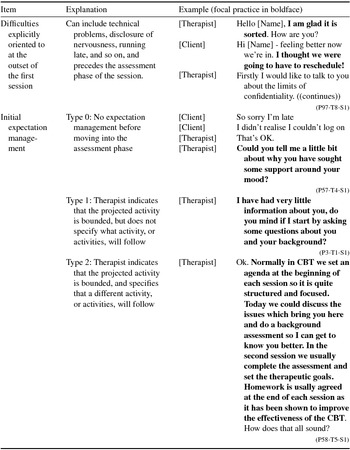
The primary focus of the coding scheme was how therapists managed client expectations for therapy. A clear space for therapists to do this was identified between the opening and assessment phases of the first session. Within that space, therapists’ conduct could be coded into one of three mutually-exclusive categories. The first category was designed “Type 0” due to the fact that therapists made no attempt to manage client expectations. The second category was “Type 1” expectation management. It involved therapists projecting the next type of activity that the dyad would undertake. A third category was designated “Type 2”, and involved a therapist attempting to comprehensively manage a client's expectations by projecting the next activity to be undertaken and the activity, or activities, that would follow once the initial activity was completed. Further information about the coding categories for this item is available in Table 1.
Coding criteria

A second key practice identified through qualitative analysis and in developing the coding scheme was the possibility that difficulties during or before the opening moments of first sessions might impact on whether client expectations were managed. On at least some occasions, it seemed difficulties may have resulted in a truncated opening and that expectation management might be omitted as a consequence of this. We therefore coded for whether difficulties, such as technical problems or one party being late for the session, were explicitly oriented to by either party before they moved into the assessment phase (see Table 1 for further details). Our work on this item resulted in a second hypothesis, that difficulties during or before first session openings would be associated with an absence of expectation management.
Following development of the coding scheme, two team members (SE and RB) independently coded a sample of 30 randomly-selected first sessions stratified to include all therapists. Kappa statistics were used to assess the level of agreement between the two raters’ coding. As the three types of expectation management formed an ordinate set, a weighted Kappa statistic was used to evaluate inter-rater agreement for this item (Cohen, Reference Cohen1968). Confidence intervals for these Kappa statistics were derived using analytical estimation (Fleiss, Reference Fleiss1981) and bootstrapping procedures (Efron and Tibshirani, Reference Efron and Tibshirani1993) for the “orienting to difficulties” and “expectation management” variables respectively.
Kappa statistics were interpreted using Landis and Koch's (Reference Landis and Koch1977) guidelines, in which 0.41–0.60 is moderate agreement, 0.61–0.80 is substantial agreement, and 0.81–1.00 is almost perfect agreement. Weighted Kappa for expectation management was 0.78 (95% CI: 0.52 to 0.94) and Kappa for orientation to difficulties in the first session opening was 0.71 (95% CI: 0.45 to 0.97). The level of agreement between the coders on these items was deemed acceptable under the above guidelines. This being confirmed, data for all 183 therapist-client dyads were subsequently coded by a single member of the team (SE).
The coding process identified 15 therapist-client dyads for exclusion from the study. Five dyads were excluded because the client changed therapist mid-way through treatment, three because the client was found to not meet inclusion criteria, three had severe technical problems in the first session that prohibited observing expectation management, three did not have transcripts of the first session on record, and one dyad agreed the client was no longer depressed by the time therapy had commenced. A further 21 dyads were excluded from primary analysis since full data were not available. This resulted in data for 147 dyads suitable for primary analysis. A sensitivity analysis was then performed on 168 dyads using the partial data available for the 21 dyads mentioned above.
Data analysis
Initial analysis evaluated clients nested within therapists, to evaluate a potential clustering effect amongst therapists, but this produced an intra-cluster correlation of <0.001. In subsequent analysis therapists were therefore excluded. Linear models were used to examine the relationship between expectation management with client retention in therapy, measured by the total number of sessions attended. Difficulties during or before the opening moments of first sessions were evaluated as a possible confounder of expectation management. Analysis compared crude and adjusted models; adjusted models accounted for variables collected for the original trial (Kessler et al., Reference Kessler, Lewis, Kaur, Wiles, King and Weich2009): client age, gender, trial centre (Bristol, London, Warwickshire), BDI score at point of recruitment, use of anti-depressants, presence of a counsellor in the general practice from which the client was referred, and orientation to difficulties during the opening moments of the first session. Sensitivity analysis was conducted to include a further 21 dyads for whom data on antidepressant use or presence of a practice counsellor were not available.
Results
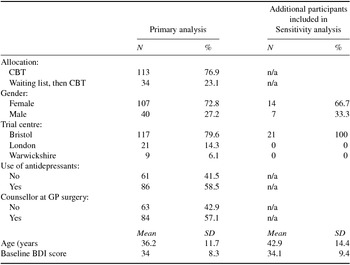
Table 2 shows that participants were predominantly allocated to the CBT arm, female, using antidepressants at baseline, and registered with primary care practices that had a counsellor service. Participants who were only included in the sensitivity analysis were slightly older but had similar baseline BDI scores as those in the primary analysis dataset.
Baseline characteristics of clients

Relationship between expectation management and retention
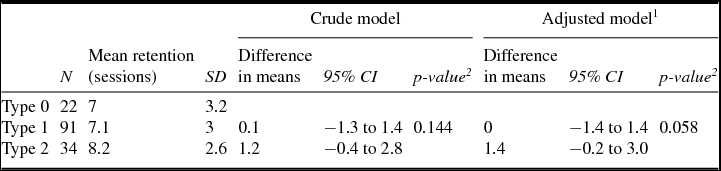
Table 3 reports results of the analysis of the relationship between therapists’ expectation management and client retention as measured by the total number of sessions attended. The crude model suggested expectation management was positively related to retention. Clients exposed to comprehensive (Type 2) expectation management were found to remain in therapy for an average of 1.2 sessions longer than clients who did not have their expectations managed at the outset of therapy (95% CI: -0.4 to 2.8). An adjusted model including a range of client variables supported this, finding clients exposed to comprehensive expectation management remained in therapy for an average of 1.4 sessions longer than those exposed to less comprehensive or no expectation management (95% CI: -0.2 to 3.0). The sensitivity analysis, involving an additional 21 dyads, further supported this finding (adjusted mean difference = 1.6 sessions, 95% CI: 0.2 to 3.1). It should be noted however that this is not strictly comparable with the primary model, since antidepressant use at baseline and presence of a practice counsellor were not available for these participants and so were omitted from the adjusted sensitivity analysis model. In all analyses, the less comprehensive form of expectation management (Type 1) was not associated with a notable increase in retention relative to no expectation management. Analysis therefore provided partial support for the first hypothesis, finding exposure to comprehensive (Type 2) expectation management was associated with increased retention in therapy.
Primary analysis of the relationship between expectation management and retention
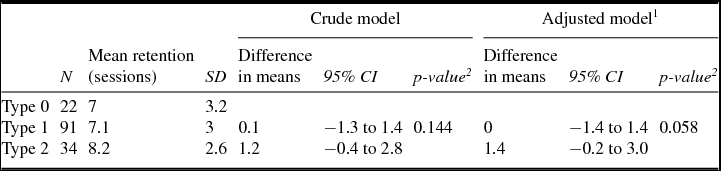
Notes: 1 Adjusted for age, sex, centre, baseline BDI score, use of antidepressants, and counsellor at GP surgery
2p-value is Wald test for overall effect of expectation management
Adjusting for orientation to difficulties in the opening moments of the first session had little impact on the estimates and corresponding confidence intervals (data not shown) and did not materially alter the conclusions from the simpler adjusted model. There was, therefore, no support for the second hypothesis that difficulties during or before first session openings would be associated with the absence of expectation management.
Discussion
The ability for therapists and clients to share an understanding and commitment to how they will collaborate in therapy appears crucial for a sound working relationship (Horvath et al., Reference Horvath, Del Re, Flückiger, Symonds and Norcross2011). The current study investigated one aspect of this: therapists’ attempts to socialize clients into what will be involved in therapy (Crits-Christoph et al., Reference Crits-Christoph, Crits-Christoph, Gibbons, Muran and Barber2010). When they commence therapy, many clients may not be familiar with the specific process of CBT, or even psychotherapy more generally. It is important therefore that their expectations about therapy are managed at the earliest possible opportunity (Ekberg et al., in press). The research reported here suggests that attempts to manage expectations in a comprehensive manner may be related to the long term therapeutic progress, as measured by retention in therapy. Our analysis found that clients exposed to comprehensive expectation management remained in therapy, on average, more than a session longer than the average of seven sessions attended by those clients who did not have their expectations managed at the outset of therapy. Given that eight sessions are required before at least half of therapeutic clients achieve a therapeutic benefit (Howard et al., Reference Howard, Kopta, Krause and Orlinsky1986) – if not more (Hansen et al., Reference Hansen, Lambert and Forman2002; Harnett et al., Reference Harnett, O’Donovan and Lambert2010) – increased retention is key to promoting therapeutic benefit.
Previous qualitative analysis based on observations of communication practices used in initial sessions of therapy (Ekberg et al., in press) identified three ways these sessions can progress. The quantitative analysis presented here suggests the use of comprehensive expectation management may be associated with increased retention in therapy. Confidence intervals in the analysis are wide, however, and include the possibility of there being no association. Further research is therefore needed to confirm this finding.
Despite its limitations, the research reported here illustrates a novel way in which psychotherapeutic process research might respond to calls for evidence-based explanations that promote successful treatment (Kazdin, Reference Kazdin2009; Strunk, Brotman, DeRubeis et al., Reference Strunk, Brotman and DeRubeis2010). Decades of studies have struggled to identify precise ways in which psychotherapy works to alleviate mental distress (Kazdin, Reference Kazdin2009). One element that has been missing is detailed understanding of actual communication practices that underpin the psychotherapeutic process. The study reported here demonstrates that observational research, applying approaches such as conversation analysis, can identify communicative practices that can be codified to enable quantitative evaluation of the relationship between discrete components of the therapeutic process and outcome. Although applied here to online psychotherapy, evidence from other health care settings has already demonstrated the feasibility of this approach for studying the relationship between process and outcomes (Heritage, Robinson, Elliott, Beckett and Wilkes, Reference Heritage, Robinson, Elliott, Beckett and Wilkes2007; Mangione-Smith, Stivers, Elliott, McDonald and Heritage, Reference Mangione-Smith, Stivers, Elliott, McDonald and Heritage2003; Stivers and Majid, Reference Stivers and Majid2007).
If the promise of the approach described here is to be realized, there will be a range of methodological challenges. Here we consider two challenges identified through our study. The first arises during the qualitative phase. To codify and thereby quantify discrete communicative practices, it is necessary to precisely define a focal practice and formally identify points at which it is possible for that practice to be relevantly produced (Schegloff, Reference Schegloff1993). This was relatively straightforward in the present study as we were able to identify the space between the opening and assessment phases as an opportunity for expectation management. It is unlikely that it will be possible, however, to identify such points for all the communication practices that are observable in psychotherapy.
A second challenge is evaluating the impact of a communicative practice. Although our research suggests a relationship between comprehensive expectation management and retention in therapy, the study design cannot provide evidence of a causal relationship. This is because therapists engaging in comprehensive expectation management could also engage in other practices that lead to increased client retention (Boyd, Reference Boyd1998; Elliott, Reference Elliott2010; Strunk, Brotman and DeRubeis, Reference Strunk, Brotman and DeRubeis2010; Webb et al., Reference Webb, DeRubeis and Barber2010). In the absence of assessing this, it is not possible to determine whether comprehensive expectation management is a crucial therapeutic technique (Barber, Reference Barber2009) or something of more incidental relevance. This limitation applies to other similar work exploring the relationship between communicative practices and health care outcomes (Boyd, Reference Boyd1998; McCabe et al., Reference McCabe, Healey, Priebe, Lavelle, Dodwell and Laugharne2013; Robinson and Heritage, Reference Robinson and Heritage2006). This could be addressed by considering more proximal outcomes, such as in Stivers and colleagues’ (Reference Stivers, Enfield, Brown, Englert, Hayashi and Heinemann2009) study of the relationship between questions and responses, although this shift from distal to proximal outcomes may impact the clinical utility of the research. Future studies should consider ways that these and other methodological challenges might be addressed.
In conclusion, the study reported here provides some evidence that comprehensive expectation management in first session openings of online CBT for depression is related to improved retention in therapy. This has relevance for therapeutic practice, highlighting one way therapists can promote their attempts to socialize clients into the therapeutic process.
Acknowledgements
This research was funded by a grant from the Bupa Foundation (UK).



Comments
No Comments have been published for this article.