Introduction
Smellmelon is an annual plant from the Cucurbitaceae family that reproduces by seed. The fruits are small, spherical to ovoid melons (Djé et al. Reference Djé, Kouonon, Zoro Bi, Gnamien and Baudoin2006), whereas the seeds are smaller than other melons and are covered by a fibrous coat (Burkhill Reference Burkhill1985). Smellmelon grows in a wide range of soil textures and prefers well-drained soil (Adekunle and Oluwo Reference Adekunle and Oluwo2008). Smellmelon is a problematic weed in cotton (Gossypium hirsutum L.) (Tingle et al. Reference Tingle, Steele and Chandler2003), peanuts (Arachis hypogaea L.) (Grichar Reference Grichar2007a), soybean [Glycine max (L.) Merr.] (Grichar Reference Grichar2007b), and many other crops. In Iran, smellmelon infests soybean fields in the Golestan and Mazandaran provinces and is becoming a troublesome invasive weed. Because smellmelon is highly competitive with soybean, yields can be decreased up to 25%, resulting in reduced profitability to the grower (Grichar Reference Grichar2007a; Sohrabi et al. Reference Sohrabi, Ghanbari, Mohassel, Gherekhloo and Vidal2016). Tingle et al. (Reference Tingle, Steele and Chandler2003) reported when smellmelon was allowed to compete with cotton for at least 6 wk, yield was reduced 7% compared to the weed-free field, but when smellmelon was allowed to compete for 10 to 12 wk, cotton yield was reduced 22% and 27%, respectively.
Seed germination is a critical stage in the life cycle of plants. Environmental factors such as temperature (constant and alternating), light, moisture, and oxygen influence the germination of nondormant seeds (Benech-Arnold et al. Reference Benech-Arnold, Rodríguez and Batlla2013). Temperature is a key factor for germination of seeds, because it interacts with other factors such as light, nitrates, phytochromes, and burial depth (Probert et al. Reference Probert, Smith and Birch1985). The cardinal temperatures (minimum, optimum, and maximum temperature) for seed germination are related to the environmental range of adaptation of plant species. These temperatures regulate the germination timing, seedling growth, and plant development (Alvarado and Bradford Reference Alvarado and Bradford2002). The cardinal temperature ranges can be important for phenological studies, the decision-making process for determination of weed control strategies, optimal periods for weed management (Grundy Reference Grundy2003), and prediction of the field emergence of weed species (Werle et al. Reference Werle, Sandell, Buhler, Hartzler and Lindquis2014). Tingle and Chandler (Reference Tingle and Chandler2003) suggested that 40 C is a maximum threshold temperature for smellmelon (Cucumis melo var. dudaim Naud.) emergence, whereas Egley (Reference Egley1983) indicated that soil temperature in a range from 40 to 50 C can reduce seedling emergence.
Depth of seed placement is important, because soil temperature and moisture availability change in the soil profile and may markedly affect germination and emergence in the field (Martin et al. Reference Martin, Leonard and Stamp1976). Therefore, determination of depths at which weed seed can germinate and emerge from soil could be important (Martin et al. Reference Martin, Leonard and Stamp1976). Tingle and Chandler (Reference Tingle and Chandler2003) stated that the interaction of planting depth and soil temperature can influence the seedling emergence of smellmelon (Cucumis melo var. dudaim Naud.). Therefore, information about tillage depth can reduce and/or stop emergence of smellmelon seeds from the soil, which could be an effective method of reducing the smellmelon problem.
Various POST herbicides have been introduced to control many weeds but not smellmelon. Valiollahpoor et al. (Reference Valiollahpoor, Mirsadati, Salehian, Khakza, Mafi and Nooralizadeh2013) showed that an application of paraquat at the two- to four-leaf growth stage controlled 90% of smellmelon in soybean 2 wk after application. Grichar (Reference Grichar2007b) reported that pendimethalin followed by glyphosate, glyphosate alone, and pendimethalin applied in combination with imazethapyr, flumioxazin, or cloransulam controlled smellmelon 70% to 95% in soybean 6 wk after herbicide application. In corn (Zea mays L.), Thompson et al. (Reference Thompson, Rosales-Robles, Chandler, Nester and Tingle2005) reported that imazapic at 0.07 and 0.14 kg ha–1 applied either PRE, early POST, or late POST produced 90% control. Tingle and Chandler (Reference Tingle and Chandler2004) reported that smellmelon control was at least 93% with low-, medium-, and high-input herbicide systems.
Maternal traits of seeds such as the presence of mucilage are effective in seed germination. Mucilage is a polysaccharide compound that is produced by the Golgi apparatus of seeds and fruits of some species (Western et al. Reference Western, Skinner and Haughn2000). This substance induces uptake of water by seeds (Zhang et al. Reference Zhang, Xue, Gao, Jin and An2005). Sun et al. (Reference Sun, Tan, Baskin and Baskin2012) showed that the mucilage of Alyssum minus Rothm. plays an important role in seed dispersal, seed adhesion to soil, and seed imbibition through enhancement of surface contact with the substrate. Also, the mucilage layer on the seed surface acts as a water storage device for germination and promotes seed germination under moisture stress (Sun et al. Reference Sun, Tan, Baskin and Baskin2012).
The objectives of our study were to (1) determine cardinal temperatures for seed germination; (2) determine the impact of the herbicides bentazon, imazethapyr, and bentazon plus acifluorfen on smellmelon control, plant reproduction, and seed germination; (3) determine distribution and frequency of smellmelon in different altitudes and regions of Golestan Province, Iran; (4) study the effect of seed burial depth on seedling emergence; and (5) investigate the influence of mucilage on germination of freshly harvested seed.
Materials and Methods
Seed Collection
Experiments were conducted at the Research Center of Agricultural Organization, Gorgan, Golestan Province, Iran, during the 2011 and 2012 growing seasons. Ripened fruits of smellmelon were collected from soybean fields in the summer of 2010, and seeds were extracted from the fruit. To test seed viability, seeds were cut in half and then soaked in a 1% (wt/vol) solution of 2,3,5-tetrazolium chloride (ISTA 1985) for 24 h. Seeds with red embryos were recorded as viable. The viability test showed that 100% of seeds were viable (data not shown).
Effect of Seed Coat Treatment and Temperature on Seed Germination
Treatments included fresh seeds with mucilage, dried seeds with mucilage, dried seeds without mucilage, and primed seeds placed in distilled water for 24 h. For the fresh seed with mucilage treatment, seeds were tested for germination in an incubator (Iran Khoodsaz, Tehran, Iran) immediately after harvesting. For the dried seeds with mucilage treatment, extracted seeds were air-dried at room temperature for 10 d before the germination test. For the dried seed without mucilage treatment, seeds were washed with tap water to remove mucilage and then air-dried at room temperature for 10 d before the seed germination test. For the priming treatment, the air-dried seeds without mucilage were soaked in distilled water for 24 h before the seed germination test.
For the germination test, seeds (for all treatments) were sterilized with 1% sodium hypochlorite solution for 2 min and washed with distilled water several times. Fifty seeds were placed on Whatman No. 1 filter paper in Petri dishes and then moistened with 5 ml distilled water. Dishes were wrapped in Parafilm M to inhibit water loss. Seed germination was tested at 15, 25, and 35 C, 12/12 h (light/dark) photoperiod, and a light intensity of 150 µmol m–2 s–1 in the incubator. Germination was evaluated by the appearance of a visible radicle protrusion 2 wk after incubation.
This experiment was carried out in a complete randomized design with three replicates and was conducted twice. Data were subjected to ANOVA, and means were compared with the LSD test at 0.05 with SAS software (version 8).
Determination of Cardinal Temperature
Seed germination of smellmelon with constant temperatures of 10, 15, 20, 25, 30, 35, 40, 45, and 50 C was evaluated. The procedure was similar to the germination test study. Germination was recorded after 14 d, and the experiment was conducted twice in a complete randomized design with three replicates. Means of two experiments were used in statistical analysis. Seed germination speed was evaluated (Maguire Reference Maguire1962) by the formula below:
 $$GS{\equals}\mathop{\sum}\limits_{i{\equals}1}^i {{{Si} \over {Di}}} ^{{}} $$
where GS is germination speed; Si is germinated seed for i th calculation; Di is days until i th calculation. To determine cardinal temperature, a two-piece segmented model (Soltani et al. Reference Soltani, Robertson, Torabi, Yousefi-Daz and Sarparast2006) was fitted by Sigmaplot 12.0 software.
 $$\eqalignno{{\rm f} & {\equals}{\rm if}( {{\rm x}\,\lt\,{\rm T}_{{\rm o}} ,( {( {{\rm x}-{\rm T}_{{\rm b}} } )\,/\,( {{\rm T}_{{\rm o}} -{\rm T}_{{\rm b}} } )} )\,/\,{\rm f}_{{\rm o}} ,( {1-( {{\rm x}-{\rm T}_{{\rm o}} } )\,/\, }} \cr & \quad \left( {{\rm T}_{{\rm c}} -{\rm T}_{{\rm o}} } \right) \right)\,/\,{\rm f}_{{\rm o}}\;$$
where Tb is base temperature; To is optimum temperature; Tc is maximum temperature; fo is minimum time required for maximum germination.
Effect of Sowing Depth on Seedling Emergence
In greenhouse experiments, seedling emergence was evaluated in two repeated experiments. A silty-loamy field-sterilized soil was used for the experiment, with the following characteristics: pH 7.6, EC 2.4 ds m–1, 23% total neutralizing value, and 2.3% total organic material. Soil was sterilized by autoclaving for 24 h at 105 C.
Fifty seeds of smellmelon were planted 0, 1.5, 3, and 5 cm deep and 12 cm apart in 20-cm-tall pots filled with sterilized soil. Pots were watered when needed to maintain soil moisture at field capacity. Seedling emergence was evaluated after 28 d. The experimental design was a complete randomized design with three replicates. The data variance was tested for homogeneity, and as no difference between the experiments was observed, the data of two experiments were combined for analysis.
Seedling emergence percentage was fitted by a Gaussian “bell curve” shape model (Chauhan, Reference Chauhan2016):
 $$y{\equals}ae^{{[{\minus}0.5({{x{\minus}x_{0} } \over b})]^{2} }} $$
where y is seedling emergence; x is seed sowing depth; a is maximum seedling emergence; b is slope of seedling emergence; x 0 is depth with maximum seedling emergence. Sigmaplot 12.0 software was used to fit the model.
Effect of Herbicides on Smellmelon Control
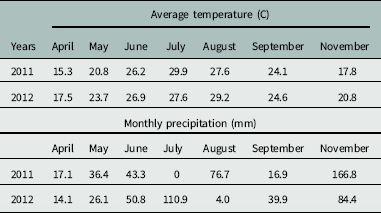
The effects of bentazon, imazethapyr, and bentazon plus acifluorfen on smellmelon control and some reproduction parameters were investigated during the 2011 and 2012 growing seasons. Meteorological data for the 2011 and 2012 growing seasons is shown in Table 1. Bentazon at 0.72, 0.94, and 1.21 kg ai ha–1, imazethapyr at 0.11, 0.22, and 0.6 kg ai ha–1, and the pre-mix of bentazon plus acifluorfen at 0.48+0.24, 0.63+0.31, and 0.81+0.4 kg ai ha–1 were included in a POST herbicide study. No surfactant was used.
Average temperature and monthly precipitation for the 2011 and 2012 growing seasons at the Research Center of Agricultural Organization, Gorgan, Golestan Province, Iran.

Golestan Province, Iran.
The experiments were arranged in a randomized complete block design with three replicates. Plot size was 1.5 m wide by 3 m in length. Seeds of smellmelon were planted in early June of 2011 and 2012 at a depth of 3 cm, and after thinning, a density of 10 plants m–2 was obtained before herbicide application. Each plot was separated by a 1.5-m-wide by 3-m-long nontreated area. Herbicides were applied with a CO2 backpack pressurized sprayer with 2-bar pressure fitted with a Polyjet nozzle DG 11003 (King Jet, Gardstar Industrial Co., Ltd., Jiangsu, China) when smellmelon produced three to five true leaves. Visual effect of herbicides was evaluated at 3, 6, 12, 24, 36, and 48 d according to the European Weed Research Council (EWRC 1964) method.
The effect of herbicides on smellmelon fruit production, fruit dry weight, fruit length and diameter, seed number per fruit, 1,000-seed weight, and seed germination were evaluated from fruit collected at the end of the plant growth stage. Seed germination was tested in an incubator with 35 C temperature, 12/12 h (light/dark) photoperiod, and a light intensity of 150 µmol m–2 s–1. Germination was evaluated by visible radicle protrusion 2 wk after incubation.
Seed germination was evaluated after 14 d. Data were subjected to ANOVA. Means were compared by the LSD test at the 0.05 level of probability.
Geographical Distribution of Smellmelon
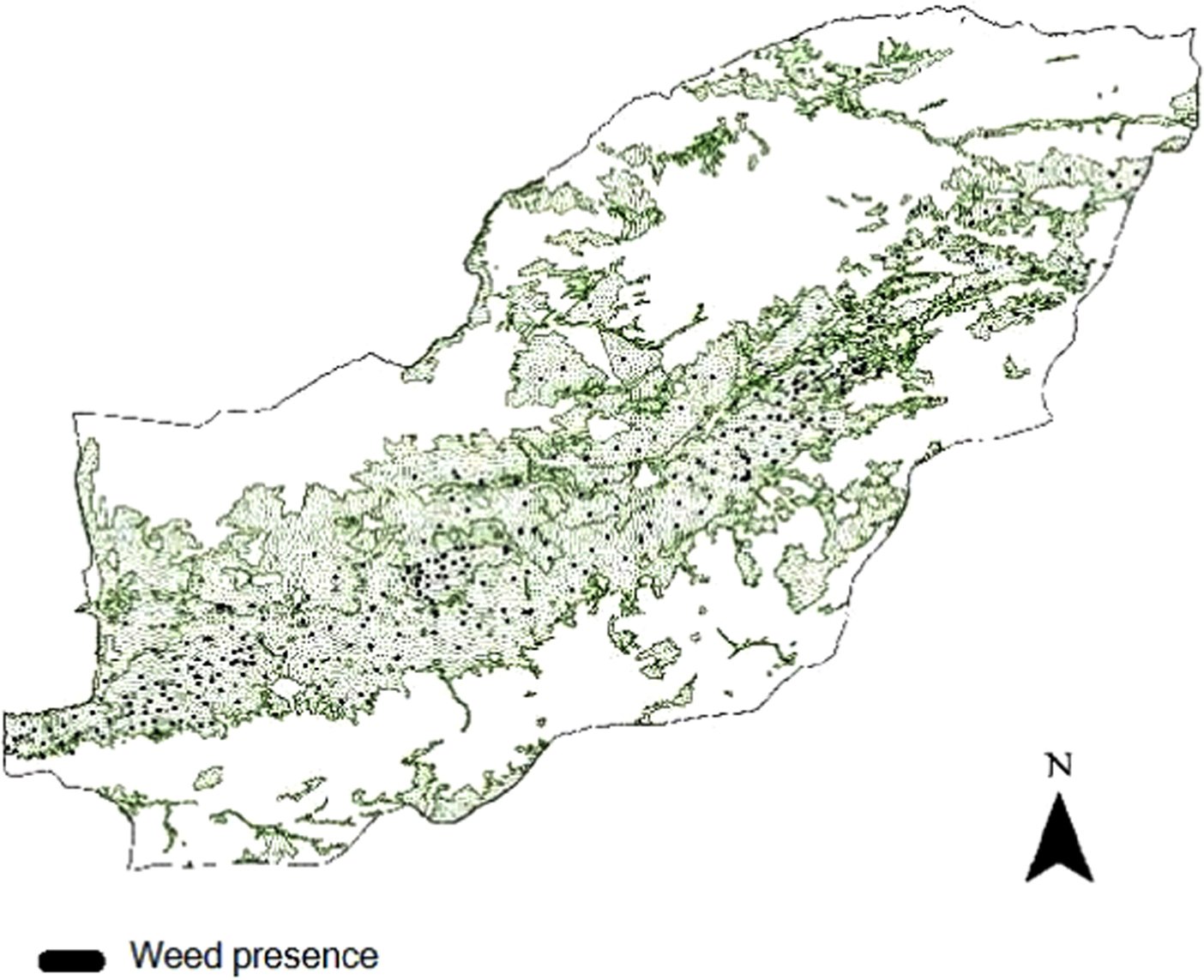
Distribution of smellmelon in crop fields in the Golestan Province was recorded from early July until early October 2011 through random monitoring of 90 fields (Figure 1). Fields were selected through interviews with farmers whose fields had smellmelon infestations in the last 5 yrs. Sampling in each field was carried out by the systematic “W” method, which covered most of the field following a “W” pattern (James Reference James1971; Basu et al. Reference Basu, Lin and Binns1977). For each 1-ha field, we placed ten 1-m2-area quadrats and sampled for smellmelon plant density and also the presence and/or absence of smellmelon. In each quadrat, geographic coordinates including latitude, longitude, and altitude were recorded by a global positioning system (Model: GARMINMAP 72CSX) (Thomas and Wise Reference Thomas and Wise1987). Elevation data were stratified to nine categories with 50-m distance. According to preset and/or none-present of smellmelon in the quadrats, frequency in each elevation category was determined by:
 $$F_{k} {\equals}{{\mathop{\sum}{y_{i} } } \over n}{\times}100$$
Map indicating different field crop regions in the Golestan Province, Iran. Black dots represent the occurrence of smellmelon in the area.

where F k is frequency of smellmelon; y i is presence or nonpresence of smellmelon in field i th, and n is number of inspected fields (Thomas Reference Thomas1985). Distribution of smellmelon was mapped with ARCGIS 9.3 software. Data of density and frequency were plotted against altitude using Sigmaplot 12.0.
Results and Discussion
Effect of Seed Coat Treatment on Seed Germination
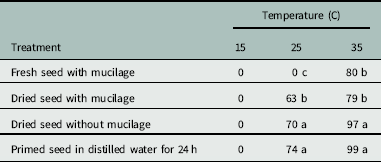
Smellmelon seed germination increased as much as 99% as temperatures increased (Table 2). At 15 C, germination was nil for all seed treatments. Dried seed without mucilage that had been primed in distilled water for 24 h had the greatest germination at 25 and 35 C; however, fresh seed with mucilage at 25 C did not germinate. Mucilage had an inhibitory effect at 25 C; this effect was reduced when the temperature increased to 35 C, and 79% to 80% of seeds germinated. Drying of seed reduced the role of mucilage in the regulation of germination, with 63% and 79% germination observed at 25 C and 35 C, respectively (Table 2). Removing mucilage at the high temperature (35 C) increased seed germination to 99%. These results indicate that fresh seeds without mucilage have no dormancy. Mucilage apparently plays a key role in the inhibition of fast sprouting of nondormant seeds. The fast sprouting can lead to late seed germination at the end of summer and early autumn. Such a risk-balancing germination strategy was proposed by Zhang et al. (Reference Zhang, Chen, Song, Tian and Gu2014) with the seed of Plantago minuta Pall.
Comparison of the effect of seed treatments at different temperatures on smellmelon seed germinationFootnote a .

a Means followed by the same letter in each column are not significantly different at P=0.05.
Sun et al. (Reference Sun, Tan, Baskin and Baskin2012) indicated that mucilage of A. minus fresh seed had an inhibitory effect on germination, especially at high temperatures. Therefore, the presence of mucilage helps to prevent germination during the summer season when the soil can be moist for a period of time due to a rain event (Sun et al. Reference Sun, Tan, Baskin and Baskin2012). Mucilage has an inhibitory effect by preventing diffusion of oxygen to the embryo (Western Reference Western2012).
Determination of Cardinal Temperature
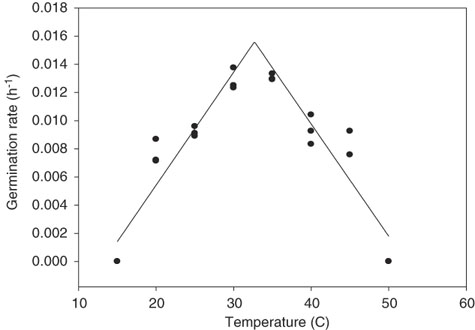
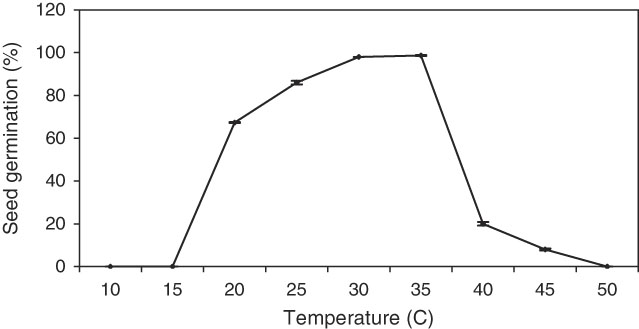
Smellmelon seed germination rate at different temperatures can sufficiently be described by a two-piece segmented model (Table 3). According to the model output, the base, optimum, and maximum temperatures were estimated to be 13.2 C, 32.7 C, and 52.3 C, respectively (Table 3). Germination rate increased with increasing temperature to 32.7 C, and then decreased as temperature increased (Figure 2). No seed germination occurred at 10 C, at 15 C, or at 50 C (Figure 3). Sohrabi et al. (Reference Sohrabi, Ghanbari, Mohassel, Gherekhloo and Vidal2016) determined the base (20 C), optimum (35 C), and maximum (45 C) ceiling temperatures for Cucumis melo L. subsp. agrestis var. agrestis (Naudin) Pangalo germination by a quadratic polynomial model. Tingle and Chandler (Reference Tingle and Chandler2003) reported that the optimum germination temperature for C. melo L. subsp. agrestis (Naudin) Pangalo var. dudaim (L.) Naudin was 30 C.
Two-piece segmented model fitted to germination rate vs. different constant temperatures with smellmelon.

Effect of different constant temperatures on smellmelon seed germination percentile. Vertical bars represent standard error.

Estimated parameters for two-piece segmented model for description of smellmelon seed germination rate.Footnote a , Footnote b

a Abbreviations: Tb, base temperature; To, optimum temperature; Tc, maximum temperature; fo, minimum time required for maximum germination. Numbers in the parentheses are standard error of means.
b Formula for two-piece segmented model: f=if(x<To, ((x – Tb)/(To – Tb))/fo, (1 – (x – To)/(Tc – To))/fo).
Temperature plays an important role in the regulation of seed germination processes by affecting enzymatic and metabolic activities (Maguire Reference Maguire1973). The inhibitory effect of low temperature on germination could be due to the inhibitory effect of low temperature on seed catabolic activity (Maguire Reference Maguire1973). At high temperatures, proteins are denatured, and enzymes necessary for seed germination can be inactivated (Maguire Reference Maguire1973). Germination of smellmelon at 13.3 C shows that the emergence of this plant can occur in tandem with the planting of crops such as soybean in mid- to late April in the Golestan Province. Also, germination of some seeds at 52.3 C in this study indicates that smellmelon can germinate at high soil temperatures in the summer if water is available.
Effect of Burial Depth on Seedling Emergence
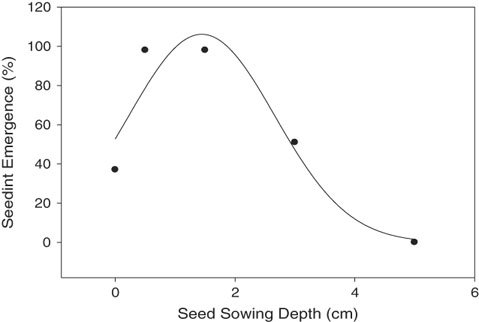
Seedling emergence increased as planting depth increased up to 1.4 cm and then decreased with increasing planting depth (Figure 4). Seedling emergence for seeds planted on the soil surface was 39%. The greatest seedling emergence occurred at a depth of 1.4 cm (X0) (Table 4). Minimal seedling emergence of seed planted at zero depth (soil surface) could be due to the drying of soil surface and reduction of moisture availability for seed germination. The reduction of seedling emergence due to increased seed burial depth has been reported in several weed species (Rezvani and Zaefarian Reference Rezvani and Zaefarian2016; Rezvani et al. Reference Rezvani, Zaefarian and Amini2014).
Effect of seed sowing depth on seedling emergence of smellmelon. Line represents Gaussian three-parameter model (
 $$y{\equals}ae^{{[{\minus}0.5({{x{\minus}x_{0} } \over b})]^{2} }} $$
) fitted to the data.

Estimated parameters of the Gaussian three-parameter model (
 $$y{\equals}ae^{{[{\minus}0.5({{x{\minus}x_{0} } \over b})]^{2} }} $$
) for description of seedling emergence of smellmelon at different depths.

a Abbreviations: a, maximum seedling emergence; b, emergence changes slope; Xo, planting depth where maximum seedling emergence occurred.
b Numbers in the parentheses are standard error of means.
The amount of energy reserves required to support elongation of the seedling from deeper depths and a reduction in light with increased planting depth have been suggested as reasons for reduced weed seedling emergence from greater depths (Benech-Arnold et al. Reference Benech-Arnold, Rodríguez and Batlla2013). Tillage operations can influence weed seed placement within the soil profile (Horak and Sweat Reference Horak and Sweat1994). These data suggest that tillage deeper than 5 cm can bury smellmelon seed in the soil and reduce seedling emergence.
Smellmelon Density and Frequency
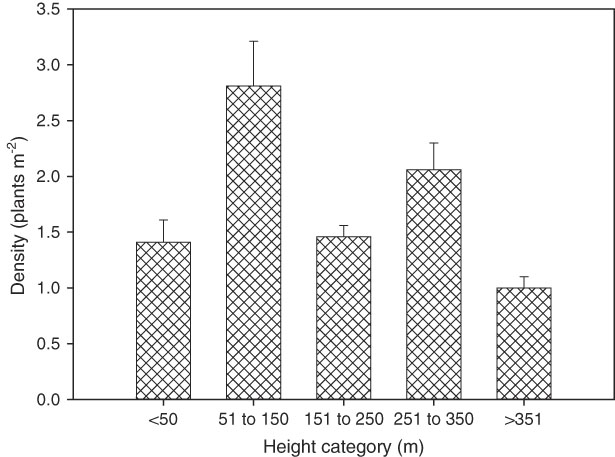
Figure 1 shows the sampling map of different crop fields in Golestan Province. The density of smellmelon varied at different elevations (Figure 5). An average of 1.4 plants m–2 was observed at elevations lower than 50 m. With increasing elevation from 51 to 150 m, smellmelon density increased to 2.8 plants m–2. The density of smellmelon decreased at elevations greater than 151 m (Figure 5).
Density of smellmelon at different altitudes. Vertical bars represent standard error.

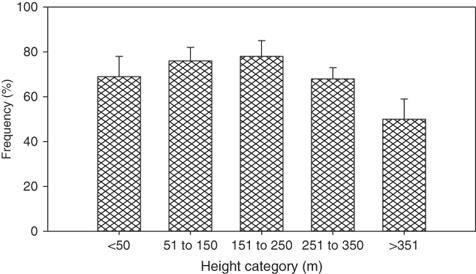
The frequency of smellmelon populations at different elevations in soybean fields showed a gradual increase and then decreased above 250 m. The presence of smellmelon seed at elevations lower than 50 m was 62%, and the frequency increased to 77% up to 250 m and then decreased with increasing elevation (Figure 6).
Frequency of smellmelon at different altitudes. Vertical bars represent standard error.

In this study, germination of smellmelon occurred at a range of temperature from 13.2 to 52.3 C, whereas smellmelon density and frequency was reduced with an increase in elevation above 250 m. This reduction is due to the declining temperature at higher elevations, which limits germination, establishment, and distribution of smellmelon. Plant establishment can occur at temperatures greater than 13.2 C, and in the Golestan Province (Gorgan region) this temperature can occur in late March and/or early April.
Effect of Herbicides on Smellmelon Control
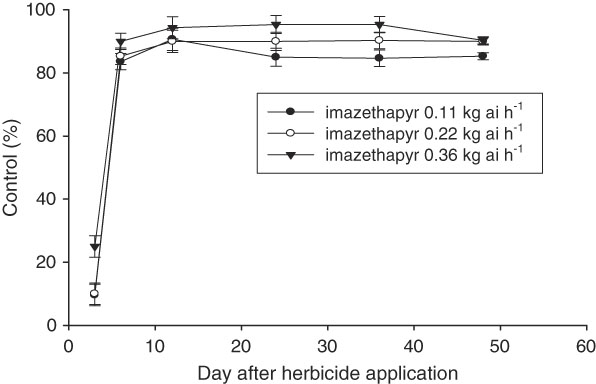
Control with imazethapyr 3 d after herbicide application was 10% to 25%. Smellmelon control with imazethapyr at 0.11, 0.22, and 0.36 kg ai ha–1 was 82%, 85%, and 90%, respectively, 6 d after application (Figure 7). The maximum control of smellmelon was observed with imazethapyr at 0.36 kg ai ha–1 12 d after application (Figure 7).
Effect of different rates of imazethapyr on smellmelon control. Vertical bars represent standard error.

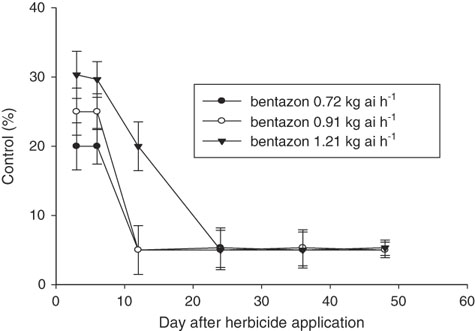
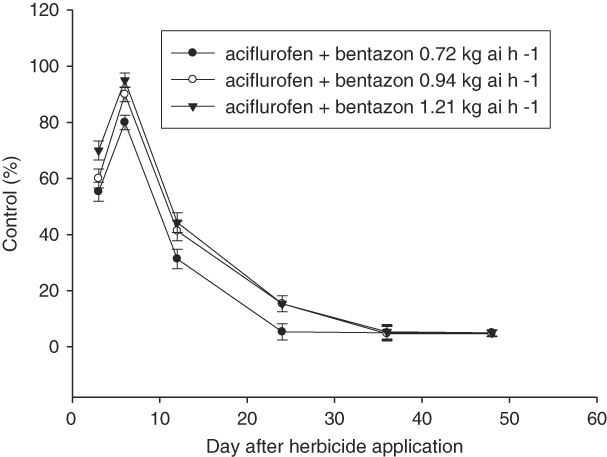
The maximum control with bentazon was observed 3 to 6 d after herbicide application. After 6 d, smellmelon control significantly decreased and reached a low of 5% with all rates because of regrowth of the injured plants (Figure 8). The pre-mix of bentazon plus acifluorfen showed 55% to 95% control 3 and 6 d after application. After six days, control was significantly reduced and reached a low of 5% 48 d after herbicide application (Figure 9).
Effect of different rates of bentazon on smellmelon control. Vertical bars represent standard error.

Effect of different rates of bentazon plus acifluorfen on smellmelon control. Vertical bars represent standard error.

Bentazon and the pre-mix of bentazon plus acifluorfen showed significant necrosis at all rates 3 to 6 d after application, and control was gradually reduced as the smellmelon plant grew, whereas necrosis with imazethapyr increased with enhancement of the interval between herbicide application and evaluation. Grichar (Reference Grichar2007a) observed greater efficacy with imazethapyr, imazapic, and lactofen on smellmelon in comparison with bentazon or 2,4-DB. Pendimethalin applied PRE controlled smellmelon about 70%, whereas pendimethalin in combination with cloransulam, flumioxazin, or imazethapyr provided almost complete control of smellmelon. Also, pendimethalin followed by acifluorfen or glyphosate applied EPOST successfully controlled smellmelon (Grichar Reference Grichar2007b).
Effect of Herbicides on Fruit Traits and Seed Germination
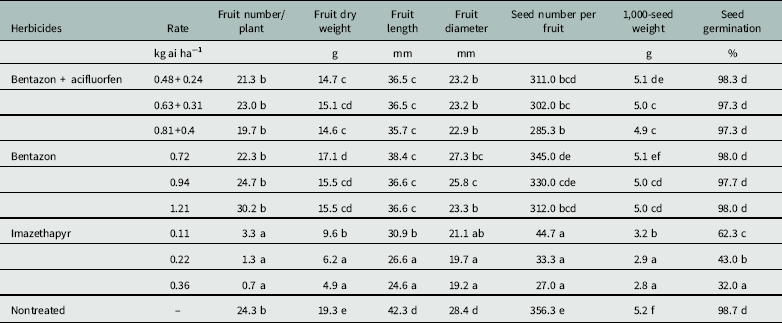
Imazethapyr reduced fruit number per plant, fruit dry weight, fruit length and diameter, seed number per fruit, 1,000-seed weight, and seed germination of smellmelon compared with bentazon and bentazon plus acifluorfen (Table 5). Imazethapyr-sprayed plots contained 0.7 to 3.3 fruits per plant, whereas plants treated with bentazon and bentazon plus acifluorfen produced at least 19.7 fruits per plant. Also, both bentazon and bentazon plus acifluorfen did not reduce fruit number per plant compared with the nontreated plots (Table 5).
Effect of herbicides and various application rates on fruit characteristics, 1,000-seed weight, and seed germination of smellmelon.Footnote a

a Means followed by the same letter in each column are not significantly different at P=0.05.
Seed number per fruit was fewer in plants treated with imazethapyr at 0.36 kg ai ha–1. Seed germination from smellmelon plants treated with imazethapyr was lower than that of seed produced by plants treated with bentazon or bentazon plus acifluorfen. Increasing the rate of imazethapyr resulted in reduced seed viability. Only 32% of the seed from imazethapyr at 0.36 kg ai ha–1 germinated, whereas 99% of the seed from the nontreated plants germinated. Seed germination from plants treated with either bentazon or bentazon plus acifluorfen did not change in comparison with the nontreated plants.
Our result suggests that imazethapyr can reduce the soil seedbank and establishment of smellmelon seedlings through reduced fruit and seed production and seed viability. Although much has been published on germination of various seed weeds treated by herbicides, very little has been written about the germination of smellmelon seed collected from herbicide-treated plants and about the effect of herbicides on the reproductive effort. Herbicides may reduce (Doliner and Stewart Reference Doliner and Stewart1992; Catizone and Viggaiani Reference Catizone and Viggaiani1990) and/or increase (Hume and Shirriff Reference Hume and Shirriff1989) germination in seeds from herbicide-treated weeds. Moreover, Tanveer et al. (Reference Tanveer, Nadeem, Ali, Tahir and Zamir2009) showed that herbicides such as bentazon, ioxynil, pendimethalin, oxynil, propachlor, and linuron did not affect seed germination and viability of common lambsquarters (Chenopodium album L.). These results suggest that the effect on seed germination may be in relationship to the plant species and the stage of plant growth at treatment rather than the herbicide used.
Low temperature (10 and 15 C) and mucilage negatively affected smellmelon seed germination. According to model output, the optimum and maximum temperatures for germination were estimated at 32.7 C and 52.3 C, respectively. The temperature at which soybean will germinate is lower than that of smellmelon; therefore, an early planting date in the region could be an effective cultural approach to reducing establishment of smellmelon in the crop. Moreover, the temperature data can help us predict the time of seedling emergence and help determine the potential of the invasion of this plant into a new region. Also, because the lowest percentage of seedling emergence occurred at a depth of 5 cm, deep tillage greater than 5 cm can bury seeds in the soil and significantly reduce seedling emergence in the next crop.
Imazethapyr was more efficient in controlling smellmelon than either bentazon or bentazon plus acifluorfen. Imazethapyr delayed the vegetative growth of smellmelon, and this could be an important factor in the growth and establishment of a soybean crop. Moreover, imazethapyr sharply reduced the ability of smellmelon to produce fruit and seed, as well as reducing seed viability, which can reduce the number of smellmelon seed in the soil. These data suggest that the use of imazethapyr in combination with cultural management practices such as an early planting date and deep tillage can help manage smellmelon in soybean.
Acknowledgments
No conflicts of interest have been declared. This research received no specific grant from any funding agency, commercial or not-for-profit sectors.