INTRODUCTION
Terminal illness threatens a patient's understanding of their world, as they are forced to confront their own limitations and mortality, potentially precipitating an existential crisis (Best et al., Reference Best, Aldridge and Butow2015a ). Subsequent suffering can be impacted by spiritual care (SC) (Best et al., Reference Best, Aldridge and Butow2015a ). Spirituality in healthcare addresses the way people engage with the purpose and meaning of human existence, which informs their personal values (Cobb et al., Reference Cobb, Puchalski and Rumbold2012). This may include, but is not restricted to, religion, which is a recognized form of organized spirituality (Matthews et al., Reference Matthews, McCullough and Larson1998). Spiritual care recognizes the importance of the spiritual dimension for patients and involves its assessment and provision of support. Research has shown that cancer patients want their doctors to be aware of the spiritual dimension as part of holistic patient care (Frick et al., Reference Frick, Riedner and Fegg2006; Astrow et al., Reference Astrow, Wexler and Texeira2007).
A doctor's enquiry into a patient's spirituality improves doctor–patient relationships by increasing trust (Ellis & Campbell, Reference Ellis and Campbell2005) and allowing the doctor to get to know the patient better through nonmedical dialogue (Frick et al., Reference Frick, Riedner and Fegg2006; Astrow et al., Reference Astrow, Wexler and Texeira2007; Best et al., Reference Best, Butow and Olver2014), thus being better placed to encourage realistic hope and give relevant advice (McCord et al., Reference McCord, Gilchrist and Grossman2004). Spirituality influences medical decision making by shaping personal values and priorities. When doctors are aware of a patient's spirituality, they can tailor medical treatment (McCord et al., Reference McCord, Gilchrist and Grossman2004; Pathy et al., Reference Pathy, Mills and Gazeley2011) to facilitate a better death for that person.
Although spirituality has always been recognized as an intrinsic component of the provision of palliative care (Saunders, Reference Saunders1988; Sepúlveda et al., Reference Sepúlveda, Marlin and Yoshida2002; Edwards et al., Reference Edwards, Pang and Shiu2010; Boston et al., Reference Boston, Bruce and Schreiber2011) and there is high patient interest in discussing spirituality with their doctors, SC occurs infrequently (Best et al., Reference Best, Butow and Olver2014; Reference Best, Aldridge and Butow2015b ; Reference Best, Butow and Olver2015c ). A lack of SC can mean that spiritual concerns remain unaddressed.
Spirituality is not avoided in the medical consultation because doctors think it is unimportant (Phelps et al., Reference Phelps, Lauderdale and Alcorn2012; Ramondetta et al., Reference Ramondetta, Sun and Surbone2013) or because they lack the time (Ellis et al., Reference Ellis, Thomlinson and Gemmill2013; Balboni et al., Reference Balboni, Sullivan and Enzinger2014b ). Insufficient knowledge and training were significant barriers identified in a recent review (Best et al., Reference Best, Aldridge and Butow2015c ). While many studies have examined whether doctors ask their patients about spirituality, data about successful conversations have been infrequently reported.
Discussions about spirituality occur most frequently in the end-of-life (EoL) context (Best et al., Reference Best, Aldridge and Butow2015c ). In order to understand how experienced practitioners discuss spirituality, we interviewed physicians who have regular contact with advanced cancer patients and are therefore most likely to regularly ask about spirituality.
Specifically, the aims of our study were to:
-
1. Enquire how experienced clinicians ask their patients about spirituality.
-
2. Identify what factors make such conversations easier.
-
3. Identify what factors make such conversations more difficult.
-
4. Explore the outcomes of discussions about spirituality in the medical consultation.
METHODS
Design
A qualitative grounded theory approach was taken to explore this topic (Charmaz, Reference Charmaz2006), which allowed avenues of investigation to be developed iteratively during the study.
Participants
The researchers approached two professional associations to advertise the study by e-mail: the Medical Oncology Group of Australia and the Australia and New Zealand Society of Palliative Medicine (ANZSPM). These are professional organizations of physicians focusing on oncology and palliative medicine, respectively. Eligible participants were medical practitioners who have worked with stage IV cancer patients (incurable disease) and practiced in Australia or New Zealand.
Procedure
The e-mails containing information about the study were sent to all members of the organizations, asking them to contact the lead researcher (MB) by e-mail if they wanted to join the study or had questions. Initial respondents were sent more information and a consent form. When informed consent was obtained, a time for interview was arranged with MB (a palliative care doctor and trained qualitative researcher). In line with grounded theory, purposive sampling was employed.
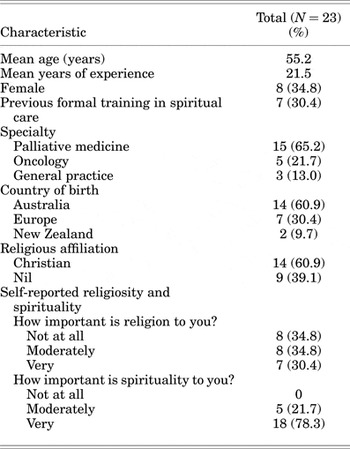
After the first six interviews, further participants were identified through snowballing to ensure that a diverse range of opinions was considered. In this way, physicians with a range of experience in several specialties were interviewed (see Table 2). These participants were invited by direct e-mail to participate.
Data Collection
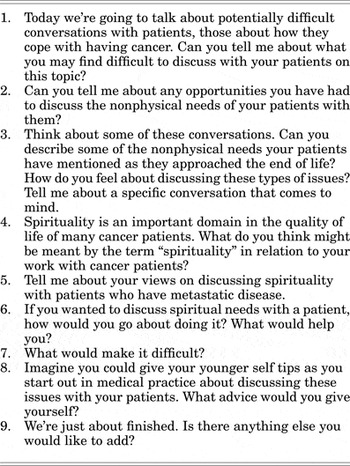
Semistructured interviews lasting 20 to 45 minutes were conducted by telephone. Questions (Table 1) aimed at eliciting doctors' familiarity with the concept of patient spirituality and with current practices regarding discussing (or not discussing) patient spirituality, as well as their perceptions of the challenges and outcomes of this type of discussion. Following the interview, a demographic survey was completed. Memos were kept throughout the data collection process. Interviews were digitally recorded and transcribed verbatim. No member checking was done.
Interview schedule

Analysis
Using line-by-line coding, MB and PB developed initial codes to detail the processes involved in spirituality discussions in medical consultations. These preliminary codes were then used to synthesize groups of data into focused codes, which were applied to further transcripts. Using the constant comparative method, new codes were written as required and new theory generated. Through iterative reading of data grouped by focused codes, axial codes were established and the relationships between them studied to build theory.
Data collection and analysis occurred concurrently. Analysis continued until thematic saturation was reached.
Rigor was derived from successive rounds of discussion and development of themes by all authors until theoretical coding was complete. The different disciplinary backgrounds (palliative care, oncology, and psychology) brought to these discussions by the research team allowed for reflection on the role of our individual perspectives in the interpretation of the data. Finally, a literature search was conducted to seek conceptual tools to explain the patterns found in the data and develop theory.
Ethics approval was given by the University of Sydney Human Research Ethics Committee (2014/156). The results were reported according to COREQ criteria (Tong et al., Reference Tong, Sainsbury and Craig2007).
RESULTS
Some 23 doctors were interviewed before thematic saturation was attained. All initial responses were made by ANZSPM members. Further participants were recruited from both organizations. The demographic details are presented in Table 2.
Demographic characteristics of the sample

All interviewees recognized that patients with life-threatening disease commonly raised spiritual issues:
The symptoms are often not the most distressing things; the pain or the nausea … are not the most distressing thing. It's the anguish, the distress, the pain of loss, which are the distressing things. (Participant 19)
A delicate, skilled, tailored process was described where doctors endeavored to create a space where patients feel safe enough to discuss intimate topics. Six themes were identified: (1) developing the self; (2) developing one's attitude; (3) approaching the patient; (4) what makes it easier; (5) what makes it harder; and (6) an important and effective intervention.
1. Developing the Self
Participants described the need to understand and be secure in one's own spiritual beliefs and also to have reflected on one's mortality, before being able to effectively discuss spirituality. Having done so made the discussion less stressful for the doctor and promoted normalization of spirituality within the medical consultation. The doctor's level of ease was considered a contributing factor in making patients feel comfortable enough to discuss personal subjects. Understanding the self required reflection and self-care, which many doctors wished they had begun to work on earlier in their career:
The first thing you've got to do is understand your own spiritual being, and that takes investment in yourself and reflection—mentoring, perhaps. And that's an ongoing thing that you should have right throughout your career. … So I would have given myself encouragement to have a go at it and explore it and read around it. And also self-care strategies, whatever it is. You can have a psychology person who supports you or you can have—just a close friend who you meet regularly with, but something that specifically is devoted to your depth in your life and understanding who you are. (Participant 4)
Helping junior doctors understand these requirements was a priority in training, and some organizations formally promoted reflective practices:
I'd start off by [telling trainees] we need to accept that a spiritual dimension is part of healthcare. I'll go on to say, “That means if a patient has a spiritual dimension and they want to address that, it also means that you have a spiritual dimension, which if you want to address this area, perhaps you need to do some homework on yourself.” … It'll be an unusual 25-year-old registrar who is comfortable discussing life and death issues. They're much more comfortable prescribing morphine. (Participant 10)
2. Developing One's Attitude
Spiritual care was regarded as a critical dimension of patient care, and an understanding of its importance was a prerequisite for providing SC:
As part of the holistic system approach and towards the end of life, it really is about what brings meaning to their life. … It's much more focused with people coming towards the end of their life, and … a lot of people can have needs and need more support. (Participant 2)
One palliative care physician reported that she would emphasize the importance of life's meaning to junior doctors and recommend focusing on that as much as on physical symptoms. This was reflected in the way many physicians raised the topic of spirituality with patients. Experienced participants asked questions about what was important or central to the life of the patient as a way of opening the conversation:
So I just say, “Is there anything that's important to you that I need to know to care for you?” So for some people, it is religion; for others, it's who's around them, their relationships; for some it's a combination of all these things. … I will say, “Are you religious in any way?” But that will only be a small part of the spiritual thing. The bigger part for me is saying, “What is important to you for me to care for you? What matters at this time when you're really, really crook [ill]? What's vital for me to know that helps me ensure that you're comfortable and that you're at peace?” (Participant 15)
The need to respect and value each patient and their beliefs was highlighted and could overcome the barrier of having different faiths. Participants could do this by making a point of affirming their patients:
I think they sense that we as doctors are really interested in them as an individual, and they warm to that. They feel even though they're dying, they're not total failures as human beings, which can happen sometimes in healthcare when things are just so busy and rushed and so on. I suppose it's a bit like dishing out dignity by my attitude towards them. That helps them relax a bit and then talk about some of these things. (Participant 4)
Part of respecting the patient involved the doctor being honest and vulnerable during the patient interview. This was described as one of the most challenging aspects of working in palliative care, because it involved opening oneself to intimacy with a patient. However, participants had found that by exposing themselves and making themselves vulnerable, patients were able to feel less vulnerable and open themselves to reveal what was distressing them most. Sharing oneself with patients to find common ground was seen not as manipulative but as a way of making the patient feel safe enough to discuss highly personal issues. However, it was acknowledged that there was a balancing act between connecting with a patient and over-connecting, which could lead to burnout. One way to find this balance was by letting the patient control the rhythm of the conversation rather than having a specific therapeutic goal:
As a young person, I think the best advice about discussing spiritual things is to be open and to not think that you know all the answers nor think that you have to take an agenda to get the patient to be something or go somewhere or do something. To be able to sit with the patient and allow things to … unfold the way the patient wishes … and with that also, I think comes issues of boundaries and limitations as you learn, as you get older. It's like … things may not be working out the way you want with a given patient. … But you never really know. (Participant 20)
Realizing that spiritual care did not involve fixing problems or having all the answers so much as being with the patient and expressing committed attention made the process less burdensome:
You know, in any spiritual encounter, we're being a companion and being there whatever it looks like, and so—I don't feel the need to fix everything. It's about being with. And what's helped me—I'm not saying that I get it right all the time by any means, but I think what helped me is my belief in it, but also my willingness to be vulnerable and to sit in that space and not need to have to solve or fix, and being able to live with the uncertainty and not having all the answers. I think that's not akin to the traditional necessarily; it's more a healer model than a fixed medical model. So for me, it's about me being truly myself in that space and allowing the patient to be truly themselves. It's a very deep thing really. (Participant 8)
An understanding of the human condition enhanced the practice, which could be accessed in several ways. One was through personal suffering. Another was found in studying the humanities. One doctor reflected on the advice he would give his younger self:
I would get him to read some poetry. I would get him to read some anthropology and a little bit of medical sociology. I think those … sort of humanities-type subjects are … squashed out of the curriculum. I think you learn about people from reading about people. You don't necessarily learn about people from reading about what other people say about people. If you're reading poetry, that comes from somebody's heart. If you're looking at art, that comes from somebody's heart, their mind. If you listen to music—Anthropology is the study of the way that people behave, and I think anthropological studies would be very, very valuable. (Participant 19)
3. Approaching the Patient
Creating a safe space where a patient would be comfortable enough to reveal personal information could be challenging on a busy ward, but several techniques were described to facilitate this process. One common practice was to allow silence:
I think the hardest thing I've had to teach myself is to keep quiet, to allow the pauses to occur, to allow people to stop and think for a while and not interrupt. Because those pauses are critical, often for people to develop their thoughts and come out with further conversation, and you can often destroy that moment if you fill the gap or keep talking. (Participant 10)
Listening well was more important than “doing it right.” Patient body language would be monitored to see how the patient was coping with a spiritual discussion. Participants also stressed the necessity of making sure that one did not make assumptions about the patient:
Listen. Listen with the head, but listen with the heart. Allow silence. Don't feel that you have to have all the answers, and realize that this isn't about you and isn't about me, I'll be telling myself, it's about the patient. In other words, just to keep checking in with their body language and what they're saying to see if it is actually therapeutic and helpful. It's certainly not a checklist approach. But it's not always—if it doesn't seem easy to me, it doesn't necessarily mean it's bad for the patient, but by far, probably one of the most important things is to learn not to assume anything. I have looked after people that are in either religious orders or vicars who have lost their faith, for example, but haven't let that be known to other people. So just assuming, for example, if it's a vicar with a title, if you just assumed things, you may not be able to really get to the nub of what's troubling them. (Participant 8)
Spirituality was never raised as the first topic of conversation, and if multiple opportunities to speak to the patient were anticipated (whether as an outpatient or inpatient), doctors often would not raise spirituality at the first meeting. They would aim to start getting to know the patient as a person and allow trust to develop in the relationship before going a little deeper. Spirituality was conceived as an ongoing conversation that evolved over time, thus supporting patients in their search for answers:
I sometimes feel a bit powerless in that often these conversations are about things for which there isn't a solution other than the patient finding their own solution. And the best that I can do is to help them to talk about it and think about it and be there and have them know that I'm with them for the duration. (Participant 5)
Experienced physicians demonstrated high-level communication skills related to reinforced experience over multiple patient encounters. Subconscious recognition of patient cues and patterns of behavior was expressed as the development of intuition or wisdom, which was used to judge the timing and content of probing questions about spiritual concerns of patients:
Well, if I think of someone who is really struggling, for example, with nausea and vague pain and … we couldn't really get control of those symptoms really well, … I guess with experience, you get a hunch that you're missing something. You haven't got the full picture here, and then actually going and sitting down, closing the door, just a one-on-one discussion with the patient. Asking them about how they think they're going, you know, what's happening for them, what are they most afraid of, if that's an issue, and just teasing out some of those nonphysical [things] can also help you find that the person is actually petrified of dying like their great aunt did in some dramatic end-of-life episode, or they haven't made amends with their family, or they've got those sorts of things going on, you can then get an insight into what might be impinging on those difficult, difficult-to-control symptoms. (Participant 9)
Above all else, spiritual discussions were tailored to each individual patient: their belief system, their preferences, and their pace. Most participants had never used a formal questionnaire. Even in units where standardized assessment tools were employed, they were designed to be flexible according to where the patient was in their spiritual journey and in the trajectory of their disease. It was expected that junior doctors would use standard questions to begin exploring a patient's spirituality, but that over time each individual would develop their own way of questioning:
The problem with these spiritual assessment tools is … if you do it when they first come on your books, it's quite often inappropriate to ask them all these questions, than when they come in for end-of-life care. So what we try to do is have a document that isn't a one-off assessment, but is something that evolves over time and then walks alongside people's increased disease burden and coming closer to the end of life. (Participant 2)
Experienced physicians waited for the patient to give them an indication that they were ready to discuss spiritual issues and follow their lead. Cues for enquiring about spirituality could be visual or verbal. Reading material at the bedside or religious trinkets on display would be commented on. Patient vocabulary could indicate a religious affiliation, such as mentioning prayer or blessings:
I've long abandoned those [questionnaires] because I feel the conversation seems to just flow and get off and revolves around them, telling me what they've done in their lives and … what's that meant for them and so on. (Participant 4)
Assessment tools explicitly asking about religion were particularly troublesome in secular communities, because:
Patients will quickly shut you down if they think that you're asking about religion. (Participant 3)
Obvious patient distress was an indication for exploring spiritual issues, but it was also seen as part of the healing process:
A year or so ago, we had some junior doctors. And I was having a consultation with some of them, and the patient burst into tears. And afterwards, one said, “How did you know to ask that question?” And I think what I had done was, for some reason, intuitively, I had found a place which was important for them and needed to be addressed but was distressing to go there. And my intuition was, that's the question I had to ask, and I did, and that allowed them to deal with the stuff that was necessary for them to deal with in order to feel better afterwards. I think that sometimes you have to go over a little hill before you can get to the other side. So having people be a little bit distressed isn't necessarily bad. And often, if they seem to be getting disproportionately distressed, then I can always back off and then come back the next day. (Participant 5)
However, a lack of cues did not mean that spirituality was not addressed. Seeing spirituality as an important issue and respecting the patient led practitioners to provide openings for patients to ask difficult questions:
Now I have, I guess, more confidence in opening up that discussion if they want to and just … teasing them with the concepts to see if they want a bite out of it because it's really up to them to … guide where we're going. I … want to make sure that I've opened up areas that they may have felt a bit embarrassed to talk about that they really want to talk about. (Participant 16)
Sometimes a patient would indicate that they were engaged in spiritually preparing for death without assistance. One participant described patients spontaneously reviewing their lives and talking about things they had done:
You could see them sort of assembling meaning. So I will, at that point, hang around and foster that—I will let them do that work. (Participant 20)
If there were issues that required more intervention than a physician felt able to provide, a referral was made, which was a time-efficient option in busy units. The high level of self-awareness in this cohort also extended to realizing that they would not always be the best person to speak to a particular patient. This could be the simple result of personality differences, time schedules, or a result of transference issues (going either way). It was also acknowledged that all individuals will see things through their own worldview and may not be aware of their biases. Working with multidisciplinary teams was therefore recommended:
This one young woman that we have now— she's 21 and she's dying, and she's been sexually abused by her father and she's petrified of dying. And I'm not the right person because I'm a middle-aged man. And so, she's always very guarded with me, and although I give her things to think about, I'm not the one who can go deeper with her. It needs to be one of our female doctors, and we've identified it in the team. I stepped back from having those meaningful conversations with her because of her past history … And also, our spiritual care coordinator, he's a similar age from me and— Yeah. She doesn't trust him either. (Participant 4)
4. What Makes It Easier
Spiritual discussion was easier when doctor and patient shared spiritual and cultural backgrounds. Having similar presuppositions and vocabulary gave the doctor more insight into a patient's experience and created a personal connection. Conversations were easier for the doctor if the patient was willing to talk. This depended on several factors, including the environment, such as who was present (spouses generally did not impede discussion but children often did), and where the patient was in the disease trajectory. There was general recognition that most patients were ready to discuss spirituality as they approached the end of life, but the ideal scenario was where the patient was the one who raised the subject. The patient needed to be comfortable, which could be an issue for patients with advanced disease. Skills improved with practice:
[In order to have the discussion,] the patient has to be ready, which they often are, at the end of life. And they have to be comfortable with the circumstance, which is the people present, usually just one—just me. If there's a family of several people together, then the patient's unlikely to disclose these things; they're too private. And I'm sure it depends on my attitude. If I'm quiet and attentive and receptive, they're more likely to respond. If I'm obviously agitated, busy or distracted, they won't. And when I've heard doctors say, “My patient never asked me this stuff,” I think that's because you never sit down and let them have a chance. It's not because your patients are different. It's because you're not attentive or receptive. (Participant 10)
5. What Makes It Harder
Experienced doctors never felt that discussing spirituality was a mistake even when challenging. However, anything that made history taking technically difficult, such as the physical condition of the patient or relatives answering on the patient's behalf, could make it harder. Problems specific to spirituality can be divided into doctor, patient, and family factors.
Doctor Factors
An emotional reaction to the discussion by the doctor was more likely to increase difficulty than emotional reactions by the patient (though this was not always the case for younger doctors)—for example, when the patient was contemplating death and leaving their family. However, the most experienced doctors did not find spiritual history taking personally draining but instead felt a reciprocal benefit:
Well, it's sad. I don't like to talk about sad things … and so I think that the sadness is what makes it hard and knowing that—Like for me, it's knowing that there's nothing I can say that's going to make you feel better. You feel awful, and I know that it doesn't matter what words I stumble around trying to use that. There isn't anything, and I say that. I say, … “I just don't know what to say, and I am so sorry, and I wish it was different for you.” That's why it's hard, because I know that there isn't … some sort of—I have it wired in me. I think everyone who does a job, to a certain degree, you feel like you can fix it, and this is a situation that I can't fix. … It's more about how I feel. I don't think, on the whole, that I'm making the patient feel worse, and I know that because when they leave, most of them look relieved or they hug me or they say, “Thank you so much.” (Participant 15)
Time was not a significant barrier to conversations, as one doctor reported:
No. They're core, you know. You can't say you don't have enough time to ask about their pain… . They're core issues. You can't not have time for them. (Participant 6)
The doctor's reaction to time was significant. If they personally felt rushed or stressed, or particularly tired from work responsibilities, they knew that spiritual discussions would be difficult and so tended to avoid them:
I remember someone … asked me—when I was new … “Oh, are you a symptomatologist or are you one of those psychosocial palliative care doctors?” Because he identified a clear difference. And, my response to him then was, “Well, I hope I'm both.” But I think there are some days when it's easier just to be a symptomatologist. (Participant 19)
This did not mean that spirituality was ignored. Strategies to deal with time constraints included referring the patient to another member of the multidisciplinary team, or rescheduling time with the patient while emphasizing the importance of addressing the matters raised. Outpatient settings were therefore more challenging than inpatient settings for arranging spiritual care, but participants realized that most patients could detect when doctors were not ready for spiritual discussions:
So, the things that will kill it? Rushing. When I'm rushing, I've got lots of people to see, not much time to see each one, but the patients know full well that I'm—well, most of them—that … I'm not going to be sitting down for a deep philosophical discussion about anything—politics, religion or whatever. Whereas I think sometimes they can tell when I seem to have undivided attention today so I'll bring up this thing that I've been waiting to talk about for a while. … People need time to relax into those sort of deeper conversations, and they don't necessarily have that in a standard consultation. (Participant 21)
Several participants discussed the problem of engaging with patients with whom they identified too closely, not only with the spiritual issues but also with the diagnosis or the family structure, for example. If a relative of the doctor had died from the same disease as the patient, or if they had children of a similar age, they might become aware of personal distress when engaging with them. In such cases, they would refer the patient to another staff member. However, this related to all aspects of care, not just spiritual care:
If the patient's problem or issue that distresses them happens to be the same as mine and I haven't resolved it in my own life, like, I got divorced many years ago, [and it] took me about 20 years to work that through. So earlier on, if somebody said, “I'm divorced,” then a little voice inside of me would say, “Don't go there. You can't handle this stuff.” (Participant 10)
Patient Factors
Patient factors that made discussion of spirituality harder included those that made it difficult to build a trusting relationship. The patient may have previously been disappointed by doctors or just did not want to engage with the situation at hand. Poor symptom control was often mentioned, rather than just poor physical condition, and failure in this aspect of care could also have an impact on the level of patient trust.
Occasionally, patients only wanted to discuss spiritual concerns with someone of their own faith, or already had a spiritual confidant for support. Interviewees were concerned about counseling a patient from a cultural or religious group with which they were unfamiliar because they did not want to make the situation harder for the patient by saying something inappropriate. It was also noted that such situations often involved the use of interpreters, which meant that much of the nuance of the conversation could get lost:
Certain denominations or religious beliefs don't appear to be comfortable talking about their religion with someone who's not from their faith. … Some patients from an Islamic background, often they appreciate when you ask the question “Is there something about you I need to know?” or “Is there something about your faith we need to know to respect your wishes?” They appreciate that but often are not comfortable going further than that because they see you as outsider who doesn't understand. And I respect that. (Participant 11)
There could be problems if the patient confused spirituality with religion, although this was quickly rectified, and some may not have been in the habit of reflecting on spirituality, but that would not preclude receiving spiritual care:
Sometimes, the patients are pretty much back in the mode that spirituality is really related to religion, and, if they are not religious, then some of them will very quickly say, “No, no. I'm not religious. I don't wanna have anything to do with any spiritual carers or anyone like that.” And sometimes, it's me sort of teasing out, well, they probably do have a spiritual aspect to their lives and trying to figure out what that might be and find out ways that we can support their spirituality even if they haven't really thought much about it themselves. (Participant 3)
Family Factors
The role of family in gatekeeping can occur for any aspect of care but was noted particularly with regard to talking about dying. It could be related to cultural factors:
I'll never forget this young man with leukemia. He was 18. He was dying from the leukemia. His mother was a pharmacist in the former Soviet Union, and his dad was a doctor, and they clearly said to me, “Never talk to my son that he can't be cured, and please have all the discussions with me.” (Participant 2)
6. An Important and Effective Intervention
Participants felt the investment of time required to build relationships was worthwhile and appreciated the outcomes. The process of discussing spirituality strengthened doctor–patient relationships by increasing patient trust and giving the doctor a “real” picture of the patient, so that a person and not a disease was the focus of care:
Just to make them very much a person rather than just someone with an illness. … And he might have pancreatic cancer, but he's a good trombone player or something. (Participant 4)
This produced benefits for both patient and doctor. Participants reported that they often noticed that if the spiritual issues were sorted out, then everything else seemed to go well. On a physical level, according to the doctors interviewed, a good spiritual rapport with the patient was associated with improved symptom control and increased patient coping. A good doctor–patient relationship allowed for transfer of information, which helped the patient and family manage their fears. On a spiritual level, the respect transferred to the patient could help them feel that they were not a failure in their life even though they were dying, and to gain a sense of closure in relationships. Taking a spiritual history was considered an important strategy in making sure that the most important problems of a terminally ill patient were not missed:
I use that in teaching to point out that when people are coming to [the] end of life, that's often a trigger when … hidden guilt and fears surface and demand attention … If you don't deal with this, you end up with terminal restlessness, where the patient is absolutely thrashing around, and it's too late then to tease out the hidden traumas. And the only option at that stage is heavy sedation, which is really sad. Nothing is quite right. (Participant 10)
Experienced doctors were aware that with spiritual care they triggered a process that allowed patients to do all the spiritual work themselves. Their role in this aspect of spiritual care was therefore solely that of facilitator:
[Describing a situation where a man told his children for the first time that he loved them and repaired relationships:] Somehow or other, I think he found the freedom to do that as he was dying, and we were just pretty well bystanders as it all happened. We might have triggered something initially, but he then took up the bat and away he went. (Participant 4)
In a few cases, spiritual nurturing helped a patient grow through the suffering associated with illness to reach a state of transcendence:
I can vividly remember the first time I met somebody who was transcendent. And it was like she was flying. She was just radiant. She was within a few days of the end of her life. And the difference that I noticed was that when you're consulting and working with people who are very ill, there is an energy flow which usually goes from you, the practitioner, to them, the patient. But with this other small minority of people who have done all of that work [of preparing to die], the energy flow comes the other way. And you go out of the consultation really buoyed up. You think, “Whoa! This is amazing! How does that happen? How do these people reach that?” And the way they reach that is by doing all of this [spiritual] work. (Participant 19)
A sense of reciprocity in spiritual discussions was common. Participants described the opportunity to understand themselves better through these discussions, and found this aspect of the job to be an important source of professional satisfaction:
It's a two-way thing … I certainly found that myself as I— Being engaged with patients' deepest issues, it triggers thoughts in me … And to me, dying healed means you've dealt with those fears, guilt, shame, anger, psychological, psychospiritual issues. (Participant 10)
DISCUSSION
This qualitative study explored the process employed by doctors experienced in the care of patients with advanced cancer to discuss spirituality, as a first step toward provision of spiritual care. Discussion of spirituality is known to require a higher level of communication skills than those needed for discussion of such EoL topics as resuscitation (Ford et al., Reference Ford, Downey and Engelberg2012), which may partly explain why acceptance of spiritual care can be influenced by who provides it (Phelps et al., Reference Phelps, Lauderdale and Alcorn2012). It is instructive to examine how this cohort approached the task.
Personal spirituality and an understanding of the human condition were considered valuable contributors to effective spiritual discussion at the end of life, as has been previously suggested (Jones, Reference Jones1999; Surbone & Baider, Reference Surbone and Baider2010). Participants suggested self-reflection, engagement with the humanities, and support from spiritual advisors as helpful ways of developing these qualities, which allowed them to feel sufficiently secure in themselves to engage with patients. Self-awareness can help a doctor to avoid being distracted by their own fears and to listen to the patient (Jones, Reference Jones1999).
While pursuing spiritual growth may be considered a personal prerogative, two recent papers reported that physicians attributed their marginalization of psychosocial-spiritual care to their medical training, which selected less caring individuals and exposed them to supervisors who devalued its importance, stressing curing and not caring as the role of the doctor (Meldrum, Reference Meldrum2011; Vermandere et al., Reference Vermandere, Choi and de Brabandere2012). Perhaps a wider curriculum than science alone in medical schools is needed.
The literature shows that physician discomfort is a predictor of doctors avoiding spiritual discussions (Chibnall & Brooks, Reference Chibnall and Brooks2001; Curlin et al., Reference Curlin, Chin and Sellergren2006; Al-Yousefi, Reference Al-Yousefi2012; Vermandere et al., Reference Vermandere, Choi and de Brabandere2012), and a recent review found that a major barrier to doctors asking patients about spirituality was a lack of training (Best et al., Reference Best, Aldridge and Butow2015c ). Poor communication skills are also associated with greater physician burnout (Graham et al., Reference Graham, Ramirez and Cull1996; Asai et al., Reference Asai, Morita and Akechi2007; Girgis et al., Reference Girgis, Hansen and Goldstein2009). The most experienced doctors in our study did not find spiritual discussions draining, in contrast to other similar cohorts (Penderell & Brazil, Reference Penderell and Brazil2010). They reported personal benefits from these conversations, including spiritual growth and professional satisfaction. While the majority of our participants had not received any formal training in the communication skills needed to discuss spiritual issues but developed them over time, such skills can be taught and learned (Delgado-Guay et al., Reference Delgado-Guay, de la Cruz and Epner2013) and hold advantage for both patients and physicians (Virdun et al., Reference Virdun, Luckett and Davidson2015).
The participants in our study also stressed the importance of individualizing how one approaches the patient, which is part of what patients consider to be ideal spiritual care (Phelps et al., Reference Phelps, Lauderdale and Alcorn2012), and avoiding the problems of trying to fit all patients into a single model (Kendall et al., Reference Kendall, Carduff and Lloyd2015). The experienced doctors in our study did not use standardized questionnaires to elicit a spiritual history but developed a relationship with the patient within which spirituality could be discussed. It is unreasonable to think that all medical practitioners could achieve the expertise in spiritual discussion demonstrated by this cohort, but several spiritual history-taking tools for physicians are available (Maugans, Reference Maugans1996; Anandarajah & Hight, Reference Anandarajah and Hight2001; Kristeller et al., Reference Kristeller, Rhodes and Cripe2005; Puchalski, Reference Puchalski2006), as well as shorter screening tools (Steinhauser et al., Reference Steinhauser, Voils and Clipp2006). A brief patient-centered approach to spiritual history taking has been found to be acceptable to the majority of patients (Kristeller et al., Reference Kristeller, Rhodes and Cripe2005; Phelps et al., Reference Phelps, Lauderdale and Alcorn2012). Wider knowledge of these tools would be beneficial, especially for those who are unable or unwilling to provide spiritual care and just need to identify which patients to refer. There is evidence that even a brief physician enquiry into spiritual concerns related to coping with cancer has a positive impact on patient perception of care and well-being, particularly those with low levels of spiritual well-being (Kristeller et al., Reference Kristeller, Rhodes and Cripe2005).
Our participants elucidated numerous benefits from discussing spirituality with their patients. Attention to patient spirituality helped patients cope with physical symptoms, improve care, and facilitate acceptance of death, as has been noted elsewhere (Brady et al., Reference Brady, Peterman and Fitchett1999; Steinhauser et al., Reference Steinhauser, Voils and Clipp2006; Balboni et al., Reference Balboni, Vanderwerker and Block2007; Phelps et al., Reference Phelps, Maciejewski and Nilsson2009; Williams et al., Reference Williams, Meltzer and Arora2011). Several studies have found that by affirming patients healthcare professionals promoted spiritual well-being (Fredriksson & Eriksson, Reference Fredriksson and Eriksson2001; Grant et al., Reference Grant, Murray and Kendall2004; Rehnsfeldt & Eriksson, Reference Rehnsfeldt and Eriksson2004; Langegard & Ahlberg, Reference Langegard and Ahlberg2009). The doctors in our sample did not alleviate spiritual problems directly but enabled patients to work through the issues themselves, creating a shift in terms of spiritual health. This process is recognized in the trajectory of holistic suffering (Arman et al., Reference Arman, Rehnsfeldt and Lindholm2002; Ohlen et al., Reference Ohlen, Bengtsson and Skott2002; Williams, Reference Williams2006; Best et al., Reference Best, Aldridge and Butow2015a ,Reference Best, Aldridge and Butow b ).
Our study provides an example of the generalist/specialist model of whole-person care (Balboni et al., Reference Balboni, Puchalski and Peteet2014a ) that is supported by consensus guidelines for spiritual care in palliative care (Puchalski et al., Reference Puchalski, Ferrell and Virani2009). It highlights the benefits of using multidisciplinary teams, which allowed doctors who felt they did not have the time or skill, or who just felt they were not the best person to help a particular patient, to ensure that SC was provided. It would be necessary to ensure patients follow through on such referrals, as this has previously been overestimated by clinicians (Eakin & Strycker, Reference Eakin and Strycker2001). For this model to be effective, personnel need to be available, and this needs to be factored into any model of SC provision.
Finally, even among this experienced cohort it was recognized that not all patients will resolve their spiritual concerns before death. Kübler-Ross's stages of grief are not prescriptive (Kübler-Ross & Kessler, Reference Kübler-Ross and Kessler2014). In recognition of this, participants were able to accept this occurrence without self-reproach. As one respondent commented,
I guess I don't feel personally responsible for the outcome for all patients, because, in the end, I can't control the lives they've led or their belief system. They have most of those as a product of a lifetime of thought … So I don't take that home with me. (Participant 5)
All the participants in our study were doctors who work with patients with advanced cancer. Other populations may demonstrate a different approach to spiritual history taking.
In conclusion, doctors with considerable experience in discussing spirituality with advanced cancer patients described a delicate and individualized process directed by the patient. It was recommended that those who desire to develop expertise in this area need to take steps to develop their own spirituality as well as practice the recommended techniques to maximize the impact of such discussions.
FUNDING
This research received no specific grant from any funding agency in the public, commercial, or not-for-profit sectors.
CONFLICTS OF INTEREST
The authors state that they have no conflicts of interest to declare.