

In childhood, emotional competence is key to socialisation and academic success (Denham, Reference Denham2007), and deficits in this area often predict behavioural problems and learning difficulties (Izard et al., Reference Izard, Fine, Schultz, Mostow, Ackerman and Youngstrom2001; Trentacosta & Fine, Reference Trentacosta and Fine2010). Denham (Reference Denham2007) identified three separate but intertwined components of emotional competence: emotion regulation, emotional expressiveness, and emotion knowledge. Regarding this last component, Denham emphasised the importance of understanding and using emotion language in social interactions in order to become socially competent with peers. For Saarni (Reference Saarni1999, Reference Saarni, Bar-On, Maree and Elias2007), knowing how to use an emotional lexicon is one of the main components of emotional competence, insofar as learning to use the vocabulary of emotion is crucial if children are to communicate about their own emotional experience, as well as others’ emotional states. Widen (Reference Widen2013) emphasised that emotional labels are more than words for labelling facial expressions: each emotional label refers to an emotional concept; that is, a script that specifies causes, behavioural consequences, nonverbal expressions, and verbal labels for given emotion (see also Fehr & Russell, Reference Fehr and Russell1984). In childhood, initial emotional concepts are broad and valence-based categories (i.e., pleasant vs. unpleasant) that gradually differentiate into specific discrete categories such as anger, fear or disgust. According to Widen, the use of labels for basic emotions such as happiness, sadness, anger, fear and disgust gradually develops between 2 and 10 years of age, and constitutes a major developmental task of emotional concept acquisition.
The role of the emotional lexicon in emotional abilities has been highlighted in several studies. For instance, Lindquist, Barrett, Bliss-Moreau, and Russell (Reference Lindquist, Barrett, Bliss-Moreau and Russell2006) found that emotion words enhanced the speed or accuracy of young adults’ perception of emotion. In preschoolers, Russell and Widen (Reference Russell and Widen2002a, Reference Russell and Widen2002b) showed that using words, rather than presenting expressive faces, produced a better understanding of the causes of fear and disgust, and found a label superiority effect in the recognition of happiness, anger and sadness. The role of language in emotion understanding was also evidenced by Widen and Russell (2004), who showed that a label is a stronger cue for describing the causes of an emotion than its facial expression or behavioural consequence for 4-year-old children. Finally, the importance of emotion labelling ability for the development of emotion knowledge was demonstrated by Salmon et al. (Reference Salmon, Evans, Moskowitz, Grouden, Parkes and Miller2013), who emphasised that fostering this ability has a positive effect on several components of emotion knowledge, such as emotion recognition and emotion cause understanding. Thus, having an extended emotional lexicon has a major positive impact on other components of emotional competence, such as emotion recognition and emotion comprehension. Surprisingly, in spite of its importance, the development of the emotional lexicon has seldom been studied. The aim of our study was thus to enhance current knowledge of how the emotional lexicon is acquired in typical development.
Until recently, few studies had specifically investigated the question of emotion knowledge through the acquisition of words referring to emotions. The first study to address this topic sought to establish age of acquisition norms for emotion words in the English language (Ridgeway, Waters, & Kuczaj, Reference Ridgeway, Waters and Kuczaj1985). To this end, the parents of children aged between 18 months and 6 years were given a list of 125 words and asked to report which ones their child understood and used. Results indicated a major change during the period of interest, with wide variability between words. Some words were understood or used by most of the younger children (e.g., sleepy, good, happy) while others were still not understood or used by half the older children (e.g., envious, hostile, joyful). Two more recent studies by Baron-Cohen, Golan, Wheelwright, Granader, and Hill (Reference Baron-Cohen, Golan, Wheelwright, Granader and Hill2010), and Li and Yu (Reference Li and Yu2015) were based on a more extended developmental period, and used either parental reports or, for the older children, self-reports. Both found that the emotional lexicon expands substantially during childhood. Baron-Cohen et al. (Reference Baron-Cohen, Golan, Wheelwright, Granader and Hill2010) observed that it doubled every 2 years between the ages of 4 and 11 years, and then seemed to stagnate in adolescents aged 12–16 years. These results suggest that the acquisition of words referring to emotions undergoes important developmental changes during childhood. These data are consistent with evidence of major developmental changes in the acquisition of the emotion concept across childhood (Widen, Reference Widen2013).
The current study was intended to expand knowledge of the development of the emotional lexicon in children, by introducing a main modification relative to previous studies. First, whereas the latter were specifically interested in the development of the emotional lexicon (Baron-Cohen et al., Reference Baron-Cohen, Golan, Wheelwright, Granader and Hill2010; Li & Yu, Reference Li and Yu2015; Ridgeway et al., Reference Ridgeway, Waters and Kuczaj1985), the present study examined children’s knowledge of words referring to emotions within the more general framework of lexical development. More specifically, as explained below, words referring to emotions were compared with words referring to either concrete or abstract concepts. In psycholinguistics, words referring to emotions have traditionally been likened to abstract words, as opposed to concrete words. Whereas concrete words refer to entities we directly perceive through our senses, abstract words (e.g., liberty or justice) refer to entities that do not have easily identifiable referents and are more detached from sensory experience. Words denoting emotions have usually been likened to abstract words because they refer to feelings, moods or emotional states (i.e., internal states that are not directly perceptible). Research has repeatedly demonstrated that concrete words have a processing advantage over abstract words, labelled the concreteness effect. Concrete words appear to be processed faster and remembered better than abstract words by both adults and children (Fliessbach, Weis, Klaver, Elger, & Weber, Reference Fliessbach, Weis, Klaver, Elger and Weber2006; Schwanenflugel, Akin, & Luh, Reference Schwanenflugel, Akin and Luh1992; Schwanenflugel, Harnishfeger, & Stowe, Reference Schwanenflugel, Harnishfeger and Stowe1988; Yuille & Paivio, Reference Yuille and Paivio1969). Moreover, research with children has shown that concrete words are acquired earlier, are easier to learn, and give rise to deeper knowledge than abstract words (Bassano, Reference Bassano2005; Hadley, Dickinson, Hirsh-Pasek, & Nesbitt, Reference Hadley, Dickinson, Hirsh-Pasek and Nesbitt2016; Paivio & Yuille, Reference Paivio and Yuille1966; Schwanenflugel & Akin, Reference Schwanenflugel and Akin1994). It may therefore seem reasonable to conclude that words referring to emotions, if they are abstract words, are more difficult for children to understand than concrete words. However, this conclusion is challenged by some authors who consider that words referring to emotions are not genuine abstract words.
Altarriba, Bauer, and Benvenuto (Reference Altarriba, Bauer and Benvenuto1999) were the first to consider that words referring to emotions are not genuine abstract words. They suggested that the distinction between abstract and concrete words should not be treated as a dichotomous variable, but as a variable including a third type of words: those referring to emotions. Accordingly, they showed that words referring to emotions differ in terms of imageability and concreteness from both abstract and concrete words. Similarly, Altarriba and Bauer (Reference Altarriba and Bauer2004) observed that adults were better at memorising emotion words than either concrete or abstract words in a free recall task. Furthermore, participants reported that visualising a mental image and thinking of a context was easier with emotion words than with abstract words, but more difficult than with concrete words. Words denoting emotional states, moods or feelings may refer to unobservable entities, but may obviously be matched to internal states that are partly experienced by the senses (McRae & Jones, Reference McRae, Jones and Reisberg2013; Vigliocco, Meteyard, Andrews, & Kousta, Reference Vigliocco, Meteyard, Andrews and Kousta2009). Put differently, words referring to emotions may not be as abstract as other abstract words, as they can be mapped onto the world just as concrete words can.
This idea was recently taken up by researchers studying word meaning acquisition or semantic memory, who distinguish between words according to their mode of acquisition (Borghi et al., Reference Borghi, Binkofski, Castelfranchi, Cimatti, Scorolli and Tummolini2017; Della Rosa, Catricalà, Vigliocco, & Cappa, Reference Della Rosa, Catricalà, Vigliocco and Cappa2010; Kousta, Vigliocco, Vinson, Andrews, & Del Campo, 2011; Wauters, Tellings, Van Bon, & Van Haaften, Reference Wauters, Tellings, Van Bon and Van Haaften2003). According to this approach, word meanings are acquired and represented using information from two sources. The first is the sensory and motor experience of the referents of words in everyday life. The second is linguistic information (i.e., each word’s verbal associations, co-occurrences in discourse, and syntactic information). The novelty of this approach lies in the assumption that meaning is grounded in both types of information, the precise proportions varying according to the type of concept. Differences between abstract and concrete word meanings therefore arise from the extent to which they are derived from each type of information. Experiential information is preponderant for concrete word meanings, whereas linguistic information has a greater influence on the acquisition of abstract word meanings. Children start to perceive and experience the world before they acquire language. Consequently, they acquire concrete words earlier than abstract ones. As for words denoting emotions, they are assumed to be associated with experiential information, insofar as they refer to internal states, but also with linguistic information, as their use in language helps children to label these internal states. As such, words for emotions provide a way of accessing abstract meanings (mainly conveyed through linguistic channels), but are acquired earlier than purely abstract meanings.
The purpose of the current study was to investigate the development of the emotional lexicon within the more general framework of lexical development by comparing the comprehension of words for emotions with that of both abstract and concrete words. Whereas questionnaires, and more particularly parental reports, had previously been used to investigate the development of the emotional lexicon (Baron-Cohen et al., Reference Baron-Cohen, Golan, Wheelwright, Granader and Hill2010; Ridgeway et al., Reference Ridgeway, Waters and Kuczaj1985), we adopted a different experimental design to assess lexical knowledge in the current study. Many studies have validated parental reports as a method for measuring language development in children (Dale, Bates, Reznick, & Morisset, Reference Dale, Bates, Reznick and Morisset1989; Fenson et al., Reference Fenson, Bates, Dale, Goodman, Reznick and Thal2015), but have also recommended exploring other assessment modes, as no measure is problem free (Ambridge & Rowland, Reference Ambridge and Rowland2013). For instance, parents may underestimate or overestimate their children’s abilities (Law & Roy, Reference Law and Roy2008). The design of the present experimental task was based on the model of the most well-known standardised measure of lexical development, the Peabody Picture Vocabulary Test (Dunn & Dunn, Reference Dunn and Dunn1981), in which children are shown four pictures and asked to point to the one that corresponds to a word spoken by the examiner. The experimental task featured words belonging to three categories: (1) words for emotions (i.e., words referring to feelings, moods or emotional states); (2) concrete words (i.e., words referring to entities we directly perceive through our senses); and (3) abstract words (i.e., words referring to entities that cannot be perceived through the senses).
As mentioned above, our literature review indicated that words for emotions were initially included in the category of abstract words, as opposed to concrete words. Within this framework, research showed that concrete words are easier to acquire than abstract words. More recently, it was suggested that emotion words should be distinguished from genuine abstract words. The latter refer to entities that cannot be perceived directly through the senses. Thus, their meaning can hardly be acquired through experience, and their acquisition relies instead on linguistic information, whereas the meanings of concrete words are mainly acquired through experiential information. Emotion words refer to feelings, moods or emotional states. As such, they can also be matched to internal states that are partly experienced by the senses. In sum, children’s understanding of words for emotions should lie at an intermediate level between concrete and abstract words. Consequently, it was assumed in this study that concrete words would be easier to understand than abstract words. In addition, words for emotions would be understood later than concrete words, but earlier than genuine abstract words.
Method
Participants
The sample consisted of 120 French children divided into four age groups: 30 4-year-olds (M age = 4 years and 5 months, range: 48–59 months), 30 5-year-olds (M age = 5 years and 6 months, range: 60–71 months), 30 6-year-olds (M age = 6 years and 6 months, range: 72–83 months), and 30 7-year-olds (M age = 7 years and 6 months, range: 84–95 months). Each group comprised 15 girls and 15 boys. Children were in a regular class at the expected grade level. Children with known language or learning problems, or developmental disorders, were not included in the study. This information was reported either by the teachers or by the parents. The participants’ lexical level was measured beforehand using the French version of the Peabody Picture Vocabulary Test Revised (EVIP; Dunn, Thériault-Whalen, & Dunn, Reference Dunn, Thériault-Whalen and Dunn1993). Their nonverbal level was assessed with Raven’s Colored Progressive Matrices (RCPM; Raven, Court, & Raven, Reference Raven, Court and Raven1998). Mean raw EVIP and RCPM scores are provided in Table 1.
Mean Raw Scores (Standard Deviations) on EVIP and RCPM According to Children’s Age

Note: EVIP = Peabody Picture Vocabulary Test Revised (Dunn, Thériault-Whalen, & Dunn, Reference Dunn, Thériault-Whalen and Dunn1993); RCPM = Raven’s Colored Progressive Matrices (Raven, Court, & Raven Reference Raven, Court and Raven1998).
Ethical approval
Ethical approval wa quired for this study, according to national and institutional guidelines. The children were all recruited in kindergartens and elementary schools in the Champagne-Ardenne and Picardy regions of France, with the approval of the local education authorities (Amiens and Reims Schools Inspectorates). In accordance with the Declaration of Helsinki, the participants’ parents gave their written informed consent and the children themselves consented orally to participating in this study.
Material
A vocabulary task was specifically designed for the purpose of the experiment. It consisted of 48 French words belonging to three categories: 16 words referring to emotions; 16 words referring to abstract concepts; and 16 words referring to concrete concepts. These words had to belong to the lexicon of children aged 4–7 years. To this end, their lexical frequency was checked with the Manulex database (Lété, Sprenger-Charolles, & Colé, Reference Lété, Sprenger-Charolles and Colé2004). Being a grade-level lexical database, Manulex is a comprehensive description of the French vocabulary addressed to children. It is based on a corpus of 1.9 million words extracted from books used in French schools. It thus allows words to be chosen that belong to the lexicon of children. The words referring to emotions belonged to the lexical fields of the four basic emotions: happiness, fear, anger, and sadness. For each of these emotions, three words in addition to the label were selected according to several criteria. To assess the words’ level of concreteness, as there is currently no French-language database concerning the concreteness dimension, we checked each word’s level of concreteness using Clark and Paivio’s (Reference Clark and Paivio2004) database.
For each word referring to an emotion, we selected one relevant picture and three other pictures illustrating distracting emotions. These images were drawn from the Karolinska Directed Emotional Faces database (Lundqvist, Flykt, & Öhman, Reference Lundqvist, Flykt and Öhman1998). The distractors had to meet several criteria. First, in order to prevent participants from confusing fear with surprise or anger with disgust (Gagnon, Gosselin, Buhs, Larocque, & Milliard, Reference Gagnon, Gosselin, Buhs, Larocque and Milliard2010), fear was never displayed at the same time as surprise, and anger was never displayed at the same time as disgust. Second, each emotion was represented to the same extent as the others.
Pictures representing the words that referred to concrete or abstract concepts and the three distractors were found in databases on the internet. We ensured that the latter were neither traps for the children, nor too easy to recognise. The order of the pictures in each set of four was manipulated to ensure that the positioning of the target picture was evenly balanced across all the sets. Regarding word type, we used a fixed order of presentation: a concrete word, followed by an abstract word, followed by a word referring to an emotion. This presentation ensured that working memory was refreshed between emotional items, which minimised the opportunities for reasoning by elimination or by deduction. Within each type, the words were randomly distributed.
Procedure
Participants were each shown sets of four pictures displayed on a laptop computer monitor (17 inches, 1280 × 1024 pixels) in two rows of two. There were 16 sets for each kind of word (concrete, abstract, and emotion), making a total of 48. Each time a set was displayed on the screen, the children had to point to the correct picture in response to an instruction that was always formulated in the same way (e.g., ‘Show me acrobat’ for a concrete word; ‘Show me fantasy’ for an abstract word; ‘Show me pleasure’ for an emotion word). Of the 16 French emotion words, four words referred to the concept of happiness (e.g., joie, bonheur), four to the concept of fear (e.g., peur, crainte), four to the concept of anger (e.g., colère, rage), and four to the concept of sadness (e.g., chagrin, malheur). The preliminary tasks (EVIP and RCPM) were administered in a first session lasting about 30 minutes, and the experimental task took place in a second session lasting about 20 minutes.
Results
First, as the experimental task was constructed on the basis of the EVIP model, we computed the correlation between the scores on the task and the raw EVIP scores. The correlation was significant, r = .83, p < .001, suggesting that the ability assessed by our experimental task was similar to that assessed with EVIP. Second, we computed an analysis of variance (ANOVA) on the mean number of correct choices. Word type (concrete, emotion, abstract) was treated as a within-participants factor, and children’s age (4 years, 5 years, 6 years, 7 years) as a between-participants factor. Partial eta-squared (ηp2) is reported as a measure of effect size. The significant effects were explored with planned orthogonal contrasts. In addition, we computed an analysis of covariance (ANCOVA) with the same within-participants and between-participants factors, adding the raw RCPM score as a covariate, in order to compare the age groups and each word type on the number of correct choices, while statistically controlling for nonverbal cognitive ability.
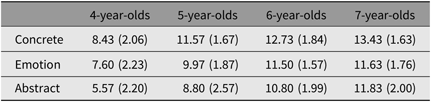
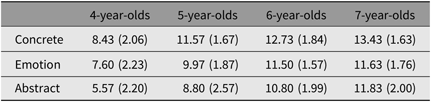
Mean numbers of correct choices according to word type and age group are provided in Table 2. The main effect of children’s age was significant and the effect size was large, F(3, 116) = 73.84, p < .001, η² = 0.66. The mean number of correct choices was lower for the 4-year-olds (M = 8.43, SD = 2.06) than for the older children (M = 11.03, SD = 1.89, p < .001). It was also lower for the 5-year-olds (M = 10.11, SD = 2.36) than for the older children (M = 11.99, SD = 2.00, p < .001). The difference between the 6-year-olds and 7-year-olds was nonsignificant (M = 11.68, SD = 1.98 vs. M = 12.3, SD = 1.97, p = .09). There was also a significant main effect of word type with a large effect size, F(2, 232) = 55.80, p < .001, η² = 0.33. Contrasts showed that the mean number of correct choices was higher for concrete words (M = 11.54, SD = 2.63) than for emotion or abstract ones (M = 9.71, SD = 2.93, p < .001), and higher for emotion words (M = 10.12, SD = 3.25) than for abstract ones (M = 9.25, SD = 2.48, p < .001). Finally, there was a significant interaction between word type and children’s age with a medium effect size, F(6, 232) = 2.51, p = .02, η² = 0.06. Contrasts showed that this interaction was due to the difference between emotion and abstract words, which was greater for the 4-year-olds (d = 2.03) than for the older children (d = 0.55), p = .005. Whereas the mean numbers of correct choices for emotion and abstract words were fairly similar for the older children, the 4-year-olds made fewer correct choices for abstract words than for emotion ones. All other contrasts were nonsignificant.
Mean (Standard Deviation) Numbers of Correct Choices According to Word Type and Children’s Age
Results of the ANCOVA indicated a significant effect of raw RCPM score, F(1, 115) = 10.02, η² = 0.04, p = .002. With this covariate, the main effect of age remained significant with a large effect size, F(3, 115) = 35.04, p = .001, η² = 0.32, as did the effect of word type with a small effect size, F(2, 230) = 3.63, p = .03, η² = 0.02. The contrasts concerning the effects of age and word type remained significant. By contrast, the interaction between word type and raw RCPM score was not significant, F(2, 230) = 0.18, p = .83. Similarly, the interaction between word type and children’s age ceased to be significant, F(6, 230) = 1.40, p = .22. However, the same contrast remained significant for this interaction effect. This interaction was due to the difference between emotion and abstract words, which was greater for the 4-year-olds than for the older children, p = .04. These results suggest that nonverbal ability, which develops with age, contributed to performance on this task, alongside verbal ability.
In sum, results revealed that the number of correct choices: (1) improved for every word type between 4 and 6 years, (2) was lower for emotion words than for concrete ones, (3) was lower for abstract words than for emotion ones, and (4) was lower for abstract words than for either concrete or emotion words in the youngest group.
Discussion
The current experiment was designed to investigate the comprehension of emotion words compared with words referring to concrete or abstract concepts among children aged 4–7 years. The children were shown sets of four pictures and asked to choose the picture that corresponded to a word pronounced by the experimenter. We assumed that the children’s understanding of words for emotions would lie at an intermediate level between concrete and abstract words. Results confirmed our hypothesis. First, they showed that the understanding of all three word types increased across the studied age range. Second, as expected, emotion words and abstract words were less well understood than concrete words, and emotion words were understood better than abstract ones. Third and last, the greatest developmental change concerned the comprehension of abstract words between the ages of 4 and 5 years. These results corroborate previous findings showing that emotion word knowledge undergoes major changes during childhood (Baron-Cohen et al., Reference Baron-Cohen, Golan, Wheelwright, Granader and Hill2010; Li & Yu, Reference Li and Yu2015; Ridgeway et al., Reference Ridgeway, Waters and Kuczaj1985). Whereas these previous experiments relied on parental reports, the present study demonstrated improvements in emotion word knowledge using a task based on the Peabody test (Dunn & Dunn, Reference Dunn and Dunn2007), the classic measure of lexical development. Our results were also consistent with the concreteness effect, which refers to the easier processing of concrete words relative to abstract words (Fliessbach et al., Reference Fliessbach, Weis, Klaver, Elger and Weber2006; Schwanenflugel et al., Reference Schwanenflugel, Akin and Luh1992; Schwanenflugel et al., Reference Schwanenflugel, Harnishfeger and Stowe1988; Yuille & Paivio, Reference Yuille and Paivio1969). In accordance with previous experiments, we showed that concrete words are easier to understand than abstract words, especially for younger children.
The novel findings of the present study concern the understanding of words referring to emotions relative to both concrete and abstract words. Our results indicate that words referring to emotions are more difficult to understand than concrete words, but less difficult to understand than abstract words. This is consistent with the idea that words for emotions should be distinguished from concrete words, but should also not be likened to abstract words, as Altarriba et al. (Reference Altarriba, Bauer and Benvenuto1999) initially proposed. Our interpretation relies on the approach developed more recently by authors in the field of word meaning acquisition and semantic memory (Borghi et al., Reference Borghi, Binkofski, Castelfranchi, Cimatti, Scorolli and Tummolini2017; Della Rosa et al., Reference Della Rosa, Catricalà, Vigliocco and Cappa2010; Kousta et al., 2011; Wauters et al., Reference Wauters, Tellings, Van Bon and Van Haaften2003). First, words referring to emotions are obviously abstract, as they refer to unobservable entities, but unlike other abstract words, they can be matched to internal states that are partly experienced by the senses. Accordingly, these authors assumed that while concrete words are learnt mainly through experience, and abstract words through linguistic information, words for emotions are learned from both sources of information. The fact that words for emotions, like abstract words, were more difficult for the children in our study to understand than concrete words, but less difficult to understand than abstract words, is consistent with the idea that their learning relies on both experiential and linguistic information. As children start to perceive and experience the world before they acquire language, words associated with experience are learned earlier than words associated with linguistic information. As words for emotions can be matched to internal states that can be perceived, as well as to a reality that can be observed in the behaviours of other people, children can learn their meanings earlier than those of purely abstract words. This is congruent with the approach proposed by Widen and Russell (Reference Widen and Russell2010, Reference Widen and Russell2011) for emotional concepts. For these authors, emotional concepts are narrative structures defined as scripts, which contain, among other things, bodily changes, phenomenological experiences and verbal labels.
These results suggest that children’s experience and language both play a role in the constitution of the emotional lexicon. Acquired earlier than abstract words, words referring to emotions have the power to simultaneously activate several components of emotion knowledge, such as causes, behavioural consequences, and facial expressions (Russell & Widen, Reference Russell and Widen2002a, Reference Russell and Widen2002b; Widen & Russell, 2004). Insofar as it promotes emotional understanding (Pons, Lawson, Harris, & de Rosnay, Reference Pons, Lawson, Harris and de Rosnay2003), the development of the emotional lexicon has a decisive influence on children’s future socio-emotional skills and socio-adaptive behaviour (Izard, Schultz, Fine, Youngstrom, & Ackerman, Reference Izard, Schultz, Fine, Youngstrom and Ackerman2000). This emphasises the importance of training students in the understanding and use of words referring to emotions. This is precisely the training provided in social and emotional learning (SEL) programs, which help students to recognise their own and others’ emotions more efficiently, understand the causes and consequence of emotions, and manage these emotions (Elias, Zins, & Weissberg, Reference Elias, Zins and Weissberg1997). One example is the RULER Feeling Words Curriculum (Maurer, Brackett, & Plain, Reference Maurer, Brackett and Plain2004), which is designed to be integrated into existing school curricula. The acronym RULER represents the five skills targeted by the program: recognise, understand, label, express, and regulate emotions, where the labelling skill allows children to put names to emotions using a diverse and accurate vocabulary. A better understanding of the way that children’s knowledge of words for emotions develops during childhood would help to improve these programs.
Emotion abilities are known to be compromised in neurodevelopmental disorders such as autism spectrum disorder and intellectual developmental disorders. Most research on emotional abilities in these disorders has focused on the recognition of emotional facial expressions. Far too little is known about the other emotional abilities. Accordingly, replicating this study among children with neurodevelopmental disorders, particularly intellectual disability, might shed light on their emotional development and prove very useful for assessing their emotional knowledge in socio-emotional learning programs.
Several limitations must be borne in mind when considering the findings of this study. The main one concerns the assessment of words for facial expressions of emotions in photographs. This situation certainly does not reflect real-life situations, in which facial expressions are constantly changing. Research on the recognition of facial expressions in children with neurodevelopmental disorders has shown that they achieve higher emotion recognition scores when dynamic emotional stimuli are used (Ibernon, Touchet, & Pochon, Reference Ibernon, Touchet and Pochon2018). Nevertheless, the task we used to assess children’s knowledge of words for emotions was based on the Peabody Picture Vocabulary Test (Dunn & Dunn, Reference Dunn and Dunn1981), the most well-known standardised measure of lexical development. Despite the lack of dynamic stimuli, our findings shed light on the development of the emotional lexicon in children with typical development.
Financial Support
This research received no specific grant from any funding agency, commercial, or not-for-profit sectors.
Conflict of Interest
This research was conducted in the absence of any commercial or financial relationships that could be construed as a potential conflict of interest.
Ethical Standards
The authors assert that all the procedures contributing to this work complied with the ethical standards of the relevant national and institutional committees on human experimentation and with the 1975 Declaration of Helsinki, as revised in 2008.
The authors assert that all the procedures contributing to this work complied with the ethical standards of the relevant national and institutional guides on the care and use of laboratory animals.