INTRODUCTION
Accuracy and reproducibility of the patient’s position, with minimal set-up errors, is crucial for successful delivery of radiotherapy (RT). Image verification is a critical component to achieving reproducibility. This process identifies deviations from the intended planned position and through the use of correction strategies, these deviations can be minimised or eliminated. Image verification protocols provide radiation therapists with guidance on how the verification process should be executed.
Imaging protocols vary between departments; a UK study reported that only 57% of departments routinely acquire images for palliative treatments.Reference Stratford, Ball and Henry 1 Often greater tolerances and less frequent imaging is practiced in the set-up verification of palliative patients. The UK Royal College of Radiologists (RCR) guidelines state that verification for palliative patients should be no less rigorous than for radical patients, especially for those receiving a small number of high dose fractions, as it is critical in identifying errors early. 2 , 3 Image verification can also play a role in quality control to aid the elimination of gross errors in the palliative setting.
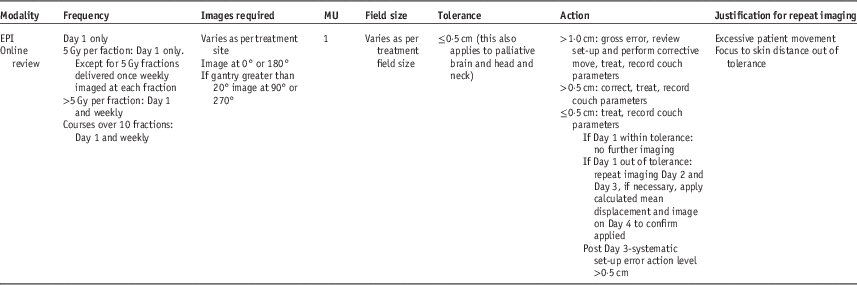
The UK RCR recommends regular compliance review and maintaining up-to-date image verification protocols. 3 The aim of this case report was to retrospectively review and to assess RT compliance to an institutional evidence-based palliative imaging protocol 2 (Table 1) and to identify and categorise non-compliance.
Summary of the institution’s palliative imaging protocol

MATERIALS AND METHODS
Ethical approval was obtained from the Trinity College School of Medicine Research Ethics Committee. The imaging data for all palliative patients treated in 2014 was anonymised and collected by a gatekeeper in a single institution. The dataset was compared to the institution’s evidenced-based palliative imaging protocol (Table 1). Deviations of protocol were identified and categorised. The data did not include the imaged field size or acquisition dose.
RESULTS
A total of 552 sites in 383 patients were identified. The number of sites per patient ranged from one to seven, for analysis each treatment site was assessed separately. Treatment sites were grouped into five categories; thorax (107 sites), pelvis/abdomen (170 sites), spine (111 sites), limb (26 sites), head and neck, and central nervous system tumours (138 sites).
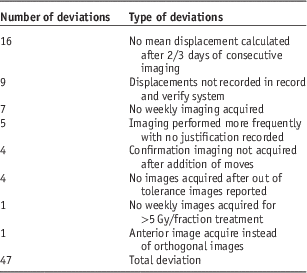
Deviation from protocol was observed for 45(8%) of treatment sites, with 47 different cases of non-compliance to protocol (Table 2). More than one deviation from protocol for the same treatment was observed for two cases.
Summary of imaging protocol deviations

DISCUSSION
Reproducibility of the patient’s position, is crucial for successful delivery of radiation therapy. Imaging protocols are implemented to ensure minimal set-up errors. A crucial component to the success of these protocols is staff compliance. This report aimed to assess RT’s compliance to palliative imaging protocol within a single institution.
In this institution, non-adherence to protocol was observed for 8% of palliative sites treated in one calendar year (Table 2). For those effected patients, this resulted in no assessment of treatment accuracy, or attempt to reduce set-up errors. This is the first of such reviews carried out for palliative patients in this institution, with 100% compliance to protocol the quality assurance ‘gold standard’.
An evaluation of treatment planning protocol compliance in the TROG 02.02 H&N trial demonstrated that nearly 50% of patients were treated on non-compliant plans despite the use of rigorous trial quality assurance procedures.Reference Peters, O’Sullivan and Giralt 4 This example emphasises the need for quality controls to ensure protocol adherence. A violation rate of 8% in this study appears low by comparison; however this study only looked at the specific aspect of verification imaging rather than the entire planning process.
The RCR guidelines state that verification for palliative patients should be no less rigorous than for radical patients and correction of each imaged fraction, is recommended. 2 As in this imaging protocol, images taken at the beginning of treatment, help detect and reduce large gross and systematic errors that could, if carried forward, have a negative impact on treatment outcomes.Reference Hurkmans, Remeijer, Lebesque and Mijnheer 5 , Reference Giraud, De Rycke, Rosenwald and Cosset 6 This is especially important in the palliative setting with the use of high dose per fractions over short treatment courses.
All RT departments should have well-written, unambiguous protocols for on-treatment verification imaging, both for radical and palliative patients. Their purpose is to ensure no gross positional error, the delivery of treatment is accurate and as intended and to ensure standardised verification processes. The delivery of accurate treatment is the responsibility of all RTs and each department must develop a safety-conscious culture. 3 As such, compliance to protocols is paramount in achieving this.
Minor ambiguities in this imaging protocol have may resulted in some of the violations. If steps are not clearly detailed and documented in protocols, staff may be uncertain about the sequence, and the likelihood of error is increased.Reference Kataria, Abhishek, Chadha and Nandigam 7 The departmental protocol (Table 1) states that if Day 1 images are out of tolerance, images are to be repeated Day 2 and Day 3 ‘if necessary’, inviting different interpretations of the instruction. It was observed that for some sites, averages of set-up displacements were performed after 2 days, and for other sites after 3 days, with no clear pattern or explanation behind the deciding rational. This report did not investigate the reasons why the deviations occurred, but they may have occurred for several reasons: the protocol was unclear; the treating RTs were not trained in the use of the protocol or the deviation was an error on the part of the RT. Further investigation is required to answer this question.
A review of RT treatment verification carried out in the United Kingdom, showed that strategies varied widely between treatment sites and departments.Reference Stratford, Ball and Henry 1 Although it did not assess staff compliance to protocol, it did highlight the importance of reviewing practice on an institutional level. Regular reviews should be conducted to ensure protocols are clear, up-to-date and relevant. Furthermore, this review highlights the importance of adequate documentation, which is critical in effective risk management and quality improvement.
Conclusion
This case report provides a baseline assessment of RT compliance to an institutional palliative imaging protocol. The most prevalent deviation was a failure to calculate the mean set-up displacement after 2 or 3 days of consecutive imaging. The findings highlighted here, offer an insight into the image verification of palliative images and may prove useful to other RT departments. Despite the presence of institutional evidence-based palliative imaging protocol unwanted deviations in practice can occur. Further studies are required to assess the cause of these deviations.
Acknowledgements
None.
Financial support
None.
Conflicts of Interest
None.