

Introduction
Biographical and life history studies can be important for revealing various cultural and historical geographies; as a result, they have often been used to examine empire (Daniels and Nash Reference Daniels and Nash2004; Thomas Reference Thomas2004). Many scholars have written about the ways in which travel writers have constructed different places in relation to empire (Blunt Reference Blunt1994; Morag Reference Bell, Bell, Butlin and Heffernan1995; Daniels and Nash Reference Daniels and Nash2004; Thomas Reference Thomas2004), although Morag (1995) has called for a change of focus from investigating travel writers ‘as a category’ to exploring specific regions and the roles that particular people have played in those spaces.
Although biographical approaches can be used productively for various purposes, many historical geographers have expressed uneasiness about referring to their work as ‘biographical’. This is largely due to theoretical considerations related to positionality and representation, which are summarised below. First, some scholars have raised concerns about inappropriately elevating or legitimising colonial subjects (Thomas Reference Thomas2004; Jones Reference Jones2004). Second, and probably more importantly, historical geographers have critiqued the idea of constructing subjectivity through biographies. In applying a post-structural lens, they have rejected realist claims related to representing ‘authenticity’ in their writings. This has led many to view biographical representations as inherently problematic (Blunt Reference Blunt1994; Morag 1995; Thomas Reference Thomas2004).
Despite these important concerns, Nikola Thomas (Reference Thomas2004) has argued that many historical geographers do, in fact, operate within biographical frameworks, and that biography can be a useful tool for historical geographers, as long as they carefully take into account the theoretical pitfalls mentioned above. Moreover, Catherine Hall (as cited in Steedman Reference Steedman1995: 322) has argued that, while critical theory has been crucial for making us aware of various problems associated with biography, ultimately “we only have access to ‘the real’ through representation, and that it is language that constructs meaning”, even if not in a purely realist sense. Felix Driver (Reference Driver1995) has argued in favour of using biographies of individuals to examine ‘unfamiliar histories’, emphasising that he is less concerned with trying to reconstruct individual experiences – a nearly impossible task – than with gaining a better understanding of the ways in which people negotiate particular circumstances. I am also interested in this research area, as the present article makes clear.
McDonagh (Reference McDonagh2013) is a historical geographer who has chosen to explicitly engage with biographical approaches, while keeping the theoretical concerns cited by Thomas (Reference Thomas2004) clearly in mind. While acknowledging the challenges associated with writing medieval biography, McDonagh demonstrates how under-used sources can help us to understand medieval individuals and their pre-modern worlds. He ultimately recognises that, given the fragmentary nature of the information available, the person he researches will always remain ‘an uncertain subject’. Other geographers have also become increasingly comfortable with explicitly using biographical approaches. Barnes and Abrahamson (Reference Barnes and Abrahamsson2015), for example, have effectively adopted a biographical approach to illuminate the fraught relationships between a German father and son – both political geographers – and the Nazi leadership in Germany during World War II. Eric Clausen (Reference Clausen2015) used a biographical approach to examine William Morris Davis, who is often considered the ‘father of American Geography’.
In this study, I have used a life history or biographical approach to explore cross-border dynamics between Laos, Thailand, and Cambodia, exploring the ways in which the borders that emerged around the sphere of influence of the Champassak Royal House in the twentieth century were negotiated. In related research, some scholars have adopted biographical approaches to examine diaspora experiences, although few studies have specifically dealt with border dynamics. Ghamari-Tabrizi (Reference Ghamari-Tabrizi2004) has studied an emerging Muslim diaspora through the experiences of a Muslim activist and scholar, Isma'il al-Faruqi; Ni Laoire (Reference Ni’ Laoire2008) has applied a ‘biographical and life-course perspective’ to an investigation of key narratives of migrants returning to Ireland, focusing on certain crucial themes, including family, child-rearing, relationship breakdown, and ‘settling down’. In addition, Andrucki and Dickinson (Reference Andrucki and Jen2015) have recently examined transnational migration experiences using a biographical approach, in order to examine the concepts of centre and margin in geography.
Despite the usefulness of this approach for analysing transboundary experiences, surprisingly few biographical studies have focused on borders or borderlands, the goal of this article. Lefebvre's (Reference Lefebvre2011) study of experiences and discourses related to colonial constructions of African borders is an exception, although her biographical approach is different from the one I employ here. By examining four unique biographies, written by colonial Africa experts between World War I and World War II, Lefebvre shows how these authors, somewhat ironically, created legitimacy within their colonial spheres by critiquing the construction of colonial borders within Africa on the basis that colonialism itself was fundamentally arbitrary. Of all the border studies that use biographical approaches, however, the one that most closely reflects my own interests was carried out by Kind-Kovács (Reference Kind-Kovács2014), who used ‘life story interviews’, or biographies, to examine people's past relationships with the Czech-German border or ‘Iron Curtain’, particularly during the Cold War period. This study is especially relevant to my work because it uses a biographical approach to look at political geographies of the past in relation to particular borderlands. Noboru Ishikawa's (Reference Ishikawa2010: 232) research, which relates to the Malaysian-Indonesian borderlands, is also quite relevant. He writes, “[t]here is much to learn from the location work of the people on the border, whose entry into transnational modernity precedes that of people living within the confines of the nation-state”.
In this article, I argue for the usefulness of a life-history or biographical approach when studying the history of borders and borderlands. To do this, I draw on the life of an important member of the Champassak Royal House, Chao Sone Bouttarobol,Footnote 2 whose story illustrates the ways in which borders were understood and negotiated through family relationships – within the twentieth century area of influence of the Champassak Royal House. By focusing on Chao Sone's mobility across and negotiation with borders, his position as a member of the ‘border elite’, and his positionality as a ‘khon sam xat’ (person of three nations), I hope to demonstrate how the biographical approach can be useful – and even vital – for much borderland research.
I start by briefly reviewing some basic background information about the Champassak Royal House, as well as the previous literature related to the Champassak Royal House and borders. I then provide a brief outline of Chao Sone Bouttarobol's life history, before engaging with the biographical details of Sone's life, I show how his life was deeply connected and affected by borders and living in borderland areas. Finally, I conclude by providing some key take-away messages that can be derived from this research. I also offer some general comments about the value of using biographical approaches to understand borders, borderlands, and the people who have historically lived in and negotiated with borderland spaces.
The Champassak Royal House and Cross-Border Studies
The Champassak Principality was established by Chao Soisysamouth or Chao Nokasat in 1713. The establishment of Champassak followed a succession battle in Vientiane that caused a famous Buddhist monk, Phra Khou Phonsamek, a large group of his followers, and the wife of a murdered candidate for King (and the mother of Chao Nokasat) to flee southward. After many years, they eventually established Champassak as a small independent principality. In 1778, during the reign of Chao Nokasat's son, Chao Sayakoumane, the Siamese attacked Champassak and forced it into vassalage. Champassak had its own small vassal principalities and nominally controlled a wide area that encompassed southern Laos and parts of what is now northeastern Thailand, as well as the Central Highlands of Vietnam and northeastern Cambodia. Champassak therefore continued to direct and collect taxes from these vassals, nominally on behalf of Siam. Champassak was further weakened when the French took control of territory east of the Mekong River in 1893. In 1904, Champassak proper was incorporated into French Laos, when territory west of the Mekong, including Champassak, was ceded from Siam (Archaimbault Reference Archaimbault1961; Sanprasith Reference Sanprasith1995; Wilson Reference Wilson1992). Many members of the Champassak Royal House moved between Champassak, in Laos, and parts of what is presently Thailand from at least the late eighteenth century onwards (see Baird Reference Baird2007, Reference Baird2009, Reference Baird2013). Laos gained independence from France in 1954, after the fall of Dien Bien Phu. In 1975, the communist Pathet Lao and their North Vietnamese allies were able to gain full control of the country, thus largely bringing to an end the Champassak Royal House's direct influence in Laos. Most of the family fled to neighbouring Thailand as political refugees, and eventually settled in France and the United States.
Only a few studies have explicitly dealt with the relationship between the Champassak Royal House and the borderlands. One such study researched a member of a Champassak Royal House, ChaoFootnote 3 Thammatheva,Footnote 4 and his ability to migrate from Champassak, in what is now southern Laos, to Veun Sai in Ratanakiri, northeastern Cambodia, and to prosper there under three different government administrations: 1) Siamese via Lao, 2) French Laos, and 3) French Cambodian, all situated within the same physical space (Baird Reference Baird2009). Another study examined the links between the Champassak Royal House and the millenarian or ‘phu mi boon’ (‘person of merit’ in Thai and Lao) uprisings that destabilised the south of French Laos and northeastern Siam (Thailand) (see Murdoch Reference Murdoch1974; Keyes Reference Keyes1977; Gunn Reference Gunn1990; Wilson Reference Wilson1997). In that study, Baird (Reference Baird2013) argued that the role of the Champassak Royal House in these uprisings had been overlooked in the literature; these royals actually instigated rebellions on both sides of the national border, albeit secretly. At least some of the Champassak royals hoped that, by destabilising the political situation, they could gain greater influence and authority from the French and Siamese governments, both of which had significantly diminished the role of the Champassak Royal House. This argument is echoed by Walker (Reference Walker2014), who shows how Shan rebels engaged, at the very beginning of the twentieth century, in their own competing processes of state-making in the borderlands, rather than simply rebelling against Siamese state-building efforts.
Chao Sone Bouttarobol – A Brief Career Timeline
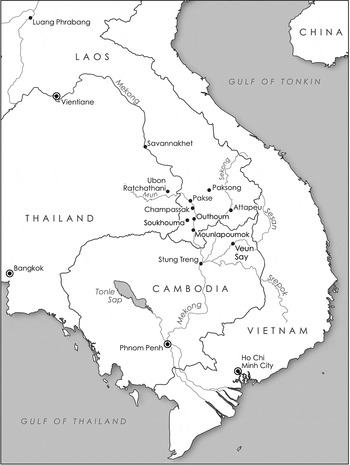
Chao Sone Bouttarobol, the subject of this article, not only spent considerable amounts of time in both Laos and Thailand, but also spent some of his early adult years in what would today be Stung Treng and Ratanakiri Provinces, in northeastern Cambodia (Figure 1).
Map of places where Chao Sone Bouttarobol travelled.

His movements were affected both by Champassak Royal House social networks, which reflected past areas of influence, and by the national borders that had recently divided up the region (see Thongchai Reference Thongchai1994 and Baird Reference Baird2010a, Reference Baird2010b for a discussion of these national borders). Sone was involved with political manoeuvring in Laos, Thailand, and Cambodia. Through his family relationships, he was often able to negotiate the national boundaries of these three countries in certain ways, not just physically but also socially and politically. At times, this was difficult or even impossible.
The spaces influenced by Champassak have long been contested in different ways and for various reasons. The life of Chao Sone Bouttarobol – including his efforts to negotiate national boundaries – clearly illustrates the value (and even the necessity) of using a transboundary approach when conducting historical research in these borderland areas. In addition to its main objective (to illustrate the importance of biographical approaches to borderlands studies), this article has an additional minor objective: to demonstrate the continued need for serious cross-border research when examining borders and borderlands.
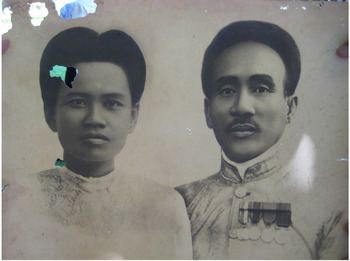
According to a handwritten summary of the significant events in Chao Sone's life that he himself prepared, and which his son, Lt. Col. Bounyalith Bouttarobol, provided to me when I visited him in the suburbs of Paris in August 2013, Chao Sone was the third childFootnote 5 of Boonpheng, a lieutenant in the Champassak/Siamese army, before eventually gaining the title of Phra Ubonkij Phrachakorn,Footnote 6 and becoming an important leader of Ubon Ratchathani (Figure 2).Footnote 7
Phra Ubonkij Phrachakorn (Boonpheng) and his wife, Chao Heuan Nying Thongphanh, the parents of Chao Sone Bouttarobol.

Sone was born in Champassak on a Tuesday, during the third Lao month of the year of the goat (1894). His mother was Chao Heuan Nying Thongphanh Na Champassak, a daughter of Chao Nyouthithamathone,Footnote 8 the eleventh king of Champassak; she was also the younger sister of Chao Ratsamphanh (Sanprasith Reference Sanprasith1995), who was locally famous for having been defeated in the Siphandone (Four Thousand Islands) area by invading French troops coming up the Mekong River in 1893. Phra Ubonkij Phrachakorn was given the royal title of ‘Bouttarobol’ by King Rama VI (Chulalongkorn) of Siam in 1915Footnote 9 ; this later became Sone's last name. In 1902, Sone attended Wasiksathan School in the city of Ubon Ratchathani, and in 1904 he studied at Ubon Withayakhom at Wat Supat Ubon Buddhist temple. After graduating from elementary school in 1906, he studied public administration at the prestigious Rataprasat School in Bangkok. In 1907, he began working as a tea boy for none other than the famous Phraya Damrong Ratchanuphap at the Mahat Lek Department in Bangkok. He may (at least occasionally) have served tea to King Chulalongkorn (King Rama V) of Siam. The details of Sone's early life are important to include here, as they set the stage for the borderlands/biographical discussion that follows.
In 1914, Sone returned to Ubon Ratchathani. According to his own timeline, written decades later, that was the year he was ordained as a novice at Wat Supat, an important Buddhist temple in Ubon. In 1915, he left the monkhood to marry Chao Heuan Nying Ourayvanh (commonly known as Chao Heuan Ou) in Champassak.Footnote 10 In 1916, he apparently worked for the French administration in Laos, and was also a ‘committee member’ for Champassak. Banditry was common in rural Laos and Thailand during the early part of the twentieth century (Johnston Reference Johnston1980; Gunn Reference Gunn1990; Reynolds Reference Reynolds2011). In 1918, Sone was working to stop ‘bad bandits’ in Soukhouma on the order of the French Commissaire Nasay and his Vientiane-based Lao counterpart. In 1923, Chao Sone, as he was commonly known, went to negotiate with the bandits and was able to stop their bad behaviour. In 1929, he moved to Soukhouma and took the position of accountant there. In 1934, he moved again, this time to suppress bandits in Phon Thong District, near the border with Thailand's Phibul District, Ubon Ratchathani Province. In 1937, he moved from Phon Thong to become Nai Kong and Chao Muang (chief of the district) in the Paksong area, on the Boloven Plateau. Although it is unclear exactly what role he played in the conflict and tensions between French Indochina and Siam in 1940–1941, Sone certainly supported the 1941 invasion of Champassak by the Siamese, which occurred during World War II, at a time when France was particularly weak. Chao Sone was one of the frontline leaders for the Kong Nuay Thai military force from Thailand that defeated the French and took over Champassak.Footnote 11 The military leaders Colonel Luang Kriangsak Phichit and Colonel Luang Chamnan Yuttasat (also more famously known as Chom Phon Phin) appointed him to the position of District Chief, rank #3 in Ubon Ratchathani.Footnote 12 He therefore had to stay in Muang Mounlapoumok and Khong Island, known as the Siphandone Sub-district at the time.
Chao Sone gained real prominence in 1944, when he was elected as the Member of Parliament for Champassak.Footnote 13 During the election campaign, he competed with Wichit Kosanlawit, a rich Thai-Chinese man from an important trading family in Ubon Ratchathani. Wichit was married to a Thai aristocrat named Khun Nai ToonFootnote 14 and had the means to organise big feasts for voters to entice them to cast their ballots for him. In the end, Chao Sone was victorious and Wichit was disappointed. Wichit later commented, “khon Lao khi kong; rao kha khwai hai kin, lao pen thay hai kin, man wa ja ao rao, sut thai kaw pai dai Chao Sone” [Lao people are cheaters, I killed buffaloes for them to eat, gave them jars of whiskey to drink, they said they would choose me, but in the end Chao Sone was victorious]. Chao Heuan Phengphanh ManikanhFootnote 15 commented that, “People elected a local person, Chao Sone. Wichit was a Thai from elsewhere”.Footnote 16 Indeed, this sense that Wichit came from elsewhere hints at the ways in which social boundaries were being constructed. These ideas must have also affected understandings of the border between Laos and Thailand/Siam.
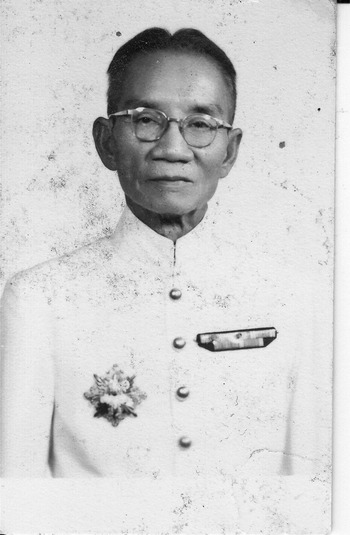
At this time, Chao Sone frequently travelled between Champassak and Bangkok. However, after the end of World War II, the Thais were compelled to return Champassak to French Laos; his position as a Thai Member of Parliament was dissolved on 8 March 1947. He was soon appointed as the deputy leader of a committee responsible for drafting the first constitution of Laos. Bong Souvannavong, a powerful Lao politician from Vientiane, was appointed as the head of the committee, as specified in Royal Order #37 (see Norindr Reference Norindr1994). Later that year, on 7 December, Chao Sone was elected as the Champassak Member of Parliament in Laos (Figure 3). A month later, on 7 January 1948, he was present at the inaugural opening of the National Assembly in Vientiane. On 24 February 1948, however, he gave up his position after having been appointed to a prestigious four-year term as an advisor to the King of Laos.Footnote 17 He started his second term on 25 August 1951; his third on 20 September 1955; and his fourth on 2 December 1959. He resigned on 25 April 1965 after over seventeen years in this position.
Chao Sone Bouttarobol as a Member of Parliament in Laos, 1947.

As should already be evident (and will become even more obvious as the article continues), Chao Sone was a person whose family relationships allowed him to connect across the border between Laos and Thailand, a border that did not exist when he was born, but which became increasingly important over the course of his life.
Important Events in Chao Sone Bouttarobol's Life
A significant number of important details associated with Chao Sone's life were left out of his brief autobiography. Many of those relate to his interactions with borders and borderlands. Some other biographical details do not relate specifically to his interactions with borders, but are necessary for understanding the way in which he viewed and negotiated borders in areas that had previously been under the influence of the Champassak Royal House.
Chao Sone's Style
Everyone I spoke with who knew Chao Sone told me that he was generally not a talkative man. The exception was when he had been drinking alcohol; then he would talk a lot. He had a great interest in politics, and was apparently close to Chao Raxadanai, the head of the Champassak Royal House,Footnote 18 who was of the same generation. As Chao Sone's daughter, Chao Heuan Phengphanh put it, “He wouldn't say much at home but he could speak about politics for three days”. She also commented that, “He was an important advisor of the Lao King. He had a Thai head [he was smart like a Thai]; he was smart. So he was an important advisor. He was a straight talker”. He was, however, not someone who got angry easily. Nevertheless, he apparently found it easy to kill bad people if they became his enemies. According to another member of the Na Champassak House, Chao Heuan Nying Bounlonh, “Chao Sone didn't speak much, but if he was going to kill, he would really kill”.Footnote 19 At various times, Chao Sone trained policemen and soldiers. For example, he recommended that the police and military not travel together in large groups, since that made them easy targets for gangs of bandits. According to his daughter, Chao Heuan Phengphanh, “Everyone respected him”. His election victories suggest that he was indeed popular, if something of a maverick. These sorts of comments from relatives underline the value of a biographical approach in understanding Sone's relationships with people in borderland spaces.
Chao Sone went to school only in Thailand, and so he preferred to write in Thai, even though he had also learned to write in Lao.
Chao Sone Stirs up Trouble in Cambodia
It appears that Chao Sone did not simply return from Bangkok to Ubon in 1914, as he wrote, but passed through Ubon and Champassak before traveling to Veun Sai, in Ratanakiri Province, northeastern Cambodia, to work with his relative Chao Thammatheva, who had left Champassak to become an important leader in the Stung Treng and Ratanakiri area (Baird Reference Baird2009). Chao Sone's youngest son, Bounyalith, was aware that his father had gone to Cambodia as a young man. He told me that Chao Sone was ordered to do this by Chao Raxadanai, the King of Champassak.Footnote 20 French archival sources indicate that, in April 1915, Chao Sone helped Chao Thammatheva incite uplanders along the Sesan River to revolt against the French, as part of a plan to help Chao Thammatheva gain more influence by appearing to solve a problem with the uplanders highlanders that he had actually created in the first place. The plan worked and Chao Thammatheva became the Governor of Stung Treng as a result.Footnote 21 Chao Sone, however, was arrested by the French for inciting the highlanders and was forced to return to Champassak.Footnote 22 He was banned from re-entering French Cambodia. Although the French knew of Chao Sone's involvement from the beginning, they were initially unaware that Chao Thammatheva was the real strategist behind the scene (Baird Reference Baird2009, Reference Baird2010a).Footnote 23
Chao Sone as a Legendary Law Enforcer
Chao Sone's adventures as a frontier area law enforcer are legendary and worth elaborating on here, as his experiences help to illustrate how law enforcement agents became more effective when they were able to cross international borders with ease. He was known as a ‘kong pap’ or enforcer in Lao.Footnote 24 According to Chao Sone's daughter, Chao Heuan Phengphanh, Chao Sone brought down a notorious bandit who operated mainly between Mounlapoumok and Champassak, but who also sometimes crossed the border with Siam. No one had previously been able to stop this bandit, partly because he could cross the border to evade the authorities. He also killed and burned down the houses of those who tried to stop him. On the night before Chao Sone killed him, the bandit had a bad dream; Chao Sone was apparently the only person he was afraid of. As the story goes, Chao Sone intercepted the bandit in Mounlapoumok, as he walked across a rice field near his wife's house, where he had just eaten lunch. Chao Sone shot him in the leg with the first shot and then killed him with the second. Once he was dead, Chao Sone cut off his head and brought it to the French officials as evidence of his success. He later hung the head from a mango tree to show people what would happen if they engaged in banditry. After the bandit was killed, his underlings dispersed and fled. The gang was disbanded and peace apparently returned to the area.Footnote 25 It should, however, be noted that during this period ‘bandits’ often occupied ambiguous positions between social banditry and anti-authority rebellion (Johnston Reference Johnston1980; Gunn Reference Gunn1990; Reynolds Reference Reynolds2011), so the situation may well have been more complicated than the above account indicates.
Chao Sone, Magic and Children
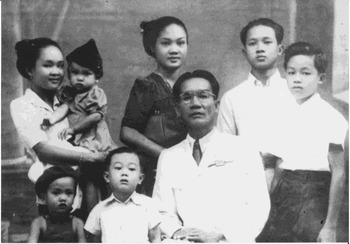
While Chao Sone's brief autobiography gives no indication of his involvement with magic, it was an important factor in his success, as someone who interacted throughout his life with potentially dangerous ethnic minorities and groups of bandits. His relative in Veun Sai, Chao Thammatheva, used magic in a very similar way (Baird Reference Baird2009). Indeed, magic was crucial for many key figures in the region at the time, especially those who crossed borders frequently and travelled to remote and dangerous borderland areas. It was understood that misusing magic could have a negative effect on the user. According to Chao Prasobsak Na Champassak, Chao Sone had a powerful talisman made from a mummified foetus, which had undergone special incantations, called louk lote in LaoFootnote 26 or kuman thong in Thai (see Baird Reference Baird2009; Sinnott Reference Sinnott2014; Terweil Reference Terweil2012 for more details).Footnote 27 However, there was a downside to the magic Chao Sone practiced, at least according to various family members: his first thirteen children all died before reaching their fifteenth birthdays.Footnote 28 Many believed that Chao Sone's involvement with magic prevented him and his wife from raising their children to adulthood.Footnote 29 However, Sengchanmany Sinhbandith, another person of Champassak royal descent presently living in Paris, told me that Chao Heuan Ou had a birthmark on her back, which some believed might have been the reason so many of her children died young.Footnote 30 In any case, after this epidemic of childhood deaths, the couple started giving their children to other family members to raise, in the hope that some would survive. This strategy worked. Their fourteenth child, Chao Heuan Maniseng,Footnote 31 was raised by another member of the Champassak Royal House, Chao Heuan Saphaothong,Footnote 32 whose husband, Chao Thongphoun, was the District Chief of Khong. Their fifteenth child, Chao Heuan Phengphanh, was given to Douangphanh to raise,Footnote 33 while their sixteenth child, Chao Thavone,Footnote 34 was given to Chao Boun Ome Na Champassak, Chao Boun Oum's younger brother. The seventeenth and youngest child, Bounyalith,Footnote 35 was not given away; instead, a Vietnamese woman and Douangphanh or Khamleuang helped to raise him (Figure 4)Footnote 36 His mother, Chao Heuan Ou, died in 1953 when Bounyalith was 15 years old.Footnote 37
Chao Sone Bouttarobol (centre bottom) and his children and grandchildren: Phengphanh and her son Bounyadet; Maniseng; Thavone; Bounyalith (above); Thongsamlit and Thanat (below), Pakse 1948–49.

Although Bounyalith does not know whether Chao Sone practiced magic, he confirmed that his father refused to allow his children to do so. At the same time, Chao Sone did sometimes write little notes in books that he then left randomly lying around for others to look at. As Bounyalith put it, people were expected to pick up the books if ‘phitsanon chap’, or if the spirits were going to catch them.Footnote 38 Chao Sone also reportedly gave his son-in-law, Lt General Bounpone Mekthapharak (who was married to Chao Heuan Phengphanh and later became Commander-in-Chief of the Royal Lao Army), a ‘lek lai’ artefact to protect him in battle. A monk apparently helped to ‘insert’ it into Bounpone's arm, using a spell known as ‘katha thon’, which had allegedly been passed down from Phra Khou Phonsamek.Footnote 39 It apparently helped the General to achieve success in battle.Footnote 40
As a final illustration of Chao Sone's links to magic, when he was finally cremated in Pakse in 1985, the funeral pyre initially would not burn. His daughter, Chao Heuan Phengphanh, had to offer her sarong to get the fire burning; as this object was considered ‘low’, it negated the magical power that initially prevented the pyre from burning. She described him as having a lot of ‘khong dy’ (good things), a phrase that referred to his magical qualities.Footnote 41 This magic was a crucial reason why he was able to become an effective enforcer who could cross fearlessly across borders and into lawless regions.
Chao Sone's association with violence, magic, and asceticism fits into a broader pattern of charismatic masculine figures in Southeast Asia and the way their personal power is sometimes constructed. Although it may seem counter-intuitive, there are important links between violence/roughness and Buddhism, which can help us to better understand the social lives of Thai men and their roles in society (Pattana Reference Pattana2013). Indeed, Pattana (Reference Pattana2013) argues for a ‘boxing-Buddhism nexus’, pointing out that many of Thailand's modern national patriarchal models historically identified as both rogue men and also strong Buddhists; Chao Sone was a patriarch of this type.
Chao Sone and Ong Kommadam in the Boloven Plateau
Another important event that Chao Sone did not mention in his autobiography involved being sent to the Boloven Plateau. While his own timeline states that he was appointed as the Nai Kong and Chao Muang of Paksong in 1937, his son, Bounyalith, claimed that Chao Sone was previously sent by the French to help kill Ong Kommadam, the rebel leader. Chao Sone is even said to have spoken with Ong Kommadam at some point. Apparently, he did not have any personal grievance against Kommadam, but felt obliged to stop him.Footnote 42 Ong Kommadam was hunted down and killed by the French Garde Indigène (indigenous guard) soldiers led by the Vietnamese Captain Nyo in September 1936 (Baird Reference Baird2013), who crossed the border to Laos specifically to take part in the mission. This demonstrates the cross-border nature of security operations in French Indochina at this time, including the ones that Chao Sone was involved in. It seems likely that Chao Sone somehow participated in that operation. Following Ong Kommadam's death, Chao Sone was appointed Nai Kong and later Chao Muang of Paksong in recognition of his success.
Chao Sone stayed at Kilometre 45, near Paksong town, during his time on the Boloven Plateau. There he had a coffee plantation, where he also cultivated cotton and sugar cane. According to Chao Heuan Nying Chitprasong Na Champassak, after her father Chao Raxadanai died in 1946, she frequently travelled to Chao Sone's plantation on the Plateau to help harvest crops. She usually spent more than ten days at the farm during each trip; in exchange for her assistance, she would be given a substantial amount of cotton to take back to Champassak for weaving. Chao Sone apparently had over 20 people working on his farm at that time, including men and women. They all came from Champassak. After Chao Sone took Mome ThongphanhFootnote 43 in Muang Outhoum as a minor wife (see below), he never went to Paksong again. His first wife, Chao Heuan Ou, took over the management of the farm.Footnote 44
Chao Sone and Secessionists in Thailand
According to Bounyalith, Chao Sone was forced to flee Ubon in 1947 because of his involvement in a plot to separate Isan (northeastern Thailand) from Thailand. He was accompanied by the well-known Member of Parliament from Ubon, Thong-in Phuriphat,Footnote 45 whose wife was another Champassak royal, Chao Heuan Siribangone, the daughter of Chao ChouyFootnote 46 and Chao Heuan Khoune (Sanprasith Reference Sanprasith1995). Thong-in had been a leader of the Free Thai movement in Ubon Ratchathani, which had opposed the Japanese during World War II. He was aligned with other northeastern Thai leaders linked to the Free Thai movement, including the Sakon Nakhorn leader Tiang Sirikhan (Wimon Reference Wimon1997). This group apparently had ideas about separating parts or all of northeastern Thailand from Bangkok.Footnote 47 Chao Sone was secretly supportive; when his involvement was somehow revealed, he was forced to flee Ubon by wagon. With the help of Thong-in, Chao Sone travelled first to the Mun River, where he met his relative Chao Sixay Na Champassak,Footnote 48 who had previously been a member of the Lao Issara or Free Lao movement and was now working as a tax collector for the Thai government. From there, Chao Sixay arranged for Chao Sone to travel to the mouth of the Mun River, from where he was able to escape to Laos.Footnote 49
Chao Sone's Minor Wives
Like many Champassak male royals of this period, Chao Sone took on minor wives, sometimes to construct political alliances, including several that crossed borders. Chao Sone's second wife was Chao Nang Chanthonh, from Ubon Ratchathani. She was the younger sister of Chao Heuan Soulot, also of Champassak royal decent. Chao Sone had no children with Chao Nang Chanthonh. She died mysteriously on the Boloven Plateau in Paksong while Chao Sone was based there. As often happened, she apparently became jealous of Chao Sone's first wife, and (according to members of the Champassak Royal House), tried to use ‘van kha’ magical rhizomes to kill Chao Heuan Ou. Her plan reportedly backfired after she kept the rhizomes near her chest, thus inadvertently allowing them to ‘eat her’.Footnote 50
Probably the most sensitive and controversial part of Chao Sone's life relates to his decision, after the death of Chao Nang Chanthonh, to take another minor wife, Mome ThongphanhFootnote 51 in Muang Outhoum, south of Champassak along the Mekong River, in today's Soukhouma District. Some believe that Chao Sone simply wanted a young minor wife, but others, including his son Bounyalith, claim that Chao Sone actually took this minor wife at the request of Chao Raxadanai, to reinforce the ties between the Champassak royals in the principality of Muang Outhoum (relatives of the late Chao Bouakham), and the Champassak Royal House.Footnote 52 Although a national border did not exist between these two spaces, a political boundary did, and the marriage may have been designed to bridge that boundary. During this time, marriages were often an important way to create alliances across space. In any case, according to Lieutenant Colonel Saveng Vongsavath, whose father was the older brother of Mome Thongphanh, Chao Sone's decision upset the relatives of Chao Sone's first wife, Chao Heuan Ou, including Chao Boun Oum, Chao Boun Ome, and others. Years later, when Saveng was a Major in the Royal Lao Army, he was not promoted for eleven years; he believes this was because he was the nephew of Chao Sone's minor wife at Outhoum. His rank was apparently only raised to Lieutenant Colonel after he appealed directly to the King of Laos in Luang Phrabang.Footnote 53 Chao Sone's daughter, Chao Heuan Phengphanh, also told me that Chao Heuan Ou was quite unhappy when Chao Sone took a minor wife at Muang Outhoum. ‘Who wouldn't have been upset’, she commented.Footnote 54 Moreover, Chao Heuan Nying Bounlonh told me that after Chao Sone took Mome Thongphanh as his minor wife, Chao Sone and Chao Heuan Ou only “met like brothers and sisters”. “They were already cousins”, she added. Chao Sone claimed that he was only marrying a divorced woman, so no one should be angry with him. He apparently initially convinced Mome Thongphanh to have a relationship with him by claiming that he had already divorced Chao Heuan Ou, although this does not seem to have been the case.Footnote 55
Bounyalith told me, however, that the situation was even more complicated because Chao Sone took his minor wife while he was living in Champassak, which was under Thai control, at a time when Chao Heuan Ou was living in Paksong, which was controlled by the French. Chao Sone and Chao Heuan Ou were therefore estranged because they were living on different sides of the border (a border that no longer exists today) during the Thai occupation period, not because Chao Sone took a minor wife.Footnote 56 Thus both political boundaries and national borders played an important role in Chao Sone's relationship with his wives.
Chao Sone in Retirement
Chao Sone's autobiography does not account for his activities after he retired as advisor to the King of Laos, in 1965. He returned to Champassak but frequently visited Savannakhet town, where his daughter Chao Heuan Phengphanh and her husband General Bounpone Maktheparak lived. Bounpone was the head of Military Region #3 from 1966; he became head of the Lao Military in 1970. According to Chao Heuan Phengphanh, because Chao Sone was a strong believer in Buddhism and had killed many ‘bad bandits’ during his life, he wanted to gain as much merit as possible during the latter period of his life. Therefore, when people came to his house, he would ask them if they sold lottery tickets. If they did, he would tell them not to come in. He did not like any kind of gambling.Footnote 57 He also made frequent trips to Thailand to commission Buddhist images that he brought to Laos so that he and others could ‘make merit’, as described below.
Chao Sone obtained money from his son-in-law, General Bounpone, and again negotiated with the border. He would travel to Khao San Road in Bangkok, Thailand (Figure 5) (now an important tourist location for backpackers) to commission new large bronze and copper Buddhist images, weighing 800–1000 kilograms, which he would later bring back to Laos to offer to various temples there. Each Buddhist image cost 40–50,000 Thai baht, a large sum at the time.
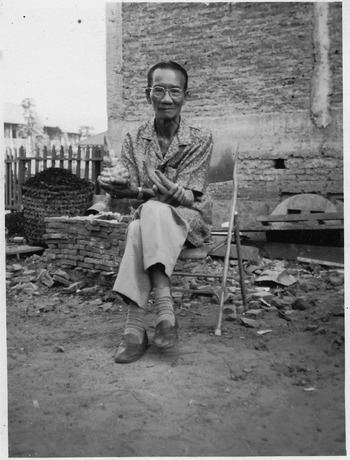
Chao Sone Bouttarobol sitting on Khao San Road, Bangkok, Thailand, near the place where he had Buddhist images made.

The border was much more porous then, allowing Chao Sone to transport Buddhist images made in Bangkok to General Bounpone's house in Savannakhet before sending them off to their various permanent homes at different temples in southern Laos. He used trucks provided by his son-in-law to transport the Buddhist images across the border. He earned much merit by holding many ‘hang phra’ parties at General Bounpone's house to collect money for the temples, often generating 2–3,000,000 kip in donations from soldiers. After a month or more, the Buddhist images would be taken to villages, including Vat Thong in Savannakhet, a temple in Thateng District, and three other temples: one on the Xe Lamphao River on the border with Cambodia, a second in Mounlapoumok District town, and a third in Outhoum Kao Village, where Chao Sone's last wife came from. Not long before Laos became Communist in 1975, he purchased two large cement Buddhist images for two villages near Dong Hen and That Ing Hang, Savannakhet Province. Chao Heuan Phengphanh rationalised the contradiction between moral practice and religious devotion by saying, “Chao Sone had a lot of wives but he liked to make merit”Footnote 58 (Figure 6).
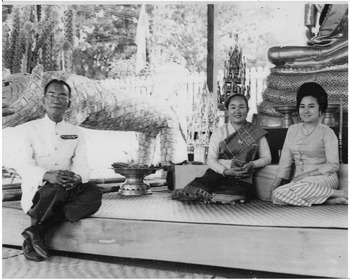
Chao Sone Bouttarobol and his daughter, Chao Heuan Phengphanh (centre), and the wife of the Thai Ambassador to Laos, merit-making at a Buddhist temple in Savannakhet Province, Laos.

Chao Sone was a pious Buddhist with a strong belief in magic, an apparent contradiction that is quite common among people from this part of Southeast Asia (Holt Reference Holt2009; McDaniel Reference McDaniel2011; Baird Reference Baird2012; Terweil Reference Terweil2012).
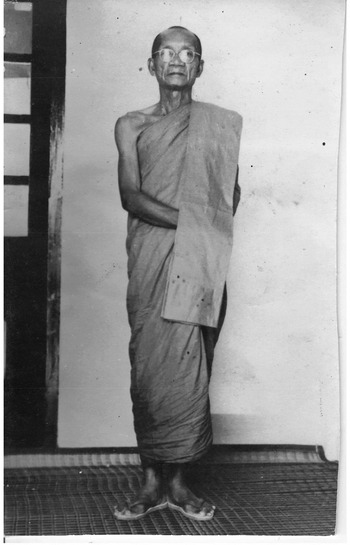
Chao Sone was ordained as a novice in Ubon after King Chulalongkorn died in 1910, although he disrobed after travelling to Champassak. He was then ordained as a monk for three months (one Buddhist Lent) in 1959, after King Sisavang Vong, the King of Laos, died in Luang Phrabang (Figure 7). Prior to King Sisavang Vong's death, when he was very sick, the king called his son, Sisavang Vattana, to his bed, along with Chao Sone, and told his son to not forget the Na Champassak family.Footnote 59 Later, King Sisavang Vattana, gave two supposedly magical swords to Chao Sone in appreciation of his service.Footnote 60 King Sisavang Vattana apparently referred to Chao Sone using the respectful term ‘Chao Ai’ [older brother royal],Footnote 61 indicating Chao Sone's close relationship with the Luang Phrabang Royal House. In 1946, he was one of the signatories of the document in which Champassak agreed for the Luang Phrabang Royal House to be the main royals of Laos, along with Chao Boun Oum Na Champassak.Footnote 62 Chao Sone undoubtedly played a role in improving relations between the Luang Phrabang and Champassak royals, and between northerners and southerners more generally. This was important because Laos was still being politically constructed as a single nation at that time; it represented another boundary-bridging activity designed to improve political relations between northern and southern Laos.
Chao Sone Bouttarobol ordained as Buddhist monk following the death of King Sisavang Vong in 1959.

After 1975
In 1975, General Bounpone and his wife, Chao Heuan Phengphanh, agreed to go with many other military and civilian government leaders from the Royal Lao Government to a seminar ‘re-education camp’ in Vieng Xay District, Houaphanh Province, after first travelling to Beijing, China for an extended visit, and then to Hanoi, Vietnam.Footnote 63 Chao Heuan Phengphanh survived the ordeal, but General Bounpone and various other key leaders were separated from the rest of the interned population in 1977 and sent to a particularly harsh facility at Sop Hao. There, General Bounpone was shackled and kept in a terrible condition, without adequate food, medical attention, or even the chance to exercise. He eventually died in early 1980 (Khamphanh Reference Khamphanh2004; Kremmer Reference Kremmer2003).
Chao Sone refused to flee Laos when the Communists took over in 1975, something that might seem a bit contradictory for someone so accustomed to crossing borders. He was, however, already old by then; this was probably the main reason he decided to stay in Laos. Due to his age, he was not considered a threat by the new government, even though he made many verbal attacks on the new regime even after it gained full control of the government. He once declared that Souphanouvong and Khamtai Siphandone (the Communist leaders) and Souvanna Phouma (the former Royal Lao Government Prime Minister) were all under him. When government officials told him they were going to take him away to seminar, Chao Sone remained defiant, saying, “What lesson are you going to teach me? … If you want to kill me, try it. … Bring your bosses here to shoot me if they want”, he dared them. His wife, Mome Thongphanh, tried to warn Chao Sone to be quiet, fearing that his insolence would lead to trouble, but he was defiant and would not listen to her. Fortunately for Chao Sone, Thongphanh was able to convince the government officials that he was crazy, even though this was not actually the case. This diagnosis kept Chao Sone from being imprisoned. He finally died in Pakse in 1979, apparently of natural causes. However, his funeral did not take place until 1985, after his daughter, Chao Heuan Phengphanh, was released from re-education camp in 1984.
Conclusions: Biography and Understanding Borderland Relationships in the Champassak Region
“Before there were no borders, there was just Champassak.”
Chao Heuan Phengphanh (daughter of Chao Sone), Bangkok, 8 July 2013The above quote is important, as it articulates the way in which borders were sometimes denied during Chao Sone's time, while at the same time, Champassak was declared to be a coherent polity.
Chao Sone Bouttarobol had an amazing life – full of adventure and crucially (for this article), a high level of cross-border mobility. His frequent movements across the countryside and across national borders are significant, but his involvement in politics in Laos, Thailand, and Cambodia is probably even more noteworthy. To benefit the Champassak Royal House, he played a significant role in politics in Laos, Thailand, and even Cambodia over the course of his lifetime. One can hardly imagine politicians being able to maintain political credibility in more than one country today, but life in the borderlands then was very different. The borders were relatively new, and the Champassak Royal House had influence across the borders.
According to Chao Heuan Phengphanh, “Chao Sone had an easy time traveling back and forth between Laos and Thailand”. Later she commented, “Chao Sone could call himself Thai or Lao. … Before they said Chao Sone was Thai, but he would say he was Lao”.Footnote 64 Indeed, as someone who frequently crossed borders and lived on different sides of the border, he undoubtedly adopted multiple identities, depending on circumstances. This is not surprising, as people who live in borderland regions frequently exhibit multiple borderland identities (Anzaldúa Reference Anzaldúa1987; Walker Reference Walker1999; Baird Reference Baird2009). Chao Prasobsak Na Champassak told me that when Chao Sone was a member of Parliament in French Laos some people questioned why a ‘Thai’ was allowed to hold such a position. However, Oun Sananikone, the famous early Lao Issara leader (see Oun Reference Oun1975), defended Chao Sone, explaining that his father was ‘Thai Isan’ and his mother was ‘Lao’.Footnote 65 As a young man, he frequently travelled between the two countries on horseback. He only liked to ride large horses and often challenged the legitimacy of borders that aimed to restrict his mobility. For him, both sides of the border were part of Champassak's territory. “He was like a cowboy”, according to Chao Heuan Phengphanh.Footnote 66 She also had memories of riding elephants with her father. When going to villages along the Mekong River south of Champassak, Chao Sone frequently travelled by boat, hiring villagers to transport him and his associates from village to village until they reached their final destination.Footnote 67 He was known to travel all over the countryside, as far as Salavan and Attapeu, east of the Mekong River. Even when he became Member of Parliament, he travelled frequently, first between Champassak, Ubon, and Bangkok and then between Champassak, Savannakhet, Vientiane and Luang Phrabang.Footnote 68 Later in life, he moved between Laos and Thailand by car.
This study of the life of Chao Sone Bouttarobol, while important for modern Lao history generally, also illustrates how vital biography can be for studying borders and borderlands, as long as theoretical constraints are acknowledged. Here, I have used biography to understand how Sone dealt with the border. This study also illustrates how crucial cross-border research is for borderland studies; while I am certainly not the first to make this point (see, for example, Walker Reference Walker1999; Baird Reference Baird2010a; Turner et al. Reference Turner, Christine and Jean2015), this point warrants reiteration, as much borderland research is still carried out on just one side of a border. As Bounyalith Bouttarobol has stated, Chao Sone was ‘khon sam xat’ (a person of three nations), although Chao Sone's own comments indicate that he often saw himself as ‘khon xat dieo’ (a person of a single nationality). At one point, that might have been ‘Champassak’; later in life, it was probably ‘Lao’ – when he lived in Luang Phrabang, Vientiane, Savannakhet and Champassak. Studies of his life must reflect these complex issues and transformations, which were certainly affected by the establishment of international borders and the construction of the ‘geobodies’ of Thailand and Laos (see Thongchai Reference Thongchai1994). Ultimately, Chao Sone's loyalties were not continuously affixed to any particular country, but remained with his relatives and the Champassak Royal House more generally. Applying a biographical approach to research of this sort can help to illuminate people's cross-border lives, ensure that their stories do not become enclosed with nation-state ‘containers’, a bias that borderland scholars generally need to avoid.
While this article illustrates the importance of cross-border historical investigations when working in the borderlands of mainland Southeast Asia, it must be pointed out that most people did not cross national borders in this region as often as Chao Sone did. While others certainly crossed borders, to a lesser or even greater extent, many people who lived in the border region undoubtedly interacted with the border in different ways from Chao Sone, who was an elite member of the Champassak Royal House and had particular family relationships and links to nation states that supported his movement across borders, physically, socially and politically.Footnote 69 These borders were politically constructed during Chao Sone's lifetime (although other types of political boundaries existed before then), making transboundary issues during his era a topic of particular interest. Indeed, circumstances related to Champassak have important parallels with what was happening along other parts of the new border between Laos and Siam during this period (see Thongchai Reference Thongchai1994; Walker 2004). Chao Sone's unique position in relation to Champassak, Laos, and Thailand makes a biographical approach to analysing life within the context of borderland studies especially relevant and important.
Acknowledgements
A special thanks to the late Chao Heuan Phengphanh Manikanh, Lt. Col. Bounyalith Bouttarobol (outside of Paris, France) and Chao Thavone Na Champassak (in Concord, North Carolina, USA) for their kind assistance in recounting important information about their father, and also for providing crucial photograph and documentary evidence regarding the life of Chao Sone Bouttarobol. Chao Heuan Nying Chitprasong Na Champassak, Chao Heuan Nying Bounlonh Na Champassak, Chao Prasobsak Na Champassak, Sengmanychanh Sinhbandith, and Khamphone Phakaising Siouthoum also made important contributions. Chao Keuakoun Na Champassak helped facilitate the interviews done in France. Thanks also for the comments on earlier drafts of this article provided by Sutida Tonlerd from Ubon Ratchathani University, Bill Klausner, and two anonymous referees. The cartography lab of the Geography Department at the University of Wisconsin-Madison helped prepare the map (Figure 1).