INTRODUCTION
Toxoplasma gondii and Neospora caninum are closely related obligate intracellular protozoan parasites which have gained considerable attention because of their roles in the aetiology of bovine abortion (Dubey, Reference Dubey2003, Reference Dubey2010; Dubey et al. Reference Dubey, Schares and Ortega-Mora2007; Yildiz et al. Reference Yildiz, Kul, Babur, Kilic, Gazyagci, Celebi and Gurcan2009). T. gondii has a wide range of intermediate hosts and can infect almost all mammals and livestock worldwide (Dubey, Reference Dubey2010). Toxoplasmosis caused by T. gondii is among the most prevalent parasitic diseases of humans and animals. Although usually subclinical, toxoplasmosis is severe or even fatal in many hosts and the effects of infection include mental retardation, blindness, abortion or congenital birth defects (Weiss and Dubey, Reference Weiss and Dubey2009; Dubey, Reference Dubey2010). N. caninum is a major abortifacient pathogen in cattle and is one of the most efficiently transmitted parasites of cattle with up to 90% of cattle in some herds infected, which makes N. caninum infection the most prevalent cause of abortion in cattle in many countries (Dubey, Reference Dubey2003; Dubey and Schares, Reference Dubey and Schares2011).
In recent years, investigations of the seroprevalence of T. gondii and N. caninum have been performed in a variety of host species and different countries, including dogs and foxes in Austria (Wanha et al. Reference Wanha, Edelhofer, Gabler-Eduardo and Prosl2005), pigs and wild boar in the Czech Republic (Bartova et al. Reference Bartova, Sedlak and Literak2006; Bartova and Sedlak, Reference Bartova and Sedlak2011), common raven and Capra pyrenaica in Spain (Garcia-Bocanegra et al. Reference Garcia-Bocanegra, Cabezon, Pabon, Gomez-Guillamon, Arenas, Alcaide, Salas-Vega, Dubey and Almeria2012; Molina-Lopez et al. Reference Molina-Lopez, Cabezon, Pabon, Darwich, Obon, Lopez-Gatius, Dubey and Almeria2011), sheep and cats in Brazil (Coelho et al. Reference Coelho, Do, Apolinario, Coelho, de Lima, Perri and Bresciani2011; Langoni et al. Reference Langoni, Greca, Guimaraes, Ullmann, Gaio, Uehara, Rosa, Amorim and Da2011), goats in Poland (Czopowicz et al. Reference Czopowicz, Kaba, Szalus-Jordanow, Nowicki, Witkowski and Frymus2011), horses in Costa Rica (Dangoudoubiyam et al. Reference Dangoudoubiyam, Oliveira, Viquez, Gomez-Garcia, Gonzalez, Romero, Kwok, Dubey and Howe2011), north American opossums in the USA (Houk et al. Reference Houk, Goodwin, Zajac, Barr, Dubey and Lindsay2010), and wild animals such as mouse, deer and foxes (Stieve et al. Reference Stieve, Beckmen, Kania, Widner and Patton2010; De Craeye et al. Reference De Craeye, Speybroeck, Ajzenberg, Darde, Collinet, Tavernier, Van Gucht, Dorny and Dierick2011; Thomasson et al. Reference Thomasson, Wright, Hughes, Dodd, Cox, Boyce, Gerwash, Abushahma, Lun, Murphy, Rogan and Hide2011). In Slovakia, the seroprevalence of N. caninum in dairy cows ranged from 2·9% to 39·4% (Reiterová et al. Reference Reiterová, Spilovská, Antolová and Dubinský2009). In the Philippines, the N. caninum seroprevalence in aborting dairy cows was 35·3% and in non-aborting dairy cows was found to be 15·9% (Konnai et al. Reference Konnai, Mingala, Sato, Abes, Venturina, Gutierrez, Sano, Omata, Cruz, Onuma and Ohashi2008). In Turkey, N. caninum seroprevalence was 10·77% in dairy cow ranches with high abortion rates and the co-existence of N. caninum seropositivity with T. gondii was 24·77% (Yildiz et al. Reference Yildiz, Kul, Babur, Kilic, Gazyagci, Celebi and Gurcan2009). In China T. gondii and N. caninum infections in cattle and water buffaloes have been reported with seroprevalences of 17·2% for N. caninum, and 2·3% for T. gondii (Yu et al. Reference Yu, Xia, Liu, Liu, Ding and Zhang2007). However, only 28 dairy cow samples from the Guangxi Zhuang Autonomous Region (GZAR) were examined, despite the fact that dairy cows are one of the most important economic animals with nearly 50 thousand tons of milk produced per year in GZAR.
As toxoplasmosis and neosporosis are considered to be important risk factors for abortions in dairy cows, the objective of the present study was to investigate the seroprevalence of T. gondii and N. caninum in dairy cows in GZAR, subtropical southern China.
MATERIALS AND METHODS
For the present work, sera were collected from the tail veins of 875 dairy cows during 2009–2010 in 6 main cow-rearing districts of 4 administrative cities in GZAR. Dairy cows were randomly selected. Blood samples were centrifuged and sera were harvested and stored at −20 °C until they were assayed for the presence of antibodies against T. gondii and N. caninum. Basic biometric data on dairy cows including age, number of pregnancies and history of abortions were obtained from the owners by personal interview.
Antibodies against T. gondii were detected using a commercially available indirect haemagglutination test (IHA) kit (Lanzhou Veterinary Research Institute, Chinese Academy of Agricultural Sciences, Lanzhou, Gansu Province, China) according to the manufacturer's recommendations. Briefly, 25 μl of each serum sample were diluted 4-fold serially with the IHA dilution solution to form 1:4, 1:16, 1:64 and 1:256 dilutions. Then 25 μl of T. gondii antigen were added into each dilution, mixed and incubated at 37 °C for 2 h. Samples with layers of agglutinated erythrocytes forming in the well of the 1:64 dilution were considered as positive. Antibodies against N. caninum were detected using an indirect Enzyme-Linked Immunosorbent Assay (ELISA) by employing a commercially available kit (N. caninum antibody ELISA kit, IDEXX Laboratories, Inc., Westbrook, Maine, USA) according to the manufacturer's instructions and cut-off recommendations. Optical densities of the samples were detected using a spectrophotometer (Bio-Rad, Hercules, California, USA). All 875 samples were used for the detection of T. gondii antibodies, and 365 of these were also used for detection of N. caninum antibodies. The positive and negative control sera used in these assays were provided by the commercial kits.
The data were analysed statistically using the Chi-square test in SPSS (Statistical Analysis System, Version 11.5, Chicago, Illinois, USA). The differences in prevalence were considered statistically significant if P ⩽ 0·05.
RESULTS
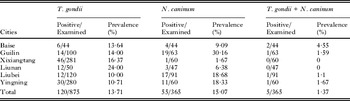
Antibodies against T. gondii were detected in 120 of 875 dairy cows, giving an overall seroprevalence of 13·71%. Positive animals were found in all districts with prevalence ranging from 10% to 24% (Table 1). There was no significant difference in seroprevalence between different districts (P = 0·212, χ 2 = 1·556) in T. gondii infection. Antibodies against N. caninum were detected in 55 (15·07%) of 365 cows, with prevalence ranging from 1·67% to 30·16% in all districts (Table 1), and there were significant differences in prevalence among different districts (P = 0·002, χ 2 = 9·261). All of the investigated districts showed positive seroprevalence for N. caninum. An indication of mixed infection (concurrent presence of both T. gondii and N. caninum antibodies) was found in 5 (1·37%) dairy cows.
Prevalence of anti-Toxoplasma gondii and anti-Neospora caninum antibodies (measured using IHA and ELISA assays, respectively) in dairy cows from 6 districts in the Guangxi Zhuang Autonomous Region (GZAR), subtropical southern China

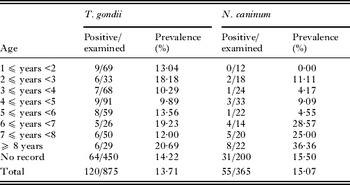
Of the 875 dairy cows, 425 had records for age. The highest prevalence of T. gondii was found in dairy cows older than 8 years (20·69%), followed by dairy cows of 6–7 years old (19·23%). T. gondii prevalence in different ages of cow ranged from 9·89% to 20·69% (Table 2). No significant difference in T. gondii seroprevalence was found between dairy cows of different ages (P = 0·895, χ 2 = 0·018). The highest seroprevalence of N. caninum was also found in dairy cows older than 8 years (36·36%). N. caninum seroprevalence in dairy cows of different age ranges ranged from 0 to 36·36% (Table 2). Dairy cows of 1–5 years old had low N. caninum prevalence, but dairy cows of 6–8 years old and those older than 8 years had higher prevalence. There was no significant difference in N. caninum seroprevalence between dairy cows of different ages (P = 0·895, χ 2 = 0·018).
Prevalence of anti-Toxoplasma gondii and anti-Neospora caninum antibodies (measured using IHA and ELISA assays, respectively) in dairy cows of different ages in the Guangxi Zhuang Autonomous Region (GZAR), southern China

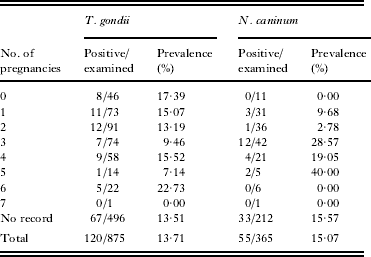
The highest seroprevalence of T. gondii was found in dairy cows which had previously had 6 pregnancies (22·73%), although there was no significant difference in seroprevalence between dairy cows with different numbers of pregnancies (P = 0·926, χ 2 = 0·009). Among the 365 samples in which N. caninum antibodies were detected, the highest prevalence (28·57%) was found in dairy cows which had previously had 5 pregnancies (Table 3). However, there were no significant differences in the seroprevalence of N. caninum in dairy cows which had previously had different numbers of pregnancies (P = 0·134, χ 2 = 2·248).
Prevalence of anti-Toxoplasma gondii and anti-Neospora caninum antibodies (measured using IHA and ELISA assays, respectively) in dairy cattle which had previously had different numbers of pregnancies in GZAR, southern China
Of the animals surveyed, 11 dairy cows had records of abortion, including 2 dairy cows that had aborted twice and 3 times, respectively. These 2 cows were seropositive for T. gondii antibodies. In addition, the cow with 3 recorded abortions was also seropositive for N. caninum antibodies.
DISCUSSION
In the present study, we found a higher seroprevalence (13·71%) for T. gondii and a lower seroprevalence (15·07%) for N. caninum in GZAR than those described in a previous study in which 28 dairy cows from a single farm were examined (Yu et al. Reference Yu, Xia, Liu, Liu, Ding and Zhang2007). In the present work, the co-existence of N. caninum and T. gondii seropositivity ranged from 0 to 4·45%, which was much lower than that reported by Yildiz et al. (Reference Yildiz, Kul, Babur, Kilic, Gazyagci, Celebi and Gurcan2009). The N. caninum seroprevalence ranged from 1·67% to 30·16%, which was similar to the values reported by Reiterova et al. (Reference Reiterová, Spilovská, Antolová and Dubinský2009) and Konnai et al. (Reference Konnai, Mingala, Sato, Abes, Venturina, Gutierrez, Sano, Omata, Cruz, Onuma and Ohashi2008).
The highest seroprevalence of T. gondii and N. caninum was found in dairy cows older than 8 years (20·69% and 36·36%, respectively). In addition, the highest seroprevalence of T. gondii was found in dairy cows which had previously had 6 pregnancies (22·73%), while for N. caninum, dairy cows which had 3 and 5 pregnancies had the highest seroprevalence of 28·57% and 40%, respectively. These data indicate that older dairy cows which had previously had more pregnancies tend to have higher infection rates with T. gondii and N. caninum. This may be because they have ingested more contaminated food or other contaminated materials within the same rearing systems.
Cats and dogs are the definitive hosts of T. gondii and N. caninum, respectively, playing significant roles in the transmission of these parasites (Dubey, Reference Dubey2010; Dubey and Schares, Reference Dubey and Schares2011). During the present investigation, we observed that cats and dogs were present on these farms and had free access to the dairy cows and their feed. This may represent a major risk factor for T. gondii and N. caninum infection in the dairy cows in these farms.
In conclusion, the results of the present study revealed the seroprevalence of T. gondii and N. caninum infections in dairy cows in GZAR, subtropical southern China, and demonstrate a significant public health and animal production concern in this region. Therefore, integrated strategies and measures should be executed to control T. gondii and N. caninum infections in dairy cows in GZAR, China.
FINANCIAL SUPPORT
This study was supported, in part, by the National Natural Science Foundation of China (Grant nos. 31172316 and 31101812) and the Program for Outstanding Scientists in Agricultural Research to X.Q.Z., the Open Funds of the State Key Laboratory of Veterinary Etiological Biology, Lanzhou Veterinary Research Institute, Chinese Academy of Agricultural Sciences (Grant nos. SKLVEB2011KFKT004, SKLVEB2009KFKT008, SKLVEB2010KFKT009 and SKLVEB2011KFKT010) to M.J.X. and X.Q.Z., the Yunnan Provincial Program for Introducing High-level Scientists (Grant No. 2009CI125) to X.Q.Z., the National Natural Science Foundation of China (Grant No. 31001117) to J.H.F., and the National Natural Science Foundation of China (Grant No. 30960251) to Q.Y.L.