Most of the empirical evidence indicates that bilinguals cannot avoid the influence of one of their languages when they are processing in their alternative language. Therefore, linguistic properties in both of the bilinguals’ languages are activated at some level, even when the bilinguals comprehend (e.g., lexical decision) or produce (e.g., picture naming) in only one of their languages (for reviews, see Costa, Reference Costa, Kroll and de Groot2005; Dijkstra, Reference Dijkstra, Kroll and de Groot2005). Cross-language activation has been observed for different types of information. The findings demonstrate that the orthographic and phonological codes from the nontarget language are activated and influence performance. For example, cognate words that share form similarity between languages are recognized and translated faster than control words (Dijkstra, Van Jaarsveld, & Ten Brinke, Reference Dijkstra, Van Jaarsveld and Ten Brinke1998; Macizo & Bajo, Reference Macizo and Bajo2006). Furthermore, it has been observed that the syntactic structure of the bilinguals’ second language (L2) modulates the processing in the bilinguals’ first language (L1), so that L1 understanding is facilitated by the presence of identical syntactic structures from the L2 language (Ruiz, Paredes, Macizo, & Bajo, Reference Ruiz, Paredes, Macizo and Bajo2008).
The revised hierarchical model (RHM; Kroll & Stewart, Reference Kroll and Stewart1994), explains how the processing in one of the bilinguals’ language is modulated by the activation of their alternative language in comprehension tasks. In this model, there are independent levels of processing for lexical forms in L1, lexical forms in L2, and meaning. All levels are connected via bidirectional links. However, the strength of these connections varies. The relation between L1 and L2 lexical representations is asymmetrical such that the link from L2 to L1 is stronger than the link from L1 to L2. In addition, the strength between lexical and semantic representations also depends on the language. The links between L1 lexical forms and their meanings are stronger than the links between L2 lexical forms and their meanings. There is strong support for the asymmetry in these connections for both lexical and semantic information. The asymmetry in lexical connections is supported by the fact that backward translation (L2–L1) is performed faster than forward translation (L1–L2; e.g., Kroll & Stewart, Reference Kroll and Stewart1994). The strong semantic link between L1 lexical forms and meaning is evidenced in the observation that forward translation is affected by semantic variables while backward translation remains unaffected (e.g., blocking the category of words to be translated; Kroll & Stewart, Reference Kroll and Stewart1994; Sholl, Sankaranarayanan, & Kroll, Reference Sholl, Sankaranarayanan and Kroll1995). According to the RHM, the bilinguals’ cross-language modulation depends on the language used in a given task. The influence of the bilinguals’ nontarget language should be greater when they are processing in their L2 than when they are processing in their L1. Thus, when bilinguals comprehend in their L2, their L1 would strongly influence the accessing of meaning because the L2–semantic connection is weak, whereas the L2–L1 lexical connection is strong. Therefore, L2 inputs would go through the L1 lexical system before accessing semantics. In addition, the influence of L2 on L1 comprehension tasks should be weak because of the strong connection between L1 lexical forms and meaning.
In the present study we extend the examination of bilingual cross-language interaction by asking whether the accessing of meaning of number words in one language is modulated by the way bilinguals process numbers in the alternative language. To this end, we explored the unit–decade compatibility effect with number words in bilinguals. In unit–decade compatibility experiments using a number comparison task, a given pair of numbers is defined as compatible if both comparisons between 10s and units lead to the same decision (e.g., 24–67, both 2 < 6 and 4 < 7), whereas a trial is incompatible if the two comparisons for units and 10s lead to different decisions (27–64, 2 < 6 but 7 > 4). When Arabic two-digit numbers are used as stimuli, it has been found that incompatible trials elicit a slower response than compatible number pairs (Macizo & Herrera, Reference Macizo and Herrera2008; Nuerk, Weger, & Willmes, Reference Nuerk, Weger and Willmes2001), and this effect is independent of the perceptual characteristics of the stimulus arrangement (Nuerk, Weger, & Willmes, Reference Nuerk, Weger and Willmes2004). The compatibility effect with Arabic numbers is explained as reflecting the parallel processing of the decade magnitude and the unit magnitude. These processes are assumed to be performed simultaneously. In compatible trials, the activation of decade and unit comparisons converge on selecting the correct response; in incompatible trials, unit comparisons and decade comparisons guide to a different response, thus increasing the time needed to select the correct response.
However, when numbers are presented in verbal format, the compatibility effect depends on the linguistic properties and the reading patterns of the language in which the comparison task is performed. When German participants perform two-digit comparison with number words (Nuerk, Weger, & Willmes, Reference Nuerk, Weger and Willmes2002), there is a regular compatibility effect for large unit distances (incompatible trials are responded to more slowly than compatible number pairs). It is reasonable to expect the regular compatibility effect with number words in German because all two-digit numbers between 21 and 98 in this language are inverted (e.g., 27 = siebenundzwanzig, literally, “seven and twenty”), and thus units are read first. However, when English participants perform the task, the compatibility effect tends to be inverted. English participants take more time to respond to compatible trials compared to incompatible trials (Nuerk, Weger, & Willmes, Reference Nuerk, Weger and Willmes2005). In Spanish, where the beginning of number words is the decade, as in English (noninverted languages, e.g., 27 = veintisiete, literally, “twenty and seven”), the inverse compatibility effect is also obtained (Macizo & Herrera, Reference Macizo and Herrera2008). The differences across languages in the compatibility effect indicate that word order plays an important role in the processing of two-digit number words, and that people have learned to process verbal numbers according to the structure of the language they use.
The inverse compatibility effect in noninverted languages is explained as follows (Nuerk et al., Reference Nuerk, Weger and Willmes2005). The overall distance between the two numbers in compatible and incompatible trials is typically matched. To compute the overall distance, the unit distance has to be added to the decade distance in compatible trials while the unit distance has to be subtracted from the decade distance in incompatible trials, and thus, the decade distance always has to be larger for incompatible versus compatible trials. To illustrate, consider the compatible trial number pair 53 and 68 and the incompatible trial number pair 59 and 74. In the example, the overall distance of 15 in the compatible trial 53 and 68 results from 10 by the decade distance (6 − 5 = 1) plus the unit distance (8 − 3 = 5), (10 × 1)+(5)=15. The overall distance of 15 in the incompatible trial 59 and 74 results from 10 by the decade distance (7 − 5 = 2) minus the unit distance (9 − 4 = 5), (10 × 2)−(5)=15. Therefore, the decade distance has to be larger for incompatible versus compatible trials to be able to subtract the unit distance. Moreover, because of this subtraction, the difference in decade distance between compatible and incompatible trials must be greater with large unit distances. Therefore, by virtue of these computational constraints, if decades became relevant in one language, participants should make faster decisions on incompatible trials than compatible trials, an outcome that would be consistent with the distance effect (Moyer & Landauer, Reference Moyer and Landauer1967).
The cross-linguistic differences in the unit–decade compatibility effect leave open the question of how bilinguals process two-digit number words if the verbal notation was inverted in one of their languages (e.g., German) but not in their alternative language (e.g., English, Spanish, Italian). From the RHM, bilinguals may access the meaning of two-digit number words differently in their two languages, with greater influence of their L1 on the processing of L2 number words than vice versa.
The current study attempted to explore this prediction with Italian/German (L1/L2) bilinguals. However, before performing the experiment with bilingual participants we wanted to evaluate the compatibility effect in Italian monolinguals and German monolinguals. Thus, in Experiment 1 a group of Italian monolinguals were required to perform a number comparison task with two-digit number words. We expected a null effect or an inverse compatibility effect resembling the results observed in noninverted languages (e.g., in Spanish, incompatible trials are processed faster than compatible trials; Macizo & Herrera, Reference Macizo and Herrera2008). In Experiment 2 a group of German monolinguals performed the two-digit number comparison task in German. We expected an overall regular compatibility effect (compatible trials are processed faster than incompatible trials) or its interaction with unit distance, replicating Nuerk et al.'s (Reference Nuerk, Weger and Willmes2002) study. Finally, in Experiment 3, Italian/German bilinguals performed the comparison task in their L1 (Italian) and their L2 (German) while the unit–decade compatibility was manipulated again. If there is little influence of L2 on the processing of L1 two-digit number words, no compatibility effect or an inverse compatibility effect should be observed when bilinguals perform the comparison task in Italian. Therefore, monolinguals and bilinguals processing in Italian should show the same pattern of results. In addition, if there is strong influence of L1 on the processing of L2 number words, the inverse compatibility effect should be obtained again for bilinguals processing in German. Thus, monolinguals and bilinguals should differ in the way they process German number words. This pattern of results would indicate that the bilinguals’ L1 modulates the processing of number words in their L2.
EXPERIMENT 1
To our knowledge, the compatibility effect has not been explored with Italian monolinguals. We expected no compatibility effect or a reverted compatibility effect similar to that observed in English (Nuerk et al., Reference Nuerk, Weger and Willmes2005) and Spanish (Macizo & Herrera, Reference Macizo and Herrera2008), because all these languages have no decade–unit inversion for number words between 21 and 98. To corroborate this prediction, in Experiment 1 we tested the compatibility effect with number words in a group of Italian monolinguals.
Method
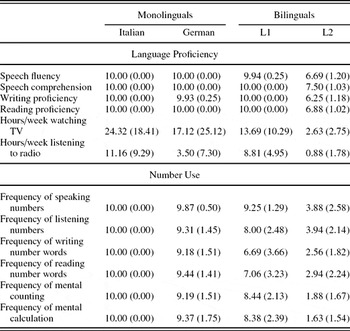
Participants. Sixteen Italian monolinguals from the University of Padova (Italy) participated in the experiment. Their mean age was 23.70 (SD = 5.31). One participant was left-handed and 15 were right-handed. After performing the current experiment, they completed a language proficiency questionnaire on reading, writing, listening, and speaking in Italian. They also responded to questions concerning the processing of numbers. The participant's characteristics are reported in Table 1.
Characteristics of participants in the experiments

Note: Mean scores (standard deviations) of Italian monolinguals (Experiment 1), German monolinguals (Experiment 2), and Italian/German (L1/L2) bilinguals (Experiment 3). The self-report ratings ranged from less to more on a 10-point scale for each dimension. L1, first language; L2, second language.
Design and materials. The design was similar to that used in previous studies to investigate the unit–decade compatibility effect (e.g., Macizo & Herrera, Reference Macizo and Herrera2008; Nuerk et al., Reference Nuerk, Weger and Willmes2001). Three variables were manipulated within participants: compatibility (compatible vs. incompatible), decade distance (small 1–3 vs. large 4–8), and unit distance (small 1–3 vs. large 4–8).
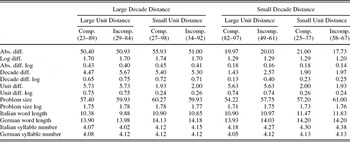
We selected 240 different two-digit number word pairs between 21 and 98 previously used by Macizo and Herrera (Reference Macizo and Herrera2008). The stimuli groups across conditions were equated in their absolute distance, unit distance, and problem size. In addition, the word length in number of letters and number of syllables were matched in Italian (see Table 2). A series of t tests revealed that all these measures were similar in all the experimental conditions (all ps > .05). The only difference across conditions was observed in the decade distance, which is attributable to the necessity of equating the overall distance (see Macizo & Herrera, Reference Macizo and Herrera2008; Nuerk et al., Reference Nuerk, Weger and Willmes2001, Reference Nuerk, Weger and Willmes2005). Decade and tie number words were not included. In addition, a set of 60 fillers was also used with pairs of number words from an identical decade (decade distance = 0).
Characteristics of stimuli in the experiments

Note: Comp., compatible; Incomp., incompatible; Abs., absolute; diff., difference of the numbers; log, logarithmic values. Word length and syllable number correspond to the mean number of letters and syllables of each stimulus pair. Examples of number pairs are given in parentheses.
Procedure. The experiment was controlled by a GenuineIntel 2993-MHz PC using E-prime experimental software, version 1.1 (Schneider, Eschman, & Zuccolotto, Reference Schneider, Eschman and Zuccolotto2002). Participants were tested individually. They were seated approximately 60 cm from the computer screen. Stimuli were presented in lowercase black letters (48-point Courier New font) on a white background. At this viewing distance, one character subtended a vertical visual angle of 1.91° and a horizontal visual angle of 1.67°. Each number word pair was presented until the subject's response. The interstimulus interval was fixed to 500 ms. In each trial, two number words written in Italian were presented above each other; participants had to indicate as quickly and accurately as possible the larger of two number words with the top key if the top number was larger and with the bottom key if the bottom number was larger. The 300 two-digit number word pairs were presented in four different lists in order to counterbalance the spatial presentation (top/bottom) and the response hand (right/left). Each participant saw only one list and number word pairs were randomized within lists. The experiment was preceded by a set of five practice trials.
Results and discussion
The incorrect responses (5.73% of the data) and the reaction times (RTs) exceeding a criterion of 3.5 SD for an individual participant's mean (Kleinbaum, Kupper, & Muller, Reference Kleinbaum, Kupper and Muller1988; 0.83% of the data) were excluded from the latency analysis.
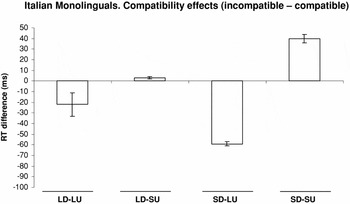
An analysis of variance (ANOVA) was performed on the RTs introducing compatibility (compatible, incompatible), decade distance (small, large), and unit distance (small, large) as within-subject factors. The analysis showed a main effect of decade distance, F (1, 15) = 67.28, p < .0001. Participants were 141 ms faster in trials with large decade distance than in trials with small decade distance. In addition, the unit distance effect was also significant, F (1, 15) = 8.48, p < .01. Participants were 31 ms slower in trials with large unit distance than in trials with small unit distance. The main effect of compatibility was not significant, F (1, 15) = 2.00, p > .05. However, the Compatibility×Unit Distance interaction was significant, F (1, 15) = 4.18, p < .05 (see Figure 1). Planned comparisons showed that the difference between compatible and incompatible trials (21 ms faster in compatible trials) was not significant for small unit distances, F (1, 15) = 1.90, p > .05. However, the RT was longer for compatible trials than for incompatible trials with large unit distance (41-ms difference), F (1, 15) = 5.24, p < .05. Neither the Compatibility × Decade Distance interaction nor the Decade Distance×Unit Distance interaction was significant (both Fs < 1). However, the Compatibility×Decade Distance×Unit Distance interaction was significant, F (1, 15) = 5.20, p < .05. This interaction was due to the tendency to observe the regular compatibility effect when unit distance and decade distance were small (40-ms difference) and the inverse compatibility effect when decade distance was small and unit distance was large (−59-ms difference). However, only the inverse compatibility effect was significant, t (15) = 2.64, p < .01.
The compatibility effect (incompatible trials minus compatible trials) on the mean reaction times (RT, ms) and standard error bars for Italian monolinguals of Experiment 1. LD, large decade distance; LU, large unit distance; SU, small unit distance; SD, small decade distance.

In the error rates analyses, the main effect of decade distance was significant, F (1, 15) = 16.54, p < .001. Participants tended to be less accurate in trials with a small decade distance (8.59% of errors) compared to large decade distance trials (2.86% of errors). In order to deal with a possible problem of unequal variance across experimental conditions, mean error proportions for each participant in each experimental condition were also computed, and the arcsine transformation of these values were introduced in a new analysis. The main effect of decade distance was again significant, F (1, 15) = 16.27, p < .001, and there were no other significant effects (all ps > .05).
In this experiment we found an inverse compatibility effect on the RTs when Italian monolinguals compared pairs of number words. Participants responded faster to incompatible than to compatible trials when the unit distance was large. These results are expected if decades had a major role in Italian because incompatible trials must have a greater decade distance than compatible trials when overall distance is matched between conditions. Thus, incompatible trials that have on average larger distances were processed quickly because large numerical distances are always easy to process (e.g., Moyer & Landauer, Reference Moyer and Landauer1967). A multiple regression analysis was performed to further corroborate that these differences in decade distance determined the inverted compatibility effect in Italian monolinguals. The predictors included in this analysis were absolute distance, problem size, decade distance, and unit distance (see also Macizo & Herrera, Reference Macizo and Herrera2008; Nuerk et al., Reference Nuerk, Weger and Willmes2001, Reference Nuerk, Weger and Willmes2002, Reference Nuerk, Weger and Willmes2005). If decades have a major role in Italian, then decade distance might be a stronger predictor than unit distance. The analysis only showed a significant effect for decade distance (adjusted R 2 = 0.34, p < .001; standardized beta coefficient estimate, b = −0.59), reflecting the occurrence of faster responses on pairs with larger decade distances. No other predictors were significant (all ps > .05).
EXPERIMENT 2
The goal of this experiment was to evaluate the compatibility effect with German number words. A group of German monolinguals performed the same comparison task previously used in Experiment 1 with Italian monolinguals.
Method
Participants. Sixteen German monolinguals from the University of Potsdam (Germany) took part in the present study. Their mean age was 24.37 years (SD = 3.93). One participant was left-handed and 15 were right-handed. After performing the current experiment, they completed a language proficiency questionnaire on reading, writing, listening, and speaking in German. They also responded to questions concerning number processing. The participant's characteristics are reported in Table 1.
Design and materials. We used a 2 × 2 × 2 within-participant design. The variables manipulated in the experiment were the compatibility (compatible vs. incompatible), the decade distance (small 1–3 vs. large 4–8), and the unit distance (small 1–3 vs. large 4–8).
The same 300 two-digit number word pairs of Experiment 1 were used in this experiment (240 between-decade number pairs for experimental trials and 60 within-decade number pairs for filler trials). These number word pairs were presented in German. The stimuli groups across conditions were equated in their absolute distance, unit distance, and problem size. In addition to the variables controlled in Experiment 1, the word length in number of letters and number of syllables in German were also equated in all of the experimental conditions used in this experiment (all ps > .05; see Table 2). All other details were identical to those of Experiment 1.
Procedure. The same procedure used in Experiment 1 was employed in Experiment 2.
Results and discussion
The incorrect responses (2.94% of the data) and the RTs exceeding a criterion of 3.5 SD for an individual participant's mean (0.78% of the data) were excluded from the latency analysis.
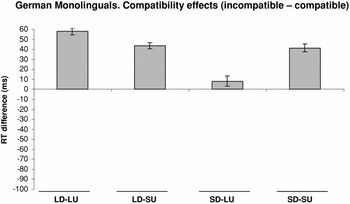
An ANOVA was performed on the RTs introducing compatibility (compatible, incompatible), decade distance (small, large), and unit distance (small, large) as within-subject factors. The main effect of decade distance was significant, F (1, 15) = 15.60, p < .001. Participants were 73 ms faster in trials with large decade distance than in trials with small decade distance. The main effect of compatibility was also significant, F (1, 15) = 6.33, p < .05. Participants were 38 ms faster on compatible trials than on incompatible trials. The main effect of unit distance was not significant (p > .05). In addition, none of the interactions between factors were significant (all ps > .05; see Figure 2).
The compatibility effect (incompatible trials minus compatible trials) on the mean reaction times (RTs, ms) and standard error bars for German monolinguals of Experiment 2. LD, large decade distance; LU, large unit distance; SU, small unit distance; SD, small decade distance.

The ANOVA performed on error rates indicated that participants were more accurate in trials with large decade distance (2.19% of errors) than in trials with small decade distance (3.70% of errors), F (1, 15) = 73.00, p < .01. The main effects of compatibility and unit distance were not significant (all ps > .05). The interactions between variables were not significant (all ps > .05). As in Experiment 1, the accuracy analyses were also performed on the arcsine transformed error rates. The outcome of these analyses indicated that decade distance was marginally significant, F (1, 15) = 3.60, p = .07. However, neither main effects nor interactions involving these variables were significant (all ps > .05).
A multiple regression analysis was performed with the same predictors that those used in Experiment 1. The regression analysis was predictive (adjusted R 2 = 0.05, p < .01). Two predictors were significant: there were faster responses on pairs with larger decade distances (standardized beta coefficient estimate, b = −0.23). In addition, there were faster responses on pairs with larger unit distances (b = −0.14). No other predictors were significant (all ps > .05).
We found a regular compatibility effect on the RTs when German monolinguals compared pairs of number words. The participants responded faster to compatible than to incompatible trials. In contrast, the participants of Experiment 1 responded faster to incompatible than to compatible trials. In this experiment we used the same material and procedure that those used in Experiment 1; therefore, the differences in the compatibility effect between experiments seem to be due to variations in the participants’ language (Italian and German in Experiments 1 and 2, respectively). Nuerk et al. (Reference Nuerk, Weger and Willmes2002) also explored the compatibility effect with German monolinguals, and they did not observe an overall regular compatibility effect; such an effect was observed only for large unit distances. It is possible that differences between Nuerk et al.'s results and the results of Experiment 2 were attributable to methodological variations between studies. We will elaborate further on this idea in the General Discussion Section.
EXPERIMENT 3
The unit–decade compatibility effect was evaluated in Italian monolinguals (Experiment 1) and German monolinguals (Experiment 2). The goal of Experiment 3 was to compare the unit–decade compatibility effect between the two languages of Italian/German (L1/L2) bilinguals, in order to evaluate cross-language modulations in the processing of two-digit number words. If the way of processing numbers in one language is permeable to influences of the alternative language, a strong modulation of the compatibility effect may be observed when Italian/German bilinguals perform the task in their L2 (it is easier to observe the influence of the more dominant L1 when bilinguals work in their weaker L2; Kroll & Stewart, Reference Kroll and Stewart1994). Therefore, the compatibility effect should be reduced or even reversed for L2 German, resembling the inverse compatibility effect observed in Experiment 1 with Italian monolinguals.
Method
Participants. Sixteen Italian/German (L1/L2) bilinguals of Italian nationality from the University of Trento participated in the study. Their mean age was 28.38 years (SD = 3.58). One participant was left-handed and 15 were right-handed. They began to learn German at age 11.63 years (SD = 5.71), and they spent 25.69 months (SD = 33.98) living in Germany. After performing the current experiment, they were asked to complete a language proficiency questionnaire on reading, writing, listening, and speaking in Italian and German. They also responded to questions concerning the processing of numbers in their two languages. The participant's characteristics are reported in Table 1. All of the participants learned the numbers in Italian. A series of t tests indicated that the participants’ scores in Italian were higher than those in German (all ps < .05). Thus, bilinguals were fluent in German but dominant in Italian.
Design and materials. We used a 2 × 2 × 2 × 2 within-participant design. The variables manipulated in the experiment were the language in which number words were presented (L1 Italian vs. L2 German), the compatibility (compatible vs. incompatible), the decade distance (small 1–3 vs. large 4–8), and the unit distance (small 1–3 vs. large 4–8).
The same 300 two-digit number word pairs of previous experiments were used in this experiment (240 between-decade number pairs for experimental trials and 60 within-decade number pairs for filler trials). These 300 number word pairs were presented in both Italian and German. All other details were identical to those of previous experiments.
Procedure. The same procedure used in previous experiments was employed in Experiment 3. The only difference was that number word pairs were presented in the bilinguals’ two languages. Thus, the participants saw two lists: one in each of their languages. The experimental session was divided in two blocks. In one block number word pairs were presented in Italian, whereas in the other block number word pairs were presented in German. A 5-min break was given in the middle of each block. Each block was preceded by a set of five practice trials. The order of the blocks was counterbalanced across participants and number word pairs were randomized within blocks for each participant.
Results and discussion
The incorrect responses (3.15% of the data in Italian L1, 3.83% in German L2) and the RTs exceeding a criterion of 3.5 SD for an individual participant's mean (0.96% of the data in L1, 0.91% of the data in L2) were excluded from the latency analysis (Kleinbaum et al., Reference Kleinbaum, Kupper and Muller1988).
An ANOVA was performed on the RTs introducing Language (Italian–L1, German–L2), Compatibility (compatible, incompatible), Decade Distance (small, large), and Unit Distance (small, large) as within-subject factors. The main effect of the Unit Distance was significant, F (1, 15) = 4.50, p < .05. Participants were 17 ms slower in trials with large unit distances than in trials with small unit distances. The main effect of the Decade Distance was also significant, F (1, 15) = 88.08, p < .001. Participants were 113 ms faster in trials with large decade distances than in trials with small decade distances. Moreover, the decade distance effect was modulated by the language, F (1, 15) = 26.12, p < .001. The difference between the large and small decade distance was significant in both languages (ps < .05). However, the effect was stronger in Italian (173 ms) than in German (53 ms). The main effect of Compatibility was not significant, F (1, 15) = 0.01, p > .05. It was important that the Compatibility×Language interaction was significant, F (1, 15) = 25.87, p < .001. The Compatibility×Language×Unit Distance interaction was also significant, F (1, 15) = 5.07, p < .05. No other main effects or interactions were significant (all ps > .05).
The ANOVA performed on error rates indicated that participants were more accurate in trials with large decade distances (2.08% of errors) than in trials with small decade distances (4.90% of errors), F (1, 15) = 38.91, p < .05. The main effects of language, compatibility, and unit distance were not significant (all ps > .05). The interactions between these variables were not significant (all ps > .05), nor was the Language×Compatibility×Decade Distance×Unit Distance interaction (F < 1). As in previous experiments, accuracy analyses were also performed on the arcsine transformed error rates and the outcomes of these analyses were identical to the ones obtained on raw data; only the main effect of decade distance was significant, F (1, 15) = 38.91, p < .0001. No other effects were significant (ps > .05).
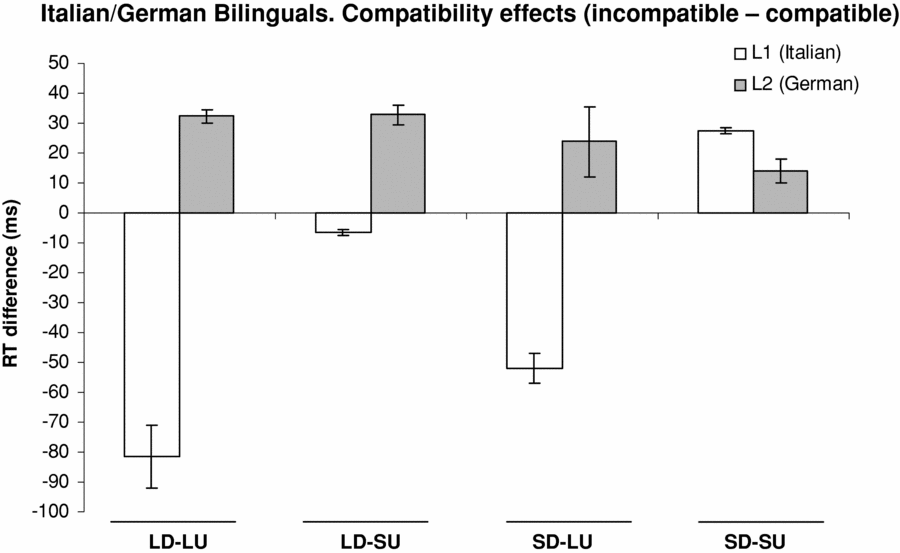
To explore whether the compatibility effect was modulated by the language in which number words were presented, separated analyses were performed for the participant's L1 and L2 (see Figure 3).
The compatibility effect (incompatible trials minus compatible trials) on the mean reaction times (RTs, ms) and standard error bars for numbers presented in the bilinguals’ first language (L1 Italian) and the second language (L2 German) of Experiment 3. LD, large decade distance; LU, large unit distance; SU, small unit distance; SD, small decade distance.
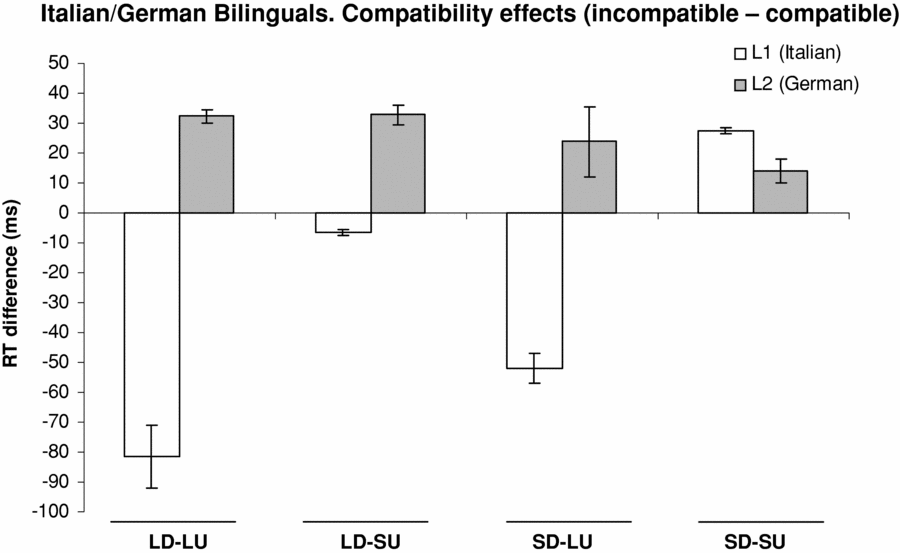
Number comparison in L1 (Italian). The ANOVA performed on the RTs showed a main effect of decade distance, F (1, 15) = 230.85, p < .0001. Participants were 173 ms faster in trials with large decade distances than in trials with small decade distances. The unit distance effect was also significant, F (1, 15) = 5.31, p < .05. Participants were 24 ms slower in trials with large unit distances than in trials with small unit distances. In addition, participants were slower on compatible trials compared to incompatible trials (28-ms difference), F (1, 15) = 8.57, p < .01. Moreover, the compatibility effect was modulated by the unit distance, F (1, 15) = 9.34, p < .01. Planned comparisons showed that the difference between compatible and incompatible trials (11 ms faster in compatible trials) was not significant for small unit distances (F < 1). However, the RT was longer for compatible trials than incompatible trials with large unit distances (67-ms difference), F (1, 15) = 17.82, p < .001. No other interactions were significant (all ps > .05).
Concerning the error data, the effect of decade distance was significant, F (1, 15) = 25.67, p < .0001. Participants tended to be less accurate in trials with small decade distances (4.79% of errors) compared to large decade distance trials (1.51% of errors). No other effects were significant. The analyses on the arcsine transformed data showed a significant main effect of decade distance, F (1, 15) = 25.58, p < .0001; no other effects were significant (ps > .05).
The multiple regression analyses performed with the same predictors as those used in previous experiments was significant (adjusted R 2 = 0.37, p < .001). The analysis showed a significant effect for decade distance (standardized beta coefficient estimate, b = −0.55). There were faster responses on pairs with larger decade distances. The problem size was also a significant predictor (b = −0.25). No other predictors were significant (all ps > .05).
Number comparison in L2 (German). The main effect of decade distance was significant, F (1, 15) = 6.56, p < .05. Participants were 53 ms faster in trials with large decade distances than in trials with small decade distances. The compatibility effect was also significant, F (1, 15) = 4.73, p < .05. In contrast to the reverse compatibility effect observed for Italian, when bilinguals performed the task in German, the RT for compatible number pairs was 26 ms faster than for incompatible numbers. No other effects reached significance (all ps > .05).
The accuracy analysis showed a significant main effect of decade distance, F (1, 15) = 14.33, p < .01. Trials with large decade distances were responded as more accurate (2.34% fewer errors) than trials with small decade distances. No other effects reached significance (all ps > .05). The analyses performed on the arsine transformed proportion of errors showed a significant main effect of decade distance, F (1, 15) = 14.33, p < .01; no other effects were significant.
The multiple regression analysis performed with the same predictors that those used in previous experiments was predictive (adjusted R 2 = 0.05, p < .01). The decade distance was a significant predictor (standardized beta coefficient estimate, b = −0.21). The responses were faster on trials with larger decade distances. In addition, the unit distance was significant (b = −0.13). There were faster responses on trials with larger unit distance. No other predictors were significant (all ps > .05).
The pattern of results obtained in Experiment 3 suggests that there is no cross-language modulation when bilinguals process two-digit number words. The compatibility effect depended on the language in which they compared two-digit numbers. When bilinguals processed two-digit numbers in their L1 (Italian), an inverse compatibility effect was observed. This result was similar to that obtained with Italian monolinguals in Experiment 1. However, when bilinguals processed number words in their L2 (German), a regular compatibility effect was observed. This result was similar to that obtained with German monolinguals in Experiment 2. We performed cross-experiment analyses to further corroborate that there were no differences between monolinguals and bilinguals in processing number words in Italian and German.
Joint analyses of monolinguals and bilinguals processing Italian number words. The participants (monolinguals, bilinguals processing numbers in Italian), compatibility (compatible, incompatible), decade distance (large, small), and unit distance (large, small) were submitted to an ANOVA. The analysis performed on the RTs showed a main effect of decade distance, F (1, 30) = 231.99, p < .001, a main effect of unit distance, F (1, 30) = 13.63, p < .001, and a main effect of compatibility, F (1, 30) = 10.27, p < .001. The Compatibility×Unit distance interaction was also significant, F (1, 30) = 12.46, p < .01. The direction of these significant effects was the same for Italian monolinguals (Experiment 1) and bilinguals processing numbers in Italian. The main effect of participants was not significant, F (1, 30) = 2.01, p > .05, nor did it interact with any other variable (all ps > .05). The comparison between Italian monolinguals and bilinguals processing Italian number words showed no differences between participants. The same pattern of results was observed in both groups of participants.
Joint analyses of monolinguals and bilinguals processing German number words. The participants (monolinguals, bilinguals processing numbers in German), compatibility (compatible, incompatible), decade distance (large, small), and unit distance (large, small) were submitted to an ANOVA. The analysis performed on the RTs revealed a main effect of decade distance, F (1, 30) = 20.61, p < .001, and a main effect of compatibility, F (1, 30) = 11.03, p < .01. There were no differences between participants, F (1, 30) = 1.40, p > .05. No other main effects or interactions were significant (all ps > .05). Thus, the pattern of results was the same for German monolinguals and bilinguals processing in German.
The cross-experiment analyses suggest that the processing of two-digit number words in one of the bilinguals’ language is not modulated by their alternative language. First, the compatibility effect when bilinguals performed the task in Italian (Experiment 3) was identical to the one observed with the Italian monolinguals of Experiment 1. Second, the pattern of results was the same for German monolinguals (Experiment 2) and bilinguals processing German number words (Experiment 3).
Another way to look at possible cross-language modulations in bilingual number processing is to evaluate the effect of the order in which they performed the task (Italian–German, German–Italian). This point is related to the idea of “language mode” as the state of activation of the bilingual's languages and language processing mechanisms at a given point in time (Grosjean, Reference Grosjean and Nicol2000, p. 3). The author suggests that there is a continuum of activation in which bilingual's can move from a “monolingual mode” to a “bilingual mode.” Factors such as the language context (e.g., the languages needed to perform the experimental task) might determine whether bilinguals process the input in a monolingual mode or a bilingual mode. The procedure used in Experiment 3 let us explore this hypothesis because the first and second experimental halves were performed in Italian–German or German–Italian, respectively. Following the language mode hypothesis, when bilinguals perform the task in one language at the beginning of the experiment, they might not be affected by their alternative language. However, in the second block of the experiment, the language used previously might modulate performance.
Analyses of language order (Italian–German vs. German–Italian). We explored whether the compatibility effect was modulated by the language used in the first and second part of the experiment. An ANOVA was carried out using the Block (first block, second block) as a between-subject factor and the Language (Italian, German) and Compatibility (compatible, incompatible) as within-subject factors. The main effect of Block was not significant, nor did it interact with Language or Compatibility (all ps > .05). Finally, the Block×Language×Compatibility interaction was not significant (F < 1). Therefore, the language used in the first part of the experiment did not modulate performance in the second part of the experiment.
GENERAL DISCUSSION
When bilinguals perform a linguistic task such as speaking or comprehending words, there is evidence that both languages are active and influence performance (e.g., Costa, Miozzo, & Caramazza, Reference Costa, Miozzo and Caramazza1999). Therefore, the bilinguals’ languages are activated in parallel and they interact in response to incoming information (e.g., in language comprehension, Beauvillain & Grainger, Reference Beauvillain and Grainger1987; in language production, Hermans, Bongaerts, De Bot, & Schreuder, Reference Hermans, Bongaerts, De Bot and Schreuder1998). Several studies have demonstrated that the bilinguals’ performance is modulated by the concurrent activation of their two languages even when the task is presented in only one language (for a review, see Kroll, Bobb, & Wodniecka, Reference Kroll, Bobb and Wodniecka2006). The rationale of these studies is to ask whether there are consequences of cross-language activation, regardless of the intention to function within one language alone. In this study we used this logic to explore how bilinguals process number words in their L1 (Italian) and L2 (German). If there was no cross-language modulation, bilinguals might achieve two-digit number processing in each of their languages independently and following the same processes used by monolingual speakers of these languages. According to this hypothesis, a larger role of decades was expected when bilinguals performed the comparison task in Italian but a higher relevance of units was expected when they processed in German. Thus, the compatibility effect might disappear (or become reversed) in the bilinguals’ L1, whereas a regular compatibility effect might be observed in the bilinguals’ L2. The alternative hypothesis might predict that the processing of numbers in one of the bilinguals’ languages might be modulated by the way they process numbers in their other language. This modulation should be greater when bilinguals processed in their L2 because it is easier to observe cross-language influences when bilinguals work in their weaker L2 (for a review, see Dijkstra, Reference Dijkstra, Kroll and de Groot2005). Therefore, it was predicted that the greater role of decades in Italian (L1) might influence the processing of German number words (L2), reducing the regular compatibility effect observed in German monolinguals (Nuerk et al., Reference Nuerk, Weger and Willmes2002, Reference Nuerk, Weger and Willmes2005).
The results obtained in this study with Italian/German bilinguals (Experiment 3) did not show cross-language modulation in the processing of number words. The compatibility effect depended on the language in which bilinguals performed the comparison task. When bilinguals processed two-digit number words in their L1 (Italian, Experiment 3), an inverse compatibility effect was found. This effect was similar to that observed with Italian monolinguals in Experiment 1. Thus, there was no influence of the bilinguals’ L2 (German) during the processing of L1 number words. This finding is what would be expected for noninverted languages in which decades have a major role. Moreover, both groups of participants, bilinguals processing in Italian and Italian monolinguals, showed the inverse compatibility effect for large unit distances, that is, when the decade distance difference between compatible and incompatible trials is largest. This interaction was attributable to the decade distance. The importance of decades when participants were processing in Italian was also confirmed in the regression analyses in which decade distance predicted RT variations. In addition, this pattern of results corroborates the findings obtained with English monolinguals (Nuerk et al., Reference Nuerk, Weger and Willmes2005), suggesting that speakers from noninverted languages (i.e., English, Italian, and Spanish) process two-digit number words similarly.
The pattern of results observed when bilinguals processed number words in Italian indicates that there is no cross-language modulation. However, these results might be explained by also assuming cross-language interactions because they are most often associated with performance in the native and more dominant L1. For example, the magnitude of cross-language influences is usually greater from L1 to L2 than from L2 to L1 (e.g., Costa & Caramazza, Reference Costa and Caramazza1999). Furthermore, empirical research has shown that speakers of two languages tend to count and perform arithmetic in the language in which they originally learned numbers, even when numerical information is presented in their L2. In addition, bilinguals solve arithmetic problems with greater speed and accuracy when they are presented in their L1 (e.g., Frenck-Mestre & Vaid, Reference Frenck-Mestre and Vaid1993). However, the results observed when bilinguals performed the task in their L2 are hard to reconcile with the idea of between-language interactions. We found the regular compatibility effect when bilinguals processed German number words. They responded faster to compatible trials than incompatible trials. This result was the same as that observed in German monolinguals (Experiment 2).
The pattern of results found with monolinguals and bilinguals processing German number words was similar to that reported by Nuerk et al. (Reference Nuerk, Weger and Willmes2002). However, there are some differences between studies. They found a regular compatibility effect for German number words with larger unit distances and an inverse effect for small unit distances. In contrast, the regular compatibility effect that we observed when monolinguals and bilinguals processed in German was not modulated by the unit distance. The interaction between compatibility and unit distance is explained by Nuerk et al. because the unit distance is less salient in small unit distance trials, so the decade distance becomes more salient in these trials producing the inverse compatibility effect (incompatible trials have large decade distances). The absence of interaction in our study might be related to differences in the unit distance values. The mean unit distance in small unit distance trials was slightly larger in our study (2.0) than in Nuerk et al.'s study (1.8). Thus, the larger unit distance in our study might increase the probability of observing the regular compatibility effect. To verify this explanation, we correlated the mean size of the compatibility effect in German with the mean unit distance (in large decade distance trials and small decade distance trials). We obtained a positive correlation that was marginally significant (r = .63, p < .09), indicating that larger unit distances were (marginally) related to larger compatibility effects.Footnote 1
CONCLUSIONS
The present study suggests that there is no cross-language modulation when bilinguals process two-digit number words in each of their languages. They process verbal numbers as if they were monolinguals in each language. It is possible that the absence of between-language influences is determined by the language proficiency and relative dominance of bilinguals in each of their languages. It has been proposed that L2 learners are more vulnerable to cross-language activation, whereas skilled bilinguals have direct semantic processing of L2 that is independent of their processing in L1. That is, proficient bilinguals may be able to achieve functional autonomy in using their two languages (e.g., Talamas, Kroll, & Dufour, Reference Talamas, Kroll and Dufour1999). For example, fluent bilinguals do not usually commit form errors attributable to confusion among words that share close lexical forms between languages, suggesting that these bilinguals are able to access meaning directly for L2 words without influence from their L1 (e.g., Talamas et al., Reference Talamas, Kroll and Dufour1999). The bilinguals participating in our study were fluent in both of their languages. Although there was a tendency to respond faster in the L1 than in the L2, this language difference was not significant. Thus, it is possible that the high fluency of our bilinguals in their L2 explained the absence of cross-language modulation. Further research is needed to explore how the speaker's language proficiency and dominance determine the processing of two-digit number words.
ACKNOWLEDGMENTS
This study was supported by the Spanish Ministry of Education and Science (Ramón y Cajal grant to P.M., and research project SEJ2006-05728/PSI to P.M. and A.H.) and the European Commission (Marie Curie Research Training Network “Numeracy and Brain Development” grant to A.H.). We thank Lorella Lotto for hosting the control experiment with Italian monolingual speakers in her laboratory at the University of Padova and Ralf Engbert and Elke Lange for hosting the control experiment with German monolingual speakers in their laboratory at the University of Potsdam.