Introduction
The fifteenth century AD was a significant period of growth in Indian Ocean trade, during which the farthest reaches of western and eastern Asia, the kingdom of Hormuz and Ming China, were linked together by trade routes, and each discovered the other's culture through commerce and communication. Contact between Ming China and the Persian Gulf, which had flourished since the earliest years of the Ming Dynasty, was greatly enhanced by the seven voyages of Zheng He, admiral of the Ming imperial fleet. By birth, he was a Muslim from Yunnan, whose Arab ancestors had migrated to China during the Yuan (Mongol) Dynasty. Sailing from China, Zheng He's voyages involved some 27400 men and 62 fleets of treasure ships, supported by 190 smaller ships (Kauz & Ptak Reference Kauz and Ptak2001; Dreyer Reference Dreyer2005: 122–24; Park Reference Park2012). On four occasions they travelled as far as the Persian Gulf and East Africa.
Zheng He's visits to Hormuz, and the trade that he undertook there, were clearly recorded in an Islamic historical account by Tarikh-i Ja’far (Kauz & Ptak Reference Kauz and Ptak2001: 55), who described the trade as follows:
During his (Saif ad-Din’s) reign, many ships (jank) from China (Chïn), with Chinese products and many silken fabrics, came [to Hormuz] on several occasions. He (Saif ad-Din) sold countless [normal] pearls and royal pearls to them, and he received many riches in return—gold, silver, silks and ceramics—filling the treasuries [with them].
Chinese historical accounts, detailed in the books of Xi Yang Fan Guo Zhi (西洋番国志), Ying Ya Sheng Lan (瀛涯胜览) and Xing Cha Sheng Lan (星槎胜览), recorded that Zheng He's first visit to Hormuz was around AD 1413. In AD 1417 and AD 1433, the kingdom of Hormuz had paid tributes to Ming China, including pearls, gemstones, and animals such as lions, leopards, war horses and giraffes (Chao Reference Chao2012: 112–19).
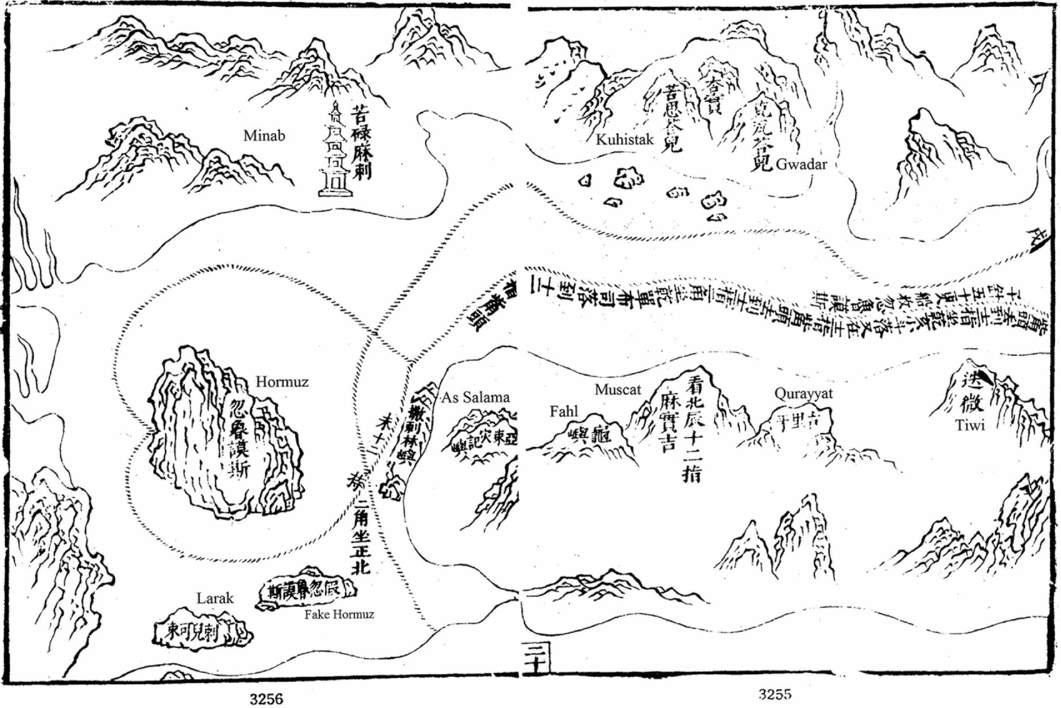
Zheng He's visit to Hormuz was also recorded by the Nautical Chart of Zheng He's Voyages (郑和航海图), dated around AD 1419–1433 (Xiang Reference Xiang1961). The chart indicates that Zheng He had visited the largest island, located at the entrance of the Gulf, and this island had been named Hormuz (忽鲁谟斯, in Chinese pinyin Hu Lu Mo Si). Two other smaller islands were separately named Fake Hormuz (假忽鲁谟斯, in Chinese pinyin Jia Hu Lu Mo Si) and Larak (剌兒可束, in Chinese pinyin La Er Ke Shu) (Figure 1).
Map of the Persian Gulf from the Nautical Chart of Zheng He's Voyages (Xiang Reference Xiang1961: 61–62).

Despite being so well recorded, there is considerable debate surrounding the island that Zheng He visited, named in the records as Hormuz. Two candidates have emerged and have divided scholarly debate: Hormuz Island and Qeshm Island. This paper presents archaeological evidence that supports the claim of present-day Hormuz Island to be the original island visited by Zheng He.
The kingdom of Hormuz (Old Hormuz) was strategically located in the Minab plain of present-day Iran, near the entrance to the Persian Gulf. During the thirteenth to fourteenth centuries AD, the two cities of Kush and Hormuz were political and economic rivals. Hormuz eventually surpassed Kush politically and economically under the leadership of Mahmud Qalhatï. Around the same time (in the early fourteenth century), the capital of the kingdom of Hormuz moved from Old Hormuz to Jarun Island and established autonomy (Aubin Reference Aubin1953: 102; Morgan Reference Morgan1991: 71–78; Piacentini Reference Piacentini1992: 171–73; Kennet Reference Kennet2002: 161). This site was regarded as New Hormuz (Kauz & Ptak Reference Kauz and Ptak2001: 17–22). By the early fifteenth century, the boundaries of Hormuz had extended to the Julfar area, situated on the southern coast of the Hormuz Strait (Williamson Reference Williamson1973: 57; Kennet Reference Kennet2002, Reference Kennet2003, Reference Kennet2004).
New Hormuz experienced an economic boom during the fourteenth and fifteenth centuries, according to historical and archaeological research. Indeed, Hormuz Island was considered a centre for world trade:
Hormuz is a port without equal on the face of the earth. The merchants of Egypt, Syria, the lands of Rum, of Azerbaijan, Khorasan, of the Ma wara’al-Nahr and Turkestan direct their paths to this port. The inhabitants of maritime countries arrive from China, Java, Tanasserim, from Bengal, Malabar, Zanzibar, Abyssinia, Aden, Jeddah […] With the goods they bring they may buy anything they wish. People of all religions, and even idolaters, meet in this city, and nobody permits any hostile gesture or injustice against them (Thackston Reference Thackston2001: 69).
While the Persian Gulf was experiencing this economic boom, the Mongol rule of the Yuan Dynasty (AD 1274–1368) in the east was over and Ming China had begun to play a new role in Indian Ocean trade, as described in Ray Huang's (黃仁宇) book, 1587, A year of no significance (萬曆十五年) (Huang Reference Huang1981). Ming China had a large and strong domestic market, and continuous foreign trading was not essential. This self-sufficiency, combined with a desire to protect China's coastline, led to a ban on international trading; any unofficial trade was therefore illegal (Huang Reference Huang1981). However, Ming China before AD 1587 was very different from the declining China described by Huang (Reference Huang1981).
It is well known that, in the fourteenth year of Hongwu's reign (AD 1381), the Ming court stipulated that “no unofficial activity has been allowed to trade with foreign countries” (Zhang Reference Zhang1974: vol. 93) and, in the seventeenth, twentieth and twenty-third years of Hongwu's reign (AD 1384, 1387 and 1390), this public annunciate was repeated many times (Weng Reference Weng and Xuehui1991: 78). Despite the stringency of these measures under the Emperor Hongwu, the ban was relaxed significantly, although unofficially, by his son, the Emperor Yongle. While Yongle never officially recognised international trading, his decision not to enforce the ban on illegal trade opened China's maritime trade routes; in short, the “ban (during the Yongle reign) was flexible” (Gu Reference Gu2012 [1639–1662]: vol. 2 of Zhejiang, 49) and “private foreign maritime trades occurred with fake official permissions” (Anonymous 1962: Xuanzong Shilu vol. 103, 125). Trade was essentially a monopoly, with expeditions such as those of Zheng He occurring in the name of the Emperor, while China welcomed tribute trade with foreign countries (Chao 2012: 73–80).
Thus, in the early fifteenth century, Emperor Yongle had attempted to monopolise tributes and foreign trade through Zheng He's expeditions, while still nominally adhering to the ‘no-unofficial trade’ policy (Kerr Reference Kerr2002: 125; Park Reference Park2012: 169). From AD 1413–1433, four of Zheng He's voyages to Hormuz Island had apparently contributed to the economic boom in the Gulf (Kauz & Ptak Reference Kauz and Ptak2001: 27; Chao Reference Chao2012: 101), trading luxuries such as ceramics, silk, gold, silver, jewellery and gemstones between the kingdom of Hormuz and Ming China.
The debate on the site visited by Zheng He
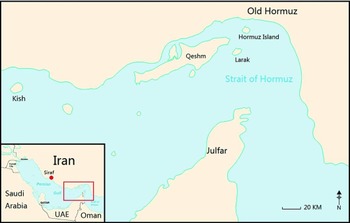
The Nautical Chart of Zheng He's Voyages (Xiang Reference Xiang1961) records that the biggest island in the Gulf is Hormuz Island (Hu Lu Mo Si). However, the biggest island is actually present-day Qeshm Island, known to have been visited by Zheng He's fleet (Figure 2). Chen Xinxiong and Zhang Yueqi (Reference Chen and Zhang2004) have argued that there are two islands named Hormuz shown on the Nautical Chart of Zheng He's Voyages, Hormuz (Hu Lu Mo Si) being the biggest, and Fake Hormuz (Jia Hu Lu Mo Si), one of the smaller islands. The Chinese character for fake, 假 (pronounced ‘jia’), has a similar pronunciation to that of the word ‘island’ in ancient Persian (pronounced ‘jazireh’). Therefore, ‘Fake Hormuz’ could be translated to Hormuz Island, and the biggest island on the chart, named Hormuz, may actually be present-day Qeshm Island (Chen & Zhang Reference Chen and Zhang2004). Zhou Yunzhong disagrees, however, insisting that the true destination of Zheng He's voyage to the Gulf was present-day Hormuz Island. Zhou argues that Hormuz Island was presented as the largest island because of its prominent position in the Gulf; its representation at a larger size was therefore intentional and reflected its relative importance, rather than its accurate size (Zhou Reference Zhou2007).
Map of the present-day entrance to the Persian Gulf.

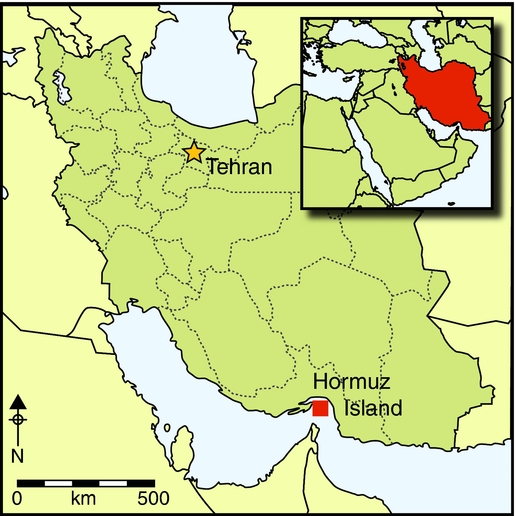
In 2006 archaeological excavations were undertaken to try to resolve the true identity of the original Hormuz Island; these excavations targeted four sites on the island of Qeshm. The excavations revealed phases from the Parthian to later Islamic periods, but no Chinese ceramics were discovered (Khosrowzadeh Reference Khosrowzadeh2006; Hojabri-Nobari et al. Reference Hojabri-Nobari, Khosrowzadeh, Mousavi and Kouhpar2011). Interpretations of the few excavations and surface surveys of Qeshm Island are still limited; Chinese ceramics have, however, been found on present-day Hormuz Island. Below, we present archaeological evidence that supports the claim that the nautical charts have been misinterpreted and Zheng He's destination in the Persian Gulf was present-day Hormuz Island, not Qeshm.
Zheng He's visits to Hormuz Island: the archaeological evidence
As long as research remains based mainly on historical context and archaeological findings from surface surveys of Hormuz Island, our knowledge of Zheng He's expeditions in the western Indian Ocean will be limited. It is clear that further archaeological excavations on these two islands and quantified studies on the finds from the Gulf and China would enhance our understanding of the historical significance of these voyages. However, the archaeological evidence presented here provides a firm starting point for additional investigations.
Evidence for trading activities related to Zheng He's visits to Hormuz Island is broadly divided into two groups of archaeological material. The first group, comprised of Chinese ceramic material in the Williamson Collection, was assembled during an extensive programme of excavations and surface surveys of approximately 900 archaeological sites in southern and south-eastern Iran between September 1968 and April 1971, which were undertaken by British archaeologist Andrew Williamson. The collection includes over 19000 ceramic sherds, around 3500 of which were imports from the Far East (Priestman & Kennet Reference Priestman and Kennet2002: 266–67; Kennet et al. Reference Kennet, Zhang and Priestman2011: 447–49). Approximately 300 sherds of Chinese ceramics, including Qingbai stoneware, blue and white porcelain, and Longquan celadon, that have been dated to between the fourteenth and sixteenth centuries were found on Hormuz Island (Priestman Reference Priestman2005).
The second group of finds comprises over 3400 pieces of Persian and Indian jewellery and gemstones discovered during 2001 in the early Ming Chinese mausoleum of King Liang Zhuang, located in the Hubei Province of China. These so-called treasures of the vassal states include 589 pieces of goldwork (weighing 16kg), 392 pieces of silverwork (weighing 13kg) and jade ornaments (weighing 14kg). The treasure contains 18 types of gemstone, including chrysoberyl, emeralds, sapphires and rubies (Liang Reference Liang2003: 4–23). Re-analysis of both groups of material revealed evidence that could connect those archaeological finds directly to Zheng He's voyages and provide a better understanding of trading activities between Ming China and the kingdom of Hormuz in the early fifteenth century.
Blue and white Ming-period porcelain sherds (AD 1380–1435)
A small group of Chinese blue and white porcelain sherds found during excavations on Hormuz Island share a number of features, namely dense bodies in grey-white, painted a dark cobalt-blue and coated by a thin, light-bluish-white and transparent glaze.
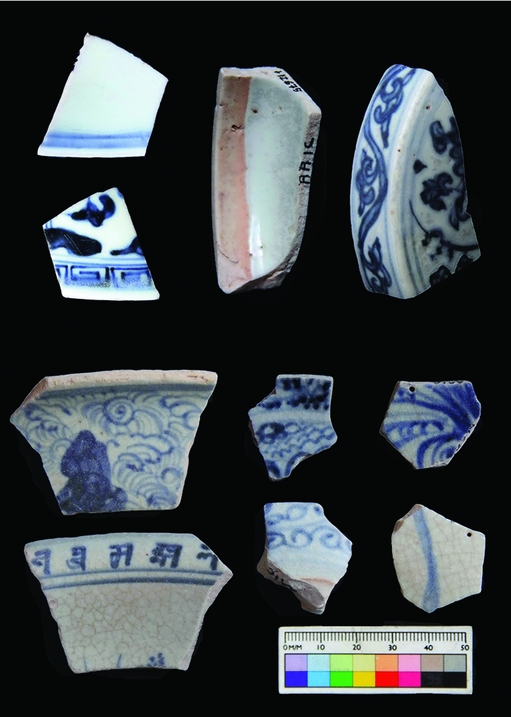
The reconstructed shapes of these porcelain sherds mainly consist of bowls and plates, but nobases have been found. A sherd painted with floral scrolls could be the cover of a porcelain box. The cobalt blue patterns of the underglaze on these sherds include a floral scroll, lions with stylised clouds, a stylised wave, a band of squared spirals and Tibetan letters (Figure 3).
Chinese blue and white porcelain sherds (fifteenth century) found on Hormuz Island (photograph by Ran Zhang).
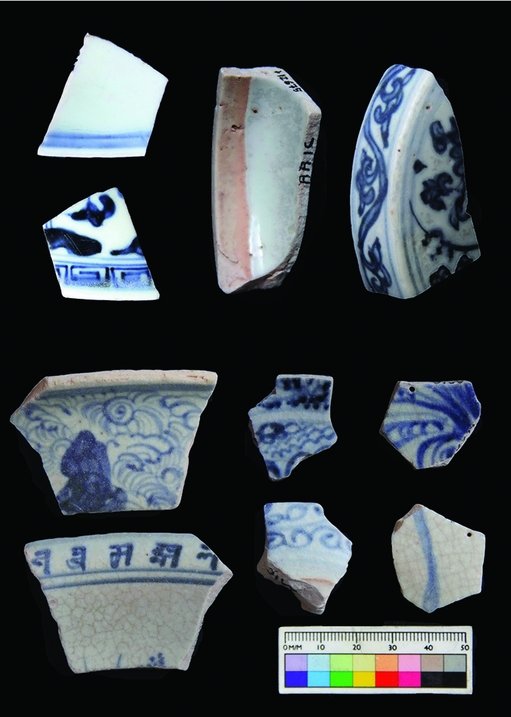
The Hormuz sherds are very similar to a type of blue and white porcelain that has been found in the Jingdezhen kilns, where vast amounts of well-dated imperial porcelain have been unearthed. An imperial blue and white plate (Figure 4) with Wucai-enamelled painting and decorative Tibetan letters can be dated to the Xuande period (AD 1426–1435), based on the cobalt blue reign mark Da Ming Xuan De Nian Zhi (大明宣德年制, ‘Made in the Xuande Reign of the Great Ming Dynasty’). Legible Tibetan alphabet decoration was common in the early Ming period (XDFB & JTKY 1992: 141–43). Similar types of ‘common’ (as opposed to imperial) blue and white porcelain sherds have also been found at the Maojiawan site in Beijing, during excavations between 2005 and 2007, that can be dated to the early Ming period (Beijingshi Wenwu Yanjiusuo 2007: 302–305).
Imperial blue and white plate with Wucai painting (fifteenth century) from the Jingdezhen kilns, Jiangxi, China (Zhang Reference Zhang2008: fig. 177).

In addition to the Williamson Collection, a selection of Chinese ceramics from Hormuz Island was also collated by German scholar Ulrich Wiesner; he published six sherds, which were similar blue and white porcelain (Wiesner Reference Wiesner1979: figs 6 & 7). Beyond Hormuz Island, another group of blue and white porcelain ceramics (Figure 5) was also found in Julfar, in the United Arab Emirates; this has been dated to the early fifteenth century by Pirazzoli-T’Serstevens (Reference Pirazzoli T’ Sertevens2003: 3–10). It is also found at Fustat, Egypt, dated to the fifteenth century by Tadanori Yuba (Reference Yuba2014: 10–11). The appearance of this characteristically Ming-period ceramic ware on Hormuz Island lends weight to the argument that present-day Hormuz Island and Zheng He's Hormuz are one and the same.
Blue and white porcelain sherds (fifteenth century) found in Julfar, the United Arab Emirates (left Pirazzoli-T’Serstevens Reference Pirazzoli T’ Sertevens2003: fig. 9) and in Fustat, Egypt (right Yuba Reference Yuba2014: fig. 7.1).

Longquan celadon sherds (of common quality) dated to the early Ming period
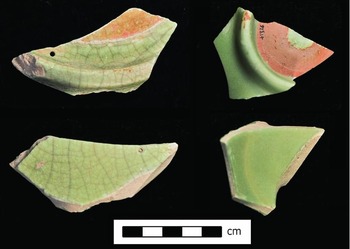
Longquan celadon was one of the most popular ceramics traded in the Indian Ocean during the thirteenth to fifteenth centuries. A small group of Longquan celadon sherds (Figure 6) of common quality found on Hormuz Island has been roughly dated to the mid fourteenth century to mid fifteenth century, according to research by Seth Priestman and Regina Krahl (Priestman Reference Priestman2005). Lin, who has studied southern Chinese celadon for many years,suggested that some sherds in this Longquan celadon group from Hormuz Island belong to the Tong’an-type celadon, which is a kind of imitation Longquan celadon specially produced for export trading (Huo & Lin Reference Huo and Lin2004). Lin Li has also discovered the provenance of these sherds: they may come from the Houbi Shan kiln on Dongshandao Island near Zhangzhou in the Fujian Province of China.Common Longquan celadon (in contrast to imperial-type celadon) has a long history, from roughly the tenth to the sixteenth centuries, and it was exported to the Indian Ocean from the twelfth or thirteenth centuries, until the sixteenth century (Zhu Reference Zhu1998; Qin & Liu Reference Qin, Liu and Bowuguan2012: 19). Imperial Longquan celadon, however, was only produced in the early Ming period in the Hongwu and Yongle regions (Shen Reference Shen, Yanjiusuo, Xueyuan and Bowuguan2009).
For many years, the detailed methods of distinguishing and identifying common Longquan celadon dating to the late Yuan (middle and late fourteenth century) and early Ming (late fourteenth to early fifteenth centuries) periods were very problematic in archaeological studies. However, the 2005 excavation of the Fengdongyan kiln in Longquan county of Zhejiang Province in southern China provided new information that could resolve this issue.
Common-quality Longquan celadon found on Hormuz Island, approximately dated to the late thirteenth to early fifteenth centuries (photograph by Ran Zhang).
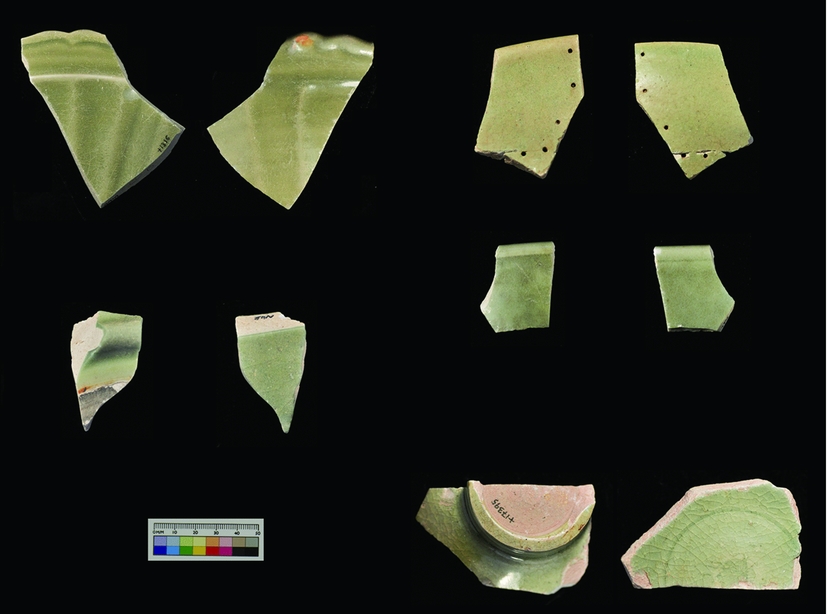
According to the common Longquan celadon collections found at the Fengdongyan kiln site, the early Ming-period Longquan celadon had the following general features: a heavy, thick and rough body with glaze (about 0.5mm to 1mm thick) in a variety of greens (dark green, olive green and bluish green). The bowls and plates had low, thin foot rings, and they were fully but unevenly glazed on top. Inside the foot ring was an obvious unglazed ring where a separator had been. In imperial ware the separator marks are much better disguised beneath the foot, giving a finer finish. A collection of Longquan celadon of similar quality can be precisely dated to the period between AD 1387 and 1418, based on excavations of General Xue Xian's tomb (AD 1387), Zhang Yun's tomb (AD 1395), Song Cheng's tomb (AD 1407) and the Ye Shi tombs (AD 1418) (NWBW 1962: 470, 474–78; Nanjingshi Bowuguan 1999: 27–30, 2001: 11–13). These tombs belonged to high-ranking officers (and their families) serving the Ming court; they can be reliably dated by tombstones and historical texts.
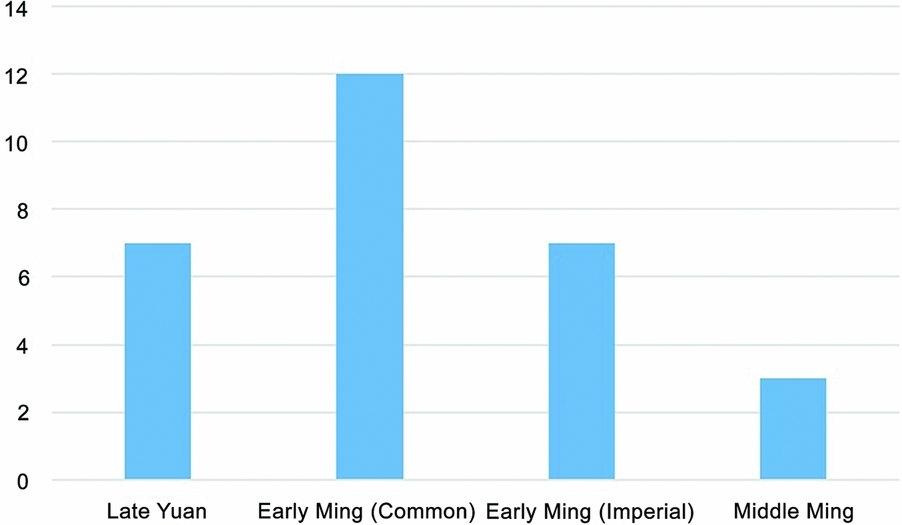
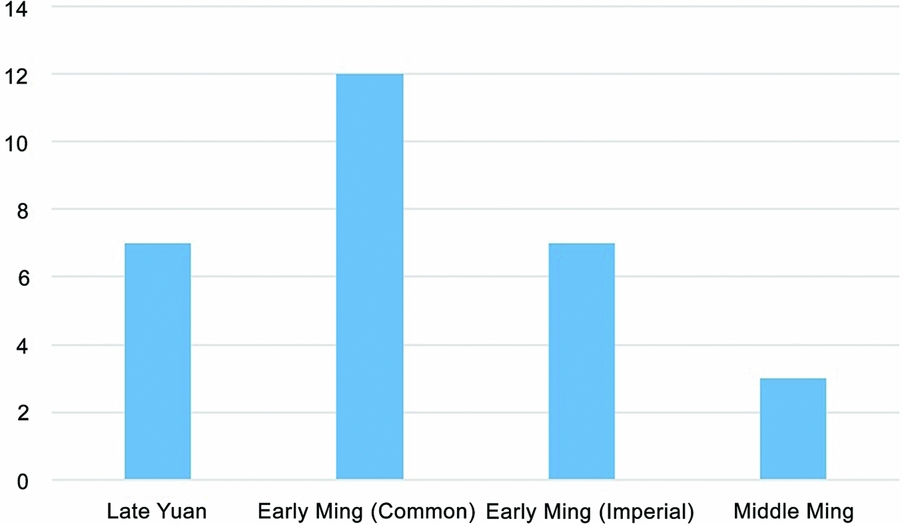
Early Min-period Longquan celadon sherds (of common quality) from Hormuz Island comprise a relatively large proportion of all Longquan celadon finds (Figure 7). One must, however, be cautious in assuming that the Longquan celadon trade with Hormuz Island was thriving during the early Ming dynasty; this phenomenon is based on a small quantity of ceramic finds. However, to a greater or lesser extent, we can identify an increase in imported Longquan celadon during this period on Hormuz Island; this does not fit with the common understanding of Chinese ceramic trade in the Indian Ocean, which is that most of the Ming unofficial trade was illegal and that ceramic trade during this period declined (Kerr Reference Kerr2002: 125; Brown Reference Brown2009).
Quantification of Longquan celadon sherds found on Hormuz Island.
Imperial-type Longquan celadon sherds dating to the early Ming period (AD 1368–1435)
Imperial type ceramics (官样瓷器) have been found rarely in archaeological sites in the Indian Ocean; this is because they were not intended for trade. However, Longquan celadon could be an exception, as it has been found recently in very small quantities in the western Indian Ocean (Qin & Liu Reference Qin, Liu and Bowuguan2012: 20). Wang Guangyao from the Palace Museum of Beijing suggests that imperial-type ceramics should be distinguished from the so-called ‘imperial ceramics’ (御用官窑) because the former were used by the central court of Ming China for official trading, gift exchange or royal benefaction, while the latter were the finest wares manufactured especially for the Ming emperors (Wang Reference Wang2004: 156).
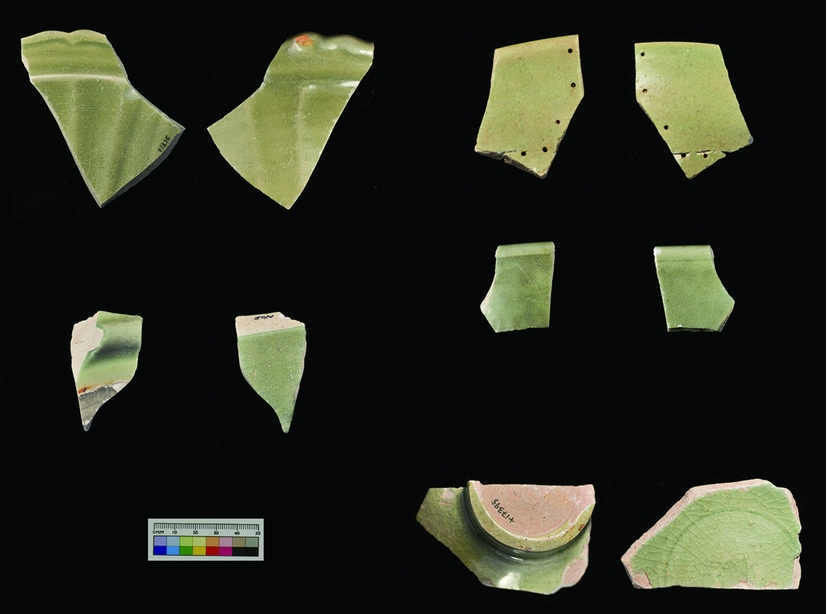
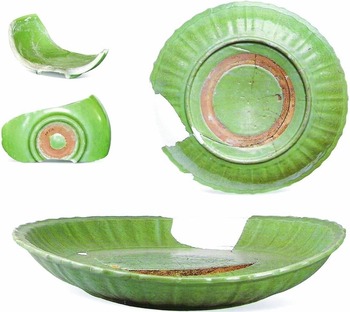
Re-examination of work on the Longquan celadon in the Williamson Collection has shown that some sherds have features similar to those of imperial Longquan celadon. Two vessels that can be reconstructed highlight the similarities: a Longquan celadon bowl with a base diameter of 68mm and a plate with a base diameter of 180mm (Figure 8). These imperial-type Longquan sherds feature a porcelain-like stoneware body, which is hard, dense and light greyish-white. They all have a light-green, jade-like glaze, which is 1–2mm thick and evenly applied. The tops of their foot rings are fully glazed, and a nice, refined and unglazed ring on their bases has been red-stained. Similar types of imperial celadon bowls and plates that can be dated to the early Ming period have been found at the Fengdongyan kiln site (Shen Reference Shen, Yanjiusuo, Xueyuan and Bowuguan2009: 7–9).
Longquan celadon sherds of imperial quality found on Hormuz Island (photograph by Ran Zhang).

Many imperial celadon sherds (Figure 9) have been excavated from the Fengdongyan kiln sites, as well as a large number of common celadon sherds. Imperial celadon sherds have a very thick glaze and their colour was well controlled to become light green during firing. The bowls and plates have a carefully formed, fully glazed foot ring. A deliberate unglazed area on the inside of the foot ring can also be seen. Imperial celadon wares found at the Fengdongyan kiln sites were decorated with a dragon pattern, which was strictly for use by the imperial court in the early Ming Dynasty. This is recorded in volume 68 of The History of Ming (明史): “from the 26th year of Hongwu reign (AD 1393), no red wares, gilding gold wares and dragon pattern wares can be used [on common objects]” (Zhang Reference Zhang1974: vol. 68). The Collected Statutes of the Ming Dynasty (大明会典) also state that: “from the 26th year of Hongwu reign, the manufacturing of tribute and imperial wares should follow the specific patterns and designs authorised by the imperial court” (Li Reference Li1995: vol. 194).

It appears that the high-quality Longquan celadon sherds found on Hormuz Island are similar in quality to imperial celadon wares that were unearthed from the Fengdongyan kilns. These sherds can be grouped into the class of imperial-type Longquan celadon, and they can be clearly distinguished from the common quality celadon wares of the same period. Among traded Chinese ceramics, these imperial-type ceramics are very rare and were intended as tributes or gifts, rather than commodities in common trading activities (Krahl Reference Krahl1986; Kennet et al. Reference Kennet, Zhang and Priestman2011: 456; Qin Reference Qin2013: 38–39).
Jewellery discovered in China dating to the early Ming period
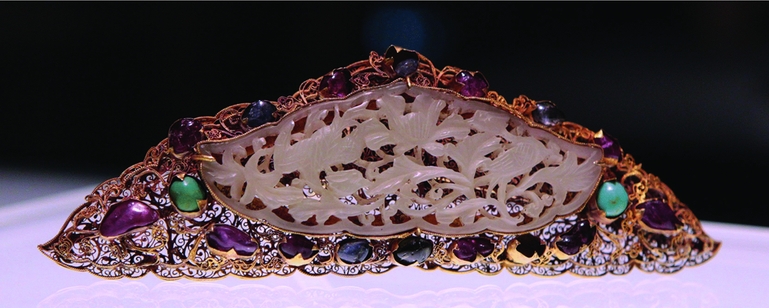
A significant part of the finest jewellery and gemstones from the so-called treasures of the vassal states (诸藩宝物), imported from the Gulf to Ming China by Zheng He's voyages, were given to a member of the Ming royal family, the King of Liang Zhuang (AD 1411–1441), between AD 1424 and 1433. The King of Liang Zhuang was the ninth son of the Emperor Hongxi (AD 1378–1425), who became king in AD 1424 and died in AD 1443. Excavation revealed the extent of the mausoleum to be 250m long and 70m wide. The southern part of the peripheral structures has been destroyed. The crypt of the mausoleum is beneath a hill, constructed in the shape of ‘中’, and it consists of a central hall and corridors. The crypt is a perfectly preserved brick structure that, excluding the corridors, is about 15.4m long, 7.88m wide and 5.3m high (Liang Reference Liang2003: 4–23).
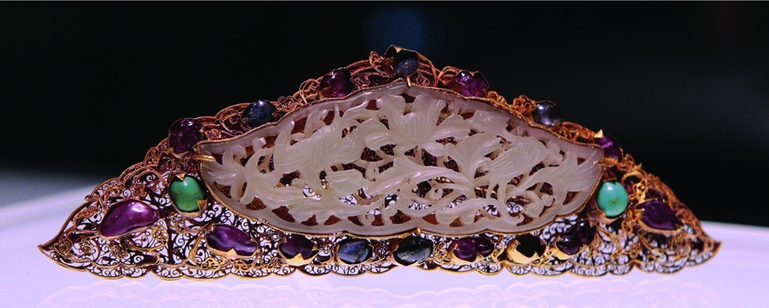
Some of the gems in the jewellery were unique productions from the Gulf (Figures 10 & 11). For example, the Nishapur turquoise gems are known to be from Iran originally (Yang et al. Reference Yang, Di and Zhou2004: 22–24; Lin Reference Lin2013: 87–99). A gold ingot was also found, with the carved inscription ‘永乐十七年四月□日,西洋等处买到 (‘on…day of April of the 17th year in Yongle reign, purchased in the Western Oceans’). The seventeenth year of the Yongle reign can be dated to AD 1419, and ‘Western Oceans’ is an ancient Chinese term for the Persian Gulf, indicating that the ingot was imported from the Gulf (Clunas & Harrison-Hall Reference Clunas and Harrison-Hall2014: 280-81).
Gold ingot found in the mausoleum of the King of Liang Zhuang, Hubei Province, China (photograph by Jian Liang).

A golden hat with chrysoberyl, emerald, sapphire and Persian turquoise found in the mausoleum of the King of Liang Zhuang, Hubei Province, China (photograph by Jian Liang).
Discussion: trade between Hormuz and early Ming China
During most of the Ming Dynasty period, unofficial trade was illegal (Kerr Reference Kerr2002: 125), and the export of Chinese ceramics to the Gulf almost came to a halt (Brown Reference Brown2009). However, trade can be traced through ceramics in the archaeological record. The so-called ‘Ming Gap’, refers to a hiatus in the archaeological evidence for Chinese ceramics that is best reflected in studies of shipwrecks. This suggests that a Chinese ceramic export shortage occurred between AD 1352 and 1487 (Brown Reference Brown2009). The Rang Kwien, Turiang, Nanyang and Longquan shipwrecks, studied by Roxanna Brown and dated to the late fourteenthand early fifteenth centuries, show that common-quality Chinese ceramics were still being traded during this period, but in smaller quantities. The data show a reduction in trade of around 50 per cent between AD 1368 and the early Ming period (Brown Reference Brown2009: 69–70). Further evidence for continued trade, in perhaps lower-quality ceramic wares, survives from the Gedi ruins, a coastal town of Malindi in Kenya. Liu Yan and Qin Dashu argue that the early Ming trade continued with low-quality, brown-glazed jars, common-quality blue and white porcelain and Longquan celadon sherds (Liu et al. Reference Liu, Qin and Kiriama2012: 47–54, 59). Common ceramic wares from the early Ming period are rarely found among the vast array of exports to the Indian Ocean (Lin Reference Lin2010: 84–96), but it is difficult to deny that illegal trading continued during the Ming Dynasty and that Chinese ceramics were traded on a small scale.Longquan celadon sherds (both imperial and common types) and blue and white early Ming-period porcelain from Hormuz Island might have been imported by Zheng He during his visits. The presence of these ceramics on Hormuz Island presents two possible scenarios for early Ming trading activities: illegal private trade or the tribute trading of Zheng He's voyages. The former is suggested by common ceramic finds from Hormuz Island that are usually associated with illegal trade; the latter is supported by the imperial-type ceramics from the island and gemstones and gold from the Persian Gulf excavated in China. The common celadon sherds found at Hormuz suggest that is highly probable that Chinese ceramics were still being traded in the early Ming period, but only in small quantities. These common ceramics could be broken pieces of everyday tableware belonging to Zheng He's retinue, while the imperial-type ceramics might have been reserved for tributes and gift exchanges. Zheng He's visits to Hormuz Island are also evident in the discovery of gemstones and gold from the Persian Gulf in the Hubei Province of China.
The evidence presented here suggests that Zheng He's visits to Hormuz were, to some extent, about the exchange of luxuries. The gemstones and gold ingots imported from the Gulf could indicate that Zheng He traded with Hormuz, the most important regional port of the time and the most notable trading centre in the Gulf.
Conclusion
The evidence presented above supports the claim that the island named Hu Lu Mo Si on the Nautical Chart of Zheng He's Voyages is the capital of the kingdom of Hormuz and present-day Hormuz Island. In addition, the coastline of Hu Lu Mo Si is similar to that of present-day Hormuz Island (Figure 12). There are two smaller islands near Hormuz Island, one of which is named La Er Ke Shu, or Larak Island (Chen et al. Reference Chen, Xie and Lu1986: 573). The other smaller island, named Jia Hu Lu Mo Si, could refer to an island that belonged to the kingdom of Hormuz. Present-day Qeshm Island is not shown on the chart.
Landscape of Hormuz Island (photograph by Meicun Lin).

The early Ming Chinese ceramic sherds found on Hormuz Island might have been both illegally traded and exchanged through Zheng He's voyages. Evidence for Zheng He's trading interactions, particularly the new discovery of imperial-type Longquan celadon sherds, suggests that Zheng He visited present-day Hormuz Island. Early Ming blue and white porcelain sherds found on Hormuz Island also demonstrate this notion. The similar and less-common ceramic finds from Julfar support the argument that Zheng He visited the kingdom of Hormuz, which controlled Julfar between AD 1330 and 1507 (Pirazzoli-T’Serstevens Reference Pirazzoli T’ Sertevens2003: 4). The argument that Qeshm Island could be the destination of Zheng He's voyages cannot be sustained when considered in light of this evidence, as it was at that time occupied by Bahrain, which could not in any way be referred to as Hormuz (Zhou Reference Zhou2007).
Archaeological finds from both Hormuz Island and China reveal that Zheng He was instrumental in the economic boom during the fifteenth century AD. Despite its disproportionate representation on the Nautical Chart of Zheng He's Voyages, there is no doubt that it was Hormuz Island that Zheng He visited. The imperial-type Longquan celadon and early Ming blue and white porcelain sherds in the Williamson Collection are very significant in supporting this argument, and they are therefore important in the study of maritime trade between China and the Gulf in the fifteenth century.
Acknowledgements
We are very grateful to the Williamson Collection Project run by Dr Derek Kennet from the Department of Archaeology, Durham University, and for support from SACH Centre of UCH, Chinese Academy of Cultural Heritage.