Grasses are an important forage and potential biofuel (Guretzky et al. Reference Guretzky, Biermacher, Cook, Kering and Mosali2011) and a key component of diverse tallgrass prairies ecosystems (Larson et al. Reference Larson, Bright, Drobney, Larson, Palaia, Rabie, Vacek and Wells2013) dominated by species that include big bluestem (Andropogon gerardii Vitman), Indiangrass [Sorghastrum nutans (L.) Nash], and switchgrass (Panicum virgatum L.). Most of the original tallgrass prairie was converted into cropland during the 19th and 20th centuries (Gurevitch et al. Reference Gurevitch, Scheiner and Fox2006). Fire suppression and removal of native nomadic grazers has increased invasion from weedy forbs and woody plants, and the native and restored prairies that remain are threatened by current and continued human disturbance.
Management Implications
Control of invasive species in natural areas often includes reseeding or initial seeding of desirable species. However, herbicides used to control the invasive weed can injure newly seeded species. A regional study was conducted in Minnesota, North Dakota, and South Dakota to determine when native grasses can be established following September applications of aminopyralid relative to pyridine herbicide standards to control invasive broadleaf weeds in the upper midwestern tallgrass prairie region of the United States. The impact of aminopyralid, clopyralid, and picloram applied preceding fall-dormant or spring-seeded cool- and warm-season native grass establishment was evaluated. Herbicides were applied at rates used for invasive species management in the region. Aminopyralid did not reduce seedling establishment of any grass species in either fall or spring seedings at any of the three rates tested. Establishment of fall-dormant seedings of green needlegrass and intermediate wheatgrass and spring seedings of Canada wildrye, big bluestem, and little bluestem occasionally improved following aminopyralid application. Also, grasses generally were not affected by a pretreatment of clopyralid or picloram. These herbicides can be used prior to seeding grasses in an integrated management strategy to allow land managers to facilitate reestablishment or initial seeding of desirable grass species and slow or prevent invasive species reintroduction. Aminopyralid provides an additional tool for invasive management strategies in grass systems.
Restored prairies are subject to invasion by weeds for several reasons. There is a lack of an established plant community that can compete for the available resources (Joern and Keeler Reference Joern and Keeler1995), there are high nutrient levels that may be exploited by invasives (Funk et al. Reference Funk, Cleland, Suding and Zavaleta2008), and the length of time it takes for native species to fully establish allows undesirable species to establish (Solecki Reference Solecki1997). Also, most remaining prairies are fragmented, increasing their vulnerability to invasion (Hobbs and Huenneke Reference Hobbs and Huenneke1992).
New prairie establishments are particularly vulnerable to weed competition, which can stunt or reduce densities of recently planted native grass seedlings. In California, chemical weed control during the year of seeding was critical to establish seeded perennial grasses (Wilson et al. Reference Wilson, Orloff, Lancaster, Kirby and Carlson2010). However, treatments that resulted in the best establishment and highest biomass production varied by herbicide, grass species, and location of the study. Bahm et al. (Reference Bahm, Barnes and Jensen2015) reported improved stand establishment of native grass seedings in South Dakota when weeds were controlled with herbicides during establishment. Reseeding desired species following weed control can also improve long-term restoration (Mangold et al. Reference Mangold, Orloff, Parkinson and Halstvedt2015). However, newly seeded species mortality can be high during the first few years after seeding (Mangold Reference Mangold2012), which can allow rapid reinvasion by the targeted weed. To prevent reestablishment of weeds, land managers often use herbicides both prior to and following establishment of newly seeded grass species (DiTomaso Reference DiTomaso2000; DiTomaso et al. Reference DiTomaso, Enloe and Pitcairn2007; Lym and Tober Reference Lym and Tober1997).
A survey of 38 tallgrass prairie managers found most respondents preferred planting in the dormant season, because this practice mimics natural conditions most closely (Rowe Reference Rowe2010). In the same survey, invasive plants were considered a major threat to restorations, and a majority of managers devoted at least 50% of their restoration efforts on combating these weeds. Thus, inclusion of herbicide applications prior to reseeding grasses would both reduce the threat from invasive weeds and likely lead to increased populations of desired species.
Aminopyralid has become widely used as an alternative to clopyralid or picloram to control invasive species such as Canada thistle [Cirsium arvense (L.) Scop.] and spotted knapweed (Centaurea stoebe L.) because of consistent, efficacious weed control with minimal effect on native forbs and grasses (Allendorf and Lundquist Reference Allendorf and Lundquist2003; Almquist and Lym Reference Almquist and Lym2010; Mangold et al. Reference Mangold, Orloff, Parkinson and Halstvedt2015; Mikkelson and Lym Reference Mikkelson and Lym2013; Samuel and Lym Reference Samuel and Lym2008). Aminopyralid is labeled for use on established desirable grasses and can be applied in the spring prior to seeding grasses the following fall (Halstvedt et al. Reference Halstvedt, Peterson, Becker, Lym and Moechnig2011). This time delay from spring herbicide application until fall seeding can be problematic for establishment of desired species, with nearly an entire growing season for weeds to reinvade prior to seeding. A shorter plant-back interval is desired, but the potential for injury to seeded grasses is largely unknown. The purpose of this research was to determine whether soil residue of fall-applied aminopyralid, clopyralid, or picloram affected desirable grasses seeded either as a fall-dormant planting or seeded the following spring. If successful, this integrated program would allow the seeded species to establish soon after herbicide treatment and extend the interval for growth of desired species before reinvasion occurred.
Methods and Materials
Field trials at three locations in the upper Midwest were established in 2009 to evaluate the effects of aminopyralid, clopyralid, and picloram on native and introduced seeded grasses. Sites were located near Fargo, ND, Rosemount, MN, and Beresford, SD. The soil at the North Dakota site was a Fargo silty clay (Fine, smectitic, frigid Typic Epiaquerts), at the Minnesota site a Tallula silt loam (Coarse-silty, mixed, superactive, mesic Typic Hapludoll), and at the South Dakota site a silty clay loam (Fine-silty, mixed, mesic Udic Haplustoll).
The soil was tilled in August 2009 at all sites to prepare a seedbed, and the entire area was subsequently treated with glyphosate at 840 g ae ha−1 to maintain weed-free conditions prior to seeding. Individual herbicide treatments were applied on September 15, 16, or 22, 2009, at the North Dakota, Minnesota, and South Dakota locations, respectively. The South Dakota location had separate fall- and spring-seeded studies, while the Minnesota and North Dakota locations were seeded in the fall or spring, respectively. Preseeding treatments included aminopyralid at 52.5, 123 (standard use rate), or 246 g ae ha−1, or the standard use rates for clopyralid at 630 g ae ha−1 or picloram at 560 g ae ha−1.
Herbicides were applied with a four- or six-nozzle, handheld boom or bicycle sprayer equipped with 8002 (North Dakota and Minnesota) or 8003 (South Dakota) flat fan nozzles (TeeJet, Spraying Systems, P.O. Box 7900, Wheaton, IL 60189-7900) delivering 160 to 188 L ha−1 (17 to 20 galha−1) at 205 to 240 kPa (35 psi). A nonionic surfactant (X-77, Loveland Industries, Greeley, CO 80634) at 0.25% v/v was included for all treatments. The plots were 4.5 by 12 m (15 by 40 ft) in North Dakota or 3 by 13 m (10 by 43 ft) in Minnesota and South Dakota with four replications in a randomized complete block design at all locations.
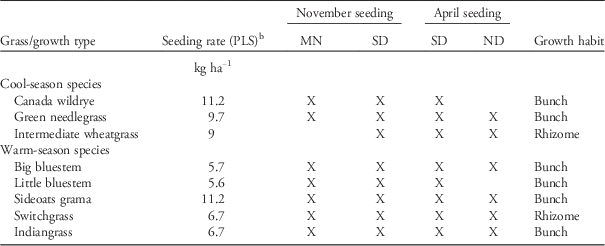
Cool- and warm-season grasses commonly planted in prairie restoration projects in the tallgrass prairie region of the upper Midwest were seeded after herbicide applications as a fall-dormant seeding in November or the following season in April. Grasses were seeded on November 17 at the Minnesota location and November 9 at the fall South Dakota location in 2009. The spring seedings were made on April 4, 2010, at the spring South Dakota site and April 22, 2010, at the North Dakota location. Grasses were planted with a six-row cone seeder with 18- or 31-cm (7- or 12-inch) row spacing at National Resources Conservation Service (NRCS) recommended seeding rates, and grass species varied by location (Table 1). Cool-season grasses included the native species Canada wildrye (Elymus canadensis L.) and green needlegrass [Nassella viridula (Trin.) Barkworth] and the introduced forage species intermediate wheatgrass [Thinopyrum intermedium (Host) Barkworth & D.R. Dewey]. Canada wildrye was only seeded at the South Dakota and Minnesota sites, green needlegrass at all three sites, and intermediate wheatgrass at the North Dakota and South Dakota sites. Green needlegrass did not establish at the Minnesota site and was not included in the analysis. Native warm-season species big bluestem, sideoats grama [Bouteloua curtipendula (Michx.) Torr.], switchgrass, and Indiangrass were seeded at all three sites. Little bluestem [Schizachyrium scoparium (Michx.) Nash] was seeded at the Minnesota and South Dakota sites.
Prairie restoration grass species seeded and seeding rate at three locations in the northern Midwest following pre-planting herbicide application in September 2009.Footnote a

a Grasses were seeded in November 2009 at the MN and fall SD locations, and in April 2010 at the ND and spring SD locations.
b PLS, pure live seed; MN, Minnesota; SD, South Dakota; ND, North Dakota.
Nontreated control plots were hand weeded for the early part of the growing season in 2010 to help ensure seedling success. In Minnesota, MCPA plus metsulfuron-methyl at 80.8 g ai ha−1 + 3.36 g ha−1 was applied on June 16, 2010, to the entire trial to control high populations of broadleaf and grass weeds that could no longer be managed with hand weeding. No effects of MCPA plus metsulfuron-methyl were observed on emerged seeded grasses, which is consistent with previous use for native grass establishment (T Whitson, personal communication). The dominant weeds present at the Minnesota site were common lambsquarters (Chenopodium album L.), prostrate pigweed (Amaranthus blitoides S. Wats.), and pale smartweed (Polygonum lapathifolium L.). Common lambsquarters and prostrate pigweed were common in North Dakota, as was common mallow (Malva neglecta Wallr.). Lambsquarters, common dandelion (Taraxacum officinale F. H. Wigg.), and common waterhemp (Amaranthus rudis Sauer) were commonly present at the South Dakota locations.
Grass establishment was determined by evaluating grass density in July 2010. Density was measured by counting the number of individual plants in 100 cm of row centered on the fourth and eighth seeded row of each plot. To account for the significant overdispersion of the population density response variable that was present, data were analyzed by applying a negative binomial model fit to the count data using Proc Genmod in SAS 9.3 (Stroup Reference Stroup2012) and the multiple means comparison P-values compared by the Tukey-Kramer method at a 95% confidence level. Because population densities were lower when grasses were seeded in the fall compared with the spring seeding, discussion of data will compare results within fall and spring seedings separately.
Results and Discussion
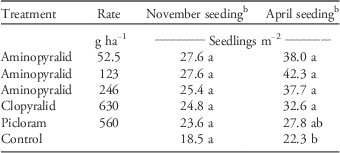
Herbicide application prior to seeding cool- and warm-season grasses generally had little effect on establishment when averaged over all species and study locations (Table 2). However, spring-seeded grass population density averaged 33.5 seedlings m−2 compared with only 24.6 seedlings m−2 when the same species were planted in the fall. The recommended dates for seeding cool-season grass species in the Northern Great Plains is prior to May 20 or from mid-August to mid-September, while warm-season species should be seeded by late June (U.S. Department of Agriculture, Natural Resources Conservation Service [USDA-NRCS] 2015). Seeding in November just prior to soil freeze-up is often done so that the seed will remain dormant and is in place to begin growth as soon as possible the following spring. This practice is used to avoid possible delays in seeding in the spring due to wet field conditions or to save time, since land managers often have more time in late fall for reseeding than in the spring. However, grass seed can be subjected to predation, desiccation, and winter-kill in seasons with little or no snow cover, which results in poor stand establishment when fall seeded. The weather conditions in fall 2010 were not favorable for dormant seeding, because temperatures from mid-November to mid-December averaged 18C below normal at both fall seeding locations with little to no snow cover (xmACIS2 2010). The cold and dry conditions may have killed imbibed seeds, resulting in a reduced stands the following spring.
Comparison of average grass seedling population densities established by July of 2010 following herbicide application in September of 2009 for fall or spring seedings combined across grass species and locations at three sites in the northern Midwest.Footnote a

a Grasses were seeded in November 2009 at the MN and fall SD locations, and in April 2010 at the ND and spring SD locations.
b Means followed by the same letter within a column are not different at the P≤0.05 significance level.
Grass Population Densities following Fall Seeding
Desired stand densities vary widely depending on seeding mix and intended use of the site. As a reference point from which to compare monoculture seedings achieved in this study, a stand of at least 46 and 28 seedlings m−2 of bunch and rhizomatous grasses, respectively, is considered adequate to meet NRCS program guidelines to certify that a stand was established (USDA-NRCS 2015). Fall-seeded stands achieved in this study were below NRCS guidelines values regardless of herbicide treatment (Table 3). However, regarding the focus of this study—tolerance to soil residues if present from prior herbicide application—cool- and warm-season grass species stand establishment was not reduced by application of herbicides approximately 2 mo prior to fall seeding compared with controls. Occasionally, fall-seeded cool-season species had higher stand establishment following herbicide use, but never lower stand establishment. For example, fall-seeded stands of the bunchgrass green needlegrass averaged 23.8 seedlings m−2 when aminopyralid was applied at the field use rates of 52.5 and 123 g ha−1 compared with 6.3 seedlings m−2 in the control. Green needlegrass establishment was higher than the control with 27.8 seedlings m−2 when clopyralid was applied at 630 g ha−1 prior to seeding, while picloram at 560 g ha−1 had no effect on the initial green needlegrass stand. Canada wildrye stands were not reduced by herbicides applied prior to fall seeding and averaged 36.9 seedlings m−2 across the three aminopyralid treatments, compared with 25.5 seedlings m−2 in the control, though stand densities overall were less than the 46 seedlings m−2 considered necessary to obtain an adequate stand of this bunchgrass species for NRCS programs. The bunchgrass green needlegrass (South Dakota) population density (excluding the control) averaged 21.6 seedlings m−2, which was only about 43% of an adequate stand. Intermediate wheatgrass (South Dakota) met the 32 seedlings m−2 that is considered an adequate stand for rhizomatous species only when seeding was preceded by aminopyralid at 123 g ha−1.
Comparison of average grass seedling population densities established by July of 2010 when seeded in November 2009 approximately 2 mo after herbicide application in September for fall, averaged over two locations (MN and SD).

a Means followed by the same letter within a column are not different at the P≤0.05 significance level.
b Seeded green needlegrass did not establish at the MN location; data presented only for the SD location.
c Intermediate wheatgrass was only seeded at the SD location.
Fall-seeded warm-season grasses did not show the occasional higher stand establishment following herbicide application seen with cool-season grasses (Table 3). Switchgrass, a rhizomatous grass, was the only fall-seeded species to reach the 28 plants m−2 stand densities recommended by NRCS, with an average 37.1 seedlings m−2 (control included) compared with the bunchgrasses sideoats grama and Indiangrass, which averaged 26.8 and 25.2 seedling m−2, respectively, short of the 46 plants m−2 NRCS target. The bunchgrasses big and little bluestem only averaged 16.5 and 12.4 seedling m−2, respectively, less than half the density NRCS considers necessary for an adequate stand. Since fall-seeded population densities were relatively low, data were collected in 2011 in Minnesota to determine whether dormant seed that may not have germinated the first growing season did so the second growing season after seeding. However, population densities remained unchanged by 2011 (unpublished data), supporting our suspicions of high mortality during initial stand establishment in the spring of 2010. Regardless, fall-seeded grass species stand establishment was not harmed by application of any of these pyridine herbicides 2 mo prior to seeding.
Grass Population Densities following Spring Seeding
Herbicide application in September 2009 prior to seeding in April 2010 did not harm establishment of any of the cool- or warm-season grasses evaluated (Table 4). Additionally, prior herbicide application always improved seedling establishment of Canada wildrye and little bluestem and occasionally improved big bluestem compared with the control. Canada wildrye establishment averaged 33.1 seedlings m−2 across all herbicide treatments compared with 4.5 seedlings m−2 in the control, big bluestem averaged 35 and 13 seedlings m−2, respectively, and little bluestem averaged 15.6 and 0 seedlings m−2, respectively.
Comparison of average grass seedling population densities established by July 2010 when seeded in April 2010 approximately 7 mo after herbicide application, averaged over two locations (ND and SD).

a Means followed by the same letter within a column are not different at the P≤0.05 significance level.
b Canada wildrye was not seeded at the ND location; data presented are only for the SD location.
Green needlegrass averaged 48.9 seedlings m−2 when aminopyralid was applied in the fall prior to spring seeding and was considered an adequate stand (USDA-NRCS 2015) (Table 4). Switchgrass establishment averaged 41 seedlings m−2 (including the control). Sideoats grama and Indiangrass averaged 18.2 and 24.2 seedlings m−2, respectively, when seeded in the spring following a fall herbicide application. As seen with the fall-seeded grasses, spring-seeded grass-stand establishment was not harmed following application of these pyridine herbicides. The fact that establishment of fall-dormant seedings of green needlegrass and intermediate wheatgrass, and spring seedings of Canada wildrye, big bluestem, and little bluestem occasionally improved following applications of aminopyralid indicates there is an adequate margin of safety for use of aminopyralid prior to establishment of grass species tested.
With either fall- or spring-seeded trials, the residual weed control from the herbicide treatments may have contributed to greater grass densities in the treated versus untreated areas. Weeds can compete with native grass seedlings, causing mortality, especially when soil moisture is limiting during establishment or, with fall seedings, when weed competition can delay seedling perennation, reducing the plants’ ability to withstand winter conditions (personal observations). Weed removal during native grass establishment was more easily achieved following herbicide treatments and may account for occasional improved population densities following herbicide use compared with hand-weeded controls for some species. At the Minnesota and South Dakota sites, population densities of small-seeded annual weed species and common dandelions, respectively, were lower in treated plots requiring less hand weeding, which reduced the potential damage to seeded grass seedlings (unpublished data). Although efforts were made to minimize weed competition in all treatments, even the temporary presence of very high population densities of weeds and the stress of manual weed removal could have affected native grass establishment in the untreated plots. Additional research would be needed to determine the potential timing and impact of reduced weed competition during native grass establishment by applying herbicides closer to the time of native grass seeding, which was not the focus of this research. The soil persistence of aminopyralid in this region of the country was generally unknown at initiation of the study. Thus, picloram and two higher aminopyralid-rate treatments were also applied in July the summer prior to fall seeding at the Minnesota and South Dakota locations in case the 2 mo interval was not adequate. There were no effects of herbicides applied in July on the establishment of the same grass species studied in November (unpublished data, P = 0.05), confirming that the shorter, September 2-mo interval application timing was the appropriate residual interval target.
Several studies have demonstrated improved native grass species establishment with the use of selective herbicides (Bahm and Barnes Reference Bahm and Barnes2011; Bahm et al. Reference Bahm, Barnes and Jensen2011, Reference Bahm, Barnes and Jensen2015; Martin et al. Reference Martin, Moomaw and Vogel1982; Masters et al. Reference Masters, Nissen, Gaussoin, Beran and Stougaard1996), but there has been limited research on the potential carryover effects of broadleaf herbicides, particularly aminopyralid, on the establishment of native grass seedlings. Aminopyralid is a viable alternative for controlling susceptible invasive forbs in an integrated program to establish grasses in the upper Midwest tallgrass prairie region. The results of this regional research project were corroborated by a similar study of shortgrass prairie species in Colorado, in which pre-planting applications of aminopyralid made either in the spring or fall prior to grass seeding assisted in the establishment of native grasses by controlling otherwise competitive weeds (Douglass et al. Reference Douglass, Vassios, Nissen and Peterson2011). Use of herbicide occasionally improved establishment of green needlegrass and intermediate wheatgrass in our trials, possibly due in part to suppression of weeds beyond what would be possible with hand weeding alone. A land manager must consider the grass species seeded as well as the herbicide used for weed control for best establishment results, as grass species vary in their sensitivity to herbicides. Huffman and Jacoby (Reference Huffman and Jacoby1984) demonstrated that picloram slightly reduced germination and early seedling growth of buffalograss [Buchloe dactyloides (Nutt.) J. T. Columbus], blue grama [Bouteloua gracilis (Willd. ex Kunth) Lag. ex Griffiths], and sideoats grama, whereas clopyralid had less or no effect on these species. Sheley et al. (Reference Sheley, Whitson, Carrithers, Jacobs and Gehrett2002) demonstrated that picloram tended to reduce biomass and vigor of wheatgrass species more than clopyralid, although results varied among sites in the western United States. In this research, aminopyralid, clopyralid, or picloram generally did not affect newly seeded native grass stands when applied in the fall prior to fall or spring planting.
Although the approximately 2-mo interval before planting after fall herbicide applications did not greatly affect grass establishment at the times evaluated in this research, shorter intervals between herbicide application and grass planting could affect grass emergence and early-season growth. In a greenhouse trial, Wagner and Nelson (Reference Wagner and Nelson2014) determined that aminopyralid and picloram reduced emergence and early growth of some common native grass species when applied immediately after planting in pots. Sheley et al. (Reference Sheley, Whitson, Carrithers, Jacobs and Gehrett2002) observed that planting native grass species at the time of the herbicide application resulted in early-season growth reduction, but no injury was observed when grasses were seeded at least 24 d after the herbicide treatment. This study did not attempt to define the minimum interval before seeding to avoid potential herbicide residual effects. However, the timings evaluated are optimal for both controlling target invasive weeds such as Canada thistle and for seeding native grasses in this region of the country.
Land managers often use integrated methods to control invasive species. These methods can include the use of fire, grazing, and reseeding with desirable species (Enloe et al. Reference Enloe, DiTomaso, Orloff and Drake2005; Krueger-Mangold Reference Krueger-Mangold and Sheley2006; Mangold Reference Mangold2012). The use of aminopyralid as a pre-planting herbicide in an integrated management strategy would allow land managers to control key invasive broadleaf plants to either facilitate revegetation of desirable grass stands when remnant populations of desirable grasses are insufficient to recover after invasive plant control or to benefit initial establishment of grass-only stands. This study confirms that pyridine herbicides can be applied at least 2 mo prior to fall seeding or in the fall before spring seeding native grasses to control key invasive broadleaves such as Canada thistle and spotted knapweed.
Acknowledgments
Statistical analysis and advice was provided by Eric Maloney, Statistical and Mathematics Department, Dow AgroSciences, Indianapolis, IN.