In the process of becoming fluent readers, children in alphabetic orthographies must first learn the systematic relations between graphemes and phonemes and then gradually apply their decoding skills with greater accuracy and speed until word recognition becomes automatic and the reading of connected text fluent (e.g., Adams, Reference Adams1990). This process has been described as a continuum that ranges from slow and laborious decoding to rapid and effortless word recognition with children going through several phases along this continuum (e.g., Ehri, Reference Ehri2005). Researchers have further argued that orthographic consistency (i.e., the degree of correspondence between graphemes and phonemes) influences the growth rates in reading in alphabetic orthographies (e.g., Seymour et al., Reference Seymour, Aro and Erskine2003). Whereas children learning to read in consistent orthographies (e.g., Finnish, Greek) master decoding relatively quickly after formal reading instruction starts, children learning to read in opaque orthographies (e.g., English, French, Danish) take longer to reach the same level of competence. Longitudinal studies have further shown that while reading in English undergoes a more protracted initial growth in the early grades (e.g., Caravolas et al., Reference Caravolas, Lervåg, Defior, Malkova and Hulme2013; Francis et al., Reference Francis, Shaywitz, Stuebing, Shaywitz and Fletcher1996; Peng et al., Reference Peng, Fuchs, Fuchs, Elleman, Kearns, Gilbert, Compton, Cho and Patton2019; Skibbe et al., Reference Skibbe, Grimm, Bowles and Morrison2012), the initial growth in consistent orthographies is rapid and restricted to Grade 1 (e.g., Caravolas et al., Reference Caravolas, Lervåg, Defior, Malkova and Hulme2013; Parrila et al., Reference Parrila, Aunola, Leskinen, Nurmi and Kirby2005).
The studies that have examined the growth trajectories of reading have some important limitations: First, with the exception of a few studies in consistent orthographies (Caravolas et al., Reference Caravolas, Lervåg, Defior, Malkova and Hulme2013; Leppänen et al., Reference Leppänen, Niemi, Aunola and Nurmi2004; Lervåg & Hulme, Reference Lervåg and Hulme2009; Parrila et al., Reference Parrila, Aunola, Leskinen, Nurmi and Kirby2005),Footnote 1 most studies on the growth of reading have been conducted in English (e.g., Clayton et al., Reference Clayton, West, Sears, Hulme and Lervåg2020; Compton, Reference Compton2000; Francis et al., Reference Francis, Shaywitz, Stuebing, Shaywitz and Fletcher1996; Fuchs et al., Reference Fuchs, Fuchs, Hamlett, Walz and Germann1993; Kim et al., Reference Kim, Petscher, Schatschneider and Foorman2010; Peng et al., Reference Peng, Fuchs, Fuchs, Elleman, Kearns, Gilbert, Compton, Cho and Patton2019; Speece & Ritchey, Reference Speece and Ritchey2005), which is an outlier in the family of alphabetic orthographies (Share, Reference Share2008). Second, with the exception of Francis et al. (Reference Francis, Shaywitz, Stuebing, Shaywitz and Fletcher1996) who followed a group of American children from Grade 1 to Grade 9 and Verhoeven and van Leeuwe (Reference Verhoeven and van Leeuwe2009) who followed a group of Dutch children from Grade 1 to Grade 6, most studies on the growth trajectories of reading have covered a short developmental span and focused on the transition from Kindergarten to Grade 1 rather than on later grades. As a result, little is known about the growth trajectories of reading in later grades. Third, with one exception (Lervåg & Hulme, Reference Lervåg and Hulme2009), no studies have examined the growth trajectories of text-reading fluency. Finally, it remains unclear if the predictors of growth in reading change over time. Because the previous studies covered a relatively short developmental span (Caravolas et al., Reference Caravolas, Lervåg, Defior, Malkova and Hulme2013; Leppänen et al., Reference Leppänen, Niemi, Aunola and Nurmi2004), they did not test if different cognitive skills contribute to reading development at different developmental periods. Thus, the purpose of this study was to examine the growth of reading (word-, nonword-, and text-reading fluency)Footnote 2 from Grade 1 to Grade 10 in a transparent orthography (Greek)Footnote 3 and what cognitive skills predict the growth patterns in reading during two developmental periods (early grades and later grades).
Growth trajectories of reading
According to the dual-route model of reading (Coltheart, Reference Coltheart, Snowling and Hulme2005), children in alphabetic orthographies read words by accessing one of two routes: a direct visual route that is used in reading words that require item-specific knowledge (e.g., irregular words) and a phonological recoding route that is used in reading regular words or nonwords. The extent to which readers rely on each route may vary as a function of orthographic consistency (see Marinelli et al., Reference Marinelli, Zoccolotti and Romani2020; Schmalz et al., Reference Schmalz, Marinus, Coltheart and Castles2015). In consistent orthographies, all words can be read correctly by applying grapheme–phoneme correspondence rules. In contrast, in inconsistent orthographies, readers need to develop flexible unit size (e.g., morphemes, syllables, rimes, grapheme–phoneme mappings) recoding strategies. Based on the fact that learning and skillfully using multiple strategies takes longer than learning one strategy, it should take longer for children learning to read an inconsistent orthography to reach the same level of proficiency in reading as children learning to read a consistent orthography. Seymour et al. (Reference Seymour, Aro and Erskine2003) confirmed this prediction in a study with Grade 1 children from 14 European countries. Specifically, Seymour et al. showed that children learning to read in consistent orthographies master grapheme–phoneme correspondences more quickly than children in inconsistent orthographies, and this leads to a faster growth of word- and nonword-reading skills in the former than in the latter. Unfortunately, because Seymour et al.’s study was not longitudinal, no growth patterns in reading could be estimated.
Caravolas et al. (Reference Caravolas, Lervåg, Defior, Malkova and Hulme2013) addressed this shortcoming in a longitudinal study that spanned Kindergarten to Grade 2 in English, Spanish (a consistent orthography), and Czech (a relatively consistent orthography). They showed that the growth of reading in English was slower than in Spanish or Czech, both of which showed a rapid growth spurt as soon as children received formal reading instruction (Grade 1) that was followed by slower growth in Grade 2. In a subsequent study with Grade 1 English, Czech, and Slovak (also a relatively consistent orthography) children followed until Grade 2, Caravolas (Reference Caravolas2018) replicated these findings and further showed that there was a lexicality effect (i.e., word-reading growth was faster than nonword-reading growth) across languages. Also, even though the lexicality effect increased over time in all languages, it was larger in English than in Czech or Slovak because of the slower growth of nonword-reading fluency in English.
Contrasting the growth trajectories of real word- and nonword-reading has significant theoretical implications. More specifically, one of the premises of the psycholinguistic grain size theory (Ziegler & Goswami, Reference Ziegler and Goswami2005) is that in consistent orthographies children derive pronunciations by relying on small-grain-size decoding strategies irrespective of the type of stimulus (real word or nonword). In contrast, in inconsistent orthographies, while small-grain-size decoding strategies are preferred when reading nonwords, larger-grain-size strategies are used in reading real words. This implies that readers of consistent orthographies should benefit little from the lexical status of words; thus, we should observe a small lexicality effect in consistent orthographies. In addition, assuming children in consistent orthographies do not show preference to larger-grain-size units when reading words, the observed growth patterns of real word- and nonword-reading should be comparable (i.e., nonword-reading deceleration should not be significantly larger than that of real word reading). Caravolas’ (Reference Caravolas2018) findings confirmed both predictions but need to be replicated in orthographies that are more consistent than Czech or SlovakFootnote 4 and over a longer developmental span. The latter is crucially important in light of evidence that beyond Grade 2 and under speeded conditions, children in consistent orthographies may also shift to a more holistic reading of words (e.g., Georgiou et al., Reference Georgiou, Parrila and Papadopoulos2008; Marinelli et al., Reference Marinelli, Zoccolotti and Romani2020). If this is true, then a clear lexicality effect should also be found in consistent orthographies.
To summarize, the few studies that employed a trajectory analysis to examine the growth of reading and included data from consistent orthographies have shown that there is rapid growth in Grade 1 (soon after formal reading instruction starts) followed by a period of slower growth. It remains unknown what the growth trajectories look like after Grade 2 in consistent orthographies.Footnote 5 Given that reading development does not stop in Grade 2 (see Eklund et al., Reference Eklund, Torppa, Aro, Leppänen and Lyytinen2015; Torppa et al., Reference Torppa, Niemi, Vasalampi, Poikkeus and Lerkkanen2020; for evidence from longitudinal studies in Finnish and Calet et al., Reference Calet, Gutierrez-Palma and Defior2013; Protopapas et al., Reference Protopapas, Mouzaki, Sideridis, Kotsolakou and Simos2013; Tobia & Marzocchi, Reference Tobia and Marzocchi2014, for evidence from cross-sectional studies in Spanish, Greek, and Italian, respectively), it is important to examine if the growth continues to decelerate or if there is a second spurt at a later point in time. In addition, with the exception of Caravolas (Reference Caravolas2018), no other studies have examined the growth trajectories of real word and nonword reading.
Cognitive predictors of growth patterns in reading
An issue that goes together with examining the growth trajectories of reading is that of identifying the predictors of reading development. Assuming that word recognition can be achieved by accessing the direct visual and the phonological recoding routes (Coltheart, Reference Coltheart, Snowling and Hulme2005), the ability to identify and manipulate sounds in words (i.e., phonological awareness) should be critical in phonological recoding, and orthographic knowledge (i.e., the ability to form, store, and access orthographic representations or words) should be critical in processing whole words (or sub-lexical units larger than graphemes). Previous studies have generally confirmed the role of phonological awareness in early reading development (e.g., Caravolas et al., Reference Caravolas, Lervåg, Defior, Malkova and Hulme2013; Kim & Pallante, Reference Kim and Pallante2012; Leppänen et al., Reference Leppänen, Niemi, Aunola and Nurmi2004). For example, in a study with Finnish children followed from preschool (what is kindergarten in North America) to Grade 1, Leppänen et al. (Reference Leppänen, Niemi, Aunola and Nurmi2004) showed that phonological awareness (assessed at the beginning of preschool) was predictive of both the initial status (i.e., intercept) and growth (i.e., slope) of reading from preschool to Grade 1. What remains unclear is whether phonological awareness continues to predict growth in reading in upper elementary grades. This is important in light of arguments that the contribution of phonological awareness to reading development in consistent orthographies is restricted to early grades (Landerl & Wimmer, Reference Landerl and Wimmer2008; Müller & Brady, Reference Müller and Brady2001; Papadopoulos et al., Reference Papadopoulos, Georgiou and Kendeou2009a; however, see also Caravolas et al., Reference Caravolas, Snowling and Hulme2005; Tafa & Manolitsis, Reference Tafa and Manolitsis2012). To our knowledge, no studies have examined if orthographic knowledge is associated with different growth patterns of reading. Assuming children need to rely more heavily on sight word reading to become fluent readers, then orthographic knowledge should be predictive of both the initial status and growth in reading (particularly in the upper elementary grades).
Another important predictor of reading development (particularly of reading fluency in consistent orthographies) is rapid automatized naming (RAN; e.g., Caravolas et al., Reference Caravolas, Lervåg, Defior, Malkova and Hulme2013; Georgiou et al., Reference Georgiou, Parrila and Papadopoulos2008; Landerl et al., Reference Landerl, Freudenthaler, Heene, De Jong, Desrochers, Manolitsis, Parrila and Georgiou2019). Previous studies have shown that RAN predicts reading over and above the effects of phonological awareness (e.g., Georgiou et al., Reference Georgiou, Parrila and Papadopoulos2008; Landerl et al., Reference Landerl, Freudenthaler, Heene, De Jong, Desrochers, Manolitsis, Parrila and Georgiou2019) and orthographic knowledge (e.g., Georgiou et al., Reference Georgiou, Parrila and Papadopoulos2008; Houlis et al., Reference Houlis, Hogben, Visser, Ohan, Anderson and Heath2019). However, similar to phonological awareness, there are contrastive views as to the time when RAN plays a significant role in reading. Whereas some researchers have argued that RAN is more important in the first two grades (e.g., Torgesen et al., Reference Torgesen, Wagner, Rashotte, Burgess and Hecht1997; see also Araújo et al., Reference Araújo, Reis, Petersson and Faísca2015, for a meta-analysis), others have argued that RAN continues to predict reading even in upper grades and its effect increases over time (e.g., Kirby et al., Reference Kirby, Parrila and Pfeiffer2003; Vaessen & Blomert, Reference Vaessen and Blomert2010). Mixed findings have also been reported regarding the growth patterns in reading that RAN contributes to. For example, whereas Clayton et al. (Reference Clayton, West, Sears, Hulme and Lervåg2020) found that RAN predicted both the initial status and the growth of word reading, Caravolas et al. (Reference Caravolas, Lervåg, Defior, Malkova and Hulme2013) found that RAN predicted only the initial status in word reading. Thus, examining whether RAN contributes to both growth patterns in two developmental periods is also important.
Finally, to our knowledge, no studies have examined the role of phonological short-term memory and articulation rate in the growth patterns of reading. Regarding the former, some researchers have shown that phonological short-term memory is not a significant predictor of reading after controlling for the effects of phonological awareness and RAN (e.g., Georgiou et al., Reference Georgiou, Parrila and Papadopoulos2008; Parrila et al., 2004). However, phonological short-term memory may become important when predicting nonword reading that requires sounds to be available for a short period of time for blending to take place. Also, given that the reading fluency tasks include progressively longer words (longer words typically tax phonological short-term memory more heavily) and older children attempt these words more frequently than younger children, phonological short-term memory may predict performance in these tasks in upper grades. Finally, controlling for articulation rate is important because the oral reading measures involve overt articulation and articulation rate may influence growth estimates when reading fluency is measured with oral as opposed to silent reading tasks.
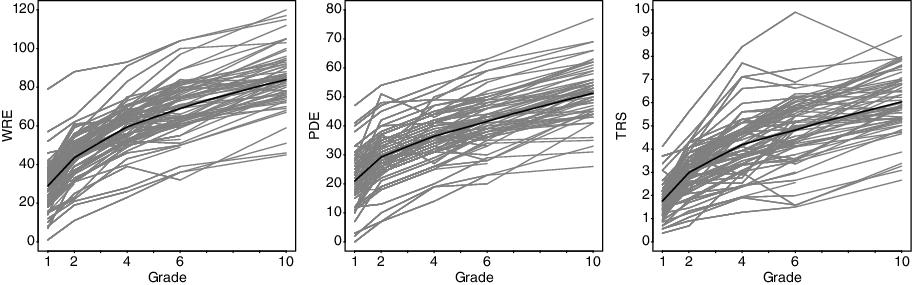
Observed Score Trajectories for the Three Measures. Each of the Grey Lines Connects the Data Points of a Single Child Over the Four Time Points. The Black Line Connects the Average Scores at Each Time Point. WRE, Word Reading Efficiency; PDE, Phonemic Decoding Efficiency; TRS, Text Reading Speed.

The present study
The purpose of this 10-year longitudinal study was three-fold: (a) to examine using a trajectory analysis the growth of reading (word, nonword, and text reading) in two separate periods (from Grade 1 to Grade 4 and from Grade 4 to Grade 10) in a consistent orthography (Greek), (b) to examine whether the lexicality effect increases during this time, and (c) to examine what cognitive skills predict the growth patterns (i.e., intercept and slope) in reading in these two developmental periods. We tested the following three hypotheses:
-
1) There will be rapid initial growth between Grades 1 and 4 and slower growth between Grades 4 and 10 (Caravolas et al., Reference Caravolas, Lervåg, Defior, Malkova and Hulme2013; Francis et al., Reference Francis, Shaywitz, Stuebing, Shaywitz and Fletcher1996; Verhoeven & van Leeuwe, Reference Verhoeven and van Leeuwe2009).
-
2) There will be small lexicality effect in Grades 1 and 2 (Caravolas, Reference Caravolas2018) followed by an increase in later grades (Davies et al., Reference Davies, Rodríguez-Ferreiro, Suárez and Cuetos2013; Pagliuca et al., Reference Pagliuca, Arduino, Barca and Burani2008).
-
3) Phonological awareness, RAN, and orthographic knowledge will predict the initial status in the first developmental period (Grades 1–4; Caravolas et al., Reference Caravolas, Lervåg, Defior, Malkova and Hulme2013; Lervåg & Hulme, Reference Lervåg and Hulme2009), whereas only RAN and orthographic knowledge will predict the initial status in the second developmental period (Grades 4–10). We further expected phonological short-term memory to be a significant predictor of the initial status of nonword-reading fluency and text-reading fluency development in both developmental periods. We did not formulate a hypothesis about articulation rate because of the absence of any previous studies in consistent orthographies.
The findings of the present study are expected to contribute to the literature in four important ways: First, to our knowledge, this is the first study using a trajectory analysis to follow the same children for 10 years. This allows us to build on the findings of previous studies in consistent orthographies that examined the growth trajectories only during the early school years (e.g., Caravolas et al., Reference Caravolas, Lervåg, Defior, Malkova and Hulme2013; Parrila et al., Reference Parrila, Aunola, Leskinen, Nurmi and Kirby2005). Second, because we assessed both real word-reading fluency and nonword-reading fluency, this allows us to test if there is a lexicality effect and how it manifests itself in upper elementary grades when children become fluent readers and rely more heavily on sight word reading. Third, we have included a measure of text-reading fluency (with no comprehension requirements) that allows us to compare its growth against that of word-reading fluency. Word-list-reading fluency and text-reading fluency are considered “superficially” identical (e.g., Fuchs et al., Reference Fuchs, Fuchs, Hosp and Jenkins2001; Hudson et al., Reference Hudson, Pullen, Lane and Torgesen2009) in that they both involve lower-level lexical skills (i.e., the ability to recognize individual words quickly and accurately). Still, they differ in the demand for higher-level supralexical processing skills, such as syntactic parsing and semantic integration, which are only involved in text-reading fluency (Jenkins et al., Reference Jenkins, Fuchs, van den Broek, Espin and Deno2003; Rasinski et al., Reference Rasinski, Reutzel, Chard, Linan-Thompson, Kamil, Pearson, Birr Moje and Afflerbach2012). Assuming children read lists of words in a way similar to reading simple texts (Altani et al., Reference Altani, Protopapas, Katopodi and Georgiou2020), the growth trajectories of text-reading fluency should be similar to that of word-reading fluency. Finally, we have included a variety of known predictors of reading development that were assessed twice: in Grade 1, to predict the growth patterns from Grade 1 to Grade 4 and, in Grade 4, to predict the growth patterns from Grade 4 to Grade 10. This is important because all previous studies on the growth trajectories of reading assessed the predictors once (at the onset of the study) and they could not test whether the same predictors are important for reading in different developmental periods.
Method
Participants
Letters of information describing our study were sent to the parents of 92 first graders attending three public elementary schools in Larnaca, Cyprus. Seventy-five children (42 girls, 33 boys, M age = 82.20 months, SD = 3.33) with parental consent participated in the study and were reassessed when they were in Grades 2 (M age = 94.48 months, SD = 3.22), 4 (M age = 115.82, SD = 3.47), 6 (M age = 136.29, SD = 3.42), and 10 (M age = 180.55, SD = 3.47). All children were native speakers of Greek and came from middle- to upper-middle class families (based on mother’s and father’s educational level; this information was collected as part of a larger project when children were in Grade 4; see Georgiou et al., Reference Georgiou, Parrila and Papadopoulos2016). None of the children were diagnosed with any intellectual, emotional, or sensory disabilities (based on school records). Nonverbal IQ was assessed in Grade 4 with Block Design from Wechsler Intelligence Scale for Children (WISC)-III (Georgas et al., Reference Georgas, Paraskevopoulos, Bezevegis and Giannitsas1997) and was found to be within the average range (mean scaled score was 10.45, SD = 2.77). By Grade 10, our sample consisted of 70 children (41 girls, 29 boys). The children who withdrew from our study did not differ significantly from those who remained in the study in any of the Grade 1 measures (all ps > .09). Parental consent and school consent were obtained prior to each testing point.
Materials
Phonological awareness
Phonological awareness was assessed with Phoneme Elision in Grade 1 and Grade 4. Children were asked first to hear a word and then say what was left in the word after deleting one of its sounds (e.g., Say “poli” [city]. Now say “poli” without saying the /p/ sound). After deleting the target phoneme, the remaining phonemes formed a real word. The items were recorded digitally on a laptop computer with the help of a native speaker and were presented to children through external speakers. There were three practice items and 24 test items. Four test items required the participant to say the word without saying one of the syllables, eight test items required the participant to delete the initial phoneme, six test items required the participant to delete the medial phoneme, and six test items required the participant to delete the final phoneme. In Grade 4, we added five more items requesting children to delete one of the sounds in consonant clusters. In both grades, testing was discontinued after three consecutive errors. A participant’s score was the total number correct (max = 24 in Grade 1 and 29 in Grade 4). Cronbach’s alpha reliability in our sample was .92 in Grade 1 and .91 in Grade 4.
Rapid automatized naming
RAN was assessed in Grades 1 and 4 with two measures: Color Naming and Digit Naming. Both tasks required children to name as quickly as possible five colors (blue, black, green, red, and yellow) or digits (2, 4, 5, 7, and 9) repeated 10 times each and arranged in semi-random order in five rows of 10. Prior to timed testing, each child was asked to name the colors or digits in a practice trial to ensure familiarity with the stimuli. A participant’s score was the number of items per second. Because very few naming errors occurred (the mean number of errors was less than 1 in either task), they were not considered further. Color Naming and Digit Naming correlated .62 with each other in Grade 1 and .74 in Grade 4. We created a composite score for RAN by averaging the z-scores for Color Naming and Digit Naming.
Phonological short-term memory
Digit Span Forward from WISC-III Greek adaptation (Georgas et al., Reference Georgas, Paraskevopoulos, Bezevegis and Giannitsas1997) was used to assess phonological short-term memory. Children were asked to repeat a string of digits in the same order they heard them. The strings started with only two digits, and one digit was added for each new digit string. The task was discontinued when the child failed both trials of a given length. A participant’s score was the number of digit strings that they could accurately provide. Cronbach’s alpha reliability in our sample was .62 in Grade 1 and .70 in Grade 4.
Orthographic knowledge
To assess orthographic knowledge, we administered the Orthographic Choice task that was modeled after the work of Olson and colleagues (e.g., Olson et al., Reference Olson, Wise, Conners, Rack and Fulker1989, Reference Olson, Forsberg, Wise, Rack and Lyon1994). Children viewed 30 pairs of letter strings that sounded alike (e.g., σχολϵίο - σχολίο) and were asked to circle the one that was spelled correctly. The items in Grade 4 were different from those in Grade 1 to allow enough variability. A participant’s score in each grade was the number of correctly circled real words (max = 30). Cronbach’s alpha reliability in our sample was .87 in Grade 1 and .80 in Grade 4.
Articulation rate
To assess articulation rate, we administered the Speech Rate task from the Das–Naglieri Cognitive Assessment System (Naglieri & Das, Reference Naglieri and Das1997; Greek standardization: Papadopoulos et al., Reference Papadopoulos, Georgiou, Kendeou and Spanoudis2009b). Children were asked to say a series of words, 10 times, as fast as possible. There were five items, each containing three very common two-syllable words (e.g., γάτα-παιδί-μήλο; cat-boy-apple). A participant’s score was the average time to complete all five items. Repetitions with errors were not included, but children were allowed to correct themselves. Test–retest reliability for Speech Rate with a subsample of children in our study was .79 in Grade 1 and .84 in Grade 4.
Oral reading fluency
We administered three measures of oral reading fluency in all assessment points: Word Reading Efficiency (WRE), Phonemic Decoding Efficiency (PDE), and Text Reading Speed (TRS). In WRE, children were asked to read as fast as possible a list of 104 words (in Grade 10 we added 26 more), divided into four (five in Grade 10) columns of 26 words each. Test–retest reliability for WRE with a subsample of children in our study was .85 in Grade 1, .92 in Grades 2 and 4, .93 in Grade 6, and .88 in Grade 10. In PDE, children were asked to read as fast as possible a list of 63 nonwords (in Grade 10, we added 21 more) divided into three (four in Grade 10) columns of 21 words each. A short, 8-word/nonword practice list was presented before each subtest. In each task, the participant’s score was the number of correct words/nonwords read within a 45-s time limit. Test–retest reliability for PDE with a subsample of children in our study was .80 in Grade 1, .86 in Grade 2, .89 in Grades 4 and 6, and .85 in Grade 10. Finally, in TRS, children were asked to read as fast and as accurately as possible a short narrative text. A preliminary list of six short stories from different storybooks was compiled for each grade level. Five independent teachers, whose teaching experience ranged from 5 to 15 years, read and rated each text for topic familiarity, number of potentially unfamiliar words, and overall text difficulty. The text that all teachers judged to have an unfamiliar topic but relatively few unfamiliar words and to be appropriate for a given grade level was administered. The text contained 19 words in Grade 1, 31 in Grade 2, 91 in Grade 4, 125 in Grade 6, and 147 in Grade 10. A participant’s score in TRS was the number of syllables in the correctly read words per second. This scoring procedure was deemed necessary because of differences in the length of the words included in each text across grades. Because only a few reading errors occurred (the mean number of errors was less than 1), they were not considered further. Test–retest reliability for TRS with a subsample of children in our study was .76 in Grade 1, .81 in Grade 2, .89 in Grade 4, .82 in Grade 6, and .88 in Grade 10.
Procedure
Children were tested individually in their respective schools during school hours by trained experimenters. The testing was conducted toward the end of each grade level (April/May; 8–9 months after the beginning of the school year). To estimate test–retest reliability for the speeded measures, a subsample of our participants (n = 22) was retested on the same measures 3 weeks after the initial testing.
Statistical analysis
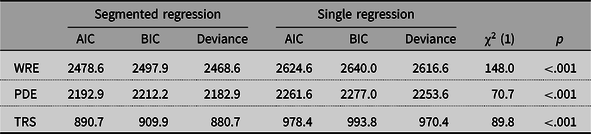
The analyses were conducted within a multilevel modeling framework using the lme4 package (version 1.1-13; Bates et al., Reference Bates, Maechler, Bolker and Walker2015) in R (R Core Team, 2017). To examine the growth trajectories of reading skills and their cognitive predictors in the two developmental periods (from Grade 1 to Grade 4 and from Grade 4 to Grade 10), we estimated separate growth models for the early (Grades 1, 2, and 4) and upper (Grades 4, 6, and 10) grades for each reading outcome (see also Figure 1). First, prior to conducting any further analyses, we confirmed the difference in the growth patterns between the two developmental periods by testing a segmented regression model (Carroll, Reference Carroll2008; Wagner et al., Reference Wagner, Soumerai, Zhang and Ross-Degnan2002) with two slope terms (i.e., early slope and later slope) for the five time points. Model fit was evaluated based on two standard parsimony-adjusted fit statistics: the Akaike Information Criterion and the Bayesian Information Criterion. Second, we examined an appropriate description of the growth trajectories for the two developmental periods separately for each reading outcome. We considered two alternative models: a steady growth model and a deceleration model. In the steady growth model, the three testing points in each developmental period were coded as follows: For the early grade models, they were coded as 0, 1, and 3, respectively; for the upper grade models, they were coded as 0, 2, and 6, respectively. By implementing this coding scheme, the intercept term in the models represents estimated performance at the first assessment point (i.e., Grade 1 or Grade 4), and the slope term represents estimated growth rate over the period (Biesanz et al., Reference Biesanz, Deeb-Sossa, Papadakis, Bollen and Curran2004; Compton, Reference Compton2000). In the deceleration model, the three testing points in both developmental periods were coded as 0, 1, and 2, respectively. By implementing this coding scheme, we considered a steeper growth during the early period (from the first to the second assessment point) and a less rapid growth during the later period (from the second to the third assessment point; see Skibbe et al., Reference Skibbe, Grimm, Bowles and Morrison2012). Third, to test whether growth rates of each reading outcome significantly varied across individuals, we compared the model fits between a random-intercept model and a random-slope model for each reading skill. Finally, we examined the relative importance of the cognitive skills at an earlier time point as predictors of both initial status (intercept) at the time and growth rates (slope) during the following period in each reading outcome. The confidence intervals (CIs) were used to test for the significance of each estimated effect. If the 95% CI does not include zero, the effect is significant at p < .05.
Results
Preliminary data analysis
The descriptive statistics and the correlations for all the study measures are shown in Table 1. The skewness and kurtosis values were in the acceptable range (Kline, Reference Kline2015). The few outliers in some measures (scores more than 3 SDs above/below the mean of the sample) were moved to the tails of the distributions before further analyses to avoid overemphasizing their effects on the results. The results of one-way repeated measures ANOVA for the reading measures showed that, as would be expected, the effect of grade was significant in all measures. The effect sizes from the pairwise comparisons indicated that WRE and TRS showed a relatively larger improvement from Grade 1 to Grade 4 (Cohen’s ds = 1.53–2.52) compared to those from Grade 4 to Grade 10 (ds = 0.90–1.85). In turn, there was a steady growth in PDE over the 10 years (ds = 1.31–1.96).
Descriptive statistics and correlations for the measures used in the study

Note. RAN, rapid automatized naming; DS, Digit Span; OC, Orthographic Choice; SR, Speech Rate; WRE, Word Reading Efficiency; PDE, Phonemic Decoding Efficiency; TRS, Text Reading Speed; G1, Grade 1; G2, Grade 2; G4, Grade 4; G6, Grade 6; G10, Grade 10. Correlations lower than .25 are nonsignificant; correlations between .25 and .32 are significant at the .05 level; and correlations higher than .32 are significant at the .01 level.
a Scores indicate the numbers of syllables in the correctly read words per second.
Similar to Caravolas (Reference Caravolas2018), we operationalized the lexicality effects as the difference between WRE and PDE at each time point and calculated them using Hedges’ g. The lexicality effects at each time point were 0.73, 95% CI [0.56, 0.91], 1.36, 95% CI [1.12, 1.62], 2.11, 95% CI [1.76, 2.50], 2.22, 95% CI [1.85, 2.63], and 2.64, 95% CI [2.22, 3.12] for Grades 1, 2, 4, 6, and 10, respectively. These values indicate that the lexicality effect increased across grades and that the increase was significant from Grade 1 to Grade 2 and from Grade 2 to Grade 4.
Growth patterns of reading skills
The results of the segmented regression models for each reading skill are shown in Table 3. All model fits were better for the segmented regression models that included two slope terms (i.e., early slope and later slope) than the single regression models that included only one slope term across time points (see Table 2), indicating that the growth patterns were significantly different between the early and the later developmental periods for all reading outcomes.
Results of model comparisons between the segmented regression models and the single regression models

Note. AIC, Akaike Information Criterion; BIC, Bayesian Information Criterion; WRE, Word Reading Efficiency; PDE, Phonemic Decoding Efficiency; TRS, Text Reading Speed.
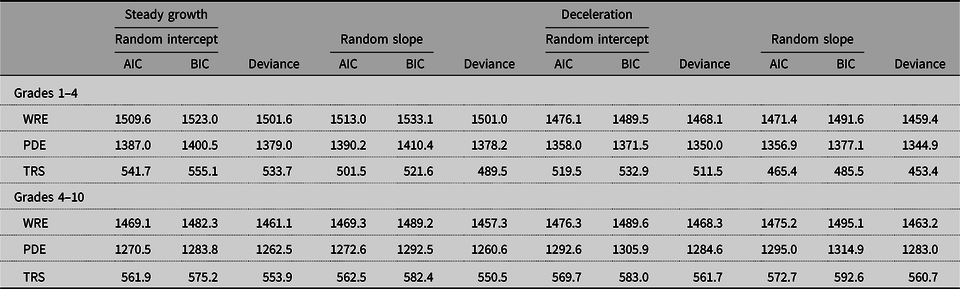
Results of model comparisons for the separate multilevel models for the early and later developmental periods

Note. AIC, Akaike Information Criterion; BIC, Bayesian Information Criterion; WRE, Word Reading Efficiency; PDE, Phonemic Decoding Efficiency; TRS, Text Reading Speed.
The results of the model comparisons between the steady growth models and the deceleration models are shown in Table 3. For the early grades, model fits were better for the deceleration models than for the steady growth models in all instances, indicating a rapid initial growth from Grade 1 to Grade 2 followed by a slower growth from Grade 2 to Grade 4. In contrast, for the upper grades, model fits were better for the steady growth models than for the deceleration models, indicating steady growth in all reading skills over the period.
Next, to test whether the growth rates of each reading outcome varied across individuals, we compared the model fits between a random-intercept model and a random-slope model for each variable (see Table 3). For WRE and TRS in the early grades, the model fits were better for the random-slope models than for the random-intercept models. In contrast, the model fits were largely comparable across the random-intercept models and the random-slope models in the upper grades. Indeed, for PDE and TRS in upper grades, the model fits were slightly better for the random-intercept models than the random-slope models, indicating that the growth rates of those variables did not differ across individuals. Taken together, we used the deceleration random-slope models for the early grades and the steady growth random-intercept models for the upper grades in further analyses.
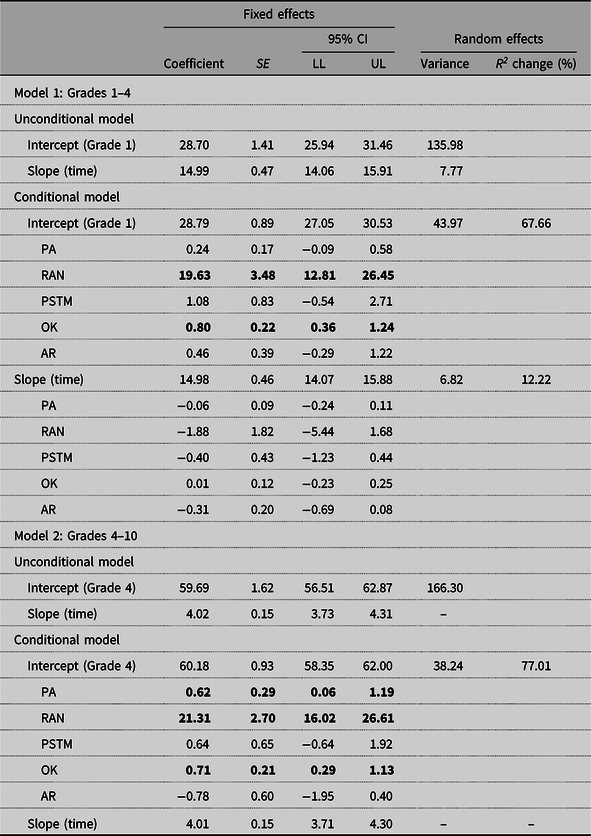
The results of the unconditional growth models for the reading outcomes are shown in Tables 4–6. The correlations between the intercept and the slope for the early grade models of each reading skill were −.18, −.32, and .52 for WRE, PDE, and TRS, respectively. These indicate that the higher the initial level of word and nonword-reading fluency, the less improvement there was during the period; in contrast, the higher the initial level of TRS, the more improvement there was during the same period.
Unconditional and conditional models for the growth of word-reading efficiency (Grades 1–4: deceleration–random-slope model; Grades 4–10: steady growth–random-intercept model)

Note. Predictor variables are initial values measured in Grade 1 and Grade 4 for the models for Grades 1–4 and the models for Grades 4–10, respectively. SE, standard error; CI, confidence interval; LL, lower limit; UL, upper limit; PA, phonological awareness; RAN, rapid automatized naming; PSTM, phonological short-term memory; OK, orthographic knowledge; AR, articulation rate. Estimates are considered to be significantly different from zero when the confidence interval does not include zero. Bolded numbers are significant.
Unconditional and conditional models for the growth of phonemic decoding efficiency (Grades 1–4: deceleration random-slope model; Grades 4–10: steady growth–random-intercept model)

Note. Predictor variables are initial values measured in Grade 1 and Grade 4 for the models for Grades 1–4 and the models for Grade– 4–10, respectively. SE, standard error; CI, confidence interval; LL, lower limit; UL, upper limit; PA, phonological awareness; RAN, rapid automatized naming; PSTM, phonological short-term memory; OK, orthographic knowledge; AR, articulation rate. Estimates are considered to be significantly different from zero when the confidence interval does not include zero. Bolded numbers are significant.
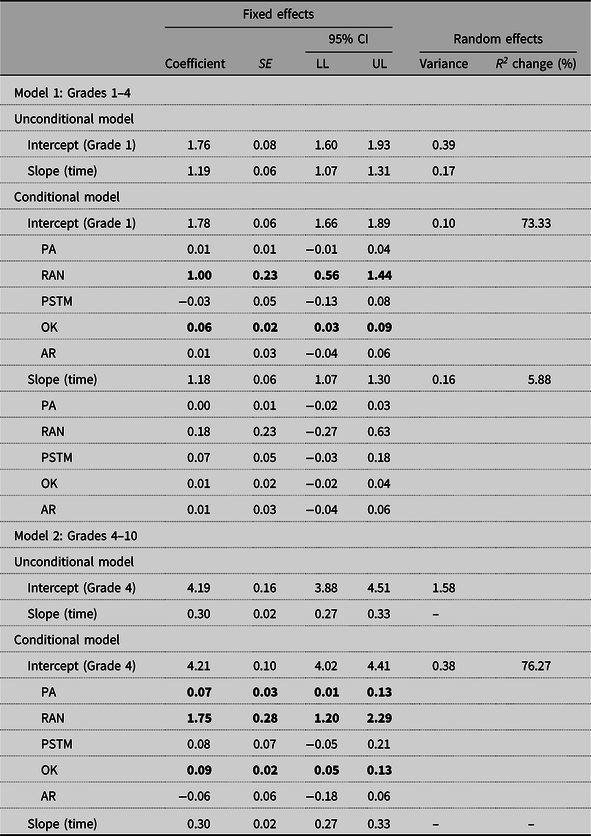
Unconditional and conditional models for the growth of text reading speed (Grades 1–4: deceleration random-slope model; Grades 4–10: steady growth–random-intercept model)

Note. Predictor variables are initial values measured in Grade 1 and Grade 4 for the models for Grades 1–4 and the models for Grades 4–10, respectively. SE, standard error; CI, confidence interval; LL, lower limit; UL, upper limit; PA, phonological awareness; RAN, rapid automatized naming; PSTM, phonological short-term memory; OK, orthographic knowledge; AR, articulation rate. Estimates are considered to be significantly different from zero when the confidence interval does not include zero. Bolded numbers are significant.
Cognitive predictors of the growth of reading skills
The conditional growth models for WRE are presented in Table 4. In the conditional models, phonological awareness, RAN, phonological short-term memory, orthographic knowledge, and articulation rate in either Grade 1 (Model 1) or Grade 4 (Model 2) were entered simultaneously as predictors. The results showed that RAN and orthographic knowledge were associated with the intercept term in both models. Additionally, phonological awareness was associated with the intercept term in the late development model. In contrast, no predictor variable made an independent and significant contribution to the slope term in the early development model. The conditional models predicted 67.66% and 77.01% of the intercept variances in the early and late development models, respectively; the model for the first developmental period predicted 12.22% of the slope variance.
The conditional growth models for PDE are presented in Table 5. First, the results indicated that RAN, phonological short-term memory, and orthographic knowledge were associated with the intercept term in both models. Phonological awareness was also associated with the intercept term in the early development model. Second, no predictor variable made an independent and significant contribution to the slope term in the early development model. The conditional models predicted 66.37% and 76.47% of the intercept variances in the early and late development models, respectively; the model for the first developmental period predicted 34.70% of the slope variance.
Finally, the conditional growth models for TRS are presented in Table 6. The results showed that RAN and orthographic knowledge were significantly associated with the intercept term in both early and late development models. Also, phonological awareness was associated with the intercept term in the early development model. No predictor variable made an independent and significant contribution to the slope term in the early development model. The conditional models predicted 73.33% and 76.27% of the intercept variances in the early and late developmental periods, respectively; the model for the early developmental period predicted 5.88% of the slope variance.
Discussion
The purpose of this 10-year longitudinal study was to use trajectory analysis to examine the growth of reading skills in a consistent orthography (Greek) and the cognitive predictors of the growth patterns over two developmental periods. In line with our hypothesis, during the first developmental period, we found a rapid initial growth from Grade 1 to Grade 2 followed by a less rapid growth from Grade 2 to Grade 4. In the second developmental period (from Grade 4 to Grade 10), the growth was linear and slower. These findings are in line with those of previous studies in early grades in consistent orthographies (Caravolas et al., Reference Caravolas, Lervåg, Defior, Malkova and Hulme2013; Leppänen et al., Reference Leppänen, Niemi, Aunola and Nurmi2004; Parrila et al., Reference Parrila, Aunola, Leskinen, Nurmi and Kirby2005). However, what is most striking here is the prolonged growth in these relatively simple reading skills. This implies that there are elements in these skills that are still developing even in upper elementary grades. A possible candidate is the ability to simultaneously process multiple stimuli in parallel (Altani et al., Reference Altani, Protopapas, Katopodi and Georgiou2020; Protopapas et al., Reference Protopapas, Katopodi, Altani and Georgiou2018). In early grades, this may involve intra-word processing, while in later grades inter-word processing.
Our results also showed that the growth rates of the reading skills varied significantly across individuals in the first developmental period (i.e., Grades 1–4), but not in the second developmental period (i.e., Grades 4–10). In other words, the individual differences established by Grade 4 remained at least relatively stable until Grade 10. Additionally, whereas the initial performance and the subsequent improvement in word- and nonword-reading fluency were negatively correlated in the first developmental period, those of text-reading fluency were positively correlated during the same period. According to Aunola et al. (Reference Aunola, Leskinen, Onatsu-Arvilommi and Nurmi2002), if the intercept is positively related to the growth, this means the gap between poor and good readers becomes wider over time. In contrast, if the correlation is negative, this means the gap between the two groups becomes narrower over time (i.e., poor readers catch up). Our results are in line with the argument that constrained skills (such as word-level reading) lead to a compensatory developmental pattern (Pfost et al., Reference Pfost, Hattie, Dorfler and Artelt2014). In turn, because text-reading fluency involves not only word recognition but also contextual knowledge, syntax, and semantics, this may amplify differences between those who have a head start in reading and those who struggle.
In contrast to one of the premises of the psycholinguistic grain size theory (Ziegler & Goswami, Reference Ziegler and Goswami2005) and to Caravolas’ (Reference Caravolas2018) findings, our results revealed a lexicality effect that increased in every assessment period. A possible explanation for this discrepancy might be that Caravolas’ (Reference Caravolas2018) study stopped in Grade 2 and, by that grade level, most children in relatively consistent orthographies like Czech and Slovak still rely on sequential grapheme to phoneme decoding in reading words and nonwords. This would reduce the chances of detecting a lexicality effect. Indeed, previous studies with Grade 1 or 2 children in consistent orthographies (including Greek) have reported similar findings (e.g., Goswami et al., Reference Goswami, Porpodas and Wheelwright1997; Havelka & Rastle, Reference Havelka and Rastle2005; Orsolini et al., Reference Orsolini, Fanari, Tosi, de Nigris and Carreri2006; Porpodas, Reference Porpodas1999). However, studies with older students in consistent orthographies do report a lexicality effect (e.g., Cuetos & Suárez-Coalla, Reference Cuetos and Suárez-Coalla2009; Davies et al., Reference Davies, Rodríguez-Ferreiro, Suárez and Cuetos2013; Pagliuca et al., Reference Pagliuca, Arduino, Barca and Burani2008; Zoccolotti et al., Reference Zoccolotti, De Luca, Di Filippo, Judica and Martelli2009). Our results revealed a significant change in the lexicality effect between Grades 1 and 2 and between Grades 2 and 4. This is when children in consistent orthographies are thought to shift to more lexical word reading (e.g., Burani et al., Reference Burani, Marcolini and Stella2002; Cuetos & Suárez-Coalla, Reference Cuetos and Suárez-Coalla2009). While the increased lexicality effect may indicate that some words were recognized as a whole, we acknowledge that familiarity with any size of sub-lexical units larger than graphemes may be an alternative explanation as we did not control for bigram, trigram, or morphemic frequencies in this study. While our results indicate that lexicality effect increases substantially from Grade 1 to Grade 10, what exactly accounts for the increasing lexicality effect is a question for future studies to examine.
In line with our second hypothesis, both RAN and orthographic knowledge predicted the intercept in all reading outcomes and in both developmental periods. This means that children with better RAN and orthographic knowledge skills are better off in word- and text-reading fluency than children with lower performance in these cognitive skills. The close connection of RAN and orthographic knowledge with oral reading fluency is not surprising as it has been shown in previous studies (e.g., Barker et al., Reference Barker, Torgesen and Wagner1992; Georgiou et al., Reference Georgiou, Parrila and Papadopoulos2008; Landerl & Wimmer, Reference Landerl and Wimmer2008; Rakhlin et al., Reference Rakhlin, Mourgues, Cardoso-Martins, Kornev and Grigorenko2019). Caravolas et al. (Reference Caravolas, Lervåg, Defior, Malkova and Hulme2013) also reported a significant contribution of RAN to the intercept of their silent reading fluency task. The fact that RAN and orthographic knowledge make independent contributions is interesting in view of Bowers and Wolf’s (Reference Bowers and Wolf1993) theoretical proposition that RAN predicts reading because of its contribution to the formation of orthographic representations. Our results show that there is something unique to RAN and oral reading fluency that is not shared with orthographic knowledge (and is also independent of articulation because we controlled here for articulation rate). We argue that this is likely due to the serial format of RAN and reading fluency measures that allows parallel processing of multiple stimuli when they appear in sequence (see Altani et al., Reference Altani, Protopapas, Katopodi and Georgiou2020; Protopapas et al., Reference Protopapas, Katopodi, Altani and Georgiou2018, for a similar argument).
Beyond RAN and orthographic knowledge, phonological awareness predicted the intercept of word- and text-reading fluency only in the second developmental period and of nonword fluency in the first developmental period. The latter was expected given that nonwords require some blending of the retrieved sounds. However, the former was unexpected not only because phonological awareness was found to predict the intercept of word-reading fluency in early grades in previous studies (e.g., Caravolas et al., Reference Caravolas, Lervåg, Defior, Malkova and Hulme2013; Leppänen et al., Reference Leppänen, Niemi, Aunola and Nurmi2004), but also because phonological awareness has been viewed as a predictor of early literacy acquisition in consistent orthographies (e.g., Landerl & Wimmer, Reference Landerl and Wimmer2008; Papadopoulos et al., Reference Papadopoulos, Kendeou and Spanoudis2012). The type of phonological awareness task used here (i.e., Phoneme Elision) did not play a role in these results since we used the same phonological awareness task in both developmental periods. A possible reason may relate to the type of words children attempted in WRE and TRS in early grades versus later grades. More specifically, the first two columns of words in WRE consist of short and mostly highly frequent words. This test structure may have allowed children to retrieve the pronunciations of these words by sight (hence orthographic knowledge was a significant predictor). However, as the words become progressively longer and less frequent, this may have forced children to rely not only on whole word recognition but also on phonological recoding that relies on phonological awareness. Similar to WRE, TRS in the early grades consisted of mostly short and highly frequent words. In upper elementary grades, the texts increased in length and included less frequent and longer words that may again elicit the effects of phonological awareness.
Phonological short-term memory also predicted the intercept of nonword-reading fluency in both developmental periods. Again, this was expected because decoding requires maintaining phonological information active in memory for a short period of time. Interestingly, the effects of phonological short-term memory were slightly stronger in the first than in the second developmental period, while the effects of orthographic knowledge followed the opposite direction. Because children are using their grapheme to phoneme mapping strategy to decode unknown words during the early grades, there is much more demand for phonological memory. In upper elementary grades, even though children still apply their grapheme–phoneme conversion rules to read parts of the nonwords, they rely increasingly on recognizing orthographic chunks within the nonwords to speed up their reading. This reduces the amount of information that needs to be kept in short-term memory and thus the effect of phonological short-term memory.
Some limitations of the present study are worth mentioning. First, our sample was relatively small. Even though similar sample sizes have been used in previous studies (e.g., Compton, Reference Compton2000), we acknowledge that a larger sample would allow us to test the effects of the predictors with stronger statistical power. Second, with the exception of RAN, the rest of the constructs were operationalized with a single measure. We acknowledge that had we administered multiple measures, our constructs would have been stronger. Third, because our study focused on oral reading fluency, we did not include any measures of silent reading fluency. Finally, due to practical reasons, we were not able to assess reading in every grade level or multiple times within the same grade level. The implications of this might be particularly important in Grade 1 since by the time we assessed reading (end of Grade 1), we may have missed the part of the rapid acceleration of reading that has been reported in previous studies (e.g., Caravolas et al., Reference Caravolas, Lervåg, Defior, Malkova and Hulme2013; Leppänen et al., Reference Leppänen, Niemi, Aunola and Nurmi2004). In addition, the lack of later time points (i.e., Grades 7–9) could be a reason for failing to find slope variability in later grades.
To conclude, our findings add to those of previous studies in consistent orthographies (e.g., Caravolas, Reference Caravolas2018; Caravolas et al., Reference Caravolas, Lervåg, Defior, Malkova and Hulme2013; Leppänen et al., Reference Leppänen, Niemi, Aunola and Nurmi2004; Lervåg & Hulme, Reference Lervåg and Hulme2009; Parrila et al., Reference Parrila, Aunola, Leskinen, Nurmi and Kirby2005) by suggesting that the growth of reading in Greek follows a rather predictable pattern with a rapid acceleration in Grade 1 (after children receive formal reading instruction) followed by a slower growth from Grade 2 onward. This implies that particular attention should be paid in early Grade 1 to consolidate the connections between graphemes and phonemes that support decoding and serve as a self-teaching device that builds up orthographic representations of words that are later on used in reading fluency. Our findings further showed that RAN and orthographic knowledge are particularly important as predictors of the initial status in reading fluency in both developmental periods. Interestingly, none of our cognitive skills predicted the slope in any reading outcome. This suggests that other variables (e.g., letter-sound knowledge, the instruction children receive) might be important beyond the ones examined here. Overall, the present findings underscore the need for further research on the growth trajectories of reading (including reading comprehension) and their predictors across languages varying in orthographic consistency.