


Introduction
Cognitive behavioral therapy for insomnia (CBT-I) has received significant attention as an effective non-pharmacological treatment for insomnia. In fact, the accumulation of substantial supporting evidence for the effectiveness of CBT-I (Brasure et al. Reference Brasure, Fuchs, MacDonald, Nelson, Koffel, Olson, Khawaja, Diem, Carlyle, Wilt, Ouellette, Butler and Kane2016) has led to its recent recommendation as first-line treatment for chronic insomnia by the American College of Physicians (Qaseem et al. Reference Qaseem, Kansagara, Forciea, Cooke and Denberg2016). In addition to its effectiveness for insomnia, CBT-I also reduces concurrent depression without ostensibly targeting non-sleep depression symptoms (Manber et al. Reference Manber, Edinger, Gress, San Pedro-Salcedo, Kuo and Kalista2008, Reference Manber, Bernert, Suh, Nowakowski, Siebern and Ong2011; Taylor and Pruiksma, Reference Taylor and Pruiksma2014). In fact, one study found that CBT-I alone resulted in a 37% decrease in depression severity (Manber et al. Reference Manber, Bernert, Suh, Nowakowski, Siebern and Ong2011). This has particular significance given the concordance between insomnia and depression, and their bi-directional relation (Lustberg and Reynolds III, Reference Lustberg and Reynolds2000). Indeed, insomnia is a reliable precursor of depression (Mahowald, Reference Mahowald2007; Li et al. Reference Li, Lam, Yu, Zhang and Wing2010; McCall et al. Reference McCall, Blocker, D'Agostino, Kimball, Boggs, Lasater and Rosenquist2010; Baglioni et al. Reference Baglioni, Battagliese, Feige, Spiegelhalder, Nissen, Voderholzer, Lombardo and Riemann2011; Pigeon et al. Reference Pigeon, Pinquart and Conner2012) and increases the risk for depression by nearly threefold compared to healthy sleepers (Zammit et al. Reference Zammit, Weiner, Damato, Sillup and McMillan1999; National Institutes of Health, 2005; Baglioni et al. Reference Baglioni, Battagliese, Feige, Spiegelhalder, Nissen, Voderholzer, Lombardo and Riemann2011; Hajak et al. Reference Hajak, Petukhova, Lakoma, Coulouvrat, Roth, Sampson, Shahly, Shillington, Stephenson and Walsh2011; Kessler et al. Reference Kessler, Berglund, Coulouvrat, Hajak, Roth, Shahly, Shillington, Stephenson and Walsh2011). Given the pervasive health impacts of both insomnia and depression, the opportunity to address both via CBT-I is advantageous and cost-effective.
Despite its promise, CBT-I is not without limitations. These primarily include a scarcity of certified practitioners, geographic distance to providers, personal limitations on travel and costs, and the requirement of 6–8 weeks of direct patient contact. These factors can contribute to reduced usage and may remain as barriers even after treatment initiation (Vincent and Hameed, Reference Vincent and Hameed2003; Espie et al. Reference Espie, Macmahon, Kelly, Broomfield, Douglas, Engleman, McKinstry, Morin, Walker and Wilson2007). Above all, the limited availability of credentialed behavioral sleep medicine (BSM) clinicians is the most salient barrier: nearly 20% of US adults experience insomnia (Roth et al. Reference Roth, Soubrane, Titeux and Walsh2006), yet there are well under 1000 board-certified BSM providers (Fields et al. Reference Fields, Schutte-Rodin, Perlis and Myers2013). The limited availability of certified clinicians is further compounded by disparities in access to health care (including CBT-I), which are particularly burdensome to those with lower socioeconomic status (SES) and racial minority groups. Furthermore, treatment dropout rates can be significantly higher in these vulnerable populations due to limited transport, insurance-coverage difficulties, child-care responsibilities, work schedule conflicts, and lack of knowledge about available treatments (Cooper and Conklin, Reference Cooper and Conklin2015). Racial minorities also historically report significant distrust in the medical and health care systems, which may be associated with reduced health-seeking behaviors (Corbie-Smith et al. Reference Corbie-Smith, Thomas and George2002; Armstrong et al. Reference Armstrong, Ravenell, McMurphy and Putt2007; Kennedy et al. Reference Kennedy, Mathis and Woods2007).
To address some of these barriers of access to CBT-I, web and mobile technologies have been utilized to develop Internet-based or digital CBT-I (dCBT-I). dCBT-I confers the advantages of reduced cost, therapist time, and empowers end users with technology to manage their own care and health. Furthermore, there may be less stigma associated with a user-driven digital health intervention compared with traditional therapy, which may also increase the accessibility of insomnia treatment. Though dCBT-I is still nascent, support for its efficacy has been accumulating from randomized controlled trials comparing it with an attention control or face-to-face CBT-I (Ström et al. Reference Ström, Pettersson and Andersson2004; Ritterband et al. Reference Ritterband, Thorndike, Gonder-Frederick, Magee, Bailey, Saylor and Morin2009, Reference Ritterband, Thorndike, Ingersoll, Lord, Gonder-Frederick, Frederick, Quigg, Cohn and Morin2017; Espie et al. Reference Espie, Kyle, Williams, Ong, Douglas, Hames and Brown2012; Zachariae et al. Reference Zachariae, Lyby, Ritterband and O'Toole2016). Other studies have also demonstrated the efficacy of dCBT-I programs in reducing depression, with effects sustained at both 6 and 18 months follow-up (Christensen et al. Reference Christensen, Batterham, Gosling, Ritterband, Griffiths, Thorndike, Glozier, O'Dea, Hickie and Mackinnon2016; Batterham et al. Reference Batterham, Christensen, Mackinnon, Gosling, Thorndike, Ritterband, Glozier and Griffiths2017). This evidence suggests the potential for the wide dissemination of an accessible and low-cost intervention for both insomnia and depression.
Ultimately, the success of dCBT-I is predicated on its effectiveness for a wide range of individuals; however, the efficacy of dCBT-I on insomnia and depression in populations with health disparities (minority and low income) has not yet been adequately examined. As such, the objective of this study was to test the efficacy of dCBT-I in reducing insomnia and depression across diverse demographic groups, including race, SES (income and education), gender, and age. Additional analyses also examined demographic differences in attrition.
Methods
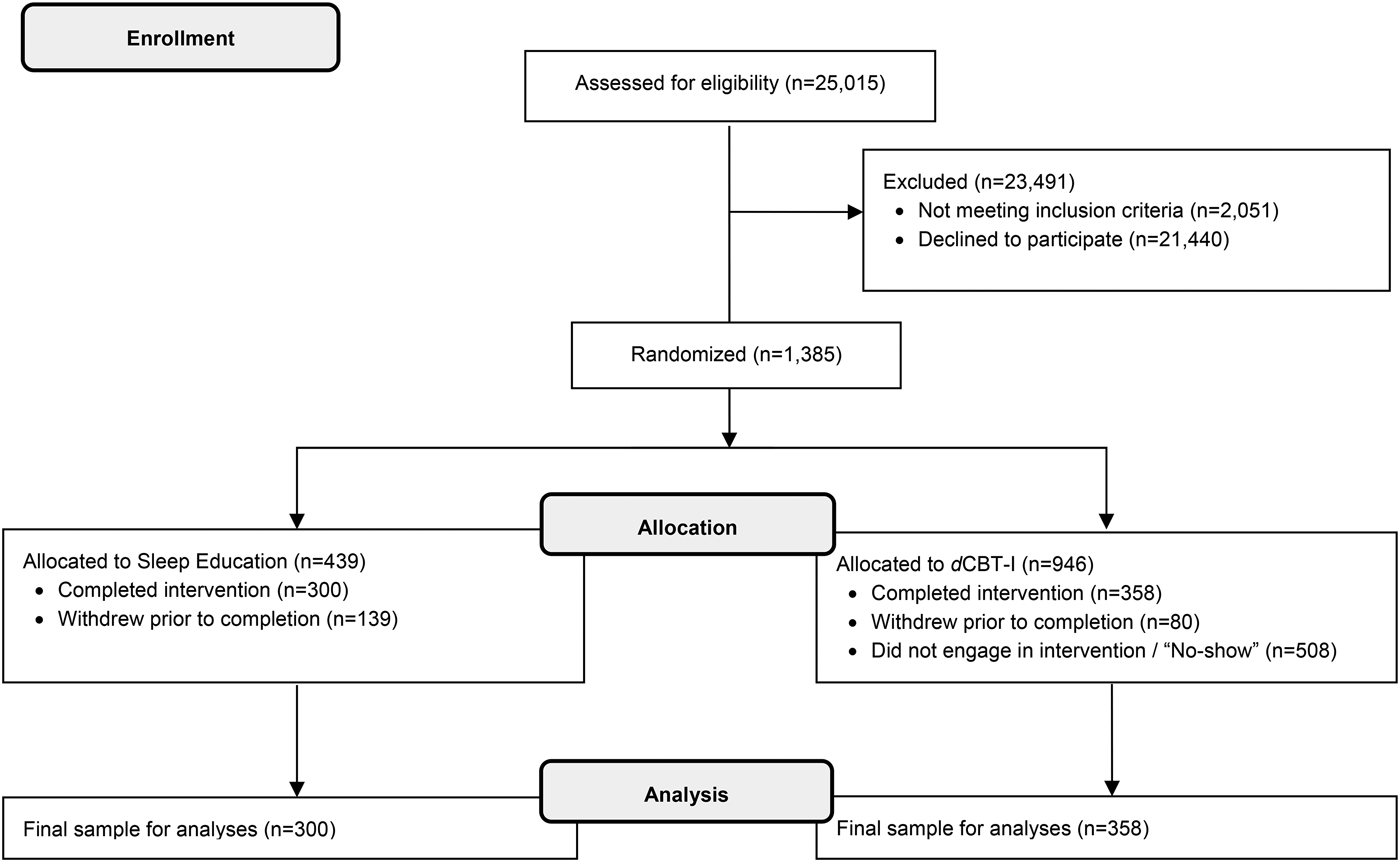
Recruitment for this study sampled from six hospitals, 38 medical centers, and subscribers of a major health insurance company in southeastern Michigan. Recruitment occurred between May and November of 2016, and utilized Internet-based methods, including health system-wide email newsletters, existing research databases (e.g. Qualtrics and prior research participants who have consented to future research recruitment), and clinic databases (e.g. health system chart review). Interested participants completed a screening survey via an online questionnaire platform (Qualtrics, Provo, UT) that assessed for study eligibility (see Fig. 1). Eligible participants had to meet the criteria for insomnia determined via Diagnostic and Statistical Manual of Mental Disorders, Fifth Edition (DSM-5) (American Psychiatric Association, 2013) diagnostic criteria, including the endorsement of sleep difficulty (i.e. difficulties falling asleep, staying asleep, or waking too early) for at least three nights a week lasting at least 3 months, accompanied by moderate distress and/or functional impairment consequential to the sleep difficulties. Exclusion criteria (assessed via the screening questionnaire) included lack of insomnia, reported diagnosis of sleep disorders other than insomnia (e.g. obstructive sleep apnea, restless legs, narcolepsy), and reported diagnosis of bipolar disorder or seizure disorder. Individuals who screened positive for signs of severe depression (i.e. self-reported daily or near daily depressed mood and anhedonia) were also excluded from study participation because a separate aim (not included in this manuscript) of this study examined the longer term prevention of depression incidence or relapse. As evidence for prevention or relapse requires longer term follow-up, additional analyses for this separate aim are planned after completion of follow-up visits.
Flow chart of study recruitment and enrollment.
Study design
This study utilized a placebo-controlled design with simple randomization into two parallel arms (dCBT-I and online sleep education). Randomization was computerized and conducted centrally through Qualtrics immediately after participants met eligibility criteria. A total of 1385 individuals with insomnia were enrolled in the study and randomized into either the dCBT-I or online sleep education conditions. The research staff was blinded to treatment allocation. Participants were randomized at a 2:1 ratio for the dCBT-I condition due to a higher anticipated attrition rate for the active compared with the sleep education condition, as has been previously demonstrated in Internet-based interventions (Christensen et al. Reference Christensen, Griffiths and Farrer2009). The final sample in the analyses included 358 for the dCBT-I condition and 300 for the online sleep education condition (age range 18–92). Attrition was operationalized as those who did not engage with treatment (i.e. no-show) and those who discontinued after treatment onset (see Fig. 1 for enrollment flow chart). All procedures were approved by the Henry Ford Health System Institutional Review Board. Informed consent was also given by all participants immediately following study eligibility, before any study procedures were executed.
Outcome measures
Assessments of insomnia and depression were used as the primary outcomes and were obtained via the same questionnaire platform as the screening survey. Assessments were conducted at pre- and post-treatment, with the latter occurring approximately 1 week following the final dCBT-I session. Insomnia severity was measured using the Insomnia Severity Index (ISI) (Morin et al. Reference Morin, Belleville, Bélanger and Ivers2011; Thorndike et al. Reference Thorndike, Ritterband, Saylor, Magee, Gonder-Frederick and Morin2011), with higher scores indicating increased insomnia severity (range 0–28). Remission at post-treatment operationalized as an ISI score of ⩽7, which corresponds to the threshold for non-clinically significant insomnia. Depression severity was measured using the Quick Inventory of Depressive Symptomatology (QIDS), with higher scores indicating increased depression severity (range 0–27). To examine the changes in non-sleep symptoms of depression, analyses only utilized non-sleep items from the QIDS (items 1–4 were dropped), unless otherwise specified. Both the ISI and QIDS have established validity and have been utilized in sleep- and depression-related clinical trials (Savard et al. Reference Savard, Savard, Simard and Ivers2005; Brown et al. Reference Brown, Murray, Carmody, Kennard, Hughes, Khan and Rush2008; Bernstein et al. Reference Bernstein, Rush, Trivedi, Hughes, Macleod, Witte, Jain, Mayes and Emslie2010; Yeung et al. Reference Yeung, Feldman, Pedrelli, Hails, Fava, Reyes and Mundt2012; American Psychiatric Association, 2013; Collins et al. Reference Collins, Nahum-Shani and Almirall2014) and clinical settings.
dCBT-I condition
Individuals randomized to the dCBT-I condition completed the Sleepio program via the Internet (www.sleepio.com, Big Health Ltd.). Sleepio is among several currently available dCBT-I programs, and was selected for this study because it is evidence-based, standardized, fully automated, and has been analyzed in multiple randomized controlled trials (Espie et al. Reference Espie, Kyle, Williams, Ong, Douglas, Hames and Brown2012, Reference Espie, Luik, Cape, Drake, Siriwardena, Ong, Gordon, Bostock, Hames and Nisbet2016; Freeman et al. Reference Freeman, Sheaves, Goodwin, Yu, Nickless, Harrison, Emsley, Luik, Foster, Wadekar, Hinds, Gumley, Jones, Lightman, Jones, Bentall, Kinderman, Rowse, Brugha, Blagrove, Gregory, Fleming, Walklet, Glazebrook, Davies, Hollis, Haddock, John, Coulson, Fowler, Pugh, Cape, Moseley, Brown, Hughes, Obonsawin, Coker, Watkins, Schwannauer, MacMahon, Siriwardena and Espie2017). Participants received access for 12 weeks during which they could take the six core sessions of dCBT-I; each session was unlocked on a weekly basis and participants were advised to take a session once a week. The intervention covered behavioral components (e.g. sleep restriction, stimulus control) and cognitive components (e.g. cognitive restructuring, paradoxical intention), as well as relaxation strategies (e.g. progressive muscle relaxation and autogenic training) and sleep hygiene. Sessions are directed by an animated ‘virtual therapist’ who guides the sessions, conducts progress reviews with the participant, discusses diary data submitted during the week, and assesses progress achieved against previously set goals. In addition, the participant will have access to additional components such as a library with background information, a forum with other users of the program, their case file, and weekly live expert sessions.
Online sleep education
Individuals randomized to the online sleep education condition received six weekly e-mails containing information on the following topics: the basics of endogenous sleep regulation; the impact on sleep of health problems; the effects of sleep disruptive substances, such as caffeine, nicotine, and alcohol; and tips on creating a sleep-conducive bedroom environment.
Demographic moderators
Treatment response was also examined by demographics, which included annual household income, race, sex, age, and education. Annual household income was operationalized as an ordinal variable with four levels: poverty, low, middle, and high. Poverty was operationalized as an annual household income less than 15k, which is consistent with the poverty threshold for a two-person household in 2016 (US Census Bureau, 2016). The thresholds for low, middle, and high income were <35k, <75k, and ⩾75k, respectively. Race was categorized as white, black, or other (i.e. Asian, American Indian/Alaska Native, multiracial, and unknown). Education was also operationalized as an ordinal variable with four levels: high school or less, some college, college, and graduate school. These categories correspond to the International Standard Classification of Education (UNESCO Institute for Statistics, 2012) levels 3 or below, 4 and 5, 6, and 7 or higher.
Analytical approach
A per-protocol analysis was conducted to examine the efficacy of dCBT-I in reducing insomnia and depression. Two mixed-effects linear regression models were implemented with ISI and QIDS scores as the outcome variables. A random intercept was included in both models to account for individual variation in pre-treatment levels of insomnia and depression. Fixed effects included time (pre- and post-treatment), condition (dCBT-I, sleep education), and the interaction of time × condition.
To test for differences in the treatment based on demographic variables (SES, race, sex, age, education), each of the two mix-effects models was further tested with demographic variables entered into the model. Demographic variables were first tested as a moderator with a three-way demographic × time × condition interaction variable. In cases where the demographic variable was not a significant moderator, they were subsequently added as a covariate to the original model with time, condition, and time × condition as fixed effects. Power analyses indicated that the final sample size achieved 80% power to detect a small effect size (0.16) for a three-way interaction.
Results
The per-protocol analyses included a final sample of 358 individuals who completed the dCBT-I condition, and 300 who received online sleep education. See Table 1 for sample characteristics between conditions.
Experimental and control conditions stratified by demographic groups

No statistical differences were detected at baseline between groups. ISI, Insomnia Severity Index; QIDS, Quick Inventory of Depressive Symptomatology.
Effectiveness of dCBT-I in reducing insomnia and depression
Insomnia
Results from the linear mixed model revealed a significant time × condition interaction, t(656) = −13.6, p < 0.001, indicating that change in ISI at post-treatment differed significantly between the dCBT-I and sleep education conditions. Specifically, the average decrease in ISI in the dCBT-I condition (−10.0 points ± 5.7 s.d.) was twofold greater than the decrease in the sleep education condition (−4.4 ± 4.6) (see Fig. 2A).
Change in ISI scores between the dCBT-I and sleep education conditions. Error bars indicate standard error of the mean. Experimental conditions in Panel A have been jittered for visual clarity and do not represent timing of treatments.
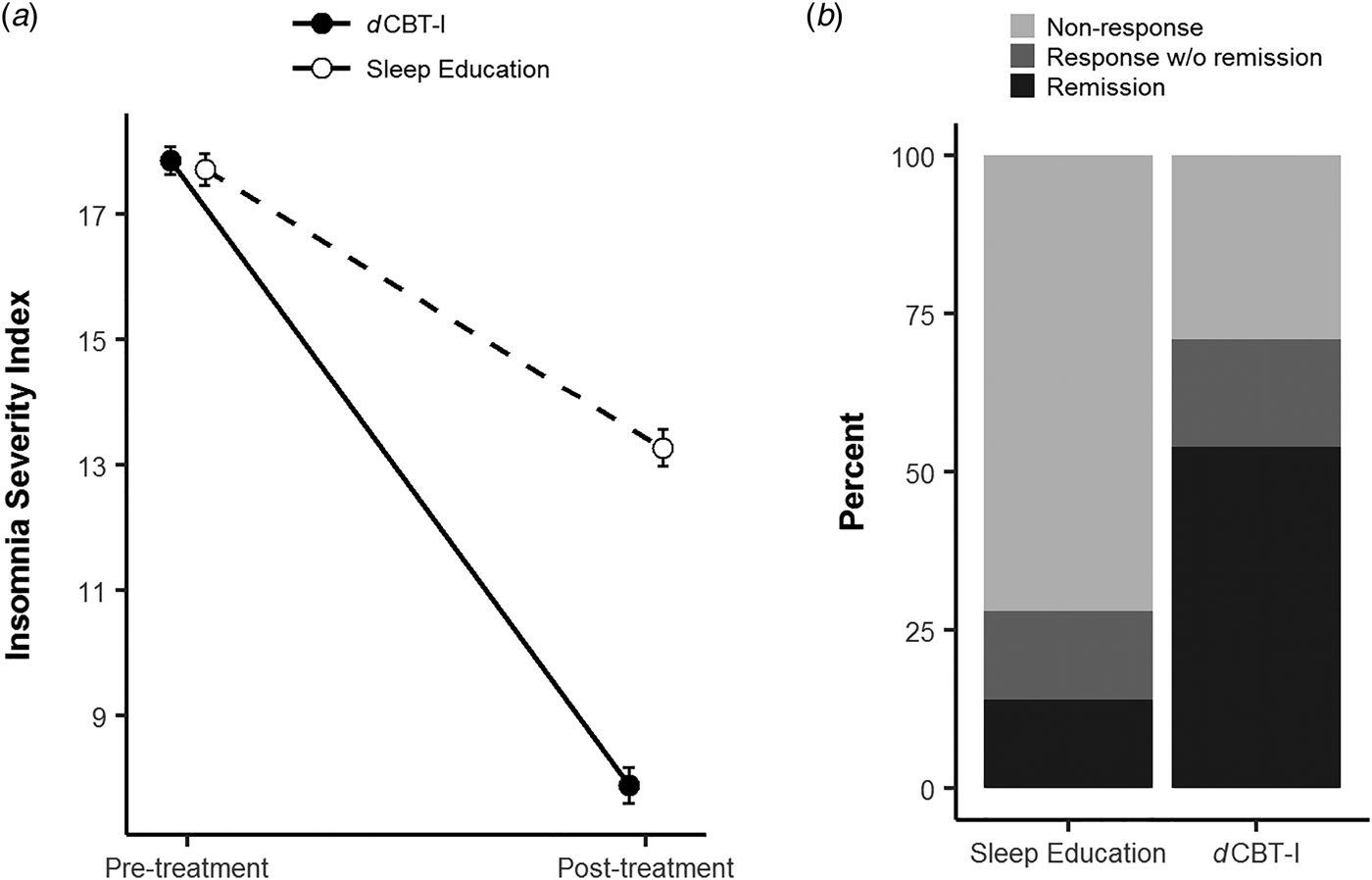
In addition to change in ISI, follow-up analyses also examined response and remission rates at post-treatment (response: reduction in ISI ⩾8; remission: post-treatment ISI ⩽7) using a χ2 test. Results indicated that more individuals in the dCBT-I condition exhibited a clinically significant treatment response (65.1%) compared with those in the sleep education condition (22.3%), χ2(1) = 16.9, p < 0.0001. Results also indicated that the remission rate at post-treatment was significantly higher in the dCBT-I condition, χ2(1) = 111.5, p < 0.0001. Specifically, the remission rate was almost four times higher in the dCBT-I condition [53.9%, 95% CI (48.7–59.1)] than in the sleep education condition [14.0%, 95% CI (10.4–17.6)] (see Fig. 2B).
Post-hoc analyses also examined if dCBT-I resulted in differential changes in difficulties with sleep onset, sleep maintenance, or early morning awakening. Results indicated comparable improvements between sleep onset difficulties (−1.25 pts), sleep maintenance difficulties (−1.31 pts), and early morning awakenings (−1.26 pts).
Depression
Models with depression symptoms as the outcome variable showed similar results compared with insomnia symptoms. A time × condition interaction, t(656) = −13.6, p < 0.001, indicated that change in QIDS at post-treatment differed significantly between the dCBT-I and sleep education conditions. Specifically, the average decrease in QIDS in the dCBT-I condition (−4.1 ± 4.7 s.d.) was 2.5 times greater than that of the sleep education condition (−1.6 points ± 3.7) (see Fig. 3 for change in QIDS). Overall, the effect size (Hedge's g; thresholds for small, medium, and large effects are 0.2, 0.5, and 0.8, respectively) for improvements in depression (with sleep items) was 0.64 (medium effect size), which is higher than the average effect size documented for a range of antidepressants (Hedge's g = 0.37) (Turner et al. Reference Turner, Matthews, Linardatos, Tell and Rosenthal2008).
Change in QIDS scores between the dCBT-I and sleep education conditions.

Exploratory analyses also examined changes by item on the QIDS, which revealed greater reductions in the dCBT-I condition in all non-sleep items except for sadness, suicidality, and restlessness – these items included weight, energy, decision-making, general interest, self-perception, sluggishness, and appetite. The greatest group difference was found with reduced energy, with dCBT-I showing an additional half point decrease compared with sleep education. This was followed by improved self-perception and decision-making, with dCBT-I showing an additional 0.39 and 0.38 point improvement, respectively (see Fig. 4 for change in QIDS items).
Change in non-sleep items on the QIDS by experimental condition.

Post-hoc analyses also indicated that differences in treatment response by condition also increased linearly by baseline depression severity (sans sleep items), condition × initial severity (lower, middle, and upper tertiles), t(652) = −3.94, p < 0.0001. Those in the upper tertile of depression severity showed the greatest improvements in non-sleep symptoms of depression from dCBT-I (−8.0 ± 4.7 s.d.) relative to the sleep education condition (−3.7 ± 4.4 s.d.), compared with the middle (dCBT-I: −3.8 ± 3.7 s.d., sleep education: −1.65 ± 3.1 s.d.) and lower tertiles (dCBT-I: −1.0 ± 2.7 s.d., sleep education: 0.41 ± 2.4 s.d.). Finally, post-hoc analyses also indicated that the reduction in non-sleep depression symptoms was significantly associated with the reduction in insomnia symptoms across both groups, though the effect was stronger in the dCBT-I condition (r = 0.50, p < 0.001) compared with the sleep education condition (r = 0.36, p < 0.001).
Demographic moderators of treatment response
SES: household income
Household income did not significantly moderate the efficacy of dCBT-I in reducing either insomnia or depression, and the estimated effects of household income were small (ISI: B = 0.78 ± 0.94 s.e.; QIDS: B = 0.78 ± 0.77 s.e.). The time × condition interactions for both ISI and QIDS remained significant with household income as a covariate. Additionally, household income was a significant covariate for both insomnia and depression, indicating higher severity with lower income. Specifically, ISI scores increased by an average of 1.59 ± 0.35 points with each decrease in income bracket, whereas QIDS scores increased by an average of 2.29 ± 0.32 points with each decrease in income bracket.
SES: education
Education also did not significantly moderate the efficacy of dCBT-I in reducing either insomnia or depression (see Fig. 5). The estimated effects of education were moderate for ISI (B = 1.67 ± 0.94 s.e.) and small for QIDS (B = 0.83 ± 0.78 s.e.). The time × condition interactions for both ISI and QIDS remained significant with education as a covariate. Education was a significant covariate for both insomnia and depression, indicating higher severity with lower education. Specifically, ISI scores increased by an average of 0.90 ± 0.36 points with each decrease in education bracket, whereas QIDS scores increased 1.03 ± 0.34 points with each decrease in education bracket.
Change in insomnia and depression in the dCBT-I condition by household income brackets.

Race
Race also did not significantly moderate the efficacy of dCBT-I in reducing either insomnia or depression, and the estimated effects of race were small for both ISI (black v. white: B = 0.71 ± 1.00 s.e.; other v. white: B = 0.78 ± 1.57 s.e.) and QIDS (black v. white: B = −0.67 ± 0.83 s.e.); other v. white: B = 0.13 ± 1.30 s.e.). The time × condition interactions for both ISI and QIDS remained significant with education as a covariate. Race was a significant covariate for insomnia but not for depression. Specifically, black individuals reported an overall average of 1.15 ± 0.38 points higher on the ISI compared with white individuals.
Sex
Sex also did not significantly moderate the efficacy of dCBT-I in reducing either insomnia or depression, and the estimated effects of sex were small for both ISI (male v. females: B = 0.64 ± 0.99 s.e.) and QIDS (male v. females: B = −0.28 ± 0.82 s.e.). The time × condition interactions for both ISI and QIDS remained significant with sex as a covariate. Sex was not a significant covariate for insomnia or depression.
Age
Age also did not significantly moderate the efficacy of dCBT-I in reducing either insomnia or depression, and the estimated effects of age were small for both ISI (B = 0.40 ± 0.25 s.e.) and QIDS (B = 0.05 ± 0.21 s.e.). The time × condition interactions for both ISI and QIDS remained significant with age as a covariate. Age was not a significant covariate for insomnia but was significant for depression, though the effect was small. Each decade increase in age was associated with a 0.64 ± 0.09 point decrease in QIDS scores, t(655) = −7.08, p < 0.0001.
Demographic moderators of treatment uptake
Given the notable attrition rates of Internet-delivered interventions (Melville et al. Reference Melville, Casey and Kavanagh2010), additional analyses were also conducted to examine if treatment uptake of dCBT-I differed by demographic variables. Results indicated significant differences by household income, education, race, and age (see Table 2). Interestingly, logistic regression indicated that dropout rates did not differ between white and black participants; however, people of color who were not black (i.e. Asian, American Indian/Alaska Native, multiracial, and unknown) showed a 66% increase in odds of dropout compared with white participants, OR = 1.66, 95% CI (1.03–2.77). Individuals with less than a college education also demonstrated higher odds of dropout relative to college graduates; those with some college showed over two-thirds increase in odds of dropout, OR = 1.73, 95% CI (1.20–2.50), whereas those who graduated high school show more than a threefold increase in odds of dropout, OR = 3.26, 95% CI (2.13–5.04). Relative to the middle class, those at low or poverty levels of income also showed greater odds of dropout; those with low household income showed twice the odds of dropout, OR = 2.00, 95% CI (1.41–2.85), and those at the poverty level showed greater than twice the odds of dropout, OR = 2.20, 95% CI (1.46–3.33). Age was also a significant predictor of dropout, with each decade increase above the average age (44.47) associated with approximately a 20% decrease in odds of dropout, OR = 0.82, 95% CI (0.76–0.89).
Dropout rate for dCBT-I compared by demographic variables

Differences in attrition were assessed via logistic regression stratified by demographic groups. Reference groups are italicized.
*p < 0.05, **p < 0.01, ***p < 0.001.
n.s., not significant.
Discussion
Findings from this study provide further evidence that dCBT-I reduces both insomnia and depression symptoms. As an Internet-based intervention, dCBT-I is less costly and more accessible than face-to-face interventions, particularly given the limited number of specialty providers trained in CBT-I. Given the potential benefits of dCBT-I, it is important that both efficacy and effectiveness are demonstrated across a range of demographic groups. This study was the first and largest to examine the efficacy of dCBT-I across different demographic groups, including those with significant health disparities. Results revealed no significant differences in the improvement of insomnia and depression between demographic groups despite having adequate statistical power to detect a small effect size. Furthermore, the estimates for the moderating effect of demographic groups were small (less than one point on the ISI and QIDS), suggesting limited clinical significance even if effects were to be detectable with a larger sample. Together, there is no strong evidence for reduced efficacy of dCBT-I for both insomnia and depression in the underserved populations studied here.
These results also support the potential for dCBT-I to serve as a first-line intervention for those with both insomnia and depression. The web-based delivery makes this approach highly scalable and sustainable, especially given the significant clinical impact. Because dCBT-I can be implemented with minimal to no involvement of a clinician, it can be easily integrated into a primary care setting where both insomnia and depression are typically first detected. Furthermore, integration at the primary care setting may also be ideal in reducing health disparities in access to mental health care. Future studies should focus on the prevention of incident depression in longitudinal follow-up designs to determine the potential impact on reducing the incidence and relapse of major depressive disorder.
dCBT-I can also be combined with CBT-I in a stepped-care framework by use of a fully automatized system with the potential for wide dissemination (Christensen et al. Reference Christensen, Batterham, Gosling, Ritterband, Griffiths, Thorndike, Glozier, O'Dea, Hickie and Mackinnon2016). Stepped-care approaches also capitalize on the strengths of both face-to-face and Internet-delivered CBT-I treatment modalities while minimizing their disadvantages and inefficiencies. As opposed to a system where everyone with insomnia receives treatment by a specialist, a stepped-care approach begins with a least restrictive intervention, and only graduates limited- or non-responders to treatment with a specialist. This reserves specialist treatment for more complex cases, thus allowing specialists to practice at the top of their licenses.
We propose that this stepped-care model would be most impactful if integrated into the primary care system, as early identification and treatment of both insomnia and depression typically occur in primary care. The current integrated care processes can be leveraged to immediately implement treatment when sleep problems are initially identified in the primary care setting. This stepped-care approach to insomnia treatment has yet to be tested in large-scale and clinically-based effectiveness trials (i.e. real-world), but has the potential to significantly impact insomnia therapeutics and transform the limited approach currently in place. In particular, the large-scale clinical studies will need a particular focus on effectiveness (including treatment uptake and adherence) in underserved minority and low-income populations to establish real-world generalizability and wide dissemination. Such trials are also needed to determine if a reduction of insomnia and depression symptoms leads to long-term mitigation of depression incidence (i.e. secondary prevention).
Demographic differences in attrition for dCBT-I
One critical consideration for the implementation of dCBT-I is the utilization and uptake by individuals. This is a critical gap in the literature as very few studies have examined demographic differences in attrition for insomnia interventions, and this is the first study that has done so for dCBT-I. As such, we were unable to assess how attrition rates by demographics for dCBT-I compare to face-to-face CBT-I or other digital insomnia interventions. However, the overall attrition rate for the dCBT-I group found in this study was within the expected range in comparison with other randomized controlled trials of Internet-delivered psychotherapy interventions (50–83%) (Yeung et al. Reference Yeung, Chung, Ho and Ho2015; Batterham et al. Reference Batterham, Christensen, Mackinnon, Gosling, Thorndike, Ritterband, Glozier and Griffiths2017; Watson et al. Reference Watson, Levine, Zerwas, Hamer, Crosby, Sprecher, O'Brien, Zimmer, Hofmeier, Kordy, Moessner, Peat, Runfola, Marcus and Bulik2017). Notably, the rate of dropout was much lower for those who engaged in CBT-I (i.e. completed at least one session) compared with those who did not engage in treatment (i.e. no-shows).
While we found no differences in the treatment effects of dCBT-I between demographic groups, results did show demographic differences in the dropout rates consistent with other intervention studies (Wierzbicki and Pekarik, Reference Wierzbicki and Pekarik1993; Melville et al. Reference Melville, Casey and Kavanagh2010; Watson et al. Reference Watson, Levine, Zerwas, Hamer, Crosby, Sprecher, O'Brien, Zimmer, Hofmeier, Kordy, Moessner, Peat, Runfola, Marcus and Bulik2017). In particular, low SES (i.e. education and income) was associated with greater risk for dropout from dCBT-I. This is consistent with prior evidence from a meta-analysis indicating that lower SES was the strongest predictor of psychotherapy dropout among demographic variables (Wierzbicki and Pekarik, Reference Wierzbicki and Pekarik1993). Importantly, results from the current study suggest that increased accessibility alone does not sufficiently mitigate treatment barriers for many individuals with limited education and financial resources. Further evidence must be collected to elucidate additional barriers to engagement and persistence for dCBT-I associated with low SES.
The finding of high attrition among those with low SES also represents an opportunity to examine if and how dCBT-I may be refined to enhance the appropriateness and feasibility across a diverse range of people. This evaluation is among the critical steps required prior to the wide dissemination of dCBT-I. The flexibility afforded via the digital platform means that both content and implementation of dCBT-I can be readily tailored to address the needs of a low SES population. Additionally, gains in retention could be further enhanced with a stepped-care model. For example, even a modest improvement of 5–10% in attrition could extend accessibility of dCBT-I to one-third of those in the lowest SES bracket. The remaining individuals can be triaged to enhanced interventions that are socially integrative and multipronged. For instance, a recent study successfully achieved a fourfold reduction in attrition in low-income racial minority participants via a strategic framework that targeted cultural and linguistic competency, relationship building, leveraging existing social networks, contingency management, and other relevant domains (Flores et al. Reference Flores, Portillo, Lin, Walker, Fierro, Henry and Massey2017). Because these approaches are generally more resource intensive, they are well matched for a stepped-care model that enables redistribution of existing resources. As such, future research should test the feasibility of stepped-care models for insomnia, particularly in those with limited education and financial resources.
Importantly, attrition rates from this study did not differ between black and white participants despite historically established differences in treatment engagement and adherence in traditional forms of psychotherapy (Yamamoto et al. Reference Yamamoto, James, Bloombaum and Hattem1967; Sue et al. Reference Sue, McKinney, Allen and Hall1974). In fact, an early study found that attrition within 6 weeks of treatment (a match to the length of dCBT-I in this study) was twice as high for black compared with white patients (Rosenthal and Frank, Reference Rosenthal and Frank1958). More recent studies have continued to show similarly higher attrition rates in black compared with white individuals (Murphy et al. Reference Murphy, Kassem, Chemerinski, Rush, Laje and McMahon2013; Johnson et al. Reference Johnson, Price, Mehta and Anderson2014). As such, it is notable that attrition rates for dCBT-I were comparable between white and black participants in this study. Interestingly, results did indicate that those in the ‘other’ category appeared to be at higher risk for dropout. The interpretation of this result is less clear because this category is significantly smaller in sample size (<25 in each condition) and comprises multiple racial identities (including multiracial identities). Future research with greater representation of non-black people of color is necessary to further understand this relationship.
While gender was not associated with differences in dropout, our final sample was predominantly female. Exploratory analyses revealed comparable gender distribution throughout the enrollment process, suggesting that the gender differences may be associated with initial interest in participating in intervention research for insomnia. There is evidence that females are more likely to engage in health-seeking behaviors in both a traditional clinical setting (Möller-Leimkühler, Reference Möller-Leimkühler2002) and on the Internet (Ybarra and Suman, Reference Ybarra and Suman2006). The gender differences in help-seeking behaviors are also further compounded by the higher prevalence of insomnia in women (Roth and Roehrs, Reference Roth and Roehrs2003). Finally, the gender distribution found in this study was also comparable to that found in another recent study of dCBT-I (Christensen et al. Reference Christensen, Batterham, Gosling, Ritterband, Griffiths, Thorndike, Glozier, O'Dea, Hickie and Mackinnon2016).
Results from this study also found that older age was associated with reduced attrition from dCBT-I, which is consistent with the previous studies that have examined intervention dropout (DeMaris, Reference DeMaris1989; Lange et al. Reference Lange, Rietdijk and Hudcovicova2005). The replication of this finding in the context of an Internet-based intervention is significant, particularly given general concerns that technological literacy in older adults would be a barrier to dCBT-I. While results do not speak specifically to the role of technological literacy, they do support the feasibility of dCBT-I in older populations, and also indicate comparable efficacy across the age ranges. This should be further examined in a larger effectiveness study in a community sample.
While the depression severity in this sample ranged from none to very severe (max QIDS = 23), the majority of depression scores fell in the ‘mild’ and ‘moderate’ range (QIDS score 7–15). As such, one limitation of this study is the generalizability to those with more severe forms of depression. Another limitation is the use of a per-protocol analysis, which can be vulnerable to bias and also precludes generalizability of the described effects to all who would be prescribed dCBT-I. However, given that our proposed stepped-care model would integrate dCBT-I as a first-line intervention, those who were unable to complete dCBT-I would be additionally triaged for other forms of intervention. Additionally, as is the case with most efficacy trials, these results describe the effect of the treatment under ideal circumstances (e.g. minimal comorbidities, ability to complete the treatment) and should be interpreted as such. Finally, there were no statistical differences in demographics between the two experimental groups, suggesting that any bias associated with the per-protocol analysis was minimal. These data also point to a clear need for further implementation research to examine how uptake of Internet-delivered interventions may be enhanced in the community, particularly in those with socioeconomic disadvantages.
Overall, results from this study lend support that dCBT-I could be an effective first-line intervention for insomnia and depression. The evidence suggests that there are little to no differences in efficacy for underserved minorities who are able to complete the intervention. Furthermore, the lack of differences in attrition between black and white participants suggests that dCBT-I may also have potential in improving the racial disparities of access to care for insomnia and depression. Future research should examine the effectiveness of dCBT-I in a community sample because this evidence was collected in the context of a research intervention and thus may have limited generalizability to a naturalistic help-seeking population. Furthermore, treatment barriers in lower SES populations need to be further characterized in order to inform interventions strategies that are feasible and appropriate.
Conclusion
Findings from this study provide further evidence for the efficacy of dCBT-I in treating insomnia and concurrent depression in a wide range of individuals from various demographic groups, including race, SES (income and education), sex, and age. Furthermore, dCBT-I appears to have comparable uptake in both black and white individuals, suggesting that it could have potential in reducing racial disparities in access to care for insomnia and depression. Together, these evidence support the further examination of the utility of dCBT-I in large-scale reduction of insomnia and depression.
Acknowledgments
Support for this study was provided from the Robert Wood Johnson Foundation, and from the National Institute of Mental Health R56MH115150 awarded to CLD. Funding for PC was provided from the National Heart Lung and Blood Institute (K23HL138166). We would also like to thank David Adler for his continued support of our research program.



