Introduction
Prostate cancer is one of the most common solid malignancies with high morbidity rate. Reference Edwards, Noone and Mariotto1 There are several treatment alternatives including prostatectomy, brachytherapy, external beam radiation or a combination of two or more. Radiotherapy is commonly used to treat localised prostate cancer. Reference Walsh, DeWeese and Eisenberger2
In radiotherapy, defining the tumor margin is a critical factor affecting the treatment outcome. In order to contour a tumor, following regions of interest should be specified: (1) gross tumor volume (GTV) that covers the primary tumor; (2) clinical target volume (CTV) to define a margin around the GTV to cover microscopic disease and (3) planning target volume (PTV), which contains margin around CTV to account for set-up uncertainty. Reference Suzuki, Nishioka and Homma3–Reference Hamamoto, Inata and Sodeoka5 The rationale of different contours is to consider set-up errors and internal target motion without compromising target coverage. The margins must also facilitate conformal avoidance of the normal tissues. The uncertainty of prostate position limits the optimisation of conformal radiotherapy (CRT), and in order to account for positional uncertainties, PTV should be expanded. Reference Sze, Lee, Hung, Yau and Lee6 The development of the three-dimensional CRT and intensity modulate radiotherapy has enabled the delivery of escalated doses to the tumor target while simultaneously sparing the surrounding normal tissues. Reference Yoshimura, Iwata, Shibuya, Sakai and Kihara7 , Reference Wojcieszynski, Olson, Rong, Kimple and Yadav8
It is observed that a small ring-shaped structure circumferentially around the PTV permits the planning programme to make the higher isodose curves more conformal to the PTV and limits the maximum dose on tumor volume. Reference Nagashima, Sakakibara, Sangai, Kazama, Fujimoto and Miyazaki9 , Reference Guckenberger, Sweeney, Nieder and Langendijk10 Presently, ring of different shapes and sizes is used by dosimetrists to improve plan quality.
In this case study, we investigated the dosimetric differences in treatment plans with rings of two different diameters (2 and 3 cm) for prostate and prostate nodes using tomotherapy.
Case Description
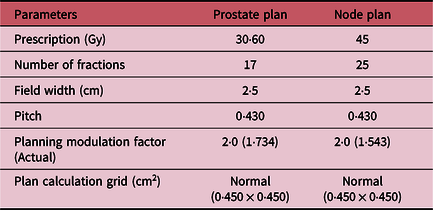
The patient was scanned on a helical computed tomography (CT) system with 2.5 cm slice thickness. The kV CT images were exported to the Pinnacle3 8.1 treatment planning system (Philips Medical Systems, Fitchburg, WI, USA) for contouring. The patient was treated for the prostate and pelvic nodes in 75·6 Gy (30·6 Gy/17 fractions with successive 45 Gy/25 fractions boost). Attending physician contoured the prostate, seminal vesicles, bladder, rectum, femoral heads, colon, bowel and abdomen. Apart from these structures, an external posterior block to reduce rectal dose was also contoured by the dosimetrist. This block is basically a dummy volume around the PTV to improve conformity in high-dose regions and to reduce dose in normal tissues. For planning, the CT datasets and the contours were transferred to the tomotherapy planning station (TomoTherapy Inc., Madison, WI, USA) using a DICOM RT export window. The patient was treated using two different plans for prostate and nodes in sequence. Patient was treated with plans (prostate and node) utilising ring-shaped contours with a diameter of 3 cm. Two more plans (one for prostate and other for pelvis nodes) were generated using 2 cm ring for retrospective study in order to analyse the impact of reducing the ring diameter in treatment plans. Also, a composite plan (combined dose volume histogram (DVH) of prostate and pelvic node plans) was generated using in-house software. The planning parameters used for plans are tabulated in Table 1. The dose was prescribed to 99% of the PTV for both prostate and node plan.
Treatment planning parameters for all prostate and node plan

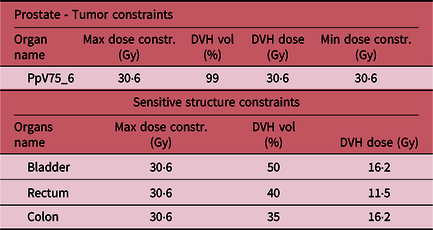
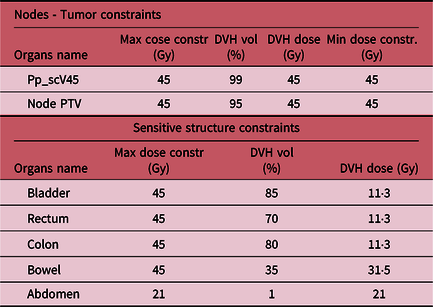
This study was conducted to demonstrate the dosimetric differences in the prostate and pelvic node plans with two different ring dimensions (2 and 3 cm). The optimisation parameters used for both plans are shown in Tables 2 and 3.
Planning constraints used in prostate plan for 2 and 3 cm rings

DVH, dose volume histogram.
Planning constraints used in pelvic node plan for 2 and 3 cm rings

DVH, dose volume histogram.
In order to do a fair comparison, the same optimisation parameters were used for both plans.
Results and Discussion
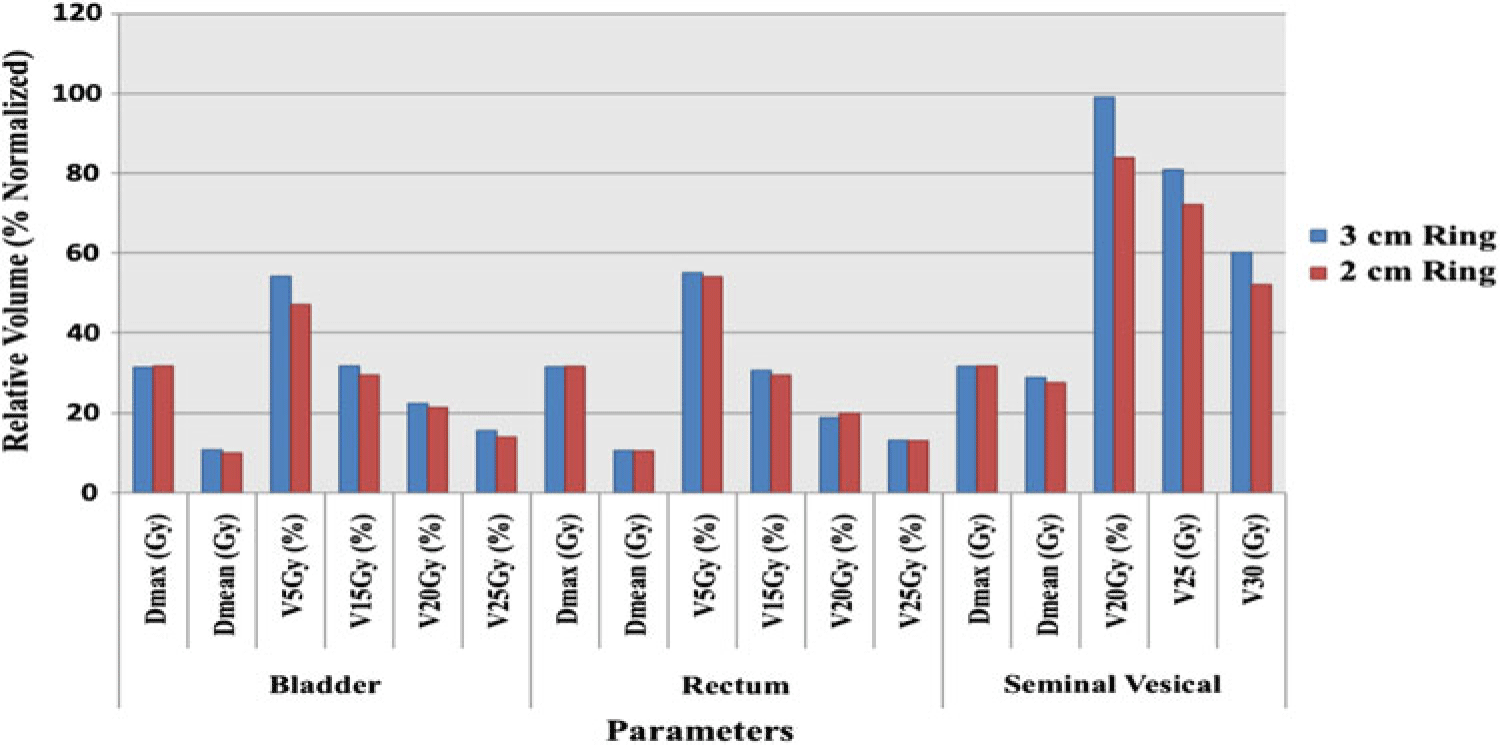
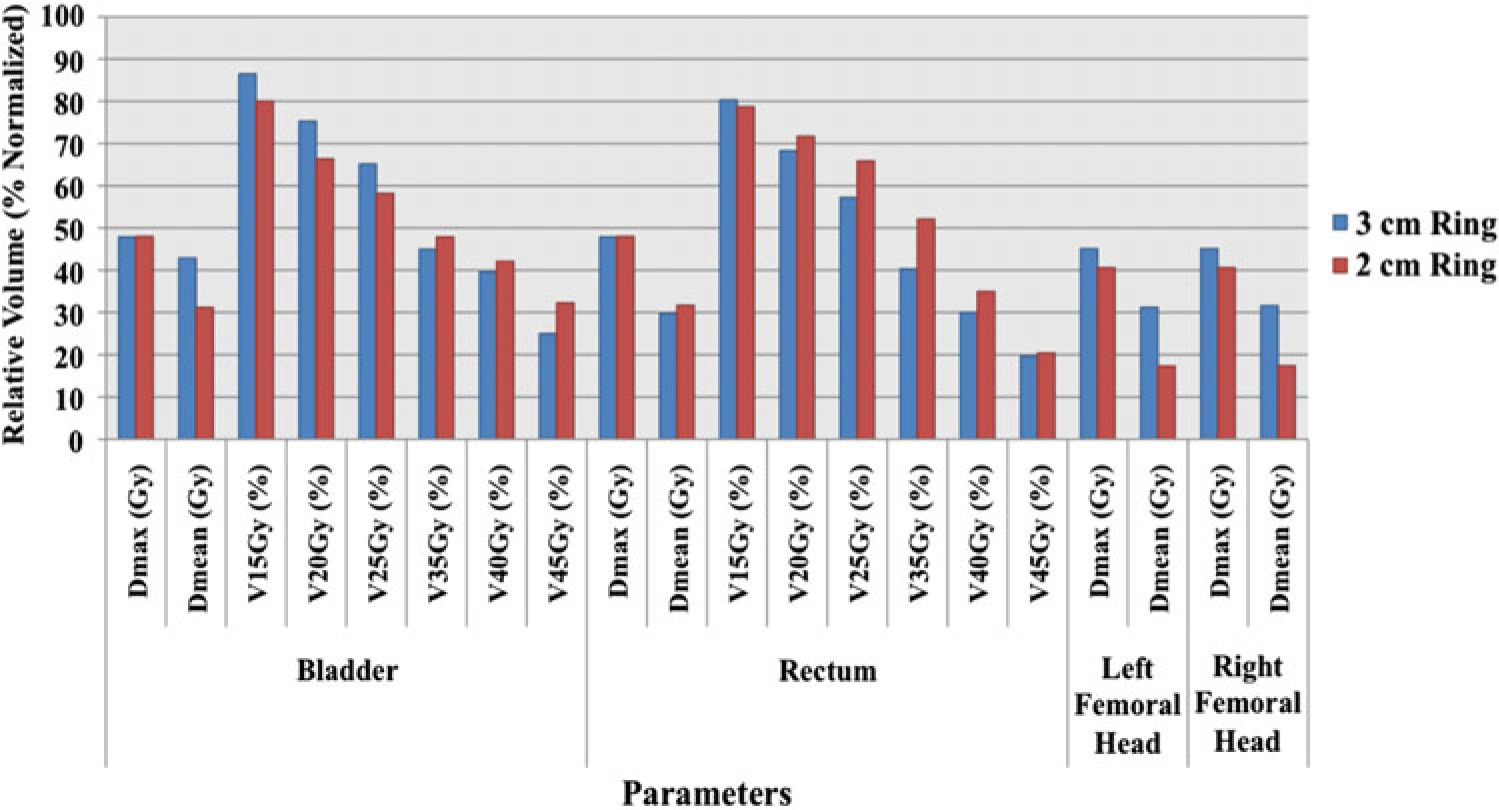
It is observed that the plan with a smaller ring structure (2 cm) shows better sparing of the organs at risk (OARs) for prostate plans (Figure 1). However, for node plan, no significant difference is observed for OAR (ROI’s) except for femoral heads. The dosimetric parameters for OARs in prostate and nodes for 2 and 3 cm are plotted in histogram shown in Figures 1 and 2. Hotspots greater than 105% were present for 2 cm plan in nodes but not for 3 cm plan.
Dosimetric parameters for bladder, rectum and seminal vesicles in prostate plans using 2 and 3 cm rings.

Dosimetric parameters for bladder, rectum, left and right femoral head in pelvic plans using 2 and 3 cm rings.

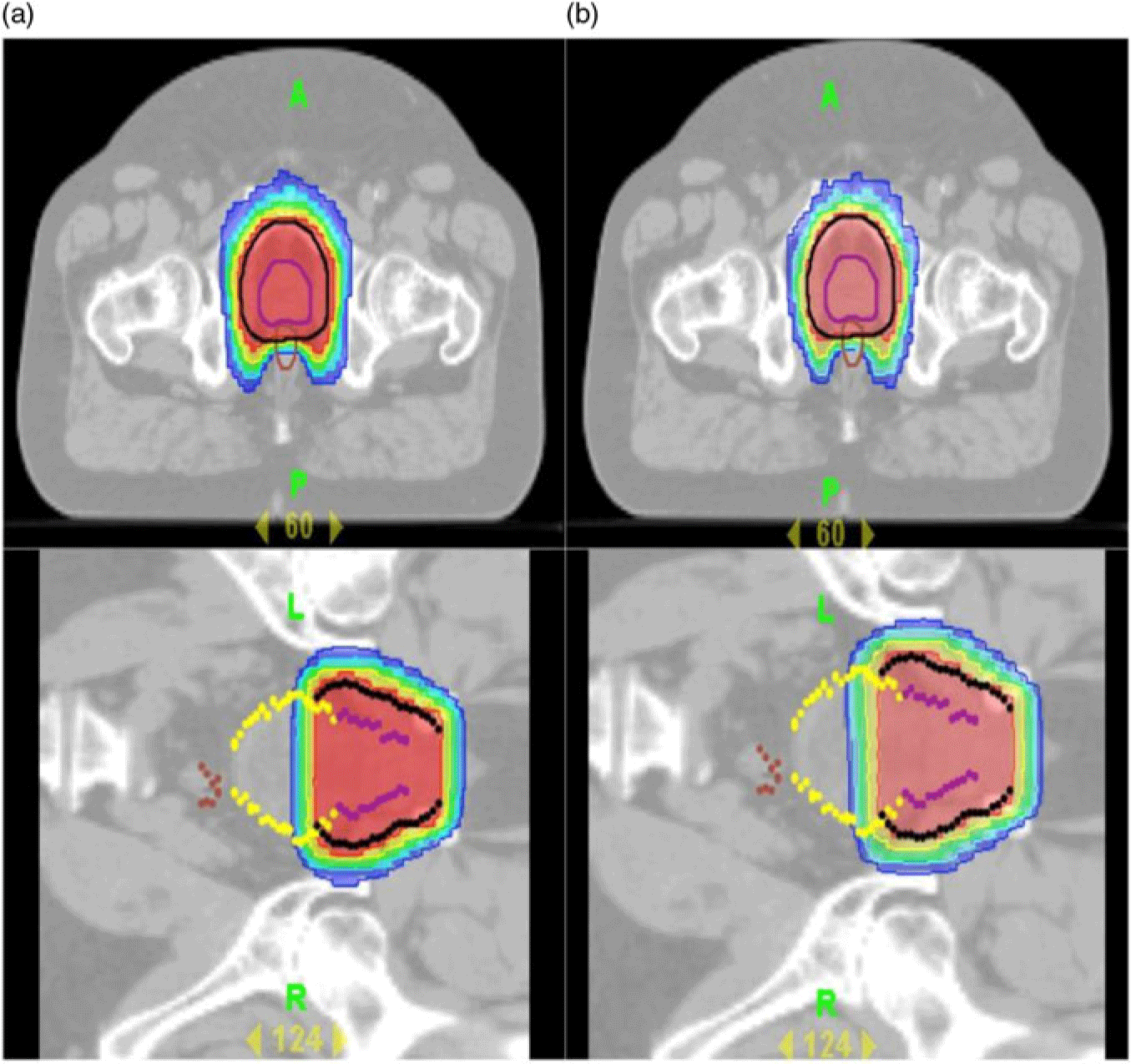
Figure 3 shows the isodose distribution for prostate with 2 and 3 cm rings.
Isodose distribution on transverse and coronal planes for 2 cm (a) and 3 cm ring (b) in prostate plan. Red, yellow, green and blue represent 100, 95, 90 and 80% isodose line, respectively.

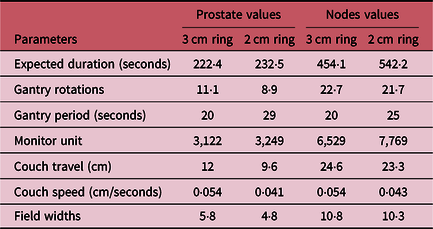
However, for 3 cm plan, these hotspots are absent. Similar results are observed in composite DVHs. The differences in the delivery parameters are shown in Table 4. As demonstrated in Table 4, monitor units and gantry period are significantly increased, if a smaller diameter ring is used.
Delivery parameters for different ring diameters’ plans

Expected duration was higher for both prostate and node plans with 2 cm ring compared to 3 cm ring.
Percentage difference between 2 and 3 cm prostate plans was slightly more for field width and couch travel compared to node plans.
Conclusion
Using a smaller size ring improves the dose to OAR without compromising tumor coverage. Hotspots can be eliminated with additional constraints on the PTV. Also, the composite plans do not show any significant difference in dose to OAR. Further studies should be conducted to explore the feasibility of compact ring for other potential tumor sites too, besides prostate.
Acknowledgements
None.