INTRODUCTION
Rajella was described initially as a subgenus of Raja by Stehmann (Reference Stehmann1970) and recently received genus status by McEachran & Dunn (Reference McEachran and Dunn1998). It is identified by a mozaic of characters generally found in other genera such as Raja, Breviraja, Malacoraja, Rhinoraja and Bathyraja, suggesting that Rajella is based on unsatisfactory artificial characters mainly associated with polyphyletics and Raja and Bathyraja need revision (McEachran & Miyake, Reference McEachran and Miyake1984, Reference McEachran, Miyake, Uyeno, Arai, Taniuchi and Matsuura1986, Reference McEachran, Miyake, Pratt, Guber and Taniuchi1990; McEachran & Dunn, Reference McEachran and Dunn1998). According to Stehmann (Reference Stehmann1970) and McEachran & Dunn (Reference McEachran and Dunn1998), the deep-water species of Rajella are mainly characterized by the following features: propterygium of pectoral girdle falls distinctly short of rostral node; preorbital processes degenerate; rostral cartilage is continuous with neurocranium and stout proximally but very slender and uncalcified distally; rostral appendices are broad, triangular-shaped, and connected to rostral cartilage at rostral node; malar thorns, derived from enlarged placoid scales, are located lateral to orbits and spiracles; thorns along the dorsal midline of disc are in several series, with thorns of lateral series as large as, or larger than, those of the medial series; triangular patch of thorns on the dorsal surface of the nuchal and scapular region of the disc; clasper glans (terminal aspect of clasper) is distinctly expanded in comparison to proximal section of clasper; clasper glans possess the component rhipidion (erectile tissue distal to hypopyle); ventral terminal cartilage has sharp, naked lateral margin, forming component shield; dorsal marginal cartilage lacks distal extension forming pseudorhipidion; clasper skeleton has four dorsal terminal cartilages; ventral terminal cartilage has proximo-medial expansion.
Rajella includes sixteen valid species distributed worldwide: R. annandalei (Weber, 1913), from the western central Pacific off eastern Indonesia; R. barnardi (Norman, 1935), from the eastern Atlantic off Mauritania to South Africa; R. bathyphila (Holt & Byrne, 1908), from the North Atlantic; R. bigelowi (Stehmann, 1978), from the North and central Atlantic; R. caudaspinosa (von Bonde & Swart, 1923), from the south-east Atlantic off Namibia and South Africa; R. challengeri Last & Stehmann, 2008, from southern Australia; R. dissimilis (Hulley, 1970), from the eastern Atlantic off Western Sahara, Namibia and South Africa; R. eisenhardti Long & McCosker, 1999, from the Galapagos Islands; R. fuliginea (Bigelow & Schroeder, 1954), from the western Atlantic off French Guiana; R. fyllae (Lütken, 1887), from the northern North Atlantic; R. kukujevi (Dolganov, 1985), from the North Atlantic, known from the type locality, 49°50′N 29°33′W, Faraday Fracture; R. leopardus (von Bonde & Swart, 1923), from West Africa; R. nigerrima (de Buen, 1960), from the south-east Pacific off Peru and Chile; R. purpuriventralis (Bigelow & Schroeder, 1962), from the western central Atlantic, northern Gulf of Mexico and northern coast of South America; R. ravidula (Hulley, 1970), from the south-east Atlantic off Morocco and South Africa; and R. sadowskii (Krefft & Stehmann, Reference Krefft and Stehmann1974), from the south-east Pacific off Chile and south-west Atlantic off Brazil (Froese & Pauly, Reference Froese and Pauly2007).
Records of Rajella in Brazilian waters include three species: R. sadowskii from off Rio de Janeiro to Rio Grande do Sul (Krefft & Stehmann, Reference Krefft and Stehmann1974; Séret & Andreata, Reference Séret and Andreata1992), R. fuliginea from off Amapá (Soto et al., Reference Soto, Mincarone, Asano, Souza, Soto and Mincarone2006) and R. purpuriventralis from off Amapá and Bahia/Espírito Santo (Gomes & Gadig, Reference Gomes, Gadig, Menezes, Buckup, Figueiredo and Moura2003; Soto et al., Reference Soto, Mincarone, Asano, Souza, Soto and Mincarone2006), all species with material deposited in the Museu Oceanográfico Univali (MOVI). Rajella sadowskii was described from the continental slope off southern Brazil between 22°30′S and 28°34′S, from 800 to 1200 m, based on eight specimens collected by the FFS ‘Walther Herwig’ (Krefft & Stehmann, Reference Krefft and Stehmann1974). Posteriorly, three more specimens were collected off Espírito Santo, from 1320 to 1360 m, during the MD-55 Brazil Oceanographic Campaign of the RV ‘Marion Dufresne’ (Séret & Andreata, Reference Séret and Andreata1992). The species has also been recorded from the Chilean coast without specimens' data (Pequeño & Lamilla, Reference Pequeño and Lamilla1993; Pequeño, Reference Pequeño1997).
During the campaigns of the ‘Campos Basin DeepSea Environmental Project’ coordinated by Cenpes/Petrobras, additional specimens of Rajella sadowskii from the south-east Brazilian coast were collected aboard the RV ‘Astro Garoupa’ between 1067 and 1353 m depth. In this study, new data on R. sadowskii is presented, including a new range of counts and measurements for sub-adults, advanced embryos and egg capsule.
MATERIALS AND METHODS
Samples from the RV ‘Astro Garoupa’ came from 19 to 21°S at depths from 1100 to 1600 m. Two cruises were made in 2003, using a small otter-trawl semi-balloon net (5.5 × 1.0 m) with the same dimensions as the OTSB No. 14, tipically used in the Gulf of Mexico's shrimp-trawl fishery. A total of 36 trawls and 59 hours trawling produced a smaller amount of fish (N = 478), and a swept-area of only 1.2 km2. External measurements were taken in millimetres according to Stehmann (Reference Stehmann2005) and expressed as a percentage of disc width (DW) and total length (TL), except the snout angle, which follows McEachran & Carvalho (Reference McEachran, Carvalho and Carpenter2002). Count of teeth was taken through a stereoscopic microscope. Count of vertebrae follows Krefft (Reference Krefft1968) from radiographs. All specimens were deposited in the MOVI—Museu Oceanográfico Univali (Itajaí, Brazil), not included in institutional abbreviations listed in Leviton et al. (Reference Leviton, Gibbs, Heal and Dawson1985).
Specimens cited for Rajella sadowskii—holotype (ZMH 25262 (formerly ISH 1807/68)), male (507.0 mm TL), off Santa Catarina, Brazil, 29°57′S 47°35′W, 1200 m depth, 27 February 1968, Station 65/68; paratype (ZMH 25263 (formerly ISH 1936/68)), female (629.5 mm TL), off Rio de Janeiro, Brazil, 24°33′S 42°32′W, 1200 m depth, 2 March 1968, Station 92/68; paratypes (ZMH 25264 (formerly ISH 1973/68a–e)), 3 males (227.0–388.2 mm TL) and 2 females (299.4–333.8 mm TL), off Rio de Janeiro, Brazil, 22°30′S 40°07′W, 800 m depth, 9 March 1968, Station 104/68; paratype (ZMH 25265 (formerly ISH 2004/68)), male (471.5 mm TL), off Santa Catarina, Brazil, 28°34′S 46°53′W, 1200 m depth, 13 March 1968, Station 120/68. All specimens collected with bottom trawl by Gerhard Krefft, aboard the FFS ‘Walther Herwig’. MNHN 1989.344, male (542 mm TL) and female (582 mm TL), off Espírito Santo, Brazil, 21°24.16′S 39°56.19′W, 1320–1360 m depth, 9 May 1987, Station 03CP04, collected with bottom trawl by Bernard Séret and José V. Andreata, aboard the RV ‘Marion Dufresne’.
New additional specimens of Rajella sadowskii—MOVI 36984, female (330 mm DW, 558 mm TL), off Rio de Janeiro, Brazil, 21°50.958′S 39°47.981′W–21°47.011′S 39°50.485′W, 1353 m depth, 21 August 2003; MOVI 36987, female (261 mm DW, 430 mm TL), off Rio de Janeiro, Brazil, 22°16.071′S 39°51.556′W–22°12.441′S 39°49.501′W, 1298 m depth, 24 August 2003, Oceanprof Station 17(2); MOVI 36988, female (279 mm DW, 519 mm TL), off Espírito Santo, Brazil, 21°15.790′S 39°53.145′W–22°12.903′S 39°52.148′W, 1138 m depth, 13 February 2003, Oceanprof Station 16/7975; MOVI 36991, female (99 mm DW, 215 mm TL), off Rio de Janeiro, Brazil, 22°27.080′S 38°54.706′W–22°24.471′S 39°52.781′W, 1310 m depth, 8 February 2003, Oceanprof Station 05; MOVI 36993, male (173 mm DW, 321 mm TL), off Rio de Janeiro, Brazil, 21°53.608′S 39°51.280′W–21°50.845′S 39°52.087′W, 1067 m depth, 14 February 2003, Oceanprof Station 13; MOVI 36996, female (56 mm DW, 152 mm TL), off Rio de Janeiro, Brazil, 22°11.929′S 39°49.123′W–22°09.113′S 39°48.846′W, 1331 m depth, 13 February 2003, Oceanprof Station 11. All specimens collected with bottom trawl by Paulo A.S. Costa, aboard the RV ‘Astro Garoupa’.
RESULTS AND DISCUSSION
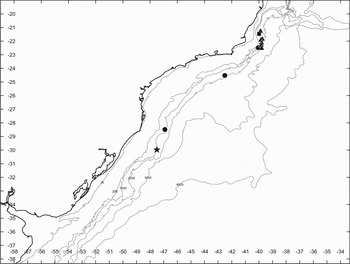
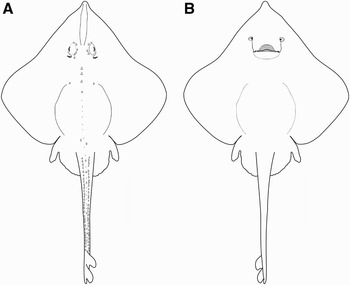
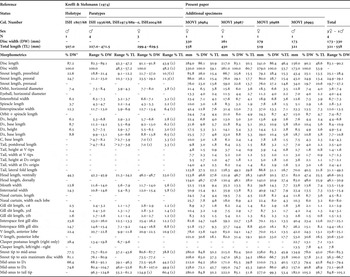
Samples from RV ‘Astro Garoupa’ came from 21°15′S to 22°16′S at depths from 1067 to 1353 m, within the horizontal and vertical ranges previously reported in the literature (Krefft & Stehmann, Reference Krefft and Stehmann1974; Séret & Andreata, Reference Séret and Andreata1992) (Figure 1). A technical drawing of the species is presented for the first time (Figure 2), showing great similarity with R. bathyphila and R. kukujevi. The morphometry presents 13 new measurements for this species and 17 with new ranges (Table 1). The discrepancy of the results obtained from the snout angle, between Krefft & Stehmann (Reference Krefft and Stehmann1974) and the present paper was certainly due to differences among the applied methods. In the first it probably crossed the line of the spiracles.
Collection stations of Rajella sadowskii off the Brazilian coast. Holotype indicated by a star, paratypes by circles and additional specimens by a square (Séret & Andreata, Reference Séret and Andreata1992) and triangles (present paper).

Dorsal (A) and ventral (B) views of Rajella sadowskii, MOVI 36984, female, 330 mm DW, 558 mm TL (by Marcelo Lanziotti).

Measurements of Rajella sadowskii from the south-west Atlantic.

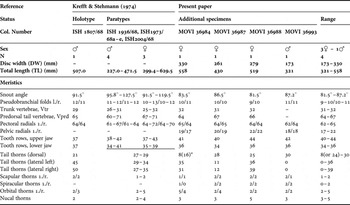
Obs, in this species the dorsal fins are united for a membrane; there is no space among them. *, in the original description the percentages of the total length for the holotype were not mentioned.
Photographs of a fresh specimen showing the natural colour of the species are presented for the first time: violet-grey in the back, with the pectorals and pelvics margins more violet than greyish; dorsal and caudal fins dark; a small black spot in the centre of each pectoral fin, which tends to disappear on preserved specimens; ventral face with a white patch on the ventral cavity extending to the scapulocoracoid; greyish ventral margins of the pectorals and pelvics, becomes clearer and abruptly light about of the half of the fins towards the centre of the disc; ventral portion of the tail greyish with whitish tip, just below the dorsal and caudal fins (Figure 3).
Fresh specimen of Rajella sadowskii, MOVI 36984, female, 330 mm DW, 558 mm TL. Dorsal and ventral view.

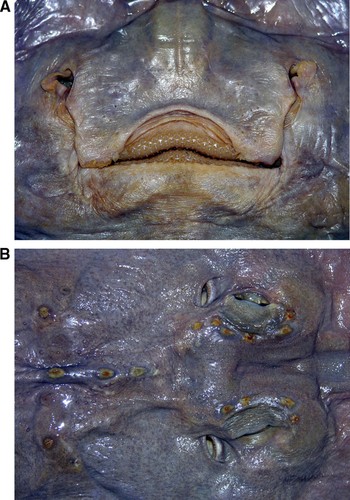
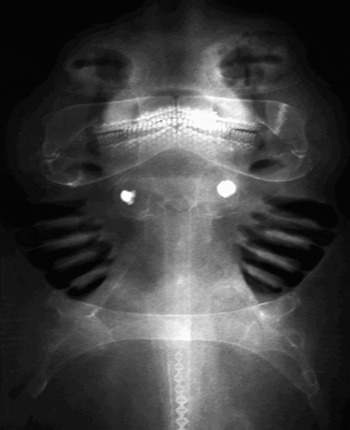
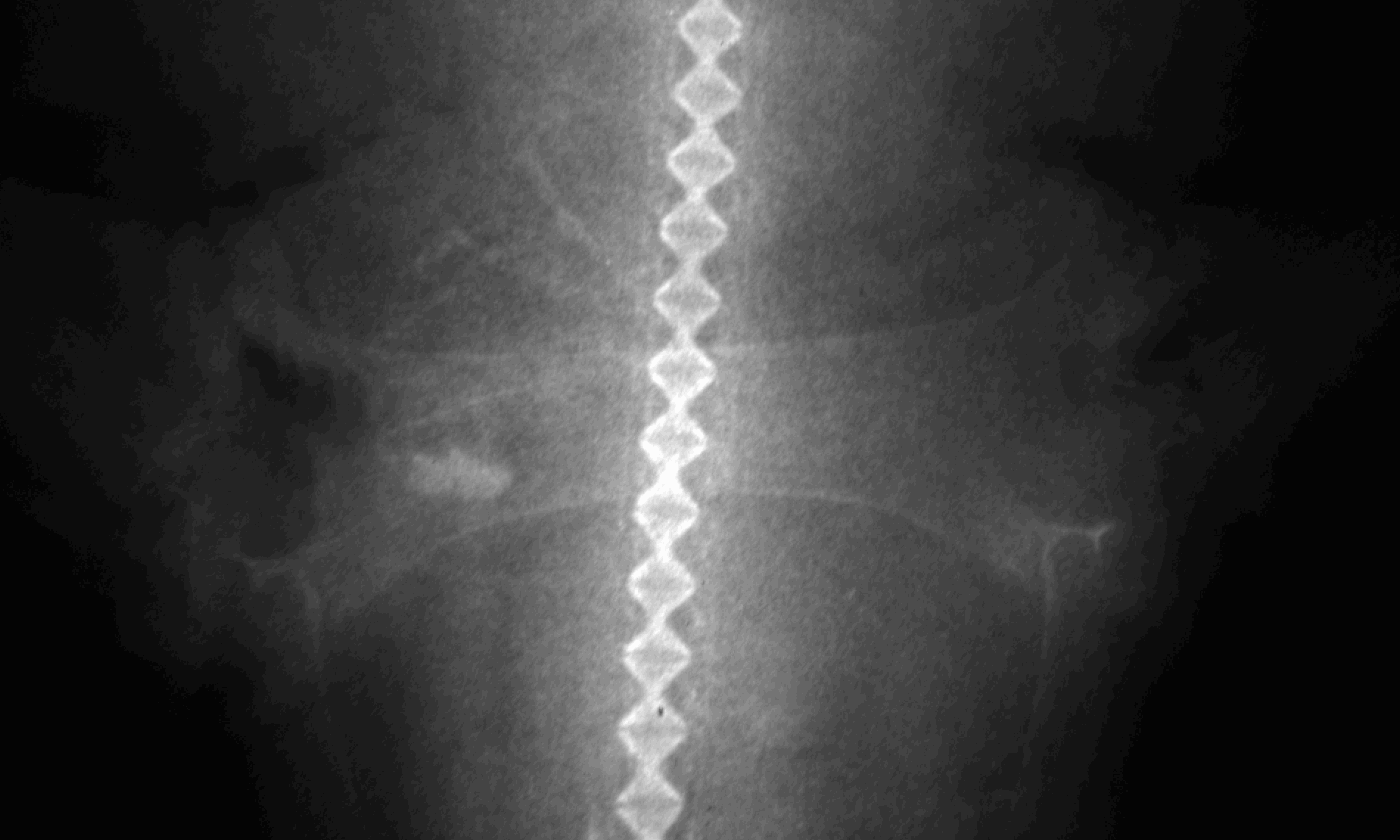
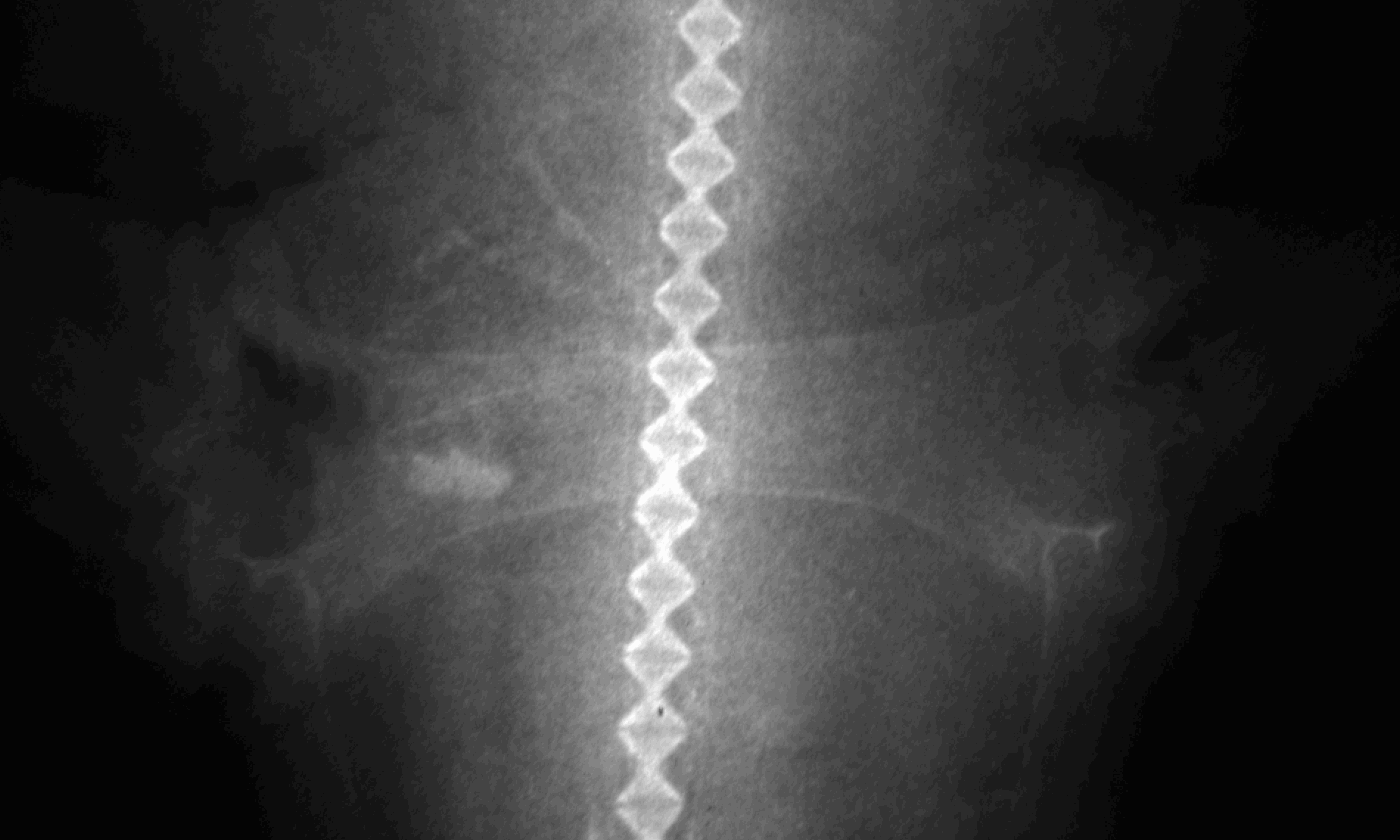
Meristic data are given in Table 2. The thorns are hyaline and strongly curved (Figure 4) and highly variable in number when compared with the original description. Teeth orange, hyaline and notably functional, with slightly worn single cusp without evident sexual dimorphism (Figure 4). Mouth–nasal region and the thorns of head and nucal region are diagnostic and illustrated in detail (Figure 5). Dorsal fins united by a membrane, without space among them; caudal fin distinctively black; a conspicuous caudal finfold laterally to dorsal and caudal fins is illustrated too (Figure 6). The scapulocoracoid and the pelvis of this species are illustrated from radiographs for the first time (Figures 7 & 8). Prepelvic processes little calcified and their tips not depicted in the radiographs.
Caudal thorns (A) and tooth rows of the lower jaw (B) of Rajella sadowskii, MOVI 36984, female, 330 mm DW, 558 mm TL.

Mouth–nasal region (A) and orbital, nucal and scapular thorns (B) of Rajella sadowskii, MOVI 36984, female, 330 mm DW, 558 mm TL.

Tip of tail with lateral finfold, dorsal and caudal fins of Rajella sadowskii, MOVI 36984, female, 330 mm DW, 558 mm TL.

Radiograph of the scapulocoracoid and mouth in dorsal view of Rajella sadowskii, MOVI 36984, female, 330 mm DW, 558 mm TL.

Radiograph of the pelvis in dorsal view of Rajella sadowskii, MOVI 36984, female, 330 mm DW, 558 mm TL.
Counts of Rajella sadowskii of the south-west Atlantic.

Obs, between parentheses they are the scars of the naturally lost thorns.
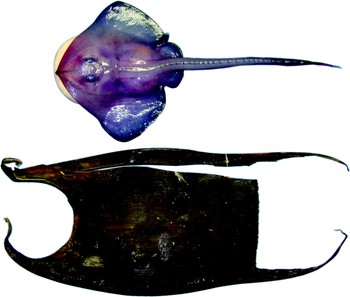
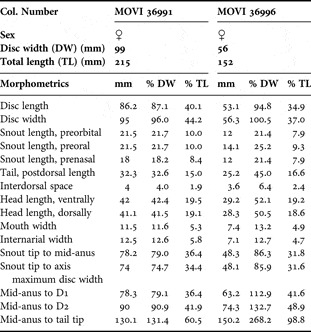
One embryo (MOVI 36996) and another embryo with egg capsule (MOVI 36991) are described. The morphometric analysis (Table 3) indicated a balanced growth and allometry compatible with the relationship length of the tail (decreasing) and width of the disc (growing), already well known for the batoids. In the embryos, the colour pattern is very similar to the adults (Figure 9), except by the bi-colour pattern of the dorsal fins in the embryos, whitish on the base and dark on the tip. The thorns of the dorsal tail are conspicuous and easy to count in the two embryos. Complementary spinulation absent in the small embryo but is observed in MOVI 36991, with 25/28 lateral tail thorns and a great number of spinules in the dorsal anterior margin of the disc. In both embryos a space between the dorsal fins was observed, including a single thorn in MOVI 36991. The egg capsule is typical of the family Rajidae (with four horns well defined), olive-brown with texture striated longitudinally, parallel low fibrous lamellae and moderate size of horns (Figure 9). The size of the yolk sac suggests that the largest embryo was still far from the size at birth.
Egg capsule with fresh advanced embryo of Rajella sadowskii, MOVI 36991, female, 99 mm DW, 215 mm TL.

Measurements of the embryos of Rajella sadowskii of the south-west Atlantic.

An additional video (MOVI 39172) obtained by the ROV Submersible SCV 3000 (Remotely Operated Vehicle) in the Campos Basin, off Rio de Janeiro, show for the first time a living specimen of R. sadowskii. The extracted frames show the two conspicuous black spots in the pectoral fins, the blackish dorsal and caudal fins and the natural violet-grey colour on the dorsum (Figure 10).
Underwater scenes of living specimen of Rajella sadowskii obtained from the ROV Submersible SCV 3000 (Remotely Operated Vehicle) on the bottom at 945 m off Rio de Janeiro, Brazil (MOVI 39172).

According to Krefft & Stehmann (Reference Krefft and Stehmann1974), Séret & Andreata (Reference Séret and Andreata1992) and the present paper, in the south-west Atlantic the species occur off south-eastern and southern Brazil, off Espírito Santo to Santa Catarina, on the lower continental slope, between 945 and 1360 m depth. Accompanying fauna taken near the locations of capture, revealed a deep mood and reef habitat (Figure 9) on the slope with deep-water gorgonians, hard corals, tube sponges, crinoids, ophiuroids and other batoids Malacoraja spinacidermis and Bathyraja sp.
ACKNOWLEDGEMENTS
We thank Ricardo G. de Amorim for his collaboration on laboratorial and curatorial work; the X-ray team of the Marieta Konder Bornhausen Hospital for their support in obtaining radiographs; Marcelo Lanziotti for preparation of the figures; and Michael M. Mincarone and Patricia Charvet de Almeida who kindly read and commented on the manuscript. Funds for this work were provided by the Universidade do Vale do Itajaí (Univali). Special thanks to Petróleo Brasileiro S.A. (Petrobras) for the opportunity of collecting and analysing the material.