Introduction
Since the 1990s, European welfare states have been subject to various reforms. A prominent feature of these reforms is the principle of ‘individual responsibility’. First promoted by international organisations and then by the European Union, this principle has led to a large variety of welfare state reforms at national level. In the central institutions of the welfare state – both in social services and in social security – ‘activation’ policies, ‘social investment’ policies and marketisation have stressed the relevance of so-called individual responsibility. These policies aim, first and foremost, to integrate every individual of working age into the labour market, and they manifest themselves, for instance, in reducing or abolishing social rights derived from the head of the household. This is especially so for entitlements to old-age security. This has led some authors and politicians to assume that welfare states are developing towards an overall individualisation of social rights as one facet of ‘modern’ society (Beck and Beck-Gernsheim Reference Beck and Beck-Gernsheim2002; Gilbert and Van Voorhis Reference Gilbert and Van Voorhis2003). At the same time, however, family-related elements have been introduced or strengthened in European welfare states (Daly Reference Daly2011; Frericks Reference Frericks2010). In social security systems, and those targeted at persons of pension age in particular, these reforms have emphasised the relevance of the family for individuals’ entitlements in two ways: first by strengthening the call for family solidarity (i.e. the state demands that families support the family member in need before he or she might turn to it for benefits) and, second, by introducing or broadening entitlements derived from family members (the state provides benefits based on e.g. having children). In view of this contradictory development, it is astonishing that there has been no systematic analysis so far of the degree to which social citizens are de facto institutionalised as individuals, and how this institutionalisation changes over time.
This paper aims to contribute to filling this research gap. Focusing on old-age security – since this policy field has been strongly subject to the contradictory developments described above – we analyse and classify institutional change with regard to individualisation. With a nuanced methodological approach, we investigate national and international differences. Finally, we aim to answer the question: to what extent have European old-age security systems been converging towards an individualisation of social rights since the 1990s?
The paper is organised as follows. In the next part we reflect upon the welfare state literature with regard to, first, the degree of individualisation of social rights, and second, welfare institutional change. Thereafter, we present our methodology and method, followed by the empirical analysis. The last section summarises and concludes the paper.
State of the art
European welfare states generally used to be based on the principle of the family, accompanied by a work-sharing concept in which it was the man's task to earn the family income on the labour market, and the woman's to carry out the non-paid housework and family care (Marshall Reference Marshall1981). The societal order was characterised by the institutionalisation of gender-specific lifecourses and activities that led to derived rights for women, that is, rights derived from the labour market status of the breadwinner (Kohli Reference Kohli2007). Yet, the manner and degree to which regulations on social rights incorporate the family differ both in international and in historical comparison. Northern European countries, for instance, show rather little incorporation of the family into welfare institutions compared with continental and southern European countries (Pfau-Effinger Reference Pfau-Effinger2004).
Since the 1990s, the principle of individual responsibility has been promoted, meaning the ‘activation’ of the former ‘passive’ social citizen in labour-market terms. This has fundamentally altered the welfare institutional framing of the family and the corresponding concept of social rights. In old-age security systems, individual responsibility has been strengthened in many ways. One is the reduction of the financial obligations of public pension systems by means of marketising parts of them, or by changing the calculation formulae of public pensions so that pensions are no longer based on the best (e.g. 30 years) of employment, but on longer periods, or even on the person's whole working life. These measures reinforce the linkage between contributions paid over the working life and pension benefits (Frericks Reference Frericks2010; Hyde, Dixon and Drover Reference Hyde, Dixon and Drover2003). In addition, individual responsibility has been strengthened by the reduction of ‘derived’ rights by, for example, reducing the level of and changing the conditions for widows’ pensions (Frericks Reference Frericks2010).
In the literature on pension reforms in Europe, it is stated that the trend towards individual responsibility and marketisation has led to a convergence of social rights in welfare states, in general, and in old-age security systems, in particular (Blair Reference Blair2014: 13–14; Hinrichs Reference Hinrichs, Mydske and Peters2006; Schroeder, Futh and Jantz Reference Schroeder, Futh and Jantz2015). In analysing the differences between welfare states to see whether they converge, the main point of reference is the ‘welfare regime approach’ of Esping-Andersen (Reference Esping-Andersen1990; see also Ferragina and Seeleib-Kaiser Reference Ferragina and Seeleib-Kaiser2011) and its further development, which also serves as a point of reference for our case selection. There is, in addition, a comprehensive literature on institutional and welfare state change. One important strand refers to the concept of convergence and its various peculiarities (for an overview, see Heichel, Pape and Sommerer Reference Heichel, Pape and Sommerer2005). For our purpose, we define convergence as an alignment of welfare states towards individualisation. Precisely, our definition means a decrease in the variation between countries (σ-convergence) in combination with a development in the same direction towards an exemplary model (δ-convergence).
Individualisation is conceptualised in different ways in welfare state literature, and one might interpret the different foci as reflecting the social risks observed at the specific time. The oldest but still most influential strand with a post-Marxist note understands individualisation as the opposite of employee and class collectivity, that is, an observed reduction in class identity and labour force power. For our analysis, we need a concept that reflects upon the family. The principle strand here is the mainly feminist one that understands individualisation as de-familialisation – the opposite of family dependence and, in particular, dependence on the male breadwinner. It is within this strand that the debate should take place over whether individual rights depend solely on (individual) labour market participation, or whether social rights need to be extended to rights that value (informal) care supply (Fraser Reference Fraser1997; Knijn and Kremer Reference Knijn and Kremer1997). These concepts are combined and enhanced in the concept of ‘activeness’ that refers to ‘individualisation’ as a development towards individualised rights and entitlements calculated not only on labour market participation but also on an increasing number of valued activities such as, for instance, supplying care for a family member (Frericks Reference Frericks2010). Since here, however, we try to identify the degree to which social citizens are conceptualised in social security systems as independent from family, we put forward another definition which is adequate for exactly this task. We define individualisation as the absence of family elements in social rights. This is independent of the question of whether such family elements increase or reduce the rights and autonomy of the individual (de-/familialisation). This definition is straightforward with regard to the family's incorporation into welfare institutions.
Concurrently with the reforms that tend to enhance individualisation as we define it, we observe the introduction or extension of pension entitlements that relate to the family, and familial care supply in particular. Sweden, for instance, introduced pension entitlements accruing from children by means of the so-called barnår in 1998 (Anderson and Meyer Reference Anderson, Meyer, Armingeon and Bonoli2006: 181), and Spain implemented pension entitlements for the care of a frail family member in 2007 (Gutiérrez et al. Reference Gutiérrez, Jiménez-Martín, Sánchez and Vilaplana2010). We find, therefore, developments that contradict the assumption that European pension systems are shaped by ongoing individualisation. Finally, we observe contradictory developments within welfare states. Germany, for instance, lowered the level of the survivors’ pension in 2001 while concurrently introducing pension entitlements for child care in it, and so reduced and increased family elements at the same time. This observation is in line with theories of neo-institutionalism. Thelen (Reference Thelen1999: 382), for instance, states that ‘the various institutional arrangements that make up a polity emerge at different times and out of different historical configurations. For this reason, the various ‘pieces’ do not necessarily fit together to a coherent, self-reinforcing, let alone functional, ‘whole’. Similarly, the welfare-arrangement approach emphasises that welfare arrangements are based on (possibly divergent) norms and values, so that ‘welfare states should not be treated as a coherent unity in cross-national comparisons and classifications’ (Pfau-Effinger Reference Pfau-Effinger2005: 7). Accordingly, we assume that certain social policies might be introduced and then withdrawn later on, so that there is not necessarily a linear development of regulations.
In this context, the findings of Pfau-Effinger and Saxonberg (Reference Pfau-Effinger, Saxonberg, Nadai and Nollert2015) are of interest. Focusing on public child care and parental leave schemes, they show that the concept of de-familialisation is too simple if it is interpreted as shifting care responsibility away from the family, and that indeed, countries do not follow this logic since they are either generous in both public child care and parental leave schemes or in neither. The Nordic countries, especially, which support female employment and provide a high level of public child care, have also introduced generous parental leave schemes. Feminist scholars interpret such leave schemes as supporting a traditional family model, while Pfau-Effinger and Saxonberg (Reference Pfau-Effinger, Saxonberg, Nadai and Nollert2015) argue that these welfare states combine seemingly contradictory policies to provide higher generosity and support parental choice and gender equality. These findings are highly relevant to our analysis since also in social security – here old-age – the two seemingly contradictory policies with regard to de-familialisation or individualisation might occur. In other words, we expect to find a reduction as well as an increase in family elements, and we might gain unexpected insights into the generosity of welfare states.
A systematic and comparative investigation of possibly contradictory institutional change in welfare states with regard to individualisation is lacking thus far and is therefore provided by this paper. A reason for this research gap may be that concepts of convergence focus on differences between welfare states, while concepts of contradictory developments study whether there is institutional change also within welfare states.
Methodology and method
In our paper, we empirically analyse the degree of individualisation of the social citizen in welfare institutions in the field of old-age security. To do so, we first have to develop a suitable conceptual frame and analysis method. Old-age security, a classical field of social policy, aims to secure income in times when the social citizen is no longer expected to generate income on the labour market. Since the 1990s, it has undergone far-reaching changes as to the inclusion of family elements in it. As the starting point of our framework we distinguish two levels of publicly institutionalised social security which can be found already in Marshall's (Reference Marshall1981) conceptualisation of social rights: the ‘target social security level’ (TSSL) and the ‘poverty prevention level’ (PPL), as we call them. The degree of institutional individualisation is analysed for these main two institutionalised levels of social security that can well inform an international comparison since they can be identified in all European welfare states (Frericks Reference Frericks2013).
We conceptualise institutional individualisation as the degree to which old-age security systems frame the social citizen as an individual. Consequently, we analyse the degree of family elements that social security institutions contain. The neutral term ‘family elements’ has two facets: the extension of entitlements based on family, and the call for family solidarity before individuals are entitled to benefits. The degree of family elements is expected to vary, in line with neo-institutional theory as referred to above. To understand conceptually and capture empirically the degree of welfare institutional individualisation, we develop and apply a theory-led typology. This typology corresponds to the Weberian ideal-types developed as a heuristic instrument for sociological analysis and the systematisation of empirico-historical reality. The ideal-type approach is based on the establishment of clear-cut terms to analytically and unequivocally describe reality (Weber Reference Weber1973). By means of four ideal-type ‘corner marks’, a ‘space of characteristics’ (Schnell, Hill and Esser Reference Schnell, Hill and Esser2005: 168) is formed, within which the degree of individualisation of social security institutions is positioned as a set of coordinates. To capture the institutionalised family elements, we differentiate three dimensions of family: ‘partners’, ‘generations’ and ‘other family members’. Consequently, we measure the degree of individualisation of the social citizen in terms of social rights by means of the following four ideal-typical corner marks: (a) fully individualised; (b) linked to the partner; (c) generationally linked; and (d) linked to other family members. The ‘partner’ dimension refers to couples formally recognised in the country concerned. If, moreover, additional conditions are put on the definition of partners in line with particular regulations, e.g. being married, each condition is considered in the weighting process (see below). ‘Generation’ is operationalised as the analysed social citizen and his or her children, while other (generational) links are operationalised on the dimension of ‘other family members’ (see Walker Reference Walker2005), since the ‘nuclear family’, comprised of parents and children, is the main point of reference for most welfare regulations.
We analyse the degree of individualisation for ten European countries and at three points in time. We compare Denmark, Estonia, the United Kingdom (UK), Italy, Sweden, Spain, the Czech Republic, Hungary, Germany and France. The choice of countries is based on the welfare regime approach by Esping-Andersen (Reference Esping-Andersen1990) and its further development, in order to make it compatible with other research. Data from three points in time are analysed. The first, 1993, is chosen so as to have a first measurement before major reforms in old-age security took place in most European countries, as well as after the collapse of the Soviet system in order to include Central-Eastern European countries. The second point in time, 2003, is chosen because many European countries implemented major reforms up to the early 2000s. The last point in time, 2013, is used because there might have been further reforms or withdrawals due to, among other things, the financial crisis. The advantage of this approach is to be able to show whether institutional change is a linear process or not. The individualisation of old-age security systems may have decreased after 1993 and increased again after 2003, or vice versa.
The qualitative empirical data on the welfare institutions are quantified and fed into our typology. To this end, we first identify the relevant indicators and assess them in the context of the calculation of ‘full’ benefits (Frericks Reference Frericks2011) on TSSL and PPL. For reasons of complexity reduction, we focus on public social security systems and do not include welfare markets, well aware that TSSL today is only fully captured as the combination of public schemes and welfare markets (Frericks Reference Frericks2013). We take into account institutional regulations affecting the financial implications, the conditionality of the entitlements and the criteria that serve in the calculation of the benefits. Regulations generally stemming from other than the specified old-age institutions (such as long-term care regulations, care of disabled family members or housing regulations) are not analysed here since these are in general regulated in separate welfare institutions. Our analysis is based on a multitude of sources, among which the databases of the International Social Security Association, the Organisation for Economic Co-operation and Development, the World Bank and the European Mutual Information System on Social Protection database are the most important, as well as scientific and public national and international reports and publications.
To identify the degree of individualisation, one needs to investigate those parts of the calculation formulae that contain the family elements, since the basic calculation formulae are in general individualised. The values indicate the degree to which family elements might form part of the benefit calculation; they do not indicate any scenario. Since the two social security levels follow other logics – as was already reflected upon in detail by Marshall (Reference Marshall1981) – their regulations, and therewith the relevant indicators for analysing them, differ. At TSSL, we capture the extent to which family elements might contribute to reaching the target level. If certain entitlements do not help reach TSSL because they cannot be combined with other entitlements, they are not considered in our analysis. At PPL, we analyse the call for family solidarity in the varying degrees necessary to cover the costs of living of the social citizen over pension age. In the case where there are no regulations at PPL targeting persons of pension age, we apply the general social assistance regulations. The more comprehensive the obligation of the citizen's relative to cover his or her living costs, the stronger the family element.
The degree of individualisation ranges on an ordinal scale from 0 to 1 in ten gradations. While 0 refers to ideal-typical individualisation, 1 refers to ideal-typical valuation of family elements. The single indicators are quantified and presented in two digits. In case regulations set additional conditions besides status and thereby bring the family element into perspective – that is, theoretically the ideal-typical corner marks cannot be reached by means of this regulation – we weight the indicator. While we need a weight below 1, it should be considered that the smaller the weight the more likely it is that indicator values tend to be 0 in the case of several conditions. Therefore, we use 2/3 for each additional condition as a reasonable weight for our purpose. Such additional conditions are, for instance, the boundary of the household which limits the incorporation of family members to those who live in the same household, or the call for activity (as, for instance, care supply) instead of rights that depend purely on family status. We can illustrate the quantification of our indicators with a straightforward example: in the Spanish survivors’ pension on the ‘partner’ dimension at TSSL in 2013, the survivor can receive 52 per cent of the pension entitlements of the deceased partner. Therefore, the indicator is initially valued at 0.52. This indicator, however, depends on the condition that the person's partner dies before the person is eligible for the survivors’ pension. Consequently, our value for the Spanish survivors’ pension is weighted at 0.52 × 2/3 = 0.35. In addition, if an indicator refers to the number of family members, this needs to be taken into account by increasing the indicator value, i.e. multiplying by a number greater than 1. If, for instance, pension entitlements for having children are granted per child, we multiply the indicators by 2, and in case the calculation only differentiates between one or more children, we multiply the value by 1.5. Lastly, some countries have institutionalised TSSL as a combination of different public schemes which we weight accordingly. In Denmark, for example, the Folkepension makes up 74 per cent and the ATP 26 per cent of TSSL pension. This is why the indicators for the Folkepension are weighed by 0.74 and the indicators for the ATP by 0.26. This approach allows us to estimate the relevance of the single components for the respective social security level.
To calculate the values of the family dimensions, the single indicator values are added for each family dimension and rounded to one digit after the decimal point. In the case that two regulations are mutually exclusive, an addition of the values of the single indicators would be logically incorrect; therefore in such cases we compute the mean of the two indicators. Since the degree of individualisation is measured separately on the three family dimensions, we identify the coordinates of individualisation within the space of characteristics. This codification allows a nuanced identification of the welfare-institutional individualisation of the social citizen. For each country and each point in time, the coordinates for both levels of social security (TSSL and PPL), i.e. two reference points within the ‘space of individualisation’ of welfare institutions, are determined. These coordinates in turn help identify country developments, country-cluster formations and contradictions in the degree of individualisation with regard to the levels of social security and the corresponding family dimension.
Finally, we use another quantitative instrument to interpret our data: the median and the average absolute deviation of the median (AAD). The reason for this is that a decrease in the standard deviation is often used as an indicator of convergence, while a change in the mean indicates the direction of convergence (Holzinger and Knill Reference Holzinger and Knill2005). Because our values are not metric but ordinal, we use the median and AAD instead. Consequently, an alignment in individualisation should be indicated by a decrease in the AAD (increasing similarity) and a decrease in the median (trend towards individualisation).
Findings
We present the findings of our analysis as follows (a database containing all indicator values and explanations can be provided on demand). First, we investigate the degree of individualisation in 1993, then how the degree of individualisation changed in 2003 and 2013. Lastly, we discuss how far the ten welfare states align (converge). We do this separately for both social security levels and give the results for each family dimension, that is, the coordinates within the space of individualisation.
Changes at the TSSL
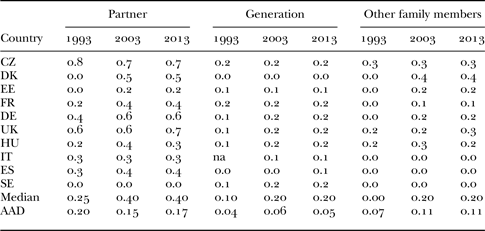
At TSSL, all countries incorporate family elements in old-age security. They do so, however, to varying degrees. Table 1 gives an overview of the results that will be explained in the following. First though, we want to introduce the indicators that are relevant at TSSL, since they differ – as stated above – from those at PPL. The indicators are deduced from the pension regulations in force.
Degree of family elements in old-age security at the target social security level (TSSL)

Notes: CZ: Czech Republic. DK: Denmark. EE: Estonia. FR: France. DE: Germany. UK: United Kingdom. HU: Hungary. IT: Italy. ES: Spain. SE: Sweden. AAD: average absolute deviation of the median. na: not available.
On the ‘partner’ dimension, the calculation formula for pension benefits includes the following family elements: the splitting of pension entitlements between partners, pension benefits for having a partner, survivors’ pension for retirement-age survivors and pension entitlements for caring for a frail partner. Indicators for the dimension of ‘generation’ are pension entitlements for having or having cared for children. On the dimension of ‘other family members’, other survivors’ pensions and rights deriving from the care of frail relatives play a role. In Denmark, France, Sweden and the UK, TSSL consists of two different public schemes. The Folk(e)pension and the ATP are relevant in the cases of Denmark and Sweden; the French TSSL includes the régime générale and the mandatory occupational pension schemes AGIRC and ARRCO; and in the UK, TSSL consists of the Basic State Pension and the Additional State Pension (SERPS in 1993 and State Second Pension in 2003 and 2013).
Partner
In 1993, the Czech Republic had the highest degree of family elements on the ‘partner’ dimension among the ten countries (0.8). This was due to the generous survivors’ pension and the pension entitlements for the care of a frail partner that could then be fully combined. In the UK (0.6), there was also a rather high degree of family elements, as it provided survivor pensions and entitlements for carrying out the care of a frail partner. Germany (0.4) combined a rather generous survivors’ pension with marginal entitlements deriving from the care of the partner. Italy, Spain (both 0.3), Hungary and France (both 0.2) were characterised by lower values on the ‘partner’ dimension as most of these countries provided survivors’ pensions but no entitlements for the care of a frail partner. In Hungary, it was not possible to combine the survivors’ pension with other pension entitlements based, for example, on care. Finally, Denmark, Sweden and Estonia (0.0) had negligible or no family elements that took into consideration the partner of the social citizen.
Changes after 1993, as observed in 2003 and 2013, are complex. There is an increase in family, that is, ‘partner’ elements in six of the countries, stability in two other ones, a decrease in one and a withdrawal in one. In Denmark (from 0.0 to 0.5), Germany (from 0.4 to 0.6), France (from 0.2 to 0.4) and Estonia (from 0.0 to 0.2), ‘partner’ elements increased after 1993 because of one major change in welfare state policies: pension entitlements for supplying care to frail relatives were introduced or extended, and these entitlements were also applied to caring for a partner. In Spain (from 0.3 to 0.4), survivors’ pensions increased, while the consideration of caring for a frail partner in 2003 is too marginal to change the value of individualisation. Lastly, the UK (from 0.6 to 0.7) extended pension entitlements for the care of a frail partner between 2003 and 2013. In Italy and Sweden, there was no change on the ‘partner’ dimension. The Czech Republic (from 0.8 to 0.7) became somewhat more individualised when the survivors’ pension was reduced. In Hungary (from 0.2 to 0.4 in 2003 and 0.3 in 2013) there was a withdrawal as survivors’ pension benefits increased but those for the care of a frail partner decreased.
The change in the median shows that family elements increased in our sample between 1993 and 2003 and remained stable thereafter. The AAD decreased between 1993 and 2003 and increased afterwards. Consequently, there is no convergence on the ‘partner’ dimension.
Generation
The values on the dimension of ‘generation’ are generally low. In 1993, family elements with regard to children were in general much lower than those with regard to the partner. There were pension entitlements for having children in all our cases in 1993 (only for Italy, 1993 data are lacking). In Denmark (0.01) and Spain (0.03), however, they were so low that they are not visible in the rounded values (both rated 0). The rounded values of the other countries are 0.1 or 0.2. Entitlements derived from children were institutionalised in different ways. They were often awarded for periods of actual care supply, as in maternity and parental leave (Czech Republic, Denmark, Estonia, France, Hungary and Spain), or to parents receiving cash benefits for raising children (Estonia, France, Hungary and UK). In Germany, pension points were granted to a parent without further conditions. In Estonia and the Czech Republic, women's pension age depended on the number of children (Monticone, Ruzik and Skiba Reference Monticone, Ruzik and Skiba2008: 3–4). This regulation is considered an increase in pension entitlements because mothers receive higher pension benefits if they work until regular pension age.
Also on this dimension the values for individualisation do not change in a uniform manner. There are no changes in the Czech Republic, Denmark, Estonia and France. Italy (0.1) provides pension entitlements for parental leave, minor entitlements for having children and a survivor's pension for parents that show no change in 2003 and 2013. A pension reform in Sweden (from 0.1 to 0.2 in 2003) granted additional pension points to parents for their children's first four years (Anderson and Meyer Reference Anderson, Meyer, Armingeon and Bonoli2006: 181). Germany (from 0.1 to 0.2 in 2003) increased the three pension points per child from 75 per cent of the average earnings of all employees per year to 100 per cent in 1999 and introduced further but marginal pension points for child care in the survivors’ pension in 2002. Hungary (from 0.1 to 0.2 in 2003) extended the survivors’ pension to parents. With the introduction of the State Second Pension in the UK (from 0.1 to 0.2 in 2003), entitlements for raising children were introduced into the Additional State Pension (Bozio, Crawford and Tetlow Reference Bozio, Crawford and Tetlow2010: 20–21, 41). In Spain, the period of parental leave considered in the calculation of pensions was extended from one to three years (from 0.0 to 0.1 in 2013). To conclude, there was no change in five of our countries and a minor increase of family elements in the other five.
If we look at the median, family elements increased on average between 1993 and 2003 and were stable between 2003 and 2013. As for the AAD, it increased between 1993 and 2003 and decreased again somewhat between 2003 and 2013, so we find no convergence towards individualisation on the ‘generation’ dimension.
Other family members
Also family elements on the dimension of ‘other family members’ do not reach the importance of those for the partner. For 1993, the Czech Republic is valued at 0.3 and this is caused by entitlements for caring for a frail relative. The UK and Hungary (0.2) had somewhat lower entitlements for taking care of a relative, and Germany (0.01) is rated at 0, which is due to the negligible entitlements granted for care at that time. Denmark, Estonia, France, Italy, Spain and Sweden were completely individualised with regard to ‘other family members’.
The changes in this family dimension of the ten countries show again a rather complex picture. There is an increase in family elements in four of our countries, stability in another four and a withdrawal in one. In Denmark (from 0.0 to 0.4 in 2003), caring family members can be employed as care workers (see ‘partner’ dimension; Frericks, Jensen and Pfau-Effinger Reference Frericks, Jensen and Pfau-Effinger2014: 73). France (from 0.0 to 0.1 in 2003), Germany, Estonia (both from 0.0 to 0.2 in 2003) and the UK (from 0.2 to 0.3 in 2013) also show an increase in family elements. Since 2002, the French welfare state has offered the opportunity for persons over 60 in need of care to employ an unemployed relative (except the partner) as a carer (Le Bihan and Martin Reference Le Bihan, Martin and Costa-Font2011: 43–44). The carer can thus earn pension entitlements by being employed. In 1999, Estonia introduced a carers’ benefit guaranteeing social insurance entitlements. Germany extended entitlements for unpaid care work in 1995, while the UK upgraded periods of unpaid care by reducing the number of years necessary to receive a full Basic State Pension. The introduction of pension entitlements for the care of a frail relative in Spain in 2007 is too marginal to change the rounded dimension value. In the Czech Republic, Italy and Sweden, there were no relevant policy reforms during that period. Hungary (from 0.2 to 0.3 in 2003 and 0.2 in 2013) extended the survivors’ pension to siblings between 1993 and 2003 and reduced entitlements between 2003 and 2013 for supplying care to a relative.
If we compare the median, there was a considerable increase in family elements between 1993 and 2003 that stagnated until 2013. Also, the AAD of the country values, again, does not indicate a convergence, since it rose between 1993 and 2003 and remained stable between 2003 and 2013.
Summary
In our findings for TSSL, individualisation as a trend cannot be observed, and in fact, family elements increase in most countries or remain stable. We observe an increase in the ‘partner’ dimension in six and in the ‘generation’ and the ‘other family’ dimension of five countries (four of them increase by at least two unit points on the ‘partner’ dimension and three by at least two unit points on the ‘other family’ dimension). Family elements are stable on the ‘partner’ dimension in two countries, on the ‘generation’ dimension in five and on the ‘other family’ dimension in four countries. More often than a decrease in family elements (only in one dimension in one country), we observe withdrawal (on the dimension of ‘partner’ and ‘other family members’ in one country). For Italy – though data are lacking for one measuring point – we find no significant change in family elements whatsoever.
The highest degree of family elements can be observed on the ‘partner’ dimension, and for the Czech Republic and the UK, in particular. This dimension is also the most dynamic, with changes in eight of our ten countries. The other two dimensions show lower degrees of family elements, and they are more stable. The degree of individualisation changes on a scale between one and four unit points – not a little in this ideal-typical space.
Finally, the most individualised pension systems are found in Sweden (only minor family elements on the dimension of ‘generation’) and Spain (apart from the ‘partner’ dimension).
One major development we observe in almost all welfare states is the introduction or extension of pension entitlements for supplying care to frail relatives. As a consequence, the degree of individualisation decreased on both the ‘partner’ dimension and the dimension of ‘other family members’.
Changes on the PPL
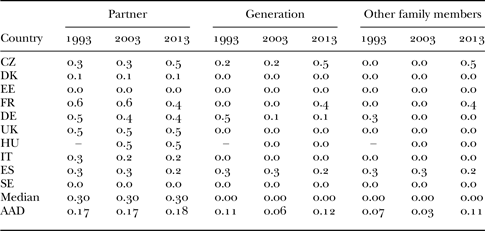
Family elements are incorporated very differently into old-age security systems that aim to prevent poverty. Table 2 gives an overview of the results for PPL, which we will now discuss. As stated above, the indicators differ from those for TSSL. The main one is the means-test in all countries, though we also find some pension entitlements at PPL.
Degree of family elements in old-age security at the poverty prevention level (PPL)

Notes: CZ: Czech Republic. DK: Denmark. EE: Estonia. FR: France. DE: Germany. UK: United Kingdom. HU: Hungary. IT: Italy. ES: Spain. SE: Sweden. AAD: average absolute deviation of the median. –: no regulation on the PPL.
Partner
In 1993, in Hungary there was neither a general social assistance scheme nor a targeted one for people over pension age (see Bálint, Szabó and Horn Reference Bálint, Szabó, Horn, Bahle, Hubl and Pfeifer2011: 95–96). France (0.6), Germany and the UK (0.5) had a rather high degree of family elements. Italy, Spain and the Czech Republic (0.3) were characterised by lower values, whereas Denmark (0.1), Sweden and Estonia (0.0) were highly individualised. In the British Income Support and the German Sozialhilfe, the income and assets of the partner were taken into account if he or she was part of the household unit (Eardley et al. Reference Eardley, Bradshaw, Ditch, Gough and Whiteford1996: 395–396). In France, there was a rather strict income test and a modest consideration of the partner's assets in the minimum vieillesse. The degree of family elements in Italy, Spain and the Czech Republic was lower because the partner's assets were not considered (Eardley et al. Reference Eardley, Bradshaw, Ditch, Gough and Whiteford1996: 234, 346; Erbenova, Sorm and Terrell Reference Erbenova, Sorm and Terrell1998: 119–120). In Denmark, the partner's income was taken into account only in calculating the pension supplement, and there was no such regulation at all in Sweden. In Estonia there was no means test in the rahvapension, including income or assets of family members (Goedemé Reference Goedemé2012: 4, 7).
The change after 1993 that we observe is as follows. There was an increase in family elements in one country, a decrease in four and stability in four countries (Hungary not considered). The degree of family elements decreased in Germany (from 0.5 to 0.4) and Italy (from 0.3 to 0.2) between 1993 and 2003, as well as in France (from 0.6 to 0.4) and Spain (from 0.3 to 0.2) between 2003 and 2013. The Spanish and the Italian means test became less strict, while in France, partners were now only taken into consideration if they lived in the same household as the person who applies for benefits. With the introduction of a new social assistance benefit for individuals over pension age in Germany, means testing was made less strict (Goedemé Reference Goedemé2012). In contrast, the Czech Republic (from 0.3 to 0.5 in 2013) became less individualised. Due to the introduction of the Příspěvek na živobytí in 2006, assets were included in means testing. Hungary (0.5) introduced the időskorúak járadéka in 1998 with a rather strict income test that did not significantly change over the period of our study. No significant changes in the degree of family elements can be identified in Denmark, Estonia, Sweden or the UK. With the introduction of Pension Credit in the UK, the means test of assets became less strict, but this minor change does not influence the rounded values.
Although there are changes in the value of ‘partner’ elements in most countries, the median has persisted since 1993. The change in the AAD of the country values indicates that there is no convergence, as we observe stability between 1993 and 2003, but an increase between 2003 and 2013.
Generation
In 1993, neither in Denmark, Estonia, France, Italy, Sweden nor the UK were children included in the means test (0.0), as was the case in Germany, Spain and the Czech Republic. Until 2003, children's income and assets were subject to a rather strict means test in Germany (0.5). In Spain (0.3), children's income and assets were tested if they lived in the pensioner's household, while in the Czech Republic (0.2) only the income of dependent children was taken into consideration.
The development on the ‘generation’ dimension is mainly characterised by stability, as in six countries there are no changes in the values. In two countries each, family elements increased and decreased. With the introduction of the German Grundsicherung im Alter (from 0.5 to 0.1 in 2003), children's financial resources were only taken into account if the annual gross income was above €100,000 (Köppe Reference Köppe2007: 177). In Spain (from 0.3 to 0.2 in 2013), the income test became less strict. In France (from 0.0 to 0.4 in 2013) and the Czech Republic (from 0.2 to 0.5 in 2013) family elements were extended. In the French ASPA, which replaced the minimum vieillesse in 2007 (Goedemé Reference Goedemé2012), children's income and assets were considered in the means test. In the Czech Republic from 2006, assets were included in the means test and children with their own resources were now considered part of the household unit. In Hungary (0.0), the időskorúak járadéka did not include children's means.
On average, there have been no changes in the degree of individualisation, as the median value is stable over the three measuring points. Although the AAD decreased between 1993 and 2003, it had its highest value in 2013. Therefore, there is no convergence.
Other family members
In 1993, Denmark, the Czech Republic, Estonia, France, Italy, the UK and Sweden had no means test including other relatives (0.0). Only in Spain and Germany (0.3) were the financial resources of other family members considered. While in Spain there was a rather strict means test for income, in Germany, relatives had to use their own income and assets to maintain a relative in need.
As for the changes in the degree of family elements, there has been stability in five countries, while two countries became less – and two became more – individualised (Hungary is omitted). There was no change in Denmark, Estonia, Italy, the UK and Sweden. Family elements increased in the Czech Republic (from 0.0 to 0.5 in 2013) and France (from 0.0 to 0.4 in 2013). In both countries, this was due to a new means test that comprised other family members in the household (for France see ‘generation’ dimension). Only Germany (from 0.3 to 0.0 in 2003) and Spain (from 0.3 to 0.2 in 2013) reduced their family elements. In Germany, this was caused by a new benefit introduced in 2003 that did not take into account the financial resources of relatives, and in Spain, means testing became less strict.
As on the ‘generation’ dimension, the median is 0 and did not change during the observation period. Comparing the three measuring points, the AAD does not indicate convergence, since it decreased at first and increased thereafter.
Summary
The change that we observe to have occurred since 1993 is again rather complex, but different from that at TSSL. We find an increase in family elements in one country on the ‘partner’ and in two countries on the ‘generation’ and the ‘other family’ dimension. There is a decrease in two countries on the dimensions of ‘generation’ and ‘other family members’ and in four countries of the ‘partner’ dimension. Stability dominates the picture, with no change in four countries on the ‘partner’ dimension, in five on that of ‘generation’ and ‘other family members’. Withdrawals were not found. In Hungary, which was not systematically considered since there were no regulations in 1993, there was no change between 2003 and 2013.
Changes on the ‘partner’ dimension are moderate (up to two unit points) while more pronounced on the other two dimensions (up to five unit points). All in all, there has been no clear direction of change in European old-age security systems at PPL since the early 1990s. Although similarity increased between 1993 and 2003 on two dimensions, it decreased again thereafter on all dimensions. This is why we find no signs of convergence, not even on a single family dimension.
Again, the highest degree of family elements can be identified on the ‘partner’ dimension, this time for France, the UK and Germany, in particular. The most individualised systems can be found in Sweden and Estonia, followed by Denmark (only 0.1 on only one dimension) and Italy.
Conclusion
The aim of this paper was to analyse whether and to what extent European old-age security systems are changing towards individualisation. To do this we also analysed contradictory developments within and between the single welfare states. We examined the degree of ‘family elements’ on three family dimensions, at three points in time and for two levels of social security in ten European countries. Family elements comprise all the regulations that cause changes in individual entitlements, whether these result from required family solidarity or entitlements derived from family members.
We conclude that there has been no general and no partial convergence towards individualisation over the past two decades. Our findings show instead that there is no trend towards individualisation since, on average, family elements have increased at TSSL and persisted at PPL. This result contradicts the literature presented above that assumes a general alignment of welfare states and a general trend towards institutional individualisation. Our analysis suggests that we can describe institutional change as a development that takes a different shape in dependence on the dimensions analysed, and that is in part contradictory. These findings are in line with theories of neo-institutionalism, as indicated above.
Firstly, the analysis of the three family dimensions helped us to obtain a nuanced picture of persistence and change. The most significant changes were found on the ‘partner’ dimension, which is at the same time the family dimension with the highest degree of family elements on both social security levels. This shows that both the granted entitlements and the state's call for solidarity are most strongly related to the partner, in comparison to children and other family members.
Secondly, the international comparison of the two social security levels presents a very mixed picture of the increase or decrease in family elements. In the Czech Republic, Germany and Spain, there is a contradictory development with regard to individualisation on the two social security levels. In Denmark, Estonia, the UK and Sweden, we find stability on one social security level and an increase in family elements on the other, while Italy and Hungary show stability on one social security level and a decrease in family elements on the other. France is characterised by an ambivalent development, as family elements increase and decrease on PPL in dependence on the family dimension. Consequently, there is no trend towards individualisation, neither with regard to the one or the other of the security levels, nor even on a single family dimension.
Lastly, we want to discuss how the developments are related to generosity towards families. Our study shows that an increase in family elements on TSSL, and/or a decrease in family elements on PPL, increases the generosity of social rights. This is because family elements on PPL are related to means testing and thereby correspond to financial obligations and responsibilities of the family. Contrarily, a decrease in family elements at TSSL and/or an increase in them at PPL results in lower welfare state generosity towards the family. This differentiation allows us to see that Germany, Spain, Denmark, Estonia, the UK, Sweden, Italy and Hungary (despite its withdrawal on TSSL) have become more generous since 1993, while the Czech Republic shows a lower level of generosity in 2013 compared to 1993. France again shows an ambivalent development. Thus, the contradictory developments with regard to the degree of individualisation in European old-age security systems can be explained by an overall increase in the generosity of eight out of our ten countries. The main reasons for this development are the increased entitlements to care supply and the decreased demand to maintain family members in some countries. European welfare states seem to have recognised that interruptions in the social citizens’ work history due to familial care need to be considered in order to guarantee what they define as an adequate pension level. Thus, our results for old-age security are in line with Pfau-Effinger and Saxonberg (Reference Pfau-Effinger, Saxonberg, Nadai and Nollert2015), i.e. also in old-age security, financial and care responsibilities are not consequently shifted out of the family (or the contrary), and the seemingly contradictory policies are, in the end, more generous. This development could inform gender-aware social policy analyses in particular, since an increase in welfare state generosity in general increases women's opportunities to be financially independent from a partner. This, in addition, is in line with the findings of Frericks (Reference Frericks2010) that individualisation increases, though in the form of individualised calculation norms that are based on an increased number of (non-work) activities valued for entitlements (Frericks 2010).