1 Introduction
It has been established that the separation of the primary vortical structure from its source would be a dominant feature in several starting flows. For the classical starting jet generated by the piston–cylinder apparatus, Gharib, Rambod & Shariff (Reference Gharib, Rambod and Shariff1998) defined a dimensionless time scale, called the ‘formation time’, as the ratio of stroke length  $L$ to diameter
 $D$ of the ejected fluid column,
 $$\begin{eqnarray}\displaystyle t^{\ast }=\frac{L}{D}=\frac{\overline{U_{p}}t}{D}, & & \displaystyle\end{eqnarray}$$
where  $U_{p}$ is the piston velocity (the overbar denotes a running time average),
 $t$ is the discharge time. The physical significance of this dimensionless quantity lies in the fact that it parameterizes and identifies the signature of the restricted formation process of a leading vortex ring. It prepares a dimensionless framework in which the results related to the vortex ring formation can be properly presented and interpreted (Dabiri Reference Dabiri2009). Specifically, the critical formation time, beyond which additional circulation provided by the vortex generator can no longer be accepted by the leading vortex ring, is termed the ‘formation number’. Subsequent experiments had shown that the limiting process of vortex formation should be a generic phenomenon in various starting flows involving vortex shedding (Jeon & Gharib Reference Jeon and Gharib2004; Pottebaum & Gharib Reference Pottebaum and Gharib2004; Ringuette, Milano & Gharib Reference Ringuette, Milano and Gharib2007). Great efforts have also been made to ensure the consistency of the definition of the formation time in more general flow configurations of vortex formation and shedding, such as starting jets with a temporally varying nozzle diameter (Dabiri & Gharib Reference Dabiri and Gharib2005), starting buoyant plumes (Shusser & Gharib Reference Shusser and Gharib2000; Pottebaum & Gharib Reference Pottebaum and Gharib2004), the wake of a circular cylinder (Jeon & Gharib Reference Jeon and Gharib2004), flapping wings (Milano & Gharib Reference Milano and Gharib2005; Ringuette et al. Reference Ringuette, Milano and Gharib2007), and so on. However, some other starting flows with vortex formation, such as starting forced plumes, are still not included. Therefore, it is necessary to propose a consistent definition of the formation time for these vortex generator configurations. An appropriate and physically meaningful definition is of practical importance to characterize the vortex formation process. More importantly, the critical formation number obtained according to the general formation time would reveal the effect of the underlying physical mechanisms on the vortex formation process in different starting flow configurations.
In § 2, various formation time definitions used in previous studies, mainly for the homogeneous starting jet, are reviewed. These previous efforts on extending the dimensionless formation time appropriately to more general cases and keeping them consistent indicate some important considerations for the general definition of this parameter. The refined general definition of the formation time is proposed in § 3, based on the one given by Dabiri (Reference Dabiri2009). By applying the general definition to the starting forced plume, the specific form of the buoyant formation time is derived in § 4. The universality of the corresponding buoyant formation number is also examined by using the Kelvin–Benjamin variational principle. The paper ends with brief concluding remarks.
2 Diversity in the formation time definition
In the studies of vortex ring formation in a starting jet, the basic idea of defining the dimensionless formation time is to normalize the physical time by the characteristic velocity scale  $U_{c}$ and length scale
 $L_{c}$ of the flow as
 $$\begin{eqnarray}\displaystyle t^{\ast }=\frac{tU_{c}}{L_{c}}. & & \displaystyle\end{eqnarray}$$
Here,  $U_{c}$ and
 $L_{c}$ are dependent on the specific flow configurations. In this spirit, the formation time for the wake of impulsively moving bluff bodies, such as a circular cylinder (Jeon & Gharib Reference Jeon and Gharib2004) and flat plate (Ringuette et al. Reference Ringuette, Milano and Gharib2007), can be defined straightforwardly as the physical time scaled by the velocity of the bluff body and its diameter or chord length. It represents the ratio of the travelling distance of the bluff body to its characteristic length (i.e. diameter or chord length), which is the direct analogue to the piston stroke ratio in the piston–cylinder apparatus. Interestingly, Jeon & Gharib (Reference Jeon and Gharib2004) and Ringuette et al. (Reference Ringuette, Milano and Gharib2007) found that the first vortex pair starts shedding from the bluff body at the formation time
 $t^{\ast }\approx 4$, the same as the value of the formation number for the leading vortex ring in the piston–cylinder apparatus.
Following the pioneering work by Gharib et al. (Reference Gharib, Rambod and Shariff1998), several modifications to the basic piston–cylinder apparatus have been set up and investigated so as to determine the generality of the critical vortex formation time, i.e. the formation number. For the starting jet issued from a temporally variable exit diameter, Dabiri & Gharib (Reference Dabiri and Gharib2005) defined the (dynamic) formation time as
 $$\begin{eqnarray}\displaystyle t^{\ast }=\int _{0}^{t}\frac{U_{0}(\unicode[STIX]{x1D70F})}{D(\unicode[STIX]{x1D70F})}\,\text{d}\unicode[STIX]{x1D70F}=t\overline{\left(\frac{U_{0}}{D}\right)}, & & \displaystyle\end{eqnarray}$$
where the nozzle exit velocity  $U_{0}$ is taken as the characteristic velocity. This definition is actually the integral form of the formation time of a starting jet with constant piston velocity and exit diameter. They pointed out that the formation time increases monotonically against the physical time because it must be able to accurately reflect the irreversible nature of the fluid ejection process. Therefore, the formation time in (2.2) properly accounts for the effect of a temporally variable exit diameter (jet discharge conditions).
Besides the starting jet generated by the piston–cylinder apparatus, other types of vortex shedding flow also share the feature of restricted vortex formation. According to (2.1), Milano & Gharib (Reference Milano and Gharib2005) defined the formation time for the unsteady two-dimensional flow behind a translating and rotating flat plate as
 $$\begin{eqnarray}\displaystyle t^{\ast }=\int _{t_{0}}^{t}\frac{U_{c}}{L_{c}}\,\text{d}\unicode[STIX]{x1D70F}=\int _{t_{0}}^{t}\frac{U_{t}-{\displaystyle \frac{c}{2}}\unicode[STIX]{x1D6FA}\sin \unicode[STIX]{x1D6FD}}{c\sin \unicode[STIX]{x1D6FD}}\,\text{d}\unicode[STIX]{x1D70F}, & & \displaystyle\end{eqnarray}$$
where  $U_{t}$ is the plate translational velocity,
 $c$ is the plate chord length,
 $\unicode[STIX]{x1D6FA}$ is the instantaneous angular velocity,
 $\unicode[STIX]{x1D6FD}$ is the instantaneous angle of attack and
 $t_{0}$ is the beginning of the plate changing its direction of motion. The quantity being integrated is in fact the ratio of the horizontal distance travelled by the plate leading edge to the projected chord length. In this way, the plate rotation is properly taken into account when determining the leading edge vortex formation at different times.
The above diverse forms of formation time have motivated Dabiri (Reference Dabiri2009) to propose a general definition of the formation time  $t^{\ast }$ based on the instantaneous vortex strength (i.e. vortex circulation
 $\unicode[STIX]{x1D6E4}$), as well as the strength (i.e. velocity difference between the discharged and ambient flows
 $\unicode[STIX]{x0394}U$) and characteristic length scale (i.e. the diameter of the nozzle exit
 $D$) of the shear layer feeding the leading vortex,
 $$\begin{eqnarray}\displaystyle t^{\ast }=\frac{C\unicode[STIX]{x1D6E4}(t)}{D\unicode[STIX]{x0394}U}. & & \displaystyle\end{eqnarray}$$
The constant factor  $C$ is determined by the inverse of the dimensionless vorticity flux from a given vortex generator whose value depends on the specific configuration of the vortex generator. Specifically, it is equal to 2 in the case of starting jet with the piston–cylinder arrangement, as estimated by the slug model (Didden Reference Didden1979; Shariff & Leonard Reference Shariff and Leonard1992).
However, some other starting flow configurations, such as the starting forced plume, have yet a consistent definition of the formation time even though the signature of restricted vortex formation can still be exhibited there. The vortex ring formation process in the starting buoyant plume, in which the initial velocity at the source is negligible, was first modelled by Shusser & Gharib (Reference Shusser and Gharib2000) and then studied experimentally by Pottebaum & Gharib (Reference Pottebaum and Gharib2004). To be comparable with the starting jet, they adopted the characteristic time scale proposed by Lundgren, Yao & Mansour (Reference Lundgren, Yao and Mansour1992) as
 $$\begin{eqnarray}\displaystyle t_{c}=\left(\frac{R\unicode[STIX]{x1D70C}_{0}}{g\unicode[STIX]{x0394}\unicode[STIX]{x1D70C}}\right)^{1/2}=\left(\frac{D}{2g^{\prime }}\right)^{1/2}, & & \displaystyle\end{eqnarray}$$
where  $D=2R$ is the diameter of the initial buoyant fluid parcel and
 $g^{\prime }=g(\unicode[STIX]{x1D70C}_{s}-\unicode[STIX]{x1D70C}_{0})/\unicode[STIX]{x1D70C}_{0}=g\unicode[STIX]{x0394}\unicode[STIX]{x1D70C}/\unicode[STIX]{x1D70C}_{0}$ is the reduced gravity (
 $\unicode[STIX]{x1D70C}_{s}$ is the source fluid density and
 $\unicode[STIX]{x1D70C}_{0}$ is the ambient fluid density). Shusser & Gharib (Reference Shusser and Gharib2000) showed further that the physical time in a starting buoyant plume normalized by this time scale is actually equivalent to the formation time defined by Gharib et al. (Reference Gharib, Rambod and Shariff1998). However, this definition for the starting buoyant plume cannot be applied directly to the starting forced plume because it does not take into account the initial momentum flux from the source. In practice, the starting forced plume with both initial momentum and buoyancy fluxes is a more common configuration for vortex formation. Therefore, it would be of more practical interest to look into the formation time definition for the starting forced plume.
Due to the existence of both momentum and buoyancy fluxes at the source, the formation time for the starting forced plume should take into account the effect of these two mechanisms on the vortex ring formation. Previous studies on the initial development of starting forced plumes (Marugán-Cruz, Rodríguez-Rodríguez & Martínez-Bazán Reference Marugán-Cruz, Rodríguez-Rodríguez and Martínez-Bazán2009, Reference Marugán-Cruz, Rodríguez-Rodríguez and Martínez-Bazán2013; Wang et al. Reference Wang, Law, Adams and Fringer2009; Wang, Law & Adams Reference Wang, Law and Adams2011; Gao & Yu Reference Gao and Yu2016), however, adopted exactly the same definition of formation time as for the homogeneous starting jet, i.e. (1.1), and the effect of buoyancy flux on the vortex formation was not included its definition. As a consequence, the effect of the source–ambient density difference can lead to great variation in the critical formation numbers reported in their studies. Moreover, in the study of the penetration dynamics of the starting forced plume in a turbulent state, Pantzlaff & Lueptow (Reference Pantzlaff and Lueptow1999) and Ai, Law & Yu (Reference Ai, Law and Yu2006) adopted another characteristic time scale for normalization, based on both initial buoyancy flux  $B_{0}$ and momentum flux
 $M_{0}$, as
 $$\begin{eqnarray}\displaystyle t_{c}=\frac{M_{0}}{B_{0}}=\frac{U_{0}}{g^{\prime }}. & & \displaystyle\end{eqnarray}$$
Their studies showed that the physical time normalized by this time scale is ideal for parameterizing the development of the starting forced plume in the far field. However, it may not be appropriate for the study of vortex formation in the near field because it is not consistent with the concept of the formation time that is essentially based on the circulation generation in the flow field.
3 General definition of the formation time
Based on the understanding of the effects of various physical mechanisms on the vortex formation process, the general form of the formation time in (2.4) originally proposed in Dabiri (Reference Dabiri2009) may be refined. After reexamining the derivation of the specific forms of the formation time in a variety of vortex generator configurations, some considerations may arise concerning the general definition in (2.4). First, circulation  $\unicode[STIX]{x1D6E4}$ should be interpreted as the total circulation produced by the vortex generator, rather than the circulation of the leading vortex ring alone. Following Gharib et al. (Reference Gharib, Rambod and Shariff1998), the formation number is determined as the formation time at which the total circulation is equal to that of the final pinched-off vortex ring. Therefore, the formation time should be defined based on the total circulation in the flow. Second, the general definition should be applied to the vortex formation process with time-dependent configurations. In those cases, the characteristic length
 $L_{c}$ and velocity
 $U_{c}$ should be variables of time. As suggested in (2.2), the instantaneous infinitesimal increment in the formation time should be integrated over the entire period of the starting flow so as to account for the temporal changes in the flow configuration (Dabiri & Gharib Reference Dabiri and Gharib2005). Moreover, the dimensionless constant
 $C$ in the general definition in (2.4) should be taken as a function of time as well, since the vorticity flux is a variable of time for the time-dependent vortex generator configurations.
According to the above considerations, a revised general definition of the formation time for various vortex generator configurations can be proposed. The instantaneous increment of the formation time can be expressed as
 $$\begin{eqnarray}\displaystyle \text{d}t^{\ast }=\frac{C(t)\text{d}\unicode[STIX]{x1D6E4}/\text{d}t}{U_{c}L_{c}}, & & \displaystyle\end{eqnarray}$$
where  $\text{d}\unicode[STIX]{x1D6E4}/\text{d}t$ is the rate of circulation production in the whole flow field. The time integral of (3.1) then leads to the general dimensionless formation time, as
 $$\begin{eqnarray}\displaystyle t^{\ast }=\int _{0}^{t}\frac{C(\unicode[STIX]{x1D70F})\text{d}\unicode[STIX]{x1D6E4}/\text{d}\unicode[STIX]{x1D70F}}{U_{c}L_{c}}, & & \displaystyle\end{eqnarray}$$
where  $\unicode[STIX]{x1D70F}$ is the dummy variable for physical time. Comparing the definitions in (2.4) and (3.2), it can be seen that, for the time-independent flow configurations with the same velocity and length scales (i.e.
 $U_{c}=\unicode[STIX]{x0394}U$;
 $L_{c}=D$), the definition of
 $t^{\ast }$ in (3.2) recovers back exactly to that in (2.4), implying the consistency in these two definitions.
When applying the general definition of the formation time to a specific vortex generator configuration, the main challenge lies in the analytical estimation of the circulation production, i.e.  $\text{d}\unicode[STIX]{x1D6E4}/\text{d}t$. For the piston–cylinder apparatus and its derivatives, circulation production is approximated by using the slug model (Didden Reference Didden1979; Shariff & Leonard Reference Shariff and Leonard1992). Similarly, the slug model can be extended to other configurations in which the vorticity flux from the separated shear layer is the only source of circulation (such as the wake flow behind a circular cylinder or a flat plate). For more general configurations of a vortex generator, it is possible that other mechanisms for circulation production, such as non-conservative external forces or the baroclinic effect, should be taken into account in deriving the specific form of the formation time.
4 Formation time in starting forced plumes at low Richardson number
4.1 The dimensionless buoyant formation time
In order to obtain a consistent formation time definition for the starting jets and forced plumes, equation (3.2) is now applied to the starting forced plume with both initial discharge velocity and fluid density difference. Without loss of generality, we consider the starting forced plume with constant exit geometry and constant initial discharge velocity  $U_{0}$. It is known that the total circulation in a starting forced plume is a combination of the vorticity flux part from the separated shear layer and the baroclinic production of vorticity, i.e.
 $\unicode[STIX]{x1D6E4}=\unicode[STIX]{x1D6E4}_{f}+\unicode[STIX]{x1D6E4}_{b}$ (Iglesias et al. Reference Iglesias, Vera, Sánchez and Liñán2005). Similar to the case of the homogeneous starting jet, the circulation produced by the vorticity flux
 $\unicode[STIX]{x1D6E4}_{f}$ can be obtained by using the slug model, while the baroclinic production of circulation
 $\unicode[STIX]{x1D6E4}_{b}$ is estimated according to the vorticity equation (Marugán-Cruz et al. Reference Marugán-Cruz, Rodríguez-Rodríguez and Martínez-Bazán2009).
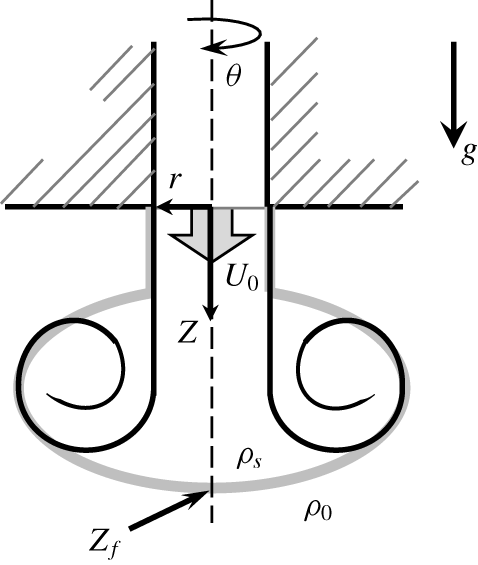
Schematic of the near wake of the starting forced plume flow with positive ( $\unicode[STIX]{x1D70C}_{s}>\unicode[STIX]{x1D70C}_{0}$) or negative (
 $\unicode[STIX]{x1D70C}_{s}<\unicode[STIX]{x1D70C}_{0}$) buoyancy. The source–ambient fluid interface is indicated by the thick grey line.

For the motion of an inviscid, incompressible and baroclinic fluid under the action of conservative external body forces, the vorticity equation can be expressed as
 $$\begin{eqnarray}\displaystyle \frac{\text{D}\unicode[STIX]{x1D74E}}{\text{D}t}=(\unicode[STIX]{x1D74E}\boldsymbol{\cdot }\unicode[STIX]{x1D735})\boldsymbol{u}+\frac{1}{\unicode[STIX]{x1D70C}^{2}}(\unicode[STIX]{x1D735}\unicode[STIX]{x1D70C}\times \unicode[STIX]{x1D735}p). & & \displaystyle\end{eqnarray}$$
During the initial development of a starting plume, the rate of baroclinic circulation production can be obtained via integrating (4.1) over the  $r$–
 $z$ plane (as shown in figure 1) as
 $$\begin{eqnarray}\displaystyle \frac{\text{d}\unicode[STIX]{x1D6E4}_{b}}{\text{d}t}=\iint \left[\frac{\text{D}\unicode[STIX]{x1D714}_{\unicode[STIX]{x1D703}}}{\text{D}t}-(\unicode[STIX]{x1D74E}\boldsymbol{\cdot }\unicode[STIX]{x1D735})u_{\unicode[STIX]{x1D703}}\right]\text{d}r\,\text{d}z=\iint \frac{1}{\unicode[STIX]{x1D70C}^{2}}\left(\frac{\unicode[STIX]{x2202}\unicode[STIX]{x1D70C}}{\unicode[STIX]{x2202}z}\frac{\unicode[STIX]{x2202}p}{\unicode[STIX]{x2202}r}-\frac{\unicode[STIX]{x2202}\unicode[STIX]{x1D70C}}{\unicode[STIX]{x2202}r}\frac{\unicode[STIX]{x2202}p}{\unicode[STIX]{x2202}z}\right)_{\unicode[STIX]{x1D703}}\text{d}r\,\text{d}z. & & \displaystyle\end{eqnarray}$$
In a quasi-steady formation process, the surfaces of constant pressure caused by the gravity are assumed to be horizontal (i.e.  $p=p(z)$ and
 $\unicode[STIX]{x2202}p/\unicode[STIX]{x2202}r=0$). For high Reynolds number and Schmidt number (or Prandtl number), the baroclinic circulation generation mainly occurs across the source–ambient fluid interface along the trailing jet and leading vortex ring, as illustrated in figure 1. Therefore, the rate of the baroclinic circulation production can be determined by considering the density difference across the interface, as
 $$\begin{eqnarray}\displaystyle \frac{\text{d}\unicode[STIX]{x1D6E4}_{b}}{\text{d}t}=-\iint \frac{1}{\unicode[STIX]{x1D70C}^{2}}\frac{\unicode[STIX]{x2202}\unicode[STIX]{x1D70C}}{\unicode[STIX]{x2202}r}\frac{\unicode[STIX]{x2202}p}{\unicode[STIX]{x2202}z}\,\text{d}r\,\text{d}z=\left(\frac{1}{\unicode[STIX]{x1D70C}_{0}}-\frac{1}{\unicode[STIX]{x1D70C}_{s}}\right)(p_{z_{f}}-p_{0})\approx \left(\frac{\unicode[STIX]{x1D70C}_{s}-\unicode[STIX]{x1D70C}_{0}}{\unicode[STIX]{x1D70C}_{s}\unicode[STIX]{x1D70C}_{0}}\right)\unicode[STIX]{x1D70C}_{s}gz_{f}=g^{\prime }z_{f},\quad & & \displaystyle\end{eqnarray}$$
where  $z_{f}$ denotes the streamwise penetration of the plume front. Combining contributions from both initial momentum and buoyancy, one can obtain the growth rate of total circulation as
 $$\begin{eqnarray}\displaystyle \frac{\text{d}\unicode[STIX]{x1D6E4}}{\text{d}t}=\frac{\text{d}\unicode[STIX]{x1D6E4}_{f}}{\text{d}t}+\frac{\text{d}\unicode[STIX]{x1D6E4}_{b}}{\text{d}t}=\frac{1}{2}U_{0}^{2}+g^{\prime }z_{f}. & & \displaystyle\end{eqnarray}$$
The next step is to estimate the specific function of  $z_{f}$ in the starting forced plume. For the initial development of a starting forced plume, it is reasonable to assume that the dynamics of the leading vortex ring has not yet been affected considerably by the buoyancy and is mainly determined by the initial momentum flux. Thus, its behaviour can be estimated based on the results for the homogeneous starting jets. Mohseni & Gharib (Reference Mohseni and Gharib1998) suggested that the translational velocity of the leading vortex ring in a starting jet is equal to
 $U_{0}/2$. Based on this approximation, the expression for
 $z_{f}$ can be given as
 $$\begin{eqnarray}\displaystyle z_{f}={\textstyle \frac{1}{2}}U_{0}t. & & \displaystyle\end{eqnarray}$$
It is realized that (4.5) is also consistent with the result of Marugán-Cruz et al. (Reference Marugán-Cruz, Rodríguez-Rodríguez and Martínez-Bazán2009), that initially the front position of a starting forced plume does not depend on the density difference for small Richardson number ( $Ri=g^{\prime }D/U_{0}^{2}$) cases, and advances at a nearly constant speed proportional to the discharge velocity. Therefore, by substituting (4.5) into (4.4), the increase rate of the total circulation is expressed as
 $$\begin{eqnarray}\displaystyle \frac{\text{d}\unicode[STIX]{x1D6E4}}{\text{d}t}=\frac{1}{2}U_{0}^{2}+g^{\prime }z_{f}=\frac{1}{2}U_{0}(U_{0}+g^{\prime }t). & & \displaystyle\end{eqnarray}$$
As discussed in § 3, the length scale for starting forced plumes is the jet exit diameter  $D$. The linear combination of the initial discharge velocity and the induced velocity of the gravitational acceleration i.e.
 $U_{0}+g^{\prime }t$, is taken as the characteristic velocity scale. It is noticed that the velocity scale is time dependent for the starting forced plumes even though the plume generator configuration does not change with time. In addition, according to (4.4), the dimensionless vorticity flux in a starting forced plume generated by a piston–cylinder apparatus is given by
 $$\begin{eqnarray}\displaystyle \frac{\text{d}\hat{\unicode[STIX]{x1D6E4}}}{\text{d}\hat{t}}=\frac{\text{d}\unicode[STIX]{x1D6E4}}{\text{d}t}\frac{1}{U_{0}^{2}}=\frac{1}{2}\left(1+\frac{g^{\prime }t}{U_{0}}\right), & & \displaystyle\end{eqnarray}$$
where the overhat denotes the corresponding dimensionless quantity. Thus, the dimensionless parameter  $C$ can be obtained as
 $$\begin{eqnarray}\displaystyle C=\left(\frac{\text{d}\hat{\unicode[STIX]{x1D6E4}}}{\text{d}\hat{t}}\right)^{-1}=\frac{2U_{0}}{U_{0}+g^{\prime }t}. & & \displaystyle\end{eqnarray}$$
Finally, by substituting (4.6) and (4.8) into (3.2), the definition of formation time for the starting forced plume, i.e. the buoyant formation time  $t_{b}^{\ast }$, is reached as
 $$\begin{eqnarray}\displaystyle t_{b}^{\ast }=\int _{0}^{t}\frac{C\text{d}\unicode[STIX]{x1D6E4}/\text{d}\unicode[STIX]{x1D70F}}{D(U_{0}+g^{\prime }t)}\text{d}\unicode[STIX]{x1D70F}=\frac{U_{0}^{2}}{g^{\prime }D}\ln \left(1+\frac{g^{\prime }t}{U_{0}}\right)=\frac{1}{Ri}\ln (1+Rit^{\ast }). & & \displaystyle\end{eqnarray}$$
4.2 Critical formation number in the starting forced plumes
As stated in the introduction, the significance of the formation time lies in its role in parameterizing the restricted vortex formation process by identifying a critical formation number. To demonstrate the physical validity of the buoyant formation time defined in (4.9), the specific values of the formation number in the starting forced plumes with different Richardson numbers are examined theoretically. Since it takes into account the contribution of both the vorticity flux from the source and the baroclinic effect in the flow field, the buoyant formation time is expected to provide a better scaling of the process of the vortex formation in terms of the improved universality of the formation number.
The theoretical prediction of the formation number in starting forced plumes is carried out based on the Kelvin–Benjamin variational principle proposed by Gharib et al. (Reference Gharib, Rambod and Shariff1998). It is obvious that the buoyancy exerting on the source fluid causes the corresponding changes in the dynamic properties of the total starting flow, namely its kinetic energy, impulse and circulation. Similar to the estimation of the total circulation in § 4.1, the kinetic energy and impulse in the starting forced plume can be determined by the linear combination of a source flux term, which can be estimated by the slug model, and a buoyancy term caused by the relative density difference. Following the analysis of Wang et al. (Reference Wang, Law, Adams and Fringer2009, Reference Wang, Law and Adams2011), the kinetic energy  $E$ and impulse
 $I$ for the starting forced plume can be approximated as
 $$\begin{eqnarray}\displaystyle & \displaystyle E=E_{f}+E_{b}={\textstyle \frac{1}{8}}\unicode[STIX]{x03C0}\unicode[STIX]{x1D70C}_{s}D^{2}U_{0}^{3}t+{\textstyle \frac{1}{4}}\unicode[STIX]{x03C0}\unicode[STIX]{x1D70C}_{0}D^{2}g^{\prime }U_{0}t\left(U_{0}t+{\textstyle \frac{1}{2}}g^{\prime }t^{2}\right), & \displaystyle\end{eqnarray}$$
 $$\begin{eqnarray}\displaystyle & \displaystyle I=I_{f}+I_{b}={\textstyle \frac{1}{4}}\unicode[STIX]{x03C0}\unicode[STIX]{x1D70C}_{s}D^{2}U_{0}^{2}t+{\textstyle \frac{1}{4}}\unicode[STIX]{x03C0}\unicode[STIX]{x1D70C}_{0}D^{2}g^{\prime }U_{0}t. & \displaystyle\end{eqnarray}$$
The dimensionless energy used to characterize the Norbury–Fraenkel family of steady vortex rings can be obtained by
 $$\begin{eqnarray}\displaystyle \unicode[STIX]{x1D6FC}_{total}=\frac{E}{\sqrt{\unicode[STIX]{x1D70C}_{s}I\unicode[STIX]{x1D6E4}^{3}}}. & & \displaystyle\end{eqnarray}$$
According to the Kelvin–Benjamin variational principle, the vortex ring pinch-off process begins when the dimensionless energy of the total flow falls below a critical value required for a steady vortex ring. This limiting value of dimensionless energy  $\unicode[STIX]{x1D6FC}_{lim}$ for a steady vortex ring was found experimentally and numerically to be approximately 0.33 for the homogeneous starting jet (Gharib et al. Reference Gharib, Rambod and Shariff1998; Zhao, Frankel & Mongeau Reference Zhao, Frankel and Mongeau2000). Under the condition of small Richardson number, it is reasonable to assume that no fundamental change occurs in the structure and dynamics of the leading vortex ring (Hurridge & Hunt Reference Hurridge and Hunt2012). Therefore, the limiting dimensionless kinetic energy of the buoyant vortex ring is still approximated as equal to that obtained for the homogeneous starting jet, i.e.
 $\unicode[STIX]{x1D6FC}_{lim}=0.33$.
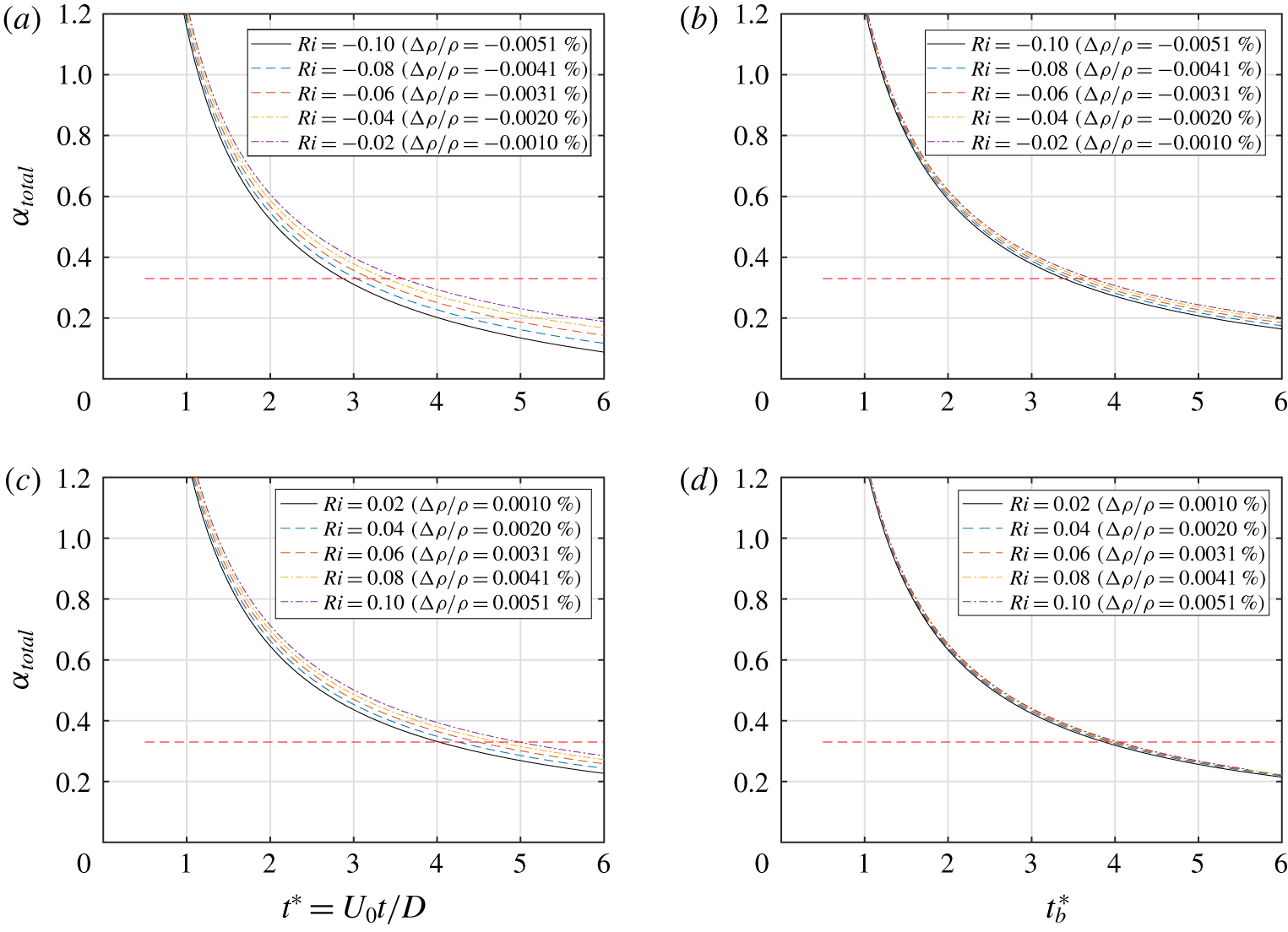
The variation of the dimensionless total energy for the starting forced plume with (a) negative buoyancy against the classic formation time, (b) negative buoyancy against the buoyant formation time, (c) positive buoyancy against the classic formation time and (d) positive buoyancy against the buoyant formation time. The horizontal dashed lines indicate the limiting value of  $\unicode[STIX]{x1D6FC}_{lim}=0.33$.

In order to apply the Kelvin–Benjamin variational principle to identify the formation number, the dimensionless energy of the starting forced plume with negative or positive buoyancy is plotted against the classic formation time defined in (1.1) and the new buoyant formation time defined in (4.9) in figure 2. The intersection of the total dimensionless energy curves with the limiting value  $\unicode[STIX]{x1D6FC}_{lim}=0.33$ (i.e. the horizontal dashed lines in figure 2), thus, determines the critical formation number
 $F$. The results shown in figures 2(a) and 2(c) indicate that, in terms of the classic formation time, increasing the Richardson number tends to increase the formation number, i.e. to elongate the vortex ring pinch-off process. This trend of variation of the formation number under the influence of the Richardson number is in qualitative agreement with the results of Gao & Yu (Reference Gao and Yu2016) and Wang et al. (Reference Wang, Law, Adams and Fringer2009, Reference Wang, Law and Adams2011). According to (4.6) and (4.10)–(4.11), this trend can be understood by considering the effects of the buoyancy on these dynamic properties of the starting forced plume. For instance, as the Richardson number increases in the positively forced plumes, the growth in circulation due to baroclinic vorticity generation is proportionally slower than the growth in kinetic energy due to buoyancy acceleration, resulting in the slower drop of the dimensionless total energy. Consequently, in terms of the energetics of the formation process, the vortex ring generated under positive buoyancy would achieve its equilibrium state more slowly.
On the other hand, using the new buoyant formation time to parameterize this process, it is striking to observe in figures 2(b) and 2(d) that the results of the dimensionless energy for all Richardson number cases considered almost collapse on a single curve, especially for the positively forced plumes. In this sense, the critical formation number  $F_{b}$ identified in terms of the buoyant formation time
 $t_{b}^{\ast }$ becomes approximately invariant for the starting forced plumes in the range of Richardson number
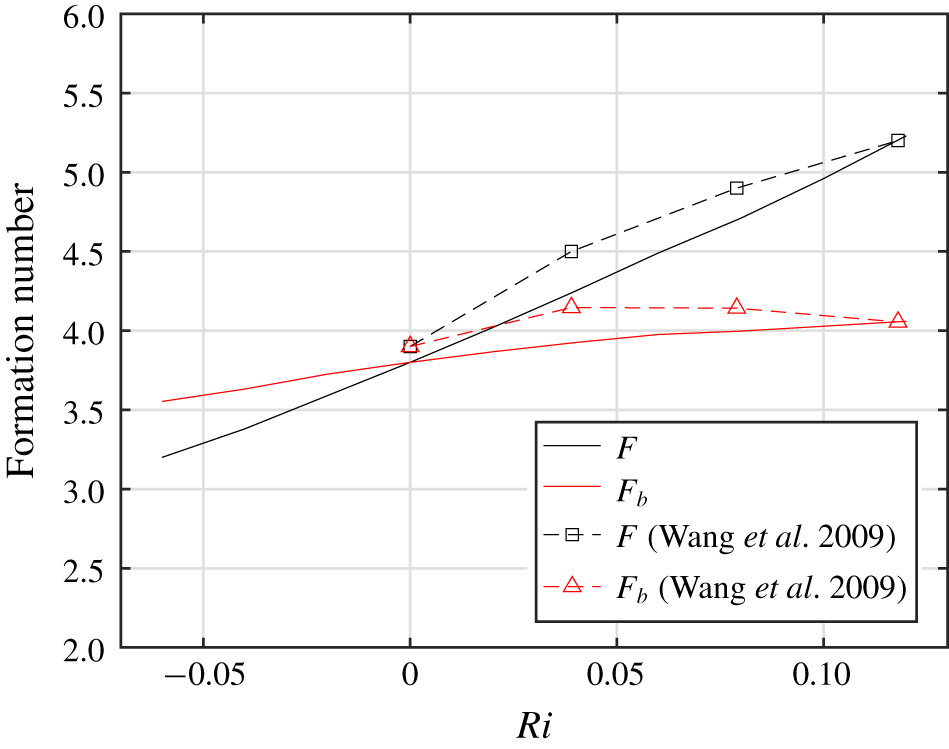
 $-0.1<Ri<0.1$. The values of the formation number of the starting jet and plumes estimated theoretically by the Kelvin–Benjamin variational principle are compared with those obtained in the study of Wang et al. (Reference Wang, Law, Adams and Fringer2009) for validation. As shown in figure 3, the buoyant formation number is in good agreement with the numerical results found in Wang et al. (Reference Wang, Law, Adams and Fringer2009) for the positively forced plumes. The relatively large variation from 3.9 to 5.2 in the formation number
 $F$ is found to be mitigated to around a universal value of
 $F_{b}=4.0\pm 0.1$ by using the new buoyant formation time definition. Therefore, it is convincing to conclude that the general definition of the formation time proposed in the present study improves the universality of the limiting formation number since it can offer a better scaling for the vortex formation process under the effect of buoyancy.
The variation of two forms of the formation number  $F$ and
 $F_{b}$ of the starting forced plume against the Richardson number.

Finally, based on the results of the formation number for the starting forced plume, some remarks can be made on the formation number for more general configurations of the optimal vortex formation. As shown in our present analysis, the variation in the formation number caused by a relative density difference between the source and ambient fluid could be appropriately scaled by incorporating the buoyancy effect in the definition of the buoyant formation time. From (3.2), the general formation time is essentially equivalent to the normalized total circulation if the characteristic length and velocity scales remain constant during the vortex formation process. It implies that the universal value of formation number actually corresponds to a relative constant dimensionless circulation in the total flow at the beginning of the vortex ring pinch-off process. Although it is the most significant factor, the magnitude of the total circulation is not the only parameter in determining the dynamics of the vortex formation process. Therefore, the critical value of the formation number may not necessarily be a constant value at around 4, which is identified for the classic starting jet and its close derivatives. In different vortex generator configurations, fundamental changes in the vortical structure may occur due to some other physical mechanisms, such as a different vortex generator geometry (i.e. elliptic or square exit), multiphase flows, etc.
5 Concluding remarks
Based on the definition given by Dabiri (Reference Dabiri2009), a general definition of the dimensionless formation time is proposed by considering the important role of the vorticity generation in the process of vortex formation. Its specific expression for the starting forced plume is then derived accordingly. A simple analysis has also been conducted to estimate the critical formation number of the starting forced plume with negative or positive buoyancy in terms of the buoyant formation time. The result suggests that the formation number calculated by using the new buoyant formation time improves the invariance of the critical time scale for the vortex formation process in the starting forced plume. It also verifies that the general formation time could serve as an appropriate dimensionless parameter to describe the vortex formation process. In addition, our analysis implies that the specific value of the formation number may essentially vary in more general or complex vortex generator configurations, due to the change caused by other physical mechanisms in their formation and interaction with the trailing shear layer. It is of practical and theoretical interest to further elaborate the influence of other physical mechanisms and to derive the specific value of the formation number in diverse vortex shedding configurations.
Acknowledgements
Financial supports from the National Natural Science Foundation of China under grant no. 11502153 and the HKPolyU grant no. 1.4W.37.99QP are gratefully acknowledged.