Look at this battalion… There are there Arabs and Copts, Mussulmans and Christians, that march in the same rank. I assure you that not one of them troubles himself about his comrade's religion. Equality between them is complete.
Ismail, Khedive of Egypt (1863–1879) (Charmes Reference Charmes and Conn.1883, p. 161)
Does industrialization act as a “melting-pot,” reducing human capital differentials between ethno-religious groups? Or do some groups benefit more than others from industrialization, hence, altering the long-standing distribution of human capital among groups? This is a particularly important concern in ethno-religiously diverse societies, where conflicts over the distribution of the benefits (or losses) from industrialization among groups may impede the “nation-building” process. In fact, political science and sociology scholars, such as Joseph Rothschild (Reference Rothschild1981), Anthony Smith (Reference Rothschild1981), Ronald Rogowski (Reference Rothschild1985), and Walker Connor (Reference Connor1994), emphasize the importance of industrialization's redistribution to explain the persistence of ethno-religious conflicts in industrialized economies. Their explanation up ends the classic thesis whereby industrialization's widespread benefits allowed scholars to ignore the challenges imposed by ethno-religious diversity.Footnote 1 A more recent literature, including Edward Miguel (Reference Atack, Bateman and Margo2004), Saumitra Jha (Reference Bhavnani and Jha.2013), and Rikhil R. Bhavnani and Jha (Reference Bhavnani and Jha.2013), examines how state policies and trade affect the provision of public goods, ethno-religious conflicts, and mass-mobilization. However, relatively little is known on whether, and how, industrialization alters inter-group human capital inequality. This evaluation is necessary if we are to understand which “nation-building” industrialization programs succeed or fail, and the consequent evolution of inter-group relations in various parts of the world.
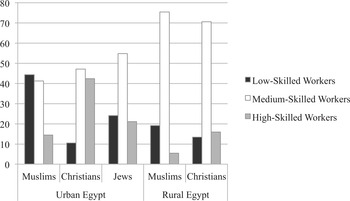
This article attempts to evaluate the impact of nineteenth-century Egypt's state industrialization program on the human capital of its two major religious groups (Muslims and Christians). Native non-Muslims in Egypt traditionally had higher human capital than the Muslim majority. Indeed Muslims were underrepresented among medium- and high-skilled workers, especially in urban Egypt (Figure 1). Specific organizations, guilds, and elementary religious schools (kuttabs), preserved these differentials for centuries by constraining access to skills (artisanship, literacy, and numeracy). Muhammad Ali Pasha, the autonomous Ottoman viceroy of Egypt, and his successors, led an ambitious state industrialization program that occurred in two waves in 1816–1848 (mostly textiles) and 1848–1868 (mostly transportation). Historians, such as Abdulrahman Al-Raf'i (Reference Al-Raf'i1982 [Reference Al-Raf'i1930], Reference Al-Raf'i1987 [Reference Al-Raf'i1932]), Jacques Tagher (Reference Bhavnani and Jha.1998 [Reference Tagher1951]), and Afaf Lutfi Al-Sayyid Marsot (Reference Marsot1984), portray the program as the cornerstone of Egypt's inter-religious integration and “nation-building,” that fostered two nationalist uprisings in 1881 and 1919. In the latter, Muslims and Christians revolted together against the British Occupation under the remarkable slogan, “Long lives the crescent with the cross!” For these scholars although the program did not produce economic development, it triggered a social transformation.Footnote 2 For example, in 1848, state firms employed 8 percent of the adult active male urban population and in 1868 3 percent, forming the nucleus of the Egyptian working class that played a crucial role in the 1919 revolution.Footnote 3
OCCUPATIONAL DISTRIBUTION BY RELIGIOUS GROUP IN 1848–1868 EGYPT

However, we cannot take this view at face value. Did the program in fact act as a “nation-building” device, reducing human capital differentials between Muslims and Christians? In an economy with low-, medium-, and high-skilled labor, where Christians have greater shares of medium- and high-skilled labor, industrialization might well shift the relative demand for, or supply of, each labor type and thus inter-religious human capital differentials. On the one hand, Claudia Goldin and Lawrence F. Katz (Reference Goldin and F1998), Jeremy Atack, Fred Bateman, and Robert A. Margo (Reference Atack, Bateman and Margo2004), and Katz and Margo (Reference Katz and Margo2013) demonstrated in the U.S. context that industrialization, a technical transition from the artisanal shop to the factory, might induce demand shifts. These shifts may benefit one religious group more than another because initially, at least, Christians were over represented among medium- and high-skilled urban workers. On the other hand, one could argue following Ann Bartel (Reference Bartel1989, Reference Bartel1994), John Bishop (Reference Bartel1994), Sandra E. Black and Lisa M. Lynch (Reference Black and Lisa1996), and Lorraine Dearden, Howard Reed, and John Van Reenen (Reference Dearden, Reed and Van Reenen2006) that on-the-job training in state firms may induce skill supply shifts. These shifts may also vary by religious group.
More generally this article contributes to a series of debates beginning with the problem of state industrialization, which concerned many scholars starting from Friedrich List (Reference List and Matile1856 [Reference Bhavnani and Jha.1841]), Alexander Gerschenkron (Reference Gerschenkron1962), and, more recently, Peter Zeitz (Reference Zeitz2011), Dan Bogart and Latika Chaudhary (Reference Bogart and Chaudhary2012, Reference Bogart and Chaudhary2013), and, in nineteenth-century Egypt's context, Laura Panza and Jeffrey G. Williamson (Reference Panza and Williamson2013). Egypt's program is one of the earliest pre-Colonial state industrialization programs in the “periphery.” Second, there is the literature on technical change and the relative demand for skills. Egypt's program, used a similar technology to the first Industrial Revolution (IR), provides further evidence on the “de-skilling” and “hollowing-out” of occupations with the adoption of modern production methods but in a totally different context from Western Europe and the United States. Finally, the article matters for Egyptian history. It provides the first quantitative analysis of the evaluation of Egypt's state industrialization that goes beyond the qualitative historical accounts of Ali Al-Gritli (Reference Al-Gritli1952), Moustafa Fahmy (Reference Fahmy and Leiden1954), Gabriel Baer (Reference Baer1964), Ahmed A. Al-Hitta (Reference Al-Hitta1967), Marsot (Reference Marsot1984), Pascale Ghazaleh (Reference Bhavnani and Jha.1999), and Roger Owen (Reference Owen2002). Equally important to Egyptian history are the extent and evolution of the human capital of non-Muslims, a phenomenon that Jacques Tagher (Reference Tagher1998 [Reference Tagher1951]), Charles Issawi (Reference Issawi and Issawi1981), and Youssef Courbage and Philippe Fargues (Reference Courbage, Fargues and Mabro1997) documented.
To do so however required collecting data on religion, human capital, and the potential exposure to industrialization. In fact, a revisionist historian, Khaled Fahmy (Reference Fahmy2009, p. 126) points out that it is important when evaluating Ali's experiment to take into account “the millions of Egyptian people whose lot, as a direct result of what Mehmed Ali actually did achieve, was that of hardship and suffering.” To this end, I constructed two cross-sectional samples of the Egyptian 1848 and 1868 population censuses, one of the earliest individual-level censuses in the Middle East, which I digitized from the original manuscripts at the Egyptian Archives, and describe in detail in Mohamed Saleh (Reference Saleh2013a). The census samples include information on a wide range of variables on every member in the household, including females, children, and slaves. Variables include household relationships, age, place of origin, place of residence, occupation, workplace (for people recruited by the state), religion, ethnicity (e.g., local, Sudanese, Nubian, Abyssinian, Armenian, Turkish), nationality (Egyptian or foreigner), legal status (free or slave), dwelling ownership, dwelling type (e.g., hut, courtyard), and school enrollment for children. The list of variables is relatively rich, even if compared to the 1850 U.S. census. I restrict the analysis in this article to Muslim and Christian active males who are at least 15 years of age.
Despite the relative richness of the data, they impose certain limitations on estimating the impact of state industrialization. In particular the censuses have no measure of income so we must focus on social status. The social status index (SSI) classifies each occupation into low-, medium-, and high-skilled ranges, following the HISCLASS measure that was constructed by Marco H. D. van Leeuwen and Ineke Maas (Reference van Leeuwen and Maas2005). I analyze the distribution of SSI scores in an ordered logit regression with district fixed effects. To simplify the interpretation of the non-linear results, I report the results for a specific profile: an Egyptian, free, non-black, and non-migrant male of average age (averaging out the district fixed effects).
Perhaps a more challenging limitation is the potential endogeneity of industrialization. Indeed, I observe the actual employment of individuals in state firms rather than their potential exposure to state industrialization. I exploit the within-district cross-sectional variation between workers in state firms and in the traditional sector in the 1848 and 1868 samples, which were collected at the end of each industrialization wave. Hence, I am not able to disentangle the causal effect of state industrialization, because workers in state firms could be different in their pre-industrialization characteristics from those in the traditional sector, even after controlling for observed characteristics. For this reason, I interpret the findings using a conceptual framework based on Katz and Margo (Reference Katz and Margo2013) (henceforth, KM), who extends Goldin and Katz (Reference Goldin and F1998) and Atack, Bateman, and Margo (Reference Atack, Bateman and Margo2004). The framework explains the differential effect of technical change (state industrialization) on the skill distribution for Muslims and Christians via two mechanisms: (a) shifts in the relative demands for low-, medium-, and high-skilled labor, whereby state firms recruit workers with skills that were acquired in the traditional sector, without altering the relative skill supplies, and (b) on-the-job training, whereby state firms recruit unskilled workers and train them to fill in jobs, hence shifting the relative skill supplies.
I find that in 1848 state firms had relatively fewer medium-skilled Muslim and Christian workers than the traditional sector, with a stronger effect on the latter in urban Egypt. For Muslims the effect was compounded by a drop in the probability of being a high-skilled worker, resulting in a “de-skilling” effect on Muslims. For Christians, the dearth of medium skill jobs in state firms was offset by a rise in the probability of being a high-skilled worker, perhaps to fill in the administrative jobs in state firms, resulting in an “up-skilling” effect on Christians. In contrast, state industrialization in 1868 (equally) decreased the probability of being a low-skilled worker among both Muslims and Christians, resulting in an “up-skilling” effect on both groups. But while the “up-skilling” of Muslims was via an increase in the probability of being a medium-skilled worker and the probability of being a high-skilled worker, the “up-skilling” of Christians was solely via an increase in the probability of being a high-skilled worker, which was greater than the increase among Muslims.
I provide suggestive evidence on whether the findings are driven by skill demand or supply shifts via decomposing the effect of state industrialization into two components. First, there are SSI differences between workers in old occupations in state firms and in the traditional sector. These are occupations that existed in both sectors and so state firms presumably recruited workers into these jobs with skills that had already been acquired in the traditional sector, suggesting that the observed SSI differences may be attributed to demand shifts. Second, there are SSI differences between workers in new versus old occupations within state firms. New occupations, such as machine operatives, railways drivers, ticket conductors, telegraphers, and printing workers, were created by state firms, and presumably required providing on-the-job training, suggesting that the observed SSI differences may be attributed to supply shifts. I find that the findings in both 1848 and 1868 hold among workers in old occupations, suggesting that demand shifts account for the findings. However, on-the-job training in 1848 seems to have driven Muslim and Christian workers into low-skilled occupations (machine operatives), and in fact accounts for Muslims’ de-skilling in Cairo and Alexandria in the first wave.
A final remark on the analysis is important to emphasize. Given the low employment share of state firms out of the adult active male population in the two industrialization waves, state industrialization did not in fact change the aggregate skill mix in the economy (or in the manufacturing sector). Indeed, this contrasts industrialization in Western Europe and the United States, which has been the focus of the technical change literature, where industrialization changed the aggregate skill mix because of the large employment share of the industrialized manufacturing sector. Instead, the analysis carried out in this article could be thought of as exploring the counterfactual aggregate skill mix, had state industrialization succeeded, and become widespread in, at least, the manufacturing sector, in its first or second waves. The analysis, however, is unable to reveal the actual evolution of the aggregate skill mix.
EGYPT'S LABOR MARKETS
At the beginning of the nineteenth century, the Egyptian labor market was organized through the guild system (ta'ifa) that encompassed most urban workers (Baer Reference Baer1964, pp. 16–48). Apprenticeship, the sole route for accession to artisanship, and the jedik, a required fee to practice a craft in a workshop, both made guild membership constrained (Baer Reference Baer1964, pp. 49–76, 107; André Raymond Reference Raymond1973, pp. 544–51). Christians were over-represented in specific artisanal occupations (weavers, spinners, carpenters, jewelers, tailors) and white-collar occupations (scribes, bookkeepers, tax collectors) (Raymond Reference Raymond1973, pp. 456–59), and they imposed significant barriers to entry into these occupations.Footnote 4
The alternative route for acquiring (white-collar) skills, besides apprenticeship, was education. Schools, however, were traditionally segregated by religion, as elementary religious schools (kuttabs) were the sole providers of education around 1800 (James Heyworth-Dunne 1938, pp. 2–7, 84–92). Historical evidence suggests that non-Muslim kuttabs were more inclined towards “useful knowledge” than Muslim ones: While Christian kuttabs taught arithmetic and geometry, Muslim kuttabs focused only on writing and reading in Arabic and memorizing the Koran. Muslim religious institutes provided further higher education as preparation for the Muslim clergy.Footnote 5 Although public schooling was introduced in 1816, starting with higher education, followed by secondary and primary schools, public education remained very limited, serving only 1 percent of the urban male population age 5 to 25 years old in 1848. Further, most of the public schools were shut down in the 1850s (Heyworth-Dunne Reference Heyworth-Dunne1938, pp. 223–43, 288–301, 313–23). Consequently, kuttabs remained the main provider of education for the Egyptian masses until well into the mid twentieth century. It is perhaps worth to note that non-Muslims were not admitted to public schools of higher education until 1873 (Sami 1928, p. 1123).
Nineteenth-century state industrialization was the first major structural break to Egyptian labor markets in centuries. Muhammad Ali, the Ottoman viceroy of Egypt from 1805 to 1848, established a state owned textiles factory in Al-Khurunfish quarter in Cairo in 1816 (Owen Reference Owen2002, p. 69). He then established a series of projects throughout his reign that, in 1848, included textiles (66 percent of state industrial employment), military industries (17 percent), and other industries, such as printing, paper, coin making, and wood (17 percent) (Al-Gritli Reference Al-Gritli1952, pp. 51–65; Fahmy Reference Fahmy and Leiden1954, pp. 21–54). Seventy percent of these firms were in the two major cities, Cairo and Alexandria. With median employment of 163 workers, state firms were larger than traditional artisanal shops. They also employed machines that were a crude imitation of Europe's technology. A few factories used steam power to operate the machines, but the vast majority resorted to animal power.
To fund his ambitious projects, Ali monopolized internal and external trade, and centralized the tax system (Owen Reference Owen2002, pp. 65–66). Nonetheless, by 1868, 67 percent of his factories had closed down, and employment in the surviving ones in Cairo and Alexandria was 25 percent of its peak. Traditional accounts of the failure of state owned firms focus on the 1838 Anglo-Turkish commercial convention which abolished monopolies and reduced tariffs in the Ottoman Empire, and the 1841 London treaty which limited the size of the Egyptian army, the raison d’être of the factories (Owen Reference Owen2002, pp. 75–76). Owen, however, suggests that there were structural causes for the failure such as a decline in Ali's authority after 1837, unqualified personnel, and the fuel and power problems. Perhaps most importantly, the fact that industrialization was undertaken by the state rather than by local entrepreneurs implies that the transition was not profitable enough to incentivize the private sector to industrialize. This might also be because Egypt lacked the human capital that allowed entrepreneurs and the general labor force in Western Europe and the United State to adopt new production technologies (Owen Reference Owen2002, p. 72).
Ali's successors focused on transportation in the second wave of industrialization after 1848. Railways, telegraph, steam navigation, and tramways employed 58 percent of the workers in state firms in 1868 (Al-Hitta Reference Bhavnani and Jha.1967, pp. 215–91). The share of military industries remained stable at 22 percent; textiles’ share fell sharply to 3 percent, while other industries, such as printing, tannery, and coin making, accounted for 17 percent. Cairo and Alexandria housed 86 percent of the projects. The technology used in these projects was presumably more capital-intensive than it had been in the first wave. Both internal and external debts were used to fund the second wave, and the increased debt (especially for the Suez Canal) led to the British Occupation in 1882. Many of the transportation enterprises, however, survived until today.
CONCEPTUAL FRAMEWORK
Industrialization and the Relative Demand for Skills
I employ the KM framework in order to understand the effect of industrialization on the Christian-Muslim human capital gap. Muslim workers fall into three categories: high skilled (denoted by HM ), medium skilled (SM ), and unskilled (LM ); the same for Christians. Both groups supply each type of labor inelastically and Christians are the minority. Labor markets are competitive, but access to artisanship, literacy, and numeracy is not. Guilds and religious schools (kuttabs), which provided access to these skills, resorted to non-competitive admission policies that were more favorable to Christians leading to their over-representation among artisans and white-collar workers:Footnote 6


Where θ is the percentage of workers who are Christian;  captures the over-representation of Christians among artisans and
 captures the over-representation of Christians among white-collar workers. These assumptions imply that:

Industrialization involves workers moving from artisanal shops (T) to factories (F). Each of the two production technologies has three tasks: (1) artisans and raw capital (Kr ) are combined to produce operating capital (Ko ) via a Leontief technology, (2) unskilled workers and operating capital are combined to produce the final output via a Cobb-Douglas technology, and (3) non-production administrative services are produced using white-collar workers in proportion to the amount of unskilled labor used in the second task:Footnote 7


Labor and output markets are competitive. Firms choose H, S, L, and Kr given factor prices (wl , ws , wh , and r) to minimize costs. As Atack, Bateman, and Margo (Reference Atack, Bateman and Margo2004) demonstrate, the optimal ratio of unskilled labor to operating capital in the second task is a function (Φ) of the final output and the ratio of the rental price of operating capital (ro ) to the unskilled wage:

Define the optimal shares of unskilled workers, artisans, and white-collar workers (relative to the total labor force) as lower-case l, s, and h respectively. It follows that:

I make one (slight) modification to the KM framework. While I follow KM in arguing that state projects and artisanal shops have different α (ratio of artisans to raw capital in the first task), Φ (ratio of unskilled workers to operating capital in the second task), and π (ratio of white-collar workers to unskilled workers in the third task), I allow these differences to vary by industry: textiles (X) and transportation (P).
First, textiles factories perhaps had lower than artisanal textiles shops. Relatively few artisans (blacksmiths, tinsmiths) were required in factories because of the economies of scale in installing and maintaining machines, unlike artisanal shops where spinners and weavers maintained their own tools (KM, p.11). However, state transportation enterprises perhaps had higher α than the traditional transportation industry. More artisans (blacksmiths, mechanics) were required in state enterprises to install and maintain railways, steamships, telegraph, and tramways, unlike traditional transportation where few artisans (blacksmiths, carpenters) were needed to build animal-driven vehicles and boats.
Second, because of mechanization and division of labor, state textiles manufactories had higher Φ than artisanal shops. Factories required a lot of unskilled machine operatives in production, unlike textiles shops that used very little unskilled labor. By contrast, because of the (medium) skill requirements of most of its operations (railways and tramways driving, ticket conducting, telegraph operations, steam navigation), state transportation enterprises required little unskilled labor, unlike traditional transportation that required a lot of unskilled animal drivers and boatmen.Footnote 8
Finally, because of their large size, both textiles and transportation enterprises had presumably higher than the traditional industries. Many white-collar workers were required to handle the accounting, bookkeeping, and other administrative (non-production) operations in state firms.
The aforementioned differences within industry j (= X or P) between technologies i (= T or F) can be summarized as follows: (1) αXF < αXT , ΦXF > ΦXT , and πXF > πXT ; and (2) αPF > αPT , ΦPF < ΦPT , and πPF > πPT . I hence obtain the following propositions that extend the KM results by allowing them to vary by industry and religious group (see online Appendix A for proofs):
Proposition 1: Industrialization of textiles decreases the share of artisans, increases the share of white-collar workers, and could either increase or decrease the share of unskilled workers. Industrialization of transportation decreases the share of unskilled workers, and could either increase or decrease the share of artisans and the share of white-collar workers.
Since labor markets are competitive, recruitment in state manufactories is “religion-neutral.” Hence, one could derive the effects of industrialization on the shares of unskilled workers, artisans, and white-collar workers among Muslims and Christians, relative to the group size:
Proposition 2: The effects on Christians of changes in demand for medium- and high-skilled workers are stronger than for Muslims.
Industrialization and the Relative Supplies of Skills
The above analysis examined the impact of state industrialization on the Christian-Muslim human capital gap via affecting the relative demands for the three types of labor. However, the relative supplies of labor may also shift with industrialization. For example, on-the-job training in state projects may increase the relative supplies of artisans and/or white-collar workers. On-the-job training could be religion-neutral or religion-biased. In the first case, it would induce an outward shift in the relative supply of artisans and/or white-collar workers, holding  constant, while, in the second case, it would affect
 and/or
 holding the relative labor supplies constant.
DATA
Examining the impact of state industrialization on the inter-religious human capital differentials requires gathering individual-level data on religion, human capital, and exposure to industrialization. I digitized two nationally representative samples (about 80,000 records each) of the 1848 and 1868 Egyptian censuses from the original manuscripts, and I constructed an oversample of non-Muslims in Cairo in both years.Footnote 9 I restrict the sample in this article to adult Muslim and Christian active males who are at least 15 years old and have non-missing values for all variables in the analysis. I focus on occupations to construct three skill categories. I start with HISCLASS (van Leeuwen and Maas Reference van Leeuwen and Maas2005). It allows me to assign a value between 1 and 12 to each occupational title, according to four criteria: manual vs. non-manual, supervisory vs. non-supervisory, skill level (from low to high), and primary sector vs. non-primary (see online Appendix B for details). I then collapse the scores into three ranges that correspond to low-, medium-, and high-skilled workers.
I control for a number of individual characteristics that are plausibly exogenous in the empirical analysis. These are: (1) age, which is reported in full years, (2) legal status, which has three categories: free, slave, and emancipated slave. I measure this variable using a “slave” dummy variable that takes the value of one if an individual is a slave or an emancipated slave, (3) nationality, which has two categories: under government's control (Egyptians, who include Nubians, Sudanese, and Abyssinians) and outside government's control (foreigners who could be Ottomans, such as Turks, North Africans, Ottoman Greeks, and Levantines or non-Ottomans, such as Moroccans, Europeans, Americans, and Asians), (4) ethnicity such as Nubian, Abyssinian, Sudanese, Turkish, Levantine, Ottoman Greek, and Armenian. I measure this variable using a “black” dummy variable that takes the value of one if an individual is Abyssinian, Sudanese, or Nubian, and (5) migration, which is a dummy variable that takes the value of one if an individual's province of birth is different from province of residence.
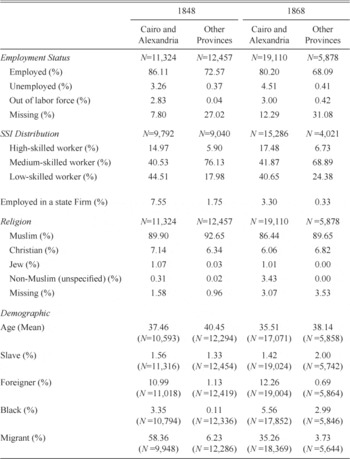
Table 1 shows the descriptive statistics. The sample size varies from one variable to another to show the degree of missing values for each variable. Around 3 percent of urban Egyptians were “without occupation,” 3 percent were out of labor force (students and retired), and 8 percent had missing occupations in 1848 (the values for 1868 were 5, 3, and 12 percent respectively). In the countryside, the percentages of unemployed and out of labor force are negligible but the percentage missing is particularly high at 27 percent in 1848 (31 percent in 1868), perhaps because they were presumed to be farmers. About 40–45 percent of the labor force in urban Egypt was low skilled, 41–42 percent was medium skilled, and 15–17 percent was high skilled. The percentage of medium-skilled workers is high in rural Egypt, since this category includes farmers. The religious composition is quite stable across the two years and across urban and rural provinces, with Muslims constituting the vast majority (about 90 percent), followed by Christians (6–7 percent), and Jews (1 percent), but the latter are mainly urban.Footnote 10 The average age in Cairo and Alexandria is about 37 years old, and is slightly higher in the countryside. Around 1.5 percent of the adult males are slaves or emancipated slaves. The percentage of foreigners is relatively high (11–12 percent) in Cairo and Alexandria. Blacks were concentrated in Cairo and Alexandria, but their population increased in the countryside in 1868. Finally, the percentage of migrants is remarkably high in Cairo and Alexandria at 58 percent in 1848 and 35 percent in 1868 (Alexandria in particular was a fast-growing city of migrants with 78 percent of its inhabitants in 1848 born outside the city).
DESCRIPTIVE STATISTICS

Notes:
Sample is restricted to adult males who are at least 15 years old. Sample size varies from one variable to another to reflect the missing values for each variable. Sample weights are used to adjust for the different sampling rates across provinces. Descriptive statistics are based on the systematic sample only. See online Appendix B for definitions of variables.
Source:
See the text.
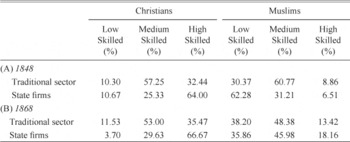
SKILL DISTRIBUTION BY RELIGION IN THE TRADITIONAL SECTOR AND STATE FIRMS

Notes:
In 1848, for Muslims, N = 15,242 in the traditional sector and 676 in state firms; for Christians, N = 1,951 in the traditional sector and 75 in state firms. In 1868, for Muslims, N = 16,129 in the traditional sector and 435 in state firms; for Christians, N = 1,700 in the traditional sector and 54 in state firms.
Source:
See the text.
EMPIRICAL ANALYSIS
Empirical Strategy and Results
To study the impact of Egypt's state industrialization, a natural starting point is to compare the skill distribution of each religious group across state firms and the traditional sector (which includes everyone else outside state firms). Table 2 shows this comparison. Among Christians in state firms in 1848, there are relatively equal low-skilled workers, fewer medium-skilled workers, and more high-skilled workers, than in the traditional sector. The same comparison holds in 1868 except that there are relatively fewer low-skilled Christians in state firms than in the traditional sector. By contrast, among Muslims in state firms in 1848, there are relatively more low-skilled workers and fewer medium- and high-skilled workers, than in the traditional sector. In 1868, the comparison is reversed with relatively fewer low- and medium-skilled workers and more high-skilled workers than in the traditional sector.
This preliminary evidence suggests that the effect of state industrialization varied by religious group and industrialization wave. Christians in state firms seem to have experienced an “up-skilling” effect in both waves, while Muslims were “de-skilled” in the first wave but “up-skilled” in the second. However, one may want to control for a set of individual characteristics that are plausibly exogenous: age, nationality, ethnicity, legal status, and migration, in addition to district of residence fixed effects, because these variables might be correlated with skills, religion, and employment in state firms. Ideally, I would have wanted to estimate the following regression:

where w* ijt is the wage of individual i residing in district j in year t (=1848 or 1868); α1 j are district fixed effects; β1 t is year fixed effect; StateIndijt measures the potential exposure to state industrialization; Christianijt is a dummy variable for being Christian; Xijt includes age, slave dummy, foreigner dummy, black dummy, and migrant dummy; eijt is the error term. I allow the marginal effects of state industrialization and religion to vary by year.Footnote 11
Unfortunately I do not observe the potential exposure to state industrialization, but rather the actual exposure: StateIndijt is defined as a dummy variable for being employed in a state firm, with the counterfactual being all workers (within a district) outside state firms, which I call the “traditional sector.” Because workers in state firms may have had different pre-industrialization characteristics from those in the traditional sector, even after controlling for observable characteristics, the results should therefore be interpreted as correlations. Moreover, instead of wages I have three socio-economic categories:

Assuming that εijt are standard logistically distributed, I estimate the conditional probability that the SSI equals each of its categories (m = 1, 2, 3) using an ordered logit specification:
![\[
\begin{array}
(1)Prob(SSI_{ijt}=m\vert Covariates)\\
=F[\alpha_{1j}+\beta_{1t}\gmma_{11t}StateInd_{ijt}+\gamma_{12t}Christian_{ijt}\\
+\gamma_{13t}(StateInd_{ijt}\times Christian_{ijt})+\gamma_{14}X_{ijt}]
\end{array}
\](https://static.cambridge.org/binary/version/id/urn:cambridge.org:id:binary:20160927090754657-0058:S0022050715000030:S0022050715000030_eqnU4.gif?pub-status=live)
The ordered logit model is difficult to interpret. Indeed the marginal effect (henceforth, ME) of state industrialization on the predicted relative probability of an individual in a state-owned enterprise of having a specific SSI value depends on the value of the SSI and all the regressors. To simplify the interpretation, I compute the MEs of state industrialization for a specific profile: Egyptian, free, non-black, and non-migrant adult active male of average age (averaging out the district fixed effects). One should keep in mind that the MEs must sum up to zero across the three SSI categories. In all the regressions standard errors are clustered at the urban quarter/village-level.
I estimate all the regressions on state industrialization for both the full sample and Cairo and Alexandria only, where most of the state industrialization took place. In what follows, I show the results for the full sample only (results for Cairo and Alexandria are mostly the same and are available upon request), except where there is discrepancy between the two (see the end of this subsection).
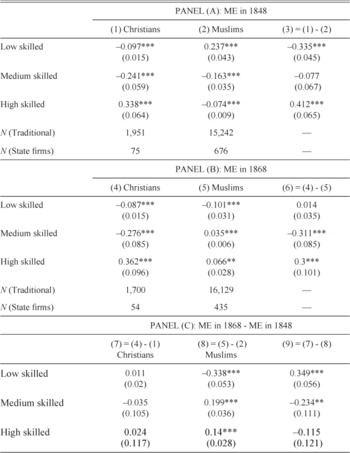
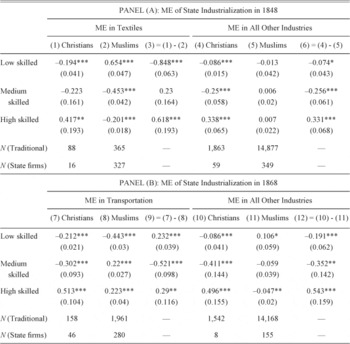
The core results of the article are shown in Table 3. Panel (A) shows the ME of being employed in a state firm on the probability that the SSI equals each of its three categories for Muslims and Christians in 1848. Muslims in state firms are 23.7 percentage points more likely to be low skilled, 16 percentage points less likely to be medium skilled, and 7.4 percentage point less likely to be high skilled, compared to Muslims in the traditional sector. However, Christians in state firms are 10 percentage points less likely to be low skilled and 24 percentage points less likely to be medium skilled and, consequently, 34 percentage points more likely to be white-collar than Christians in the traditional sector. Column 3 shows the Christian-Muslim differences in MEs, i.e., the ME for Christians minus that for Muslims at each SSI level. Compared to the traditional sector, Christians in state firms are differentially less likely than Muslims to be low skilled (by 33.5 percentage points) or medium skilled (by 7.7 percentage points) (but the difference is statistically insignificant) and differentially more likely to be high skilled (by 41.2 percentage points).
MARGINAL EFFECT OF STATE INDUSTRIALIZATION ON SSI BY RELIGION

Notes:
The reported MEs are estimated from a single ordered logit regression (equation 1), where standard errors are clustered at the urban quarter/village-level. The ME is the difference in the predicted probability that the SSI equals one of its three values, between workers in state projects and in the traditional sector for an Egyptian, free, non-black, and non-migrant adult male of average age, averaging out the district fixed effects. Standard errors are in parentheses and are calculated (in columns 1, 2, 4, and 5) by the Delta method using the “margins” command in STATA. Standard errors of differences in MEs (columns 3, 6, 7, 8, and 9) are calculated by applying the “lincom” command to the “margins” results in STATA.
Source:
See the text.
Panel (B) shows the results for 1868. Unlike in 1848, Muslims in state firms in 1868 are 10 percentage points less likely to be low skilled, 3 percentage points more likely to be medium skilled, and thus 7 percentage points more likely to be high skilled than Muslims in the traditional sector. The results for Christians are qualitatively similar to those in 1848: Christians in state firms in 1868 are 9 percentage points less likely to be low skilled, 28 percentage points less likely to be medium skilled, and thus 37 percentage points more likely to be high skilled, than Christians in the traditional sector. Column 6 shows the Christian-Muslim differences in MEs. Compared to the traditional sector, Christians in state firms are equally as Muslims to be low skilled but they are differentially less likely to be medium skilled and differentially more likely to be white-collar by a symmetric 30 percentage points.
Are these likelihoods for Muslims and Christians statistically different across 1848 and 1868? Panel (C) shows the change between 1848 and 1868 in the MEs of state industrialization. Compared to their coreligionists in the traditional sector in each year, Muslims in state firms in 1868 are differentially less likely than in 1848 to be low skilled (by 34 percentage points) and differentially more likely to be medium skilled (by 20 percentage points) or high skilled (by 14 percentage points). However, Christians in state firms did not experience statistically significant differential changes in their occupational distribution between 1848 and 1868 compared to Christians in the traditional sector.
These findings suggest that there were differences in the marginal effects of state industrialization on the distribution of skills across Christians and Muslims and across 1848 and 1868. I must, however, control for industrial affiliation, because: (1) it is important to understand which industries are generating these findings, and (2) workers in industries that had state firms may have had different pre-industrialization characteristics (e.g., religion or occupation) from other industries that remained traditional (e.g., agriculture). To this end, I extend the ordered logit regressions by controlling for MainIndustryijt , a dummy variable that takes the value of one if an individual, whether employed in the traditional sector or in a state firm, works in the largest industry that was targeted by state industrialization, textiles in 1848, and transportation in 1868:
![\[
\begin{array}
(2)Prob (SSI_{ijt}=m\vert Covariates)=F[\alpha_{2j}+\beta_{2t}+\gamma_{21t}StateInd_{ijt}+\\
\gamma_{22f}MainIndustry_{ijt}+\gamma_{23t}Christian_{ijt}+\gamma_{24t}(StateInd_{ijt}\times MainIndustry_{ijt})\\
+\gamma_{25t}(StateInd_{ijt}\times Christian_{ijt})+\gamma_{26t}(MainIndustry_{ijt}\times Christian_{ijt})\\
+\gamma{27t}(StateInd_{ijt}\times MainIndustry_{ijt}\times Christian_{ijt})+\gamma_{28}X_{ijt}].
\end{array}
\](https://static.cambridge.org/binary/version/id/urn:cambridge.org:id:binary-alt:20170126172513-42280-mediumThumb-S0022050715000030_eqnU5.jpg?pub-status=live)
DID THE MARGINAL EFFECT OF STATE INDUSTRIALIZATION ON SSI VARY BY INDUSTRY?

Notes:
The reported MEs are estimated from a single ordered logit regression (equation 2), where standard errors are clustered at the urban quarter/village-level. The ME is the difference in the predicted probability that the SSI equals one of its three values, between workers in state projects (textiles versus all other sectors) and in the traditional sector (textiles versus all other sectors, whether targeted by state industrialization or not) for an Egyptian, free, non-black, and non-migrant adult male of average age, averaging out the district fixed effects. Standard errors are in parentheses and are calculated (1, 2, 4, 5, 7, 8, 10, and 11) by the Delta method using the “margins” command in STATA. Standard errors of differences in MEs (columns 3, 6, 9, and 12) are calculated by applying the “lincom” command to the “margins” results in STATA.
Source:
See the text
The results are shown in Table 4. Notice that the MEs of state industrialization of textiles (transportation) compare workers in state textiles (transportation) firms to workers in the traditional textiles (transportation) industry, while the MEs of state industrialization of all other industries compare workers who are employed in any other industry in state firms and in the traditional sector. For Muslims, the findings of Table 3 are driven by textiles in 1848 and transportation in 1868. Muslims in state textiles factories in 1848 are two-thirds more likely to be low skilled than Muslims in the traditional textiles industry. To the contrary, Muslims in state transportation enterprises in 1868 are 75 percentage points less likely to be low skilled than their coreligionists in the traditional transportation industry. In both 1848 and 1868, however, Muslims in state firms of all other industries are not statistically different from those in the traditional sector. For Christians, the findings of Table 3 in 1848 (and 1868) at the low- and high-skill levels are driven by the state industrialization of both textiles (and transportation) and other industries. But, the MEs of state industrialization of textiles and transportation at the medium-skill level are both statistically insignificant.
The results for Cairo and Alexandria are qualitatively similar except among Christians in 1848: As for the full sample in panel (A) of Table 3, Christians in state firms in Cairo and Alexandria are differentially less likely than Muslims to be medium skilled but the difference now is statistically significant. Also, the ME of state industrialization of textiles among Christians in Cairo and Alexandria is negative and statistically significant at the medium-skill level.
Interpretation of the Results
The findings are generally consistent with the conceptual framework. As expected, the state's push into textiles in 1848 decreased the share of medium-skilled workers among both Muslims and Christians, with a stronger effect on the latter in Cairo and Alexandria (but not in the full sample), generating a “hollowing-out” of occupations or “job polarization” effect. This negative effect came about because Muslims had a particularly relatively low share of high-skilled workers, resulting in a net “de-skilling” effect: an increase in the share of low-skilled workers. For Christians, however, the negative effect on the share of medium-skilled workers was offset by greater increase in the share of high-skilled workers, resulting in a net “up-skilling” effect, a decrease in the share of low-skilled workers.
Also, as the model predicts, the later push by the state into transportation required relatively few low-skilled workers among both Muslims and Christians, generating an “up-skilling” effect on both groups. However, there are inter-religious differentials in the “up-skilling:” The share of medium-skilled workers rose among Muslims but fell among Christians (for the latter, the effect is statistically significant overall, but insignificant in transportation). Further, industrialization increased the share of high-skilled workers among both Muslims and Christians, and, as the model predicts, the effect was stronger among Christians given their initial literacy and numeracy advantage.
However, there are two findings that deviate from the model's predictions: First, while the model implies that industrialization of textiles in 1848 should have increased the share of high-skilled workers among both Muslims and Christians I find a negative effect on Muslims. Second, although the model implies that industrialization of transportation in 1868 should have raised the share of medium-skilled workers more for Christians than Muslims, I find a significantly greater effect among Muslims.
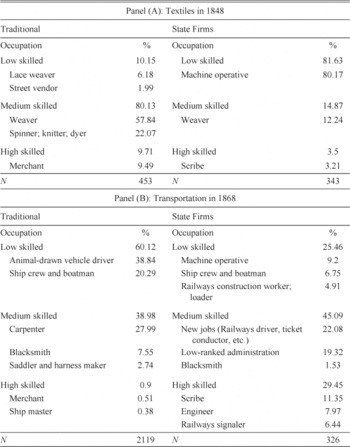
In both cases the coarse skill grid I use is likely to blame. Table 5 shows the detailed occupational distribution in textiles and transportation in both the traditional sector and state firms. State textiles firms in 1848 increased the relative demand for only a sub-class of high-skilled workers: scribes and bookkeepers, where Christians were over-represented in the traditional sector (58 percent), but they decreased the relative demand for textiles merchants, who were all Muslims. In 1868, state transportation firms increased the relative demand for a sub-class of medium-skilled workers: low-ranked administrative personnel, where Muslims were over-represented in the traditional sector (94 percent), but decreased the relative demand for carpenters, where Christians were over-represented (14 percent).Footnote 12 The alternative explanation would be that the recruitment policies of state firms were biased, compared to the traditional sector, thus contradicting the competitive labor markets assumption of the model. In particular, state projects resorted in 1848, but not in 1868, to coercive recruitment of workers (Owen Reference Owen2002, p. 76; Marsot Reference Marsot1984, pp. 181–5; Ghazaleh 1999, p. 122; Sami 1928, Vol. 2, p. 374). This might have forcibly over-drafted Muslims into low-skilled occupations away from medium- and high-skilled occupations (differential forced de-skilling).
Did State Industrialization Shift the Relative Supplies of Skills?
So far, I have argued that the findings are driven by shifts in the relative demands for low-, medium-, and high-skilled workers, without altering the relative supplies of skills. There is at least suggestive evidence that there was a supply side response via on-the-job training in state firms. In order to explore this possibility, I separate workers in state firms into two categories: (i) workers in old occupations, which existed in both state firms and the traditional sector (comprising 73 percent and 66 percent of workers in state firms in 1848 and 1868, respectively), and (ii) workers in new occupations, which existed in state firms only.Footnote 13 The rationale is that workers in old occupations were likely hired already trained into state firms, and hence differences in average SSI between them and workers in the traditional sector could be attributed to shifts in the relative demands for skills via technological differences between the traditional sector and state firms. On the other hand, workers needed in new occupations had to be trained by the firms, and so differences in average SSI between them and workers in old occupations within state firms could be attributed to shifts in the relative supplies of skills via on-the-job training. Indeed, within state firms, workers in new occupations are (slightly) younger than those in old occupations, suggesting that they might have been recruited before acquiring any skills in the traditional sector.Footnote 14 This is only an approximation, however, because skills needed for old occupations in state projects may have been acquired via on-the-job training, and the sample size of Christians in new occupations is small in both 1848 and 1868. Thus, the evidence presented below is only suggestive.
OCCUPATIONAL DISTRIBUTION IN THE TRADITIONAL SECTOR AND STATE FIRMS

Source:
See the text
I extend the ordered logit regression to include NEWijt , a dummy variable that takes the value of one if an individual works in a new occupation in state firms. By construction, NEWijt is equal to zero for all workers in the traditional sector and workers in old occupations in state firms:
![\[
\begin{array}
(3)Prob (SSI_{ijt}=m\vert Covariates)=F[\alpha_{3j}+\beta_{3t}+\gamma_{31t}StateInd_{ijt}+\\
\gamma_{32f}Christian_{ijt}+\gamma_{33t} StateInd_{ijt} \times Christian_{ijt}) +\gamma_{34t}(StateInd_{ijt}\times New_{ijt})\\
+\gamma_{35t}(StateInd_{ijt}\times Christian_{ijt} \times New_{ijt})+\gamma_{36}X_{ijt}].
\end{array}
\](https://static.cambridge.org/binary/version/id/urn:cambridge.org:id:binary:20160927090754657-0058:S0022050715000030:S0022050715000030_eqnU6.gif?pub-status=live)
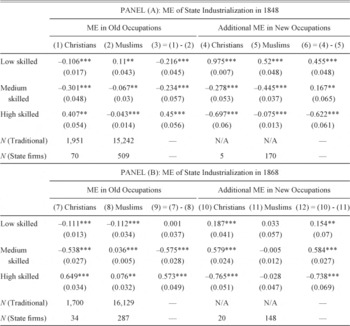
The results of this exercise are shown in Table 6. The ME in old occupations compares workers in old occupations in state firms to workers in the traditional sector, while the additional ME in new occupations compares workers in new and old occupations within state firms. Overall, the results of Table 3 for both 1848 and 1868 hold if we compare workers in old occupations in state firms to workers in the traditional sector, suggesting that demand shifts may account for the effects of state industrialization. However, it appears that on-the-job training in state firms caused a supply response among both Muslims and Christians in 1848 and among Christians in 1868. In 1848, compared to their coreligionists in old occupations in state firms, both Muslims and Christians in new occupations are more likely to be low skilled (machine operatives) and less likely to be medium or high skilled. In 1868, Muslims in new occupations are not statistically different from their coreligionists in old occupations in state firms, but Christians in new occupations are more likely to be low- or medium-skilled workers and less likely to be high-skilled workers. Finally, Muslims in old occupations in state firms in Cairo and Alexandria in 1848 are not statistically different from Muslims in the traditional sector, suggesting that the de-skilling of Muslims in urban Egypt in the first wave of industrialization is driven by new occupations (mostly machine operatives).
DECOMPOSING THE ME OF STATE INDUSTRIALIZATION INTO OLD AND NEW OCCUPATIONS

Notes:
The reported MEs are estimated from a single ordered logit regression (equation 3), where standard errors are clustered at the urban quarter/village-level. The ME in old occupations is the difference in the predicted probability that the SSI equals one of its three values, between workers in old occupations in state projects and all workers in the traditional sector for an Egyptian, free, non-black, and non-migrant adult male of average age, averaging out the district fixed effects. The additional ME in new occupations is the difference in the predicted probability that the SSI equals one of its three values, between workers in new occupations in state projects and workers in old occupations in state projects for an Egyptian, free, non-black, and non-migrant adult male of average age, averaging out the district fixed effects. Standard errors are in parentheses and are calculated (in columns 1, 2, 4, 5, 7, 8, 10, and 11) by the Delta method using the “margins” command in STATA. Standard errors of differences in MEs (columns 3, 6, 9, and 12) are calculated by applying the “lincom” command to the “margins” results in STATA.
Source:
See the text.
CONCLUSION
State industrialization was widely adopted in various parts of the world in both the nineteenth and the twentieth centuries. Using samples that I digitized from the 1848 and 1868 Egyptian census manuscripts, I examined employment in Egyptian state-owned enterprises that were set up as part of two industrialization programs. I find that the state industrialization of textiles in 1848 had “hollowed-out” occupations, with relatively smaller shares of medium-skilled workers among both Muslims and Christians, with a stronger effect on Christians (in urban Egypt). For Muslims the decrease in the share of artisans was accompanied by a relatively low share of high-skilled workers leading to a large “de-skilling” effect. For Christians the relatively low share of medium-skilled workers was offset by a larger share of high-skilled workers, leading to an “up-skilling” effect. In contrast, I find that the state industrialization of transportation in 1868 was “up-skilling” for both Muslims and Christians. But while the “up-skilling” of Muslims was through an increase in the share of medium-skilled workers and the share of high-skilled workers, the “up-skilling” of Christians was only through an increase in the share of high-skilled workers.
These findings contribute to our understanding of technical change and the relative demand for skills in the nineteenth century. Egypt's state industrialization of textiles was “de-skilling” (for the Muslim majority) in ways that are similar to the findings of Goldin and Kenneth Sokoloff (Reference Goldin and Sokoloff1982) and Atack, Bateman, and Margo (Reference Atack, Bateman and Margo2004) for the United States. Perhaps more importantly is the finding of a “hollowing-out” effect, or that the “de-skilling” mostly hit the medium-skilled artisans but that the relative demand for white-collar workers may have actually increased in order to handle the administrative services that are essential under the factory system. This is similar to what KM recently noted as a revision to our understanding of the nature of technical change during the first IR, and to what has been documented in the recent large macroeconomic literature on computerization (Acemoglu and Autor Reference Acemoglu and Autor2011). The evidence allows us two additional findings. First the “de-skilling” or “up-skilling” effects varied systematically by group consistent with the existence of large initial inter-group differences in skills. Second, the “de-skilling” or “up-skilling” effects varied by industry because of the different skill requirements of the industrialization of textiles and transportation relative to the traditional textiles and transportation industries.
The findings perhaps put the Egyptian state industrialization programs in sharp contrast to the twentieth century socialist programs, which explicitly aimed at reducing inequality, and brings them closer to other programs in “late-industrializing” countries in the nineteenth century (e.g., Russia and Japan) that were more motivated by military expansion and maximizing tax revenues. Whether these programs, which were unlike the Egyptian program, economically successful, actually increased or decreased inter-group (or overall) inequality is, to the best of my knowledge, an area for further research. What is interesting in Egypt, however, is that convergence in socioeconomic outcomes between religious groups in Egypt had to await the second major Egyptian state-led modernization program under Nasser (1952–1970). It is the emphasis on providing access to public secular education to the masses in 1953–1956 that made the program relatively more successful than its nineteenth-century precedent in improving the lot of Muslims and reducing their human capital gap vis-à-vis non-Muslims (Saleh Reference Saleh2013b).