


1. Introduction and main results
The standard way to construct Lagrangian cobordisms between Legendrian knots in the standard contact
 $S^3_{std}$
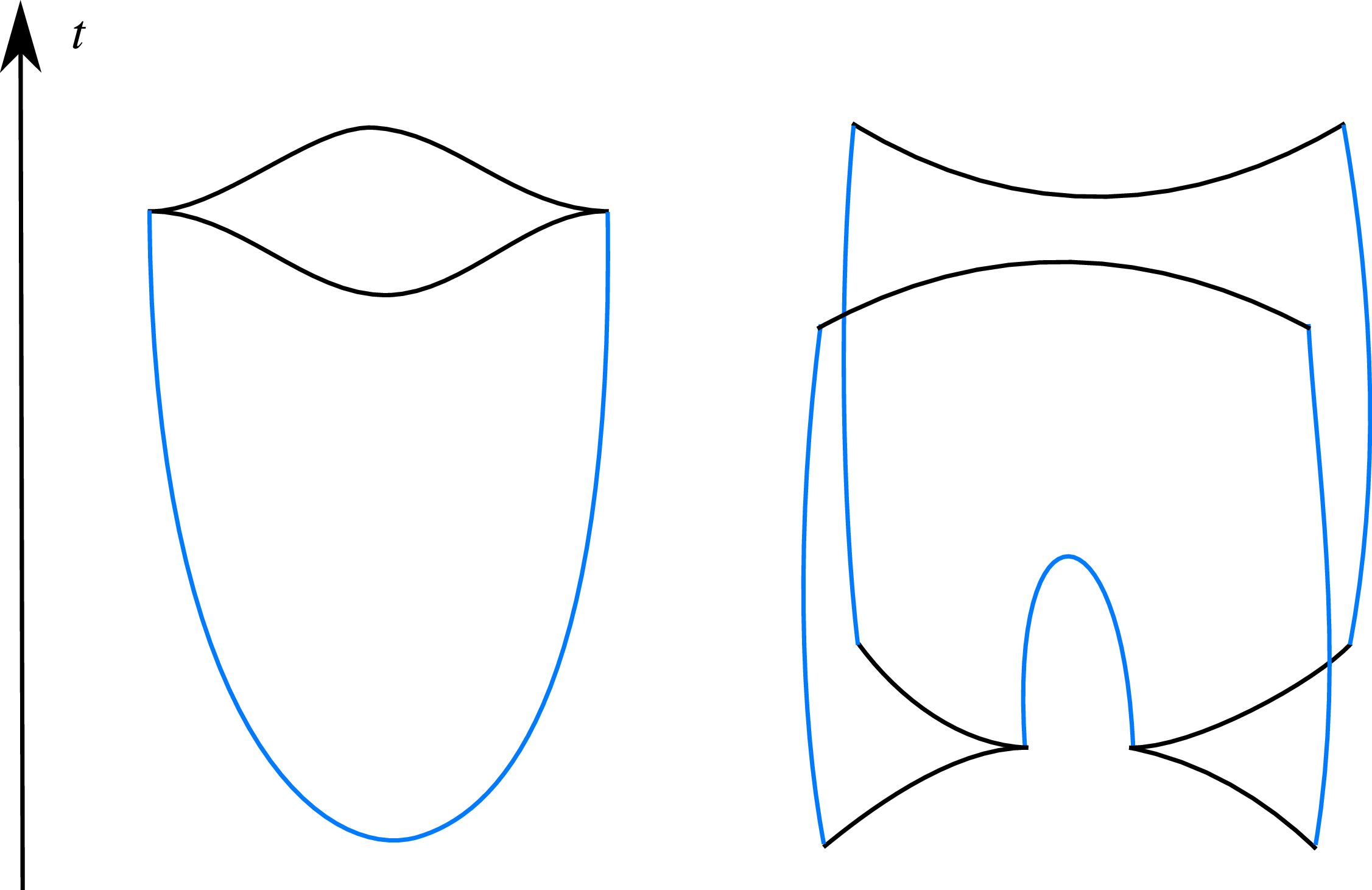
is by concatenating elementary cobordisms which are traces of three moves in the front projection: Legendrian isotopy, isolated standard unknot birth (induces Lagrangian 0-handle attachment), and Legendrian surgery, which is called a pinch move in reverse (it induces Lagrangian 1-handle attachment). See Figure 1 for the schematic description of the latter two pieces. Cobordisms obtained this way are called decomposable and have been first constructed by Chantraine in [
Reference Chantraine4
] and Ekholm–Honda-Kalman in [
Reference Ekholm, Honda and Kálmán10
].
Left: Lagrangian filling of the
 $tb=-1$
unknot; Right: Lagrangian pair-of-pants cobordism obtained from the Lagrangian 1-handle attachment.

Decomposable Lagrangian cobordisms can be seen as symplectic analogues of ribbon cobordisms in smooth topology. Recall that for a given two knots
 $K_0,K_1\subset S^3$
a ribbon cobordism
 $\Sigma$
from
 $K_0$
to
 $K_1$
is a smooth cobordism
 $\Sigma\subset S^3\times[0,1]$
from
 $K_0$
to
 $K_1$
such that the projection
 $S^3\times [0,1]\to [0,1]$
restricts to a Morse function on
 $\Sigma$
which does not have index two critical points. Note that all decomposable Lagrangian cobordisms between Legendrian knots in
 $S^3_{std}$
are ribbon.
These days, non-decomposable Lagrangian cobordisms are proven to exist in the following two forms:
-
(1) non-decomposable Lagrangian caps with stabilised Legendrian ends that have been discussed in the work of Lin [ Reference Lin13 ];
-
(2) non-decomposable Lagrangian concordances between stabilised Legendrian knots [ Reference Dimitroglou Rizell and Golovko8 ] and between Lagrangian fillable Legendrian knots [ Reference Dimitroglou Rizell and Golovko9 ] that have been constructed by Dimitroglou Rizell and the first author.
In this paper we construct non-decomposable Lagrangian cobordisms of an arbitrary non-trivial genus between Legendrian knots in
 $S^3$
. The method to determine non-decomposability that we use here is different from the ones we used with Dimitroglou Rizell in [
Reference Dimitroglou Rizell and Golovko8, Reference Dimitroglou Rizell and Golovko9
]. Recall that in [
Reference Dimitroglou Rizell and Golovko8
] we use the obstruction of non-decomposability based on the variation of the result of Cornwell-Ng-Sivek [
Reference Cornwell, Ng and Sivek6
, theorem 3·2], and in [
Reference Dimitroglou Rizell and Golovko9
] we relied on the result of Agol which says that ribbon (stably homotopy ribbon) Lagrangian concordances of knots form a partial order, see [
Reference Agol1
, theorem 1·1]. In this paper, we rely on the obstruction of ribbon cobordisms due to Livingston [
Reference Livingston14
, corollary 5·4] and its partial adaptation due to Borodzik and Truöl [
Reference Borodzik and Truöl3
, theorem 2·5].
The main result of this paper is the following:
Theorem 1·1. Let
 $\Lambda$
be a Legendrian knot in
 $(S^3, \xi_{st})$
such that:
-
(i) there is an odd prime p that divides the determinant of
 $\Lambda$
;
-
(ii) there is a decomposable Lagrangian concordance C from the
$tb=-1$
unknot U to
$\Lambda$
.


Then for a given
 $g \gt 0$
, and for all integers
 $n \gt 2g$
, there exists a non-decomposable Lagrangian cobordism
 $L_g$
of genus g, from a Legendrian knot
 $\Lambda_{-}$
obtained from
 $\Lambda^n:=\Lambda\#\dots\#\Lambda$
by sufficiently many stabilisations, to a Legendrian knot
 $\Lambda_+$
obtained from
 $U^n:=U\#\dots\#U$
by sufficiently many stabilisations.
Remark 1·2. Note that
 $\det(U)=1$
, and hence condition (i) in the formulation of Theorem 1·1 implies that
 $\Lambda$
is not smoothly isotopic to U.
2. Applicability of Theorem 1·1
Here we describe a few series of examples to which we can apply Theorem 1·1.
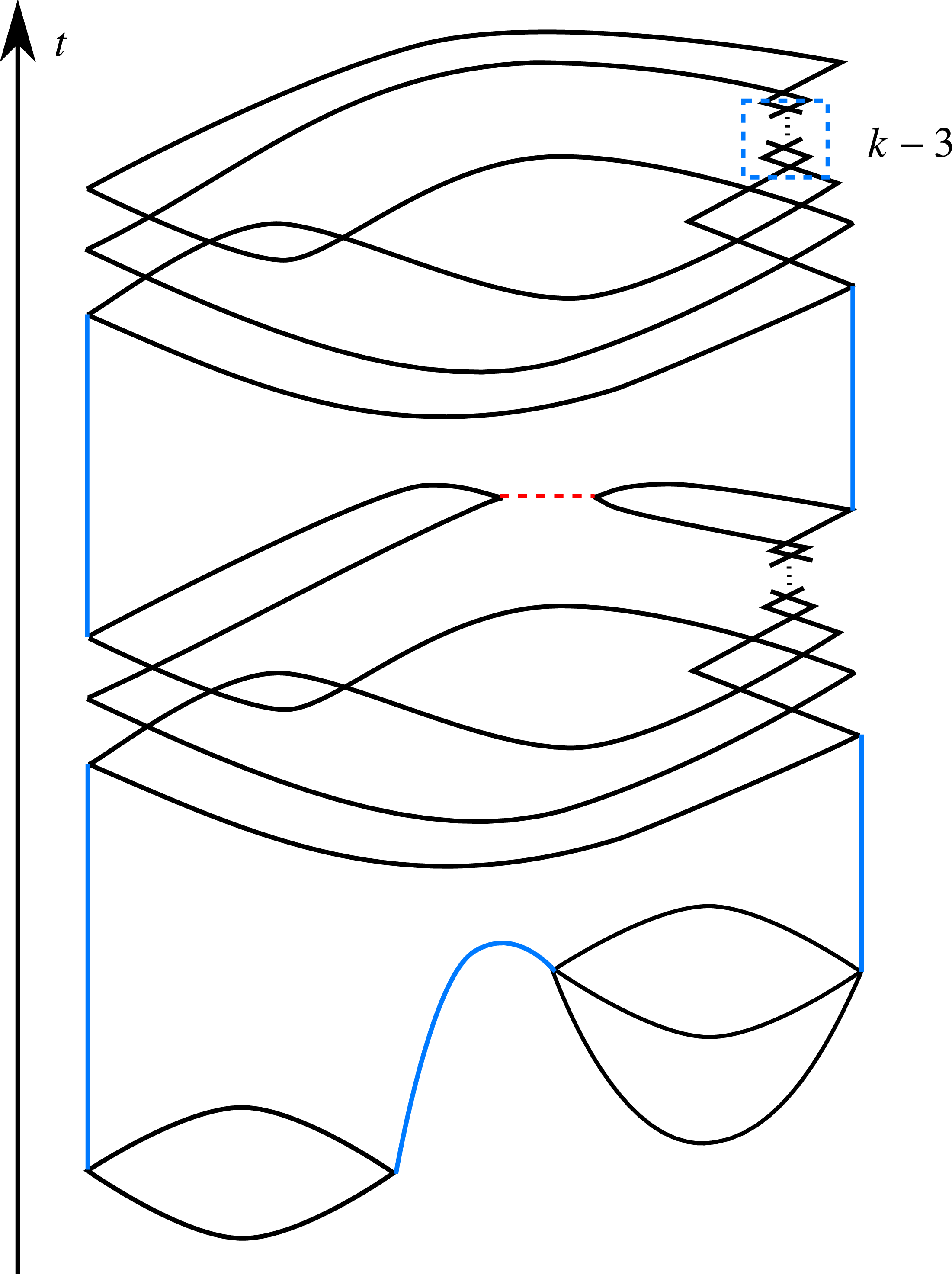
Examples 2·1. Consider the sequence of Legendrian pretzel knots
 $P(3,-3,-k)$
, where
 $k\geq 3$
, from [
Reference Chantraine and Legout5, Reference Dimitroglou Rizell and Golovko8
], we call them
 $\Lambda_{k}$
. There is a decomposable Lagrangian concordance
 $C_{k}$
from U to
 $\Lambda_{k}$
, see Figure 2, this concordance has been discussed by Chantraine and Legout in [
Reference Chantraine and Legout5
] and by Dimitroglou Rizell and the first author in [
Reference Dimitroglou Rizell and Golovko8
]. Following the computation of the determinant for pretzel knots from [
Reference Bae and Lee2
] we observe that
 $\det(P(3,-3,-k))=9$
and the odd prime p divisor of
 $\det(P(3,-3,-k))$
that is required by Theorem 1·1 can be taken to be
 $p=3$
. Hence, Theorem 1·1 can be applied to
 $C_k$
.
Decomposable Lagrangian concordance
 $C_{k}$
from the
 $tb=-1$
Legendrian unknot U to the Legendrian representative
 $\Lambda_{k}$
of the pretzel knot
 $P(3,-3,-k)$
, where
 $k\geq 3$
, induced by the ambient surgery along the dashed arc. The front projection of
 $\Lambda_{k}$
has
 $k-3$
crossings in the dashed box.

Examples 2·2. In order to describe the following family we first recall a few properties of determinant and Alexander polynomial.
Remark 2·3. Determinant and Alexander polynomial satisfy the following properties:
-
(1) For a given knot K,
$|\Delta_{K}(-1)|=\det(K)$
; -
(2) For given two knots
$K_1$
and
$K_2$
, the Alexander polynomial of the connected sum
$K_1\# K_2$
is given by
$\Delta_{K_1\# K_2}(t) = \Delta_{K_1}(t)\Delta_{K_2}(t)$
, which implies that
$$\det(K_1\# K_2) = |\Delta_{K_1\# K_2}(-1)| = |\Delta_{K_1}(-1)||\Delta_{K_2}(-1)| = \det(K_1)det(K_2);$$
-
(3) For a knot K,
$\det(K)\neq 0$
. This, in particular, can be justified by the fact that
$\det(K)$
can be seen as the order of the finite abelian group
$H_1(\Sigma_2(K);\mathbb Z)$
, where
$\Sigma_2(K)$
denotes the 2-fold branched cover of
$S^3$
over K.


Now we take a Legendrian knot
 $\Lambda$
such that there is a decomposable Lagrangian concordance
 $C'$
from U to
 $\Lambda$
. Then we take the connected sum of decomposable Lagrangian concordances
 $C_{k}\# C'$
from
 $U\# U\simeq U$
to
 $\Lambda_{k}\# \Lambda$
. Such an operation can be performed following the discussion in [
Reference Guadagni, Sabloff and Yacavone12
, section 5]. Observe that
 $C_{k}\# C'$
is decomposable by [
Reference Guadagni, Sabloff and Yacavone12
, corollary 5·1, remark 5·3]. Then note that from the third part of Remark 2·3 it follows that
 $\det(\Lambda)\neq 0$
. From this, together with the second part of Remark 2·3, it follows that
 $p=3 |\det(\Lambda_{k}\# \Lambda)$
. So, we can apply Theorem 1·1 to the concordance
 $C_{k}\# C'$
.
Remark 2·4. For example, we can take
 $C'$
to be a decomposable Lagrangian concordance from U to the Legendrian representative of (2,n)-torus knot from [
Reference Pan15
].
Examples 2·5. Here we rely on the decomposable realisation of ribbon cobordisms developed by Etnyre and Leverson in [
Reference Etnyre and Leverson11
]. We can simply take a smooth knot K satisfying that
 $p | det(K)$
for some odd prime
 $p$
and such that there is a ribbon concordance from an unknot to K. Then following [
Reference Etnyre and Leverson11
, theorem 1·2] we realize this concordance by a decomposable Lagrangian concordance C from the Legendrian representative of an unknot (in general, stabilised) to the Legendrian representative of K (in general, stabilised). Obviously, Theorem 1·1 can be applied to C.
3. Proof of Theorem 1·1
We start the proof by considering the connected sum of n copies of concordance C and denote it by
 $C^n:=C\#\ \dots \# C$
. Since C is a decomposable Lagrangian concordance, from [
Reference Guadagni, Sabloff and Yacavone12
, corollary 5·1, remark 5·3] it follows that
 $C^n$
is a decomposable Lagrangian concordance from the Legendrian knot
 $U^n=U\#\dots \#U$
, which is smoothly an unknot, to the Legendrian knot
 $\Lambda^n=\Lambda\# \dots \# \Lambda$
. We know that there is a prime number p that divides
 $\det(\Lambda)$
. From the second part of Remark 2·3 we observe that
 $\det(\Lambda^n)=\det(\Lambda)^n$
, and hence p that divides
 $\det(\Lambda)$
also divides
 $\det(\Lambda^n)$
and does not divide
 $\det(U^n)=\det(U)=1$
.
Then we argue the same way as in [
Reference Dimitroglou Rizell and Golovko9
, section 2] and [
Reference Dimitroglou Rizell and Golovko8
, section 5]. First, we revert the concordance
 $(C^n)^{-1}=\{(-t,x)\in \mathbb{R}_t\times \mathbb{R}^3_x\ | \ (t,x)\in C^n\}.$
Since
 $C^n$
is decomposable, observe that the tangent planes of
 $(C^n)^{-1}$
are homotopic to totally-real tangent planes. Using this, we apply the h-principle for totally real embeddings and see that
 $(C^n)^{-1}$
admits a compactly supported smooth isotopy to a concordance that is totally real for any choice of cylindrical almost complex structure, we denote it by
 $T^n$
. Finally, we modify
 $T^n$
using the approximation result of Dimitroglou Rizell [
Reference Dimitroglou Rizell7
] and get the Lagrangian concordance
 $S(T^n)$
from
 $S(\Lambda^n)$
to
 $S(U^n)$
. Here
 $S(U^n)$
and
 $S(\Lambda^n)$
are multiply stabilised versions of
 $U^n$
and
 $\Lambda^n$
, respectively.
3·1. Lagrangian cobordisms constructed by Sabloff, Vela-Vick and Wong
Sabloff, Vela-Vick and Wong in [
Reference Sabloff, Vela-Vick and Wong16
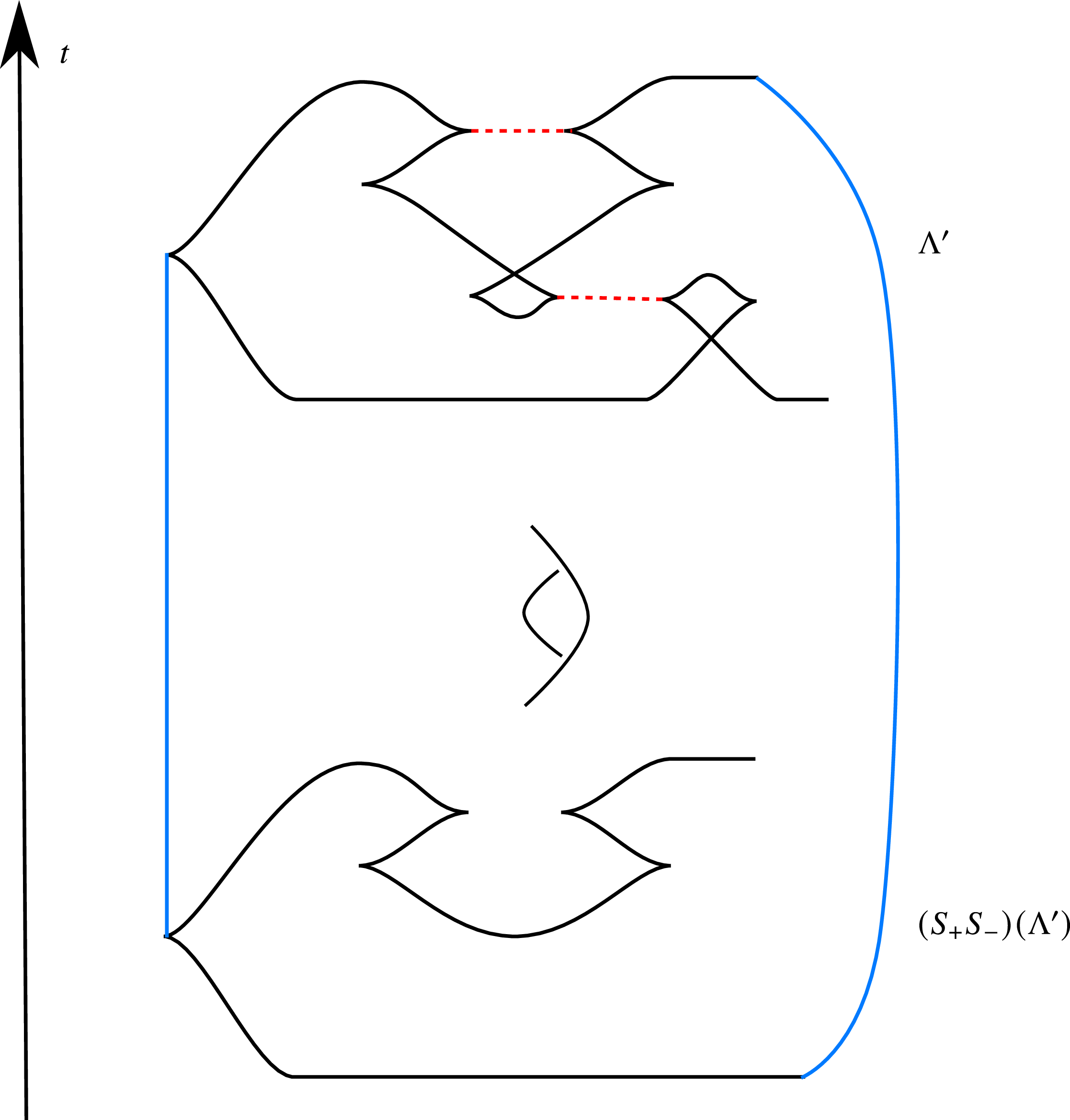
] constructed the following cobordism that will be useful for us. Given a Legendrian knot
 $\Lambda'\subset S^3_{std}$
, let
 $(S_+S_-)(\Lambda')$
be the Legendrian knot obtained by first applying the negative stabilisation to
 $\Lambda'$
followed by the application of the positive stabilisation. Sabloff, Vela-Vick and Wong in [
Reference Sabloff, Vela-Vick and Wong16
, lemma 3·2] showed that there is a Lagrangian cobordism of genus one from
 $(S_+S_-)(\Lambda')$
to
 $\Lambda'$
, the schematic picture of it appears in Figure 3.
Lagrangian cobordism of genus one from
 $(S_+S_-)(\Lambda')$
to
 $\Lambda'$
obtained by making an ambient surgery along two dashed arcs.

We apply this construction inductively to
 $\Lambda'=S(\Lambda^n)$
. In other words, given
 $g \gt 0$
, we concatenate g copies of the genus-1 Lagrangian cobordism from [
Reference Sabloff, Vela-Vick and Wong16
, lemma 3·2] to obtain a genus-g Lagrangian cobordism from
 $(S_+S_-)^g(S(\Lambda^n))$
to
 $S(\Lambda^n)$
. Note that the genus is additive because the cobordisms that we are concatenating have connected boundaries.
We then concatenate the obtained cobordism and
 $S(T^n)$
and get a Lagrangian cobordism
 $L_g$
of genus g from
 $\Lambda_-=(S_+S_-)^g(S(\Lambda^n))$
to
 $\Lambda_+=S(U^n)$
. We claim that
 $L_g$
is a non-ribbon cobordism. In order to show it, we need to rely on the estimates of Livingston from [
Reference Livingston14
].
3·2. Livingston’s estimates and the results of Borodzik–Truöl
For a given two knots
 $K_0$
and
 $K_1$
in
 $S^3$
and a connected Morse cobordism
 $\Sigma\subset S^3\times [0,1]$
from
 $K_0$
to
 $K_1$
(i.e.
 $\Sigma$
is a connected cobordism satisfying that the projection of
 $\Sigma$
to [0,1] is a Morse function), Livingston in [
Reference Livingston14
] investigates the behaviour of quadruples
 $(c_0,c_1,c_2,g)$
, where
 $c_i=c_i(\Sigma)$
denotes the number of critical points of index i on
 $\Sigma$
and g is a genus of
 $\Sigma$
. More precisely, Livingston in [
Reference Livingston14
] proved a few obstructions to the existence of
 $\Sigma$
in the form of estimates involving the homology of the n-fold branched covers
 $\Sigma_n(K_i)$
of
 $S^3$
over
 $K_i$
,
 $i=0,1$
.
In this note we rely on the partial case of Livingston’s estimates that uses the homology of the two-fold branched covers
 $\Sigma_2(K_0)$
and
 $\Sigma_2(K_1)$
.
Theorem 3·1. ([
Reference Livingston14
]). If
 $\Sigma$
is a connected Morse cobordism from
 $K_0$
to
 $K_1$
, then for an arbitrary odd prime p the following inequality holds
 \begin{align}c_2(\Sigma)\geq \frac{\beta_1(\Sigma_2(K_0);\; \mathbb F_p)-\beta_1(\Sigma_2(K_1);\; \mathbb F_p)}{2}-g(\Sigma).\end{align}
Here
 $\beta_1(\Sigma_2(K_i);\; \mathbb F_p)$
is the dimension of
 $H_1(\Sigma_2(K_i);\; \mathbb F_p)$
as an
 $\mathbb F_p$
-vector space,
 $i=0,1$
.
Note that our handle convention is opposite to that of Livingston in [
Reference Livingston14
]: Livingston considers cobordisms from
 $K_1$
to
 $K_0$
, whereas we consider cobordisms from
 $K_0$
to
 $K_1$
, and the handle indices are reversed.
Besides that, we need the following statement. It is a standard exercise, and we refer to the work of Borodzik–Truöl [ Reference Borodzik and Truöl3 ] for a proof.
Proposition 3·2 ([
Reference Borodzik and Truöl3
]). Given a knot
 $K\subset S^3$
and a prime p.
-
(i) If p divides
$\det(K)$
, then
$\dim_{\mathbb F_p}H_1(\Sigma_2(K^n=K\#\dots \# K);\; \mathbb F_p)\geq n$
. -
(ii) If p does not divide
$\det(K)$
, then
$H_1(\Sigma_2(K);\; \mathbb F_p)=0$
.


3·3. Application of Livingston’s estimates to obstruct decomposability
Now we take the Lagrangian cobordism
 $L_g$
of genus g from
 $(S_+S_-)^g(S(\Lambda^n))$
to
 $S(U^n)$
that we constructed in Section 3·1. From the second part of Remark 2·3 we observe that
 $$\det((S_+S_-)^g(S(\Lambda^n)))=\det(\Lambda)^n\quad \mbox{and}\quad \det(S(U^n))=1.$$
Besides that,
 $(S_+S_-)^g(S(\Lambda^n))$
is smoothly isotopic to
 $\Lambda^n$
. Hence, using the fact that
 $p| \det(\Lambda)$
, from the first part of Proposition 3·2 it follows that
 \begin{align}\dim_{\mathbb F_p}H_1(\Sigma_2((S_+S_-)^g(S(\Lambda^n)));\; \mathbb F_p)=\dim_{\mathbb F_p}H_1(\Sigma_2(\Lambda^n);\; \mathbb F_p)\geq n.\end{align}
Besides that, the second part of Proposition 3·2 implies that
 \begin{align}H_1(\Sigma_2(S(U^n));\; \mathbb F_p)=H_1(\Sigma_2(U);\; \mathbb F_p)=0,\quad \mbox{and hence}\quad \dim_{\mathbb F_p} H_1(\Sigma_2(U);\; \mathbb F_p)=0.\end{align}
Finally, combining Formulae 3·1, 3·2 and 3·3, we get that
 $c_2(L_g)\geq {n}/{2}-g$
. Therefore, for any fixed
 $g\gt0$
, since
 $n\gt2g$
, we see that
 $c_2(L_g)\gt0$
. So, we see that
 $L_g$
is a non-ribbon Lagrangian cobordism of genus
 $g\gt0$
, and hence
 $L_g$
is a non-decomposable Lagrangian cobordism of genus
 $g\gt0$
. This completes the proof.
Remark 3·3. Note that the ends of Lagrangian cobordisms that we get in Theorem 1·1 are stabilised. One could try to extend Theorem 1·1 to Lagrangian cobordisms with fillable Legendrian ends as Dimitroglou Rizell and the first author did for Lagrangian concordances in [
Reference Dimitroglou Rizell and Golovko9
]. In [
Reference Dimitroglou Rizell and Golovko9
], Dimitroglou Rizell and the first author used Legendrian Whitehead doubling to achieve this goal. Unfortunately, it is difficult to mimic the application of Legendrian Whitehead doubling in these settings. The reason for that is that in the proof of Theorem 1·1 we strongly rely on the first part of Proposition 3·2 which allows to control the size of
 $\dim_{\mathbb F_p}H_1(\Sigma_2(\cdot);\; \mathbb F_p)$
. Legendrian Whitehead doubling operation unfortunately does not respect (commute with) the connected sum operation. This makes the control of
 $\dim_{\mathbb F_p}H_1(\Sigma_2(\cdot);\; \mathbb F_p)$
quite difficult.
 tb=−1
 Ck
 tb=−1
 Λk
 P(3,−3,−k)
 k≥3
 Λk
 k−3
 (S+S−)(Λ′)
 Λ′


