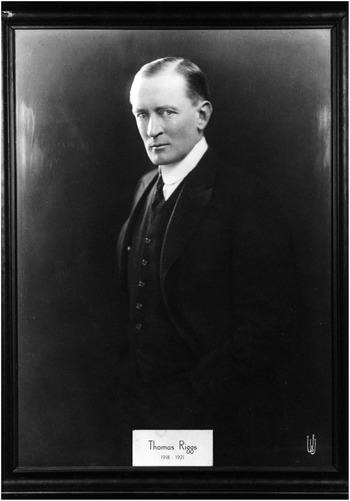
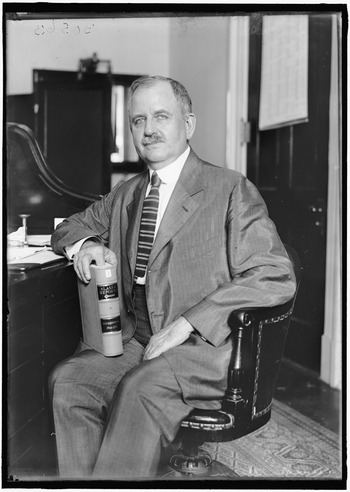
In June 1919, Franklyn Brenneman, US marshal for the Territory of Alaska’s third division, sent a telegram to Alaska Governor Thomas Riggs, Jr. (hereinafter Riggs). Brenneman (Reference Brenneman1919) wished to know whether “crews of halibut boats” operating near Latouche Island needed to pay a tax the Territory of Alaska had enacted a month earlier. Riggs responded concisely but explicitly. “Every male person between ages specified, regardless of residence, race, color, nationality or citizenship [is] subject to [the] poll tax, except natives when [they are] not competing for livelihood with whites and when [they are] still maintaining tribal relations, otherwise natives leading [a] civilized life or in competition with whites are also subject to [the] tax,” he explained (Riggs Reference Riggs1919a). Riggs was reiterating what his attorney general, George Barnes Grigsby, had decided a week earlier when he had issued revised guidelines for implementing the new tax. Two categories of Native men, Riggs and Grigsby agreed, were subject to the tax: “civilized” settler colonial subjects and “uncivilized” workers in settler spaces (Figures 1 and 2).Footnote 1
Alaska Governor Thomas Riggs, Jr. ASL-P01-1970 Alaska State Library, Photo Collection.

Attorney General George Grigsby. LC-DIG-hec-12432 Library of Congress, Harris & Ewing Photograph Collection.

The “poll tax” Riggs mentioned in his response to Brenneman was otherwise known as the Alaska school tax (Territory of Alaska 1919, chapter 29). Designed based on the remnants of a short-lived general poll tax, the school tax was explicitly enacted to help the territory finance its public school system. To maximize revenue, Alaska, which had become a US territory just seven years earlier (Territorial Organic Act of 1912), endeavored to “impos[e] and lev[y] upon each male person … within the Territory of Alaska or the waters thereof, over the age of twenty-one years and under the age of fifty years, an annual tax in the sum of five dollars ($5.00)” (Territory of Alaska 1919, chapter 29, section 1). The seemingly neutral tone of the tax, though gendered, concealed a much bleaker purpose. The school tax funded the territory’s public schools, which Native children could attend alongside their non-Native counterparts, provided that they were “of mixed blood” and “le[d] a civilized life.” Conversely, those who lacked both conditions were legally required to enroll in federally run (and funded) Native schools. Riggs’s response to Brenneman, therefore, sought to further elaborate on a tax that, George Grigsby himself lamented, “has failed to make any exception of natives” (Alaska Attorney General 1921, 48). Grigsby’s revised implementation policy seemed to make the tax more than a revenue-raising instrument, which begs an important question: why did he disconnect fiscal and educational policies by extending the tax to include certain Native men whose children were (or would be) ineligible to attend public schools?
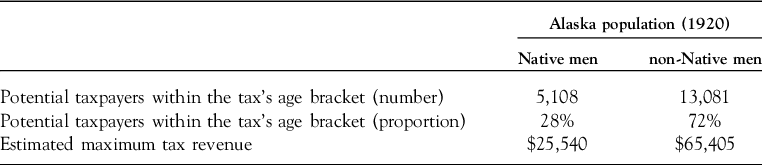
Drawing on a vast array of primary and secondary sources, including previously unexamined archival documents relating to the work of Governor Riggs and Attorney General Grigsby, this article analyzes the relationship between tax law, citizenship, and indigeneity in 1919 Alaska. I argue that the policy of applying the tax to some Native men but not others served two intertwined purposes.Footnote 2 The first one was fiscal need. In 1919, the Territory of Alaska was responsible for financing a substantial proportion of its educational system. But more than education was at stake. The territory, which was struggling economically and demographically because of World War I, had decided that strong schools would signal its status as a thriving sovereign and attract new residents. Governor Riggs thus needed revenue to finance the expanding network of public schools, and Native men comprised about 28 percent of the taxable population (Table 1). Native taxpayers, whether “civilized” or “uncivilized,” would help finance segregated territorial schools that effectively reinforced colonization and colonial power.
Scope and Revenue-Raising Potential of the Alaska School Tax as Originally Enacted

Note: Based on US Census Bureau 1922b, 1161–62 (table 10). Only men aged between twenty and forty-nine years old were included (thus, this leaves out two years of the school tax’s age bracket). Exempted men (Territory of Alaska, chapter 29, section 1), who were not many within the territory, are excluded (for an estimate, see infra). Lastly, the numerous non-Native seasonal workers, who were liable for the tax (see infra), are most likely not included. Estimated tax revenues do not include collectors’ 10 percent compensation “for each tax collected” (1919 Alaska Session Laws, chapter 29, section 12); they also exclude penalties and fines (sections 5, 6, and 8).
The second purpose was the implementation of settler colonial ideology. In revising the reach of the tax, Grigsby and Riggs were determining the conditions under which Alaska Natives would be allowed to join mainstream society as taxpayers. Being a taxpayer became a signal of readiness for citizenship and assimilation. Nevertheless, paying the tax by no means guaranteed citizenship. In 1919, territorial officials possessed almost complete control over who could become a US citizen.Footnote 3 For the most part, citizenship was only available through the Alaska Citizenship Act of 1915 (Territory of Alaska 1915, chapter 24), which used one’s “civilized” state as a core condition. Thus, by incorporating that same condition into its scope, the tax provided another antechamber to citizenship. The tax mimicked the Alaska Citizenship Act, even though the assessment of one’s “civilized” state followed a different procedure and involved different people. In other words, tax law had become a means by which territorial officials could tease out the contours of indigeneity and assess one’s degree of assimilation.
Territorial officials used the school tax to advance settler colonialism, both by ensuring that segregated territorial schools would thrive and by crafting the policy in a way that allowed them to decide who would be “civilized” enough to be a taxpayer. The tax was a convenient discursive tool, opening up the possibility of engaging in conversations about indigeneity and citizenship. But it was also performative. It held the potential, as Lisa Philipps has contended about the modern Canadian income tax, to be “a potent site for identity production” (Reference Philipps2016, 2680). Specifically, in the context of 1919 Alaska, Riggs and Grigsby used the school tax as an additional means to detect and shape “civilized” and “uncivilized” Natives. Hence, the tax allowed territorial officials to further control the ideological boundary that separated inclusion and exclusion (Mehrotra Reference Mehrotra2015, 949; S. Tillotson Reference Tillotson2017).
This article seeks to contribute to the growing body of scholarship on the relationship between tax law, identity-making, and citizenship (Kotsonis Reference Kotsonis2004, Reference Kotsonis2014; Likhovski Reference Likhovski2007, Reference Likhovski2017; Infanti and Crawford Reference Infanti and Crawford2009; Martin, Mehrotra, and Prasad Reference Martin, Mehrotra and Prasad2009; Zelenak Reference Zelenak2013; S. Tillotson Reference Tillotson2017; Williamson Reference Williamson2017; Willmott Reference Willmott2017; Vicol Reference Vicol2020). “Taxation,” Assaf Likhovski explains, “is not only a revenue-raising tool or an incentive-providing mechanism, but also a method for social construction—a way to create a shared identity and common notions of citizenship and community” (Reference Likhovski2017, 14). But colonialism—and particularly settler colonialism, with its broad logic of “elimination by assimilation” (Demuth Reference Demuth2019, 490 (paraphrasing Wolfe Reference Wolfe2001, 881))—further complicates the effects of tax law on Indigenous peoples (Levitt Reference Levitt2018; Willmott Reference Willmott2020, Reference Willmott2022). In Bolivia, for example, Miranda Sheild Johansson (Reference Sheild Johansson2018) contends that the function of state taxation, which historically was that of “exploitation,” morphed into that of multicultural “inclusion” after Evo Morales was elected president for the first time. Nevertheless, the Indigenous population still remembered the former vividly and therefore dreaded the latter, despite the government’s pro-Indigenous stance. To Audra Simpson, paying non-Indigenous taxes is part of the “game” of citizenship, that is, it is an “actio[n] that would move Mohawks out of their own sovereignty into settler citizenship and into the promise of whiteness” (Reference Simpson2016, 328). More generally, Kyle Willmott posits that “there is a specific link between informal tax imaginaries and white possessiveness as they are constituted in settler colonial contexts. Taxation as imagined by taxpayers is not simply about the fiscal, but as it relates to indigeneity, tax becomes about the entitlement to know, the entitlement to judge, and the possessive logic of the question of who gets to decide—how tax becomes a form of property” (Reference Willmott2022, 10). Furthermore, scholarship on the early-twentieth-century American South has shown the complex intersection of tax policy, education, and race (see Cyna Reference Cyna2022). Brian Sawers (Reference Sawers2017) has detailed the way poll taxes were used to fund segregated education, although they were not enough to keep schools afloat. While white schools often benefited from other sources of revenue, the poll tax was all Black schools could rely on to function (Reference Sawers2017). Camille Walsh (Reference Walsh2018) has described how tax policy and one’s status as a taxpayer could be a focal point of both discrimination (through the segregation of schools) and Black resistance.
Building on these bodies of scholarship, I use this historical episode to unpack tax law’s role in shaping subaltern political and sociocultural identities. I argue that the school tax provided two of the territory’s most powerful men another opportunity to express and reinforce both their ideological views on indigeneity and settler colonial power. This case study suggests that a single tax, though limited in its fiscal function, also contributed to the rise of settler colonialism in Alaska. More importantly, the early history of the 1919 Alaska school tax epitomizes the importance of (settler) colonial tax policies and the need to examine them in light of their broader sociocultural and political context (Redding Reference Redding1993, Reference Redding2006; Zahnd Reference Zahnd2021).
A GLIMPSE OF THE EARLY PUBLIC SCHOOL SYSTEM: THE CASE OF JUNEAUFootnote 4
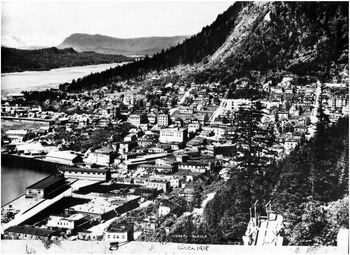
“[I]n the summer evening mists,” John Underwood observed circa 1912, Juneau “looks like a Swiss village on the shores of a lake” (Reference Underwood1913, 52) (Figure 3). Underwood, who was voyaging throughout Alaska, had been mesmerized by the magnificence of the panhandle long before he reached this “very thriving, prosperous city” (53). “No pen can describe the infinite charm, the delicate colouring, the peaceful sublimity, the dignified grandeur of the Inland Passage,” he reported (10).
Downtown Juneau, circa 1918. ASL-Juneau-Views-General-1910s-12, Alaska State Library, Photo Collection.

Juneau had been Alaska’s “seat of government” since 1900 (Alaska Civil Code Act of 1900, 321), although it took several years to find “suitable grounds and buildings” (321) to officialize “the transfer from Sitka” (Gruening Reference Gruening1954, 112). When the northern US district became a US territory in August 1912 (Territorial Organic Act of 1912), the mining town (Gruening Reference Gruening1954, 73–74; Underwood Reference Underwood1913, 50–52; Haycox Reference Haycox2002, 188–90; Naske and Slotnick Reference Naske and Slotnick2014, 113–14) was awarded the status of capital (Territorial Organic Act of 1912, 512). Upon discovering Juneau, Underwood singled out the public school, along with the courthouse, as the “most pretentious buildings” (Reference Underwood1913, 53). The conspicuous public school building stood tall not only in the new capital but also increasingly in other Alaskan settlements (Alaska Governor 1912, 20–21; 1913, 31), thereby representing Alaska’s cherished educational aspirations.
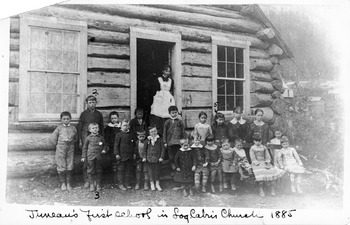
Juneau’s first school was a modest but beautiful “log carpenter shop” that the city rented and turned into a one-room schoolhouse from 1885 to 1887 (M. Tillotson Reference Tillotson1973, 2) (Figure 4). The first somewhat permanent school, built at the dusk of the nineteenth century, was a modest “one-story frame building with two rooms,” where “[w]hite pupils were taught in one room and Natives in the other” (4). But its size did not suffice for long. The school was expanded in 1900, and again two years later, even though space still had to be found elsewhere (4–9). Nevertheless, benevolence was perhaps less potent than one might assume. In his 1894 yearly report, Governor Sheakley reminded the secretary of the interior that, in Juneau, “white and native children occupied schoolrooms in the same building and on the same floor” (Alaska Governor 1894, 4). “This,” he complained, “was not agreeable to the white people and not pleasant for the natives” (4).Footnote 5 Sheakley, however, happily reported that segregated education could be established. “By direction of the Commissioner of Education at Washington a new house was built and furnished this summer, on a separate lot, for the accommodation of the native school, and the old schoolhouse has been improved, repainted, and furnished with new seats and desks. This building will be occupied by the white school, and will afford ample room and accommodations for some time to come” (4).
First School in Juneau, 1885. ASL-P01-2208, Alaska State Library, Photo Collection.

Public education in Juneau had been, by and large, defying US law. The 1884 Organic Act, which bestowed legal existence upon the then-recent and latest US purchase by granting it US district status, provided that “the Secretary of the Interior shall make needful and proper provision for the education of the children of school age in the Territory of Alaska, without reference to race” (District Organic Act of 1884, 27–28). A 1900 federal law (Alaska Civil Code Act of 1900, 330) reiterated the racial nondiscrimination (Case and Voluck Reference Case and Voluck2012, 202), but granted school boards in incorporated towns “exclusive supervision, management, and control of the public schools and school property” (Alaska Civil Code Act of 1900, 521). This newly acquired sovereignty over local schooling and education would pave the way for the racist policies non-Natives had been eager to implement (Mitchell Reference Mitchell2003, 102). As one of the few incorporated towns in Alaska, Juneau could design a public school system that was de facto segregated, thus explicitly resisting the general mandates of the law. In 1904, the new capital ran a public school building, which was “a beautiful structure lighted by electricity, steam heated, and with a well-supplied library,” and a “separate school for the natives” (Alaska Governor 1904, 121). As Darnell puts it, “the ‘city’ schools were established specifically for white children as an outgrowth of concern by settlers that their children were being slighted by the Native-oriented Bureau of Education” (Reference Darnell1970, 153).
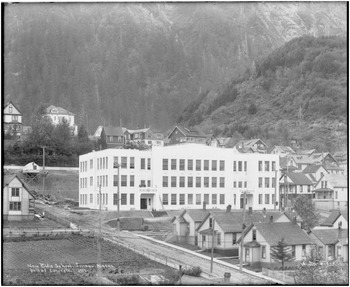
In 1917, the territory erected a much larger concrete building to be used as a “combination grade and high school” (M. Tillotson Reference Tillotson1973, 9) (Figure 5). By this point the school had 348 students and fourteen teachers (Alaska Governor 1919a, 75). Somewhat unsurprisingly, the school required significant funding to operate. During the 1917–1918 school year, the incorporated town and the territory combined spent $24,234.24 for the capital’s public school (75). The new school building would accommodate the city’s ever-growing educational needs. Yet unlike previous schools, the new one could legally close its doors to most Native children.
Juneau’s Public School, 1917. ASL-P87-0915, Alaska State Library, Winter & Pond Photo Collection.

THE ADVENT OF INSTITUTIONALIZED SEGREGATION IN PUBLIC SCHOOLS
Education had been legally segregated since the enactment of the Nelson Act in 1905 (Nelson Act of 1905). The Act mandated that public schools “be devoted to the education of white children and children of mixed blood who lead a civilized life” (1905, 619). The education of “Eskimos and Indians” who were either of “full-blood” or “mixed-blood” but did not “lead a civilized life” remained under the control of the secretary of the interior (619) and would subsequently be provided by the Bureau of Education via federally run (and funded) Native day schools (619). This “dual system” (Case and Voluck Reference Case and Voluck2012, 203) continued after the territory took over public education in 1917 and could henceforth “establish and maintain schools for white and colored children and children of mixed blood who lead a civilized life” (Act of 1917). Naske and Slotnick note that even those who disagreed with this policy of racial segregation saw it as a necessary evil, believing that “putting Natives with poorer backgrounds in schools with Americans not only would place them at a serious disadvantage but also would result in lowering educational standards for all” (Reference Naske and Slotnick2014, 153).
Governor Riggs lamented this racial disdain toward Natives. “There has been and still is an attitude of aloofness toward the native population by the white people of Alaska which is not conducive to rapid advancement by the former race,” he wrote in one of his yearly reports to the secretary of the interior (Alaska Governor 1919a, 11). Riggs continued:
Quite often the bureau employees [i.e., employees working for the Bureau of Education] and the missionaries are the only whites who seem to have any interest in the natives’ welfare. Until a tolerant and sympathetic attitude is generally exhibited by the white race, the natives will be constantly handicapped in their efforts to reach a higher plane of civilization. The natives of Alaska are unquestionably an asset to the Territory, and the intelligent development and improvement of this asset would be remunerative to Alaska in many ways. These native Alaskans are self-reliant, law-abiding, and honest, and the only help they have had from the Federal Government is the establishment of schools in the larger villages, a little medical relief, and the introduction of reindeer among the northern and western tribes. (11–12)
Nonetheless, this generous statement comes with caveats. Riggs, like many at the time, endeavored to “civilize” Alaska Natives so that they could “become a great factor in the economic life of the Territory” (Alaska Governor 1920, 59). Naturally, education was part of this plan, alongside “industry” (59) and other policies that had been deployed throughout Alaska since the turn of the twentieth century (Mitchell Reference Mitchell2003). In his 1920 annual report, the governor shared a thorough depiction of the Native population. First praising the fact that many Natives who lived in the southeastern area of the territory “are able to compete on equal terms with their white neighbors,” he then remarked that “[t]he natives of southwestern and western Alaska, as a class, have not progressed so rapidly, although progress is quite evident where education has been afforded” (Alaska Governor 1920, 59). But Riggs reserved his harshest judgment for “[t]he native of the Yukon River drainage” who, he regretted, “does not adapt himself so readily to changed conditions of life” (59). “[H]e is not so intelligent nor so adaptable as the Thlinket or the Eskimo; his problem is indeed a difficult one,” he reasoned (59). What Riggs viewed as lack of “intelligence,” and therefore the inability to “reach a higher plane of civilization” (Alaska Governor 1919a, 11), was the fact that many Natives living in interior Alaska refused to surrender their subsistence-based way of life entirely (see infra).
Within the lower forty-eight, boarding and day schools had earned a dark reputation that was well-deserved (Hoxie Reference Hoxie1984, 189–210; Adams Reference Adams1988; Treuer Reference Treuer2012, 267–72; Reyhner and Eder Reference Reyhner and Eder2017). Writing about the Alaskan context, Steven Dinero argues that “[f]ormal education in a school setting was a central part of the social conquest of territory”; “secular education,” he explains, “was designed as an agent of development, hygiene, health care improvement, and overall ‘civilization’ throughout Native Alaska” (Reference Dinero2016, 51). This settler colonial endeavor, Dinero concludes, was exacerbated by the fact that “Anglican values, combined with Victorian sensibilities, when further inscribed into the intricate machination of the colonialist enterprise, led to an almost universal effort through which ‘educating,’ ‘civilizing,’ and ‘cleansing’ became largely interchangeable concepts” (51). Such was the dire legacy of Dr. Sheldon Jackson, a missionary later hired by the government as general agent of education (Haycox Reference Haycox2002, 184–87; Mitchell Reference Mitchell2003, 65–110). Jackson, who almost single-handedly shaped Native education, advocated for the assimilation of Alaska Natives (Haycox Reference Haycox2002, 185). Acculturation, Jackson believed, would serve the needs of the non-Native population. In a statement before the Committee on the Territories, which sought comment on the proposed Nelson Act, Jackson defended the federally funded Native schools because they “will civilize … natives and make them useful assistants of the white men who go” to Alaska (Reference Jackson1904, 5–6).
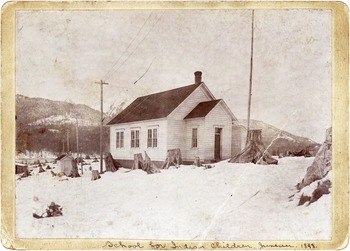
Many Native children residing in Alaska Native villages received their education from the Bureau of Education in day schools (Alaska Governor 1919a, 11–12).Footnote 6 These schools (Barnhardt Reference Barnhardt2001, 11), Riggs explained, were designed to “promote native industries, domestic arts, personal hygiene, social welfare, and in general improve the living conditions of the adult as well as the school population of the village and the vicinity” (Alaska Governor 1919a, 11–12) (Figure 6). “The curriculum covered,” Alaska Governor John Franklin Alexander Strong enthusiastically reported in 1917, “includes not only the three ‘R’s,’ but such practical subjects as manual training, domestic science, agriculture, sanitation, and hygiene … ” (Alaska Governor 1917, 16). To officials, the main difficulty in implementing education throughout Alaska was Alaska itself. Strong, for example, highlighted the fact that most villages were hard to reach, although “[t]he bureau must necessarily place its schools where the natives have their villages” (18).
Juneau’s Native School, 1898. ASL-P01-1230, Alaska State Library, Photo Collection.

Some territorial officials would critique boarding schools, which missionaries began to introduce in Alaska as early as 1878 (Barnhardt Reference Barnhardt2001, 11; Z. Jones 2014/Reference Jones2015, 5). But most attacks were directed toward boarding schools in the contiguous United States. In 1919, Riggs himself insisted that children remain where they were raised. “I do not believe in placing native and half-breed children in schools outside of Alaska, as it has been found that they do not readily become acclimatized,” he argued (Alaska Governor 1919b, 56). “They should have schools near their own homes” (56).Footnote 7 Native schools generated disgruntlement among the Alaska Native population. Concerns gravitated around the quality of the education Native children would receive vis-à-vis the “civilized,” “mixed-blood” Natives who could attend public schools, and fears that segregation would maintain Alaska Natives in a perennial state of second-class citizenry (Drucker Reference Drucker1958, 49). Better funding and less abuse, Zachary Jones (2014/Reference Jones2015, 7) contends, also drove Natives across southeast Alaska to favor public schools. Yet, as Drucker points out, “[i]t is difficult to appraise the extent to which this attitude had any real basis and that to which it was simply a way of expressing the Indians’ protest at what they felt to be discrimination in their exclusion from white schools” (Reference Drucker1958, 50).
Neither the federal government nor territorial officials implemented the segregated school system’s institutional rigors assiduously. As Darnell affirms, “historical accident[s]” (Reference Darnell1970, 185) sometimes dictated whether one could either find a territorial or governmental school in a given rural community, and some communities never established de facto segregation in their schools (Darnell Reference Darnell1979, 433; see also Drucker Reference Drucker1958, 49; Darnell Reference Darnell1970, 184–87). While this was the case in small, more remote communities (Darnell Reference Darnell1970, 184–85), cities like Juneau offered both institutions. But even then, segregation policy was often more flexible in practice than the law dictated. When Governor Riggs wrote to the secretary of the interior in 1920, territorial schools did accept Native children who were not “mixed-blood” and “civilized”—though “unwilling[ly]” (Alaska Governor 1920, 59–61). “It is thus shown that there are 930 children of native blood being educated by the Territory,” he noted, estimating that “the Territory is educating about 20 per cent of all the native children in Alaska” (61). This, he claimed, cost his taxpayers “$68,000 a year” (61).
THE ENACTMENT OF THE SCHOOL TAX
By the end of the 1917–1918 academic year, the Bureau of Education ran seventy-one schools in Alaska, including two summer schools (Alaska Governor 1919a, 11), with roughly 3,500 Native students enrolled (11). Meanwhile, the territory ran sixty-four public schools (74–75). Although eighteen of the territorial schools were located in incorporated towns and school districts, most of them (forty-six) lay outside those spatially defined legal entities.Footnote 8 The territorial school system employed 145 teachers and enrolled 3,319 students (Alaska Governor 1919a, 74–75). Riggs viewed his schools as the embodiment of what Alaska ought to become, that is, a modern, thriving, and civilized US polity. “The people of Alaska are intensely interested in their schools, the more so as many brought up on the outskirts of civilization were themselves not given the opportunity for educational advancement and wish to see this defect remedied in their children,” the governor proudly asserted (Alaska Governor 1919a, 73; see also Alaska Governor 1919b, 75). World War I intensified the critical role of the schools, and Riggs considered education to be fundamental in fostering “US patriotism” to combat “German propaganda, … [which] … attempt[ed] to destroy … American ideals” (Alaska Governor 1919a, 73; see generally P. Jones Reference Jones2013, 15–18). To quell what he believed had been a “slipping in patriotic endeavor,” the governor pledged that “never again shall our school children lack for instruction in patriotism and reverence for our flag” (Alaska Governor 1919a, 73). “Instruction in the real causes underlying the Great War, together with its important events, and in Americanism and patriotism have been prominent in the work of the year,” he added the following year, then detailing at great length how schools could “create an understanding of the principles for which our country stands and of the duties and responsibilities of American citizenship” (Alaska Governor 1919b, 76).
Spreading education throughout Alaska, however, came at a cost. Since 1917, territorial schools had been financed according to the following scheme: first, funding for the schools “outside of incorporated towns or incorporated school districts” came from the Alaska Fund (Alaska Governor 1919a, 73), which relied on “revenues derived by the Federal Government from business and trade licenses outside of incorporated towns” (41).Footnote 9 Second, funding for schools located within incorporated towns and school districts came from local and territorial revenues (73). Some of these schools were located in more densely populated, non-Native areas, where many children could qualify for public education.Footnote 10 Naturally, then, they were expensive to run. During the 1917–1918 academic year, the sixty-four public schools across Alaska cost both the US government and the territory about $270,000 (74–75). However, the handful of schools that were under the territory’s financial purview represented nearly two-thirds of that amount, that is, almost $173,000 (75).Footnote 11 For a relatively new polity that prided itself on the quality of this essential public service (73), it was a significant but necessary expenditure (Gruening Reference Gruening1954, 215).Footnote 12
But the financial condition of Alaska, the territorial treasurer concluded in his 1917–1918 report, was worrisome. “If future expenditures are to continue at the same rate as during the biennium just closed,” he cautioned, “it would seem to be imperatively necessary that additional sources of revenue be discovered” (Alaska Treasurer 1919, 8). The situation would keep getting worse. In his next biannual report, the treasurer concluded that the “cash balance in the treasury was much less at the end of the biennium [i.e., 1920] than at the beginning [i.e., 1919]; [it] is lower in fact than at any time for several years past” (Alaska Treasurer 1921, 7). Several reasons could explain the situation. Alaska “ha[d] suffered intensely from the great war,” mainly as the conflict had depleted the territory of its “young men” and skilled workers (Alaska Governor 1919a, 7), and to make the matter worse, mining had plummeted. “The value of the mineral output of Alaska in 1918 is estimated at $28,253,961, a decrease of almost $12,500,000 from the value in 1917 and the smallest since 1914,” Riggs bemoaned in 1919 (Alaska Governor 1919b, 18; see also Alaska Governor 1920, 24). With a shrinking economic base, both because of a depleted population and a waning economy, existing territorial taxes generated less revenue. Education would need its own tax.Footnote 13
The school tax was hastily enacted (Alaska Treasurer 1921, 8) on May 1, 1919, upon the remnants of the 1913 poll tax.Footnote 14 But unlike most racially motivated poll taxes one could have encountered throughout the Southern states (Ogden Reference Ogden1958; Kerber Reference Kerber1998, 119–20; see also Einhorn Reference Einhorn2006), the tax “had nothing to do with voting, but was in reality a head tax” (Gruening Reference Gruening1954, 164; see also Alaska Legislative Council 1956, 20–21). Yet form invariably dominates content, and “[p]oll tax laws,” bemoaned Attorney General Jeremiah Murphy, “are always unpopular” (Alaska Attorney General 1921, 7).
As a matter of “emergency” (Territory of Alaska 1919, chapter 29, section 16), the tax went into immediate effect and resisting taxation was a “misdemeanor” that could lead to a fine and possible imprisonment (section 6). Furthermore, any late payment incurred a “penalty” (section 5), which could also be accompanied by “a seizure and sale of any personal property” (section 9). “School Tax Collectors” were to be nominated (sections 2 and 14) and dispatched throughout the territory to collect the $5.00 from individuals (section 1) or their employers, the latter being responsible in place of employees who would not pay the tax (section 8). Each taxpayer would be given a “receipt” to acknowledge payment (section 7; see also section 10).
Notwithstanding a few limited exemptions, the territory initially strived to tax “each male person … over the age of twenty-one years and under the age of fifty years” (Alaska Attorney General 1921, 48). The tax thus left out a significant proportion of the Alaskan population, women, sidelining thousands of potential taxpayers (US Census Bureau 1922b, 1161–62 (table 10)). Considering the necessity to raise revenue and Alaska’s past policies, the decision seems puzzling. Women were enfranchised as soon as the territory was established in 1912 (Gruening Reference Gruening1954, 162; see Christen Reference Christen2019),Footnote 15 eight years before the Nineteenth Amendment made it a constitutional right (US Constitution, amend. XIX); they could also benefit from “the first old-age pension system in the United States” (Gruening Reference Gruening1954, 174).
The gendered nature of Alaska school tax was hardly novel. Taxation and one’s status as a taxpayer have always reflected a gendered dimension and could even serve as a condition to “delineat[e] claims for access to rights” (Walsh Reference Walsh2018, 9 (citing Kessler-Harris Reference Kessler-Harris2003); see also Redding Reference Redding2006, 147–73; S. Tillotson Reference Tillotson2010). Shirley Tillotson, for example, has suggested that traditional Canadian poll taxes, whose revenue-raising capacity was frequently negligible, were predominantly meant to represent “symbols,” functioning “to mark belonging or exclusion” (Reference Tillotson2017, 133–35). The taxes Tillotson describes resemble the Alaska school tax: they excluded women (who, unlike in Alaska, were also denied voting rights) and men who had reached a certain age. Poll taxes, she observes, “were aimed at men of voting age, those deemed to have a duty to contribute, to pay the price of citizenship” (Reference Tillotson2017, 134). The Alaska school tax was likely designed with a similar ideology in mind.Footnote 16
The school tax also exempted certain classes of men. On the one hand, “soldiers, sailors in the United States Navy or Revenue Cutter Service, and volunteer firemen” (Territory of Alaska 1919, chapter 29, section 1) could very well constitute, at least to territorial officials, exemplary, law-abiding citizens who did not need to be taxpayers to prove their worthiness or contribution to society. “Paupers, insane persons, or territorial charges” (section 1), on the other hand, represented people who were socially marginalized and generally unable to contribute economically to society. It remains difficult to ascertain exactly why these men did not have to pay the tax.Footnote 17 Be that as it may, exempting the abovementioned classes had a minimal impact on tax revenue.Footnote 18
USING THE TAX TO RETHINK THE RELATIONSHIP BETWEEN INDIGENEITY AND CITIZENSHIP
On June 3, 1919, the same day he was elected delegate to Congress (Alaska Attorney General 1921, 6),Footnote 19 Grigsby received a letter from Governor Riggs’s secretary, who inquired “as to whether the School Tax … can be imposed upon Orientals, Mexicans, and other foreign labor employed in the Territory” (48). Grigsby assured him with “no hesitancy” that such was the case (48–49). On June 16, Riggs would broaden the scope of this opinion and contend that the tax was to be applied “regardless of residence, race, color, nationality or citizenship” (Reference Riggs1919a). In 1920, 595 settled nonwhites who were not Natives lived in Alaska—roughly 1 percent of the territory’s residents (US Census Bureau 1922b, 1159 (table 3)). Specifically, the 1920 census reported only fifty-six Chinese and 312 Japanese residents, as opposed to respectively 1,209 and 913 a decade earlier (1159 (table 3)). Governor Riggs’s primary concern, then, was probably not with this relatively small group of men settled in the territory, but with the temporary foreign workers some industries routinely employed. Riggs certainly had a point. For instance, in 1919 fisheries employed 28,534 people, including 2,770 Chinese, 1,507 Japanese, 1,578 Filipinos, 1,891 Mexicans, and 587 nonwhites and non-Indians (Alaska Governor 1920, 53).Footnote 20 From a fiscal standpoint, it would have been unthinkable not to tax about a quarter of this workforce, representing the sizable sum of $39,165.Footnote 21
While carving out the scope of a tax that initially had a somewhat cryptic reach, Grigsby seemed to claim that race did not dictate one’s tax status or liability. And yet it did. While gender was a rigid determinant of otherness for the tax, race would become a subtle prerequisite to the inclusion or exclusion of Alaska Natives. But if and only if race could be combined with one’s culture—that is, as Abu-Lughod puts it, with “the essential tool for making other” (Reference Abu-Lughod, Oakes and Price2008, 54).
Riggs did not only ask Grigsby about transient workers. He was also anxious to know whether and how Native men, who comprised nearly a third of the territory’s taxable population (Table 1), should be taxed (Alaska Attorney General 1921, 48).
Taxation and Assimilation
In the first part of his published opinion, the attorney general reasoned that “[c]ertainly all native Indians who are citizens of the United States, that is who have severed their tribal relations and adopted the habits of civilized life, are subject to the tax” (Alaska Attorney General 1921, 48). This part of the opinion echoed a law the territory enacted in 1915 to let Alaska Natives apply for US citizenship, which conditioned the award of citizenship on stringent and culturally destructive conditions (Haycox Reference Haycox2002, 232), including the requirement to “ha[ve] severed all tribal relationships and adopted the habits of a civilized life” (Territory of Alaska 1915, chapter 24, section 1).
This dual condition—becoming non-Native, both physically and culturally, and distancing oneself from Natives—could be tracked back several decades, when the US government decided as a policy that lower-forty-eight Native Americans would need to assimilate. The Indian Allotment Act (or “Dawes Act”) (1887) “authorized” the president of the United States, whenever he was convinced that “any reservation or any part thereof of such Indians is advantageous for agricultural and grazing purposes,” to “cause said reservation, or any part thereof, to be surveyed, or resurveyed if necessary, and to allot the lands in said reservation in severalty to any Indian located thereon” (388). Those who received allotments would eventually become private owners (389–90). The Act, Thomas Biolsi contends, helped “reform Indian subjects—uplift them—by making them into liberal (and, literally, sod-busting) individuals (eventually, citizens) rather than supposedly inert subjects in a tribal mass” (Reference Biolsi2018, 5; on the effects of the Dawes Act, see Hogan Reference Hogan1990). To make assimilation even more absolute (and not entirely dependent on allotments), the Dawes Act established that “any Indian born within the territorial limits of the United States who has voluntarily taken up, within said limits, his residence separate and apart from any tribe of Indians therein, and has adopted the habits of civilized life, is hereby declared to be a citizen of the United States” (General Allotment Act of 1887, 390).Footnote 22 And since the Alaska Citizenship Act directly referred to the foregoing provision, the territory too sought to condition citizenship on assimilation.Footnote 23
The Alaska Citizenship Act was an indirect attack on tribalism and cultural identity. Moreover, as Baumgarte has argued, the “complicated and lengthy process surely discouraged many Alaska Natives from obtaining citizenship” (Reference Baumgarte2015, 57). Any Native who wanted a court-issued “certificate” that proved citizenship (and therefore assimilation) had to endure several steps that all embodied settler colonialism at its finest, including an “examination” by teachers and an “endorsement” of their effective assimilation by “white citizens” (Territory of Alaska 1915, chapter 24).
The Alaska Citizenship Act did not have a uniform impact throughout Alaska. On February 20, 1917, Superintendent George Edward Boulter, who was stationed in interior Alaska, informed the US commissioner of education that “there are no natives in this district who have become citizens under the [Act]” (Boulter and Grigor-Taylor Reference Boulter and Grigor-Taylor2015, 231). The reason was that they “have by no means abandoned their tribal customs and relationships” nor “adopted the habits of a civilized life” (231). “Any way of living such as practiced by white people,” he observed, “is more or less distasteful to them” (231). US citizenship was not necessarily appealing to Alaska Natives. Boulter pointed out the failure of Native schools to “civilize” children in the area, which Riggs would also lament:
Although nearly all the children living within a reasonable distance of our school precincts have attended school, yet because they are frequently taken away from school by their parents to attend the hunt—and because they are withdrawn completely from school at too early an age—their education has not reached that point which would enable them later on to pass the required examination for citizenship at the District Court. (231)
Boulter’s observation underlines the assimilative nature of Native schools. “Just as soon as there are any natives in this district who appear to be eligible for citizenship,” he promised the commissioner, “steps will be taken to prepare them for the same” (232).
Despite their relentless efforts to intensify colonization (and assimilation) within the area, both territorial officials and federal officials such as Boulter had to face the fact that most Natives just did not want to become US citizens under the conditions laid out by the Alaska Citizenship Act. “To the best of my knowledge, only one native in this district has endeavored to become a citizen,” Boulter noted (231). “In this case, the applicant was an intelligent man with a fair education, but because he had insufficient knowledge of the subjects necessary for him to be fairly well informed, he failed to qualify” (231).Footnote 24
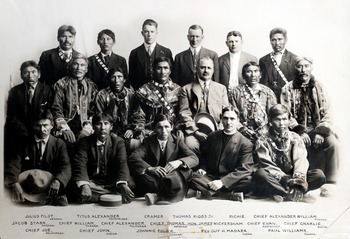
As Boulter discovered, Natives from the interior wanted tribal rights, not assimilation. Very few non-Natives lived there, few territorial schools operated, and Natives still heavily relied on their traditional way of life. In 1915 several traditional chiefs gathered in Fairbanks to discuss their concerns about non-Native encroachment on traditional lands (Schneider Reference Schneider2018), which their weakly enforced property rights (Banner Reference Banner2007, 309–10) could not protect.Footnote 25 Specifically, the imminent construction of a railroad in the area had sparked worries (Alton Reference Alton and Schneider2018, 37). Riggs attended the 1915 meeting as a member of the Alaskan Engineering Commission. In fact, he was tasked with building the railroad (Schneider Reference Schneider2018, xxv) (Figure 7). Riggs, who was probably eager to make the case for his “agenda” (xxv), warned the chiefs about what loomed on the horizon: “after the railroad which we are building comes into this country, it will be overrun with white people. They will kill off your game, your mosse [sic], your caribou and your sheep. They will run all of them out of the country and they will have so many fish wheels on the river that the Indian will not get as many fish” (Council 1915, 7). Riggs had a low opinion of Alaska Natives who lived in the interior and refused to change their way of life. Several years later, he would not hesitate, as governor, to single them out as the least “civilized” in Alaska (Alaska Governor 1920, 59).
The Tanana Chiefs at the 1915 Meeting with Wickersham and Other Participants, Including Riggs (back row, fourth from the left). ASL-P277-011-072, Alaska State Library, Wickersham State Historic Sites Photo Collection.

Alaska Natives in the southeast often held different attitudes toward US citizenship than those in the interior. Their contact with non-Natives was more intense (Bancroft Reference Bancroft1886; Black Reference Black2004; Grinëv Reference Grinëv2005; Dauenhauer, Dauenhauer, and Black Reference Dauenhauer, Dauenhauer and Black2008; Naske and Slotnick Reference Naske and Slotnick2014), and they represented a smaller proportion of the area’s population (US Census Bureau 1922b, 1168, 1169 (table 20)). As Boulter observed, “[t]he natives of the interior are undoubtedly a generation or more behind those in southeastern Alaska where several natives have, I believe, qualified for citizenship” (Boulter and Grigor-Taylor Reference Boulter and Grigor-Taylor2015, 231). Riggs concurred. “There are many natives of full or mixed blood [living in southeast Alaska] who have assumed the responsibilities of citizenship and who are able to compete on equal terms with their white neighbors. Among them are found clergymen, teachers, merchants, and navigators. They own their own homes and fishing vessels. Some of them are comparatively wealthy,” the governor concluded approvingly (Alaska Governor 1920, 59). Between 1916 and 1923, over 120 southeast Natives sought to become citizens and many were granted the “certificate” (Alaska District Court 1923).
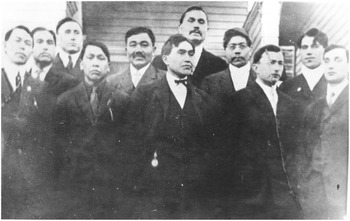
It was also in this area that the Alaska Native Brotherhood (ANB), whose members were primarily Tlingit (Mitchell Reference Mitchell2003; Case and Voluck Reference Case and Voluck2012, 362; Metcalfe Reference Metcalfe2014), had been advocating for US citizenship since it was formed in 1912 (Hope and Demmert Reference Hope and Demmert1995; Metcalfe Reference Metcalfe2014, 13–33) (Figure 8).Footnote 26 Its leaders wanted civil rights instead of tribal rights. The ANB, which would later be joined by the Alaska Native Sisterhood (Naske and Slotnick Reference Naske and Slotnick2014, 142), embraced the idea that Alaska Natives ought to be proud and diligent taxpayers as a means to justify and strengthen the case for citizenship (Hope and Demmert Reference Hope and Demmert1995, 25). The two groups contributed to the enactment of the Alaska Citizenship Act (Naske and Slotnick Reference Naske and Slotnick2014, 143; Arnett Reference Arnett2017, 236). Yet the ANB was by no means advocating for outright assimilation. In fact, it was quite the contrary (Arnett Reference Arnett2018). “During the early decades of the early twentieth century, Alaska Natives of Southeast faced a stark choice: adapt or perish,” argues Peter Metcalfe (Reference Metcalfe2014, 15). “While they were influenced by the assimilationist doctrines promoted by the Presbyterian Church, the early ANB leaders charted their own course” (15). Citizenship was, therefore, a necessary step toward greater political rights. As Jessica Arnett explains, “[m]any who pursued this route to citizenship performed ‘civilization’ as a resistance strategy while still living according to Tlingit, Haida, or Tsimshean custom” (Reference Arnett2018, 139n1).
Founders of the Alaska Native Brotherhood, 1912. ASL-P33-01, Alaska State Library, Alaska Native Organizations Photo Collection.

Grigsby’s interpretation of the school tax transplanted the “civilized” criterion on which the Alaska Citizenship Act partly relied, but left out blood quantum, another major component of federal Indian policy (Sturm Reference Sturm2002, 65–66; Spruhan Reference Spruhan2006; Comaroff and Comaroff Reference Comaroff and Comaroff2009)—as well as Alaska’s pupil assignment policy. Furthermore, others would interpret Grigsby’s “citizenship” requirement for the school tax loosely. A week later, Riggs told Brenneman that citizenship was not a prerequisite to pay the tax, but “natives leading [a] civilized life” fell within its scope (Reference Riggs1919a). The governor would further confuse things several months later when he told the solicitor of the Department of the Interior that “[t]he tax is also demanded from all natives who have announced that they are leading a civilized life and have exercised the right of franchise” (Reference Riggs1919b). From then on, citizenship was no longer used as a criterion for application of the school tax.
What mattered to the governor and his attorney general when they redesigned the scope of the tax was not Alaska Natives’ actual citizenship—or even their willingness to apply for it. Rather, it was a potential taxpayer’s ability to become a citizen under the Alaska Citizenship Act; that is, his ability to be considered “civilized.” What “civilized,” and therefore indigeneity, meant was what truly captured Grigsby’s interest. Hence, he concluded his response to Riggs by reminding him that the tax “would not be considered applicable to those [Native men] living separate and apart from white people and in an uncivilized state” (Alaska Attorney General 1921, 48–49), thereby putting citizenship aside.
Taxation and Marginalization
Grigsby then clarified the first part of his opinion. As a general principle, he explained to the governor, Alaska Natives would pay the tax whenever they “come in competition with white people and with the other classes of labor you mention,” that is, foreign labor (Alaska Attorney General 1921, 48). This exception to the then-prevalent “civilized” criterion, which Riggs accepted, reflected the territory’s acute need to raise revenue for its schools (Riggs Reference Riggs1919b). Two years later, John Rustgard, one of Grigsby’s successors, provided further justification as to why one’s occupation sometimes ought to trump indigeneity. “Where the native has adopted the ways of civilization, and especially where he comes in competition with other races subject to the tax,” he reasoned, “there is generally neither a moral nor legal reason why he should not be required to respond to the demands of the law the same as do others” (Reference Rustgard1921b) (emphasis added).Footnote 27 Rustgard then argued that “where those conditions exist, to permit the native to escape taxation would, as a rule, create dissension and dissatisfaction” (Reference Rustgard1921b). The second part of Grigsby’s opinion, consequently, also indicates that territorial officials were still grappling with the fact that some “uncivilized” Natives temporarily entered mainstream society when they worked alongside non-Natives—although they remained spatially (and socially) segregated.
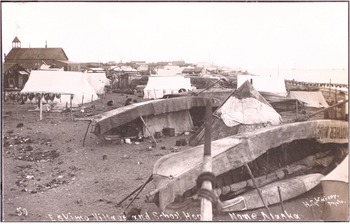
Many burgeoning non-Native communities enshrined that spatial dimension. In Nome, which became the center of the Alaskan gold bonanza circa 1900 (Cole Reference Cole1983; Demuth Reference Demuth, Mountford and Tuffnell2018), segregation was institutionalized when “a twenty-acre voluntary reservation of sorts was established at the mouth of Quartz Creek, twenty miles west of Nome” (P. Jones Reference Jones2007, 7; see Mitchell Reference Mitchell2003, 166–69) (Figure 9). Despite a particular animosity toward Native presence in town, Preston Jones notes that Nome “was not hostile to Natives” and let them buy and sell goods (Reference Jones2007, 7; see generally 6–11). Yet segregation did exist and would continue to thrive well into the 1940s. As Mitchell reports, “[i]n 1944, Juneau was a Jim Crow town where the windows of many bars and restaurants warned ‘No Dogs or Indians Allowed.’ Windows in Anchorage and Fairbanks had similar signs. In Nome, seating in the local movie theater was segregated” (Reference Mitchell2003, 379). “And after touring the territory the previous winter,” he adds, “a Bureau of Indian Affairs social worker described Alaska to Commissioner of Indian Affairs John Collier as a ‘territory where race prejudice is more shocking than in the South’” (379).
Native Village and School in Nome. ASL-P307-0023, Alaska State Library, Dr. Daniel S. Neuman Photo Collection.

This economically focused form of fiscal existence is more than baffling. To start with, Grigsby suggested that working alongside non-Natives eclipsed one’s “uncivilized” state, and thereby insinuated that taxation was solely motivated by a genuine desire to raise revenue. If Natives, he seemed to imply, could indeed work for non-Native businesses and earn money, then it only made sense to ask them to comply with the same fiscal duties as others.
The fiscal benefits of such a policy were significant. In 1919, for example, fisheries relied on the labor of 3,875 Natives (Alaska Governor 1920, 53). Together, they represented almost a third of the non-white workers and 13.5 percent of the overall workforce (53).Footnote 28 According to the 1920 census, about half of the men who were “fishermen and oystermen” and lived in Alaska all year long were Natives, as were those who engaged in “fish curing and packing” activities (US Census Bureau 1923, 1266–67 (table 11)).Footnote 29 But taxing “uncivilized” Natives just because they were wage workers remained an anomaly. In doing so, collectors would exacerbate the marginalization of those they assessed as being “uncivilized.” Unlike the first part of Grigsby’s opinion, which identified Natives as proper taxpayers with the potential to become citizens, taxing “uncivilized” workers was nothing more than economic exploitation. The tax forced “uncivilized” Natives to contribute to a polity that explicitly sought to exclude them but still relied on their labor (Alaska Governor 1921, 13–14).
The second part of the opinion also reflected the tumultuous history of Alaska Natives’ economic citizenship.Footnote 30 Most notably, since 1884 only US citizens have been allowed to stake claims to Alaska’s valuable minerals—particularly gold (Mitchell Reference Mitchell2003, 142).Footnote 31 Thus until passage of the Alaska Citizenship Act in 1915, only those few Natives who were not members of “uncivilized native tribes” according to the 1867 Treaty of Cession (1867, 542) or were assimilated according to the Dawes Act (General Allotment Act of 1887) could take part in the gold rush that had started to flourish during the late 1890s (Mitchell Reference Mitchell2003, 142, 221–22; see also Schwaiger Reference Schwaiger2011). Therefore, one needed to be “civilized” in order to own and sell gold. Riverboats, which were widely used at the turn of the nineteenth century to facilitate the gold rush in interior Alaska, were also off-limits to noncitizens (Schwaiger Reference Schwaiger2011, 180). Reality did not always align with the law, however, and Natives often piloted or worked on riverboats (Mitchell Reference Mitchell2003, 143–44).Footnote 32
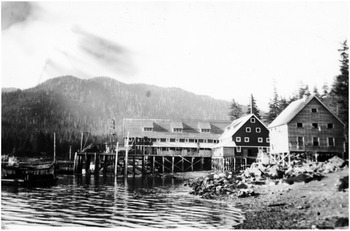
The taxation of “uncivilized” workers who temporarily entered settler spaces demonstrates the fact that the need for revenues could outweigh ideological concerns. The territory needed to tax Native and foreign workers, especially in fisheries and canneries (Bower Reference Bower1919). But what the territory really wished to tax were certain labor-intensive industries, irrespective of the race and indigeneity of those who worked there (Figure 10). This explains why Grigsby’s successors would confirm the loose residency requirements of the tax, so that seasonal workers, who were commonly employed in extractive industries such as fisheries and canneries, would also be liable. On July 31, 1922, Attorney General John Rustgard confirmed that the tax applied “only to those who stop for any time in the Territory to transact some business or to establish a residence though temporary” (Alaska Attorney General 1928, 225). Three years earlier, his predecessor Jeremiah Murphy decided that “Oriental[s] [coming to Alaska to work in canneries] … shall pay the tax, and that their employers, regardless of the method of employment, shall be held responsible to the Territory for the payment of the same” (Alaska Attorney General 1921, 55).
Cannery in Auke Bay (Juneau), circa 1920. ASL-P01-2339, Alaska State Library, Photo Collection.

Natives who paid the tax according to the second part of Grigsby’s opinion would still be unable to become citizens, precisely because they were “uncivilized.” In joining an existing corpus of discriminatory policies, the taxation of “uncivilized” Native workers thus contributed to their sociocultural and political “elimination” (Wolfe Reference Wolfe2006) from the settler space.
In sum, Grigsby’s twofold fine-tuning of the tax was motivated by the overall wish to rethink indigeneity and the place Alaska Natives should occupy within an ever-growing, non-Native settler polity. Yet the attorney general also had to take more practical matters into account, namely the necessity of taxing “uncivilized” Native wage workers to raise revenue for public schools. The tax could mean assimilation or marginalization, depending on who was liable. Either way, it did reinforce settler colonial governance.
ON THE ENTANGLEMENT OF TAX LAW, INDIGENEITY, AND CITIZENSHIP
Federal officials disagreed with Grigsby’s opinion (Riggs Reference Riggs1919b). In December 1919, Solicitor of the Department of the Interior Charles Mahaffie released an opinion that concluded, after a comprehensive historical overview of Alaska education, that the application of the tax should match the school system’s contours: “[i]t is clear that the Territory of Alaska not only cannot legally collect taxes from the natives of full blood for the support of schools established and maintained for white children but also cannot legally collect taxes for the education of children of mixed blood who do not lead a ‘civilized life’” (Mahaffie Reference Mahaffie1921, 8). Mahaffie offered a paternalistic rationale for why most Native men should not be required to pay the tax even when their children attended government-funded schools. “[T]he Indians and other natives of Alaska are as truly the wards of the Nation as are the aborigines and their descendants inhabiting the States with whom the Government has had to deal since its organization; and that Congress has assumed full cost for all educational facilities among the Alaska Natives” (7). Only “civilized,” “mixed-blood” Alaska Natives who were legally entitled to public education were, according to Mahaffie, liable to pay the school tax (10).
The solicitor (Mahaffie Reference Mahaffie1921, 8–10) cited the infamous case Davis v. Sitka School Board, 3 Alaska 481 (D. Alaska 1908), which found that several “mixed blood” children could not attend their local public school because they did not “lead a civilized life” as mandated by the Nelson Act. To the court, “[c]ivilization … includes … more than a prosperous business, a trade, a house, white man’s clothes and membership in a church” (Getches Reference Getches1977, 5 (citing Davis, 3 Alaska at 491)). Indeed, one also needed to “have turned aside from old associations” (Davis, 3 Alaska at 488). Mahaffie used the case to contend that the particularly restrictive conditions under which one could be considered “civilized” necessarily meant that “the number of mixed bloods who could be admitted to schools supported by Territorial Funds would apparently be negligible” (Reference Mahaffie1921, 10). Certainly, logistical realities contradicted his doctrinal assessment.
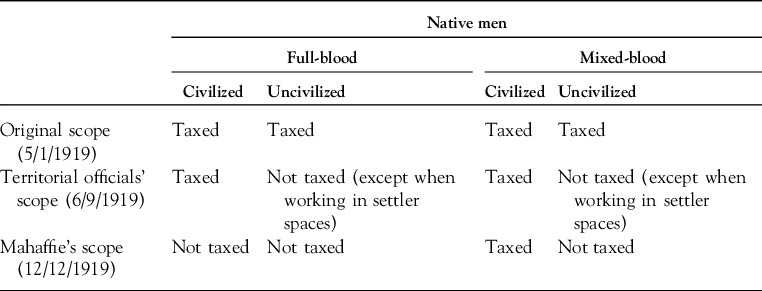
The main point of disagreement between Mahaffie and Grigsby was whether to tax “full-blood,” “civilized” Alaska Natives (Table 2). If exemption logically mirrored the structure of the public school system and strengthened an already institutionalized segregationist policy, taxation would entail a certain degree of possible sociopolitical inclusion and belonging, and a route toward assimilation. Eventually, Grigsby’s position would prevail.
Comparison of the Three Different Scopes of the Tax

Governor Riggs responded to Mahaffie’s opinion swiftly on December 27, 1919, making the case for Alaska’s unique and pressing situation. The territory was already spending a “considerable sum of money” providing education to many Alaska Natives, he wrote, attaching a list of eighteen schools where “native children [were] in the predominance” (Riggs Reference Riggs1919b) to support his claim.Footnote 33 The governor then emphasized the tax’s capacity to forge one’s identity, thereby paving the way for assimilation. He remarked that Charles Hawkesworth, superintendent of the southeastern division of the Bureau of Education, “is decidedly in favor of taxing the natives so that they may take pride in participating in the government of the Territory” (Reference Riggs1919b). Riggs, therefore, used both pragmatism (i.e., the existence of several desegregated schools and the need to raise revenue) and ideology (i.e., the use of the tax to shape Alaska Natives’ sociocultural identity and prepare them for assimilation as taxpayers) to explain why the scope of the tax deviated from that of the school system.
Territorial officials feared a backlash from Natives who were subjected to the new tax. In September 1921, Attorney General John Rustgard warned that tax collectors would need “to exercise sound discretion in the matter of enforcing this law among the Native population with a view of minimizing possible friction” (Reference Rustgard1921b). Even if territorial officials could implement the tax without significant difficulty in cities and non-Native settlements, where colonial power was strong, collecting the tax outside major settlements, where Natives outnumbered non-Natives and colonial power was weak, would be a much more intricate matter. Territorial officials were right to be prudent. Before Alaska became a US possession, the Russians experienced the limits of their power to tax. “An experiment with collecting a ‘tribute’ from the natives, an imposed tax, was abandoned because native resistance was so great that collecting the tax undermined the fur trade,” Sidney Harring (Reference Harring1989, 280) points out. Besides, several conflicts between the US military and the Tlingit were particularly violent, as the former did not hesitate to use brute force to assert colonial power and implement US laws (Harring Reference Harring1989; Z. Jones Reference Jones2013). In October 1882, for instance, the US Navy “bombard[ed] and burn[t] the Tlingit village of Angoon” (Tlingit & Haida Indians of Alaska & the Angoon Tribe v. United States, 32 Ind. Cl. Comm. 273 (1973); see also Furlow Reference Furlow and Tláa2009, Reference Furlow2010). As a nascent, still relatively unstable polity, territorial officials likely believed that they had to avoid conflict at all costs.
In his response to Mahaffie, Riggs also seized this opportunity to share his interpretation of Grigsby’s opinion. Whereas Grigsby had identified two categories of Natives who were subject to the school tax, Riggs laid out three. He reiterated Grigsby’s conclusion that Alaska Natives “who lived a civilized life or who competed with white in any work entered into by such white” (emphasis added) should be taxed, noting that he believed taxing those who competed economically with non-Natives to be “quite logical” (Riggs Reference Riggs1919b). The governor then added that “the tax is also demanded from all natives who have announced that they are leading a civilized life and have exercised the right of franchise” (Reference Riggs1919b). Although this third group of taxed Natives resembled the first, a significant difference lay in the meaning Riggs ascribed to one’s “civilized” state. While a set of codified regulations determined the former, the latter clearly entailed a more subjective assessment. Besides, the third exemption necessarily implied US citizenship, the sole condition to obtain voting rights. Riggs also chose to express what one could understand to be a partial disagreement with these exemptions. “I regret,” he conceded to Mahaffie, “that this is not within the power of the Governor to set aside a ruling of the Attorney General of the Territory and to instruct school tax collectors to the contrary” (Reference Riggs1919b). Perhaps Riggs felt that he could critique his attorney general’s opinion because Grigsby resigned in July, shortly after he was elected delegate to Congress—a position he had hoped to hold for several years (Cravez Reference Cravez2017, 26).
Not all territorial officials disagreed with the solicitor’s opinion. In August 1921, Attorney General John Rustgard (Reference Rustgard1921a) unequivocally concurred when he responded to Judge Stout, who was eager to know whether Natives who worked for the “Haines Masonic Club” and were not “citizens” ought to be taxed.Footnote 34 Rustgard responded as follows:
It would seem to me at the present time, and until the subject is further adjudicated by the courts that the practical solution of the question is to refrain from collecting the school tax from those natives who are so situated that their children, if they had any, would be required to attend the native schools maintained by the Bureau of Education, while those who are so situated that their children, if they had any, would be required to or entitled to attend the schools maintained by the Territory [would need to pay the tax]. (Reference Rustgard1921a)
Rustgard believed his proposal “appears to [be] the most practical and calculated to cause the least trouble” (Reference Rustgard1921a). By limiting the tax to Native taxpayers who could send their children to public schools, Rustgard was attempting to reconcile the disconnect between the scope of the tax and that of public education both Riggs and Grigsby had created. His proposal (and that of the Department of the Interior) would not prevail; indeed, within a month Rustgard himself seemed to have accepted Grigsby’s original interpretation. “While Natives are legally as liable for the tax as any other persons,” he reasoned to Judge Stout, “it is not the policy of the officials of the Territory to collect this tax from those natives who still live in their uncivilized state and who are too ignorant to comprehend the purpose of this contribution to the territorial treasury” (Rustgard Reference Rustgard1921b) (emphasis added). Two years later he made much the same point when he wrote: “[a]ll natives are subject to school tax same as other people but the Territorial officers have undertaken to enforce the tax only against such natives as are intelligent enough to understand its purpose and who in their vocations are in competition with white people” (Alaska Attorney General 1928, 222) (emphasis added).
CONCLUSION
For the non-Natives who ran Alaska’s territorial government, the school tax was a means to either assimilate Native men or banish them from the new Alaska society they were envisioning. Riggs and Grigsby had created a colonizing instrument par excellence, destined to conquer space and spread the territory’s sociopolitical ideology (Zahnd Reference Zahnd2021). It provided a recurring and systematic territory-wide assessment of one’s indigeneity and, ipso facto, ability to become a member of the Alaskan polity. Taxation, indigeneity, and citizenship intersected in the name of a merciless spatio-cultural conquest (Reference Zahnd2021).
But what neither Grigsby nor Riggs could foresee when they fine-tuned the scope of the tax was that the federal government would soon overhaul the legal status of Alaska Natives. The Indian Citizenship Act, which Congress passed on June 2, 1924, extended citizenship to all Alaska Natives—at the time, about a third of the territory’s population over twenty-one years old (Table 3). As a matter of legal status, one’s “civilized” state stopped being a decisive marker of assimilation or marginalization. Now with the right to vote, Alaska Natives gained significant clout in the polity’s future. Nevertheless, segregation remained vigorous throughout the territory.
Overview of the Native and Non-Native Population over 21 Years Old in 1920

Note: Based on US Census Bureau (1922b, 1160 (table 8)).
Alaska Governor Scott Bone worried about the effects of this legal transformation. “The status as to citizenship of the Indians of Alaska has become an acute and troublesome issue,” he warned the secretary of the interior (Reference Bone1924). “They are assering [sic] and exercising the right to vote, and in this judicial division (Southeastern Alaska) to-day [sic] hold the balance of power politically” (1924). Bone noted that “Indians employed by canneries in competition with white labor pay the Territorial School tax of $5.00 per year” but that Alaska Natives residing in southeastern villages “are exempt from Federal and Territorial taxation” (1924). Nevertheless, he failed to explain why most Natives did not pay taxes, including the school tax—they were exempted because they were considered to be “uncivilized” and did not work alongside non-Natives. “The situation presented is a serious one,” he insisted, and if the Natives “put themselves on the same footing as the whites,” they “would … be subject to taxation and denied special privileges” (1924).
Bone used an even viler tone in his 1924 report to the secretary of the interior. Once again, he posited that taxation was an essential condition for claiming citizenship and then voting. Vowing to impose a literacy test to curb Native power, Bone ranted about Natives who lived in remote villages and resisted assimilation:
Indians living in less favored localities are still a primitive people, many of them densely ignorant, unable to read or write and eking out a miserable, decadent existence. The “community house,” so-called, wherein several families abide in squalor, still exists in backward villages and such degradation naturally serves, while not typical, to create a prejudice against the natives as a whole. The fact that many of this class exercise the right to vote without the least qualifications and hold a balance of power politically has aroused a deep resentment and produced an urgent demand for a literacy test law to preserve the integrity of the ballot. It is contended that in exercising the right of citizenship the Indians automatically forfeit the special privileges of the killing of game out of season for food and the catching of seal, accorded to them as wards of the nation, and place themselves on the same footing with the whites and become subject to taxation, but this phase of the burning issue has not been judicially passed upon. (Alaska Governor 1924, 3)
The governor would execute his threat the following year. On April 24, 1925, the territory introduced a literacy test as a compulsory precondition to one’s right to vote (Territory of Alaska 1925, chapter 27).Footnote 35 In Alaska, where, in 1920, about two-thirds of Natives over twenty-one years old could not write in English (US Census Bureau 1922b, 1166 (table 16)),Footnote 36 the literacy test probably delayed the effects of the Indian Citizenship Act (Christen Reference Christen2019, 98).Footnote 37 Besides, the test, Natalie Landreth and Moira Smith point out, “likely reflected the opinion of many Whites at the time” (Reference Landreth and Smith2007, 90–91), who resented—and resisted—the idea that Alaska Natives could be their equals. If the ability of the school tax to reassess Alaska Natives’ potential to become US citizens had vanished, its symbolic dimension, which conflated paying taxes and one’s “civilized” state, continued to be deeply rooted in non-Native consciousness. Bone, for example, welcomed the fact that “[e]nlightened Indians in considerable number, in order to reenforce their claims to citizenship, voluntarily pay the Territorial school tax” (Alaska Governor 1924, 3). Taxation, which territorial officials used to advance their colonizing agenda, was destined to remain deeply entangled with indigeneity and citizenship.