INTRODUCTION
The montane rainforests of Ethiopia are the primary centre of origin and genetic diversity for the known fine quality standard arabica coffee species (Coffea arabica L). In its natural habitat, arabica coffee is found in shaded or semi-shaded forest environments. Its response to light has traditionally caused it to be considered a heliophobic plant requiring high, somewhat dense cover in a plantation. Although coffee is said to be a shade-loving plant with greater quantum utilization efficiency for photosynthesis, excessive shading or light interception by the upper two to three canopy strata of various tree species would decrease growth and productivity of the crop, as the plant spends much of its photosynthetic activities for maintenance (Edjamo et al. Reference Edjamo, Shimber, Kufa, Yilma, Negewo, Netsere, Bogale, Tenywa, Ekwamu and Ogengu-Latigo1996).
Today, the cultivation of coffee in open sun is common in most of the coffee-producing countries. It is known that coffee trees with high productivity potential are capable of high yields when they are cultivated intensively without shade (Coste Reference Coste1992; Wintgens Reference Wintgens2004). However, if the light intensity is too high, there are inadequate reaction centres in the leaves of the crop to accommodate the light energy and convert it into biochemical energy. As a result, photorespiration may be excessively high in the coffee trees, eventually most of the stored carbohydrates become depleted and the trees may suffer serious die-back. Besides excessive evapotranspiration and severe drought stress, the death of actively growing shoot parts, seasonal crinkling of leaves, frost damage and subsequent yield reduction are other common problems observed in unshaded coffee orchards (Wrigley Reference Wrigley1988; Wintgens Reference Wintgens2004).
Plant growth is controlled directly by climate and soil factors: the major climatic factors include temperature, water, light and wind. Water is required for the manufacture of carbohydrates, to maintain hydration of protoplasm and as a vehicle for the translocation of carbohydrates and nutrients. Hence, limited availability of water within plant tissues due to drought stress directly affects the normal physiological processes and growth of plants. Soil and atmospheric drought stress also affects plants indirectly through its influences on the behaviour of soil micro-organisms. Hence, moisture deficit slows root growth and decreases water absorption (Hale & Orcutt Reference Hale and Orcutt1987; Larcher Reference Larcher2003). The water status of plants has received much attention in recent years to provide baseline information for evaluating plant needs for water or how well it is adapted to its environment (site-plant matching), especially where water is a limiting factor (Prasad Reference Prasad1997). Hopkins (Reference Hopkins1995) emphasized that drought stress indicates the demand for water within a plant and integrates the soil moisture tension in the rooting zone, the resistance to water movement within the plant and the demand for transpiration imposed by the environment (temperature, humidity, wind, etc.).
The growth of coffee, as in all other plants, is driven by moisture supply and in several coffee-growing countries drought is becoming the major environmental stress affecting sustainable coffee production and diversity. The physiology of plant responses to drought stress is complex, showing different modifications following soil drying. Furthermore, particularly in the tropics, drought episodes are aggravated by both high solar radiation and temperature, so drought should be seen as a multidimensional stress (DaMatta et al. Reference DaMatta, Loos, Silva and Loureiro2002; DaMatta Reference DaMatta2004).
According to Sobrado (Reference Sobrado1993), study of the adaptation mechanisms of plant species is important to understand their ecological success and growth conditions. It is known that the degree of drought stress tolerated profoundly influences virtually all physiological and metabolic functions that are responsible for determining plant adaptation, growth and distribution (Ritchie & Hinckley Reference Ritchie and Hinckley1975). To this end, a practical measure of the hydraulic supply capacity of the xylem is leaf-specific conductivity (Zimmermann Reference Zimmermann1978). The distribution of leaf-specific conductivity within a tree influences patterns of water potential throughout the crown and can impose constraints on such physiological processes as transpiration and photosynthesis (Shumway et al. Reference Shumway, Steiner and Kolb1993; Yang & Tyree Reference Yang and Tyree1993). Many authors (DaMatta & Ramalho Reference DaMatta and Ramalho2006; Dias et al. Reference Dias, Araujo, Moraes, Barros and Damatta2007) have also reported differences among arabica coffee genotypes in adaptation mechanisms to drought stress conditions.
Recurrent drought stress and limited availability of soil moisture, particularly at critical growth stages of the coffee plant are becoming the major constraints affecting coffee production and productivity in the major and potential coffee growing areas of Ethiopia. However, there are still huge untapped genetic potentials and favourable environments, though drought tolerance strategies among and within coffee populations are not studied and fully exploited. According to Edjamo et al. (Reference Edjamo, Shimber, Kufa, Yilma, Negewo, Netsere, Bogale, Tenywa, Ekwamu and Ogengu-Latigo1996), the different coffee selections and local landraces can be grouped broadly into three canopy classes of open, medium and compact crown nature, and they noted that specific leaf area, leaf dry weight and leaf moisture content are indirect indicators of drought resistance in arabica coffee. They also differ in shoot and root growth characteristics and thus their adaptation can vary in changing and heterogeneous field conditions (Taye et al. Reference Taye, Shimber and Yilma2004). In this regard, Burkhardt et al. (Reference Burkhardt, Kufa, Beining, Goldbach and Fetene2006) described that wild arabica coffee populations from drier areas had deeper root to mine soil water, but were more vulnerable to environmental stress pressures. According to Greenwood et al. (Reference Greenwood, Zhang, Hilton and Thompson2010), there are opportunities for improving irrigation efficiency with quantitative models, soil water sensors and wireless technology. Patil et al. (Reference Patil, Rajput, Nema and Singh2010) also reported on the possibility of predicting hydraulic properties of seasonally impounded soils.
In Ethiopia, the fragmented coffee forest areas with immense coffee genetic resources are shrinking, among other factors, due to population pressure, deforestation and land degradation (Tadesse Reference Tadesse2003). Besides, the known coffee local landraces are either replaced by other crops or their cultivation is expanding into marginal areas and open fields, which are vulnerable to climate changes (Paulos & Demel Reference Paulos and Demel2000). These threats could seriously damage the native coffee environments and aggravate coffee genetic erosions unless there is an urgent global collaborative action to support sustainable conservation, management and use of coffee genetic resources in its birth country, Ethiopia.
In this regard, plant hydraulic properties are the most important and genetically fixed selection criteria, though not studied and used in fully exploiting the enormous Ethiopian coffee genetic diversity and production systems. In the present study, it was hypothesized that hydraulic resistances in coffee germplasm lines would vary in response to heterogeneous environments. This provides highlights on the underlying drought tolerance strategies and would contribute to sustainable conservation, management and use of Arabica coffee genetic resources and its natural forest ecosystems. The study was conducted with the aim of determining the variations in coffee germplasm accessions in hydraulic resistances under contrasting shade regimes at Jimma Agricultural Research Center, southwestern Ethiopia.
MATERIALS AND METHODS
Study area
The study was carried out under controlled nursery conditions at the Jimma Agricultural Research Center (JARC, 7°46′N and 36°0′E, 1753 m asl), southwestern Ethiopia. The area is located within the tepid to cool humid highlands agro-ecological zone and receives an average annual rainfall of 1595 mm per annum, distributed over 173 days. The driest season usually lasts from December to January. The average maximum and minimum air temperatures are 25·9 and 11·2 °C, respectively, the coldest month being December (Paulos & Demel Reference Paulos and Demel2000; Taye Reference Taye2006).
Experimental procedures
The wild coffee populations studied are geographically distant and represent the remaining fragmented montane rainforests in southeast and southwest Ethiopia, hosting the wild arabica coffee gene pools. These include Harenna, Bonga, Berhane-Kontir and Yayu. With the exception of Harenna in the southeast, the other forests are located in southwest Ethiopia. They are separated by the Great East African Rift Valley, which divides the country into southeast and northwest highlands and represents the climate gradients of Ethiopia. These natural coffee forests differ in area, edaphic and climatic factors with annual precipitation gradients decreasing in the order of Berhane- Kontir>Yayu>Bonga>Harenna (Taye Reference Taye2006).
From these, fully ripe red cherries were collected from coffee trees at three locations within four wild arabica coffee populations and used to conduct the ex-situ experiment under controlled nursery settings. Consequently, a total of 12 arabica coffee germplasm accessions (I-1, I-2, I-3, II-1, II-2, II-3, III-1, III-2, III-3, IV-1, IV-2 and IV-3) were compared under contrasting shade environments at the Jimma Research Centre, south western Ethiopia. Seedlings of each accession were planted in black plastic plant pots (5·8 litres) filled with the recommended potting medium ingredients of topsoil and decomposed coffee husk compost at the respective ratio of 3 : 1 (v/v) (Taye et al. Reference Taye, Shimber and Yilma2002). The plastic pots were perforated at the bottom, firmly filled with the soil medium and arranged on seedbeds. The seedlings were managed under moderate shade conditions for two consecutive months before commencing the treatments. Then, after 3 months, half of the seedlings of each accession were moved to full sunlight, while the other half remained under moderate shading and maintained from June to August 2005. All other nursery practices were applied according to the recommendations of the Jimma Agricultural Research Center (IAR 1996).
The treatments were arranged in a randomized complete block design with three replicates of 25 coffee seedlings per plot. The full sunlight exposed seedlings were acclimatized over 4 weeks to the increased heat stress environment through gradual reduction of the shade cover, to minimize the possible risks associated with a sudden change to new and more stressful environments. In both shade treatments, the seedlings were uniformly irrigated to field capacity of the potting medium at 4-day intervals, in the late afternoon of the day before the hydraulic measurements. The microclimate was monitored and significant differences were noticed between the shade regimes to bring about environmental effects (Taye Reference Taye2006). In addition, shoot morphological growth parameters (Table 1) were recorded to ascertain their relationships with the patterns of hydraulic movements in coffee seedlings under controlled nursery conditions.
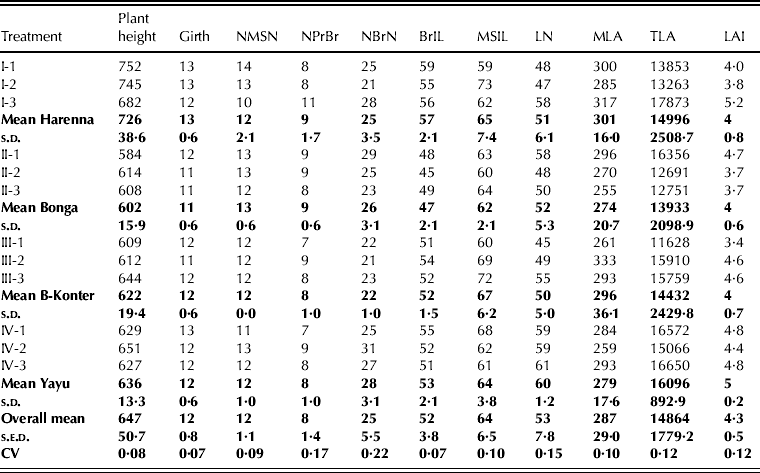
Morphological characteristics of 1-year-old coffee seedlings used for the hydraulic measurements. Seedlings were collected from four wild arabica coffee populations, Harenna (I), Bonga (II), Berhane-Konter (III) and Yayu (IV). Measurements were made of: the number of nodes on the main stem (NMSN), the number of primary branches (NPrBr), the number of branch nodes (NBrN), branch internode length (BrIL), main stem internode length (MSIL, mm), the number of leaves LN, mean leaf area (MLA, mm2), total leaf area (TLA, mm2) and leaf area index (LAI, mm2/mm2)

Measurements of hydraulic resistances
Four central seedlings (i.e. ignoring those on the edge of the block) were used to determine the root and shoot hydraulic resistances of each accession. The data were measured using a high-pressure flow meter (HPFM, Dynamax Inc, Houston, TX, USA). The red flow range (one of the eight manifold ranges/tubes on the HPFM. The red bleeding tubing is 1500 mm long with 0·12 mm internal diameter, ID) was determined to be the most suitable and used for the hydraulic measurements as described in Tyree et al. (Reference Tyree, Patino, Bennink and Alexander1995) and Tausend et al. (Reference Tausend, Goldstein and Meinzer2000). First, the HPFM was connected to the base of the debarked main stem cut at c. 50 mm above the soil surface. The initial pressure was set at zero and increased at 5 kPa/s; flow rates were recorded at 2 s intervals.
Root hydraulic resistance was measured by the transient method and hydraulic conductance was calculated from the slope of the change in the amount of water flow and applied pressure as described by other authors (Tyree et al. Reference Tyree, Graham, Cooper and Bazos1983, Reference Tyree, Patino, Bennink and Alexander1995; Sperry & Tyree Reference Sperry and Tyree1990). Next, the seedling was saturated by immersing and flushing with clean water and the main stem was cut again under water, debarked and attached to the HPFM to measure hydraulic resistances in the whole shoot and different shoot parts (leaf, petiole and primary branch). This was measured using the steady state flow meter method of the HPFM. The resistance of the shoot components was determined by the consecutive removal of each growth part. The hydraulic resistance was recorded whenever the steady state flow meter attained a constant flow rate. The initial result with all above-ground shoot parts was recorded as whole-shoot resistance and then, leaves, petioles and primary branches were sequentially removed. The main stem was cut to a height of 200 mm. Finally, the contribution to whole-plant and whole-shoot hydraulic resistance was calculated from the difference in resistance before and after removal of each growth segment. The whole-plant resistance included root and whole-shoot hydraulic resistance.
Data analysis
The analysis of variance (ANOVA) was computed using the SAS system for Windows 8 software (SAS Institute, Cary, NC) to compare the variations due to the main treatments (shade levels and coffee accessions) and interaction effects on the hydraulic resistances in arabica coffee seedlings. Treatment means were compared with t tests using P<0·05 as the critical value for significance.
RESULTS
Shoot growth
The results revealed that most extension growth in 1-year-old-coffee seedlings were comparable due to shade levels and coffee accessions. Nonetheless, shade treatment had significant variations on leaf number (P<0·01) and mean leaf area (P<0·05). Consequently, significantly higher leaf growth and average leaf area were determined under full sun and shaded plots, respectively. With regard to coffee germplasm accessions, the Harenna seedlings exhibited the highest average values for most growth parameters. Similarly, Berhane-Kontir seedlings had reduced main stem nodes and long internodes on the primary branch. The shortest seedlings with thin main stem diameter and short internodes on lateral branches were found in the Bonga and Yayu seedlings. In contrary, the Harenna and Berane-Kontir seedlings had relatively higher average leaf areas as opposed to the lowest values from the Bonga and Yayu accessions. Despite the narrow leaf size, Yayu accessions had maximum total leaf surface area and leaf area index (Table 1). There were no significant interactions between shade and coffee accessions for most of the seedling morphological growth parameters. However, most accessions exposed to direct sunlight had higher results for leaf variables, except average leaf area.
Hydraulic resistances
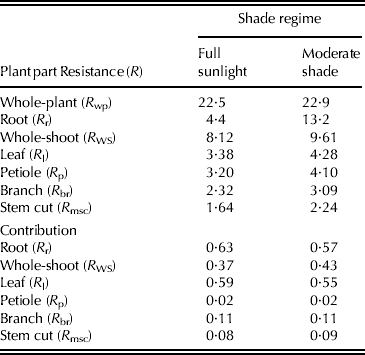
Shade regimes significantly (P<0·01) influenced the hydraulic resistances in the whole shoot and in its various parts, but not in the root and whole plant. However, maximum root values were recorded for sun seedlings as compared with those in shade environments. Whole-plant and shoot resistances were higher in seedlings managed in moderate shade than those in full sunlight conditions. The removal of leaves, petioles and primary branches led to reductions in shoot hydraulic resistances from 81 to 23 GPa m2 s/kg in seedlings kept in full sun and from 96 to 31 GPa m2 s/kg in moderately shaded coffee seedlings (Table 2).
Hydraulic resistance (R h, means×104MPa m2 s/kg) in root and shoot components of arabica coffee seedlings and their proportional contributions to whole-plant hydraulic resistance in full sunlight and moderate shade conditions
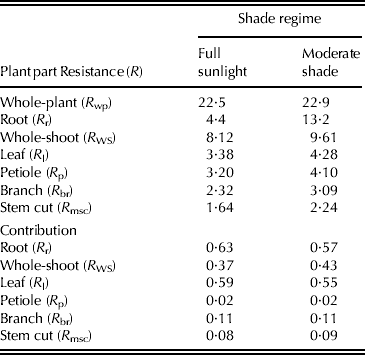
The lowest hydraulic resistances were recorded for the reduced main stem length (200 mm), and were significantly (P<0·01) different in the sun (16 GPa m2 s/kg) and in the shade (22 GPa m2 s/kg). Likewise, significant minimum and maximum main stem-specific hydraulic resistances were determined for sun and shaded seedlings, respectively (P<0·01). In contrast, root hydraulic resistance did not show significant differences between the shade levels, though the respective maximum and minimum values were measured for full sun and shaded seedlings. The leaf-specific hydraulic resistance was significantly (P<0·01) higher in shaded than in seedlings in full sunlight (Table 2).
The contribution of root and shoot hydraulic resistances also differed significantly (P<0·01) between the light regimes and an inverse trend in root and whole-plant was observed. The proportion of the total plant resistance attributable to the root was significantly (P<0·01) higher in full sun than in shaded seedlings. Similarly, significantly maximum leaf resistance of the shoot was measured in full sun as compared with shaded leaves. However, petioles and branches did not differ due to shade levels. In contrast, higher shoot and main stem cut resistances were obtained from seedlings maintained in moderate shade v. from those in full sun (Table 2).
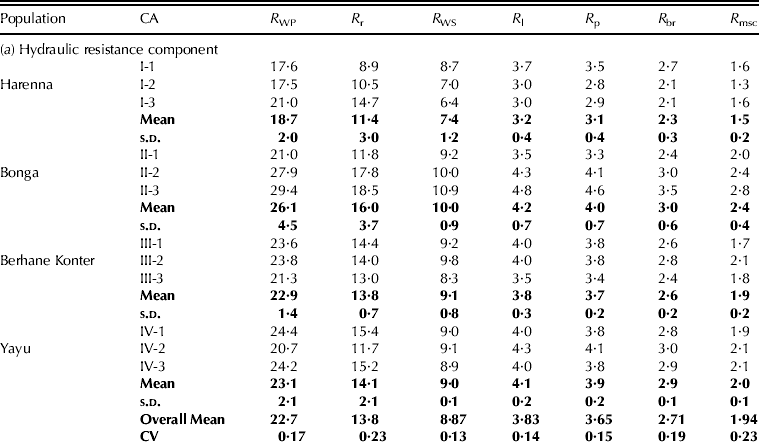
There was no difference among coffee accessions in patterns of whole-plant hydraulic resistance. However, low and high values were found for the Harenna and Bonga accessions, followed by Yayu and Berhane-Kontir. Variation in root and shoot hydraulic resistance was also not significant between seedlings of different accessions (Table 3a).
Hydraulic resistance (R h, means×104 MPa m2 s/kg) in root and shoot segments (a) and their percent contributions to whole-plant and whole-shoot resistances (b) in seedlings of Arabica coffee accessions (CA). Seedlings were collected from four wild arabica coffee populations, Harenna (I), Bonga (II), Berhane-Kontir (III) and Yayu (IV). The symbols of resistances include: whole-plant (R WP), root (R r), whole-shoot (R WS), leaf (R l), petiole (R p), branch (R br) and main stem cut (R msc)
The removal of various shoot components was seen to reduce resistance, though the magnitude did not differ significantly between accessions. The maximum main stem cut hydraulic resistances of seedlings were in the order Bonga>Berhane-Kontir>Yayu wild coffee populations (Table 3a). In contrast, resistances were relatively low for the Harenna accessions with mean values ranging from 13 GPa m2 s/kg (I-2) to 16 GPa m2 s/kg (I-3), whereas the Bonga and Berhane-Kontir accessions had relatively higher resistances in the whole-shoot, but exhibited low resistances in the other shoot parts.
Coffee seedlings were not significantly different regarding the proportional contributions of hydraulic resistances in roots, whole shoot and shoot segments. However, a maximum root contribution was associated with a minimum shoot resistance in all seedlings, though the differences varied among accessions. The highest root, lowest shoot and leaf proportional resistance contributions were determined from accession I-3 of the Harenna population (Table 3b). This is in contrast to the highest leaf resistance contribution and lowest petiole resistance obtained from the Bonga accession (II-1). The contribution of the main stem-cut to whole-shoot resistance was significantly (P<0·05) different between coffee accessions. The lowest and highest main stem-cut resistance contributions were seen in Bonga and Harenna accessions, respectively. There were no significant differences among the other coffee accessions. In general, the hydraulic resistance in roots, shoot, leaf, petiole and lateral branch followed similar patterns in most accessions with average contribution proportions of 0·60, 0·57, 0·40, 0·11 and 0·02, respectively (Table 3b).
DISCUSSION
The results of resistance contributions revealed different patterns between shade levels and various plant growth components. Coffee seedlings subjected to full sun exhibited lower whole-shoot resistances as compared with those in the shade conditions. This was in line with the variations in the microclimate variations recorded between the shade levels. This could also be associated with the maximum main stem diameter, thick leaves and high dry mass in the seedlings exposed to full sun (Taye Reference Taye2006). In contrast, shaded seedlings might be constrained primarily by low light availability in the morning and limited water supply to the leaf at midday, which demonstrates the importance of moderate shade environments for Arabica coffee that has evolved in the natural forest ecosystems of Ethiopia. Moreover, the average whole-plant hydraulic resistance was higher for the shaded seedlings versus that in full sunlight, due mainly to the reduced resistance in the roots, which are less sensitive than shoots to drought stress. The growth of leaves is more sensitive than root growth (Hopkins Reference Hopkins1995). This could be related to the variations in photosynthetic photon flux density, leaf-to-air vapour pressure difference and thus bulk leaf water potential. The present results support the most widely accepted theory for movement of water through plants, i.e. cohesion–tension theory, which states that the driving force is provided by evaporation from the leaf and the resulting tension or negative pressure. According to Sack et al. (Reference Sack, Tyree and Holbrook2005), sun-establishing species had a higher proportion of leaf resistance in the xylem.
As expected from the hypothesis, accessions from Harenna populations exhibited minimum shoot resistance compared with the others, suggesting that maximum water transport is proportional to allocation to maximum photosynthetic capacity of these accessions. The compact coffees from Yayu and Bonga with short stature, narrow basal area and reduced leaf surfaces may have the morphological plasticity to tolerate drought and thrive better under limited soil moisture conditions. In contrast, the differences in growth habit of the Harenna and Berhane-Kontir accessions with the highest values for most growth parameters (Taye Reference Taye2006) could have resulted in decreased hydraulic resistance and thus required the availability of sufficient soil moisture. This is consistent with growth characters of coffee seedlings presented in Table 1 and hydraulic conductance of wild arabica coffee populations (Taye & Burkhardt Reference Taye and Burkhardt2006). This reflects the importance of crown architecture in determining the hydraulic characteristics of coffee plant. The variations in hydraulic resistance patterns in the coffee accessions may shade a light on their adaptive mechanisms and mitigation strategies for withstanding drought-stress. This corroborates with the work done by Tausend et al. (Reference Tausend, Goldstein and Meinzer2000) on the water balance of C. arabica.
The low whole-plant resistance for the Harenna accessions may be attributable to high rates of transpiration in the presence of sufficient water and increased water-use efficiency. The present findings suggest that hydraulic resistance was higher in the root than in the shoots of all coffee accessions both in the sun and shade plots. Unlike in the root system, hydraulic resistance in the whole shoot and its various components tended to decline in the shaded seedlings. The differences in hydraulic resistance and contribution in the root and shoot segments due to shade regime could be explained in terms of the rate of water uptake and water use, which was much higher in the full sunlight conditions. In well-watered conditions, the resistance contributions across root and shoot components were in the order root>leaf>whole shoot>primary branch>petioles of coffee seedlings, indicating the increased susceptibility to loss of hydraulic conductivity and xylem vulnerability limited availability of soil moisture. This is in agreement with Tsuda & Tyree (Reference Tsuda and Tyree1997) and Tausend et al. (Reference Tausend, Goldstein and Meinzer2000): as the water potential is higher in the root than in the shoot during steady state evaporation, this pattern of hydraulic resistance and vulnerability segmentation guarantees high-water flow and/or water-use efficiency when soil water is sufficient. However, this does not provide an adaptive advantage in dry environments, as roots may become dried due to cavitation before leaf death. Roots usually have wider conduits and higher hydraulic conductivity than shoots, and are more vulnerable to xylem embolism (Ewers et al. Reference Ewers, Carlton, Fisher, Kolb and Tyree1997). To this end, Clark et al. (Reference Clark, Gowing, Lark, Leeds-Harrison, Miller, Wells, Whalley and Whitmore2005) reviewed the progress and opportunities of sensing the physical and nutritional status of the root environment in the field.
The present findings on the hydraulic architecture of coffee seedlings support these and support the existence of a trade-off between xylem conductivity and resistance to cavitation (Zimmermann Reference Zimmermann1983). Similarly, Tsuda & Tyree (Reference Tsuda and Tyree1997) also described a trade-off between vulnerability patterns and whole-plant resistance, as plants with low whole-plant resistance tend to be more vulnerable to cavitation and exhibit vulnerability segmentation when compared with plants with high whole-plant resistant. In this case, the distal portion is more vulnerable than the basal portion, which provides the ability to conserve soil water by shedding leaves and allows the roots and survive in dry soil conditions.
In plants with low-hydraulic resistance, there may be no development of a steep pressure gradient across the whole plant, and thus vulnerability to segmentation will confine cavitation to the distal region. However, in plants with high resistance, high evaporation may induce a great pressure drop, thus cavitation might develop at the distal portion without vulnerability segmentation. In contrast, at the same rate of evaporation, leaf water potential is lower in plants with higher resistance and cavitation is less likely to occur over normal ranges of the environment. Katul et al. (Reference Katul, Leuning and Oren2003) elaborates this as assimilation and leaf-specific conductivity is mediated by stomata to meet the demand for photosynthetic CO2 assimilation, while controlling water loss from leaves in a manner that minimizes cavitation in the plant hydraulic system. The difference between root and shoot parts can be accounted for by the resistance of the xylem and by the physical location of the two organs in the soil–plant–atmosphere continuum. Whitehead (Reference Whitehead1998) presents evidence that short-term changes in stomatal conductance are linked closely to the hydraulic properties of the conducting system to minimize loss of hydraulic conductivity through xylem by cavitation. He described homoeostatic mechanisms that operate to ensure the long-term balance between evaporative demand and the potential hydraulic conductivity of trees growing in different coffee growing ecologies.
Moisture contents (in leaf, stem and root) and hydraulic resistances in root and shoot parts showed indirect relationships (Taye Reference Taye2006), reflecting the constrained balance between water transport in root-to-leaf conductance and carbon gain. In line with the variation in stem diameter, highly significant minimum and maximum main stem specific hydraulic resistances were determined for sun and shaded seedlings, respectively. Again, hydraulic resistance components were inversely associated with fresh main stem density, especially in the Berhane-Kontir accessions, confirming the high-hydraulic resistances with increased stem water storage and decreased stem size. The accumulation of more biomass with age and development of more xylem elements can contribute to low stem hydraulic resistance. The results reveal that stem size and leaf growth are the most morphological traits in determining hydraulic movements in coffee seedlings.
In this regard, Santiago et al. (Reference Santiago, Goldstein, Meinzer, Fisher, Machado, Woodruff and Jones2004) found a proportional decrease in leaf-specific conductivity and leaf area with increasing wood density, and suggested that the biophysical structure of wood might contain a physical function to specific operating ranges and reflect life-history trade-offs at whole-organism level. Meinzer et al. (Reference Meinzer, Grantz, Goldstein and Saliendra1990) pointed out that coffee genotypes with greater soil-to-leaf hydraulic conductance can deplete soil moisture more rapidly and experience symptoms of physiological stress earlier when water is withheld. These can be explained in terms of the three basic aspects of drought stress dynamics, including the atmospheric demands on the plant, plant regulation or how the plant reacts to drought stress, and soil texture and plant nutrients, which should be studied in Ethiopia.
The atmospheric demand includes radiation, air temperature, humidity and wind. The plant regulates drought stress by opening and closing the stomata, leaf flagging, rolling and shedding (Hale & Orcutt Reference Hale and Orcutt1987). Likewise, Shao et al. (Reference Shao, Zhang, Hideki, Tsuji and Chen2010) also pointed out the effects of defoliation on grain yield and water use of winter wheat. In addition, main stem diameter was strongly negatively correlated with hydraulic resistances in main stem-cut, whole shoot, leaf and root parts in that descending order, demonstrating trade-offs between hydraulic capacity and photosynthetic rate (Burkhardt et al. Reference Burkhardt, Kufa, Beining, Goldbach and Fetene2006). This coincides with the significantly maximum hydraulic conductance in Harenna as compared with other wild arabica coffee populations (Taye & Burkhardt Reference Taye and Burkhardt2006). In contrast, coffee accessions from the more humid southwest exhibited high-hydraulic resistance. In general, accessions from the wettest areas seem to be more tolerant to sub-optimal environments than those from the drier Harenna area in the southeast Ethiopia. According to Taye (Reference Taye2006), the latter show the highest mortality rate due to sever moisture deficits over a 2-week period. In contrast, the Bonga and Berhane-Kontir accessions showed strong resistance, possibly indicating their conservative drought tolerance strategy. However, more information is needed to clarify the trade-off between hydraulic resistance and xylem vulnerability to cavitation in arabica coffee genetic resources at drought-prone areas and dry seasons.
In conclusion, the present findings provide the first information on hydraulic resistances in Arabica coffee germplasm accessions. The results also showed the contributions of moderate shading in mitigating the effects of direct sunlight stress and the different coffee accessions and seedling growth parts reacted differently. The study also indicated the effects of genetic and environmental factors, though hydraulic and growth parameters remain unexplained, suggesting other traits beyond the scope of the present paper. These include, among others, soil conditions and seasonal variations in hydraulic properties with other relevant functional traits of breeding works, particularly against the effects of climate changes. This would contribute to promote in situ and on-farm conservation and use of arabica coffee genetic resources for future development and benefits of the coffee sector in the country and worldwide.
The study was financed by the BioTeam program of the German Federal Ministry for Education and Research (BMBF) and the Ethiopian Institute of Agricultural Research (EIAR) under the auspices of the project: Conservation and utilization of Coffea arabica populations in the montane rainforests of Ethiopia-CoCE (Project Number 01LM0201). We are also indebted to Alemseged Yilma of the Jimma Agricultural Research Center for his versatile technical assistance.