Nursing homes house a high prevalence of residents with either methicillin-resistant Staphylococcus aureus (MRSA) or methicillin-susceptible S. aureus (MSSA) colonization, creating a high-risk environment for resident-to-resident transmission of S. aureus. Reference Bradley1 The mix of short-stay and long-stay residents in community-based nursing homes blends a population recovering from acute illness with a chronically ill population frequently colonized with S. aureus. Reference Weissert2 In past work, we found that short-stay residents are at 4-fold higher risk for MRSA acquisition than long-stay residents. Reference Furuno, Shurland and Zhan3 Once S. aureus acquisition occurs, residents are at higher risk for infection as colonization typically precedes infection. Up to 30% of MRSA colonized patients develop an infection. Reference Huang and Platt4,Reference Datta and Huang5 Nursing-home stay was identified as a common risk factor for invasive MRSA infection after recent hospital discharge. Reference Epstein, Mu and Belflower6
Nursing-home staff are the most frequent vectors for transmission because their clothing and hands become contaminated with S. aureus during the care of S. aureus–colonized residents. Reference Roghmann, Johnson and Sorkin7 In hospitals, the standard of care for patients with MRSA colonization is use of contact precautions (eg, gowns and gloves for all patient contact). In contrast, community-based nursing homes typically use standard precautions (eg, gowns and gloves for anticipated contact with blood, body fluids, skin breakdown, or mucous membranes) for residents with MRSA colonization and reserve contact precautions for residents on treatment for MRSA infection. Prior research demonstrating high rates of MRSA acquisition in nursing homes suggests that standard precautions do not adequately reduce the transmission of S. aureus. Reference Furuno, Shurland and Zhan3,Reference Mody, Krein and Saint8
Contact precautions have not been widely adopted by nursing homes for several reasons. Reference Dumyati, Stone, Nace, Crnich and Jump9 Nursing homes are often resource-limited settings with frequent staff and leadership turnover and they often lack the well-trained staff and infrastructure of hospitals. In addition, nursing-home staff have deeply rooted beliefs that contact precautions stigmatize residents. Reference Furuno, Krein, Lansing and Mody10 There is a clear need for a solution, tailored to the nursing-home setting, to reduce the risk of S. aureus (and other antibiotic resistant bacteria) acquisition and infection. Given the complexity of the nursing-home environment, the associated work system, and the barriers to effective implementation of novel infection prevention interventions, an approach guided by human factors engineering (HFE) principles may be helpful. Reference Gurses, Rosen and Pronovost11–Reference McGlynn, Asch and Adams13 The goal of HFE is to actively involve workers in designing systems that work in real-world settings while optimizing the strengths of those that use them.
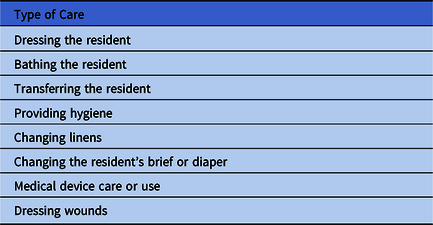
The objective of this project was to test the feasibility of a novel intervention, the addition of targeted gown and glove use, to prevent S. aureus acquisition in short-stay residents of community-based nursing homes. Gown and glove use was targeted to specific high-risk care activities (Table 1) for high-risk residents defined as those with chronic wounds (ie, wounds that require dressing) and medical devices such as urinary catheters, vascular catheters, or feeding tubes.
Care Activities with a High Risk of S. aureus Transmission in Nursing Homes

Methods
Study design and setting
We performed an uncontrolled clinical trial of targeted gown and glove use for high-risk residents on 2 mixed (short- and long-stay) units at 2 community-based nursing homes in Maryland between December 2017 and July 2018. All adult residents living in the nursing homes during that period who were not identified by nursing-home staff as combative were eligible. The first nursing-home unit had 60 beds; the second had 45 beds. These 2 nursing homes are part of an independently functioning healthcare system specializing in postacute care, skilled nursing, and rehabilitation. The policy at both nursing homes was to put residents with known MRSA colonization on standard precautions, not contact precautions. Nurses and support staff in both nursing homes are similarly trained in infection prevention procedures; however, each nursing home in the system functions independently in terms of daily practice, roles, and administrative structure. Each nursing home has an educator responsible for monitoring and training staff on infection prevention practices. The study was approved by the University of Maryland, Baltimore Institutional Review Board with a waiver of informed consent. No sample-size calculations were performed because the goal of this project was to demonstrate the feasibility of the intervention.
During a 2-month baseline period, we measured S. aureus acquisition using anterior nares and inguinal fold surveillance cultures obtained by research staff using a nylon-flocked swab (Copan ESwabs) from all residents. We assessed healthcare personnel (HCP) gown and glove use, and we designed the intervention using an HFE approach. During a 1-month preparatory period, we developed the intervention. During a 2-month intervention period, residents identified with (1) wound(s) which required a dressing or (2) medical devices (eg, urinary catheters, vascular catheters or feeding tubes) had targeted gown and glove use incorporated into high-risk care activities. During this period, we measured S. aureus acquisition again and assessed HCP gown and glove use. We did not collect demographic information about study participants.
Design of the intervention
We iteratively designed the intervention using a participatory ergonomics HFE approach defined as involving people in “planning and controlling a significant amount of their own work activities, with sufficient knowledge and power to influence both processes and outcomes in order to achieve desirable goals.” Reference Gyi, Shalloe, Wilson, Wilson and Sharples14 Nursing-home stakeholders, including nursing-home administrative and clinical staff, codesigned the new work system of the intervention along with the research team.
We used a multimethod participatory ergonomics approach (ie, contextual inquiry, semistructured interviews) for data collection during the baseline and intervention periods. Our analysis revealed that implementation required the following major changes in the work system: (1) a mechanism to identify and flag residents with wounds and medical devices and (2) making acceptable gowns and gloves available at the point of care in a reliable manner. We used the following procedures in the co-design and implementation of the intervention (Supplementary Table S1 online):
-
1. Initial evaluation of nursing-home work systems. We met with nursing-home infection preventionists at the beginning of the study to tour each facility. We identified key work-system characteristics (eg, physical layout, tools and technologies, roles, and morning care routines), and we obtained a detailed understanding of the site-specific gown, glove, and signage protocols.
-
2. Participatory design and feedback sessions. We conducted several informal participatory design and feedback sessions with HCP at each facility during the baseline period. The following goals were set for these sessions: (1) introducing the project and its rationale to the HCP to get buy-in; (2) asking for input on any barriers to and strategies for successful implementation; and (3) codesigning the intervention components (ie, selection of gown type, door signs, suggestions on where to store supplies, physical location of caddies) with them. HCP tried on sample gowns and tested other components of the intervention in a simulated environment. Design decisions were finalized by asking HCP to rank their preferences and to provide reasons for their selection, followed by a facilitated discussion and consensus reaching. Detailed notes were taken at each session and were analyzed to inform site-specific intervention protocols.
-
3. Contextual inquiry session. We observed HCP while they performed routine work in their work environment, and afterward we probed to clarify what was observed or to obtain further details. Reference Xie, Rock and Hsu15 At the beginning of each shift, rooms with high-risk residents were identified by the charge nurse or infection prevention educator, and HCP who cared for residents in those rooms were observed during their morning rounds. An observation form was used to capture quantitative (eg, number of gloves and gowns used, and number of times hand hygiene was performed) and qualitative data (eg, activity description, barriers and strategies for successful implementation of the intervention) from observations during the baseline and intervention periods (Supplementary Table S2 online). Detailed notes were taken by each observer, combined into 1 document, and uploaded to a secure server for analysis.
-
4. Qualitative longitudinal face-to-face interviews with care professionals. 16 Digitally recorded, semistructured interviews 20–30 minutes in length (for interview guide, see Supplementary Table S3 online) were conducted with 3 HCP at each site during the baseline, intervention, and postintervention periods to explore perspectives over the course of the project. All interviews were transcribed by a professional transcription service and were analyzed using qualitative content analysis using a consensus approach.
-
5. Training. The training of HCP in both nursing homes on the various components of the intervention (ie, the identification of high-risk residents and usage of gowns, gloves, caddies and signage) was coordinated by the facility’s educator and the research team infection preventionist in a series of on-site presentations. Teamwork behaviors of communication and mutual support were highlighted. An instructional flier was distributed and posted in high visibility staff areas for reference.
Outcome
Our prespecified primary outcome was a change in S. aureus acquisition rates in short-stay residents comparing baseline to intervention periods. Residents were swabbed in the anterior nares and inguinal fold at the start of the study period or when they were admitted. All residents were reswabbed at discharge or when the study period ended. Acquisition was defined as a new positive culture for MRSA or MSSA in a short-stay resident who was negative for that S. aureus at the start of the study period or on admission. Cultures were performed in a central research microbiology lab using standard laboratory procedures. Reference Furuno, Shurland and Zhan3,Reference Roghmann, Johnson and Sorkin7,Reference Pineles, Morgan and Lydecker17
Whole-genome sequencing (WGS) of S. aureus isolates from short- and long-stay residents was performed to determine whether the S. aureus acquisition represented resident-to-resident S. aureus transmission. S. aureus isolates were grown in broth overnight, and DNA was isolated using Qiagen columns (Qiagen, Valencia, CA). Libraries for Illumina sequencing were prepared using the KAPA High-Throughput Library Preparation Kit (Millipore-Sigma, St Louis, MO), enriched and barcoded by PCR amplification using primers containing an index sequence. The libraries were sequenced using a paired-end run on an Illumina HiSeq2500 (Illumina, San Diego, CA). The reads were separated based on the barcodes indicative of the library. The quality of the sequences was assured by trimming with the software trimmomatic, Reference Bolger, Lohse and Usadel18 running fastqc, Reference Brown, Pirrung and McCue19 and removing anything that mapped to the human or phix genomes. The reads were assembled using metacompass (https://www.cbcb.umd.edu/software/metacompass) with S. aureus NCTC 8325 (NC_007795.1) as the reference sequence. Contigs <1,000 bp and any that did not match the reference were removed. The annotated sequences were submitted to GenBank (accession no. SAMN13331741-SAMN13332053). The BioProjectID is PRJNA590514. Genetic and resident source information for each S. aureus isolate is found in Supplementary Table S4 (online).
The assembled genomes were compared to S. aureus NCTC 8325 (NC_007795.1) to identify single-nucleotide variants (SNVs). From the Harvest suite (v1.2), Parsnp was used to perform core-genome alignment of all input genomes to the reference and Gingr was used to visualize and export the SNV alignment file. Reference Treangen, Ondov, Koren and Phillippy20 Parsnp was run with the -c option to retain all samples for analysis. When maximizing the number of samples in the analysis, the total coverage of the reference genome among all sequences was 77.8% and the core alignment represented 53% of the reference genome, suggesting sufficient overlap for core genome analyses. Related isolates were defined as those differing by <30 nucleotides based on Supplementary Fig. S2 (online). Most related isolates were isolated from swabs from the same individual; related isolates from different individuals were considered to result from transmission events. The acquiring individual was determined by the date of swab collection. Reference Stine, Burrowes, David, Johnson and Roghmann21
Results
Intervention implementation
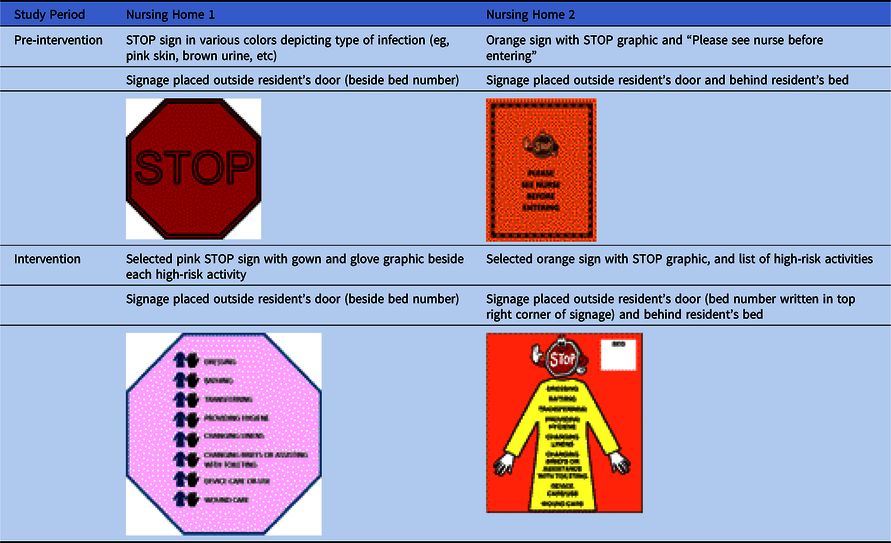
Baseline assessment at both sites revealed many similarities between the work system design and care practices at the sites. HCP at both facilities selected the same gown and over-the-door gown-and-glove caddies but different signage for use during the intervention. Table 2 summarizes the signage at each nursing home before and during the intervention. Participatory design and feedback sessions showed that the main determinant for choosing a particular intervention component design was the HCP’s familiarity with a particular design based on experience. Additional factors such as perceived protection, comfort, and ease of use of the gown; size, layout and ease of disinfection of the caddy; and the color of the signage also played a role in selection of specific intervention components by HCP.
Intervention Signage Development

Intervention adherence and effectiveness
Implementation of the intervention was successful as judged by (1) our ability to recruit 2 nursing homes to participate in the project, (2) an increase in gown use during high-risk care activities from 0% before the intervention to 78% after the intervention for high-risk residents, and (3) 97% of high-risk residents were correctly identified for targeted gown and glove use. Intervention compliance and effectiveness were similar in both nursing homes.
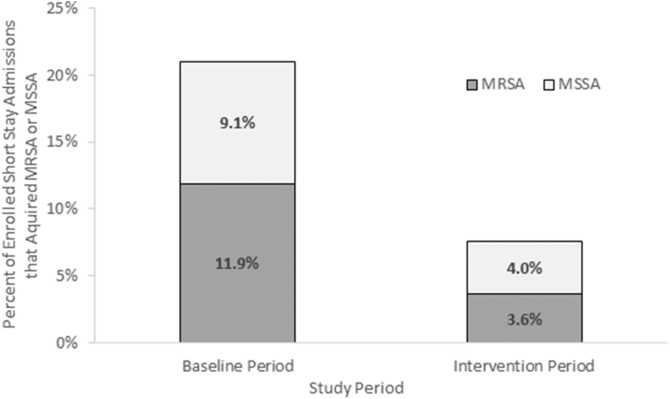
The S. aureus acquisition rate among short-stay residents decreased from 17 of 101 residents (16.8%) during the baseline period to 8 of 120 residents (6.7%) during the intervention period (OR, 0.35; 95% CI, 0.15–0.86; P = .02). The MRSA acquisition rate in short-stay residents decreased from 10 of 84 residents (11.9%) during the baseline period to 4 of 111 residents (3.6%) during the intervention period (OR, 0.28; 95% CI, 0.08–0.92; P = .026). The MSSA acquisition rate in short-stay residents decreased from 9.1% (8 of 88) during the baseline period to 4.0% (4 of 101) during the intervention period (OR, 0.41;, 95% CI, 0.12–1.42; P = .15) (Fig. 1). One resident acquired both MRSA and MSSA during the baseline period. Overall, 57 short-stay residents did not have cultures performed. Cultures were not done (1) because the resident declined (n = 19), (2) because the resident was identified by HCP as agitated (n = 3), or (3) because the resident was discharged or moved to a non–study unit prior to being approached about the study (n = 35). The latter typically had a short length of stay on the study unit.
Percentage of enrolled short-stay admissions that acquired methicillin-resistant Staphylococcus aureus (MRSA) or methicillin-susceptible S. aureus (MSSA) in the nose or inguinal fold by study period: S. aureus, 16.8% (17 of 101) vs 6.7% (8 of 120) (P = .02); MRSA, 11.9% (10 of 84) vs 3.6% (4 of 111) (P = .026); and MSSA, 9.1% (8 of 88) vs 4.0% (4 of 101) (P = .15).

DNA sequences were obtained and compared from 319 isolates. The isolates were collected before and after the intervention from all 3 floors. A tree of genetic relatedness based on SNVs from the core genome showed that some isolates were closely related and others were not (Supplementary Fig. S1 online).
We evaluated whether the S. aureus isolate from each acquisition in short-stay residents could be matched within 30 SNVs to another epidemiologically linked (same floor, same study period) S. aureus isolate (Supplementary Fig. S2 online). Based on this analysis, we observed a decrease in S. aureus transmission rate from 5.9% (6 of 101) during the baseline period to 0.8% (1 of 120) during the intervention period (OR, 0.13; 95% CI, 0.02–1.12; P = .06), an 86% reduction in S. aureus transmission. Of the 7 resident-to-resident transmissions identified, 2 were from a roommate.
Barriers and facilitators and strategies to intervention development
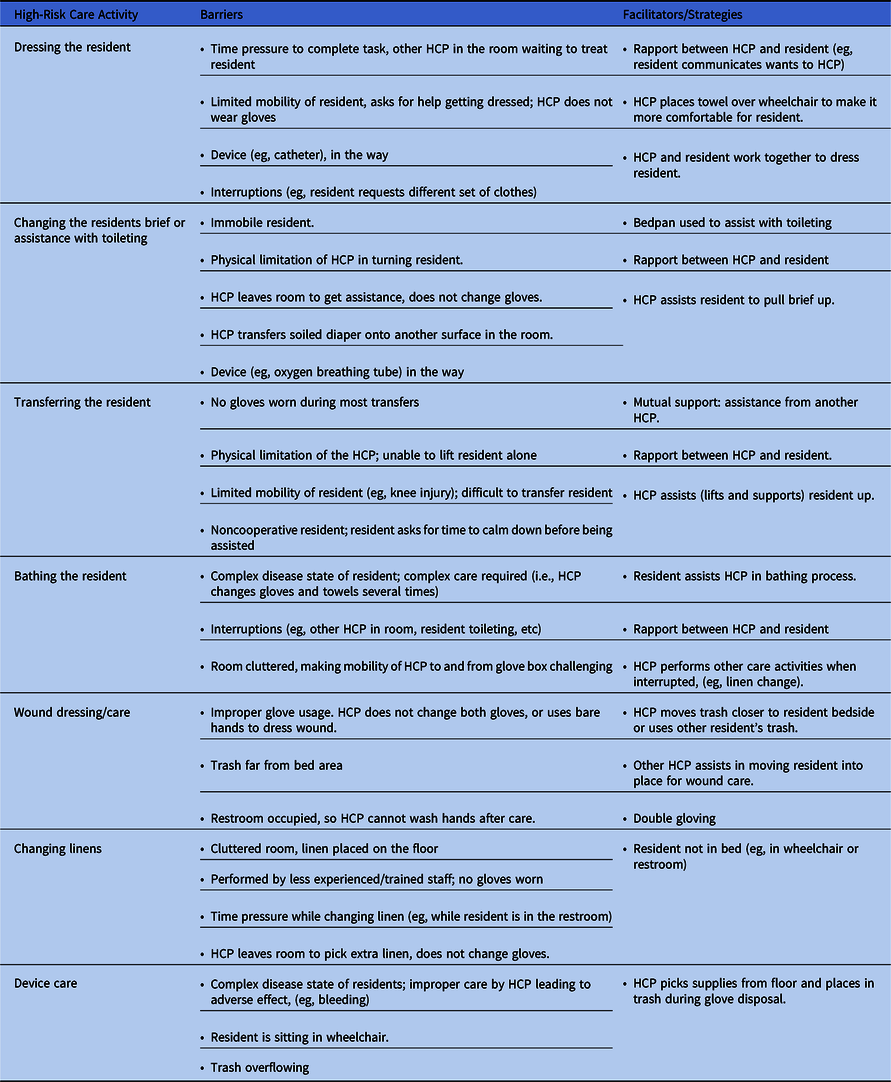
The HCP in nursing homes often encounter barriers (eg, such as time pressure to complete a high-risk activity), and they develop “workarounds” to complete their duties (eg, by employing the assistance of another HCP). The following work system factors were identified using our multimethod participatory ergonomics approach: characteristics of the HCP, specific tasks of the HCP and other caretakers, teamwork among HCP, tools and supplies, physical environment, and organizational factors. Table 3 summarizes the barriers and facilitators to the individual high-risk care activities that informed training design and may have contributed to the overall adherence and effectiveness of the intervention.
Barriers to and Facilitators for High-Risk Care Activities in Long-Term Care Settings

Note. HCP, healthcare personnel.
Discussion
During this project, we demonstrated the feasibility of incorporating targeted gown and glove use into resident care activities in 2 community-based nursing homes with excellent adherence to gown use. Furthermore, the rates of S. aureus acquisition decreased, particularly for MRSA. Whole-genome sequencing of the S. aureus isolates suggested that the decrease was, at least in part, due to a decrease in resident-to-resident transmission of S. aureus.
Our novel intervention was based on extensive prior research on the risk of S. aureus transmission from residents to HCP gown and gloves during care interactions, the first step in transmission. We have studied MRSA transmission to gowns and gloves worn by direct-care staff interacting with >600 residents in community-based nursing homes and Veterans’ Affairs nursing homes. Reference Roghmann, Johnson and Sorkin7,Reference Pineles, Morgan and Lydecker17 We identified specific care activities with a high risk for MRSA transmission (Table 1). In addition, HCP caring for residents with chronic wounds had significantly higher rates of gown and glove contamination. When MSSA and resistant gram-negative bacteria Reference Blanco, Johnson and Sorkin22 transmission were examined, the results were comparable. Importantly, the results from the 2 different study populations were very similar, which demonstrates the reproducibility of these results.
Our results suggest that a novel, evidence-based approach to preventing S. aureus transmission and S. aureus acquisition, targeted gown and glove use, could be used to prevent the spread of S. aureus and, likely, other pathogens in nursing homes. Rather than wearing gown and gloves for all care activities for residents with known colonization with a multidrug-resistant organism (MDRO), gown and glove use are targeted toward (1) specific high-risk types of care while caring for (2) high-risk residents. The high-risk types of care activities targeted for gown and glove use are those most likely to transmit S. aureus to HCP clothing and hands. The high-risk residents targeted are (1) most likely to be colonized with S. aureus, (2) most likely to acquire S. aureus, Reference Mody, Krein and Saint8 (3) most likely to transmit S. aureus to HCP clothing and hands, and (4) most likely to develop an S. aureus infection. This allows us to get away from culture positivity as the driver of infection control practices.
We believe that using a participatory ergonomics approach (ie, codesigning the intervention with HCP and tailoring intervention component details based on the context and needs of each setting) contributed to high adherence with glove and gown use. An increasing number of studies have applied participatory ergonomics in healthcare Reference Bohr, Evanoff and Wolf23–Reference Jun, Canham and Altuna-Palacios29 and have proven the importance of this approach for intervention design, implementation, and acceptance. Although most of these studies were focused on clinicians (eg, physicians and nurses) and patients and families, few participatory ergonomics studies have looked at infection prevention interventions in nursing homes. Reference Katz, Osei, Vignesh, Montalvo, Oresanwo and Gurses30 This study is among the first to use a multimethod HFE approach to care delivered in a nursing-home setting with the involvement of staff members in the design and implementation of an infection prevention intervention. Reference Udo, Kobayashi, Udo and Branlund31
There are important limitations and strengths to our study. This study was intended to demonstrate feasibility and not efficacy. Although it was a clinical trial, there was no contemporaneous control group. This study was a simple before-and-after intervention in 2 typical-sized nursing homes in Maryland. Thus, it is limited in sample size and geographic diversity. The strengths of the study are in its novel intervention. Our targeted intervention limited both cost and stigma while blocking the transmission and acquisition of multiple organisms. In a cost analysis, we showed that a targeted intervention is significantly less expensive and thus more sustainable for community-based nursing homes. Reference Dumyati, Stone, Nace, Crnich and Jump9 We also conducted focus groups and semistructured interviews that demonstrated that the use of gowns and gloves could be well accepted in nursing homes. Reference Albrecht, Croft, Morgan and Roghmann32 Staff understand that they provide self-protection, and residents accept the use of gowns and gloves when educated about their purpose. Reference Furuno, Krein, Lansing and Mody10
This intervention is an example of “precision public health.” We are targeting the right prevention in the right amount to the right resident at the right time. Furthermore, this general strategy, if successful, could also be applied to other healthcare settings, changing how we use barriers, such as gowns and gloves, as part of transmission-based precautions to prevent the spread of antibiotic-resistant bacteria.
Supplementary Material
To view supplementary material for this article, please visit https://doi.org/10.1017/ice.2020.1219
Acknowledgments
We thank the residents, staff, and leadership of the participating nursing homes, as well as Georgia Papaminas, and the members of the laboratory for their contributions to the project. The views expressed in this manuscript are those of the authors and not necessarily those of the University of Maryland or Johns Hopkins University. The views expressed are those of the authors and do not necessarily reflect the official policy or position of the US Centers for Disease Control and Prevention or the US Department of Health and Human Services.
Financial Support
This work was supported by funding from the CDC Office of Acquisition Services (contract award no. 200-2017-95512). Dr Mody is funded by P30 AG024824, K24 AG050685, and RO1 HS025451.
Conflicts of Interest
Joan Hebden is a consultant for PDI and is on the speaker’s bureau for Cepheid. All other authors report no conflict of interest related to the contents of this manuscript.