“Media capture” is commonly used to characterize situations where insiders (government, politicians, corporate interests) extract personal benefits from controlling newspapers. As the recent example of the Leveson report (Reference Leveson2012) on the activities of press Mogul Rupert Murdoch reminds us, newspapers offer attractive possibilities to those who control them: promotion of certain views and politics, help with lobbying, support for partner industries in a conglomerate, campaigns for or against certain regulations, etc. These benefits have value. These values, however, are not often made public and researchers, as far as we can tell, have not sought to compute the returns from media capture—nor the effects of capture on the value of newspapers.
This article attempts to measure returns to media control and discuss the valuation of capture. Our contribution is thus both analytic and empirical. On the analytic side, we adapt theories of shareholder value and the pricing of control rights in order to underscore an issue that is not emphasized in modern studies of media economics: readers (customers) and minority shareholders are in the same payoff group in that both are adversely impacted by insiders' exploitation. We can thus use simple indicators of corporate governance developed in financial economics such as the voting premium or the control premium to provide empirical insight on the phenomenon of media capture and newspaper looting which is studied in media economics.
We measure these premia in interwar France because its newspapers were notorious for being looted by their owners, but our approach could be deployed in other context. The abuse of the press was denounced, first by a number of members of the French résistance or exiles, such as Henri de Kérillis (Reference Lazareff1942), Pierre Lazareff (Reference Lazareff1942), and most famously by economic historian Marc Bloch (Reference Bloch1946). Bloch placed part of the blame for the country's defeat in the hands of Hitler's Third Reich on France's debasement of its media.Footnote 1 Subsequent historians have corroborated this account by emphasizing the role of corruption of the press (Albert Reference Albert, Bellanger, Godechot, Guiral and Terrou1972, pp. 487–90; Chalaby Reference Chalaby1996). A cartel agreement between incumbent newspapers (owned and controlled by incumbent politicians) limited entry during the interwar and thus the supply of substitutes, facilitating capture. Jean-Noël Jeanneney, a leading student of the politics of French newspapers and elites during the interwar years has deplored the corrupting power of money, the source of much evil (Jeanneney Reference Jeanneney1984). For lack of data, previous accounts have never been able to document the historical evolution of corruption. We by contrast provide a tool that illustrates its time-series behavior. The result is fully consistent with the conjecture by Bloch.
From a theoretical and empirical point of view, this unsavory context is a blessing: It facilitated looting and enables us to study the mechanics of newspaper's exploitation by insiders.Footnote 1 We argue that valuable data have been hiding in plain sight—in the stock price series of publicly traded newspaper shares (and evidence on takeovers). Indeed, several important French newspapers had issued both voting and nonvoting shares on the stock market. By comparing the price of those two types of shares, we can identify the control premium.Footnote 2 Moreover, both Le Temps and The Times (France and Britain's respective leading highbrow newspapers) changed hands in the 1920s enabling us to evaluate their value as commercial outlets selling news and as instruments for securing influence. These data provide a neat empirical way to identify the gains to owners from controlling a newspaper. It also helps underscore the “time consistency” problem that undermines the operation of newspapers: once it has established its credibility, a paper has the temptation to abuse its readers for political and pecuniary gains.
Our analysis of newspaper quality thus presents an addition to and departure from recent literature on modern media capture which seeks to explain “slanting” (Prat and Stromberg Reference Andrea and Strömberg2011). Timothy Besley and Andrea Prat (Reference Timothy and Prat2006) and Simon Anderson and John McLaren (Reference Simon and McLaren2012) emphasize political motivations for news suppression; Matthew Ellman and Fabrizio Germano (Reference Matthew and Germano2009) relate news suppression to the characteristics of advertisers; Gregory L. Bovitz, James N. Druckman, and Arthur Lupia (Reference L., Druckman and Lupia2002) discuss the writers' ideological bias; David P. Baron (Reference Baron2006) focuses on low-paid journalists' moral hazard. These papers generally emphasize competition and its regulation, which they show may determine the ability of governments or sectional interests to undertake capture.
There is by contrast little research on empirics, the focus of this article.Footnote 3 But while the article is primarily about the “muchness” of press corruption during the interwar, our empirical analysis also brings to the fore two theoretical concepts. On the one hand, in line with research in media economics, we underscore the quality effects of newspaper competition.Footnote 4 In the story we tell, competition suppression played a crucial role in permitting insider abuse and the deterioration of newspaper quality. On the other hand, building on the experience of some British newspapers, we emphasize the importance of corporate constitutions as a protection of newspaper quality. This comes naturally through the bridge we build with financial economics. One does not need to “choose” between these two related perspectives. For instance, if there is no competition between newspapers, then the incentive for adopting quality enhancing constitutions is reduced.
LOOTING: THE CONTEXT
The interwar French press experienced decline. On the eve of World War I, five papers printed more than a million copies a day. In 1939 there were only two left and their combined circulation was smaller than that of the top two in 1913. Formerly leading newspapers saw their circulation fall between 50 percent (Journal) and 80 percent (Matin, Petit Journal) over the same period. Hence while in 1914 the estimated daily circulation per 1,000 inhabitants put France on par with English- speaking democracies (244 in France, 220 in the United Kingdom; 255 in the United States), France started lagging behind in the interwar and in 1939, the estimated circulation per 1,000 inhabitants was only 280 copies while the ratio had grown to 360 and 320 for the United Kingdom and United States respectively.Footnote 5 The interwar French press was also corrupt—by almost everybody, from the French government to political parties and French corporate interests. Italian, Greek, Spanish, Soviet, and Nazi governments also bribed various French publications (Albert Reference Albert, Bellanger, Godechot, Guiral and Terrou1972, pp. 487–90).Footnote 6 Payments made by fascist dictatorships after 1935 occupy a prominent place in previous narratives, although they were not the only ones as Sabine Dullin's work on Stalin's ambassadors shows (Dullin Reference Dullin2001). The British journalist Alexander Werth, Paris correspondent of Manchester Guardian, published in 1936 an estimate for the amount of bribes French papers would have received from Mussolini during the Ethiopian War in 1935/36. Werth later stated that £2,000,000 had been distributed by the Nazis to French newspapers during the “greater part” of 1938 (in relation to Munich-related international tensions).Footnote 7 Werth famously characterized this process using the expression “Gleichschaltung” (“forcible-coordination,” a word which, in the Nazi vocabulary, summoned the image of having people march in step) (Werth Reference Werth1942).Footnote 8
There was a tight relation between the corruption, financial performance, and industrial organization of the French press. Readers realized that corruption was taking place but they could not switch easily to more reliable newspapers because a powerful and politically connected press cartel had been created in 1916. Nor could they fully realize the extent of the corruption, precisely because the newspaper industry was a cartel. This cartel was part of an increase in cooperation between the large array of parties who shared power during World War I and limited political competition (an arrangement known as “Union Sacrée” – Sacred Union). The cartel restrained newspapers' ability to differentiate products. It set the number of pages per issue and the prices. It regulated the size of pages, the spatial distribution of each newspaper and prevented canvassing. Morning and evening newspapers committed not to attempt poaching one another's readers and agreed on limits for typesetters' working hours (Amaury Reference Amaury1972, vol. 1, pp. 333–48).
The press cartel survived the war. It lasted until World War II, involved both leading Paris mass newspapers and influential highbrow papers such as Le Temps (Albert Reference Albert, Bellanger, Godechot, Guiral and Terrou1972, pp. 510–11; Kupferman Reference Kupferman1965, pp. 130–40; Chalaby Reference Chalaby1996, pp. 147–48; Lefébure Reference Lefébure1992, pp. 221–34; Eveno Reference Eveno2003, p. 81). Attempts at contesting the leadership of the cartel were fiercely repressed. The only newspaper that significantly increased its circulation (Paris-Soir) made sure to secure good relations with the cartel. This was a contrast with the prewar system when political and media competition remained fierce and led to newspapers reporting on one another's wrongdoings (Bignon and Flandreau Reference Vincent and Flandreau2011; Bignon and Miscio Reference Vincent and Miscio2010). In the end, both the distribution of newspapers and the availability of substitutes (even the radio) were controlled or uncompetitive (Albert Reference Albert, Bellanger, Godechot, Guiral and Terrou1972).Footnote 9
In his classic account of France's defeat, Bloch (Reference Bloch1946) provided a scathing criticism of the impact of this debilitating setup (debilitating because it dissipated rents accruing to quality). He delivered an indictment of Le Temps, France's leading conservative highbrow newspaper commonly seen as a counterpart to Britain's Times: “Both newspapers respond and cater to similar interest, [yet] he who reads the former [The Times] would know always as regards the world such as it is infinitely more than he who reads the latter [Le Temps].”Footnote 10 Bloch's remark suggests that the question of the partisanship of the press was less important than its “depth”: He recognized that conservative, “pro-business” Le Temps was bound to have some bias. But on this account, The Times would not be different: What really mattered was informational quality, which is not the same as lack of political orientation (Anderson and McLaren Reference Simon and McLaren2012). Interwar politicians and businessmen did not pay so much for biased coverage or “slanting.” Rather they secured blurred, noisy coverage—or noncoverage.
A suggestive (not isolated) anecdote shows how stories were not written. It comes from the memoirs of journalist Pierre Lazareff (Reference Lazareff1942).Footnote 11 As he explained in the book, Lazareff lost his illusions when, a young journalist, he was briefed by his boss at Le Soir (Lazareff Reference Lazareff1942, pp. 29–30):
“You know, Lazareff, when I was your age I thought that all you had to do was to write a good article, and that then some newspaper would be only too glad to pay a good price for it and to feature it. […] Young fellows like you ought to be told just how matters stand. For instance, I just wrote three articles on Romania. Really good articles, full of sensational revelations, carefully checked articles in which I may say I boldly attacked the strange conduct of some of the Rumanian Ministers. Since we wanted to make absolutely sure of the authenticity of all the statements, I submitted them for final checking to the Rumanian Minister (in Paris). He kept the manuscripts for a few days, then asked one of our managers to come to see him. The articles were very interesting, the Minister said. He added that the Rumanian Government was very grateful for this valuable information. The government requested, however, as a personal favor, that we postpone publication of this material. Then, in conclusion and quite incidentally the Minister informed our manager that the Rumanian Government had decided to give our paper a rather handsome contract for advertising the beautiful scenery of the Rumanian countryside. You see, Lazareff, what happened. For these three articles which will never be published, I received more money than I ever received for any published material in my life. And, thanks to this windfall, I'll be able to pay your salary at the end of the month. So you see what goes on in this business.”
While Lazareff's boss was trying to persuade him that the racket money had been put to “good” use (“I'll be able to pay your salary”), it is clear that newspaper proprietors did what they wanted with the money. Contradicting the naive idea that the racket would have served to reward journalists, we have, in 1941, writer Arthur Koestler recalling interwar France as a place where “prostitutes of the pen were just as badly rewarded as their colleagues on the street corners” (Koestler Reference Koestler1941, p. 53).
Thus newspapers were not primarily about information. The opinion of external observers such as Eric Phipps (British ambassador in Paris during the Gleichschaltung and himself a user of bribery) was that they were about rent seeking. French newspapers he explained attracted a peculiar class of “investors” who sought both revenue and to “win power and influence” (Herman Reference Herman1998).Footnote 12 Pierre Lazareff's memoirs concur. He mentions receiving inquiries from a senior French Minister (Malvy, a central player of the Union Sacrée during World War I) regarding the benefits sought by newspaper owner and businessman Prouvost: “What does [Prouvost] really want? It isn't easy to figure him out. Why, he doesn't even want the Légion d'Honneur! Do you think he bought Paris-Midi [a newspaper] with the object of benefiting his textile business?”(Lazareff Reference Lazareff1942, pp. 49–50).
All this suggests that the press encompassed two lines of business. On the one hand, a newspaper was about the origination or purchase of “news,” its “analysis” and distribution, earning revenues from sales of copies and advertising. On the other hand, a newspaper was an instrument for “trafficking.” A newspaper allows its owner access to politicians. It also secures and protects privileges and positions, provides political consideration, and rewards clients through eulogy. These activities give rise to benefits which are both pecuniary and non-pecuniary and both tend to be absent from the balance sheet. Such benefits are acquired at the expense of three groups of stakeholders: minority shareholders, readers, and journalists. Readers get misleading news. This lowers the reputation of the newspaper, which is bad for journalists, and also for junior (nonvoting, or minority) shareholders, because readers react by lowering demand and/or willingness to pay. When the owner uses the newspaper for personal profit, he is exploiting minority stakeholders.
The rest of the article unpacks this intuition by providing empirical evidence of the impact of influence money. We do so in four steps. First, we compute post-acquisition performance and acquisition premia to show that minority and majority shareholders had opposing interests. Second, we study the time-series behavior of the marginal value ascribed by investors to the ability to influence a newspaper's policy. Third, we compute an estimate of goodwill in the French and British media industries (the extra amount of cash paid at acquisition). Finally, we relate the different record in France and Britain to the existence (in some British newspapers) of a constitution or “governance pill” preventing those who controlled the newspaper from “cashing out” their goodwill investment. This prevented looting and protected accumulated reputation. The low profits of France's media industry mostly resulted from looting the reputational capital of newspapers.
THE MARKET FOR CORPORATE CONTROL OF NEWSPAPERS
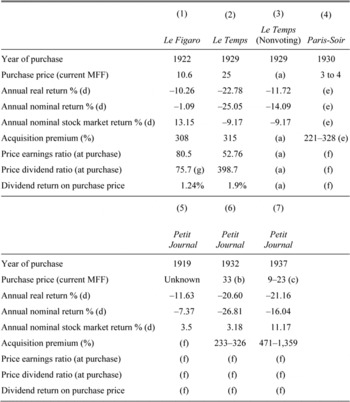
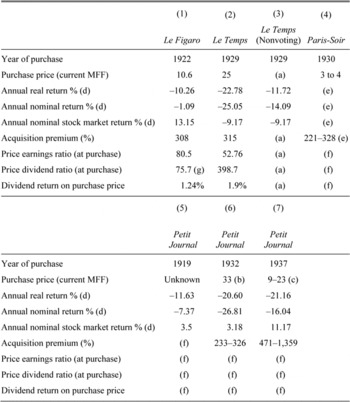
Owing to the cartelized character of the industry, the market for corporate control of newspapers was not overly active during the interwar. Yet occasionally, newspapers changed hands. These events allow us to compare post-acquisition performance with the price paid. We find that post-acquisition returns on newspapers are negative for any takeover during the Interwar period. Consider, for instance, Le Temps which was purchased by a group of leading industrialists in 1929.Footnote 13 Using figures from Jeanneney, Patrick Eveno reports a dismal nominal return of 0.259 percent in the year following purchase (1929)—a Price Dividend Ratio close to 400—and concludes that the price paid was out of line with “reasonable” profitability.Footnote 14 As Table 1 (column 2) shows, improvements on Eveno do not alter the basic result.Footnote 15 Evidently, as the purchase had taken place at the peak of the stock market bubble, losses were to be expected: Still, the return on this stock shows an average annual real loss of 23 percent (22.78 percent), about three times higher than the annual loss on an investment on the stock market index. Acquiring Le Temps was a disastrous proposition.
PERFORMANCE OF NEWSPAPERS
Notes:
(a) To our knowledge, nonvoting shares were not purchased by acquirers.
(b) This purchase price is the sum of the price paid to owners (17 MFF) and a capital injection of 16 MFF; Kupferman and Machefer (Reference Kupferman and Machefer1975, p. 10).
(c) Kupferman and Machefer (Reference Kupferman and Machefer1975, p. 37) provide two diverging contemporary sources proposed 9 m or 23 m (4.8 or 12.2 m of 2009 euros).
(d) Annual return includes capital gains and dividend revenues and was computed over a five-year period starting with the year of purchase of ownership.
(e) Paris-Soir was not listed on the stock market but the archives contain evidence on transaction completed over-the-counter.
(f) One element of the ratio is not available.
(g) The reserves were lowered to pay parts of the dividends in 1922 (by 40,000 FF on top of 632,000 earnings), explaining a price dividend ratio lower than the price earnings ratio.
Sources:
See Appendix 1 for formulas. Numbers are from: Le Figaro: Albert (Reference Albert, Bellanger, Godechot, Guiral and Terrou1972, p. 539); Le Temps: Jeanneney (Reference Jeanneney1976, p. 456); Paris-Soir: Albert (Reference Albert, Bellanger, Godechot, Guiral and Terrou1972, pp. 523–24); Petit Journal 1Reference Albert, Bellanger, Godechot, Guiral and Terrou919: Kupferman and Machefer (Reference Kupferman and Machefer1975, p. 10); Petit Journal 1932: Kupferman and Machefer (Reference Kupferman and Machefer1975, p. 10); Petit Journal 1937: Albert (Reference Albert, Bellanger, Godechot, Guiral and Terrou1972, p. 518) and Kupferman and Machefer (Reference Kupferman and Machefer1975, p. 37). Nominal stock return is the “total return index” of Hautcoeur and Le Bris (Reference Hautcoeur and Le Bris2010, p. 40). Equity shares prices of newspapers on the stock market are from Cote Officielle de la Bourse except Paris-Soir: France, Paris, Archives Nationales, Archives Le Journal, 8AR 418.
This result was not isolated. For instance, businessman François Coty purchased Le Figaro (before World War I a leading and profitable newspaper) in 1922 for 10.6 million (see Table 1). He then faced 10.26 percent average real yearly losses in each of the next 5 years when the stock market was booming at an average rate of 13 percent per year.Footnote 16 Or again, after businessman Patenôtre purchased Le Petit Journal (a founding member of the press cartel) in June 1932 the performance during the next five years was a 20.6 percent real annual loss on initial investment. In nominal terms, the loss was 27 percent in a period of small rebound of the stock market—with an average growth of 3.2 percent per year.Footnote 17
How can we explain that a group of powerful men, who “knew the ropes,” could be found on the losing end of the deal?Footnote 18 Businessmen can make bad deals from time to time, but not all businessmen will make bad deals all the time. Previous historians have sometimes explained these numbers by a general failure of the press (Eveno Reference Eveno2003, p. 92), blaming readers for their change of taste and demoralization. Another possibility is that the expensive price secured the valuable right to manage the newspaper. In other words, purchasers of money-losing newspapers did pay a premium on the price of publicly traded shares, because the “paper” losses were fully compensated by expected trafficking profits, which typically did not appear in the legal accounts. In that case any difference between the purchase price of a group of shares providing control (“block”) and the marginal price of one share purchased on the market but not conferring control reflects benefits that accrue to the blockholder alone or equivalently the private benefits from control (Barclay and Holderness 1989).
To test this hypothesis, we compute the acquisition premium as the difference between the price of a share acquired by the controlling party and the listed price of this share (see Appendix 1 in the Online Appendix for the formula). In Table 1, the line “Acquisition Premium” gives the acquisition premium as the percentage of the market price of the newspaper before the transaction. For instance, the acquisition of Le Figaro in 1922 shows a premium of 308 percent. In 1929 the acquiring group paid Le Temps 315 percent more than its market price. The stocks of Paris-Soir were acquired in 1930 for 221–328 percent more than their previous price. These numbers paint a gloomy picture of the newspaper industry.Footnote 19 The divergence in value to minority shareholders and the acquiring majority was severe. More importantly, a change in management did not herald improved performance for junior shareholders, because the new controlling party was primarily concerned with off-balance-sheet income.
THE VOTING PREMIUM OF A NEWSPAPER: THEORY AND EVIDENCE
The previous discussion suggests that relevant data to track the evolution of the price of media capture could be retrieved from stock price lists. Our intuition builds on the pioneering work of Kristian Rydqvist on the “voting premium” (and its extensions by Luigi Zingales) (Rydqvist Reference Rydqvist1987; Zingales Reference Zingales1994).Footnote 20 The voting premium is the percentage difference between the price of voting and nonvoting shares. Nonvoting shareholders only receive visible revenues (dividends). Voting shares do not confer control but they have extra value compared to nonvoting ones because someone may need to buy them to secure control. This premium reflects the private value of looting the newspaper for the acquirer: Indeed, the acquirer intends to use control for trafficking and as a result, the premium he is prepared to pay for the voting share is related to the present value of his projected looting activities. In a competitive market for shares, outside voting shareholders may expect to obtain part of the trafficking benefits.
Previous studies of the voting premium in different countries and industries have related large premia to poor governance.Footnote 21 The reason is that the premium measures the extent to which insiders can expropriate outsiders. For instance, Luigi Zingales explains the record high voting premia for firms listed on the Milan Stock Exchange during the 1990s (about 80 percent) by arguing “whoever controls a company can dilute minority property rights to a greater extent in Italy than in other countries.” Based on studies for modern non-press groups, we take high voting premia (above 20 percent) as evidence of weak protection of outsiders against insiders (Nenova Reference Nenova2001). In our case, however, outsiders are both minority shareholders and readers. Therefore the beauty of the theory of the voting premium when applied to journalism is that it enables one to construct an indicator of reader protection, which has deep historical significance: For the exploited outsider here, is public information quality.
That the voting premium does capture a fraction only of the control value is straightforward. Under majority voting and without limits on number of votes, a shareholder who already controls 51 percent of a newspaper will not be prepared to give a cent for any additional voting share. Thus the voting premium (which measures the controlling value of owning a marginal stock) is more informative of the (full) value of complete control when the ownership of the firm is unstable (so that subgroups of shareholders want to buy out others to secure majority). This is the case, when there are disputes among controlling shareholders, when there are rules diluting the power of majority shareholders (forcing subgroups of shareholders to enter into unstable coalitions), or when the shareholding of family-owned firms is split as a result of death of the majority owner.Footnote 22
Formally, the voting premium may be written as the percentage price difference between voting and nonvoting shares: VP = [Pv –Pnv ]/Pnv where Pv is the price of voting shares and Pnv the price of nonvoting shares. Now let's call B the present value of visible income (news printing) and V the present value of the invisible income (political trafficking). If the benefits of the invisible income from the firm are distributed equally among all voting shareholders then the ratio of the present value of the visible income to the present value of the invisible income is equal to the product of the voting premium by the proportion of voting shares in all company shares (Nv is the number of voting shares and N the total number of shares—voting and nonvoting):

During the interwar, two French newspapers had both voting and nonvoting shares traded in the stock market.Footnote 23 Le Temps and Le Petit Parisien were also very relevant journals. As noted above, Le Temps was the leading highbrow.Footnote 24 Before World War I, it had established itself as the mouthpiece of conservative interests and the place of choice for the executive to distil official views (explaining the conventional comparison with The Times).Footnote 25 Le Petit Parisien was the only pre-1914 leader that still enjoyed a circulation above one million on the eve of World War II. Le Petit Parisien was a mass daily known as the “doormen's newspaper” (journal des concierges). Lazareff describes Petit Parisien as a newspaper with several assets such as some famous reporters (Albert Londres) and “not too definite a political stance” which he relates to a concern with its own “independence” (Lazareff Reference Lazareff1942, p. 61ff). A member of the cartel, it attempted to defect several times, and invested in its own distribution system. However, Petit Parisien's historian states that it started to decline in 1935 at the same time it accepted bribes from Mussolini (Lazareff Reference Lazareff1942, p. 61 ff; Amaury Reference Amaury1972, vol. 2, p. 1199ff).
VOTING PREMIUM OF TWO LEADING FRENCH NEWSPAPERS, 1900–1940

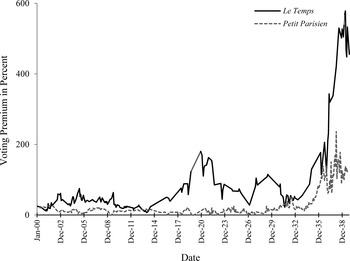
Figure 1 shows voting premia 1900–1940.Footnote 26 They are consistently high. The voting premium of Le Temps was already substantial before World War I (averaging 33.1 percent, min: 6.7 percent; max: 75 percent). After the war, it jumped to new heights (on average 101.8 percent in the 1920s) peaking at 180.3 percent in 1920/21. There is a second jump when the newspaper was purchased in 1929. Yet this 100 percent premium is nothing compared to the explosion observed during Gleichschaltung (1935–1940). Then the average voting premium increased to 374 percent. When the Munich crisis erupts in 1938 (which is when, Werth says, the Nazis were pouring in money), we see that for the first time the premium exceeds 500 percent. A maximum is reached after the annexation of Czechoslovakia by Hitler and before the declaration of war (June 1939—a staggering 578 percent). At the time of the Munich agreement, the Prague correspondent of Le Temps Hubert Beuve-Méry resigned causing scandal. Beuve-Méry had opposed the editorial line of the newspaper, which concealed Czechoslovakia's pathetic calls to Western European leaders and played down the seriousness of the situation. Beuve-Méry would become the chief editor of Le Monde when it was created after World War II and a prominent figure of post-World War II journalism.Footnote 27
The record for Petit Parisien is less dismal but similar, especially for the last period. Before World War I, voting premia range from 0.4 percent to 27.2 percent with an average of 13.1 percent. They stay constant in the 1920s with an average of 10 percent and a maximum at 24.7 percent. This contrast with Le Temps may be put in relation to Lazareff's assessment on Petit Parisien being comparatively a more serious newspaper and its position as the less corrupt newspaper in the cartel.Footnote 28 However, over time, the premium gradually rose. It averages 25.4 percent between 1930 and 1934, and 101.5 percent between 1935 and 1939. This is when Petit Parisien got involved with Mussolini (and probably not only Mussolini). A last jump occurred in the spring of 1938 (236.4 percent) with the Czechoslovakian crisis.
One may want to replicate the same test with other firms in the industry, or with other industries, to see whether this result for two media outlets was general or not.Footnote 29 As said, however, within the French newspaper industry, such material is only available for the two newspapers mentioned. On the other hand, the enormous acquisition premia that we computed for other newspapers in the previous section are fully consistent with the hypothesis that the results for the two most “significant” French newspapers of the time hold for French newspapers at large. Beyond the media industry, our strenuous investigation of dual class shares in other industries yielded a few examples only, and the extraction of information required additional hypotheses (for instance, dividend rights varied in a nonlinear way with voting rights, complicating the algebra). Still, under additional demanding assumptions, four contemporary non-media firms for which a measure of the voting premium could be constructed showed no evidence, neither of the large nor of the rising premia identified for newspapers.Footnote 30
These premia suggest Petit Parisien and Le Temps were involved in a similar process and that something rather unique was happening. A number of political factors at play can be meaningfully related to the lines we have drawn. It could be, as Werth emphasized, that the diplomatic battle that emerged with the rise of fascism and the greater involvement of the Soviet Union in international affair triggered a “bribes race” between totalitarian countries. This coincides with the arrival of Nazi representative Otto Abetz in Paris in 1934 with the goal of organizing the bribes paid to French newspapers, triggering a vigorous reaction by the USSR.Footnote 31 It might also have to do with the French Haute Bourgeoisie fear of the left—its political fortune brightened and the socialist-led coalition of the Popular Front won the 1936 election. Domestic conservatives may have increased their spending to the press to influence its content in an attempt at stopping the rise of the left. Annie Lacroix-Riz (Reference Lacroix-Riz2006) suggests these matters were related, but whatever was the ultimate factor, informed traders were picking something. This bears witness of the relevance of our tool as an instrument to probe historical narratives.
THE PRICE OF CONTROL: LE TEMPS VS. THE TIMES
To outline that there was something special with France's newspapers (as argued by Bloch), we now organize a comparison between Le Temps and its British counterpart The Times. To be sure, several British newspaper groups, including Times Ltd. had nonvoting (“preferred”) shares. These preferred “shares” had fixed (or quasi-fixed) coupons and hence they do not allow us to compute voting premia. However, there does exist detailed information about a takeover of The Times that took place in 1922 only seven years before that of Le Temps. The comparison between the two transactions is natural (it is at the heart of Bloch's conjecture on the failure of French newspapers) and relevant given the historical parallel between the attitudes of two countries' political establishments. As shown by Richard Cockett (Reference Cockett1989), British Conservatives, like their French counterparts at Le Temps had a soft spot for Hitler and The Times' has been criticized for supporting Chamberlain's Appeasement. But as we will see the two cases are quite different. To that end, we discuss the details of the two acquisitions, with the goal to identify in the purchase price, the commercial value (the price of the newspaper as a seller of news), and the political value (its price as an instrument of influence).
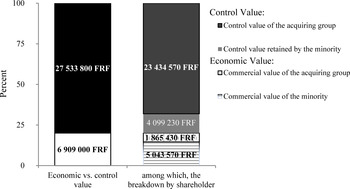
We begin with Le Temps. In 1929 a coalition of business interests, the Suez Company, the House of Rothschild, the association of insurance companies, the employers' association Confédération Générale du Patronat Français, mining magnate Henri de Peyerimhoff, two steel mills (La Marine – Homécourt and Denain – Anzin), allied with diplomat Edmond de Fels and the de Wendel brothers bought 50.76 percent of the voting shares of Le Temps. They left the rest (the balance of voting shares and all the nonvoting shares) with the public.Footnote 32 The value of the newspaper's equity at the time of purchase is equal to the price paid by the group, plus the market value for the remaining voting and nonvoting equity shares. Details on the transactions enable to decompose the equity value into a commercial or economic value and a control value. The economic value includes the value of nonvoting shares (about 5.04 MFF) plus the dividend rights in the voting shares (about 1.86 MFF) or a total of 6.9 MFF.Footnote 33 The control value is the premium paid by the acquiring group on top of the price of the dividend rights (or 23.4 MFF), plus the voting premium on the voting shares not purchased by the acquiring group (4.1 MFF), or a total of about 27.5 MFF (for details, see Appendix 3 in the Online Appendix).
Figure 2 shows the resulting breakdown. The first bar reports the shares of the influence capital and economic capital and the second bar breaks down those numbers by type of shareholder (acquirers vs. the rest). As seen, the economic value was only 20 percent of the total. Thus, 80 percent of the business of Le Temps was about something other than the selling of news, underscoring that the bleak picture from the voting premia is really too optimistic (and naturally so because again, the voting premium for a voting share does not provide control but only the option to sell at a higher price to someone seeking control).
The Times was acquired in 1922 by John Astor (a wealthy investor and member of the Conservative party) in conjunction with Ralph and John Walter (from the Walter family which had owned The Times until 1908), following the death of controlling stake owner Lord Northcliffe.Footnote 34 Northcliffe's had owned 78 percent of the voting shares.
DECOMPOSING THE ECONOMIC AND CONTROL VALUE OF LE TEMPS (1929)

When his heirs decided to sell, they sought to do so as a block, and they faced the additional restriction that John Walter owned the right to match the “best price” offered by anyone else.Footnote 35 Initially, John Walter and Astor's banker thought they would pay “in the neighborhood of one million pounds.” All the bids which other potential buyers had contemplated ranged between £900,000 and £1,050,000 (History of The Times 1952).Footnote 36 But stakes were raised when on October 19th press tycoon Rothermere (Northcliffe's brother) offered £1,350,000 (History of The Times 1952, p. 747). Astor and Walter then matched that price and acquired The Times newspaper on October 23rd (History of The Times 1952, p. 766).
According to W. B. Peat (the chartered accountant estate's administrator George Sutton had hired to assess the property), the £1,350,000 paid was a “fancy” price. Correspondence reported in The History of The Times refers to the purchase price as a “stupendous sum” and “a figure that no business man, no banker, no investor would for a moment think of equaling” (History of The Times 1952, p. 764). Astor's banker reported being shocked (History of The Times 1952, p. 764). Peat related the price to “peculiar political circumstances” (History of The Times 1952, p. 758). History of The Times (p. 757 ff) argues that Rothermere's price was intended to discourage Walter from matching it. The higher bid, Astor's banker and counsel emphasized, made “all the difference between buying The Times as a business and buying it as something else” (History of The Times 1952, p. 764). Rothermere's offer was not “a commercial price” it was emphasized. We now ask: In what way did this differ from Le Temps?
Measuring the control premium for The Times is more complicated than for Le Temps. First, unlike Le Temps, The Times did not have pure dividend right securities to compare to voting rights, and thus no straightforward way to assess the commercial value of the newspaper.Footnote 37 Second, the changeover from the hands of Northcliffe was also related to an attempt at raising the journalistic standards of The Times. The Times had had a grand old reputation but under Northcliffe it had experienced a process of looting that had resulted in declining circulation. Northcliffe was a professional trader in influence famous for having said that when he wanted a peerage he “would buy it, like any honest man.” Because what one wants to do with a newspaper determines the breakdown between the economic value and the influence value, we are left with a range of hypotheses regarding how to estimate goodwill in 1922. For greater security, we provide a range within which the true value of influence must lie. Thus in the first scenario, we use the purchase price of voting shares in a number of transactions that occurred off the London Stock Market and just before the death of Northcliffe. Because Northcliffe fully controlled The Times these voting shares had no control value. Their price is thus a good proxy for pure dividend rights. Such transactions valued shares at £1 (per share) and this is an acceptable estimate of pure dividend rights. This gives a rough 50 percent–50 percent breakdown between commercial and control value in 1922 (see Appendix Table 3 in Appendix 4 of the Online Appendix for details). On the other hand, the very involvement of accounting experts (such as Howard Frank, land adviser to the Ministry of Munitions or the accountant Peat) in the valuation of The Times in 1922 suggests a concern with economic returns. If the goal was to redress the standard of the newspaper and boost profitability, then the value of dividend rights after Northcliffe's death was somewhat higher than share prices for transactions occurring before his death suggest.
Bids were evaluated against expected dividends to minority shareholders, which auditors took as basis for assessing value of The Times (History of The Times 1952, p. 717).Footnote 38 In setting his “high price,” Rothermere appears to have also partly considered the commercial value. He expected large revenues from The Times (with potential net annual earnings of £250,000).Footnote 39 Additional evidence supporting the view that shares might have been underpriced comes from the fact that the price paid by Astor and Walter did not make the investment a financial disaster. For instance, in 1924 the 505,997 ordinary shares of the controlling stake purchased at £2.67 a piece received a total £63,250 in dividends (a price-earnings ratio of 21.4) and results would continue to improve.Footnote 40 We thus construct a second scenario that takes advantage of the “commercial” bids as they would reveal the “true” commercial potential of The Times. To be on the safe side, computations are made using the most conservative offer at £1.78 (the Lloyd George-Davis bid). This produces an influence premium of about 25 percent.
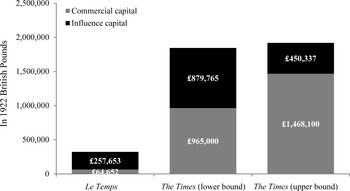
Figure 3 now plots the resulting breakdown of the value of The Times between the commercial and control capital and compares them with those computed for Le Temps (converted in 1922 pound sterling). As seen, the two newspapers had quite different goals. Whatever the exact share of influence capital within the 25 percent–50 percent bracket, The Times stands in contrast with the estimate reported above for Le Temps, where influence dominated (80 percent). Another striking difference is the relative sizes of the total capital (economic and goodwill). The Times towers over Le Temps, as if to illustrate Bloch's statement that The Times was “infinitely” superior. The figure illustrates that a newspaper may be biased but yet remain a valid source of information.
Figure 3 captures much of the underlying dynamics of that era: Influence comes from greater credibility, which is itself supported by a larger reader base.Footnote 41 Illustrating this, we have the total value of political influence, which was much bigger for The Times. Trafficking and corruption leads to economic hardship and decline because as suggested in models of rational media bias and as emphasized by economic historians and observers such as Bloch, readers would react in an intelligent way to “insincere advice.” They would stop buying the paper or only pay a fraction of what they would have for a more honest news outlet (Bloch Reference Bloch1946, p. 163).Footnote 42 This makes free competition a preferred situation for the newspaper industry, as it is capable of dissipating rents accruing to political control. When faced with a cartelized and corrupt media market, readers react by just poring over newspapers, behaving passively or doing exactly the opposite of advised (all behaviors identified by Bloch). This sheds light on the fact that, while French readership of newspaper had been among the highest in the world before World War I (at a time when media competition was vibrant), it stagnated during the interwar years despite progress in instruction and literacy. One cannot publish poorly informed newspapers and sell them durably to readers. And in turn, an industry suffering from credibility problems has trouble attracting capital. What Bloch called the “more informative” Times was first and foremost more capitalized than Le Temps, too (Figure 3).
THE COMMERCIAL VS. THE INFLUENCE VALUE OF THE TIMES AND LE TEMPS Footnote 43

GOVERNANCE AND COMMITMENTS
The previous section outlined the relevance of competition for newspaper quality (the debilitating effect of competition repression on the ability to attract capital). This finding is in line with substantial research on media economics. It is well-known however, that certain institutional fixes may be found that also have quality promoting effects and although they have not been thus far emphasized in the literature, we suggest they played a crucial role in accounting for the contrast between Times and Temps. To show this, we now examine the issue of the original constitution adopted by the British paper after its purchase by the Astor-Walter partnership.
The Astor-Walter acquisition was accompanied with reforms of corporate governance. The process had three milestones. First, on September 27th 1922, when Astor and Walter paired with the goal to secure control of The Times, Walter suggested some innovation or reform in the governance of the newspaper whereby Walter would be Chairman, Astor Vice-Chairman, and both would acknowledge that control of editorial matters would be vested equally in both, with appeal to the Board of Governors in the event of a dispute. Financial control on the other hand would lie “with the majority of shares” (meaning Astor, at least, to begin with) (History of The Times 1952, p. 747). The idea of a corporate compact (a “constitution”) crystallized when Astor had to put out additional cash to beat the Rothermere offer. Grant (his banker) then declared that The Times could no longer be bought as a business but “perhaps, as a trust” (History of The Times 1952, p. 764).
The next milestone was the Memorandum which Geoffrey Dawson transmitted to the new proprietors as a condition for his becoming the editor. The Memorandum separated the newspaper into a money making and a “public guidance” function and stated that the two objectives could only be achieved if the editor had a seat in the board and full control over the entire editorial line (news, letters, pictures, captions, supplements), appointments of journalists as well as “final authority to strike out any advertisement whatever which in his opinion is mischievous”— in sum, as Dawson himself put it, a “freehand policy” (History of The Times 1952, pp. 779–80). Dawson was responsible “in bulk” before the proprietors who could hire and fire him. We are told that Dawson wanted to make his position “bomb-proof”—he had been editor under Northcliffe and had repeatedly clashed with him on editorial matters (Taylor Reference Taylor and Percivale1952). Walter and Astor acquiesced and Dawson assumed editorship.
Finally, the new constitution of The Times was made public on August 7, 1924. The central feature of the new Constitution was the creation of a Committee of Trustees comprising, ex officio, a number of members of the British (Conservative) Establishment.Footnote 44 The trustees, who had no role in the management of the newspaper, had full control over the transfer of shares from the owners. They were instructed to approve share transfers subject to two conditions “a) maintaining the best traditions and political independence of The Times newspaper and national rather than personal interests and b) eliminating as far as reasonably possible question of personal ambition or commercial profit” (History of The Times 1952, p. 79; Royal Commission on the Press 1949, p. 236).Footnote 45
These three elements aligned the interests of proprietors with those of readers. The financial interest had control over the choice of the editor. The editor, once appointed, had a free hand over the newspaper. Astor was not expected to interfere with editorial policy. The fierce competition for readers among British newspapers left the editor with little choice but to deliver a good quality product that would attract readers and deliver value (Williams Reference Williams2010). Indeed, while Astor's political influence was neutered, it was also recognized that Astor's capital outlay deserved protection. The Board of the newspaper saw to it that the newspaper should be profitable. Because Astor's only way to secure revenues was through visible revenues, his incentives were aligned with those of his readers. Illustrating the continuous concern with keeping Astor satisfied, we have the subsequent financial reports, which frequently recorded the yield on Times Publishing Cy, Ltd., as a share of “the capital [initially] invested by the Stockholders and Shareholders of The Times Holding Company Limited.”Footnote 46
In an environment of fierce competition, one unintended consequence of the large Rothermere bid was that, by forcing Astor to come up with more money, it created a greater need to come up with a successful product. Given the high price, efforts would have to be made to raise revenues. And since Astor could not cash in his “ownership” of The Times except through visible revenues, he was firmly enlisted in the cause of profitability. And sure enough The Times managed to reach satisfactory levels of profitability, even considering the high purchase price. Ten years after the purchase, Astor and Walter had recovered 42.67 percent of their initial investment through dividend payments (or 62.1 percent if the newly retained earnings of this decade are included).47 Dividend payments represented an annual real return of 3.62 percent during the 1923–1932 period (or 4.95 percent if newly retained earnings are included). These achievements may be compared to those of the purchasers of Le Temps (which did not make any provision for protecting editorial independence) who lost most of their initial investment: But again, this was fine for them because they recuperated it through influence.
While The Times and Le Temps were only two newspapers, their experience was emblematic. The case of The Times was not isolated. Other “prestigious” British journals underwent similar transformations, plausibly because looting is more tempting in the case of a well-established journal. As the British Royal Commission on the Press of 1947–1949 argued, the “trust” arrangement adopted by The Times was not an isolated instance: “One of the most interesting developments of the last 25 years has been the appearance of what The Daily News Ltd. [whose managers had been interviewed by the Commission] described as ‘voluntary agreements of owners to limit their own sovereignty in the public interest'” (Royal Commission on the Press 1949, p. 24). In France by contrast such schemes intended to reduce the power of the owner and promote the interests of readers were the exception. Attempts to use such institutional innovations for the process of news production, unsurprisingly came from outsiders to the press cartel. But even in that case, success was far from guaranteed as shown by the example of Le Quotidien whose founders had established a governance system aimed at protecting editorial independence. The press cartel was able to impose huge retaliatory costs on the newcomer, and the owner was finally “convinced” to get rid of the governance structure.48
TIME INCONSISTENCY
The contrasting experience of The Times and Le Temps show that newspapers may handle very differently the trade-off between earning revenues from visible or invisible revenues, leading to dramatically different outcomes. All newspaper owners face the temptation to use their paper to secure influence. If a paper has a large readership and enjoys greater credibility, it may also have severe incentives in the short run to exploit its readers when few credible substitutes are available. The problem, in essence, is one of time inconsistency, and one possible answer, as outlined in the previous section, is editorial independence.
Bloch neatly summarized this time-consistency problem. He found corporate elites locked into a paradox: individuals bragged “at noon” that they had successfully influenced a newspaper and complained “at the end of the day” of the “corrupt” state of the French press (Bloch Reference Bloch1946, p. 101). This reflects the fact that newspaper owners faced an incentive to establish credibility and then use it through trafficking. While this inexorably destroyed reputation, it could still be worth doing if short-run political benefits surpassed long-term losses.
Another important fact is that news is a peculiar kind of “experience good” because its quality is learnt through time rather than immediately when purchased. Time may be needed before the occurrence of events can contradict facts distorted by a corrupt media. Indeed it was only with the Soviet-German Pact that even the most skeptical Frenchmen could no longer deny that the Soviet Union had reneged on the French-Soviet Pact of 1935 and was no longer an ally of France. Before that event, any doubt raised was very quickly ridiculed by Le Temps. Similarly, it took the 1940 defeat for the most skeptical Frenchmen to stop denying that Monsieur Hitler had aggressive intentions and the French army was not properly equipped.
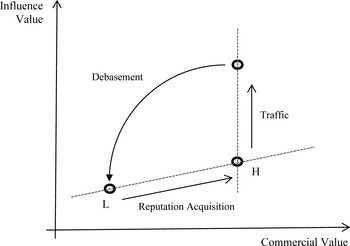
The interaction between time consistency and the inherent delays in quality learning were at the heart of what we suggest to call “debasement cycles” illustrated in Figure 4. We start from a situation in which a newspaper aims at selling news to readers and gains the ability to influence them at the same time. But it does not exploit this ability too much. If the newspaper's reputation increases, it may attract more readers and this will also increase its influence value. There should therefore be a positive relation between commercial value and influence value. Suppose therefore that, to begin with, the newspaper is located in a high-credibility equilibrium (point H). From that point, the owner starts selling influence, thus looting the newspaper. As long as he is not found out, he manages to improve his situation, by increasing revenues from trafficking while revenues from the selling of news are stable. However, sooner or later he is found out and readers reduce their demand (thus reducing the paper's commercial value) while the ability of the owner to traffic declines dramatically (precisely because he has been found out). Eventually, the newspaper reaches a low credibility equilibrium characterized by reduced sales and reduced ability to traffic (point L). It may also be, as we saw earlier, that at this new point the share of traffic in total value is higher than for the high credibility point (as in the contrast between Times and Temps).
THE LOGIC OF NEWSPAPER DEBASEMENT

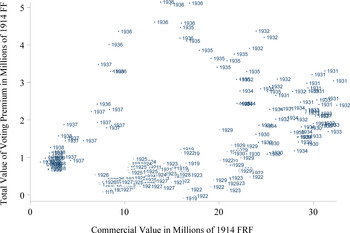
Suggestive evidence supporting the logic of this “debasement cycle” may be garnered from the experience of Petit Parisien. As a leading and initially successful paper, Petit Parisien was probably more credible at the beginning of the period than at the end, when it surfaced that it had accepted payments from some foreign powers and began losing readers at an increased rate. Using the same background data as in Section III on pure dividend rights and the voting premium (used as a proxy of the influence value), Figure 5 provides a scatter plot of commercial and total voting premium for the interwar period (1919 to 1939). Each observation corresponds to a given month in that period. To ease reading, we only print the year label. Four phases are identified and they nicely “circle” counterclockwise, as suggested by the debasement paradigm. During the initial period (the 20s), we observe a stable positive relation between commercial value and influence value. At the beginning of the 1930s, however, the control value begins to rise “alone” (suggesting looting). In the next phase, the control value becomes negatively correlated with the commercial value (when more and more readers begin to figure out what is happening and reduce their purchases of the newspaper). After 1936, debasement accelerates: both the commercial value and the total value of the voting right decline dramatically. The new equilibrium is reached in 1938/39 (last phase), when a debased Petit Parisien survives on subsidies and traffic.
Such was the situation in France. Of course, the British “solution” did not safeguard from the attractions of Nazi Germany's ideology. Cockett's discussion of Dawson (still the editor of The Times during Appeasement) shows this clearly (Cockett Reference Cockett1989, pp. 27–30, 64–66). But even in this context, there were partial safeguards of quality. The Times' corporate governance rules protected the standards of reporting because even when Dawson preached Appeasement and limited the visibility of articles by anti-Appeasement journalists, he could not totally stop the publication of such articles. Moreover, the fact that England maintained a critical degree of competition in its media produced positive feedback effects on newspaper quality and the institutions designed to safeguard it. This was certainly much better than the situation in France, and offered Britain, beyond the Channel, another line of defense against Nazi Germany. It was a very imperfect defense, but still it was one, as revealed by the French mirror.
PETIT PARISIEN, BUSINESS AND INFLUENCE FROM DEC. 1918 TO DEC. 1939

CONCLUSION
As we repeatedly emphasized, those who control newspapers are tempted to loot them. Papers provide news but as they acquire readership, they become vehicles for influencing opinion. The temptation to debase newspapers for personal gain is fundamental. We have provided evidence to substantiate this insight during France's media debacle during the interwar years. First, we showed that newspaper acquirers were prepared to pay a premium that cannot be rationalized with reference to the newspaper's visible revenues: Even when they lose money, newspapers remain valuable as political instruments. Second, we showed that the difference between the price of voting and nonvoting shares in secondary markets is an insightful instrument to explore the value of control in newspapers. We found huge numbers (several hundred percent in the late 1930s).
Third, comparing France and Britain, we decomposed the trafficking and commercial value of the two countries' leading conservative newspapers (Le Temps and The Times) and found that France's highbrow was mostly about securing influence (80 percent of the total value) while The Times was a more evenly split venture. Last, we emphasized how in Britain institutional innovation helped reduce corruption.
While this article is primarily about the empirics of newspaper looting, it also concerns important historical issues. For instance, building on our measure of “looting” in two leading French newspapers, we discovered, strikingly, that corruption worsened during the 1930s exactly as described qualitatively by current historians, such as Lacroix-Riz (Reference Lacroix-Riz2006) or contemporary observers, such as Werth (Reference Werth1942). We hope that these finding will spur future historical investigations into the political difficulties in interwar France. In particular, a key insight is that at the heart of the difficulties of French newspapers was an organizational failure both within (newspapers' editorial independence) and across (cartelization of distribution). To blame some kind of “cultural” problem with money as some historians such as Jeanneney have argued misses the point. We are left wondering with Bloch, how come French corporate leaders failed to implement the sort of institutional solutions that their British counterparts identified. Various groups and constituencies might have had an interest in a high-quality press, but it seems that the corporate sector and the political elite of France were not among them—something Bloch had been puzzled by in the aftermath of France's debacle of 1940. We conjecture that the seeds of the French Debacle in 1940 were planted with the advent of information control with the beginning of World War I. This policy was implemented by the Union Sacrée Government, ironically as a tool to win World War I.
Primary Material: Archive and Printed Sources
Archives:
France, Paris, Archives Nationales, Le Journal, 8 AR 418, 8 AR 326.
United Kingdom, London, Guildhall Library, Times Publishing Cy, balance sheets and annual reports of The Times, 1924–1931.
Printed sources:
Annuaire Desfossés. Valeurs cotées en banque et à la bourse de Paris. Paris: Editions Desfossés, various issues.
Compagnie des Agents de Change. Bulletin Hebdomadaire (1900–1919) and Cote Officielle des Agents de Change de la Bourse de Paris (1920–1940). Paris: Imprimerie Chaix, various issues.
Cours de la Banque et de la Bourse ou Cote Desfossés. Paris: Editions Desfossés, various issues.
Financial Times. Various issues, 1924–1931.
Stock Exchange Official Intelligence, various issues 1918–1933. London: Spottiswoode Ballantyne.