The genus Rhabditis (Family: Rhabditidae) comprises small, free-living, saprophytic nematodes that are commonly found in soil, and there have been many sporadic reports of infections in humans (Muller, Reference Muller2002). Free-living nematodes can sometimes be confused with Strongyloides sp. during routine faecal examination and this may provide false records on strongyloidiasis, particularly in areas where humans and animals frequently come into contact with soil (El-Azazy et al., Reference El-Azazy, El-Gawady and Nada1988). Rhabditis (Rhabditella) axei (Feng & Li, Reference Feng and Li1950) is a common species in soil which has been reported several times in human urine (Feng & Li, Reference Feng and Li1950; Goldsmit, Reference Goldsmid1967; Ye et al., Reference Ye, Zhu and Zhang2002) and the digestive system (Joyeux & Baer, Reference Joyeux and Baer1942; Shinohara, Reference Shinohara1960), as well as in animal excreta (El-Azazy et al., Reference El-Azazy, El-Gawady and Nada1988). In the present paper, severe infections with R. axei in two AIDS patients in Iran, when screening for strongyloidiasis, are reported.
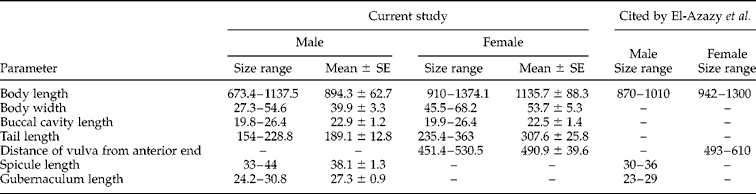
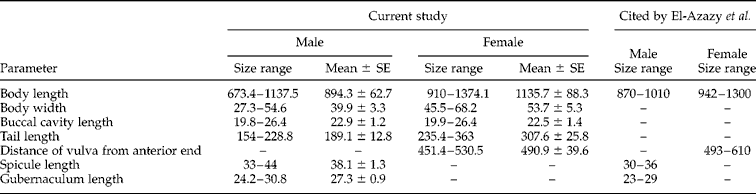
As part of a continuing programme, commencing in 2002, on strongyloidiasis in HIV+/AIDS patients in Iran, direct smears, formalin–ether concentrates and agar plate culture examinations were performed on fresh stool samples of these patients. During this screening, two AIDS patients showed watery diarrhoea, with severe infections of a parasite resembling Strongyloides stercoralis. However, the morphological characteristics of this nematode and its behaviour on nutrient agar plate cultures differed from those of S. stercoralis. In direct smear preparations of fresh stools, a large number of embryonated eggs and motile larvae were present; the eggs were similar to those of S. stercoralis. Following culture of these samples on nutrient agar plates, a large number of eggs, larvae and adult males and females were found in the agar media after 48 h incubation at 26 °C. In contrast to S. stercoralis, which has only one generation of free-living stages, this nematode could easily be maintained by subcultures, producing many generations. From camera lucida drawings of the adult male and female, and descriptions of morphometric criteria, the nematode was identified as R. axei. Both males and females possessed a narrow buccal cavity, a rhabditiform oesophagus and prominent long tails. Males had six pairs of caudal papillae, a gubernaculum and two equal spicules. Females had didelphic uteri filled with embryonated eggs. The measurements of 15 specimens of each sex, isolated from nutrient agar plates, are given in table 1 and compared with the description given by El-Azazy et al. (Reference El-Azazy, El-Gawady and Nada1988).
Measurements (in μm) of 15 male and 15 female Rhabditis axei specimens collected from nutrient agar plates containing watery stools of two AIDS patients, compared with equivalent measurements given by El-Azazy et al. (Reference El-Azazy, El-Gawady and Nada1988).
Inoculation of live juveniles of R. axei, recovered from nutrient agar plates, to albino rats and guinea-pigs, either orally or intraperitoneally, did not lead to the presence of R. axei within the faeces 24 h after inoculation, at daily intervals until death or at necropsy.
Both infected patients were male drug addicts (44 and 29 years old) and imprisoned at the time of examination. Stool samples of these patients were negative with respect to other parasites or pathogenic bacteria. No referral of these patients was possible, as a few days after examination the 44-year-old man died and the 29-year-old man was freed from prison.
There have been several reports on the association between rhabditid nematodes and the human digestive system (Joyeux & Baer, Reference Joyeux and Baer1942; Ahn et al., 1985; Campos et al., Reference Campos, Araujo, Vieria, Damasceno and Barbosa2002; Ye et al., Reference Ye, Zhu and Zhang2002) and urinary tract (Feng & Li, Reference Feng and Li1950; Goldsmid, Reference Goldsmid1967; Hara et al., Reference Hara, Nakazato, Araki and Iwata1974; He & Jiang, Reference He and Jiang1985; Eldridge, Reference Eldridge1993). These reports included patients in different age groups, ranging from a 5-month-old child (Campos et al., Reference Campos, Araujo, Vieria, Damasceno and Barbosa2002) to a 81-year-old woman (Eldridge, Reference Eldridge1993). In the present paper, severe infections with R. axei in the digestive systems of two AIDS patients in Iran are reported for the first time. The association of this infection with immunodeficiency and its pathogenicity for patients need to be investigated further. In addition, the discrimination of Rhabditis spp. from S. stercoralis should be considered during examination of patients for parasites, especially in endemic areas of S. stercoralis.
Acknowledgements
The valuable advice received from Professor Mobedi, Department of Medical Parasitology and Mycology, School of Public Health and Institute of Public Health Research, Tehran University of Medical Sciences, is much appreciated.