Through many dangers, toils, and snares we have already come. T'was grace that brought us safe thus far, and grace will lead us home. (“Amazing Grace” Anglican Hymn, 1779)
INTRODUCTION
Personal religious beliefs shape U.S. politicians' appeal as candidates for public office (Clifford and Gaskins Reference Clifford and Gaskins2016) and their congressional policy priorities and voting behavior (Yamane and Oldmixon Reference Yamane and Oldmixon2006; Oldmixon and Hudson Reference Oldmixon and Hudson2008). Members of Congress also publicly invoke religious ideas when they engage with their colleagues and constituents. Yet, researchers know relatively little about this public-facing religiosity. How, and in what contexts, do legislators publicly invoke religious rhetoric when communicating with their constituents? Do periods of heightened public anxiety make legislators more likely to use religious rhetoric?
Individuals and communities often increase their own religious behavior during times riddled with national security concerns, when they face economic duress, or in the aftermath of traumatic events (Schuster et al. Reference Schuster, Stein, Jaycox, Collins, Marshall, Elliott, Zhou, Kanouse, Morrison and Berry2001; Norris and Inglehart Reference Norris and Inglehart2011; Sibley and Bulbulia Reference Sibley and Bulbulia2012). Amid turmoil, elected officials may similarly turn toward religion in their personal lives, and they may also invoke religious ideas as part of their public profiles in an effort to quell constituents' feelings of insecurity or anxiety. If elected officials' behavior mirrors or responds to general trends toward increased religiosity amid insecurity, we may observe associations between anxiety and religious ideas in their curated public rhetoric.
This paper examines the relationship between insecurity, anxious sentiments, and religious rhetoric among U.S. senators' public profiles. To do so, we analyze the content of senators' official congressional websites, based on web-crawl captures during four election years (2006, 2008, 2010, and 2012). Using this truly “big data” resource and an externally validated measure of public-facing religiosity (Gade et al. Reference Gade, Dreier, Wilkerson and Washington2020), we estimate the relationship between senators' proportional use of anxious rhetoric and religious rhetoric in a given year. We find a strong association between a senator's public expression of anxiety and invocation of public-facing religiosity. This association maintains across various model specifications. As senators adopt increasingly anxious rhetorical sentiments in their broad political communication profiles, they become substantially more likely to invoke religious rhetoric. This association within a senator's macro-level political profile does not appear to be shaped by traumatic real-world events, including natural emergencies or terrorist attacks.
This paper makes valuable substantive and methodological contributions. First, it provides evidence about when and how U.S. politicians invoke religion in their public roles as leaders and policymakers. It suggests crucial links between demonstrations of anxiety and religious ideology among senators' online rhetoric. In doing so, it extends research on religion in public life to new terrain—elected officials' curated, public-facing religious rhetoric over time—and it advances knowledge about the contours of religion in U.S. political culture. Second, this paper demonstrates the novel contributions that large text sources can make to scholarly knowledge about elite political communication and about the broader intersections between religion and politics.
This paper proceeds as follows. First, we discuss religion's relevance to U.S. campaigns and congressional behavior. Second, we theorize the connections between public anxiety and elected officials' public-facing religiosity. This curated public display of religiosity is related to, but substantively distinct from, broader associations between insecurity and religiosity among citizens' everyday lives. Third, we detail our use of the Internet Archive's (IA) 90-terabyte collection of U.S. government website content, and we describe the text-data methods we use to construct novel proportional rhetoric variables based on this data source. Fourth, we present beta regression results that confirm an association between anxiety and religious rhetoric (but not with traumatic real-world events). We include robustness checks that consider possible sources of false positive results and structural endogeneity concerns. We close by highlighting the implications of these results for existing research on religion, politics, and securitization; and by discussing the contributions that web-based text data archives can make to social science research.
RELIGION IN CAMPAIGNS AND CONGRESS
Article 6 of the U.S. Constitution directs that “no religious test shall ever be required as a qualification to any office or public trust under the United States.” Despite this constitutional prohibition, seven U.S. states explicitly prohibit those who deny the existence of a God from holding state office.Footnote 1 Meanwhile, religious belief—whether authentic or feigned (Alberts Reference Alberts2008)—regularly serves as a de facto prerequisite for candidates seeking public office. Religious politicians, particularly those who identify as Christian or Jewish, are disproportionately represented in Congress.Footnote 2 Although 23% of U.S. adults today claim no religious affiliation, virtually all members of the U.S. Congress self-identify as religious. Congress has had only one open atheist (Rep. Pete Stark, D-CA),Footnote 3 one explicitly religiously unaffiliated member (Sen. Krysten Sinema, D-AZ),Footnote 4 and several additional members (eighteen in the 116th Congress) who do not report a religious affiliation (Sandstrom Reference Sandstrom2019).
When it comes to religiosity, the United States is outlier. American adults tend to be more religious—and report higher frequencies of religious behavior—than those living in other wealthy countries (Fahmy Reference Fahmy2018). Given these high levels of religiosity, politicians throughout the country encounter a variety of political norms, expectations, or incentives to engage religious ideas in their public roles. Appealing to voters' religious sentiments is a crucial political tactic for contemporary U.S. politicians (Weber and Thornton Reference Weber and Thornton2012; McLaughlin and Wise Reference McLaughlin and Wise2014; Albertson Reference Albertson2015). Among the highly religious U.S. citizenry (Norris and Inglehart Reference Norris and Inglehart2011, 84–85), voters' religious beliefs routinely shape their public opinions and their voting behavior (Pew Research Center 2003; Smidt, Guth and Kellstedt Reference Smidt, Guth and Kellstedt2017). Voters tend to perceive religious candidates to be more trustworthy than their non-religious counterparts (Clifford and Gaskins Reference Clifford and Gaskins2016, 1066). Considerable subsets of American voters expect their candidates to publicly exhibit faith by invoking religious rhetoric on the campaign trail (Coe and Chapp Reference Coe and Chapp2017),Footnote 5 although the political efficacy of invoking religion varies across candidate identities.Footnote 6 Candidates highlight (often authentic) religious beliefs in a calculated, deliberate, and partisan way to connect with religiously inclined American voters (Domke and Coe Reference Domke and Coe2008, 3–10) or to demonstrate their moral superiority over opponents (Glenn Reference Glenn2010).Footnote 7
Once elected, legislators' own religious affiliation (Page et al. Reference Page, Shapiro, Gronke and Rosenberg1984; Fastnow, Grant and Rudolph Reference Fastnow, Tobin Grant and Rudolph1999), their degree of orthodoxy (Green and Guth Reference Green and Guth1991), the salience of own their religious beliefs (Yamane and Oldmixon Reference Yamane and Oldmixon2006), and the religious breakdown of their constituency (Meier and McFarlane Reference Meier and McFarlane1993; O'Connor and Berkman Reference O'Connor and Berkman1995; Oldmixon Reference Oldmixon2005; Martin Reference Martin2009; Marchetti and O'Connell Reference Marchetti and O'Connell2018) all shape legislators' voting behavior and policy preferences. This has been particularly true among policies that regulate hot-button private issues (Oldmixon and Hudson Reference Oldmixon and Hudson2008) such as access to abortion or marriage equality (Richardson and Fox Reference Richardson and Fox1972, Reference Richardson and Fox1975; Chressanthis, Gilbert and Grimes Reference Chressanthis, Gilbert and Grimes1991; Tatalovitch and Schier Reference Tatalovitch and Schier1993; Gohmann and Ohsfeldt Reference Gohmann and Ohsfeldt1994; Schecter Reference Schecter2001; Guth Reference Guth2014; Blackstone and Oldmixon Reference Blackstone and Oldmixon2015).Footnote 8 However, with the polarization of American politics (Layman Reference Layman1999) and Christian conservatism's entrenchment in the Republican Party (Dowland Reference Dowland2015; Newman et al. Reference Newman, Guth, Cole, Doran and Larson2016, 6), these effects are increasingly mediated through a legislator's partisan identification and political ideology (Yamane and Oldmixon Reference Yamane and Oldmixon2006; Marietta Reference Marietta2009; Norris and Inglehart Reference Norris and Inglehart2011, 211).Footnote 9
PUBLIC-FACING RELIGIOSITY
We examine politicians' curated, public-facing religious rhetoric, particularly during times of real or perceived insecurity. In doing so, this research advances several understudied dimensions of religion in U.S. politics. First, existing research emphasizes how politicians' specific religious identities shape their electoral strategies and policy agendas. It focuses on private religious practices (Guth Reference Guth2014) or on fixed religious identities, which are insufficient for quantifying the ways in which legislators publicly perform and invoke their religiosity. Indeed, “given the entry of religion into political debates issuing in effective policies… it makes little sense to measure the social significance of religion only in terms of such indices as church attendance” (Asad Reference Asad2003, 182). As a result, researchers lack a comprehensive understanding of the extent to which legislators across religious affiliations use religious signaling in their constituent communication strategies. Second, research that does examine politicians' religious rhetoric focuses almost exclusively on campaign strategies (Coe and Chapp Reference Coe and Chapp2017). We know relatively little about how officials, once elected, publicly and broadly invoke religious rhetoric (Djupe Reference Djupe2013), even though congressional discourse is crucial in shaping public attitudes and policy outcomes (Leep Reference Leep2010). The novel data we employ in this paper enable us to examine the religious rhetoric that politicians, once elected, use in their curated communication outreach to their entire constituency. Third, research that has interrogated U.S. legislators' religious rhetoric predominately focuses on highly partisan issues, such as abortion (Marchetti and O'Connell Reference Marchetti and O'Connell2018), in which religious and partisan motivations are not easily distinguishable.Footnote 10 However, politicians' religious rhetoric is frequently more encompassing than issue-specific approaches consider or measure (Chapp Reference Chapp2012).
In short, existing research leaves unanswered questions about how elected officials, across political ideologies or religious affiliations, deploy religious rhetoric as part of their broad public profile. In the United States' uniquely religious environment, elected officials are likely to invoke religious ideas in a range of contexts and for a variety of objectives. Doing so, in turn, reinforces religion's relevancy in U.S. political culture. This paper begins to fill these research gaps by examining the rhetorical sentiments that accompany elected officials' public displays of religiosity. By dislodging our analysis from polarizing social issues or partisan politics, we gain insights about the broader and more deeply ingrained contributions religious ideas make to American politics.
Insecurity, Anxiety, and Religious Rhetoric
Religious rhetoric provides a bridge between material circumstances and the ethereal or symbolic ideas that give those circumstances meaning, importance, or recourse (Geertz in Pals, Reference Pals2009). Individuals and communities often gravitate toward religious concepts when they face circumstances of insecurity or anxiety. Social science research suggests that religion can serve as a source of comfort and stability to communities facing insecurity or economic hardship. Norris and Inglehart (Reference Norris and Inglehart2011)'s comparative analysis demonstrates that people living in countries that experience relatively high levels of poverty or insecurity exhibit higher levels of religiosity than those living in more economically secure countries. Meanwhile, religion's importance and vitality gradually erodes among societies with greater security:
[T]he importance of religiosity persists most strongly among vulnerable populations, especially those living in poorer nations, facing personal survival-threatening risks. We argue that feelings of vulnerability to physical, societal, and personal risks are key factor driving religiosity (Norris and Inglehart Reference Norris and Inglehart2011, 4–5).
Similar trends shape subsets of a country's population. Poorer Americans are notably more religious than their wealthier counterparts (Norris and Inglehart Reference Norris and Inglehart2011, 108). In fact, the United States' considerable economic inequality partially explains its high level of religiosity. Indeed, these are the dynamics then-presidential candidate Barack Obama observed when he said that Americans facing economic uncertainty “cling to guns, or religion, or antipathy toward people who aren't like them, or anti-immigrant sentiment, or anti-trade sentiment as a way to explain their frustrations” (Pilkington Reference Pilkington2008).
Religion may also help people understand and cope with traumatic events. Evidence suggests that even people who are not particularly religious look to religion during times of crisis. Religious faith increased among those affected by a 2011 earthquake in New Zealand (Sibley and Bulbulia Reference Sibley and Bulbulia2012). Similarly, high percentages of Americans turned toward religion in the immediate aftermath of the September 11, 2001, terrorist attacks in the United States (Schuster et al. Reference Schuster, Stein, Jaycox, Collins, Marshall, Elliott, Zhou, Kanouse, Morrison and Berry2001).Footnote 11
Following these trends, elected officials may be more likely to integrate religious ideas into their public-facing rhetoric during times of real or perceived insecurity. Some may do so because they, like the general public, turn toward religious ideas and behaviors amid insecurity or anxiety. However, this public rhetoric is not simply a proxy for an elected official's personal religious ideas. Instead, it represents her curated public profile, which bespeaks a uniquely religious electorate and political culture that foregrounds religiosity as a relevant venue for expressing political ideas. Utilizing religious rhetoric alongside anxiety could allow politicians to elevate transcendental solutions to materially insurmountable dilemmas, catalyze commonly shared religious sentiments, uphold a uniquely religious political culture, and establish themselves as invaluable leaders during insecure times. We therefore expect that senators' curated public rhetoric will engage or adopt religious ideas at higher rates following traumatic events or to accompany their own demonstrations of anxiety.
H1: H1: Senators whose states experience traumatic events will use religious references at higher proportional rates, relative to senators whose states do not experience such events in a given year.
H2: H2: When senators invoke anxiety-related concepts at proportionately higher rates, they will also make proportionately more religious references.
Evidence supporting these hypotheses would suggest an association between insecurity (H1) or anxiety (H2) and religious rhetoric. This association could be intentional or unintentional, direct or implicit. It could occur for a variety of reasons. Senators, like their constituents, may turn toward religion during times of insecurity or anxiety. Alternatively, senators may use religious messages because they expect that doing so will comfort or appease their constituents. Finally, senators may respond to, or even manufacture, perceptions of anxiety, insecurity, or a threatening “common enemy” (Lausten and Wæver Reference Lausten and Wæver2000; Williams Reference Williams2003; Rythoven Reference Rythoven2015)—and then offer religious concepts to assuage those anxieties—to advance their own political objectives (including strengthening their reelection bids or supporting partisan platforms). Although our data do not allow us to identify these motivations, testing our hypotheses provides a first step toward exploring these relationships between American religiosity, political communication, and social or economic insecurity.
DATA AND VARIABLES
Archived Congressional Website Text
To test hypotheses, we analyze U.S. senators' public-facing political communication with their statewide constituency. State-based constituencies are the appropriate units of analysis for this research because the insecurity-related events we examine (e.g., natural disasters or terrorist threats) tend to elevate to statewide concerns; they are not localized to specific congressional districts. Furthermore, this unit of analysis allows us to consider relevant state-level demographics (e.g., constituent religiosity and political ideology). Because senators' constituencies are inevitably more diverse than those at the district level, senators must also engage a more generalized approach to political messaging, relative to members of the U.S. House of Representatives.
Our data represent text from U.S. senators' congressional websites over a 6-year period (2006–2012). Congressional website text provides a novel opportunity to study elected officials' broad constituent communications. Floor speeches, press releases, and other forms of constituent engagement provide valuable information about elected officials' policy priorities and political behavior (Maltzman and Sigelman Reference Maltzman and Sigelman1996; Osborn and Mendez Reference Osborn and Mendez2010; Grimmer, Westwood and Messing Reference Grimmer, Westwood and Messing2014). However, any of these alone yield an incomplete analysis of an elected official's communication strategies. Official congressional websites—which provide legislators a controlled, direct venue for communicating with their constituents—more comprehensively represent their public-facing communication (Esterling, Lazer and Neblo Reference Esterling, Lazer and Neblo2010). Official websites may contain a senator's biographical information, policy priorities, committee work and leadership roles, published opinion pieces, constituent services, in-district events, and archived floor speeches or press releases.Footnote 12
Our data are comprised of Internet-archived parsed text captures of congressional websites during four election years: 2006, 2008, 2010, and 2012. During these years, the IA contracted with the U.S. Library of Congress to target, capture, and curate material on U.S. government websites (those within the “.gov” domain). This initiative dramatically increased the quality and reliability of curated U.S. government website data during these time periods. Although Internet-archived data are unavoidably incomplete and unrepresentative,Footnote 13 this curated collection is among the most comprehensive archives of Internet text data available (Gade, Wilkerson and Washington, Reference Gade, Wilkerson and Washington2017).Footnote 14 A total of 144 unique senators held office during the 109th to 112th Congresses (2005–2013). We created a regular expression to identify each senator's URL root (e.g., clinton.senate.gov for Sen. Hillary Clinton, D-NY) and collected all archived website captures within that domain. To avoid duplication, we limited our text analysis to data from senators' original website captures and all additional content added since the most recent capture.Footnote 15 By aggregating our observations to the election-year level, we avoid concerns about how website material was scraped and can reasonably infer that our dataset approaches a near-complete record of congressional website content that year. This record provides an unprecedented opportunity to conduct large-scale, multi-year examinations of the ways in which senators invoke religious rhetoric in their public engagement with constituents.
Main Explanatory and Outcome Variables
We use the Linguistic Inquiry and Word Count (LIWC) dictionary to construct variables that capture senators' yearly proportional use of anxiety-related rhetoric and religious rhetoric (Pennebaker et al. Reference Pennebaker, Boyd, Jordan and Blackburn2015). LIWC software provides pre-established, equivalent word lists, each categorized according to a specific concept (e.g., religious terms) or sentiment (e.g., anxiety terms). The dictionary methods we employ take a given LIWC list of words or strings (explicit mentions of a given concept or sentiment) and retrieve exact matches to that list in the text corpus (here, text captures from senators' official congressional websites). We use the resulting word-list units to compare the prevalence of concepts or sentiments in our text corpus.
Our outcome variable is a senator's yearly proportional use of LIWC's religious terms in congressional website text.Footnote 16 This measure represents a senator's deliberate, public invocation of religious rhetoric while communicating with constituents. Gade et al. (Reference Gade, Dreier, Wilkerson and Washington2020) externally validate this approach as a meaningful measure of public-facing religiosity, which correlates with legislators' private religious behavior (Guth Reference Guth2014).
Our explanatory variables represent real or demonstrated anxiety. First, we estimate the effect that real-world traumatic events have on a senator's religious rhetoric. To do so, we include counts of a given year's state-level Federal Emergency Management Agency declarations of emergency (FEMA, 2019), reported state-level terrorist attacks, and terrorist attacks occurring worldwide (GTD, 2019).
Second, we include a senator's yearly proportional use of LIWC's list of anxiety-related terms. The resulting text-based measure represents a senator's deliberate, public invocation of anxious sentiments in constituent communications. When a senator couples anxiety-related rhetoric in one week with religious rhetoric the next, these two elements contribute to a macro-level political narrative that associates these two concepts. By evaluating the relationship between a senator's proportional use of anxiety- and religion-related terms, we therefore gain information about a senator's broad political communication profile. Appendix A provides complete word lists and word clouds (Figure 1) depicting the frequency with which each of these words appear on senator websites.
Controls
We include several senator- and state-level factors that likely shape the frequency with which senators use religious rhetoric. Existing research suggests that adopting a prominent public-facing religiosity may be more likely among—and particularly advantageous to—conservative senators or senators with highly religious and/or very conservative constituencies.Footnote 17 We therefore control for senators' political conservatism (Lewis et al. Reference Lewis, Poole, Rosenthal, Boche, Rudkin and Sonnet2018)Footnote 18 and for their state's level of conservatism and religiosity (Kuriwaki Reference Kuriwaki2018).Footnote 19 We also include binary controls for senator gender, which can mediate religious rhetoric's political advantage (Calfano and Djupe Reference Calfano and Djupe2011), and the year(s) each senator ran for re-election.
Virtually all senators in our dataset claim a religious affiliation (see Figure 2 in Appendix B for senator religious affiliation by party). The considerable majority identify as Christian. It therefore makes little sense to control for religious affiliation. Additionally, Christian denominational specifications can mask such variation as to provide limited meaningful information.Footnote 20 However, since evangelical Protestants—who may be more predisposed to adopting public religious rhetoric—are increasingly associated with conservative political ideologies, controlling for political ideology is likely to capture much of these religio-political dynamics. Appendix B provides descriptive statistics of outcome, explanatory, and control variables.
MODELS AND RESULTS
We estimate all models with beta regression. This allows us to appropriately analyze the unique proportional structure of our outcome variable (public-facing religiosity as a yearly proportional measure of a senator's overall website text), in which most values fall close to the lower bound.Footnote 21 The formula for beta regression is given as:

where β = (β1, …, βk)T represents regression parameters, ηi houses a linear predictor, and g represents a link function (Cribari-Neto and Zeileis Reference Cribari-Neto and Zeileis2009, 3). We estimate the effects that real-world traumatic events and anxious sentiments have on senators' use of religious rhetoric at the senator-year level. In lieu of including fixed effects for each senator (which are incompatible with beta regression), we include a lagged outcome variable. This controls for the fact that senators who used religious rhetoric in the past may be more likely to use it in the current year. In doing so, our models control for qualities that are unique to how each senator uses religious rhetoric, similar to the senator-specific qualities that would be captured by models with fixed effects.
Results
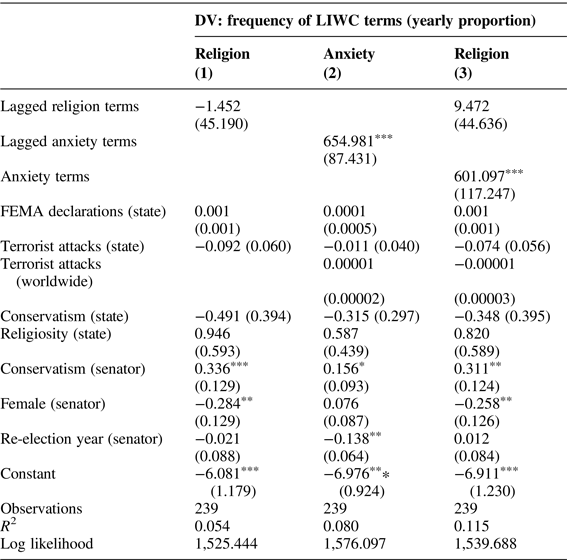
Models suggest that anxiety-related rhetoric is associated with religious rhetoric but that these dynamics are not shaped by the real-world events we consider here. Specifically, Models 1 and 2 (Table 1) demonstrate no clear association between real anxiety-inducing events (e.g., state-level FEMA declarations, state-level terrorist attacks, or international terrorist attacks) and either a senator's religious rhetoric (Model 1) or a senator's anxiety-related rhetoric (Model 2). Traumatic or anxiety-inducing real-world events do not, alone, appear to elicit uniquely religious or anxiety-related rhetoric. We therefore do not find support for H1; real natural disasters or security threats predict neither religious rhetoric nor anxiety-related sentiments among senators' websites.
Model results

Model: beta regression: ∗p < 0.1; ∗∗p < 0.05; ∗∗∗p < 0.01.
Next, we explore the relationships between public displays of anxious rhetoric and religious rhetoric, controlling for real-world traumatic events. Model 3 (Table 1) demonstrates a strong, statistically significant (p < 0.01), positive relationship between anxiety-related rhetoric and public-facing religiosity (religious rhetoric). Senators who publicly use anxious rhetoric are likely to frequently invoke public-facing religiosity (Model 3). This result supports H2. Given Model 2's results, we expect that Model 3 is not simply capturing anxiety rhetoric as a proxy for real-world events (see Robustness Checks). Instead, there is an independent, strong relationship between senators' anxious public sentiments and their public-facing religiosity, which is stable across various model specifications.
All models confirm expectations about the relationships between senator-level demographics and senators' use of religious rhetoric. Consistent with existing research, male senators and conservative senators are more likely to use religious rhetoric than their peers.Footnote 22 State-level political ideology and religiosity does appear to shape a senator's use of religious rhetoric.
This analysis suggests that, in their macro-level political communication profiles, senators display anxiety-related sentiments and religious rhetoric concomitantly. However, this association exists independently of state disasters or security threats. Senators may be unknowingly, intentionally, or even strategically using their broad public profiles to promulgate anxious sentiments among their constituents and then offering their constituents transcendental comforts to assuage those anxieties.
Robustness Checks and Endogeneity Concerns
We conduct several robustness checks to evaluate the stability of our findings and address potential endogeneity concerns. First, we re-estimate our models using an alternative list of religious terms as the basis for measuring senators' religious rhetoric. Chapp (Reference Chapp2012) generated a list of politically mobilized religious words, based on the words used by 2012 presidential candidates on the campaign trail. This alternative list of religious terms (also measured as a yearly proportion of a senator's overall website text) yields results that are very similar to those from models based on LIWC's religious terms (Table 4 in Appendix C).
Second, post-9/11 associations between Islam and terrorism could yield false positive results between anxiety and religious rhetoric. This paper argues that senators will invoke religious rhetoric as a recourse or a source of support during times of perceived anxiety. However, after the 9/11 terrorist attacks, an increased number of U.S. senators rhetorically framed Islam as a security issue (Coen Reference Coen2017).Footnote 23 Elites who engage in this behavior are part of a prominent trend—which accelerated after 9/11—that makes erroneous heuristic associations between Islam, American Muslims, and terrorism (Nacos and Torres-Reyna Reference Nacos and Torres-Reyna2007; Sayyid Reference Sayyid2014; Considine Reference Considine2017; Lajevardi and Oskooii Reference Lajevardi and Oskooii2018). In this political context, select co-occurrences of anxiety-related terms and Islam-specific religious terms could represent political elites' securitization of Islam rather than their use of religious concepts to counteract anxiety or perceptions of insecurity. In our analysis, this dynamic would therefore interject a false positive association between anxiety- and religious-related terms. We account for this potential validity threat by replicating models on a subset of LIWC religious terms that exclude those specific to Islam. This model retains the strength and significance of our main results (Table 5 in Appendix C).
Third, senators' condolences of “thoughts and prayers” amid tragedy or turmoil could be driving our results. This common invocation of a religious concept is consistent with our theory. However, if it was the sole driver of our results, this would weaken the theory's broader applicability. We therefore re-estimate our analysis on a subset of religious terms that excludes “prayer(s).” This exclusion does not significantly alter our main findings (Table 6 in Appendix C).
Finally, we consider whether our explanatory and outcome variables share structural similarities. Concepts measured by congressional website text data are likely to be structurally related to one another, regardless of content; rhetoric is more likely to be related to other forms of rhetoric than it is to anything else. It may therefore be unsurprising that our models demonstrate strong associations between demonstrations of anxiety and public-facing religiosity. To address this concern, we replicate our analysis with two other concepts measured as a yearly proportion of overall website text: LIWC's optimism-related terms and the U.S. Department of Homeland Security's defense-related terms—a list of terms that the DHS uses to search social media to identify potential and unfolding threats to the United States or its citizens (DHS, 2018).Footnote 24 Some measures of speech (e.g., DHS terms) do not significantly relate to religious rhetoric and other measures of speech (e.g., optimism terms) demonstrate a considerably weaker association with religious rhetoric, relative to the association between anxiety and religious rhetoric (Table 7 in Appendix C). Relative to other measures of speech, anxiety terms have a uniquely strong association with religious rhetoric. Each of these robustness checks supports and reinforces the reliability of our main model results and conclusions. We therefore remain confident in our conclusion that a uniquely meaningful relationship exists between senators' use of anxiety-related terms and their invocation of public-facing religiosity.
CONCLUSIONS AND CONTRIBUTIONS
In this paper, we leveraged a truly “big data” source—the IA's 90-terabyte collection of content from the U.S. government's Internet domain—to contribute new insights about U.S. senators' use of religious rhetoric in public constituent communication. We used election-year congressional website data to examine the relationships between senators' displays of anxious sentiments and their use of public-facing religiosity. We find that senators who publicly display anxious sentiments in a given year (regardless of real anxiety-inducing state-level events) are strongly likely to invoke public-facing religiosity. As part of their broad public profile, we suggest that senators appear to be presenting and promulgating anxious sentiments alongside modeling religious beliefs as a mechanism for comfort to assuage this public anxiety. In this study, we focused on U.S. senators, which allowed us to consider relevant state-level variables (including real-life events and constituent ideologies), identify generalizable results, and conduct a “tougher” test for our theory (relative to more granular district-level unit of analysis). Future research should extend this study to members of the U.S. House of Representatives, which are likely to demonstrate greater variation in religious rhetoric.
Our findings introduce four important substantive research agendas about the relationships between insecurity, public anxiety, and political religious rhetoric. First, our analysis demonstrates a disconnect between real-world events and anxiety-based rhetoric. What, then, are the sources of this anxiety? Are senators offering anxious sentiments (which do not reliably reflect real-world traumatic events) and transcendental comforts unknowingly, intentionally, or strategically? Existing research on the securitization of politics demonstrates that political elites can cultivate or even manufacture social anxieties and perceptions of insecurity to advance their own political objectives (Newman et al. Reference Newman, Merolla, Shah, Lemi, Collingwood and Karthick Ramakrishnan2019). By framing an issue as a national security threat, for example, legislators cultivate fear, give the issue greater political urgency, move the issue beyond the realm of normal politics, and justify suspending “normal” democratic rules and procedures (Lausten and Wæver Reference Lausten and Wæver2000; Williams Reference Williams2003; Rythoven Reference Rythoven2015; Mulherin and Isakhan Reference Mulherin and Isakhan2019). In the global North, social and political elites advance perceptions of security threats to justify policies that racialize or otherize Muslims (Nacos and Torres-Reyna Reference Nacos and Torres-Reyna2007; Hussain and Bagguley Reference Hussain and Bagguley2012; Collingwood, Lajevardi and Oskooii Reference Collingwood, Lajevardi and Oskooii2018; Dana et al. Reference Dana, Lajevardi, Oskooii and Walker2018; Lajevardi and Oskooii Reference Lajevardi and Oskooii2018; Breen and Meer Reference Breen and Meer2019; Oskooii, Lajevardi and Collingwood Reference Oskooii, Lajevardi and Collingwood2019) and cast immigrants as threatening “outsiders” (Kanstroom Reference Kanstroom2004; Miller Reference Miller2005; Watson Reference Watson2007). When elites present specific religious (e.g., Christian or Jewish) frameworks as sources of comfort amid heightened senses of threat, they could further solidify group identities and otherize certain Americans. Additional research that examines senators' motivations for their anxiety-related rhetoric, and the effects that the associated religious rhetoric has on U.S. group identities and racialized attitudes, could further advance our knowledge about both the intentionality and the racializing implications of this securitization of politics.
Second, how do these broad associations between anxiety and religion emerge in more granular time periods? We examined whether anxious sentiments and religious rhetoric are associated within a senator's broad political communication profile. Senators who couple anxiety-related sentiments in one week with religious rhetoric the next contribute to a macro-level political narrative that associates these two concepts. Textured qualitative work should explore the mechanisms that connect anxiety and religion in political spaces. Future research should additionally examine the relational proximity of these associations (e.g., whether and when these associations occur in a given press release). Researchers could conjoin our approach to measuring public-facing religiosity with computer science approaches (e.g., Natural Language Processing) to examine these relational associations and to identify legislators' associations between religious rhetoric and specific policy areas.
Third, how do these dynamics vary across an increasingly diverse U.S. Congress roster? What are the implications of these associations between anxiety and religious rhetoric, particularly for senators who identify with groups typically under-represented in American politics? Considering that employing religious rhetoric is uniquely advantageous to white, male, Christian politicians, legislators from other identity groups may face increased racial or gender-based discrimination if they invoke religious rhetoric. Future research should consider whether U.S. senators or representatives from various identity groups use, or avoid, public-facing religiosity in substantively distinct ways. Relatedly, religious rhetoric may enable certain legislators to construct, codify, and elevate perceptions of anxiety or national-security threats. As some political elites leverage public anxiety and religious rhetoric to advance racialized associations between Islam and security threats, for example, how do these associations impact Muslim American politicians and communities?Footnote 25
Finally, researchers should examine the future stability of these anxiety-religion associations. Recent outrage against American gun violence has demonstrated a growing intolerance among some American demographics toward policymakers' offers of religiously grounded “thoughts and prayers” alongside policy inaction. Similarly, images of prayers in the Oval Office alongside the U.S. government's protracted public-health response in the early stages of the 2020 coronavirus pandemic attracted opprobrium among select Americans (Barber and Wilson-Hartgrove Reference Barber and Wilson-Hartgrove2020). Do these recent events demonstrate an emerging public demand that legislators dislodge their invocation of religious rhetoric from times of public crisis? The measures and methods we model here will prove crucial for tracking these and other possible shifts in the role religion plays in American politics.
In addition to advancing our understanding about how legislators invoke religious concepts in their public-facing communication, the research we presented here models a novel approach for using “big data” sources in an empirically grounded manner to answer previously unapproachable questions. Few social science studies have leveraged the potential power of these archived Internet resources, the use of which are at the frontiers of social science text-as-data analyses. This paper therefore lays the groundwork for scholars to catalyze archived Internet data to develop scalable, time-variant measures of legislators' religious identities and political behavior.
Supplementary material
The supplementary material for this article can be found at https://doi.org/10.1017/S1755048320000322.