For over three decades, family scholars have been interested in documenting the nature and direction of the relationship between interparental conflict and parenting behaviors. As the predominant conceptual model in the literature, the spillover hypothesis proposes that the negative affect and emotion arising from interparental conflict sets in motion processes that ultimately negatively influence interactions within the parent–child system (Easterbrooks & Emde, Reference Easterbrooks, Emde, Hinde and Stevenson-Hinde1988, Grych, Reference Grych and Bornstein2002). A large body of research has shown that interpartner relationships characterized by conflict, anger, and aggression have substantial negative implications for caregiving behaviors (e.g., Levendosky, Leahy, Bogat, Davidson, & von Eye, Reference Levendonsky, Leahy, Bogat, Davidson and von Eye2006; Margolin, Gordis, & Oliver, Reference Margolin, Gordis and Oliver2004; Margolin & John, Reference Margolin, John, Kaufman and Jasinski1997; Sturge-Apple, Davies, Cicchetti, & Manning, Reference Sturge-Apple, Davies, Cicchetti and Manning2010; Sturge-Apple, Davies, & Cummings, Reference Sturge-Apple, Davies and Cummings2006a).
In contrast, however, a smaller body of work has documented that interpartner difficulties may be associated with more effective parenting practices (Casanueva, Martin, Runyan, Barth, & Bradley, Reference Casanueva, Martin, Runyan, Barth and Bradley2008; Letourneau, Fedick, & Willms, Reference Letourneau, Fedick and Willms2007; Levendosky, Huth-Bocks, Shapiro, & Semel, Reference Levendosky, Huth-Bocks, Shapiro and Semel2003). The compartmentalization hypothesis puts forth the central idea that parents may be able to separate their roles as spouse/partner and parent, effectively establishing an affective boundary between these relationships (Grych, Reference Grych and Bornstein2002). Thus, although parents may experience elevated levels of interpartner conflict, they are able to continue to provide effective and responsive caregiving to their children.
Testing the viability of these two hypotheses, the results of two large-scale meta-analytic reviews of the empirical landscape concluded that the association between higher levels of interpartner conflict and diminished parenting practices as proposed in the spillover hypothesis is more strongly supported by the available data (Erel & Burman, Reference Erel and Burman1995; Krishnakumar & Buehler, Reference Krishnakumar and Buehler2004). However, a central limitation of empirical efforts has been the reliance upon linear continua to characterize functioning across these family subsystems. This approach may detect the predominant process of spillover at the expense of failing to identify interdependencies between interpartner and parenting subsystems reflected in compartmentalizing accounts that are somewhat less common yet still highly significant, particularly from a developmental psychopathology perspective. Accordingly, the present study seeks to employ a person-based approach to determine whether these differentiated profiles of associations between interpartner conflict and maternal parenting practices can be identified within a single sample.
A Person-Based Approach to Links Between Interpartner and Parenting Domains
Person-based approaches focus on patterns in relationships across variables and use this information to cluster individuals. Researchers have increasingly called for the utilization of these methods in family science toward identifying multiple, nonlinear configurations (e.g., Magnusson & Bergman, Reference Magnusson, Bergman and Rutter1988; Mandara, Reference Mandara2003; Maughan & Cicchetti, Reference Maughan and Cicchetti2002; Sturge-Apple, Davies, & Cummings, Reference Sturge-Apple, Davies and Cummings2010). Toward this objective, recent empirical endeavors have illustrated the utility of person-based approaches to identify conceptually meaningful profiles of family functioning across multiple subsystems, including interpartner, co-parental, and parent–child domains (e.g., Belsky & Fearon, Reference Belsky and Fearon2004; Davies, Cummings, & Winter, Reference Davies, Cummings and Winter2004; Mandara & Murray, Reference Mandara and Murray2002). However, despite the potential significance and clinical utility of differentiating both spillover and compartmentalizing patterns of functioning, to our knowledge no study has employed a pattern-based approach to delineate these profiles.
Previous work utilizing a person-based approach has demonstrated some support for the expectation that these profiles may emerge. In particular, Belsky and Fearon (Reference Belsky and Fearon2004) applied a latent class analysis to interpartner and parenting domains, and they identified four differentiated patterns of functioning, including good marriage/good parenting, poor marriage/good parenting, good marriage/poor parenting, and poor marriage/poor parenting. Although this study provided a useful first step in examining differences in the interplay between marital and parenting quality, it was not specifically designed to distinguish spillover and compartmentalizing models given the focus on marital intimacy and parenting sensitivity. These constructs are adept at capturing variability in supportive processes across families; however, spillover and compartmentalization models focus on how caregivers parent in the face of destructive interpartner disputes characterized by escalating hostility, aggression, and detachment. In addition, Belsky and Fearon focused exclusively on parental sensitivity within their typology. Evidence suggests that family antecedents of parenting may vary across parenting dimensions (Pettit, Laird, Bates, Dodge, & Criss, Reference Pettit, Laird, Bates, Dodge and Criss2001), and empirical work has linked interpartner conflict with an array of parenting difficulties, including insensitivity, diminished warmth, and harsh discipline (e.g., Levendosky et al., Reference Levendonsky, Leahy, Bogat, Davidson and von Eye2006; Margolin & John, Reference Margolin, John, Kaufman and Jasinski1997; Owen, Kaslow, & Thompson, Reference Owen, Kaslow and Thompson2006; Sturge-Apple, Davies, & Cummings, Reference Sturge-Apple, Davies and Cummings2006b). Therefore, to provide a more definitive test of parenting within spillover and compartmentalization patterns, we assessed the two broad dimensions of maternal caregiving practices, including sensitivity and discipline practices, in our analysis.
To further build upon previous endeavors, the present study examines interpartner-parenting patterns within a racially and ethnically diverse and socioeconomically disadvantaged sample. Scholars have demonstrated that profiles of family functioning predicated on conceptualizations drawn from Eurocentric theory may not necessarily hold when empirically tested within diverse family contexts (e.g., Hill, Reference Hill1995; Mandara & Murray, Reference Mandara and Murray2002). This may be particularly true for models of interpartner conflict and parenting processes. For example, ethnic minority families may be at increased risk for more pervasive and pernicious forms of interpartner conflict and violence as well as relationship dissolution in comparison to European American families (Fragile Families and Child Wellbeing Study, 2004; McLoyd, Harper, & Copeland, Reference McLoyd, Harper, Copeland, Grych and Fincham2001). In addition, the meaning of marriage may differ across ethnic groups, with African Americans being more likely to cohabitate compared to European Americans (Clayton, Mincy, & Blankenhorn, Reference Clayton, Mincy and Blankenhorn2003; Goldstein & Kinney, Reference Goldstein and Kinney2001). Furthermore, family functioning and family structure may look very different depending upon economic circumstances. In particular, the family stress model proposes that economic upheaval and impoverishment may be particularly likely to undermine family dynamics (Conger & Conger, Reference Conger and Conger2002; Conger et al., Reference Conger, Wallace, Sun, Simons, McLoyd and Brody2002). Empirical tests of the family stress model have shown that financial instability and economic problems are associated with lower levels of marital quality, and they may play a role in family formation with less stable living arrangements and higher instability in home environments (e.g., Amato, Booth, Johnson, & Rogers, Reference Amato, Booth, Johnson and Rogers2007; Dakin & Wampler, Reference Dakin and Wampler2008; Falke & Larson, Reference Falke and Larson2007). Socioecological models have also theorized that neighborhood characteristics such as community violence and chaos associated with disadvantaged living circumstances may also place families at greater risk for higher levels of conflict and lack of cohesion (e.g., Cooley, Turner, & Beidel, Reference Cooley, Turner and Beidel1995; Lynch & Cicchetti, Reference Lynch and Cicchetti1998; Margolin & Gordis, Reference Margolin and Gordis2000; Wadsworth & Compas, Reference Wadsworth and Compas2002). Given that ecological conditions surrounding the family are not nearly as resource rich and benign as many early studies on spillover and compartmentalizing processes assume, the current study allows for a powerful test of the generalizability of associations proposed in these models through examining these profiles within a disadvantaged and ethnically heterogeneous sample.
Sociocontextual Predictors of Interpartner-Parenting Types
Consistent with the transactional, ecological systems approach of developmental psychopathology (e.g., Cicchetti & Lynch, Reference Cicchetti and Lynch1993; Cicchetti & Toth, Reference Cicchetti, Toth, Luthar, Burack, Cicchetti and Weisz1997), models of family process underscore the value of identifying sociocontextual factors that may impact associations between interpartner relationships and parenting (e.g., Belsky, Reference Belsky1984). Process-oriented research has documented the interplay among family characteristics, parental psychological problems, and child characteristics in association with family processes. In particular, parental occupational status, family instability, and family support may constitute central family-level factors that may be potent influences in interpartner-parent patterns of functioning (Ackerman, Kogos, Youngstrom, Schoff, & Izard, Reference Ackerman, Kogos, Youngstrom, Schoff and Izard1999).
In addition, developmental psychopathology models of parental psychological problems testify to their importance in understanding their impact on family dynamics (Cicchetti & Toth, Reference Cicchetti and Toth1998; Goodman & Gotlib, Reference Goodman and Gotlib1999). For example, parental depressive symptoms have been identified as a consistent correlate of interpartner aggression and hostility (Cummings, Keller, & Davies, Reference Cummings, Keller and Davies2005; DuRocher Schudlich & Cummings, Reference Du Rocher Schudlich and Cummings2003) and have been unequivocally associated with perturbations in maternal parenting behaviors (Goodman & Gotlib, 2002). With respect to the influence of these sources of risk and support in person-based approaches to interpartner and parent dynamics, Belsky and Fearon (Reference Belsky and Fearon2004) demonstrated that families within a profile defined by low interpartner intimacy and diminished parenting sensitivity evidenced the highest levels of risk, including the lowest levels of social support, occupational status, and family income coupled with elevated maternal depressive symptoms. Therefore, the current study will examine how these factors may serve as potential predictors of profile membership and test whether the pattern of associations is similar within a more socioeconomically disadvantaged sample.
Finally, sociocontextual frameworks also propose that child characteristics may serve as an important source of influence on family functioning. Reflecting traitlike ways of behaving that are largely constitutional in origin and stable across time and context (McCrae et al., Reference McCrae, Costa, Ostendorf, Angleitner, Hřebíčková and Avia2000; Rothbart & Posner, Reference Rothbart, Posner, Cicchetti and Cohen2006), child temperament may serve as a potential source of heterogeneity in family contexts (e.g., Bates, Schermerhorn, & Petersen, Reference Bates, Schermerhorn, Petersen, Zentner and Shiner2012; Crockenberg & Langrock, Reference Crockenberg, Langrock, Grych and Fincham2001; Feinberg, Reference Feinberg2003). In particular, the present study focused on difficult temperament (i.e., high negative emotionality, proneness to distress, low adaptability, and high activity level; Chess & Thomas, Reference Chess, Thomas, Kohnstamm, Bates and Rothbart1989), given that these characteristics may be particularly challenging for family dynamics. Research in the parenting realm has demonstrated that infant and toddler difficult temperament is associated with less optimal caregiving, including emotional unavailability and harsh/punitive parenting (e.g., Bates et al., Reference Bates, Schermerhorn, Petersen, Zentner and Shiner2012; Braungart-Rieker, Garwood, & Stifter, Reference Braungart-Rieker, Garwood and Stifter1997; Kiff, Lengua, & Zalewski, Reference Kiff, Lengua and Zalewski2011). A smaller corpus of studies has attempted to chart associations between interpartner relationships and child temperament, and the results have been less than conclusive. For example, Katz and Gottman (Reference Katz and Gottman1993) found no associations between parental ratings of difficult child temperament and a range of marital constructs, including satisfaction, hostility, and withdrawal. However, several studies have linked difficult infant temperament to decline in marital quality (e.g., Belsky & Rovine, Reference Belsky and Rovine1990; Levy-Shiff, Reference Levy-Shiff1994). Perhaps discrepancies lie in the potential interactive effect that temperament may have on family processes. Thus, the present study investigated whether child temperament was differentially linked to interpartner-parenting profiles in the current sample. Research examining child temperament within spillover and compartmentalization models have been largely absent in empirical studies; however, based upon previous work, we hypothesized that difficult temperament would be primarily associated with the spillover profile.
Developmental Outcomes Associated With Interpartner/Parenting Typology
The utility of interpartner-parenting profiles for developmental science is predicated on whether they have meaningful associations with children's long-term outcomes. Results of studies highlight substantial diversity in the unfolding pathways between interpartner conflicts, dimensions of parenting, and children's adjustment (e.g., Buehler, Anthony, Krishnakumar, & Stone, Reference Buehler, Anthony, Krishnakumar and Stone1997; Sturge-Apple, Skibo, & Davies, Reference Sturge-Apple, Skibo and Davies2012). However, research utilizing interpartner-parenting typology approaches to family dynamics and child outcomes has been rather scarce. In their paper, Belsky and Fearon (Reference Belsky and Fearon2004) tested the developmental sequelae of children at first grade and reported that children within the low marital quality/poor parenting profile evidenced the highest levels of externalizing symptoms. In contrast, they found that children did not differ across interpartner-parenting profiles on internalizing symptoms. These findings are illuminating; however, the static nature of the outcome assessment does not allow for tests of developmental change over time. Thus, the present study sought to test differences in trajectories of children's internalizing and externalizing symptoms associated with interpartner-parenting profile membership.
From a process-oriented perspective, the present study further examined how children's physiological functioning may underlie their psychological adaptation to family environments. Consistent with calls to integrate the study of the limbic–hypothalamic–pituitary–adrenocortical system in risky family environments (Cicchetti, Reference Cicchetti2002, Reference Cicchetti2011; Repetti, Robles, & Reynolds, Reference Repetti, Robles and Reynolds2011), we specifically investigate how changes in children's adrenocortical activity may underlie changes in children's psychological adjustment across family profiles. During the course of early childhood, the hypothalamic–pituitary–adrenal (HPA) axis is socially regulated and susceptible to contextual sources of stress, such as interpartner conflict and parenting disturbances (e.g., Blair et al., Reference Blair, Raver, Granger, Mills-Koonce and Hibel2011, Gunnar & Vazquez, Reference Gunnar, Vazquez, Cicchetti and Cohen2006; Tarullo & Gunnar, Reference Tarullo and Gunnar2006). Progressive changes in physiological activity are proposed to occur through the process of allostasis in which biological “set points” are altered in order to generate the physiological resources necessary to successfully cope with stressful events (McEwen, Reference McEwen1998). Recurring cycles of allostasis may result in progressively greater changes in the operation of children's stress-sensitive neurobiological systems. Over time, the resulting allostatic load is reflected in deterioration of neurodevelopmental systems and increases in psychological problems (Cicchetti, Reference Cicchetti2002; Repetti et al., Reference Repetti, Robles and Reynolds2011; Susman, Reference Susman2006). Thus, the HPA system may be a central construct underlying children's psychological adaptation to stressful interpartner-parenting dynamics.
A corpus of empirical research examining children's basal set points in the HPA axis in relation to psychological adjustment has born this assertion out. Low basal cortisol has been reported in children with externalizing problems (Gunnar & Vazquez, Reference Gunnar and Vazquez2001; Klimes-Dougan, Hastings, Granger, Usher, & Zahn-Waxler, Reference Klimes-Dougan, Hastings, Granger, Usher and Zahn-Waxler2001; McBurnet, Lahey, Rathouz, & Louber, Reference McBurnett, Lahey, Rathouz and Loeber2000; Pajer, Gardener, Rubin, Perel, & Neal, Reference Pajer, Gardner, Rubin, Perel and Neal2001; Shirtcliff, Granger, Booth, & Johnson, Reference Shirtcliff, Granger, Booth and Johnson2005). Cortisol has also been implicated in the development of internalizing symptoms including depression and anxiety (e.g., Adam, Sutton, Doane, & Mineka, Reference Adam, Sutton, Doane and Mineka2008; Buss, Davis, & Kiel, Reference Buss, Davis and Kiel2011; Wilkinson & Goodyer, Reference Wilkinson and Goodyer2011). Previous work has specifically identified that underactivation of the HPA axis is associated with elevated depressive symptoms, particularly within more stressful living environments (e.g., Badanes, Watamura, & Hankin, Reference Badanes, Watamura and Hankin2011; Rogosch, Dackis, & Cicchetti, Reference Rogosch, Dackis and Cicchetti2011). However, whether specific constellations of environmental risks that children experience interact with allostatic load on the HPA system to predict the development of internalizing and externalizing problems in early childhood remains largely unknown. To address this gap, we tested whether links between changes in children's basal cortisol functioning were associated with their psychological adjustment. Drawing from previous work on allostatic load models within family contexts, we hypothesized that links between cortisol and psychological problems would be particularly pronounced within more caustic family environments such as those present in spillover patterns of functioning.
In summary, the present study seeks to determine the presence of both spillover and compartmentalizing patterns through applying a person-based approach in identifying interpartner-parenting profiles. Toward achieving methodological rigor, we incorporate both self-report and observational assessments of interpartner and parent–child subsystems to allow for a more fine-grained evaluation of these family relationships. Finally, as an initial foray into testing differences in children's basal cortisol levels and children's psychological adaptation over time, we employed a multimethod, prospective measurement design.
Methods
Participants
Participants were drawn from a larger study of 201 mothers and their 2-year-old child who resided in a moderately sized metropolitan area in the northeastern United States and included 192 dyads for whom we had completed interpartner and parenting assessments at Wave 1. Because of the focus on understanding differences in how children cope with significant family adversity, a two-step recruitment procedure was implemented. In the first step, to achieve a relatively homogeneous sample with respect to socioeconomic status, participants were recruited through local agencies in contact with high-risk, low socioeconomic status families such as Women Infant and Children offices, the Temporary Assistance for Needy Families program, and from the county family court system. In the second step, to maximize variability in exposure to interpartner conflict in our sample, mothers completed an abbreviated form of the physical assault subscale of the Conflict Tactics Scale 2 (Straus, Hamby, Boney-McCoy, & Sugarman, Reference Straus, Hamby, Boney-McCoy and Sugarman1996). Using recommended scale criteria, screening procedures were implemented to ensure that relatively equal proportions of participating mother–child dyads were represented along three bands in the interpartner violence continuum: severe, mild to moderate, and no interpartner violence. Additional inclusionary criteria for the study consisted of the following: (a) the adult female participant is the biological mother and primary caregiver of the target child; (b) the child participant is 27 months old (±5 months); and (c) the child has no serious cognitive, sensory, or motor impairments.
With respect to marital status, 63% of the sample reported being never married/living with someone, 23% were married, 5% were widowed, and 9% were separated. In the sample, 73% of the child participants lived with the biological mother and biological father. The remaining children in the study lived with the mother and the target partner was either a stepfather or a partner. With respect to whether the partners were in the home, we did not ask specifically if the partner was in the home, but inclusion criteria required that mother, her partner, and the target child were together at least 1 day every 2 weeks for the past year. Median annual income for the family household was $18,300 (US) per year and a substantial minority of mothers (30%) and their partners (24%) did not complete high school. Most families received public assistance (95%) and were impoverished according to the US Federal Poverty Guidelines (99.5%). The mean age of the children at Wave 1 was 26 months (SD = 1.69), with 44% of the sample consisting of girls (n = 84). The majority of participants were Black (56%), followed by smaller proportions of family members who identified as White (23%), Latino (11%), multiracial (7%), and other (3%).
The cumulative retention rate across the measurement occasions was 86%. The sample size at each wave is as follows: Wave 1, n = 192; Wave 2, n = 166; and Wave 3, n = 173. Because of the highly mobile and at-risk nature of the families, it was difficult to successfully locate and conduct the visits within the annual measurement occasions; however, we were able to retain back into the study at Wave 3 seven of the mothers who were not able to complete the study at Wave 2. To test for selective attrition, we conducted statistical comparisons between the mother–child dyads who participated through the measurement occasions and dyads who dropped out during the longitudinal component of the study along 36 variables comprising the primary variables, covariates, and demographic characteristics at Wave 1 (e.g., family income, maternal education, and maternal and child race). No significant differences were identified in the analyses.
Procedures
Data for this study were collected at three measurement occasions each spaced 1 year apart. At each wave, mothers and children visited our research laboratory two times within a period of approximately 2 weeks. Procedures used in the present study are described within their associated measure. Observational assessments were scored using coding teams across the tasks, which consisted of graduate students and research associates who were not involved with data collection. Coding across the different tasks was supervised by the first and second authors with respect to training and reliability. To minimize methodological overlap, different tasks were coded by different coders. The research procedures were approved by the institutional review board at the research site prior to conducting the study.
Measures
Interpartner conflict
Multimodal assessments were used as indicators of interpartner conflict. Mother reported on their own and their partner's conflict tactics using the Conflict and Problem-Solving Scales (CPS; Kerig, Reference Kerig1996). The verbal aggression, physical aggression, and escalation subscales were selected to index destructive interpartner conflict. Items on verbal and physical aggression scales were rated on a 4-point Likert scale (0 = never, 3 = often) indexing the frequency with which mothers and their partners engaged in (a) conflict tactics such as yelling, accusing, and insulting (e.g., verbal aggression) and (b) conflict tactics such as threatening or inflicting physical harm (e.g., physical aggression). Derived from analytic efforts to identify the multidimensional factor structure underlying the CPS resolution scale (Davies, Cicchetti, & Martin, Reference Davies, Cicchetti and Martin2012), the CPS escalation scale consists of nine items that reflect unsuccessful or destructive ways of ending conflict (e.g., “We feel worse about one another than before the fight” and “We stay mad at one another for a while”). Internal consistency was satisfactory in this sample (αs = 0.87–0.89 across ratings on each subscale), and research supports the validity of the measures (El-Sheikh, Cummings, Kouros, Elmore-Staton, & Buckhalt, Reference El-Sheikh, Cummings, Kouros, Elmore-Staton and Buckhalt2008; Kerig, Reference Kerig1996).
An additional indicator of interpartner conflict was derived from a semistructured, narrative interview with the mother on the Interparental Conflict Characteristics Module of the Interparental Disagreement Interview. This measure is designed to assess the frequency, nature, and course of interpartner conflicts. Video records of the interview were subsequently coded for maternal and partner aggression and anger in interpartner conflicts. Aggression was operationally defined as acts of physical or verbal hostility directed toward the partner in the interpartner relationship, whereas anger was characterized by signs of irritation, tension, anger, or fury. Coders rated each construct along 7-point scales ranging from 0 (no sign of anger/aggression) to 6 (high levels of anger/aggression that reflect considerable dysregulation, disorganization, or loss of control). Because of high correlations between ratings of partner and spousal aggression (r = .54) and anger (r = .47), the codes were summed together to form target constructs of interpartner aggression and anger. The intraclass correlation coefficients reflecting interrater agreement on 25% of the interviews were 0.92 and 0.80 for respective ratings of aggression and anger.
Parenting practices
Indices of maternal parenting practices were assessed using both maternal self-report and behavioral observation. First, mothers completed the Adult–Adolescent Parenting Inventory (Bavolek, Reference Bavolek1984). The Empathetic Awareness Toward Children's Needs Scale indexes parental sensitivity to the developmental needs of young children (e.g., “Young children who feel secure often grow up expecting too much”). The Physical Punishment Scale assesses maternal endorsement of physical discipline (e.g., “Children should always be spanked when they misbehave”). Ratings were on a Likert-type scale ranging from 1 (strongly agree) to 5 (strongly disagree). The scales had good internal reliability in our sample, with αs of 0.82 for empathetic awareness and 0.87 for physical discipline in our sample.
Second, observer ratings during the free play and compliance tasks were completed using the Iowa Family Interaction Rating Scales (Melby & Conger, Reference Melby, Conger, Kerig and Lindahl2001). Ratings were assessed on 9-point Likert-type scales ranging from 1 (not characteristic at all) to 9 (mainly characteristic). Insensitive/parent-centeredness assessed the extent to which the mothers lack an awareness of the child's needs, moods, interests, and capabilities. As such, interactions with the child are paced to the parent's behavior and mood, are not well timed, and the mother appears to “miss” opportunities to appropriately engage child and enforces rules, regulations, and constraints without considering the child's age-appropriate choice, control, or autonomy. Maternal behaviors that indicated care or support toward the child (e.g., giving praise, smiling or laughing, and showing physical affection) were assessed via the warmth scale. Warmth was rescaled such that higher scores indicated lower affection and lower levels of positive affect. Third, harshness was measured by mother's behaviors that reflect anger, contempt, or harsh rejection of her child. Examples include angry or contemptuous facial expressions, sarcastic tone of voice, and menacing/threatening body posture. The intraclass correlation coefficients, which reflect the interrater reliability of three independent coders for 25% of the interactions, ranged from 0.84 to 0.94 across the three coders across the two interactions.
Difficult child temperament
Following comparable procedures to previous temperament batteries (e.g., Fox, Henderson, Rubin, Calkins, & Schmidt, Reference Fox, Henderson, Rubin, Calkins and Schmidt2001; Kagan, Reznick, & Snidman, Reference Kagan, Reznick and Snidman1987; Putnam & Stifter, Reference Putnam and Stifter2005), children were exposed to a series of novel objects and events during Wave 1. In the first episode, the experimenter escorted the child into the room containing a number of unusual objects (e.g., funnel, goggles, and windshield cover). After the experimenter departed, the child was free to explore the room and play with the objects for 3 min. The experimenter returned and instructed the child to manipulate the objects in different ways (e.g., windshield cover: “Poke it!”; funnel: “Put it on your head!”). In the third episode, an unfamiliar female experimenter dressed as a clown invited the child to play with a sack of toys for 2 min after introducing herself. In the final event, the primary female experimenter instructed the children to imitate the following events after first enacting them herself: (a) reaching behind a black curtain to pull out a doll, (b) placing a finger in glasses of water and prune juice, and (c) picking up a rubber snake and letting it slide back on to the table.
Video records of children's behavioral expressions in response to each of the four unfamiliar episodes were rated by a set of coders along four 5-point scales ranging from 0 (no) to 4 (multiple, intense, and prolonged) indications, to index children's reactivity to novel stimuli and events. Activity level was adapted from previous coding systems (e.g., Fox et al., Reference Fox, Henderson, Rubin, Calkins and Schmidt2001; Putnam & Stifter, Reference Putnam and Stifter2005), and assessed presence and quality of gross motor activity in each episode using a scale ranging from 0 (none = child is completely or nearly still) to 4 (intense = child engages in multiple, intense gross motor activity throughout the segment). Approach reflected physical movement toward the novel stimuli that was commonly accompanied by self-confidence, unbridled curiosity, and excitement about the objects or events. Avoidance assessed the extent to which the child actively avoided or withdrew from stimuli such as covering eyes, hiding, or asking to go home. Inhibition characterized children's tendency to restrain behavior in order to assess the situation through signs of vigilance and hesitant or apprehensive forms of curiosity. Finally, dominant negative affect was defined as children's displays of frustration, anger, hostility, and aggression. Two coders, who were extensively trained to reliability, were randomly assigned to code approximately 60% of the children in the unfamiliar episodes, overlapping on approximately 24% of the video records for purposes of calculating reliability. Intraclass correlation coefficients, which examined interrater reliabilities, ranged from 0.89 to 0.96. Because of the satisfactory internal consistency of each of the temperament codes across the four novel episodes (αs = 0.74–0.82), the ratings of each code were aggregated across the episodes to obtain composites of the five temperament dimensions. To test if assessed dimensions are reflected along a temperament continuum, a principal components analysis with varimax rotation was performed on the five temperament composites. Inspection of the eigenvalues (>1) and scree plot supported a single-factor solution. The solution accounted for 66% of the variance. Consequently, after reverse scoring the avoidance and inhibition variables, we aggregated the indices to create a single, internally consistent (α = 0.78) composite of difficult temperament.
Occupational status
Mothers completed a demographic interview to obtain measures of their occupational status. Our assessment of occupational status was based upon the Hollingshead Occupational Score (Hollingshead, Reference Hollingshead1975) and was based on all mothers and their usual occupation, regardless of whether they were currently employed. Scores ranged from 1 to 7 in the current sample.
Maternal depressive symptomatology
Trained experimenters administered the Computerized Diagnostic Interview Schedule IV (C-DIS-IV; Robins et al., Reference Robins, Cottler, Bucholz, Compton, North and Rourke2000) to mothers to obtain assessments of maternal depressive symptom patterns. The DIS is a structured psychiatric interview originally designed for lay interviewers in the Epidemiological Catchment Area studies. The interview consists of a computer-generated series of structured interviewed questions with “yes” or “no” response alternatives. Consistent with established procedures (Toth, Rogosch, Sturge-Apple, & Cicchetti, Reference Toth, Rogosch, Sturge-Apple and Cicchetti2009), all interviewers were trained to criterion reliability in the administering the DIS. C-DIS-IV modules were utilized to obtain a continuous index of the presence and absence of DISM-IV symptoms for major depressive disorder module from the C-DIS-IV. Research provides well-documented support for the reliability and validity of the C-DIS-IV (e.g., Compton & Cottler, Reference Compton, Cottler, Hilsenroth and Segal2004; Hofstra, van Der Ende, & Verhulst, Reference Hofstra, van Der Ende and Verhulst2001; Melchior et al., Reference Melchior, Caspi, Milne, Danese, Poulton and Moffitt2007; Toth et al., Reference Toth, Rogosch, Sturge-Apple and Cicchetti2009).
Family instability
Mothers completed the Family Instability Questionnaire (FIQ; Ackerman et al., Reference Ackerman, Kogos, Youngstrom, Schoff and Izard1999; Forman & Davies, Reference Forman and Davies2003). The FIQ asks caregivers to report on the cumulative occurrences of eight disruptive family events over the past 3 years across domains of (a) caregiver changes, (b) residential changes, (c) caregiver intimate relationship changes, (d) job/income loss, and (e) family member death. The validity of the FIQ is supported by its theoretically meaningful ties to child adjustment (Forman & Davies, Reference Forman and Davies2003).
Family social support
Social support was assessed with maternal report on the Social Support Behaviors Scale (Vaux, Riedel, & Stewart). This measure assesses five modes of supportive behavior provided by family members. Mothers reported on the emotional, socializing, practical, financial, and advice scales using a 5-point Likert-type scale, which ranged from 1 (no one would do this) to 5 (most family members would do this). Internal consistency for the measure was α = 0.99.
Children's psychological symptoms
Mothers completed the Child Behavior Checklist (CBCL) at Waves 2 and 3 (Achenbach & Rescorla, Reference Achenbach and Rescorla2000) to assess children's behavioral and emotional difficulties. The CBCL is one of the most widely used standardized measures of children's functioning. Mothers reported on two syndrome scales assessing anxious/depressed symptoms and aggressive behaviors. Internal consistency estimates of the CBCL scales in this sample ranged from 0.64 to 0.91 at Wave 2 and 0.65 to 0.91 at Wave 3.
Salivary cortisol
Basal cortisol measures were obtained through a saliva sample collected from each child at the beginning of the visit to the laboratory. Two samples per wave were obtained during different laboratory visits. The two saliva samples were collected at the beginning of two different visits to the laboratory at each wave. The visits were conducted within 2 weeks of one another on average, and no visits were conducted on the same day. To limit the effects of diurnal patterns, samples were collected within a narrow time window in the morning (M = 9:32 a.m., SD = 30 min). All children had been awake at least 1 hr prior to providing the morning saliva samples, thus avoiding the period of the dynamic cortisol awakening response (Susman et al., Reference Susman, Dockray, Schiefelbein, Herwehe, Heaton and Dorn2007). Children were also monitored to ensure they did not eat or drink for 30 min before sample collection to limit saliva contamination. Because of the age of the participants, a sorbette was held under the child's tongue by a research assistant for 1 min to ensure a sufficient quantity of saliva was obtained. Saliva samples were immediately stored at –36 °C until shipped on dry ice to Salimetrics LC (State College, PA). All samples are assayed for salivary cortisol in duplicate using a highly sensitive enzyme immunoassay (Salimetrics, PA). The test uses 25 µl of saliva per determination, has a lower limit of sensitivity of 0.003 µg/dl, a standard curve range from 0.012 to 3.0 µg/dl, and average intra- and interassay coefficients of variation 3.5% and 5.1%, respectively. Method accuracy, determined by spike and recovery, and linearity, determined by serial dilution, are 100.8% and 91.7%, respectively. Values from matched serum and saliva samples show the expected strong linear relationship, r (63) = .89, p < .0001 (Salimetrics, Reference Salimetrics2005). Cortisol data were checked for possible outliers. If a cortisol value was greater than 3.5 SD away from the means, the value was eliminated and estimated as missing data within Mplus. Cortisol values were significantly correlated within wave and so were averaged to create a composite for each wave. Given the skewed distribution of cortisol, values were log transformed prior to model analyses.
Results
Examination of family typology at Wave 1
Latent profile analysis (LPA; e.g., Hagenaars & McCutcheon, Reference Hagenaars and McCutcheon2002) was utilized to determine interpartner-parenting profiles. LPA is a variant of latent class analysis techniques and is used when the manifest indicators of the categorical latent variable are on a continuous scale. As in other latent variable modeling techniques, the profiles in LPA are not observable directly from the data but are identified based on a function of a set of the continuous manifest indicators. To determine the optimal number of profiles, we used two likelihood tests for comparing nested models, including the Bayesian information criterion (BIC; Schwartz, Reference Schwarz1978) and the Vuong–Lo–Mendell–Rubin (VLMR) likelihood ratio test (Lo, Mendell, & Rubin, Reference Lo, Mendell and Rubin2001). The model with the lowest BIC value is generally considered the best-fitting model. As a further test of model fit, the VLMR provides a p value that indicates whether the k – 1 profile model is rejected in favor of the k profile model (see Nylund, Asparouhov, & Muthen, Reference Nylund, Asparouhov and Muthen2007, for more details). When the p value is nonsignificant, the model with fewer classes is preferred. In addition, we examined model entropy, which is an indicator of the probability of optimal classification. Finally, it is also important to consider the substantive implications of profile solutions when determining optimal number of profiles (e.g., Muthén, Reference Muthén and Kaplan2004).
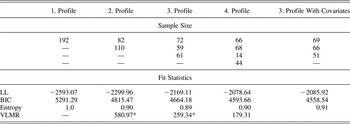
All models were estimated using the latent variable software Mplus, Version 7.0 (Muthén & Muthén, Reference Muthén and Muthén2012). Missing data were estimated using the Mplus maximum likelihood estimation. To examine the best profile solution, we extracted two, three, four latent profiles from our models. Results of the LPA revealed that the three-profile model was the best fitting, most parsimonious representation of the data (Table 1). In particular, the VLMR indicated that the three-profile solution was a significantly better fit than a two-profile solution, and the VLMR indicated that the four-profile solution did not provide a statistically improved fit relative to the three-profile solution. Furthermore, model entropy in the three-class solution was at an acceptable level. In the present study, average latent class probabilities for most likely latent class membership by latent class were excellent. Specifically, posterior probabilities of being classified into most likely class ranged from 0.94 to 0.96. Finally, with respect to substantive considerations, the three-profile solution cohered into adequate functioning, spillover, and compartmentalized patterns among indicator variables. Although the BIC suggested that the four-profile solution may provide better fit, inspecting the profiles revealed that the additional profile in the four-profile solution (n = 14) was similar in nature to the spillover class in the three-profile solution. Given the results from the fit statistics, conceptual interpretations, and the low sample size and conceptual overlap in the additional class within the four-class solution, we retained the three-profile solution.
Fit statistics for latent profile models

Note: The sample size is based upon estimated counts for latent classes based upon posterior probabilities. LL, log likelihood; BIC, Bayesian information criteria; VLMR, Vuong–Lo–Mendall–Rubin likelihood ratio test of additional class.
*p < .05.
For each family, the LPA analysis produces posterior (Bayesian) probabilities of likelihood of membership in each latent profile, and Mplus classifies families into the latent profile for which their posterior probability is highest. The probabilities are a function of the model's parameters (estimated conditional response probabilities and estimated prevalence of each latent class). It is important in LPA to inspect individual cases to ensure distinction in profile probability. Inspection of the cases revealed that five families displayed some indiscrimination among profiles. Their highest profile probability (range = .49–.52), coupled with high cross profile probabilities (range = .42–.45) among the other profiles, suggested that they could not be validly classified within one of the three latent profiles (e.g., Nagin, Reference Nagin2005). Therefore these families were not retained in further analyses.
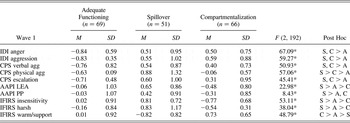
Table 2 shows the means and standard deviations of the standardized measures of family process for each of the three family profiles identified by the LPAs as well as the results of analysis of variance comparisons among the groups. The adequate profile displayed low levels of interpartner violence and conflict, maternal harsh and punitive parenting, and average levels of parental insensitivity and warmth. Families in the spillover profile displayed very high levels of interpartner violence and conflict along with high levels of maternal harsh, punitive, insensitive parenting coupled with low warmth. Finally, the last profile of families was classified as compartmentalized. This profile was characterized by relatively high levels of interpartner conflict and anger, and high levels of maternal warmth, while also exhibiting low levels of maternal harsh, punitive, and insensitive parenting.
Means, standard deviations, and analysis of variance comparisons of the three latent profile analysis profiles on 10 defining variables

Note: Standardized means are presented for ease of interpretation. Post hoc comparisons used the Tukey honestly significant difference to control for the alpha level. In the post hoc column, a greater than sign (>) refers to significantly larger means and a comma (,) refers to not significantly different at α = .05 level. IDI, Interparental Disagreement Interview; S, spillover; C, compartmentalization; A, adequate functioning; CPS, Conflict Properties Scale; Agg, aggression; AAPI, Adolescent Adult Parenting Inventory; LEA, lack of empathetic awareness; PP, physical punishment; IFIRS, Iowa Family Interaction Rating Scales.
*p ≤ .001.
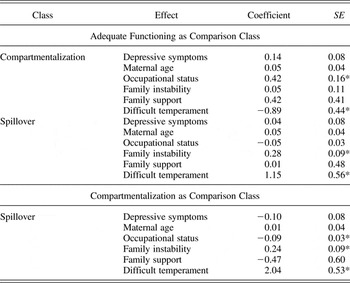
We next examined how sociocontextual background variables were differentially associated with family type. This was accomplished by including covariates in our model analysis as predictors of class membership through logistic regression equations (Table 3). The inclusion of covariates in our analyses did not change the nature of the profiles or membership in a significant way. This suggested that profile membership was not determined on the basis of covariates (e.g., nature of classes identified changes as a function of covariates) but that the covariates were meaningfully related to the three different profiles as identified. Using the adequate profile as the comparison class, logistic regression coefficients revealed that mothers with higher occupational status coupled with lower difficult child temperament were more likely to be in the compartmentalized profile. Families with higher levels of both family instability and difficult child temperament were more likely to be classified within the spillover profile compared to the adequate profile. The comparison with the compartmentalizing and spillover profiles suggested that mothers with lower occupational status scores coupled with higher levels of family instability and difficult child temperament were more likely to be classified within spillover families. No other comparisons were significant.
Logistic regression coefficients for three-class model

*p < .05.
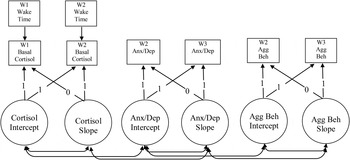
Our final set of model analyses charted changes in children's basal cortisol level and psychological symptoms over time across the different interpartner-parenting typology. To parameterize change within family profiles, we specified a multigroup latent growth curve model across two measurement occasions. These models assess the effects of linear change in basal cortisol levels on linear changes in children's psychological outcomes. A conceptual model is presented in Figure 1. Models were estimated with Mplus, Version 7.0 with maximum likelihood estimation for missing data (Muthén & Muthén, Reference Muthén and Muthén2012).
The conceptual model for latent growth curve analyses examining change over time in developmental outcomes. This model was specified within each interpartner-parenting typology. Anx/Dep, Child Behavor Checklist anxiety/depression; Aggressive Beh, Child Behavor Checklist aggressive behavior; W1, Wave 1; W2, Wave 2; and W3, Wave 3.

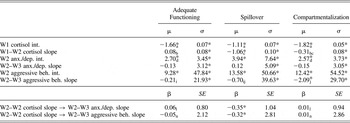
We first examined the unconditional latent growth model for study constructs within the three profile groups. To control for the diurnal pattern on cortisol levels, we followed previous recommendations for controlling for the impact of time of day of assessment in the growth curve analyses (e.g., Davies, Sturge-Apple, Cicchetti, & Cummings, Reference Davies, Sturge-Apple, Cicchetti and Cummings2007; Sturge-Apple, Davies, Cicchetti, & Manning, Reference Sturge-Apple, Davies, Cicchetti and Manning2012). To accomplish this, children's wake-up hour as reported by mothers was regressed onto the manifest cortisol indicators of the respective latent growth curve (see Figure 1). This practice effectively separates the variability in the cortisol value into that attributed to child wake-up time and that attributed to linear change over time via the factor loadings of the growth curve constructs. The model fit the data well, χ2 = 55.01 (54, N = 180), p = .44, root mean square error of approximation = 0.01, comparative fit index = 0.99, χ2/df = 1.02. Slope factor means and variances as well as pairwise comparisons across the three classes are presented in Table 4. With respect to basal cortisol levels, although compartmentalizing and adequate children demonstrated no significant change in cortisol, the spillover group experienced a significant decline in basal cortisol levels from Wave 1 to Wave 2. In addition, this was significantly different from children in the adequate profile although not different from children in the compartmentalizing profile. With respect to psychological adjustment, children in the spillover profile evidenced significantly higher levels of anxiety/depressive symptoms at Wave 2 than did children within other family profiles, and also experienced increases in symptoms over time. Finally, children in the spillover profile had elevated levels of aggressive behavior symptoms at Wave 2 compared to other profiles. Although all groups evidenced decreases in symptoms from Wave 2 to Wave 3, this change was only significant within the compartmentalizing profile.
Results from latent growth model analyses of child sequelae within interpartner-parenting profiles

Note: W1, Wave 1; W2, Wave 2; W3, Wave 3; int., intercept; anx./dep., Child Behavior Checklist (CBCL) anxiety/depression; aggressive beh., CBCL aggressive behavior. Comparisons used critical ratio for difference in parameter estimates at the α = 0.05 level. Similar subscripts denote no difference in parameter estimates whereas different subscripts denote a significant difference in estimates.
*p < .05.
We next specified our process model examining how change in basal cortisol from Wave 1 to Wave 2 was associated with change in psychological functioning from Wave 2 to Wave 3 across the family profiles. This was accomplished by regressing the anxiety/depressive symptoms and aggressive behavior slope factors on the cortisol slope factor within each family profile (Table 4). The model fit the data well, χ2 = 73.60 (51, N = 180), p = .04, root mean square error of approximation = 0.04, comparative fit index = 0.94, χ2/df = 1.44. Analyses revealed that the cortisol slope factor was a significant predictor of both anxiety/depressive symptoms and aggressive behaviors slope factors within the spillover profile only (βs = –0.35 and –0.32, respectively; p < .05). The betas for both of these effects were negative, which indicated that greater decreases in basal cortisol over time were associated with elevations in children's psychological symptoms on average. In addition, the regression pathway accounted for 12% of the variability in changes in anxiety/depression symptoms and 10% of the variability in changes in aggressive behaviors over time for children in spillover families. For both compartmentalizing and adequate functioning profiles, cortisol slope was not a significant predictor of psychological adjustment.
Discussion
The present study represents an advance in our understanding of the nature of the interplay between interpartner conflict and maternal parenting behaviors, and it highlights how adopting a person-based approach to family dynamics offers a powerful and more nuanced assessment of the nature of the associations across family subsystems (Belsky & Fearon, Reference Belsky and Fearon2004; Henry, Tolan, & Gorman-Smith, Reference Henry, Tolan and Gorman-Smith2005; Mandara, Reference Mandara2003). Our ability to detect both spillover and compartmentalizing patterns lends credence to the assertion that the considerable heterogeneity in research findings examining associations between interpartner conflict and parenting may be a result of reliance on linear models of family functioning. Of additional significance is the explication of how sociocontextual variables may be differentially associated with profile membership. Furthermore, our profiles had developmental utility in differentiating children's physiological functioning and adjustment difficulties over time. Finally, the specific focus of coupling latent class analysis with latent growth curve modeling illuminates a new way of examining complex family interactional patterns within a developmental psychopathology framework.
Consistent with past empirical and clinical work, three interpartner-parenting profiles could be reliably identified utilizing multilevel assessments. Analyses extracted a spillover profile across the interpartner and maternal parenting domains illustrated by higher levels of interpartner conflict and aggression, coupled with diminished maternal parenting, including lower warmth and maternal sensitivity, along with higher levels of harsh and punitive discipline. Families classified as compartmentalized exhibited similar levels of interpartner difficulties as the spillover profile while evidencing the highest levels of maternal warmth and the lowest levels of problematic parenting variables. A final profile identified was delineated by low levels of interpartner difficulties and modest levels of maternal parenting constructs. Thus, the profiles culled in the present study map onto distinctions found in previous empirical work utilizing linear and person-based approaches to associations between these two subsystems. Moreover, the detection of profiles within a more disadvantaged and ethnically diverse sample substantiates the generalizability of conceptual models of spillover and compartmentalization patterns of functioning to broader populations.
The current findings also add to our knowledge of maternal parenting within spillover and compartmentalizing processes. Our ability to simultaneously examine multiple domains of parenting provided a test of the relationship between interpartner conflict and maternal parenting behaviors in typology models. Results revealed that within the current sample, compartmentalizing and spillover processes operated similarly across different maternal parenting constructs. Spillover families experienced deficits in all domains of maternal parenting, while compartmentalizing profiles demonstrated high levels of competent parenting. These findings echo results from a meta-analysis of interpartner-parenting relationships, which reported strong associations for both harsh and insensitive parenting behaviors and suggest a contagion of effects across parenting constructs (Krishnakumar & Buehler, Reference Krishnakumar and Buehler2000). If these findings are replicated, they call for the expansion of parenting domains considered in typology models of family dynamics and stress the importance of considering multiple dimensions of parenting behaviors in interventions with families experiencing elevated levels of interpartner discord.
Our next aim was to identify how sociocontextual determinants may operate as risk or resource mechanisms with respect to interpartner-parenting patterns. Our findings suggested that profiles were not differentiated on the basis of maternal age, depressive symptoms, and levels of family support. These findings stand in contrast to previous work reported by Belsky and Fearon (Reference Belsky and Fearon2004), who found that these three contextual factors were particularly related to spillover patterns. Given the more disadvantaged nature of the current sample, it may be that living within elevated levels of socioeconomic risk supersedes any benefits that these factors might otherwise confer on interpartner and maternal parenting associations. However, the current study did reveal some interesting differentiation in the sociocontextual domains of family instability, maternal occupation, and child temperament.
First, the spillover profile was distinguished by higher levels of family instability when compared with the other two profiles. Characterized by the accumulation of disruptive family events (e.g., housing changes, job/income loss, or family deaths), family instability functionally reflects breakdowns in the family unit (Ackerman et al., Reference Ackerman, Kogos, Youngstrom, Schoff and Izard1999; Forman & Davies, Reference Forman and Davies2003). Our findings parallel empirical research connecting stressful life events and declines in marital functioning (e.g., Cohan & Bradbury, Reference Cohan and Bradbury1997; Lavee, McCubbin, & Olson, Reference Lavee, McCubbin and Olson1987) as well as in parenting practices (Webster-Stratton, Reference Webster-Stratton1990). However this was the first study to examine how disruptive events may be associated with interpartner-parenting relationships. Our findings suggest that under particularly disadvantaged ecological contexts, the experience of life stressors may intensify the eradication of boundaries between interpartner difficulties and parenting systems, leading to heightened difficulties across both.
Second, the compartmentalization profile was primarily defined by a higher level of occupational prestige for mothers. Research has shown that higher levels of occupational status are associated with more optimal parenting practices and more positive beliefs about parenting (Hoff, Laursen, & Tardiff, Reference Hoff, Laursen, Tardif and Bornstein2002; Hoffman, Reference Hoffman2002; Luster, Rhoades, & Hass, Reference Luster, Rhoades and Haas1989). In addition, higher occupational prestige may allow for greater access to material resources, which may have a buffering effect on parenting under stressful interpersonal circumstances (Duncan & Magusson, Reference Duncan and Magnuson2002). Our findings suggest that this effect may be particularly pronounced within more disadvantaged populations and may represent one potential protective factor for parenting when faced with higher levels of interpartner problems and difficulties.
Third, difficult child temperament was uniquely associated with membership within the spillover profile compared to both compartmentalizing and adequate functioning families. Given the correlational nature of these results, conclusions should be tempered; however, emerging models of family dynamics suggest evocative effects of child temperament on the family environment (e.g., Crockenberg & Leerkes, Reference Crockenberg, Leerkes, Crouter and Booth2003; Crouter & Booth, Reference Crouter and Booth2003) and have been identified with respect to the occurrence of coercive and negative family processes (e.g., Neiderhiser, et al., Reference Neiderhiser, Reiss, Pederson, Lichtenstein, Spotts and Hansson2004; Patterson, Reference Patterson1982). The findings of the present study extend this work into interpartner-parenting patterns and add to the evidence that difficult child temperament may exacerbate interpartner difficulties, compromise coparenting relationships, and constitute a potential risk for spillover dynamics within family relationships. Empirical research has provided some evidence for this expectation (Belsky & Rovine, Reference Belsky and Rovine1990; Schoppe-Sullivan, Mangelsdorf, Brown, & Sokolowski, Reference Schoppe-Sullivan, Mangelsdorf, Brown and Sokolowski2007), and that associations may be particularly pronounced within lower socioeconomic status families such as those in the present sample (Paulussen-Hoogeboom, Stams, Hermanns, & Peetsma, Reference Paulussen-Hoogeboom, Stams, Hermanns and Peetsma2007).
The finding that difficult child temperament characteristics differentiated compartmentalizing families from adequate parenting families is also of interest. Although caution in interpreting these findings is warranted given that low scores on a difficult temperament assessment is not necessarily indicative of a more “easy” temperament, recent research has indicated that easy child temperament may play a protective role in caregiving situations (e.g., Heinrichs, Conrath, Degen, & Snyder, Reference Heinrichs, Cronrath, Degen and Snyder2010) and may elicit more positive parenting behaviors (e.g., van den Akker, Dekovic, Prinzie, & Ascher, Reference van den Akker, Dekovic, Prinzie and Asscher2010). Mothers within the compartmentalizing profile evidenced a range of more optimal parenting practices when compared to mothers within the adequate functioning profile. Interpreted within the current study, it may be that mothers who are facing a challenging interpersonal environment with their partner may be particularly likely to devote psychological resources and invest more energy in the context of the caregiving domain when children are less temperamentally difficult. In the context of prevailing assumptions of the role of “difficult” temperament in potentiating psychopathology, our findings highlight the potential informative value of examining how child temperament may operate as a protective factor in family process models and child development (e.g., Davies, Cicchetti, Hentges, & Sturge-Apple, in press).
To document the developmental utility of specific interpartner-parenting configurations, we tested whether patterns of relationship dynamics were associated in meaningful ways with children's physiological functioning and psychological development. Supporting allostatic load conceptualizations, exposure to both elevated interpartner conflict and aggression coupled with mothers' harsh and insensitive rearing practices in the spillover profile was associated with significant dampening of basal cortisol levels in children over time. This finding of downregulation in neurobiological processes within extraordinary socialization contexts is consistent with the literature on allostatic load (Heim et al., Reference Heim, Newport, Heit, Graham, Wilcox and Bonsall2000; McEwen, Reference McEwen1998), and has been demonstrated in empirical research reporting negative associations between family risk factors (e.g., family conflict, maltreatment, and parenting difficulties) and child cortisol levels (e.g., Cicchetti & Rogosch, Reference Cicchetti and Rogosch2001a; Reference Cicchetti and Rogosch2001b; Cicchetti, Rogosch, Toth, & Sturge-Apple, Reference Cicchetti, Rogosch, Toth and Sturge-Apple2011; Granger et al., Reference Granger, Serbin, Schwartzman, Lehoux, Cooperman and Ikeda1998; Gunnar & Vazquez, Reference Gunnar and Vazquez2001). Although not hypothesized, children in the compartmentalizing profile also demonstrated a decline in basal cortisol over time that, although not significant, was statistically similar to children in the spillover typology. The comparative declines are of note and suggest that basal HPA axis activity in children in compartmentalizing families may be buffered to a certain extent by optimal caregiving practices; however, exposure to interparental conflict and aggression may continue to have a detrimental effect on children's stress response system.
With respect to psychological outcomes, children in the spillover profile exhibited significantly higher initial levels as well as increases in anxious/depressive symptoms over time compared to other profiles. Given the age of the sample examined in the present study, the present findings suggest that the early childhood years may be a particularly sensitive period for the role of spillover processes in the development of internalizing difficulties (e.g., Cicchetti & Toth, Reference Cicchetti and Toth1998). Younger children may find themselves emotionally drawn into family difficulties that in turn may amplify worries and distress about family relationships (e.g., Davies et al., Reference Davies, Cummings and Winter2004). As expected, children in spillover families also displayed higher initial values on externalizing symptomatology. However, an intriguing finding was that children in compartmentalizing families were comparable to the spillover profile in exhibiting a heightened vulnerability to aggressive behavior difficulties at Wave 2. In the context of the prevailing notion that spillover processes within families is a more potent prognosticator of externalizing difficulties, the finding that children in compartmentalizing families are at similar risk may be somewhat surprising. However, models of interpartner conflict suggest that the presence of high levels of conflict may be particularly pathogenic for the development of externalizing problems (e.g., Cummings & Davies, Reference Cummings and Davies2010). Thus, although higher levels of maternal sensitivity may be present, the elevated threat associated with destructive and hostile interpartner dynamics in compartmentalizing families may amplify children's dispositions to use dominant and aggressive strategies to help regulate exposure and cope with interpartner discord and aggression.
Building on our documentation of developmental change in outcomes in children, a final objective was to determine how physiological functioning was associated with psychological symptoms over time across typology membership. Consistent with predictions, children within the spillover profile evidenced significant associations between change in basal cortisol levels and changes in anxiety/depressive and aggressive behavior symptoms. The direction of effects support allostatic load conceptualizations that chronic activation of stress response systems in response to pathogenic family contexts may underlie the emergence of psychological problems in young children (Badanes et al., Reference Badanes, Watamura and Hankin2011; Repetti et al., Reference Repetti, Robles and Reynolds2011). The finding that cortisol predicted both internalizing and externalizing symptoms in these children highlights the potential operation of multifinality in heightened risk for psychopathology within these home environments. The lack of association between cortisol trajectories and psychological adjustment in the compartmentalizing profile is also notable. This result is in line with animal models and human research, which has demonstrated that variations in early caregiving behaviors can have long-term effects on stress physiology and related behavior (e.g., Gunnar & Vazquez, Reference Gunnar, Vazquez, Cicchetti and Cohen2006), an assertion that has been born out in the human literature through demonstrating that psychosocial interventions designed to improve maternal caregiving in the context of adversity can reverse or prevent disruptions in children's HPA functioning (Cicchetti et al., Reference Cicchetti, Rogosch, Toth and Sturge-Apple2011; Fisher, Stoolmiller, Gunnar, & Burraston, Reference Fisher, Stoolmiller, Gunnar and Burraston2007). Thus, the present study highlights the potential protective factor of higher levels of supportive maternal caregiving behaviors in allostatic models of family process.
Several limitations warrant discussion. First, interpartner-parenting profiles were determined within the same assessment wave, and therefore the directional nature of spillover processes is open to alternative explanations, including genetic factors and external stressors that may undermine both domains. Second, future research should complement the longitudinal assessment of children's adjustment in the present study with comparable prospective assessments of interpartner-parenting typology to test whether sociocontextual variables are associated with stability and change in typology membership over time. In addition, research should examine how change in typology membership may correspond with trajectories of adjustment over time. Third, although we examined several sociocontextual domains with respect to typology membership, future work incorporating a larger assessment battery may shed additional light on determinants of interpartner-parenting profile differentiation. Fourth, our models in the present study did not incorporate children's coping in stressful family systems, which might have served to further elucidate the links between interpartner-parenting typology and children's psychological adjustment. Fifth, the study did not conduct assessments on fathers. Given previous work demonstrating the importance and differential impact of father–child relationships (e.g., Sturge-Apple, Davies, & Cummings, Reference Sturge-Apple, Davies and Cummings2006b), future work should examine these processes within fathers to determine the stability of the findings. Sixth, these results are based on a community sample; the function, correlates and sequelae of specific family configurations in clinical populations may be different than those reported here.
In summary, the results of the present study support the contention that employing a person-based approach to the study of interpartner-parenting dynamics may illuminate both spillover and compartmentalizing patterns of functioning with important implications. The results presented suggest that future work should focus on delineating both spillover and compartmentalizing patterns given the identification in the present study of the different sociocontextual risk and protective factors associated with them. In addition, both patterns had significant implications for children living in these homes, and findings emphasize how the consideration of multiple domains of children's adaptation over time may more fully explicate how family functioning impacts children.