INTRODUCTION
Since the initial development of sea-cage offshore (i.e. open ocean) aquaculture in the early 1980s, the number of sea-cage fish farms has increased rapidly throughout coastal areas of the world to produce almost 60 million tons of fish every year (FAO, 2010). Offshore aquaculture facilities are often installed in open areas with high water renovation, i.e. exposed to currents and located at greater depths relative to those located in fjords and shallow enclosed bays. Because of these oceanographic conditions, the level of environmental perturbation is expected, at least theoretically, to be low.
The environmental impacts of sea-cage fish farms have received attention in the last few decades (Gowen & Bradbury, Reference Gowen and Bradbury1987; Kalantzi & Karakassis, Reference Kalantzi and Karakassis2006; Giles, Reference Giles2008). These include, among others, impacts on biogeochemical processes, alterations over the distribution of benthic communities, including sensitive habitats such as seagrasses and maërl beds, and transfer of antibiotics and other therapeutics to the environment (Iwama, Reference Iwama1991; Rönenberg et al., Reference Rönenberg, Adjers, Ruokolahti and Bondestam1992; Ruiz et al., Reference Ruiz, Perez and Romero2001; Sanz-Lazaro & Marin, Reference Sanz-Lazaro and Marin2011). One of the effects on the seabed is the accumulation of organic matter, which affects the sediment structure in different ways (Holmer & Kristensen, Reference Holmer and Kristensen1992; Holmer et al., Reference Holmer, Wildfish, Hargrave and Hargrave2005): (i) increasing the oxygen demand, (ii) creating hypoxic layers and (iii) even anoxic sediment. These processes boost anaerobic metabolism (mainly sulphate reduction) (Middleburg & Levin, Reference Middleburg and Levin2009) and enhance the emission of associated toxic gases (Pusceddu et al., Reference Pusceddu, Fraschetti, Mirto, Holmer and Danovaro2007; Hargrave et al., Reference Hargrave, Holmer and Newcombe2008). These changes can modify the composition and abundance of benthic organisms (Tomasetti et al., Reference Tomasetti, Persia, Mercatali, Vani, Marusso and Porrello2009; Edgar et al., Reference Edgar, Davey and Sheperd2010). For example, a clear dominance of capitellids (e.g. Capitella cf. capitata), dorvilleids (Ophyotrocha spp.) and cirratulids (Tharyx heterochaeta and Chaetozone spp.) has been observed in sediments beneath fish cages (Lu & Wu, Reference Lu and Wu1998; Karakassis et al., Reference Karakassis, Tsapakis, Hatziyanni, Papdopoulou and Plaiti2000; Lee et al., Reference Lee, Bailey-Rock and McGurr2006; Hall-Spencer et al., Reference Hall-Spencer, White, Gillespie, Gillham and Foggo2006; Aguado-Gimenez et al., Reference Aguado-Gimenez, Marin, Montoy, Marin-Guirao, Piedecausa and Garcia-Garcia2007; Kutti et al., Reference Kutti, Ervik and Hansen2007; Edgar et al., Reference Edgar, Davey and Sheperd2010). The area of influence of cages largely depends on local factors, such as hydrodynamic conditions, cage feeding management and production, seabed topography and depth (Giles, Reference Giles2008; Borja et al., Reference Borja, Rodríguez, Black, Bodoy, Emblow, Fernandes, Forte, Karakassis, Muxika, Nickell, Papageorgiou, Pranovi, Sevastou, Tomassetti and Angel2009). In fact, the area affected by organic matter enrichment may vary from tens of metres up to several kilometres (Holmer et al., Reference Holmer, Black, Duarte, Marbà and Karakassis2008a, Reference Holmer, Marba, Diaz-Almela, Duarte, Tsapakis and Danovarob). This pattern follows the ‘Pearson–Rosenberg’ theory; a prominent model of spatial organic enrichment gradient. Typically, these differences in the composition and abundance of faunal assemblages with varying proximity to sea-cage fish farms follow this ‘zonation’ pattern, consisting of three distinct areas (Dimech et al., Reference Dimech, Borg and Schembri2002): (i) the area occupied by fish cages, characterized by a low species richness and the dominance of grazers and depositivorous fauna; (ii) the area located on the surroundings of the fish cages (typically between 30 to 90 m away from the farm), characterized by the highest species richness and abundances; and (iii) the area not directly affected by fish cages (>100 m away), with intermediate values of species richness and abundances and a representation of a wide spectrum of trophic guilds (grazers, depositivorous, suspensivorous and predators). Yet, inconsistent results among studies have been detected and attributed to environmental drivers, such as sedimentary composition (i.e. grain size composition) and local hydrodynamics (reviewed by Sanz-Lazaro & Marin, Reference Sanz-Lazaro and Marin2011).
In this study, we assessed whether proximity to three sea-cage fish farms altered patterns in the abundance, assemblage structure and species richness of soft-bottom macrofauna in a predictable way.
MATERIALS AND METHODS
Study area and sampling strategy
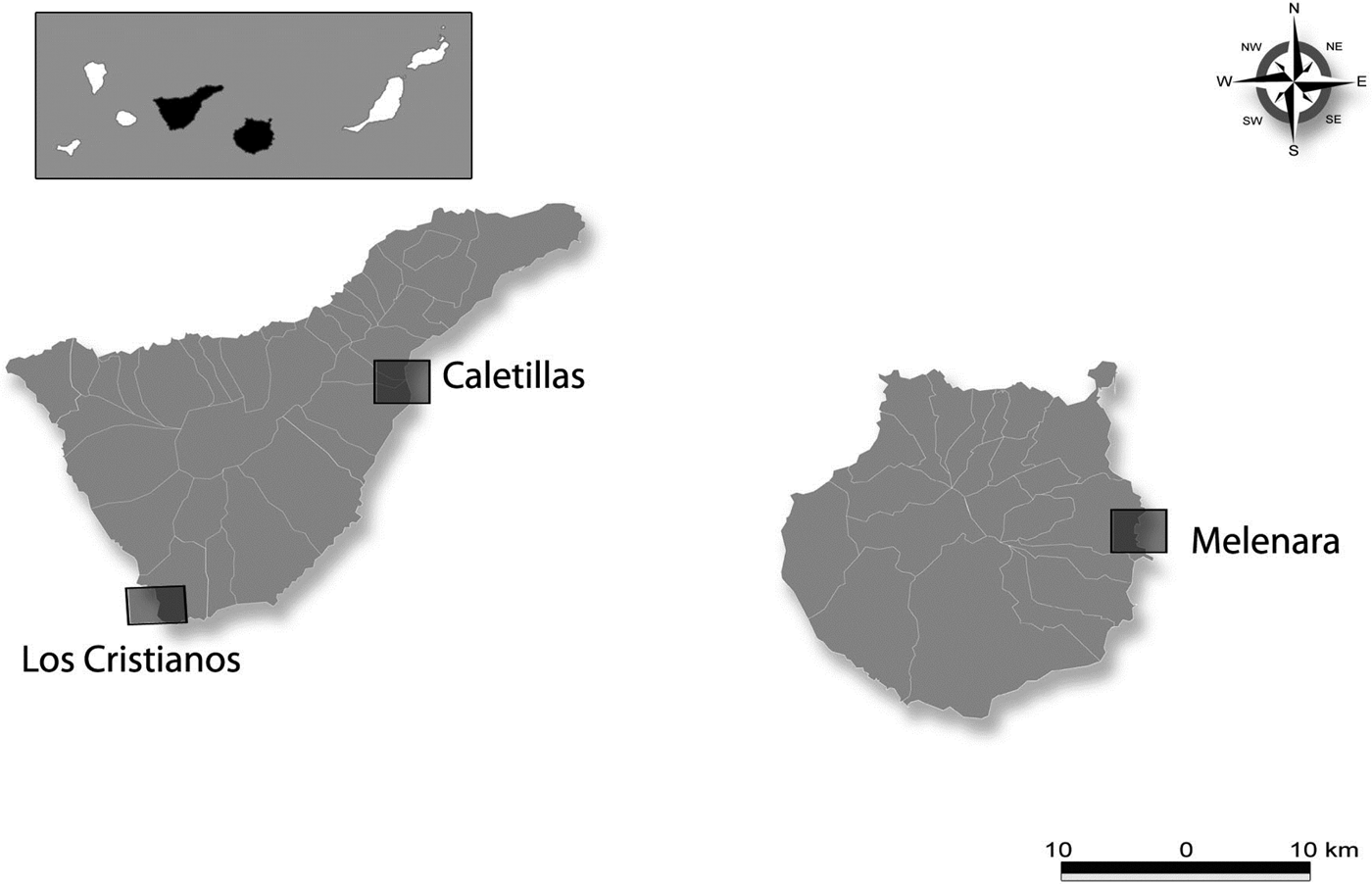
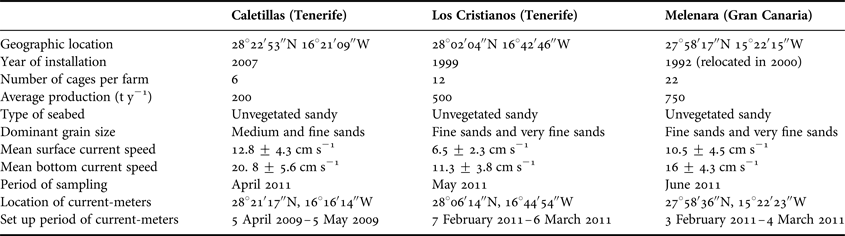
This study was conducted around three sea-cage fish farms at the Canary Islands (NE Atlantic Ocean, 28°N), one located off Gran Canaria (Melenara) and two off Tenerife (Caletillas and Los Cristianos), which culture the same fish species, the gilt-head sea bream Sparus aurata and the sea-bass Dicentrarchus labrax, but under different production conditions (Figure 1, see Table 1 for details on production and culture conditions). Collection of samples took place, by scuba-divers, at 0, 20, 40 and 60 m away and at two controls, between 0.5–1 km away, from each fish farm. One control was upstream and the other downstream of the main current, based on previous hydrodynamic studies from the Canary Archipelago (Table 1) (Barton et al., Reference Barton, Basterretxea, Flament, Mitchelson-Jacob, Jones, Arístegui and Herrera2000, Reference Barton, Flament, Dodds and Mitchelson-Jacob2001). Controls had a similar depth and grain size composition relative to fish farms (25–30 m depth). Stations at 0 m (27–30 m depth) were established beneath the cage located in the farm perimeter that was exposed to the main current; from here, the sampling stations followed a transect running parallel to the downstream current. Sediment cores (20 cm inner diameter) were pushed into the sediment to a depth of 20 cm; this size is within the standard range used to study macrofaunal assemblages (e.g. Heilskov et al., Reference Heilskov, Alperin and Holmer2006; Gillet et al., Reference Gillet, Fedrerick-Holland and Sanger2007). Three replicates per sampling station were randomly collected for faunistic determinations and one core for sediment grain size composition. This replication level has been used in monitoring assessment studies (e.g. Del-Pilar-Ruso et al., Reference Del-Pilar-Ruso, De-la-Ossa-Carretero, Loya-Fernández, Ferrero-Vicente, Giménez-Casalduero and Sánchez-Lizaso2009; Riera et al., Reference Riera, Tuya, Ramos, Rodríguez and Monterroso2012), including off-shore fish cages (Grego et al., Reference Grego, De Troch, Forte and Malej2009). The samples were collected during spring–summer 2011 (Table 1).
Map of the study area, showing location of the three sea-cage fish farms.

Location, production and environmental data of each sea-cage fish farm.
Environmental conditions at each fish farm
To assess the sediment grain size composition of each sample, ~100 g of sediment was oven dried at 105°C, passed through a graded series of sieves (2, 1, 0.5, 0.25, 0.125 and 0.063 mm), and then weighed (Buchanan, Reference Buchanan, Holme and McIntyre1984). These sieves characterized seven different sedimentary types (gravels, very coarse sands, coarse sands, medium sands, fine sands, very fine sands and silt/clay). Current velocities at each fish farm were measured by Acoustic Doppler Current Profilers (ADCPS, models Argonaut-XRand and FlowQuest 600). ADCPSs recorded current velocity every 30 min in 10 layers covering the entire water column (see Table 1 for details).
Patterns of faunal assemblages with proximity to fish farms
Faunal samples were preserved in a 10% seawater formaldehyde solution, and subsequently decanted through a 0.5 mm mesh sieve. The fraction remaining was separated into different taxonomic groups under a binocular microscope, and preserved in 70% ethanol. Macrofaunal specimens were determined to species level, whenever possible, by means of a binocular microscope, or a Leica DMLB microscope equipped with Nomarski interference.
To visualize affinities in faunal assemblage structure according to varying proximity from each fish farm, a NMDS (non-metric multidimensional scaling) was carried out on square-root transformed abundance data via the Bray–Curtis similarity, separately for each farm. Differences in faunal assemblage structure with varying proximity to each fish farm (i.e. distance: 0, 20, 40, 60 m and controls) were tested by means of a Permutational Multivariate ANOVA (PERMANOVA) that included the factors: ‘Distance’ (fixed factor) and ‘Farm’ (random factor, orthogonal to ‘Distance’). The same model, but in a univariate context via permutation-based ANOVAs, was used to test for differences in the abundance of the most conspicuous species, including Ampelisca brevicornis, Apseudes talpa, Dasybranchus caducus, Ditrupa arietina, Platynereis dumerilii, Scoloplos armiger and Urothoe marina – these species accounted for ~78% of total individuals observed – as well as for species richness. In all cases, P values were obtained through 4999 permutations of the raw data under a reduced model. Because variances remaining heterogeneous in most cases regardless of transformations, we reduced Type I error using an α value to 0.01 (Underwood, Reference Underwood1991). Pairwise tests were used to resolve differences in faunal assemblage structure, species abundances and species richness among distances separately for each farm when significant ‘Distance × Farm’ interactions were detected (i.e. all distances were compared for each farm). All multivariate procedures were carried out via the PRIMER 6.0 and PERMANOVA+ statistical package.
RESULTS
Environmental conditions at each fish farm
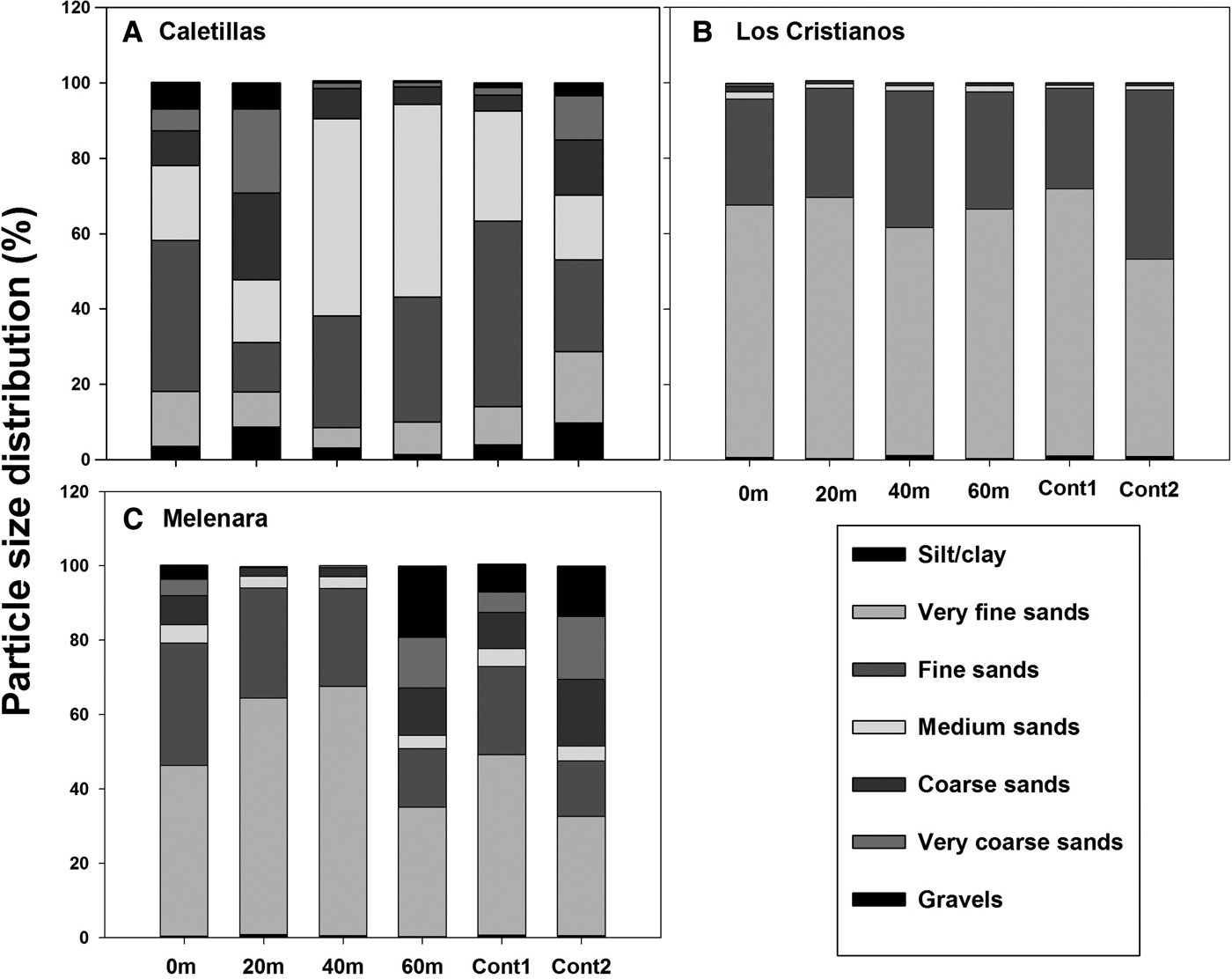
Caletillas was dominated by medium and fine sands (Figure 2A), while Los Cristianos and Melenara were dominated by fine and very fine sands (Figure 2B, C, respectively); these granulometric patterns were linked with larger current speeds at Caletillas relative to Los Cristianos and Melenara (Table 1).
Sediment grain size composition with varying proximity from each fish farm.
Faunal assemblages with varying proximity to fish farms: species-level patterns
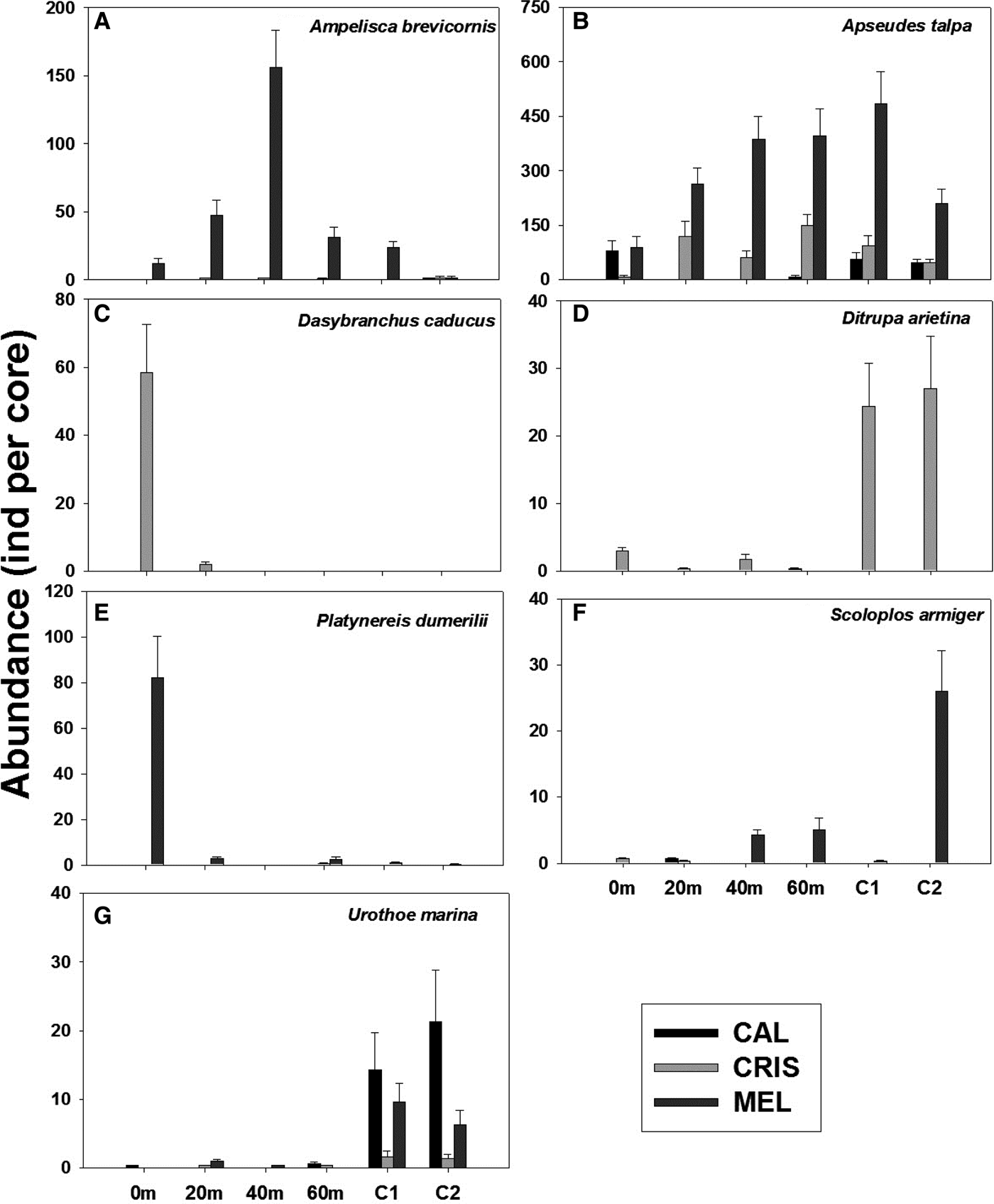
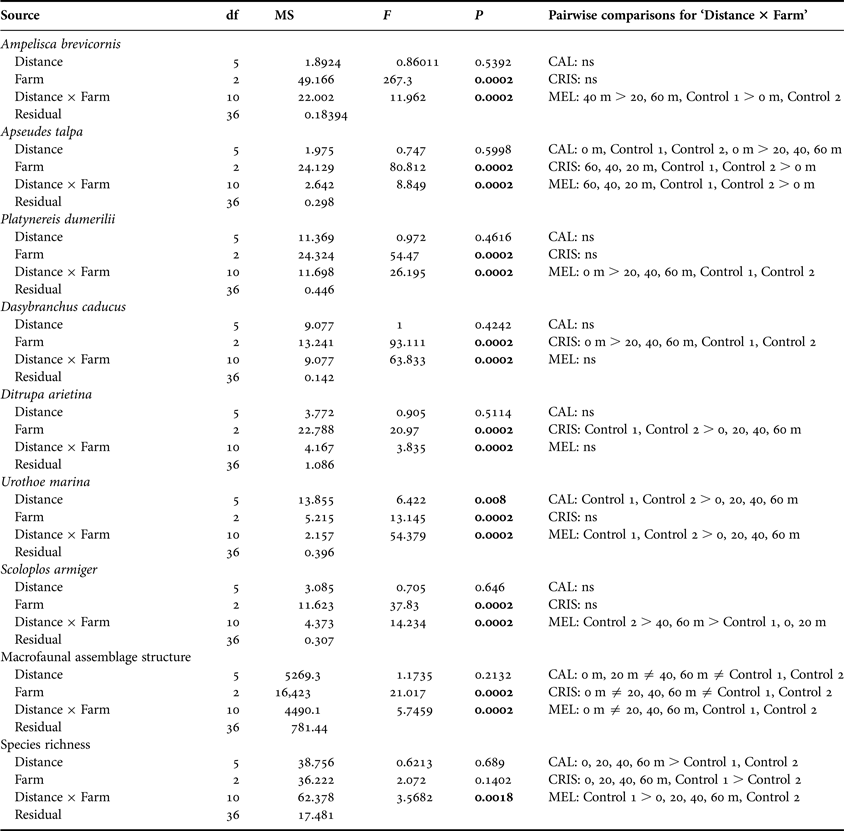
A total of 13,579 specimens were collected, belonging to 15 taxonomic groups, including: Amphipoda, Cumacea, Decapoda, Echinodermata, Isopoda, Leptostraca, Mollusca, Nematoda, Nemertea, Oligochaeta, Ostracoda, Polychaeta, Sipuncula, Stomatopoda and Tanaidacea (Appendix 1>). In terms of species, 177 taxa were recorded; polychaetes (70 species) and molluscs (33 species) were the most conspicuous groups. In contrast, leptostraceans and stomatopods were exclusively represented by one species (Appendix 1). We observed contrasting patterns of abundance among species with varying proximity to fish farms (Figure 3). Some species significantly decreased their abundances with increasing distance from some fish farms, e.g. Platynereis dumerilii (Figure 3E) at Melenara and Dasybranchus caducus (Figure 3C) at Los Cristianos (Table 2, pairwise comparisons). In contrast, some species increased their abundances with increasing distance from fish farms, e.g. Apseudes talpa (Figure 3B) and Scoloplos armiger (Figure 3F) at Melenara, Ditrupa arietina (Figure 3D) at Los Cristianos and Urothoe marina (Figure 3G) at Caletillas and Los Cristianos (Table 2, pairwise comparisons).
Abundances of the most conspicuous macrofaunal species at varying proximity from each fish farm. Error bars are SE of means. CAL, Caletillas; CRIS, Los Cristianos; MEL, Melenara.
Results of two-way uni- and multivariate ANOVAs testing for differences in the abundances of the most conspicuous species, the assemblage structure and the species richness of macrofauna with varying proximity (‘Distance’, fixed factor) from three fish farms (‘Farm’, random factor, orthogonal to ‘Distance’). Significant differences are highlighted in bold. (CAL, Caletillas; CRIS, Los Cristianos; MEL, Melenara).
Faunal assemblages with varying proximity to fish farms: assemblage-level patterns
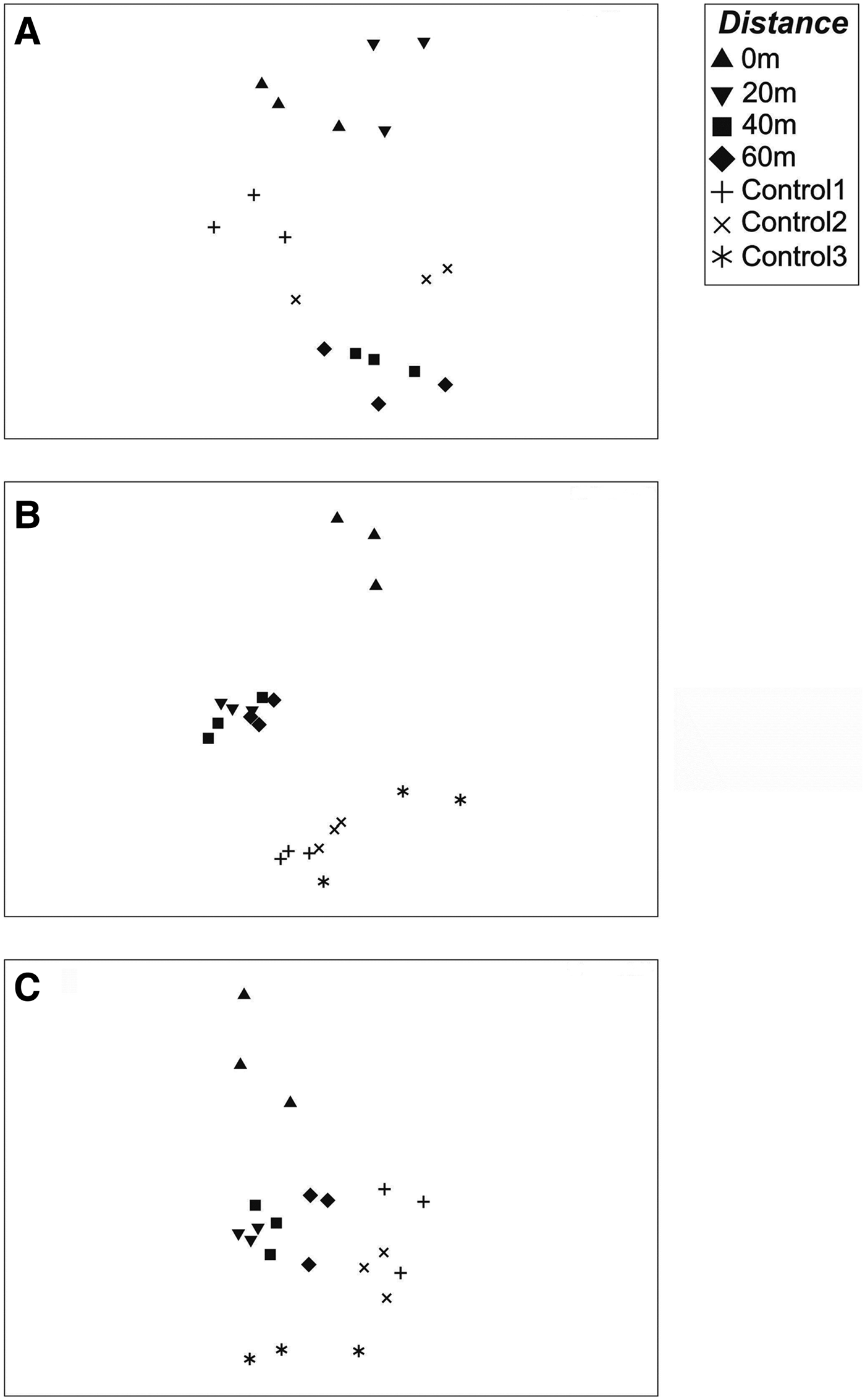
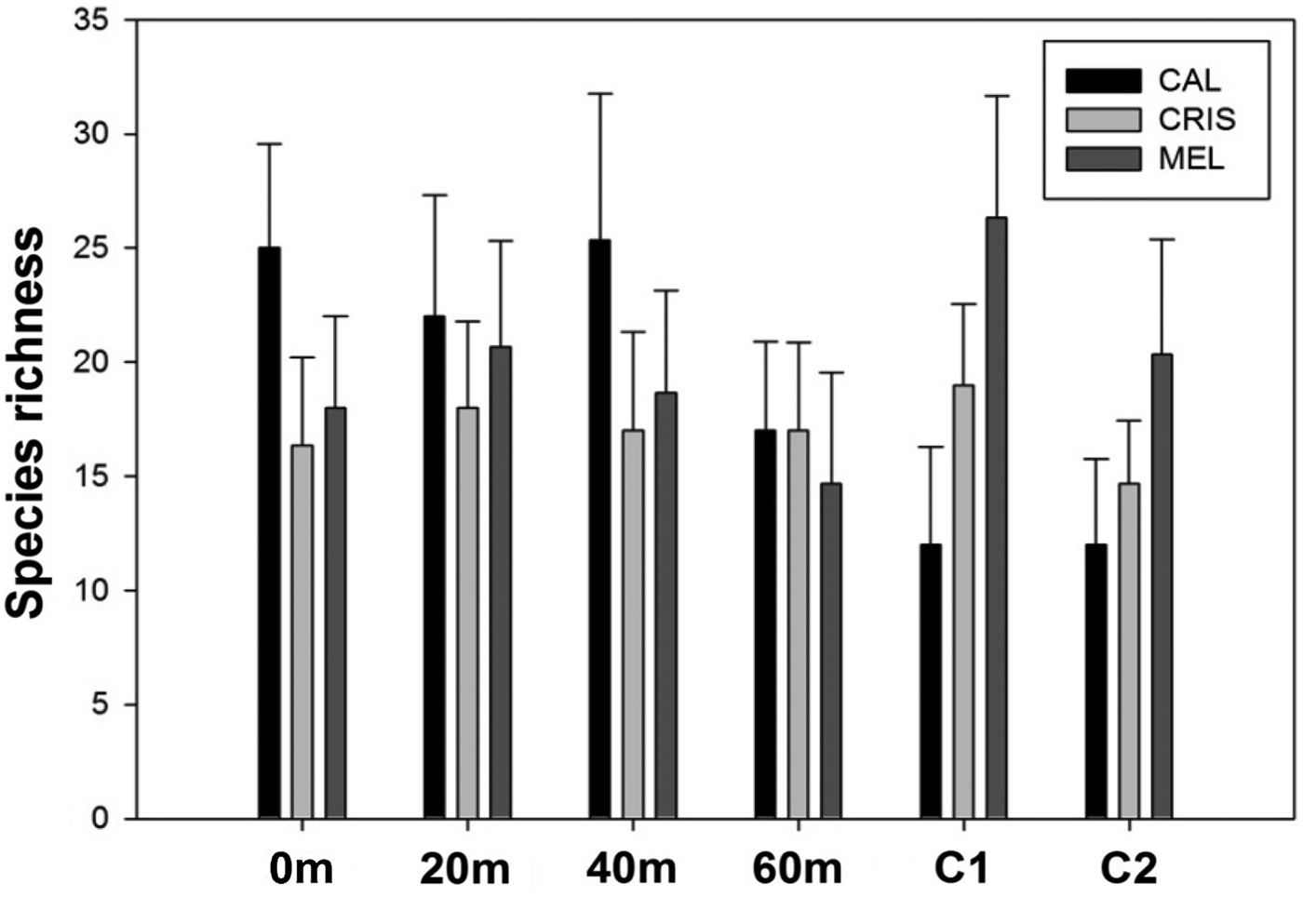
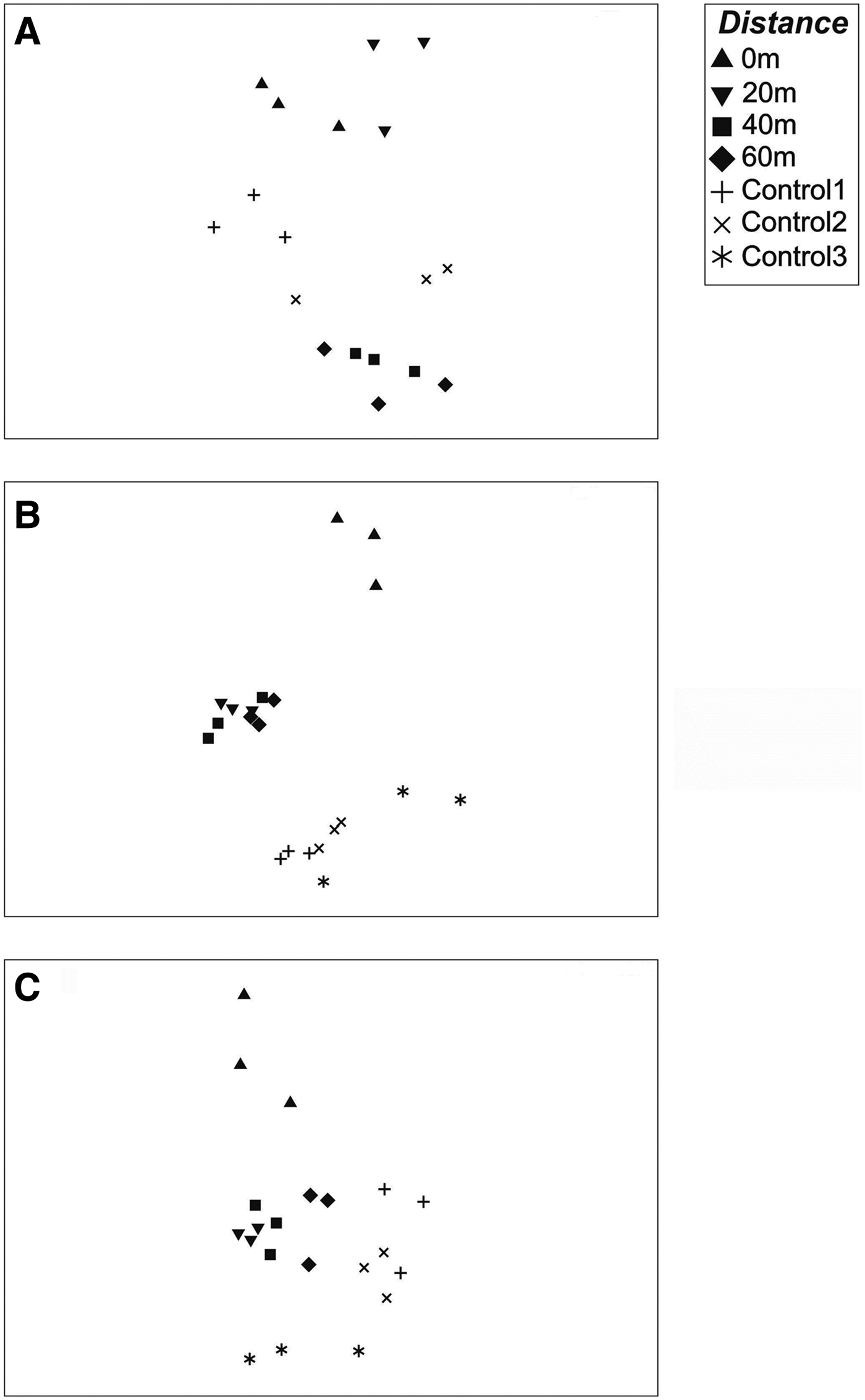
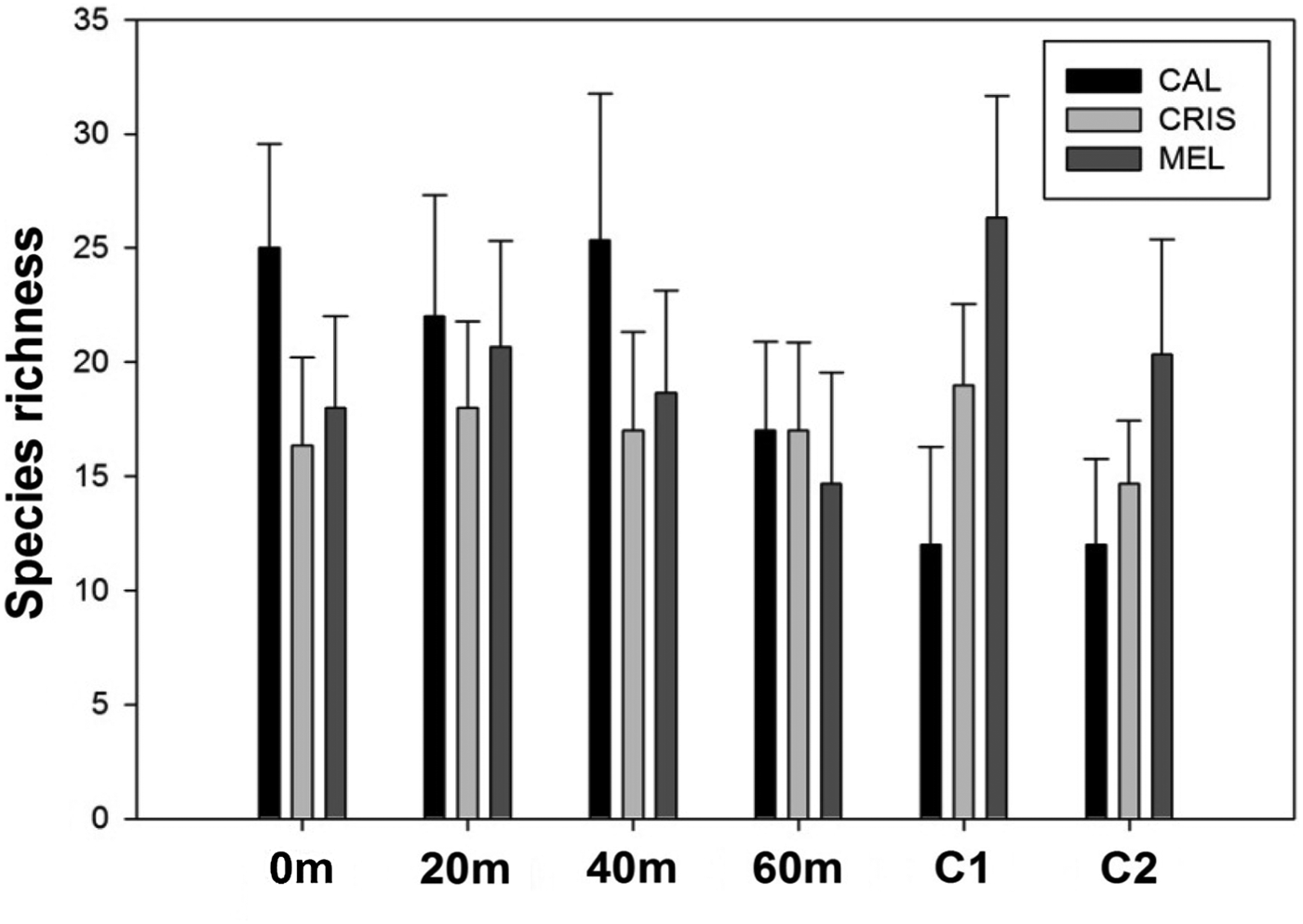
Proximity to fish farms affected macrofaunal assemblage structure: faunal assemblages at 0 m were different from those found at controls at the three fish farms (Figure 4, PERMANOVA, pairwise comparisons, Table 2). However, pairwise differences in assemblage structure among distances away varied among fish farms (Table 2). At Caletillas, fauna at 0 and 20 m away were not different in terms of assemblage structure, while fauna at controls differed relative to fauna at 40 and 60 m away (Figure 4A, Table 2). At Los Cristianos, the macrobenthic fauna at the controls also differed, in terms of assemblage structure, relative to the fauna at 40 and 60 m away (Figure 4B, Table 2). Fauna at 0 m differed, in terms of assemblage structure, from all other stations at Melenara (Figure 4C, Table 2). Species richness showed inconsistent patterns with proximity among fish farms (Figure 5, Table 2). Species richness was lower at controls than at 0, 20, 40 and 60 m at Caletillas (Figure 5, Table 2, pairwise comparisons), while at Los Cristianos no significant differences were detected (Figure 5, Table 2). At Melenara, we only detected a significant difference in species richness between controls and at 60 m distance from the cages (Figure 5, Table 2, pairwise comparisons).
Ordination plots (nMDS) showing similarities in macrofaunal assemblage structure at varying proximity from each fish farm: (A) Caletillas (stress = 0.11), (B) Los Cristianos (stress = 0.08) and (C) Melenara (stress = 0.14).
Species richness at varying proximity from each fish cage. Error bars are SE of means. CAL, Caletillas; CRIS, Los Cristianos; MEL, Melenara.
DISCUSSION
Faunal assemblages with varying proximity to fish farms: species-level patterns
Our results showed that some species significantly decreased their abundances with increasing distance from some fish farms. For example, the polychaetes Dasybranchus caducus and Platynereis dumerilii were almost exclusively found in sediments beneath sea-cages, particularly at Los Cristianos and Melenara fish farms, respectively. The capitellid D. caducus has been previously collected in organic-enriched sediments on shallow areas (Bigot et al., Reference Bigot, Conand, Amouroux, Frouin, Bruggemann and Gremare2006). This species is a motile deposit-feeder and selective in its ingestion of sediment (Fauchald & Jumars, Reference Fauchald and Jumars1979), being attracted to organic loads released from fish cages (Junyi et al., Reference Junyi, Aigen, Xiuren and Dongsheng2007). Indeed, this species belongs to a family (Capitellidae) widely found in sediments beneath aquaculture facilities under different culture scenarios, such as salmon farms in Scottish lochs (Nickell et al., Reference Nickell, Black, Hughe, Overnell, Brand, Nickell, Breuer and Harvey2003), off-shore fish cages in the Mediterranean Sea (Karakassis et al., Reference Karakassis, Tsapakis, Hatziyanni, Papdopoulou and Plaiti2000) and intertidal oyster cultures in New Zealand estuaries (Forrest & Creese, Reference Forrest and Creese2006). The nereidid P. dumerilii has been frequently found in organically enriched sediments as well (e.g. Musco et al., Reference Musco, Terlizzi, Licciano and Giangrande2009), including sublittoral bottoms affected by off-shore aquaculture activities (Cook et al., Reference Cook, Black, Sayer, Cromey, Angel, Spanier, Tsemel, Katz, Eden, Karakassis, Tsapakis, Apostolaki and Malej2006). In turn, P. dumerilii is considered as an opportunistic species able to fulfil its energy needs from different diets, and it is attracted by the organic load from sea-cage fish farms (Henderson & Ross, Reference Henderson and Ross1995). In our study, the former two species (D. caducus and P. dumerilii) were exclusively observed in fine-grained sediments (fine and very fine sands) beneath fish cages at Los Cristianos and Melenara farms. Both species have a preference for this type of sediment; P. dumerilii can burrow rapidly into the sediment to avoid predators (Chapman, Reference Chapman1958) and D. caducus lives in mucous-lined tubes or burrows that are built of fine sediments (Blake, Reference Blake, Blake, Hilbig and Scott2000).
The polychaetes Ditrupa arietina and Scoloplos armiger, as well as the amphipod Urothoe marina, significantly increased their abundances with increasing distances from fish cages. The filter-feeder Ditrupa arietina has a preference for fine sands and muddy sediments (Gremare et al., Reference Gremare, Sarda, Medernach, Jordana, Pinedo, Amouroux, Martin, Nozais and Charles1998); well-sorted fine sands are a suitable sediment type for the construction of the tube in young post-metamorphic juveniles (Gremare et al., Reference Gremare, Sarda, Medernach, Jordana, Pinedo, Amouroux, Martin, Nozais and Charles1998). This fact can explain its presence on seabeds beneath cages at Los Cristianos farm, which was characterized by fine and very fine sands. The sub-surface deposit feeder Scoloplos armiger is more abundant in fine sediments (Rice et al., Reference Rice, Bianchi and Roper1986), which explains its presence beneath cages at Melenara farm (dominated also by fine and very fine sands). However, competition may have excluded this polychaete from sediments immediately beneath fish cages, since it is not well-adapted (i.e. low growth rate and low food conversion rate) to changing conditions compared with other polychaete species. In fact, S. armiger has been observed to be excluded by opportunistic polychaetes (e.g. the surface deposit feeder Pygospio elegans) in sediments beneath an intertidal clam culture facility in the Philippines (Spencer et al., Reference Spencer, Kaiser and Edwards1997). The detritivorous amphipod Urothoe marina is considered as a very sensitive species to organic enrichment (Borja et al., Reference Borja, Franco and Perez2000), including in the Canary archipelago (Riera et al., Reference Riera, Tuya, Ramos, Rodríguez and Monterroso2012). This species is probably displaced by opportunistic species; for example, due to competition for food with the nereidid Platynereis dumerilii, since the latter species lives on the top surface of the sediment and hence can take advantage of the excess of organic enrichment (Quintana et al., Reference Quintana, Yoshinaga and Sumida2010).
In contrast to our observations, a former study (Monterroso et al., Reference Monterroso, Nuñez and Riera2004) conducted in another fish cage from the Canary Archipelago showed a dominance of the tanaid Apseudes talpa in sediments beneath fish cages, as well as high abundances of the polychaetes Galatowenia oculata, Myriochele danielsseni and Aricidea assimilis. The most abundant species was the fire-worm, Hermodice carunculata, which formed aggregates of hundreds of individuals beneath fish cages (Monterroso et al., Reference Monterroso, Nuñez and Riera2004). This species, however, was exclusively represented by one single specimen in our study. Such an outcome might be explained by seasonal variations, i.e. the present study was conducted in spring–summer whilst the other was accomplished in winter (Monterroso et al., Reference Monterroso, Nuñez and Riera2004). Polychaetes such as Hermodice carunculata can show a remarkable spatial variability at scales ranging from hundreds of metres to tens of kilometres (Martin et al., Reference Martin, Ballesteros, Gili and Palacin1993; Frojan et al., Reference Frojan, Hawkins, Aryuthaka, Nimsantijaroen, Kendall and Paterson2005).
Faunal assemblages with varying proximity to fish farms: assemblage-level patterns
Differences in macrofaunal assemblage structure of sediments located immediately beneath cages relative to the controls were found for the three fish farms. However, differences in macrofaunal assemblage structure at varying proximity to the cages in relation to controls varied among fish farms. Similarly, there were inconsistent patterns in species richness with varying proximity among fish farms. Our results have shown that the area directly affected by off-shore aquaculture, in terms of the macrofaunal assemblage structure, was ~ < 20 m in Los Cristianos and Melenara and <40 m in Caletillas, similar to what Vita & Marin (Reference Vita and Marin2007) observed, and thus reduced compared with other studies, e.g. 80–180 m (Lee et al., Reference Lee, Bailey-Rock and McGurr2006; Edgar et al., Reference Edgar, Davey and Sheperd2010). The hydrodynamic conditions around each fish farm affect the spatial extent of the organic enrichment from the fish cages, since low current intensities (1.4–1.6 cm s−1) trigger the deposit of organic matter beneath fish farms (Kutti et al., Reference Kutti, Ervik and Hansen2007). For example, Cromey et al. (Reference Cromey, Nickell and Black2002) showed that current speeds >5 cm s−1 are strong enough to keep organic particles (i.e. fish faecal material and pellets) re-suspended. Aguado-Gimenez et al. (Reference Aguado-Gimenez, Marin, Montoy, Marin-Guirao, Piedecausa and Garcia-Garcia2007) found an affected area of less than 200 m around off-shore fish cages (36–38 m deep) in an area of mean current velocity of 26.9 cm s−1. Thus, the current intensity largely determines the footprint of offshore cages.
In several studies, the spatial change in macrofaunal abundances and diversity caused by off-shore aquaculture followed the Pearson–Rosenberg model (Pearson & Rosenberg, Reference Pearson and Rosenberg1978). Briefly, the largest abundances, biomasses and species richness of macrofauna peak at intermediate levels of organic enrichment, while there is an abrupt decrease in abundances and richness at higher levels of organic enrichment, i.e. directly beneath cages (Karakassis et al., Reference Karakassis, Tsapakis, Hatziyanni, Papdopoulou and Plaiti2000; Edgar et al., Reference Edgar, Davey and Sheperd2010). Our results, however, showed that macrofauna did not follow this model, as has been also previously reported for off-shore fish cages in the Mediterranean Sea (Aguado-Gimenez et al., Reference Aguado-Gimenez, Marin, Montoy, Marin-Guirao, Piedecausa and Garcia-Garcia2007; Vita & Marin, Reference Vita and Marin2007; Sanz-Lazaro et al., Reference Sanz-Lazaro, Belando, Marin-Guirao, Navarrete-Mier and Marin2011) and other European areas (Carroll et al., Reference Carroll, Cochrane, Fieler, Velvin and White2003; Mayor et al., Reference Mayor, Zuur, Solan, Paton and Killham2010). Despite it being plausible that the organic load was not large enough to produce consistent changes over macrofaunal assemblages, we lack data to unambiguously make this conclusion. This is actually the normal result given the emphasis on sustainable aquaculture practices (Sanz-Lazaro et al., Reference Sanz-Lazaro, Belando, Marin-Guirao, Navarrete-Mier and Marin2011). A wider sampling scheme through time would have provided more solid conclusions. In summary, inconsistent patterns of macrofaunal assemblages with varying proximity to aquaculture facilities do not allow solid predictions on the way offshore aquaculture alters macrofauna for the study region. Site-specific peculiarities seem then to be relevant and should be accounted for to adequately work out the effects of offshore aquaculture on recipient assemblages.
ACKNOWLEDGEMENTS
We thank Tony Sánchez, Harue Hernández and Leonor Ortega (ULPGC) for their help during the sampling campaigns. The present study was funded by the Transnational Cooperation Program MAC 2007–2013 (PCTMAC) (Research Project: MACAROMOD, ‘Dispersion of organic matter from aquaculture farms: development of a mathematical model to assure environmental sustainability’, code: MAC/3/C136).